
EBS MAED LECTURE 6 INTRODUCTION TO MAEDD Version
EBS & MAED LECTURE 6 INTRODUCTION TO MAED-D Version 1. 0 11
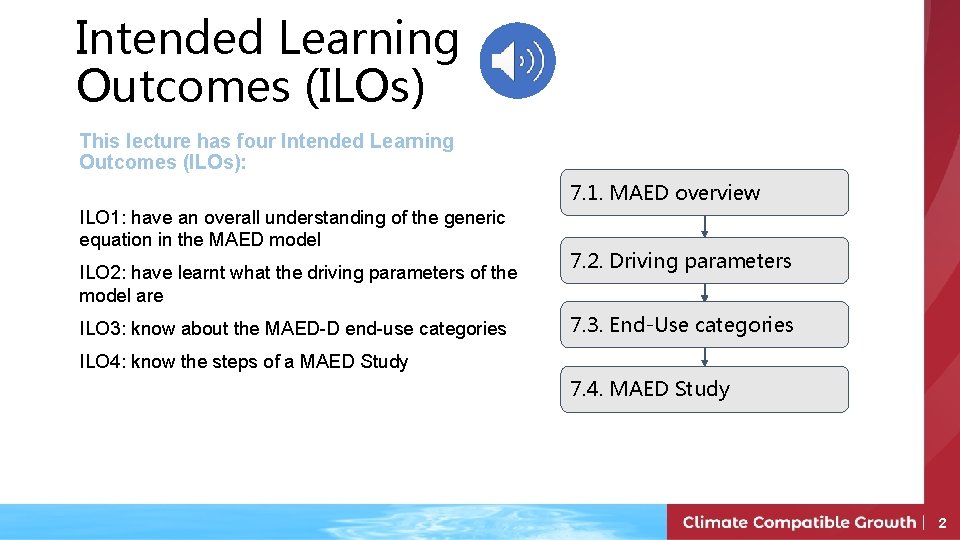
Intended Learning Outcomes (ILOs) This lecture has four Intended Learning Outcomes (ILOs): 7. 1. MAED overview ILO 1: have an overall understanding of the generic equation in the MAED model ILO 2: have learnt what the driving parameters of the model are ILO 3: know about the MAED-D end-use categories 7. 2. Driving parameters 7. 3. End-Use categories ILO 4: know the steps of a MAED Study 7. 4. MAED Study 2
Lecture 6. 1 MAED overview Main features of MAED: Model for Analysis of the Energy Demand • Simulation model best applicable for long-term analysis. • Using bottom-up scenario approach for evaluating energy demand in a country or region. MAED has been designed to reflect: • Structural changes in energy demand by means of detailed analysis of the social, economic, and technological factors. • Evolution of the potential behaviour for each final energy form (e. g. electricity, fossil fuels, motor fuels, etc. ) 3
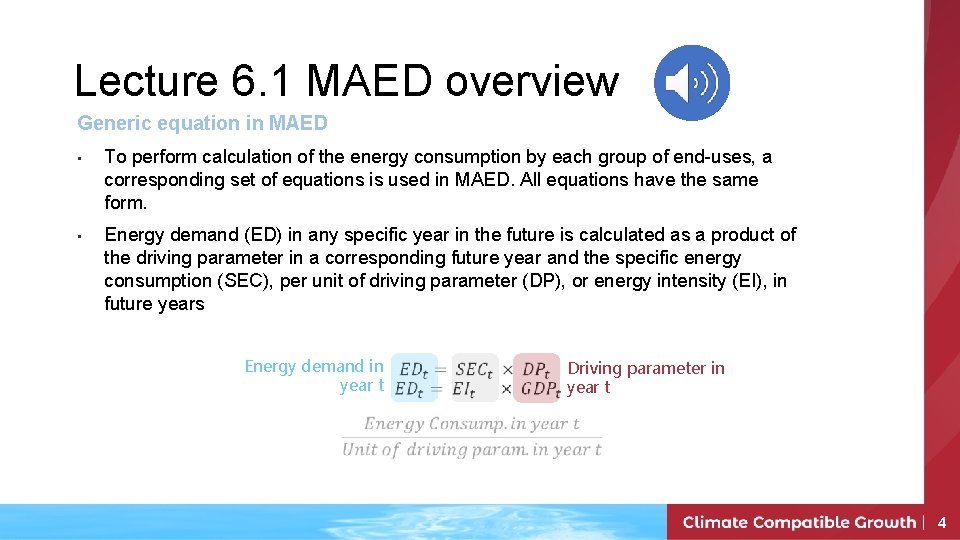
Lecture 6. 1 MAED overview Generic equation in MAED • To perform calculation of the energy consumption by each group of end-uses, a corresponding set of equations is used in MAED. All equations have the same form. • Energy demand (ED) in any specific year in the future is calculated as a product of the driving parameter in a corresponding future year and the specific energy consumption (SEC), per unit of driving parameter (DP), or energy intensity (EI), in future years Energy demand in year t Driving parameter in year t 4
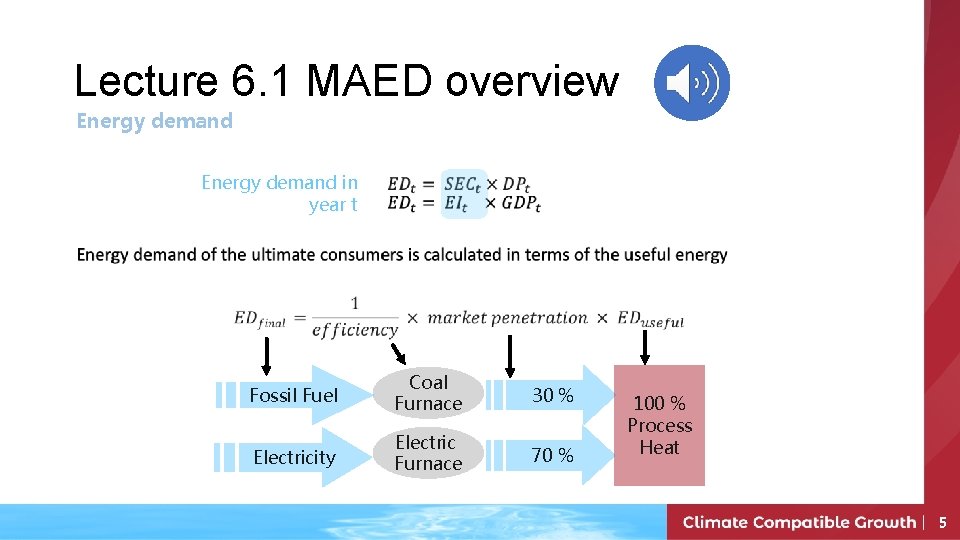
Lecture 6. 1 MAED overview Energy demand in year t Fossil Fuel Coal Furnace 30 % Electricity Electric Furnace 70 % 100 % Process Heat 5
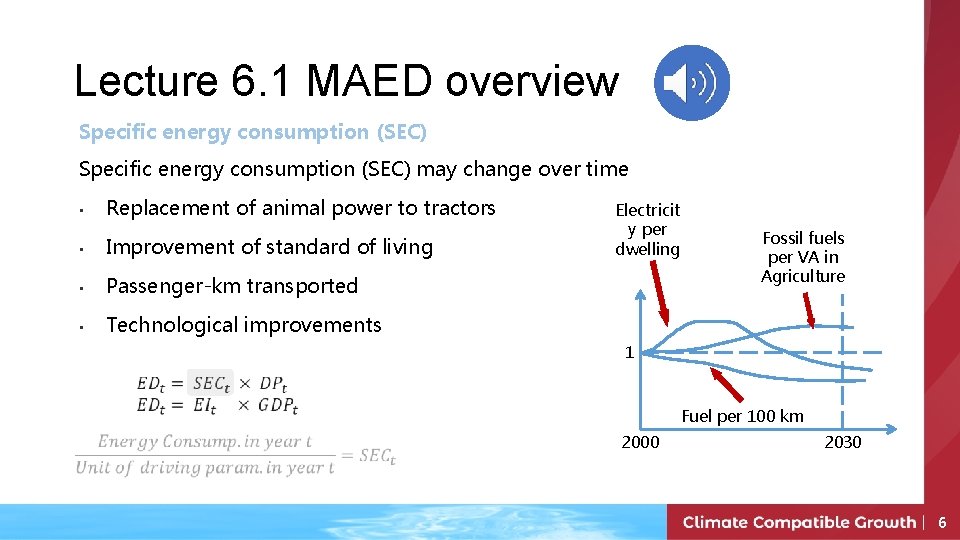
Lecture 6. 1 MAED overview Specific energy consumption (SEC) may change over time • Replacement of animal power to tractors • Improvement of standard of living • Passenger-km transported • Technological improvements Electricit y per dwelling Fossil fuels per VA in Agriculture 1 Fuel per 100 km 2000 2030 6
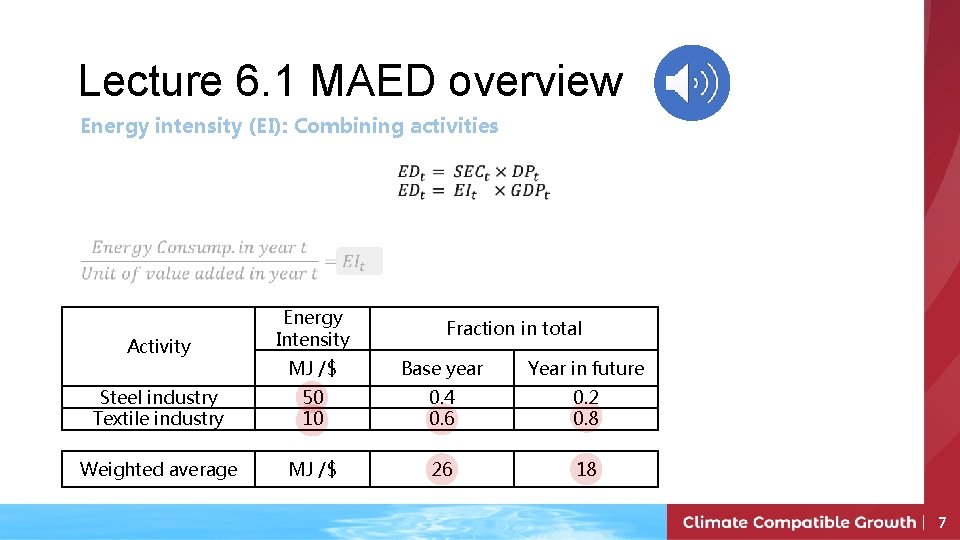
Lecture 6. 1 MAED overview Energy intensity (EI): Combining activities Activity Energy Intensity MJ /$ Base year Year in future Steel industry Textile industry 50 10 0. 4 0. 6 0. 2 0. 8 Weighted average MJ /$ 26 18 Fraction in total 7
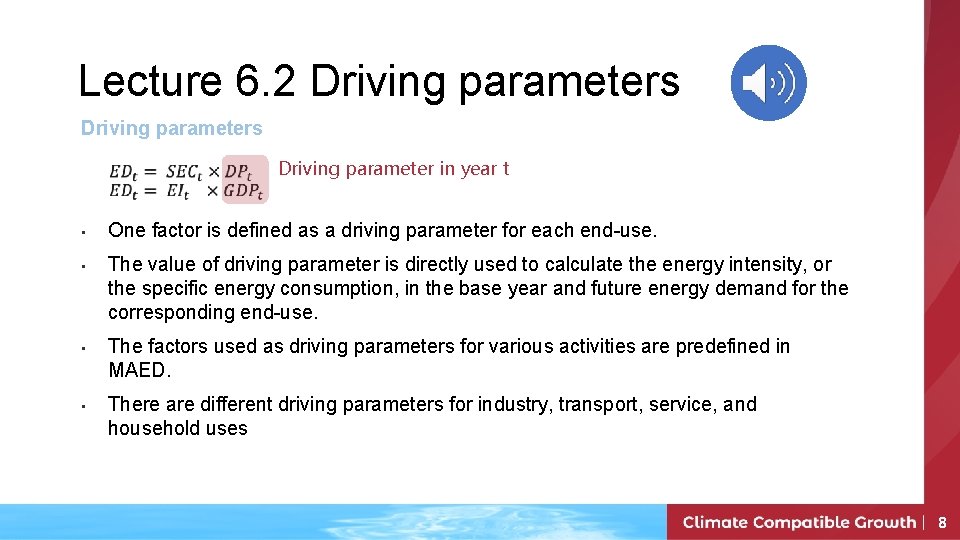
Lecture 6. 2 Driving parameters Driving parameter in year t • One factor is defined as a driving parameter for each end-use. • The value of driving parameter is directly used to calculate the energy intensity, or the specific energy consumption, in the base year and future energy demand for the corresponding end-use. • The factors used as driving parameters for various activities are predefined in MAED. • There are different driving parameters for industry, transport, service, and household uses 8
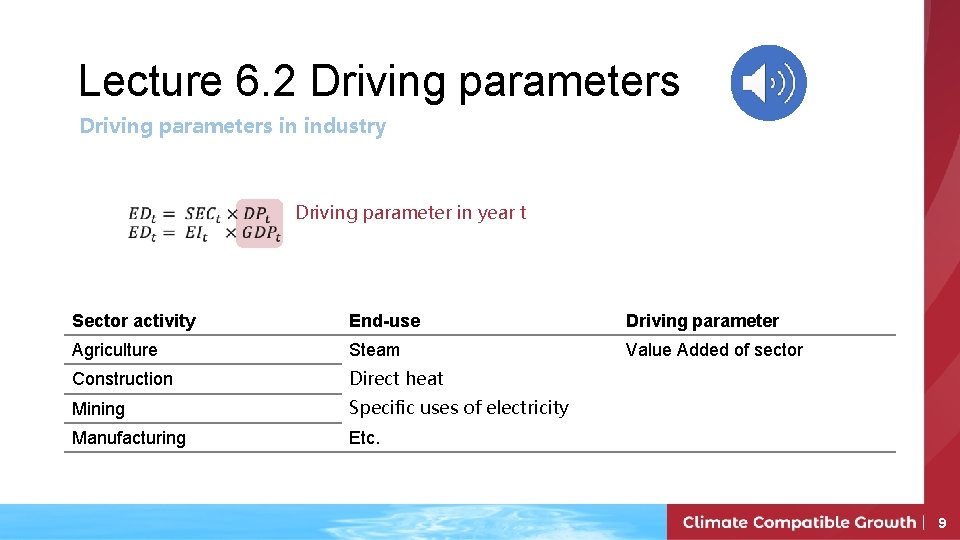
Lecture 6. 2 Driving parameters in industry Driving parameter in year t Sector activity End-use Driving parameter Agriculture Steam Value Added of sector Construction Direct heat Mining Specific uses of electricity Manufacturing Etc. 9
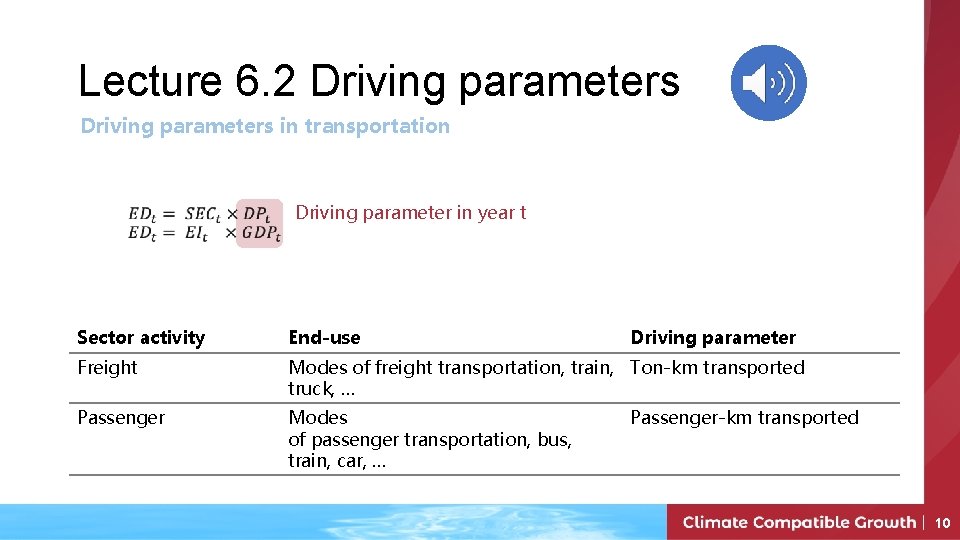
Lecture 6. 2 Driving parameters in transportation Driving parameter in year t Sector activity End-use Driving parameter Freight Modes of freight transportation, train, Ton-km transported truck, … Passenger Modes of passenger transportation, bus, train, car, … Passenger-km transported 10
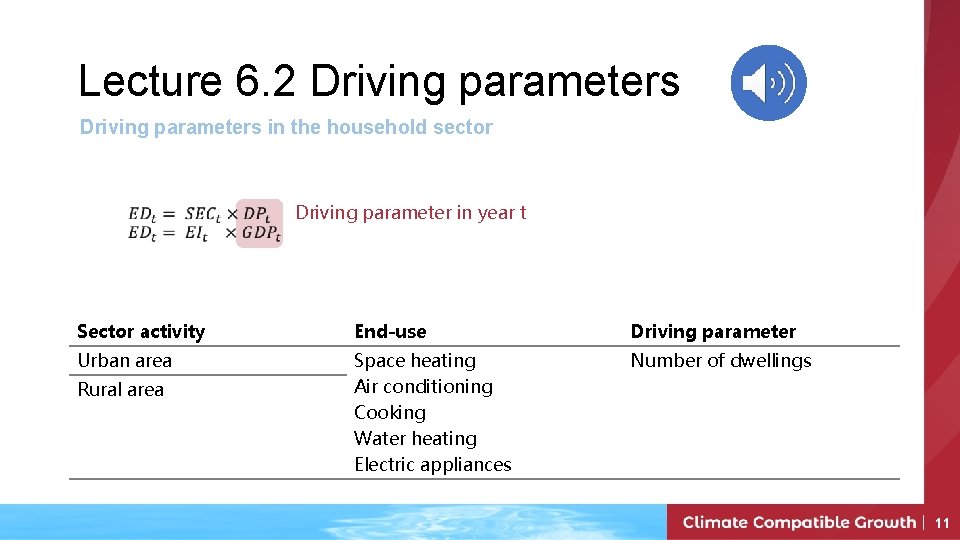
Lecture 6. 2 Driving parameters in the household sector Driving parameter in year t Sector activity End-use Driving parameter Urban area Space heating Air conditioning Cooking Water heating Electric appliances Number of dwellings Rural area 11
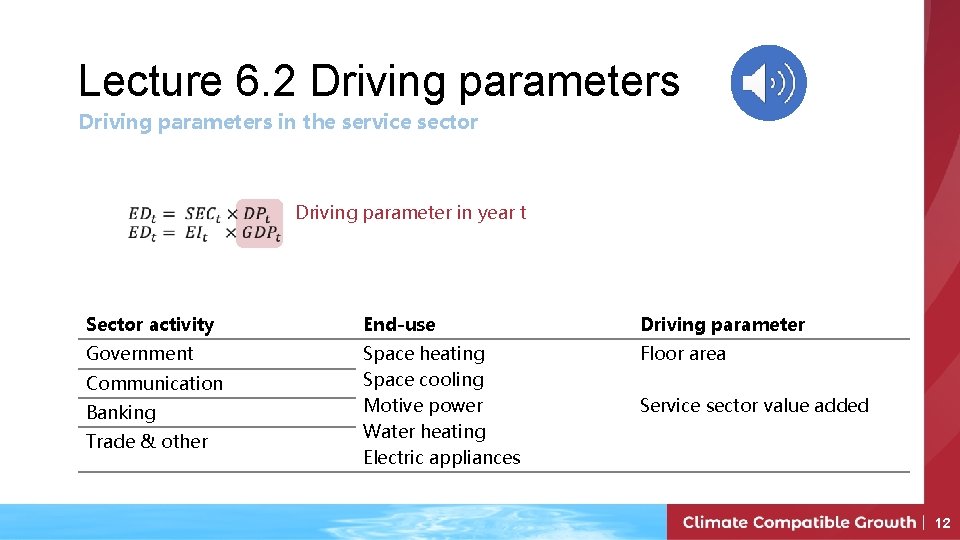
Lecture 6. 2 Driving parameters in the service sector Driving parameter in year t Sector activity End-use Driving parameter Government Space heating Space cooling Motive power Water heating Electric appliances Floor area Communication Banking Trade & other Service sector value added 12
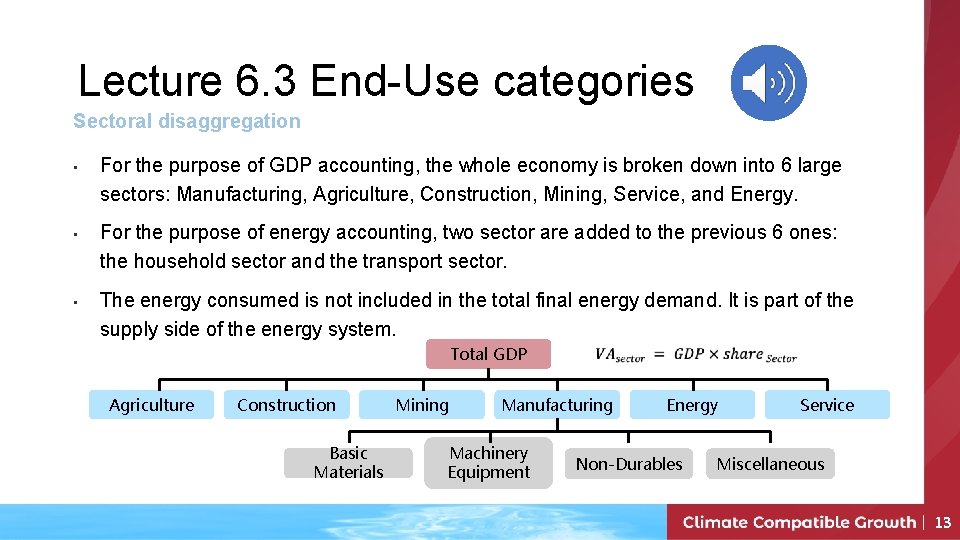
Lecture 6. 3 End-Use categories Sectoral disaggregation • For the purpose of GDP accounting, the whole economy is broken down into 6 large sectors: Manufacturing, Agriculture, Construction, Mining, Service, and Energy. • For the purpose of energy accounting, two sector are added to the previous 6 ones: the household sector and the transport sector. • The energy consumed is not included in the total final energy demand. It is part of the supply side of the energy system. Total GDP Agriculture Construction Basic Materials Mining Manufacturing Machinery Equipment Energy Non-Durables Service Miscellaneous 13
Lecture 6. 3 End-use categories End-Use categories All single energy-consuming activities cannot practically be listed at the scale of a country for modelling purposes. • Individual end-use categories are therefore introduced, which group together similar activities • End-use categories are selected as the “right” amount of detail considered, given the data available to the modeller and the objectives of the analysis • In the MAED model individual activities are grouped in end-uses, with some flexibility for the modeller as to which level of detail is most adequate. 14
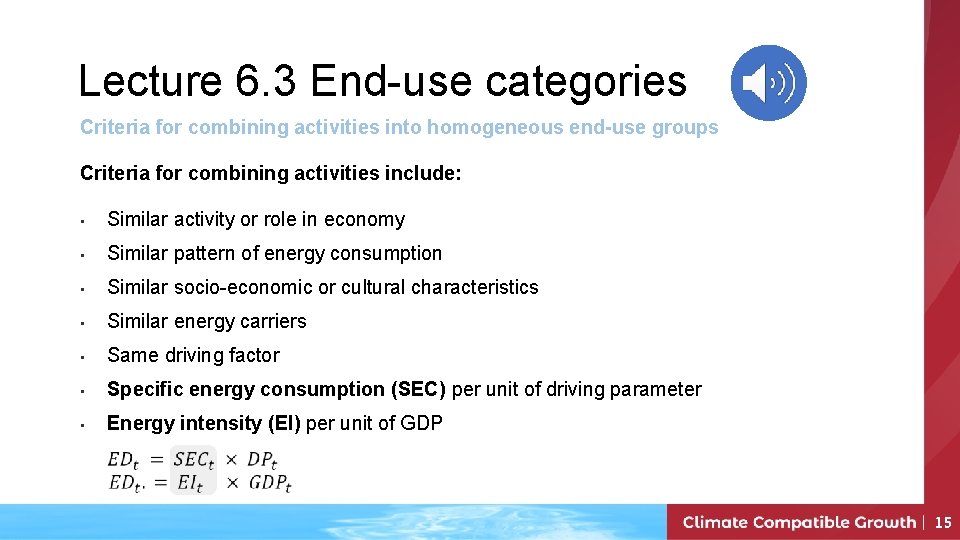
Lecture 6. 3 End-use categories Criteria for combining activities into homogeneous end-use groups Criteria for combining activities include: • Similar activity or role in economy • Similar pattern of energy consumption • Similar socio-economic or cultural characteristics • Similar energy carriers • Same driving factor • Specific energy consumption (SEC) per unit of driving parameter • Energy intensity (EI) per unit of GDP 15
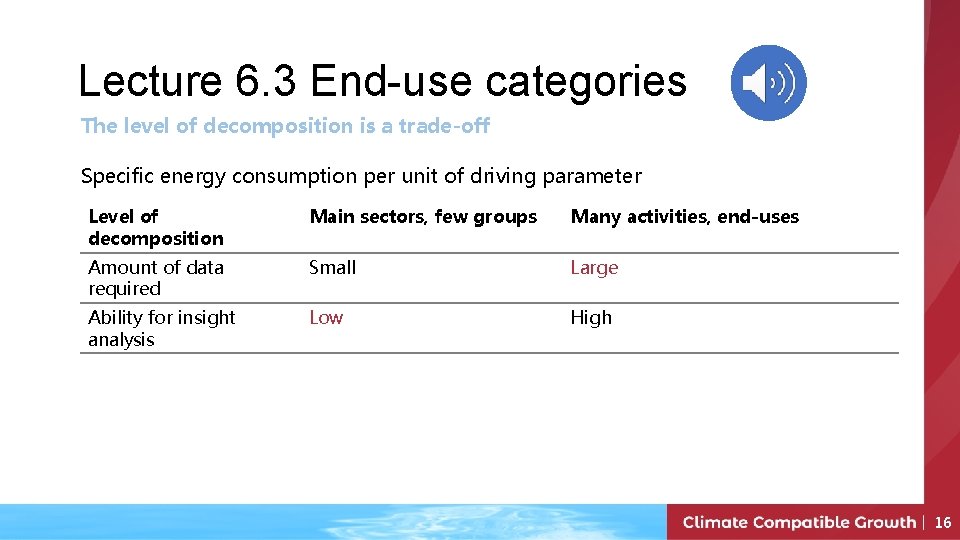
Lecture 6. 3 End-use categories The level of decomposition is a trade-off Specific energy consumption per unit of driving parameter Level of decomposition Main sectors, few groups Many activities, end-uses Amount of data required Small Large Ability for insight analysis Low High 16
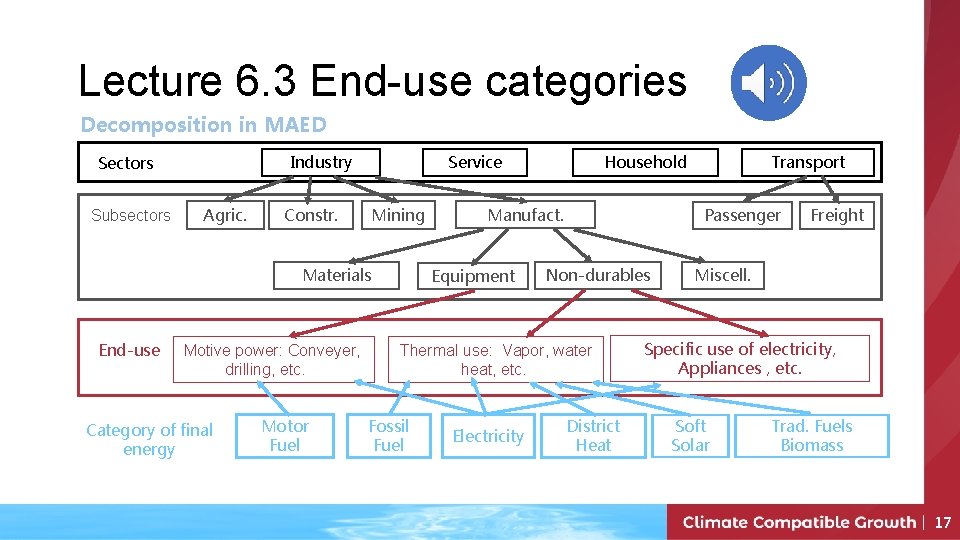
Lecture 6. 3 End-use categories Decomposition in MAED Industry Sectors Subsectors Agric. Constr. Service Mining Materials End-use Motive power: Conveyer, drilling, etc. Category of final energy Motor Fuel Household Manufact. Equipment Passenger Non-durables Thermal use: Vapor, water heat, etc. Fossil Fuel Electricity Transport District Heat Freight Miscell. Specific use of electricity, Appliances , etc. Soft Solar Trad. Fuels Biomass 17
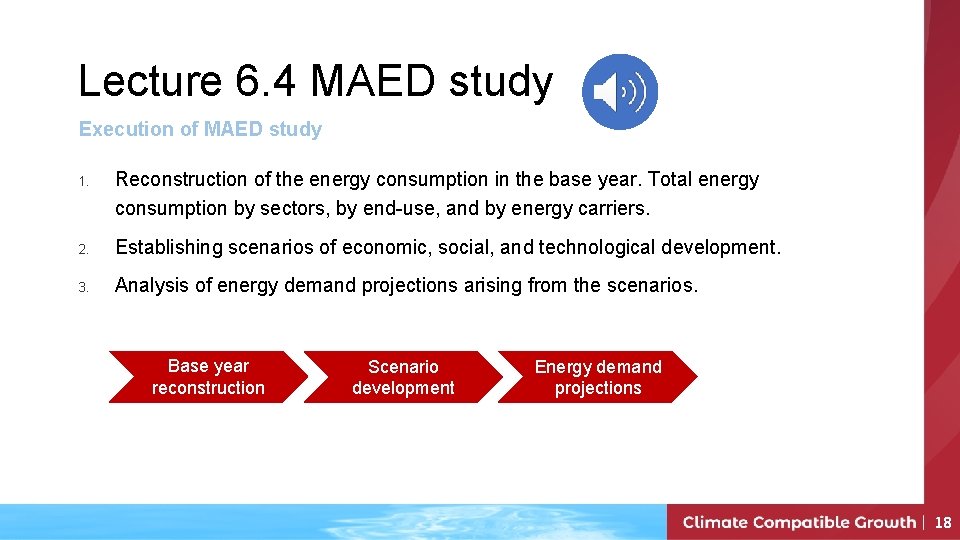
Lecture 6. 4 MAED study Execution of MAED study 1. Reconstruction of the energy consumption in the base year. Total energy consumption by sectors, by end-use, and by energy carriers. 2. Establishing scenarios of economic, social, and technological development. 3. Analysis of energy demand projections arising from the scenarios. Base year reconstruction Scenario development Energy demand projections 18
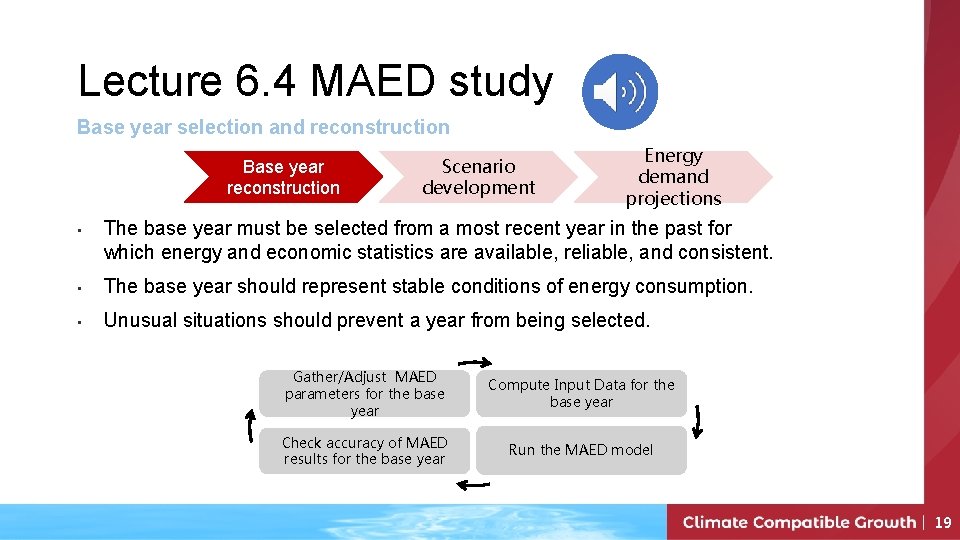
Lecture 6. 4 MAED study Base year selection and reconstruction Base year reconstruction Scenario development Energy demand projections • The base year must be selected from a most recent year in the past for which energy and economic statistics are available, reliable, and consistent. • The base year should represent stable conditions of energy consumption. • Unusual situations should prevent a year from being selected. Gather/Adjust MAED parameters for the base year Compute Input Data for the base year Check accuracy of MAED results for the base year Run the MAED model 19
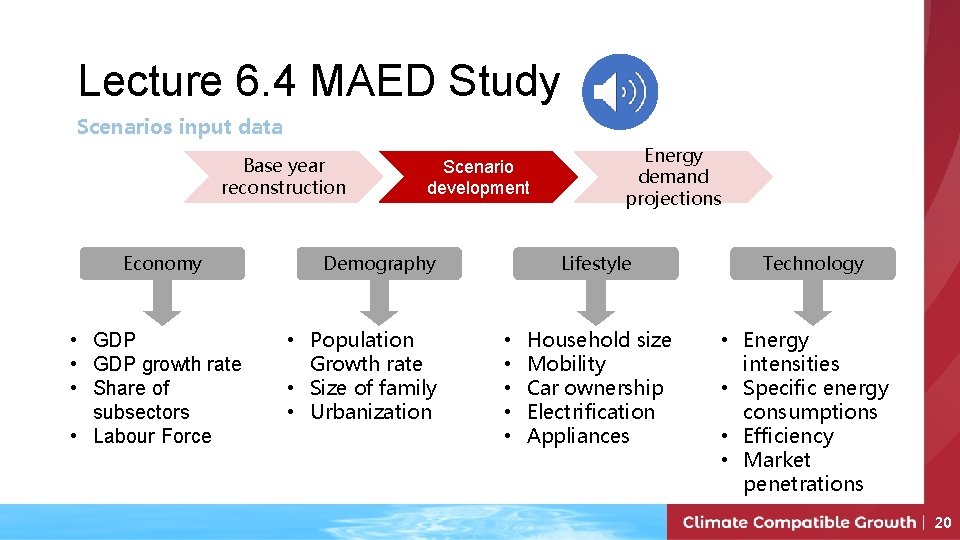
Lecture 6. 4 MAED Study Scenarios input data Base year reconstruction Economy • GDP growth rate • Share of subsectors • Labour Force Scenario development Demography • Population Growth rate • Size of family • Urbanization Energy demand projections Lifestyle • • • Household size Mobility Car ownership Electrification Appliances Technology • Energy intensities • Specific energy consumptions • Efficiency • Market penetrations 20
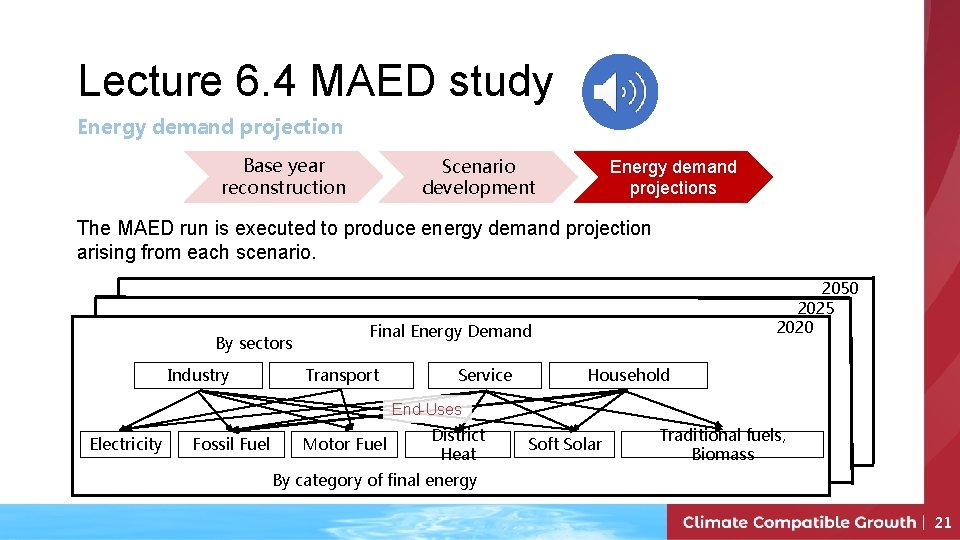
Lecture 6. 4 MAED study Energy demand projection Base year reconstruction Scenario development Energy demand projections The MAED run is executed to produce energy demand projection arising from each scenario. By sectors Industry 2050 2025 2020 Final Energy Demand Transport Service Household End-Uses Electricity Fossil Fuel Motor Fuel District Heat Soft Solar Traditional fuels, Biomass By category of final energy 21
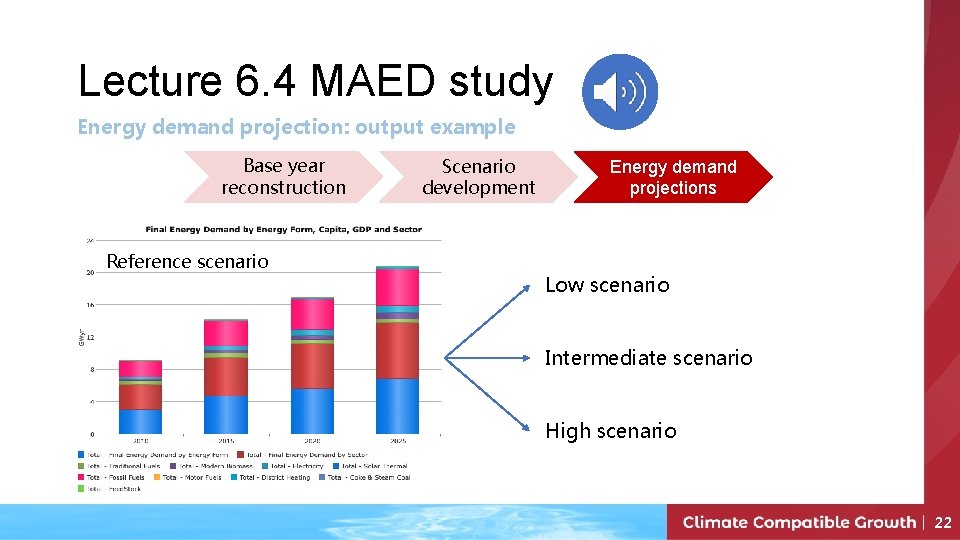
Lecture 6. 4 MAED study Energy demand projection: output example Base year reconstruction Reference scenario Scenario development Energy demand projections Low scenario Intermediate scenario High scenario 22

Take Quiz Collett, K. A. , Charbonnier F. , Ahsan A. , Halloran C. , Vijay, A. , Berdellans I. , Hasanovic S. , Gritsevskyi A, Stankeviciute L. , Tot M. ; Welsch M. , Hirmer S. , 2021. Lecture 6: Introduction to MAED-D, Energy Balance Studio and MAED (demand projections). Release Version 1. 0. [online presentation]. Climate Compatible Growth Programme and International Atomic Energy Agency. CCG courses (this will take you to the website link http: //www. Climate. Compatible. Growth. com/teachingmaterials)
- Slides: 23