
EBS 282 Forms and Functions of the English
EBS 282: Forms and Functions of the English Clause Week 8 Forms and functions of nominal cla uses: • Infinitive nominal clause (to-infinitive and bare infinitive) • -ing nominal clause
Outline of Lesson �Objectives � Required reading � Key terms �Introduction � Non-finite nominal clause Infinitive nominal clause (to-infinitive, bareinfinitive) -Ing participle clauses. �Functions of the nominal infinitive, and -ing participle clauses �Summary � Self-study questions
Lesson objectives � By the end of the lesson, the student should be able to: a. Identify the structure and functions of infinitive nominal clauses b. Analyse the structure and functions of -ing participle clauses c. Write at least two functions of to-infinitive, bare infinitive, and -ing participle clauses. d. Construct at least three sentences illustrating to-infinitive, bare infinitive, and ing participle clauses.
Required Reading � Quirk, R, & Greenbaum, S. (1973). A University Grammar of English. London: Longman. � Focus on page 316 -322

Key terms � Non-finite nominal clause � to-infinitive clause � bare infinitive clause � -ing participle clause

Introduction � In Week 6, we discussed the forms and functions of the that-nominal c lause, wh - nominal clause, and the yes-no interrogative clause. � This lesson discusses the structure and functions of the infinitive (to-infinitive, and bare infinitive), and –ing participial nominal clauses. These clauses fall under the umbrella name, “Non-Finite nominal Clauses. ”

Non-finite nominal clause � A non-finite nominal clause is a clause whose verb element is a non-finite verb phrase. � Non-finite nominal clause includes, to-infinitive clause, bare-infinitive clause, -ing participle clause, and ed/en participle clause. � But in this lesson, the focus is on to-infinitive, bare infinitive, and –ing participle clauses

Non-finite nominal clause cont’d… � These nominal clauses can function as subject, subject complement, direct object, indirect object, object complement, and prepositional complement. � We will now take them one by one.

To-infinitive nominal clauses �To-infinitive nominal clauses are those that begin with “to-infinitive verb”. The to-infinitive clause is highlighted in the following. 1. She wants to buy some stamps. 2. He likes to relax. 3. To marry a decent husband is a blessing. 4. To err is human. 5. To be a responsible person is not easy. 6. To succeed in life demands hard work.

Functions of to-infinitive nominal clauses cont’d… � To-infinitive nominal clauses can act as subject, direct object, subject complement, and adjectival complement. � Subject: 1. To be a good man is not simple. 2. To say there is no afterlife would mean a rejection of religion. 3. To go out in this COVID-19 period is suicidal.

Functions of to-infinitive nominal clauses cont’d… � Direct 1. 2. 3. 4. 5. object: He likes to be happy. We want to study hard. Mary starts to lace her shoes. We met to discuss the issue. Dora married to have children.

Functions of to-infinitive nominal clauses cont’d… � Subject complement: 1. Their plan is to escape from here. 2. The minister's first duty will be to stop inflation. What we need to do is to go shopping. He seems to be complaining. She appears to be short. 3. 4. 5.
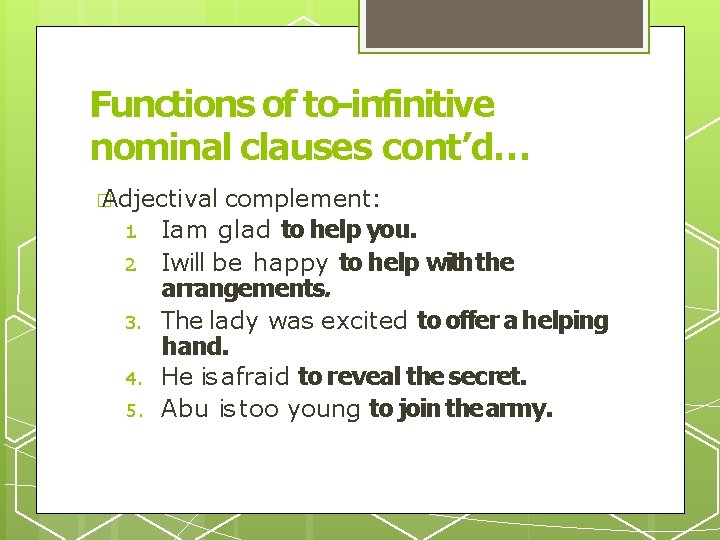
Functions of to-infinitive nominal clauses cont’d… � Adjectival 1. 2. 3. 4. 5. complement: Iam glad to help you. Iwill be happy to help with the arrangements. The lady was excited to offer a helping hand. He is afraid to reveal the secret. Abu is too young to join thearmy.
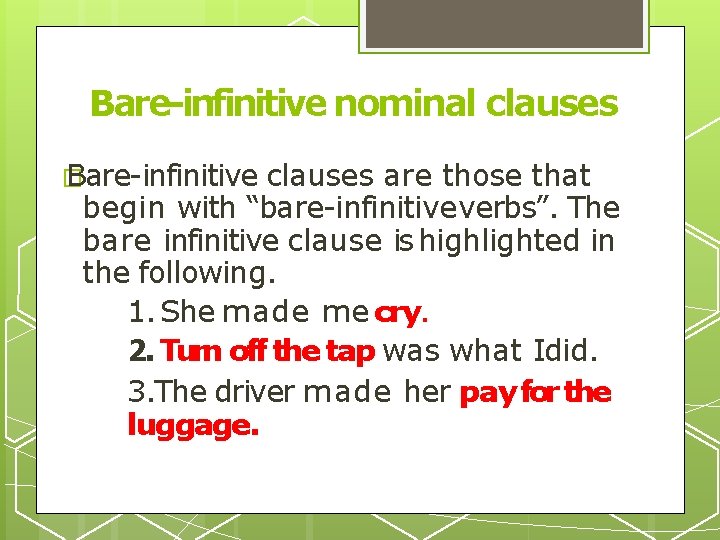
Bare-infinitive nominal clauses � Bare-infinitive clauses are those that begin with “bare-infinitive verbs”. The bare infinitive clause is highlighted in the following. 1. She made me cry. 2. Turn off the tap was what Idid. 3. The driver made her pay for the luggage.

Functions of bare-infinitive nominal clauses � Bare - infinitive clauses can function as Subject, Subject complement and object complement �Subject: 1. 2. 3. 4. 5. Warn him is the answer. Turnoff the lights was all Idid. Have breakfast is what I'll do first. Stop them is the best option. Stay at home prevents the disease.
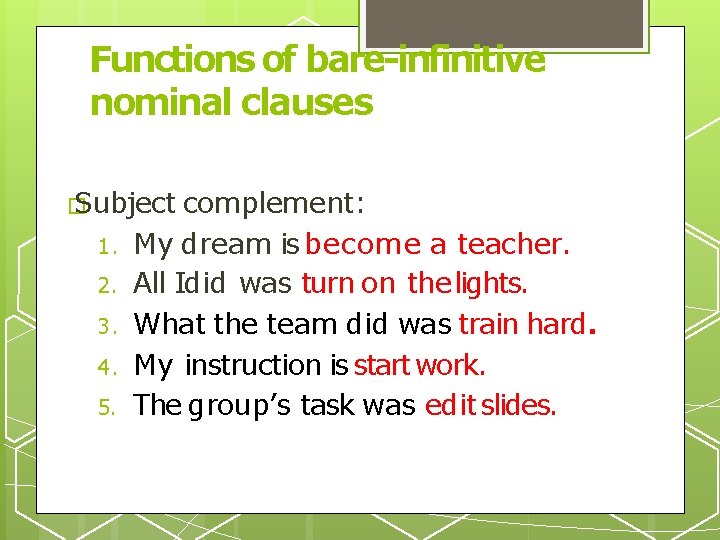
Functions of bare-infinitive nominal clauses � Subject 1. 2. 3. 4. 5. complement: My dream is become a teacher. All Idid was turn on the lights. What the team did was train hard. My instruction is start work. The group’s task was edit slides.
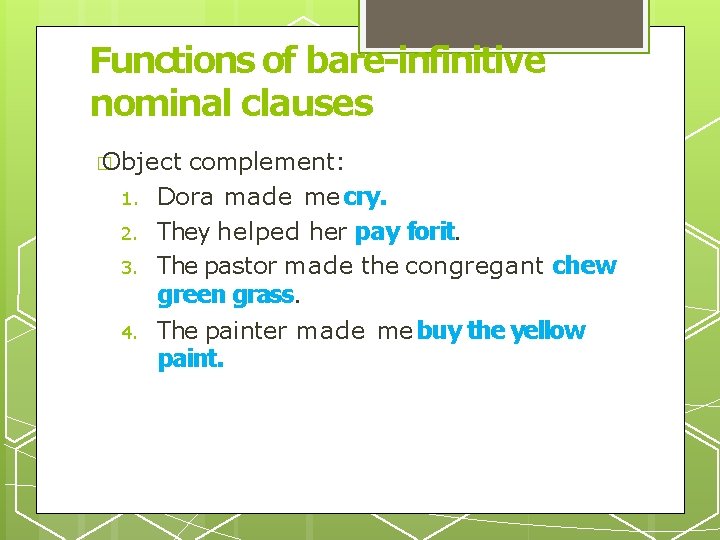
Functions of bare-infinitive nominal clauses � Object 1. 2. 3. 4. complement: Dora made me cry. They helped her pay forit. The pastor made the congregant chew green grass. The painter made me buy the yellow paint.
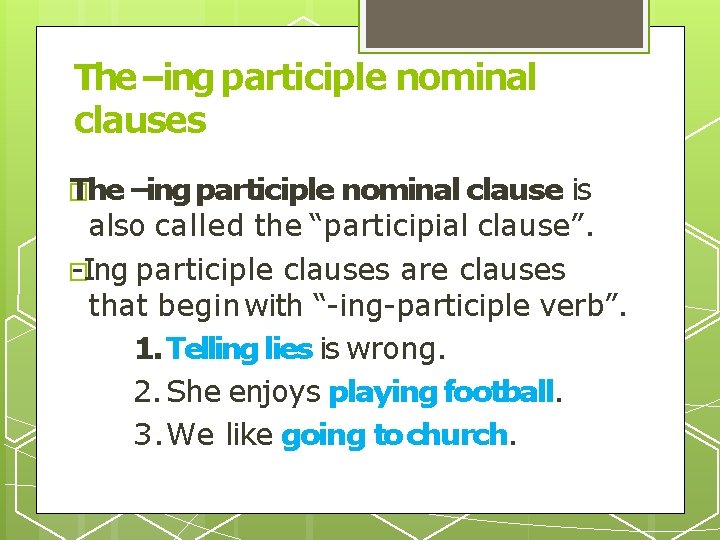
The –ing participle nominal clauses � The –ing participle nominal clause is also called the “participial clause”. � -Ing participle clauses are clauses that begin with “-ing-participle verb”. 1. Telling lies is wrong. 2. She enjoys playing football. 3. We like going to church.
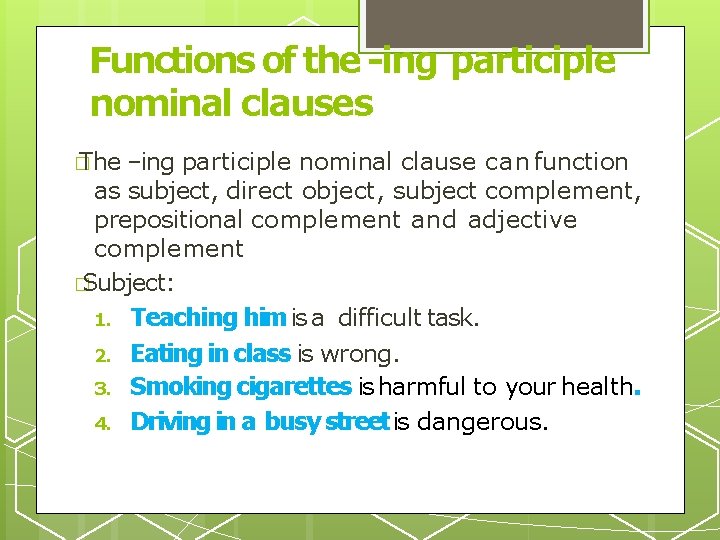
Functions of the -ing participle nominal clauses � The –ing participle nominal clause can function as subject, direct object, subject complement, prepositional complement and adjective complement �Subject: 1. Teaching him is a difficult task. 2. Eating in class is wrong. 3. Smoking cigarettes is harmful to your health. 4. Driving in a busy street is dangerous.
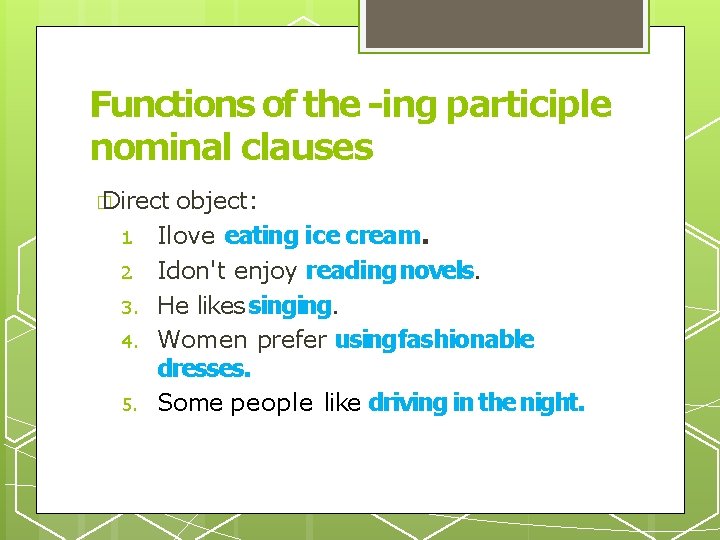
Functions of the -ing participle nominal clauses � Direct 1. 2. 3. 4. 5. object: Ilove eating ice cream. Idon't enjoy reading novels. He likes singing. Women prefer usingfashionable dresses. Some people like driving in the night.
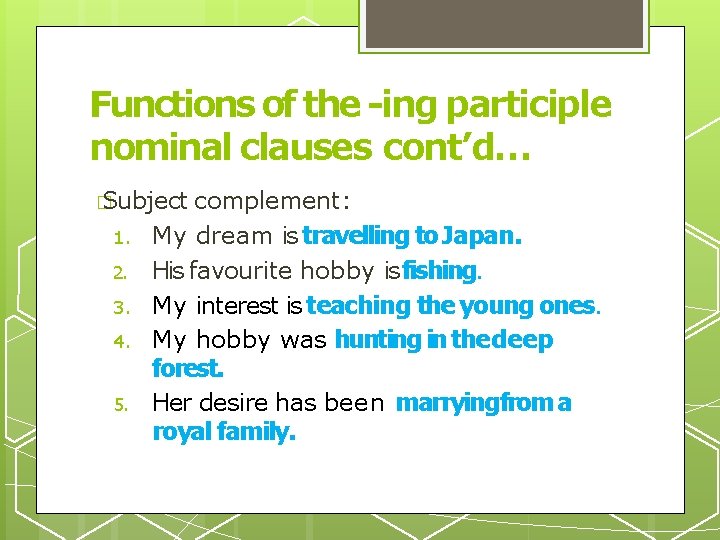
Functions of the -ing participle nominal clauses cont’d… � Subject complement: 1. 2. 3. 4. 5. My dream is travelling to Japan. His favourite hobby is fishing. My interest is teaching the young ones. My hobby was hunting in thedeep forest. Her desire has been marryingfrom a royal family.
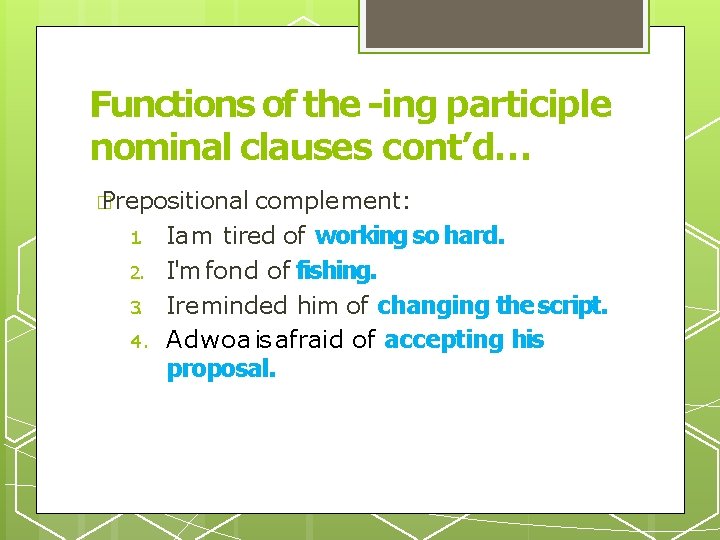
Functions of the -ing participle nominal clauses cont’d… � Prepositional 1. 2. 3. 4. complement: Iam tired of working so hard. I'm fond of fishing. Ireminded him of changing the script. Adwoa is afraid of accepting his proposal.
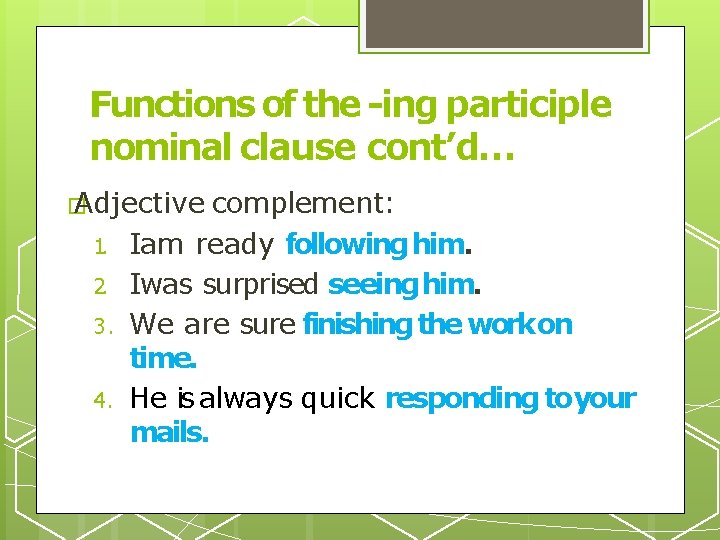
Functions of the -ing participle nominal clause cont’d… � Adjective 1. 2. 3. 4. complement: Iam ready following him. Iwas surprised seeing him. We are sure finishing the work on time. He is always quick responding toyour mails.
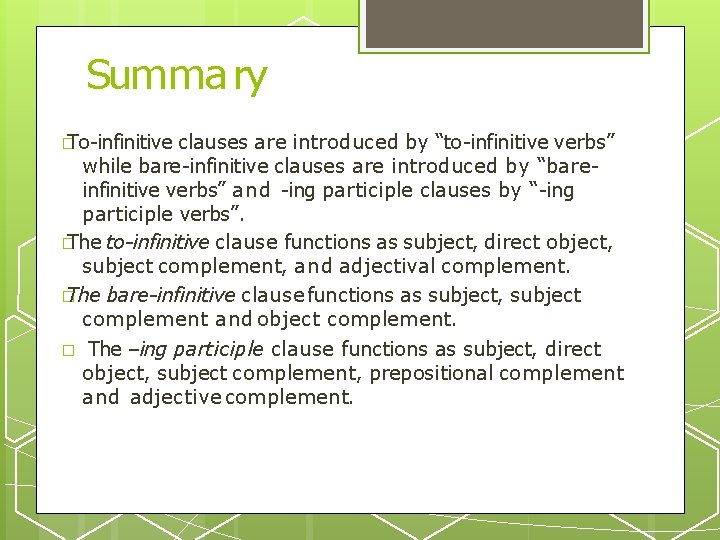
Summary � To-infinitive clauses are introduced by “to-infinitive verbs” while bare-infinitive clauses are introduced by “bareinfinitive verbs” and -ing participle clauses by “-ing participle verbs”. � The to-infinitive clause functions as subject, direct object, subject complement, and adjectival complement. � The bare-infinitive clause functions as subject, subject complement and object complement. � The –ing participle clause functions as subject, direct object, subject complement, prepositional complement and adjective complement.
Self-study questions 1. 2. 3. What is the non-finite nominal clause? Mention three (3) types of the non-finite nominal clause. Construct two (2) sentences each under the following headings: a) to-infinitive clause. b) bare infinitive clause. c) –ing participle clause.
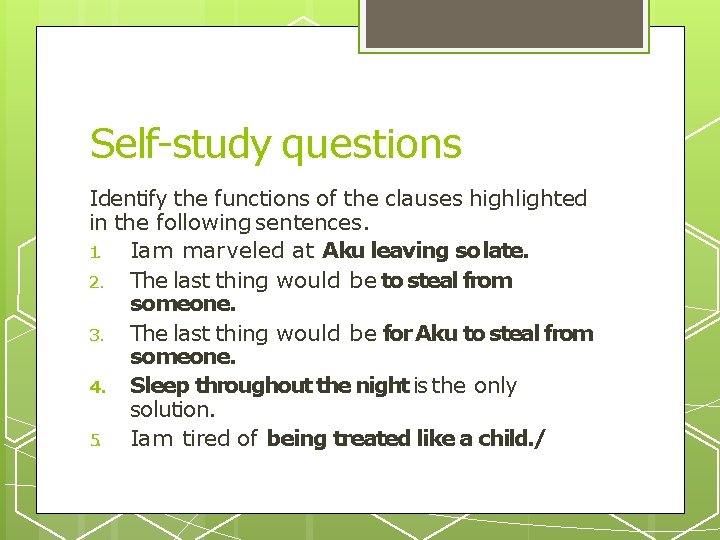
Self-study questions Identify the functions of the clauses highlighted in the following sentences. 1. Iam marveled at Aku leaving so late. 2. The last thing would be to steal from someone. 3. The last thing would be for Aku to steal from someone. 4. Sleep throughout the night is the only solution. 5. Iam tired of being treated like a child. /
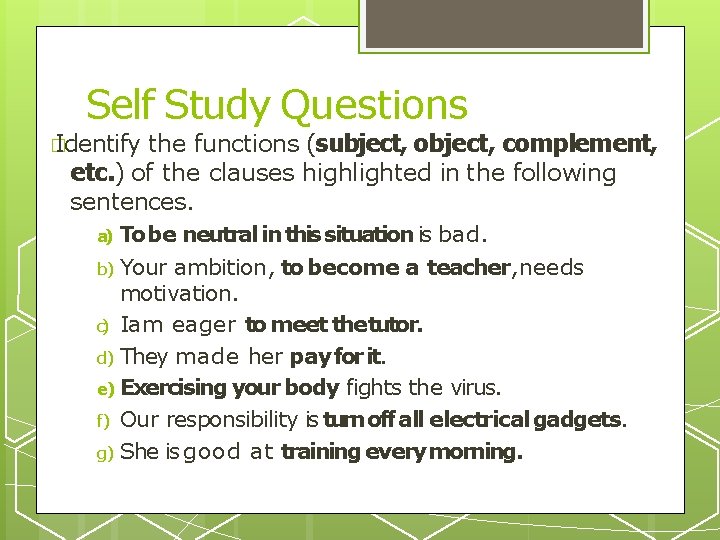
Self Study Questions � Identify the functions (subject, object, complement, etc. ) of the clauses highlighted in the following sentences. a) To be neutral in this situation is bad. b) Your ambition, to become a teacher, needs motivation. c) Iam eager to meet thetutor. d) They made her pay for it. e) Exercising your body fights the virus. f) Our responsibility is turn off all electrical gadgets. g) She is good at training every morning.
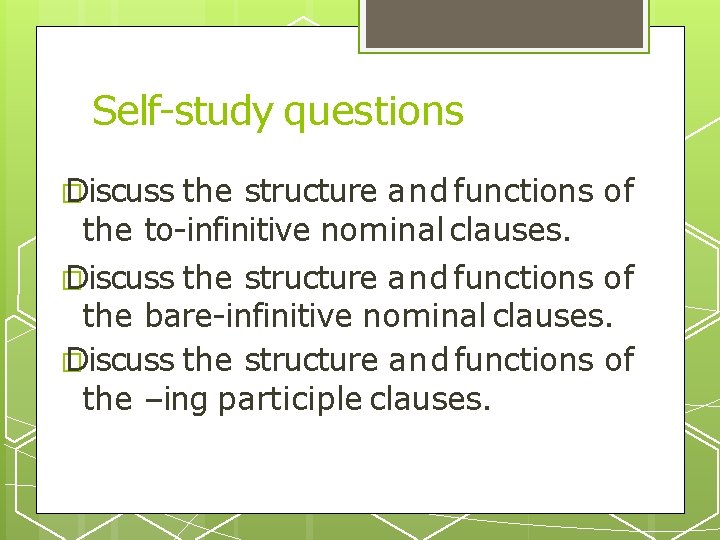
Self-study questions � Discuss the structure and functions of the to-infinitive nominal clauses. � Discuss the structure and functions of the bare-infinitive nominal clauses. � Discuss the structure and functions of the –ing participle clauses.
Prepared by: � Dr. Isaac N. Mwinlaaru � Gershon K. Ladzekpo � Rose Srem-Sai
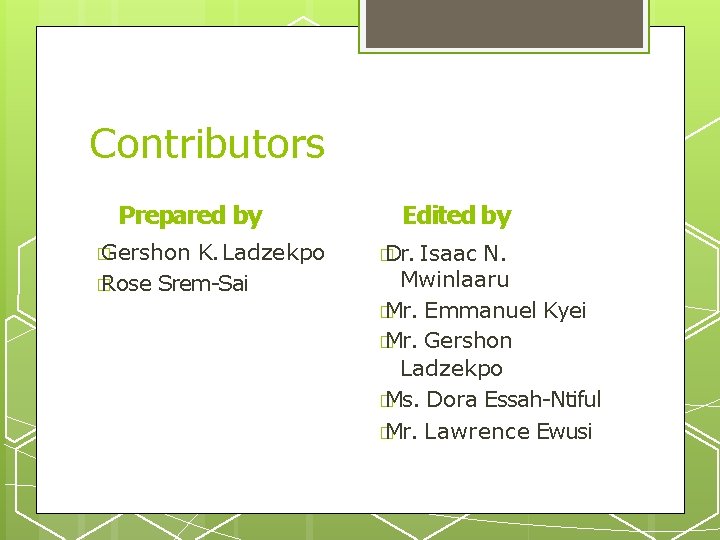
Contributors Prepared by � Gershon K. Ladzekpo � Rose Srem-Sai Edited by � Dr. Isaac N. Mwinlaaru � Mr. Emmanuel Kyei � Mr. Gershon Ladzekpo � Ms. Dora Essah-Ntiful � Mr. Lawrence Ewusi
- Slides: 30