
Ebra Secka Spring 2021 An Educational Change Project

Ebra Secka Spring 2021 An Educational Change Project to improve Pharmacy and Nursing Collaboration EVIDENCE-BASED BENCHMARK STUDY
Improve communication between nurses and the pharmacy personnel. More collaboration between nursing and pharmacy personnel. Rational Nurses and pharmacy staff spending time in each other’s departments during orientation for new staff. Better understanding of each other’ roles between the pharmacy staff and the nursing staff. Timely verification of doctor’s orders and delivery of medication to unit for administration to the patients.
Goal To improve communication and collaboration between nursing and pharmacy personnel. To facilitates better understanding between these two departments and enhance the quality patient care delivery. finding tangible solutions to the communication gab that exist between these two professionals and possibly avert any potential harm that could arise if such measures are not taken
Literature Review Poor collaboration and communication among health care professionals could lead to dire consequences, including disrupted and delayed care (Celio et al. , 2018). Participants in interprofessional education gained better communication skills, understood other professions' roles, valued, and respected other professionals (Wong et al. , 2017; Mellor et al. , 2013; Jung et al. , 2020; Tsakitzidis et al. , 2015). Interprofessional educational program will improve communication between professionals and strengthen collaboration (Wong et al. , 2017; Mellor et al. , 2013; Jung et al. , 2020; Tsakitzidis et al. , 2015). Inter professional education improved knowledge, skills, and behavior of interprofessional collaborative competences (Riskiyana et al. , 2018; Darlow et al. , 2015; Hamada et al. , 2019).
Literature Review Mahler et al. (2018) revealed that students assessed interprofessional learning as positive and that it allows them to have a better understanding of other professions and their perspectives
Project Stakeholders Upper-level Management: Chief Nursing Officer Regional Nurse Managers. Mid-level Management-Nurse Mangers, Supervisors. Staff Nurses-Nurse Preceptors, LVNs, Newly hired nurses, Newly hired pharmacist and pharmacy technicians
Outcomes 1. Improve communication between nurses and pharmacy personnel. 2. More collaboration between nursing and pharmacy personnel. 3. Better working relationship between nurses and pharmacy personnel. 4. Nurses and pharmacy staff spending time in each other’s departments during orientation of new staff. 5. Better understanding of each other’ roles between the pharmacy staff and nursing staff and 6. Timely verification of doctor’s orders and delivery of medication to the unit for administration to the patients.
Evaluation Design The project will be evaluated based on the number of missing medication requests made by nurses from the pharmacy. Missing medication data will be collected every shift and compared to absent medication requests before the implementation. A decrease will indicate success. Nurses will be encouraged to record missing amounts for one month before implementing this education program and the project’s three-month duration.
Evaluation Design The change project will monitor missing medication while equally examining nurse-pharmacist relations. Pretest and post test questionnaire will be utilized to gage nurses and pharmacy perception and attitude towards interprofessional collaboration Comparation will be made between the pretest and post test to determine the level of impact the program have on participants.
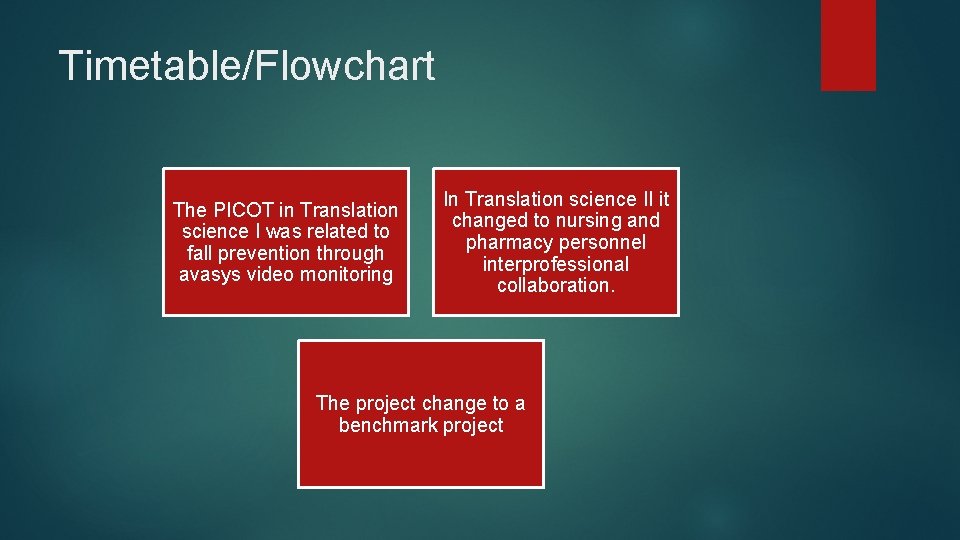
Timetable/Flowchart The PICOT in Translation science I was related to fall prevention through avasys video monitoring In Translation science II it changed to nursing and pharmacy personnel interprofessional collaboration. The project change to a benchmark project
Data Collection Methods Data collection was mainly through literature search on programs that were implemented before. a personal tool was created in which nurses document all the missed medications they requested from the pharmacy, how long it took them to receive their request and whether follow up calls were made to the pharmacy and how long they spent on those calls. Pre- post- tests results reviewed prior to implementation and after implementation of educational project.
Cost/Benefits The most valuable resources for this benchmark project is the time spent by nursing and pharmacy personnel to implement this project successfully. This evidence-based change project requires a financial cost estimated at 700 dollars. $500 expenditure is estimated to cover the cost of breakfast, lunch, dinner, snacks, and drinks for participants for a three-day session, including the day shift and evening shift. The remaining $200 is estimated to cover the cost of stationery supplies such as pens writing papers. The benefit outweighs the cost because with a successful nurse-pharmacy collaboration, there will be better staff working relationship which facilitate understanding and respect and better patient care delivery.
Conclusion Nursing and the pharmacy department play a significant role in the delivery of quality health care. The relationship between nursing and the pharmacy staff is interdependence, making it extremely important for these two departments to communicate. Poor collaboration and communication among health care professionals could lead to dire consequences, including disrupted and delayed care (Celio et al. , 2018). In the absence of effective communication, misunderstanding between nurses and pharmacists could lead to unnecessary delays in the quality of service that the patients receive. Given the significant role nurses and pharmacists play in any healthcare environment, it is paramount that collaboration and healthy working relationships exist. A healthy working environment could minimize stress among health care workers, but most importantly, it promotes quality service delivery for maximum patient satisfaction.
References Celio, J. , Ninane, F. , Bugnon, O. , & Schneider, P. M. (2018). Pharmacistnurse collaboration in medication adherence-enhancing intervention: A review. Elsevier BV 101, 11751192. https: //doi. org/10. 1016/j. pec. 2018. 01. 022 Darlow, B. , Coleman, K. , Mc. Kinlay, E. , Donovan, S. , Beckingsale, L. , Gray, B. , Neser, H. , Perry, M. , Stanley, J. , & Pullon, S. (2015). The positive impact of interprofessional education: a control trial to evaluate a programme for health professional students. BMC Medical Education. 15(98), 1 -9, http: //doi. org/10. 1186/s 129090150385 -3
References Hamada, S. , Haruta, J. , Maeno, T. , Suzuki, H. , Takayashiki, A. , Inada, H. , Naito, T. , Tomita, M. , Kanou, N. , & Baba, T. (2019). Effectiveness of an interprofessional education program using team-based learning for medical students: a randomized controlled trial. Journal of General and Family Medicine. 1 -9, http: //doi. org/10. 1002/igf 2. 284 Jung, H. , Park, H. K. , Min, H. Y. , & Ji, E. (2020). The effectiveness of interprofessional education programs for medical, nursing, and pharmacy students. Korean Journal of Medical Education. 32(2), 131 -142. https: //doi. org/0000 -0002 -0008 -2400
References Mahler, C. , Schwarzbeck, V. , Mink, J. , & Goetz, K. (2018). Students’ perception of interprofessional education in the bachelor programme interprofessional health care in Heidelberg, Germany: An exploratory case study. BMC Medical Education. 18(19), 1 -8, http: //doi. org/10. 1186/s 12909018 -1124 -3 Mellor, R. , Cottrell, N. , & Moran, M. (2013). “Just working in a team was a great experience…”- Student perspectives on the learning experiences of an interprofessional education program. Informa UK, Ltd. 27: 292 -297. https: //doi. org/10. 3109/13561820. 2013. 769093
References Riskiyana, R. , Claramita, M. , & Rahayu, G. R. (2018). Objectively measured interprofessional education outcome and factors that enhance program effectiveness: A systematic review. Nurse Education Today. 66, 73 -78, http: //doi. org/10. 1016/j. nedt. 2018. 04. 014 Tsakitzidis, G. , Timmermans, O. , Callewaert, N. , Truijen, S. , Meulemans, H. , & Royen, V. P. (2015). Participant evaluation of an education module on interprofessional collaboration for students in health studies. BMC Medical Education. 15(188), 1 -8. https: //doi. org/10. 1186/s 12909 -01504770
References Wong, C. K. A. , Wong, Y. K. F. , Chan, K. L. , Chan, N. , Ganotice, A. F. , & Ho, J. (2017). The effect of interprofessional team-based learning among nursing students: A quasi-experimental study. Elsevier Ltd. 13 -18. https: //dx. doi. org/1010116/j. nedt. 2017. 03. 004
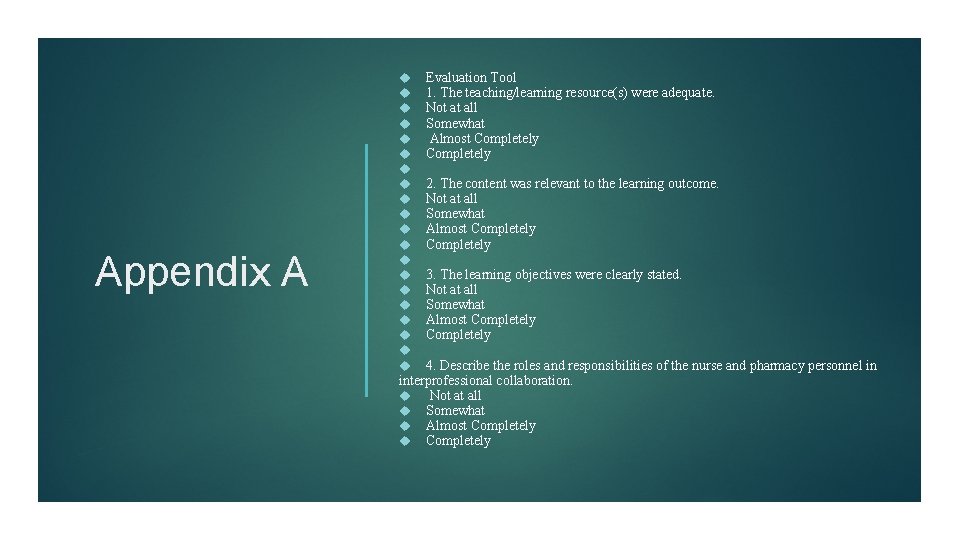
Appendix A Evaluation Tool 1. The teaching/learning resource(s) were adequate. Not at all Somewhat Almost Completely 2. The content was relevant to the learning outcome. Not at all Somewhat Almost Completely 3. The learning objectives were clearly stated. Not at all Somewhat Almost Completely 4. Describe the roles and responsibilities of the nurse and pharmacy personnel in interprofessional collaboration. Not at all Somewhat Almost Completely
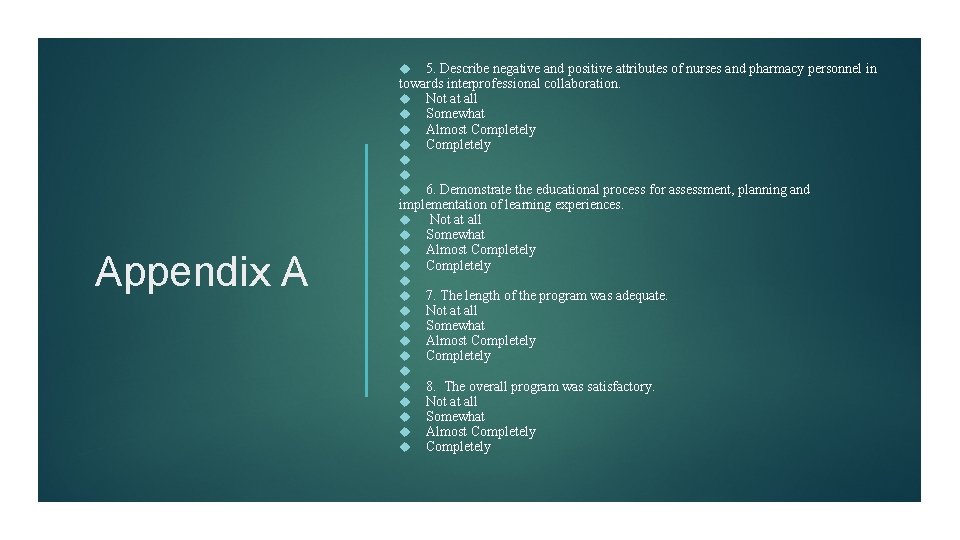
5. Describe negative and positive attributes of nurses and pharmacy personnel in towards interprofessional collaboration. Not at all Somewhat Almost Completely Appendix A 6. Demonstrate the educational process for assessment, planning and implementation of learning experiences. Not at all Somewhat Almost Completely 7. The length of the program was adequate. Not at all Somewhat Almost Completely 8. The overall program was satisfactory. Not at all Somewhat Almost Completely
Questions & Discussion
- Slides: 21