
Ebeam test stand at CERN RD linked to
E-beam test stand at CERN R&D linked to long range beam compensation) HS, 1 -10 -2014
Situation November 2014 (1/2) • CERN is considering to install two hollow electron beams for LHC collimation. • CERN is studying the possibility for four/eight electron beam installations for the compensation of long range beam-beam effects in the LHC. • Both projects require the development of higher electron beam currents, potentially an amplitude modulation of the electron beam current and improved diagnostics on the transverse electron beam profile. CERN needs a test-stand
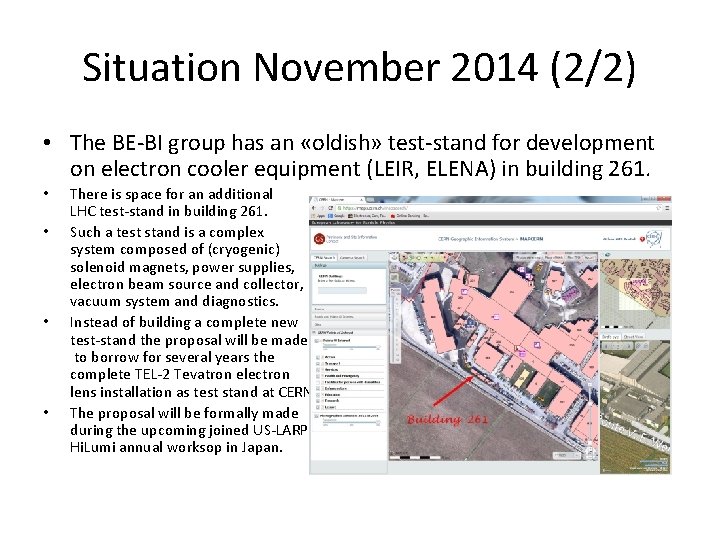
Situation November 2014 (2/2) • The BE-BI group has an «oldish» test-stand for development on electron cooler equipment (LEIR, ELENA) in building 261. • • There is space for an additional LHC test-stand in building 261. Such a test stand is a complex system composed of (cryogenic) solenoid magnets, power supplies, electron beam source and collector, vacuum system and diagnostics. Instead of building a complete new test-stand the proposal will be made to borrow for several years the complete TEL-2 Tevatron electron lens installation as test stand at CERN. The proposal will be formally made during the upcoming joined US-LARPHi. Lumi annual worksop in Japan.
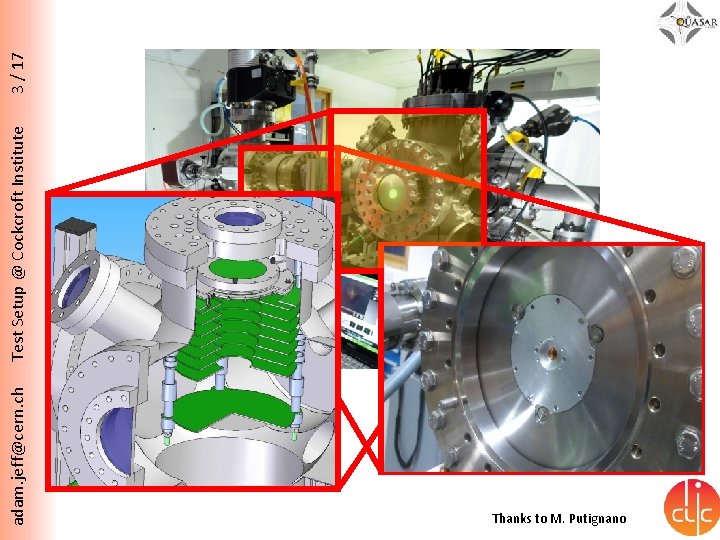
Outline of developments to be made • Pre-requisite: Import the technologies towards CERN engineers. • Increase the electron beam current by a factor two to five. • Modulate the electron beam intensity by about 10% at 40 MHz; potentially with a low power steering grid. • Develop an instanteneous beam profile measurement at full beam power. An existing development for the CLIC drive beam (Adam Jeff, Liverpool University) could be adapted to the new geometry : Injection of a gas-curtain and measurement of the beam profile through ionization/fluorescence (2 following slides)
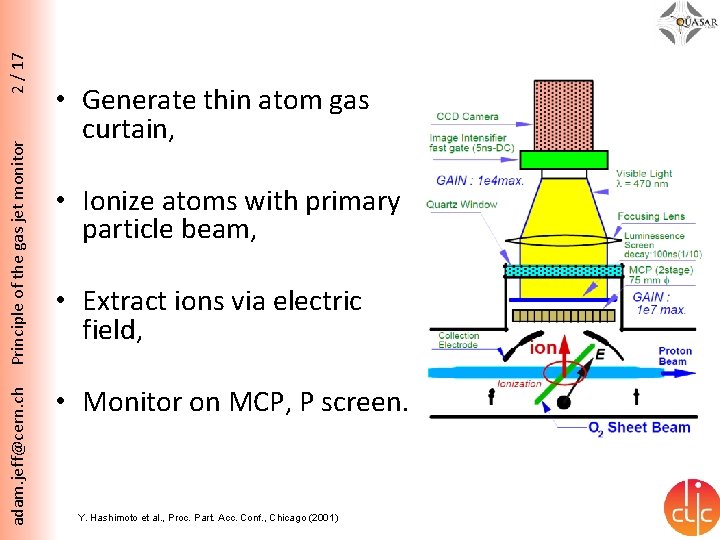
2 / 17 Principle of the gas jet monitor adam. jeff@cern. ch • Generate thin atom gas curtain, • Ionize atoms with primary particle beam, • Extract ions via electric field, • Monitor on MCP, P screen. Y. Hashimoto et al. , Proc. Part. Acc. Conf. , Chicago (2001)
adam. jeff@cern. ch Thanks to M. Putignano Test Setup @ Cockcroft Institute 3 / 17
Resources • • Financial Resources: CERN Hi-Lumi Project Building: OK TEL-2 on loan from FNAL People: - Guido Stancari through US-LARP - Gun development: Through Collimation project - Test stand assembly: BE-BI - Instrumentation: BE-BI • Timeline: TEL-2 at CERN in Summer 2015? ?
Two slides on Halo- Monitoring • Definition: Almost real-time observation of the 2 D- transverse LHC beam profile over 5 or 6 orders of magnitude. • Important for machine operation, collimation (effect of hollow electron lens), diagnostics for BB compensation. • Collaboration in preparation between: 1) CERN: E. Bravin et al. (BE-BI) 2) KEK: T. Mitsuhashi 3) SLAC: A. Fisher et al. 4) Cornell: D. Rubin et al. 5) NASA: S. Thomas (Exo Planet investigations) • Basic principle: Optical detector(s) hooked onto the synchrotron light telescope
Ideas on LHC Halo Monitoring: • See: https: //portal. slac. stanford. edu/sites/conf_public/bhm_2014/Presentatio ns/Forms/All. Items. aspx • Most likely two approaches: 1) coronograph: First developped by F. Lyot in the 1930’s for the observation of the sun corona: Obturation of the core by a mask and at the same time avoiding the diffraction pattern generated by the mask. 2) High dynamic range camera (for the moment limited to 80… 100 d. B dynamic range) Common problem: - Diffraction generated by by dust or ditches in all optical elements (Mie scattering)
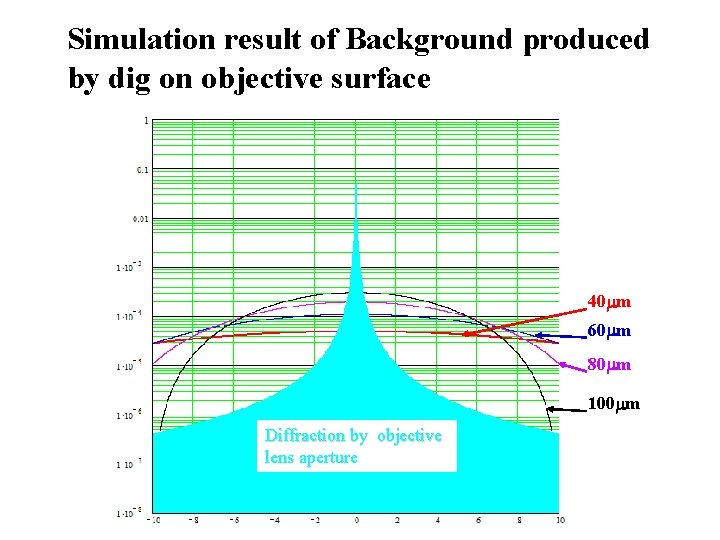
Simulation result of Background produced by dig on objective surface 40 mm 60 mm 80 mm 100 mm Diffraction by objective lens aperture
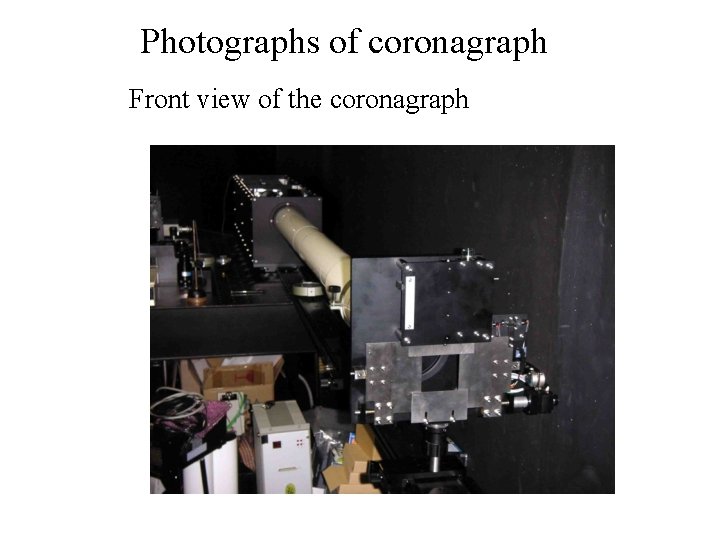
Photographs of coronagraph Front view of the coronagraph
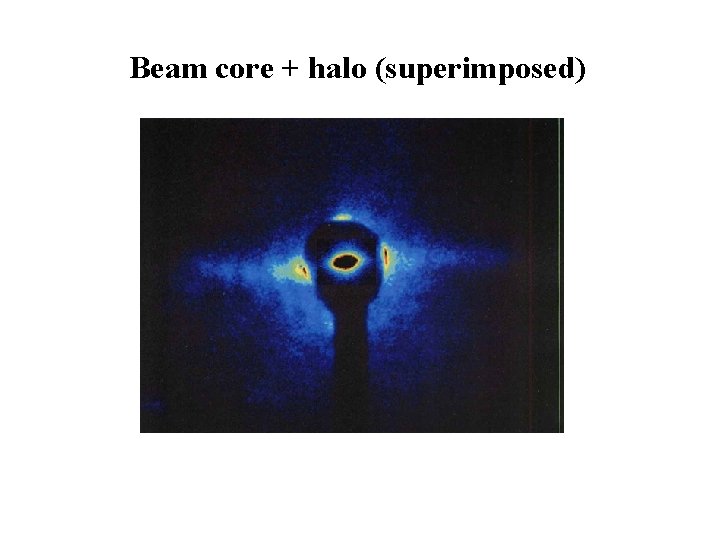
Beam core + halo (superimposed)
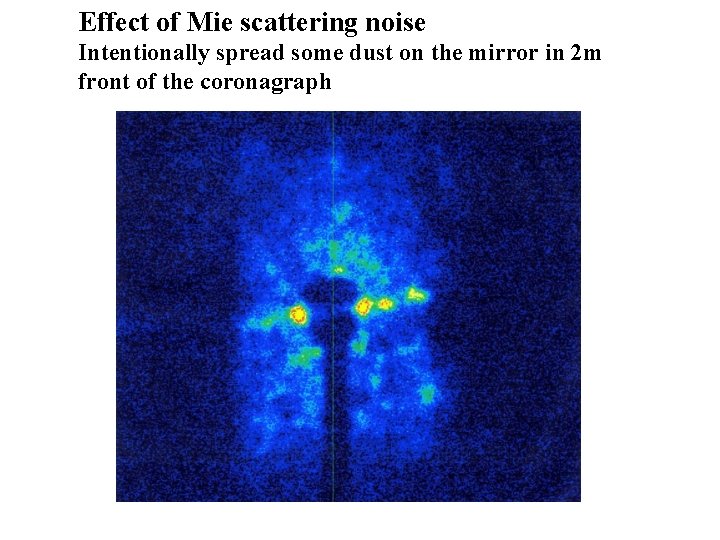
Effect of Mie scattering noise Intentionally spread some dust on the mirror in 2 m front of the coronagraph
- Slides: 13