
Eb XML Technical Architecture Overview TM www ebxml
Eb. XML Technical Architecture Overview TM www. ebxml. org Editor: Duane Nickull Constributors: All eb. XML Committees, participants V 0. 3 (c)2000 eb. XML TM - Editor: Duane Nickull (duane@xmlglobal. com)
Part One What is eb. XML? (c)2000 eb. XML TM - Editor: Duane Nickull (duane@xmlglobal. com)
eb. XML™ “Creating a Single Global Electronic Market™” A United Nations – CEFACT / Oasis sponsored initiative (c)2000 eb. XML TM - Editor: Duane Nickull (duane@xmlglobal. com)
eb. XML Mission. . . To provide an open XML-based infrastructure enabling the global use of electronic business information in an interoperable, secure and consistent manner by all parties. (c)2000 eb. XML TM - Editor: Duane Nickull (duane@xmlglobal. com)
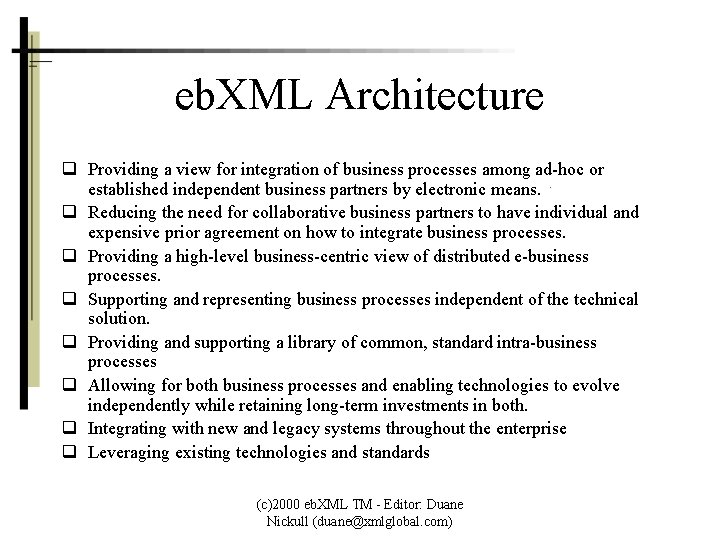
eb. XML Architecture q Providing a view for integration of business processes among ad-hoc or established independent business partners by electronic means. q Reducing the need for collaborative business partners to have individual and expensive prior agreement on how to integrate business processes. q Providing a high-level business-centric view of distributed e-business processes. q Supporting and representing business processes independent of the technical solution. q Providing and supporting a library of common, standard intra-business processes q Allowing for both business processes and enabling technologies to evolve independently while retaining long-term investments in both. q Integrating with new and legacy systems throughout the enterprise q Leveraging existing technologies and standards (c)2000 eb. XML TM - Editor: Duane Nickull (duane@xmlglobal. com)
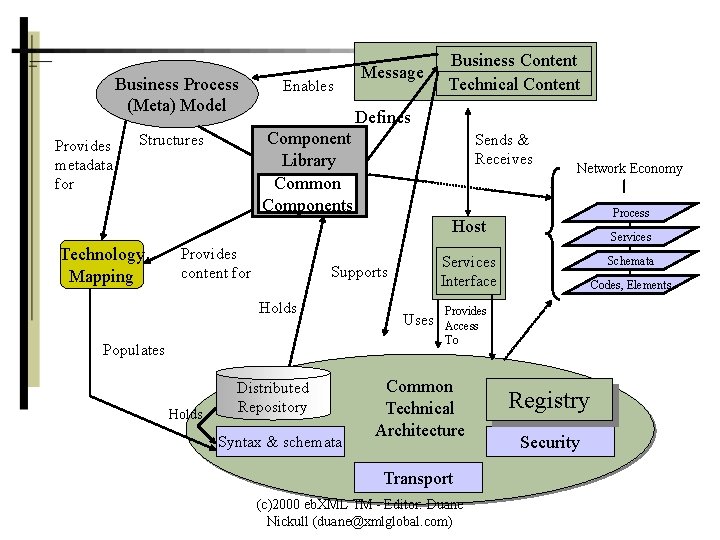
Business Process (Meta) Model Provides metadata for Enables Message Business Content Technical Content Defines Component Library Common Components Structures Sends & Receives Network Economy Process Host Technology Mapping Provides content for Populates Holds Services Interface Supports Holds Distributed Repository Syntax & schemata Services Uses Schemata Codes, Elements Provides Access To Common Technical Architecture Transport (c)2000 eb. XML TM - Editor: Duane Nickull (duane@xmlglobal. com) Registry Security
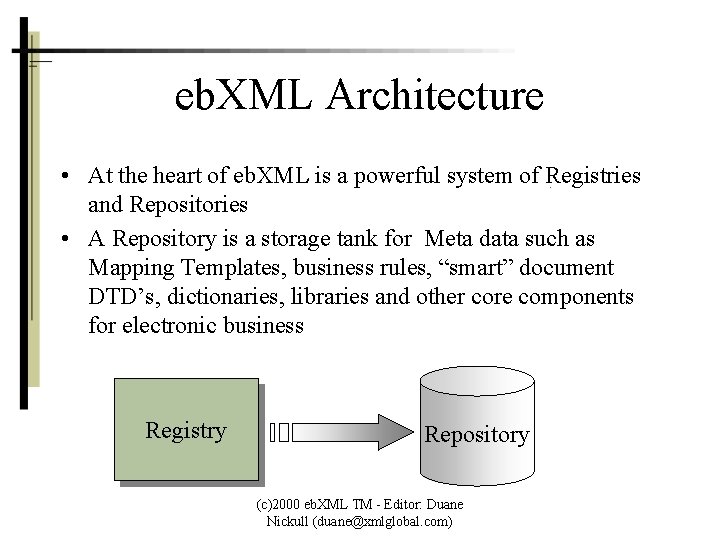
eb. XML Architecture • At the heart of eb. XML is a powerful system of Registries and Repositories • A Repository is a storage tank for Meta data such as Mapping Templates, business rules, “smart” document DTD’s, dictionaries, libraries and other core components for electronic business Registry Repository (c)2000 eb. XML TM - Editor: Duane Nickull (duane@xmlglobal. com)
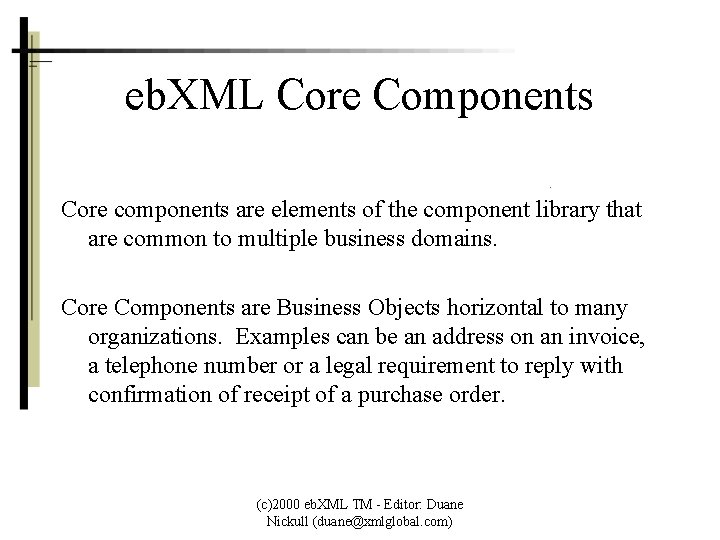
eb. XML Core Components Core components are elements of the component library that are common to multiple business domains. Core Components are Business Objects horizontal to many organizations. Examples can be an address on an invoice, a telephone number or a legal requirement to reply with confirmation of receipt of a purchase order. (c)2000 eb. XML TM - Editor: Duane Nickull (duane@xmlglobal. com)
Part Two - eb. XML Mapping / Rendering A review of eb. XML Mapping / Rendering Architecture (c)2000 eb. XML TM - Editor: Duane Nickull (duane@xmlglobal. com)
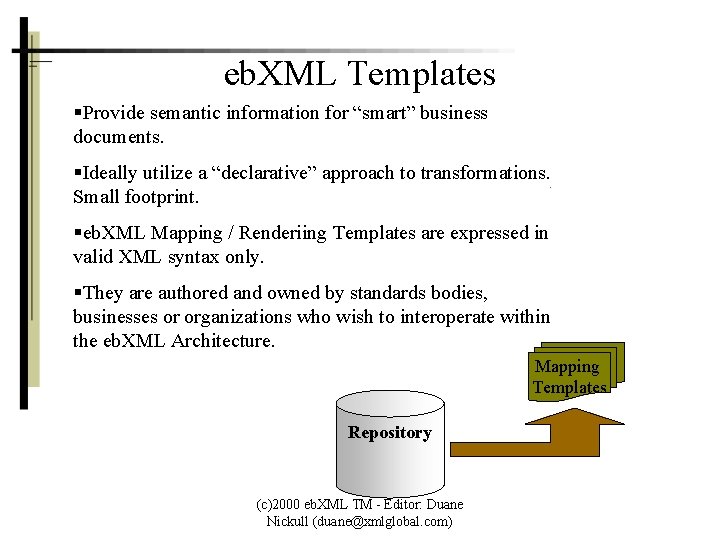
eb. XML Templates §Provide semantic information for “smart” business documents. §Ideally utilize a “declarative” approach to transformations. Small footprint. §eb. XML Mapping / Renderiing Templates are expressed in valid XML syntax only. §They are authored and owned by standards bodies, businesses or organizations who wish to interoperate within the eb. XML Architecture. Mapping Templates Repository (c)2000 eb. XML TM - Editor: Duane Nickull (duane@xmlglobal. com)
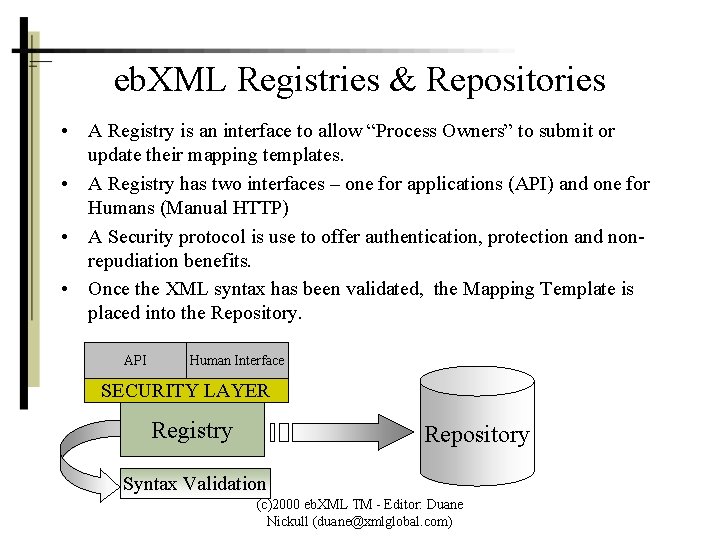
eb. XML Registries & Repositories • A Registry is an interface to allow “Process Owners” to submit or update their mapping templates. • A Registry has two interfaces – one for applications (API) and one for Humans (Manual HTTP) • A Security protocol is use to offer authentication, protection and nonrepudiation benefits. • Once the XML syntax has been validated, the Mapping Template is placed into the Repository. API Human Interface SECURITY LAYER Registry Repository Syntax Validation (c)2000 eb. XML TM - Editor: Duane Nickull (duane@xmlglobal. com)
Eb. XML Repository Search Requirements • Once the Mapping Templates are stored in a Repository, a search and retrieval mechanism must be employed. • The XML Repository Search engine must provide: – A Web Search interface for humans to manually locate data – An API for applications to rapidly access stored data – A caching mechanism (c)2000 eb. XML TM - Editor: Duane Nickull (duane@xmlglobal. com)
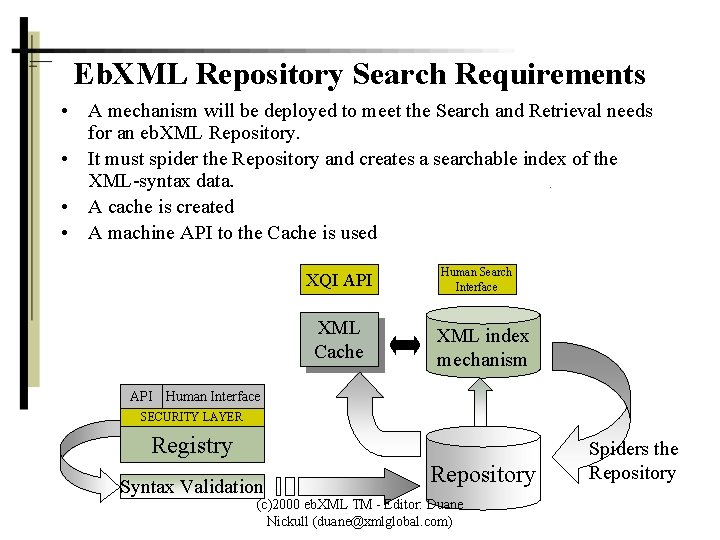
Eb. XML Repository Search Requirements • A mechanism will be deployed to meet the Search and Retrieval needs for an eb. XML Repository. • It must spider the Repository and creates a searchable index of the XML-syntax data. • A cache is created • A machine API to the Cache is used XQI API XML Cache Human Search Interface XML index mechanism API Human Interface SECURITY LAYER Registry Syntax Validation Repository (c)2000 eb. XML TM - Editor: Duane Nickull (duane@xmlglobal. com) Spiders the Repository
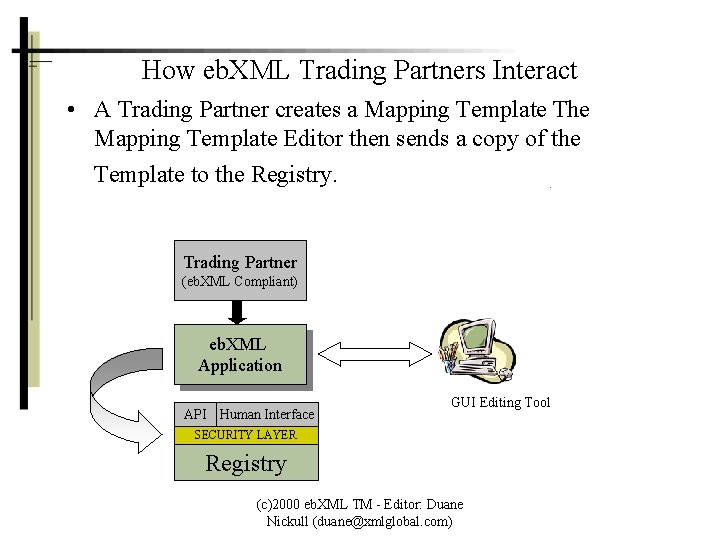
How eb. XML Trading Partners Interact • A Trading Partner creates a Mapping Template The Mapping Template Editor then sends a copy of the Template to the Registry. Trading Partner (eb. XML Compliant) eb. XML Application API Human Interface GUI Editing Tool SECURITY LAYER Registry (c)2000 eb. XML TM - Editor: Duane Nickull (duane@xmlglobal. com)
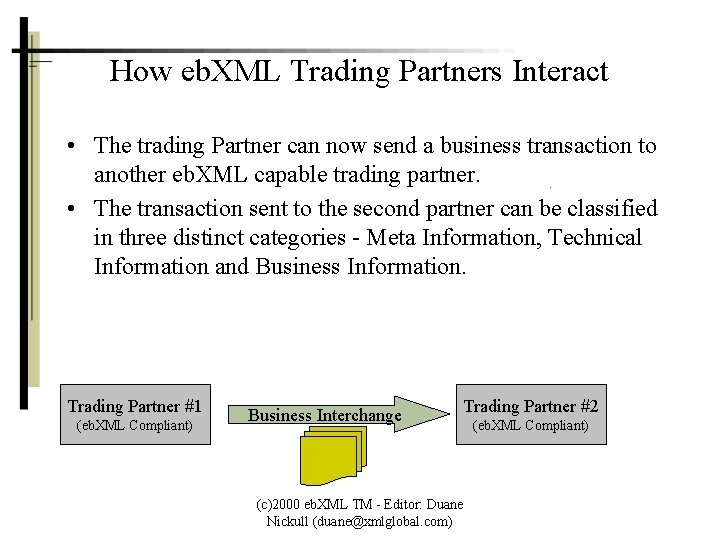
How eb. XML Trading Partners Interact • The trading Partner can now send a business transaction to another eb. XML capable trading partner. • The transaction sent to the second partner can be classified in three distinct categories - Meta Information, Technical Information and Business Information. Trading Partner #1 (eb. XML Compliant) Business Interchange Trading Partner #2 (c)2000 eb. XML TM - Editor: Duane Nickull (duane@xmlglobal. com) (eb. XML Compliant)
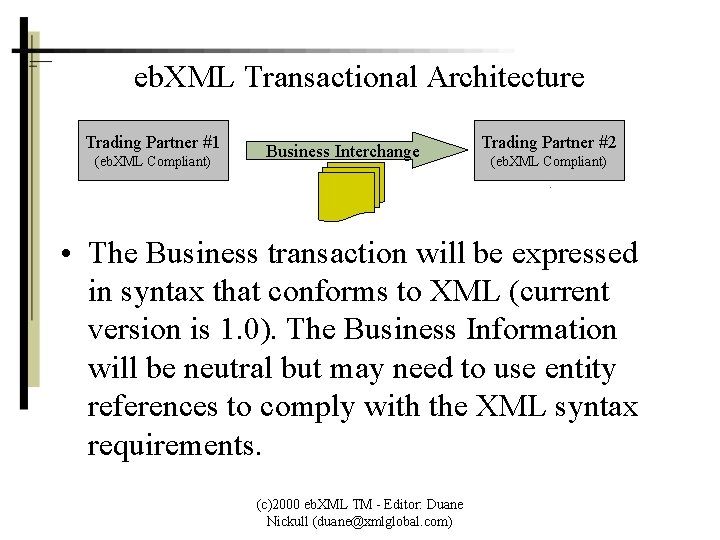
eb. XML Transactional Architecture Trading Partner #1 (eb. XML Compliant) Business Interchange Trading Partner #2 (eb. XML Compliant) • The Business transaction will be expressed in syntax that conforms to XML (current version is 1. 0). The Business Information will be neutral but may need to use entity references to comply with the XML syntax requirements. (c)2000 eb. XML TM - Editor: Duane Nickull (duane@xmlglobal. com)
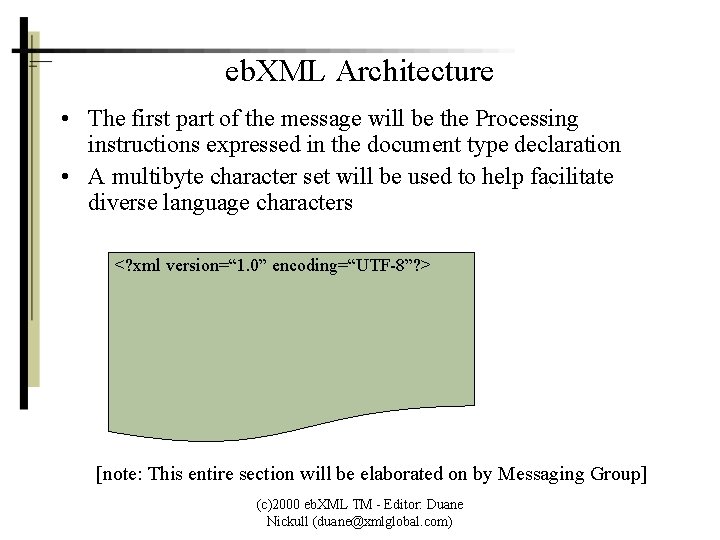
eb. XML Architecture • The first part of the message will be the Processing instructions expressed in the document type declaration • A multibyte character set will be used to help facilitate diverse language characters <? xml version=“ 1. 0” encoding=“UTF-8”? > [note: This entire section will be elaborated on by Messaging Group] (c)2000 eb. XML TM - Editor: Duane Nickull (duane@xmlglobal. com)
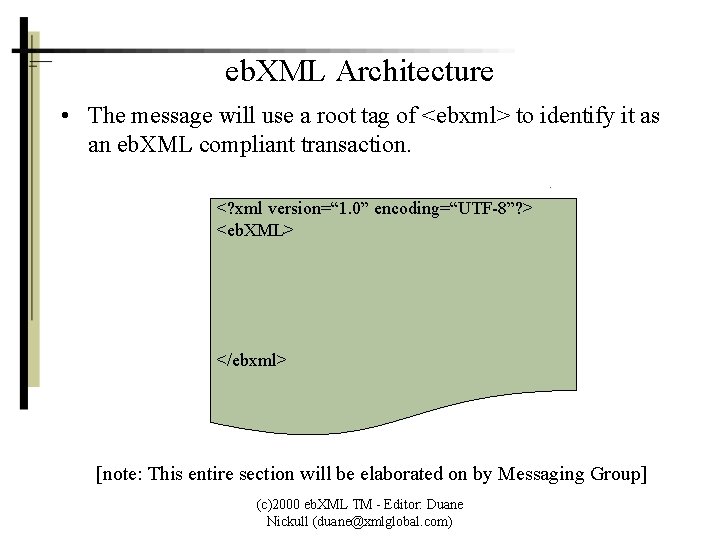
eb. XML Architecture • The message will use a root tag of <ebxml> to identify it as an eb. XML compliant transaction. <? xml version=“ 1. 0” encoding=“UTF-8”? > <eb. XML> </ebxml> [note: This entire section will be elaborated on by Messaging Group] (c)2000 eb. XML TM - Editor: Duane Nickull (duane@xmlglobal. com)
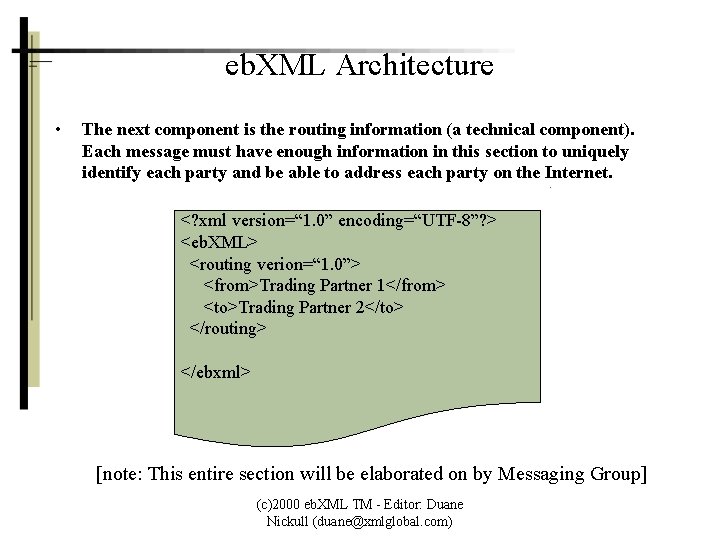
eb. XML Architecture • The next component is the routing information (a technical component). Each message must have enough information in this section to uniquely identify each party and be able to address each party on the Internet. <? xml version=“ 1. 0” encoding=“UTF-8”? > <eb. XML> <routing verion=“ 1. 0”> <from>Trading Partner 1</from> <to>Trading Partner 2</to> </routing> </ebxml> [note: This entire section will be elaborated on by Messaging Group] (c)2000 eb. XML TM - Editor: Duane Nickull (duane@xmlglobal. com)
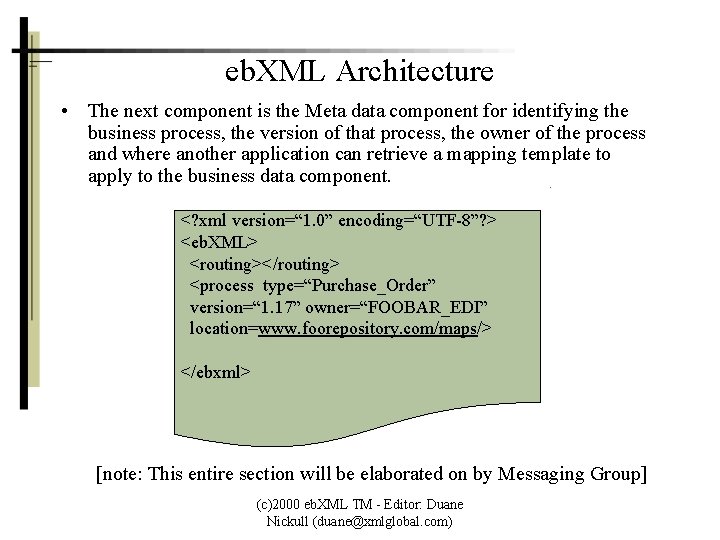
eb. XML Architecture • The next component is the Meta data component for identifying the business process, the version of that process, the owner of the process and where another application can retrieve a mapping template to apply to the business data component. <? xml version=“ 1. 0” encoding=“UTF-8”? > <eb. XML> <routing></routing> <process type=“Purchase_Order” version=“ 1. 17” owner=“FOOBAR_EDI” location=www. foorepository. com/maps/> </ebxml> [note: This entire section will be elaborated on by Messaging Group] (c)2000 eb. XML TM - Editor: Duane Nickull (duane@xmlglobal. com)
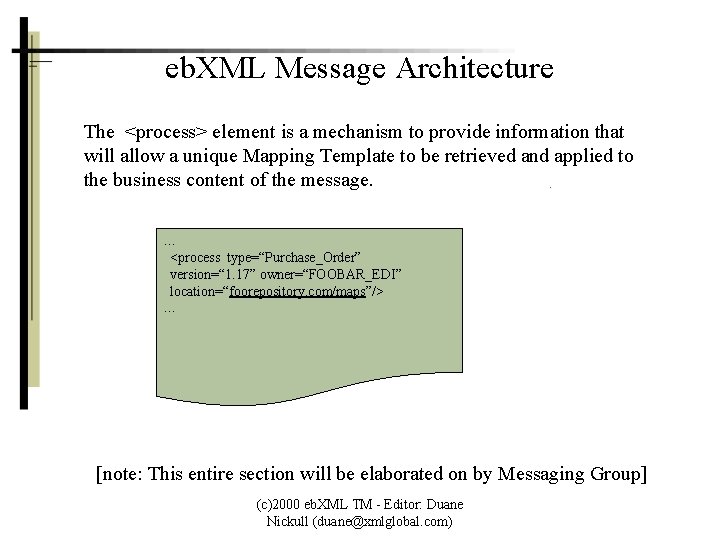
eb. XML Message Architecture The <process> element is a mechanism to provide information that will allow a unique Mapping Template to be retrieved and applied to the business content of the message. … <process type=“Purchase_Order” version=“ 1. 17” owner=“FOOBAR_EDI” location=“foorepository. com/maps”/> … [note: This entire section will be elaborated on by Messaging Group] (c)2000 eb. XML TM - Editor: Duane Nickull (duane@xmlglobal. com)
eb. XML Message Meta Architecture • The “type” attribute: – Is used to uniquely identify the process type in conjunction with the “owner” and “version” attributes. – Any combination of characters can be used as long as they are legal in XML syntax. – Can be used with other attributes to locate a specific Mapping Template in a Repository [note: This entire section will be elaborated on by Messaging Group] (c)2000 eb. XML TM - Editor: Duane Nickull (duane@xmlglobal. com)
eb. XML Message Meta Architecture • The “version” attribute: – Is used to identify a specific version of a process unique to each process “owner” – Not to be confused with the “version” attribute of the <routing> element which is used to maintain state within a transaction – Standard conventions of major. minor should be applied (ie version=“ 1. 17”) [note: This entire section will be elaborated on by Messaging Group] (c)2000 eb. XML TM - Editor: Duane Nickull (duane@xmlglobal. com)
eb. XML Message Meta Architecture • The “owner” attribute: – Is used to identify a the organization who “owns” the process being identified. – Any combination of characters can be used as long as they are legal in XML syntax – A shared Registry/Repository will be used to provide unique identification and assign “Owner” names. [note: This entire section will be elaborated on by Messaging Group] (c)2000 eb. XML TM - Editor: Duane Nickull (duane@xmlglobal. com)
eb. XML Message Meta Architecture • The “location” attribute: – Is used to retrieve Mapping Templates or UML modelling of the process. – Ideally will utilize http to point to this information [note: This entire section will be elaborated on by Messaging Group] (c)2000 eb. XML TM - Editor: Duane Nickull (duane@xmlglobal. com)
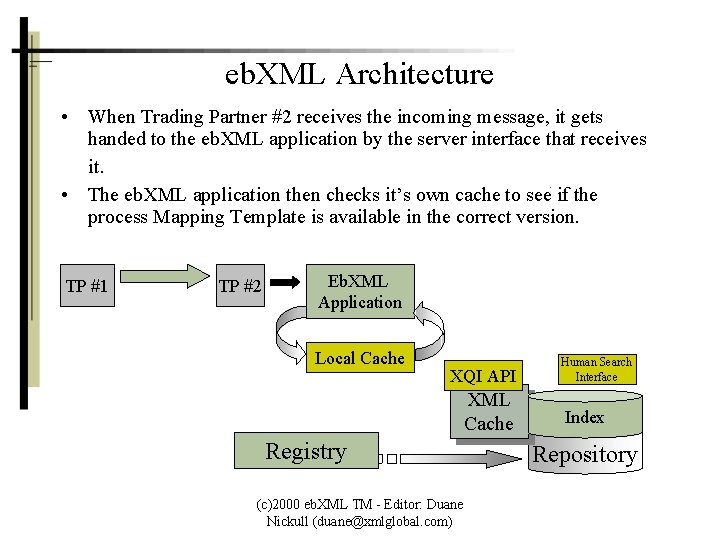
eb. XML Architecture • When Trading Partner #2 receives the incoming message, it gets handed to the eb. XML application by the server interface that receives it. • The eb. XML application then checks it’s own cache to see if the process Mapping Template is available in the correct version. TP #1 TP #2 Eb. XML Application Local Cache XQI API XML Cache Registry (c)2000 eb. XML TM - Editor: Duane Nickull (duane@xmlglobal. com) Human Search Interface Index Repository
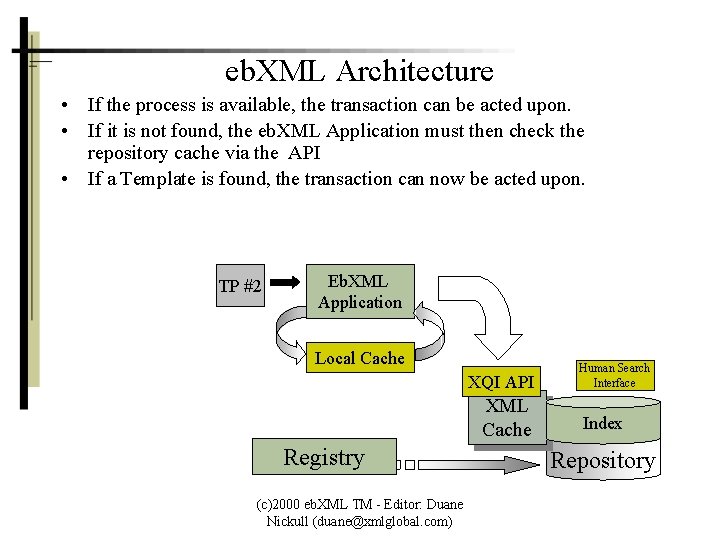
eb. XML Architecture • If the process is available, the transaction can be acted upon. • If it is not found, the eb. XML Application must then check the repository cache via the API • If a Template is found, the transaction can now be acted upon. TP #2 Eb. XML Application Local Cache XQI API XML Cache Registry (c)2000 eb. XML TM - Editor: Duane Nickull (duane@xmlglobal. com) Human Search Interface Index Repository
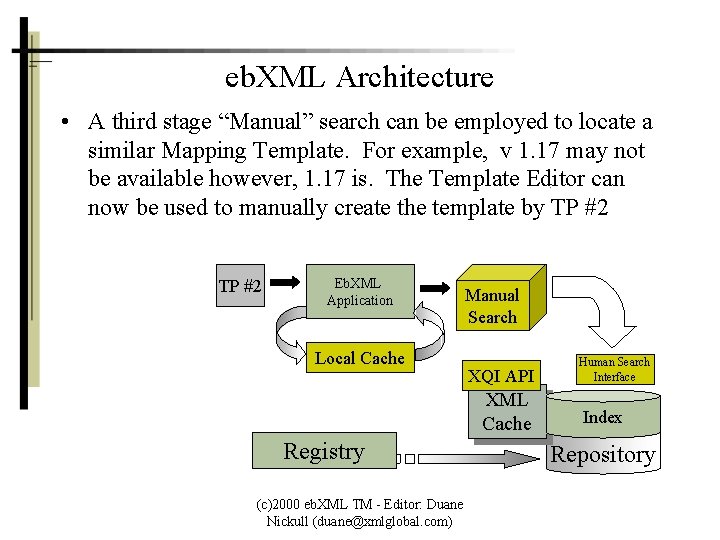
eb. XML Architecture • A third stage “Manual” search can be employed to locate a similar Mapping Template. For example, v 1. 17 may not be available however, 1. 17 is. The Template Editor can now be used to manually create the template by TP #2 Eb. XML Application Local Cache Manual Search XQI API XML Cache Registry (c)2000 eb. XML TM - Editor: Duane Nickull (duane@xmlglobal. com) Human Search Interface Index Repository
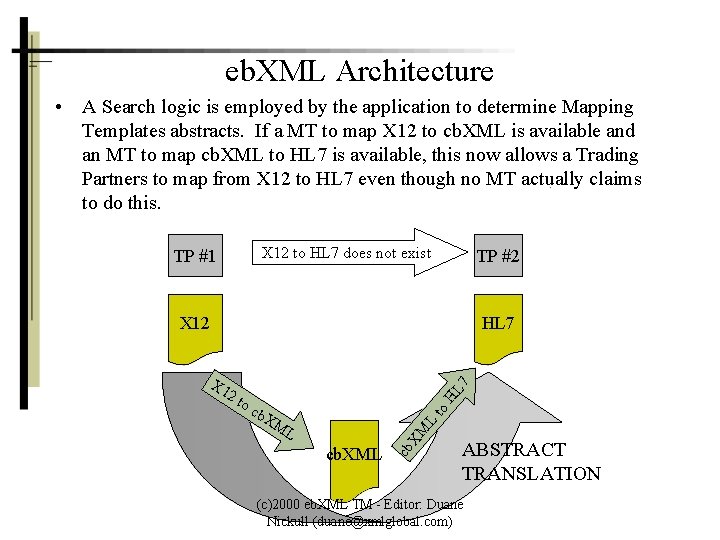
eb. XML Architecture • A Search logic is employed by the application to determine Mapping Templates abstracts. If a MT to map X 12 to cb. XML is available and an MT to map cb. XML to HL 7 is available, this now allows a Trading Partners to map from X 12 to HL 7 even though no MT actually claims to do this. X 12 to HL 7 does not exist TP #1 TP #2 HL oc L to b. X ML cb. XML XM 2 t cb X 1 HL 7 7 X 12 ABSTRACT TRANSLATION (c)2000 eb. XML TM - Editor: Duane Nickull (duane@xmlglobal. com)
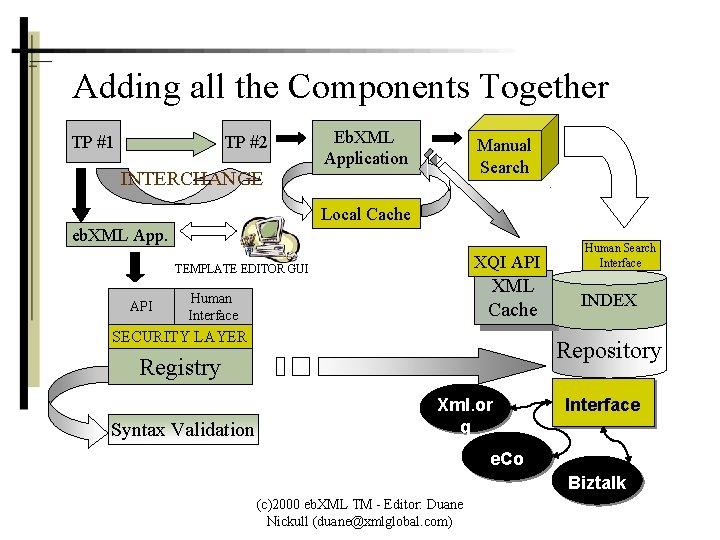
Adding all the Components Together TP #1 TP #2 INTERCHANGE Eb. XML Application Manual Search Local Cache eb. XML App. XQI API TEMPLATE EDITOR GUI API XML Cache Human Interface SECURITY LAYER INDEX Repository Registry Syntax Validation Human Search Interface Xml. or g Interface e. Co Biztalk (c)2000 eb. XML TM - Editor: Duane Nickull (duane@xmlglobal. com)
Some Final Thoughts. . • Build an open architecture, not a “Standard” • Truly Inter-operable and Extensible Thank you! Editor: Duane Nickull (c)2000 eb. XML TM - Editor: Duane Nickull (duane@xmlglobal. com)
- Slides: 31