
EAX A twopass authenticated encryption mode Mihir Bellare
EAX A two-pass authenticated encryption mode Mihir Bellare U. C. San Diego Phillip Rogaway David Wagner U. C. Davis and Chiang Mai University (Thailand) U. C. Berkeley
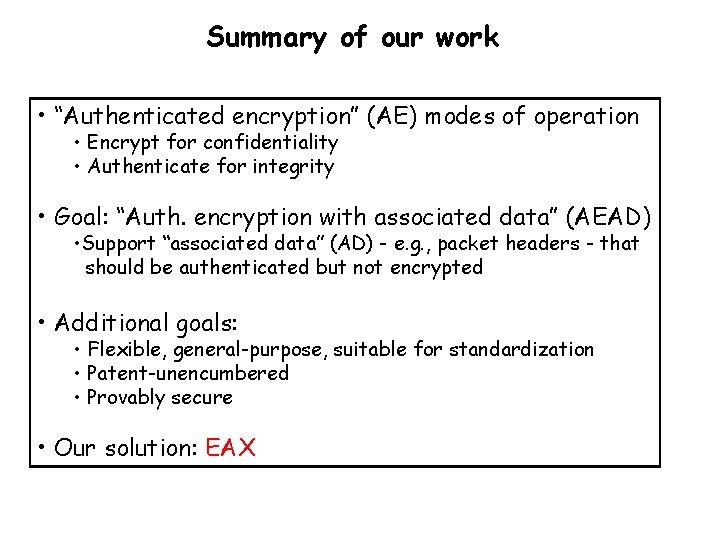
Summary of our work • “Authenticated encryption” (AE) modes of operation • Encrypt for confidentiality • Authenticate for integrity • Goal: “Auth. encryption with associated data” (AEAD) • Support “associated data” (AD) - e. g. , packet headers - that should be authenticated but not encrypted • Additional goals: • Flexible, general-purpose, suitable for standardization • Patent-unencumbered • Provably secure • Our solution: EAX
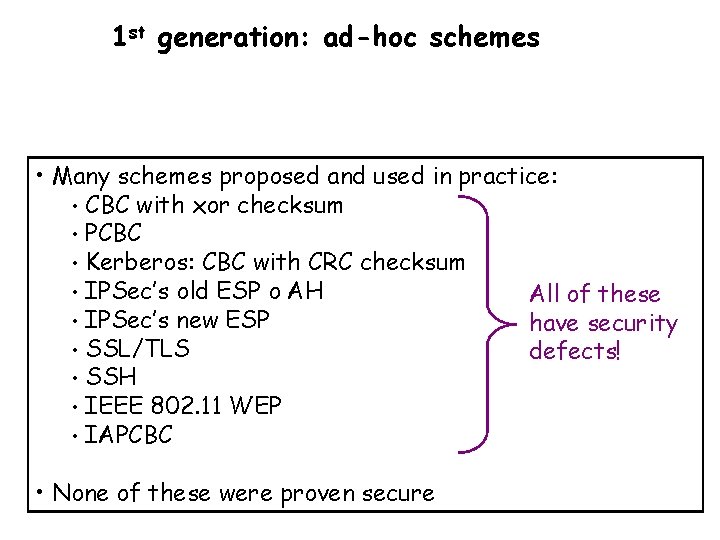
1 st generation: ad-hoc schemes • Many schemes proposed and used in practice: • CBC with xor checksum • PCBC • Kerberos: CBC with CRC checksum • IPSec’s old ESP o AH All of these • IPSec’s new ESP have security • SSL/TLS defects! • SSH • IEEE 802. 11 WEP • IAPCBC • None of these were proven secure
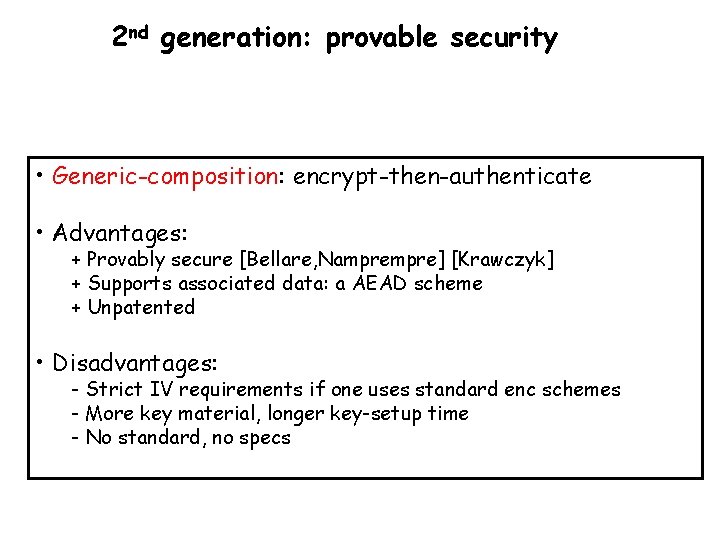
2 nd generation: provable security • Generic-composition: encrypt-then-authenticate • Advantages: + Provably secure [Bellare, Nampre] [Krawczyk] + Supports associated data: a AEAD scheme + Unpatented • Disadvantages: - Strict IV requirements if one uses standard enc schemes - More key material, longer key-setup time - No standard, no specs
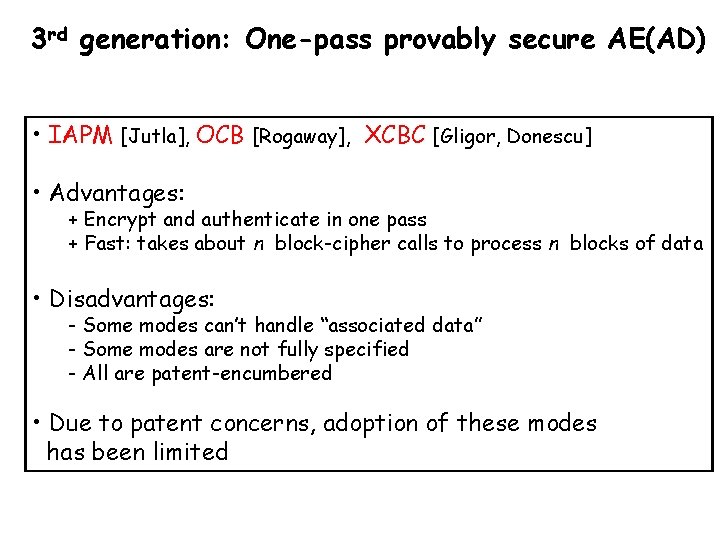
3 rd generation: One-pass provably secure AE(AD) • IAPM [Jutla], OCB [Rogaway], XCBC [Gligor, Donescu] • Advantages: + Encrypt and authenticate in one pass + Fast: takes about n block-cipher calls to process n blocks of data • Disadvantages: - Some modes can’t handle “associated data” - Some modes are not fully specified - All are patent-encumbered • Due to patent concerns, adoption of these modes has been limited
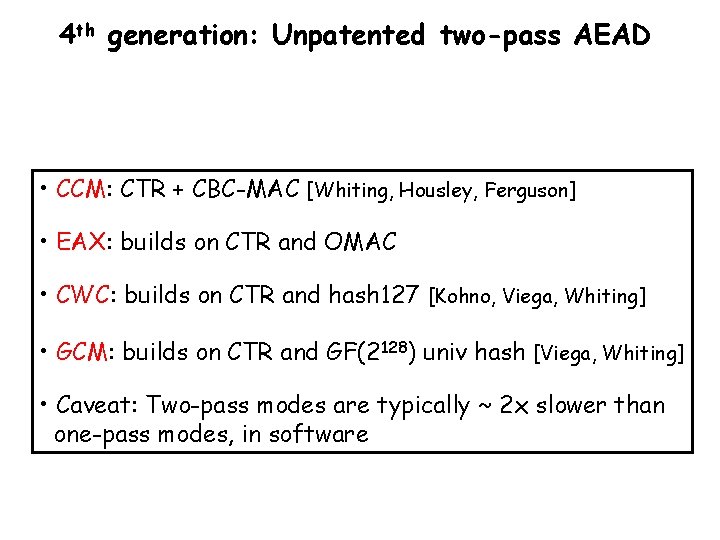
4 th generation: Unpatented two-pass AEAD • CCM: CTR + CBC-MAC [Whiting, Housley, Ferguson] • EAX: builds on CTR and OMAC • CWC: builds on CTR and hash 127 [Kohno, Viega, Whiting] • GCM: builds on CTR and GF(2128) univ hash [Viega, Whiting] • Caveat: Two-pass modes are typically ~ 2 x slower than one-pass modes, in software
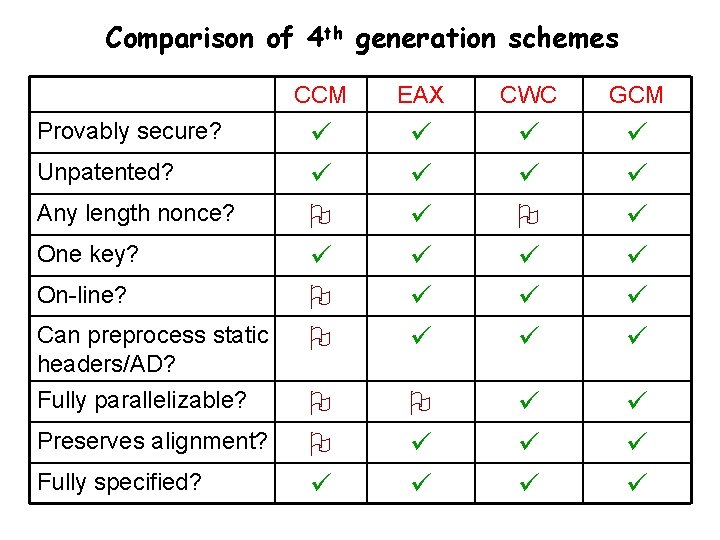
Comparison of 4 th generation schemes Provably secure? Unpatented? Any length nonce? One key? On-line? Can preprocess static headers/AD? Fully parallelizable? Preserves alignment? Fully specified? CCM EAX CWC GCM
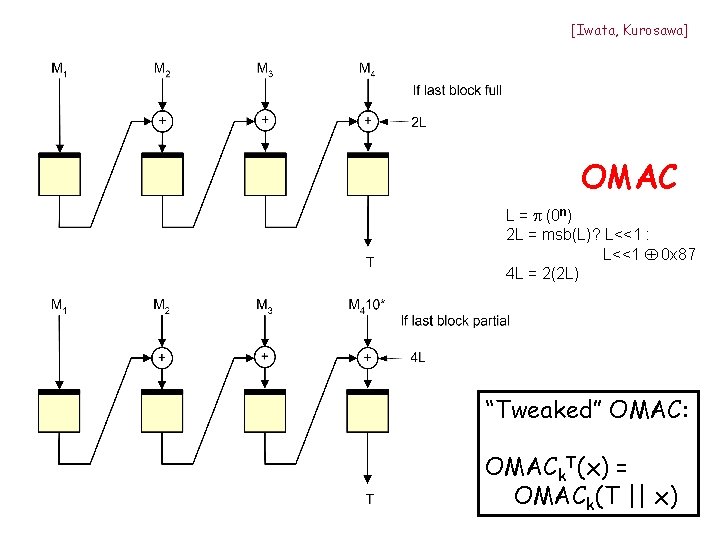
[Iwata, Kurosawa] OMAC L = p (0 n) 2 L = msb(L)? L<<1 : L<<1 Å 0 x 87 4 L = 2(2 L) “Tweaked” OMAC: OMACk. T(x) = OMACk(T || x)
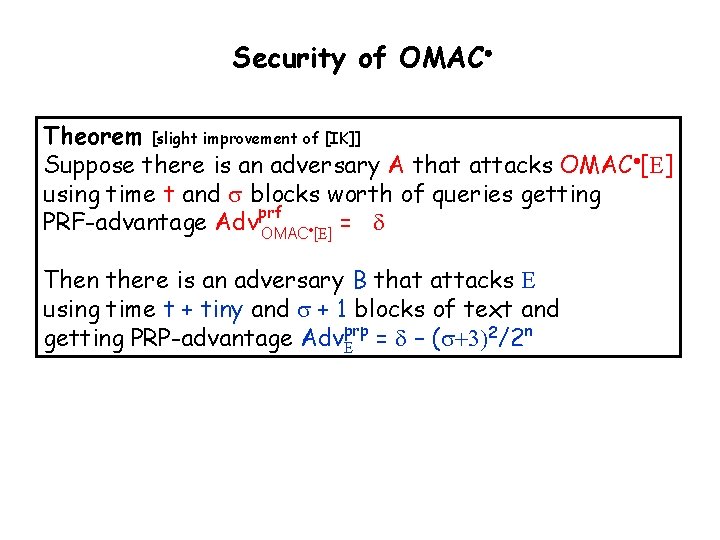
Security of OMAC Theorem [slight improvement of [IK]] Suppose there is an adversary A that attacks OMAC [E] using time t and s blocks worth of queries getting PRF-advantage Advprf = d OMAC [E] Then there is an adversary B that attacks E using time t + tiny and s + 1 blocks of text and 2/2 n getting PRP-advantage Advprp = d – (s+3) E
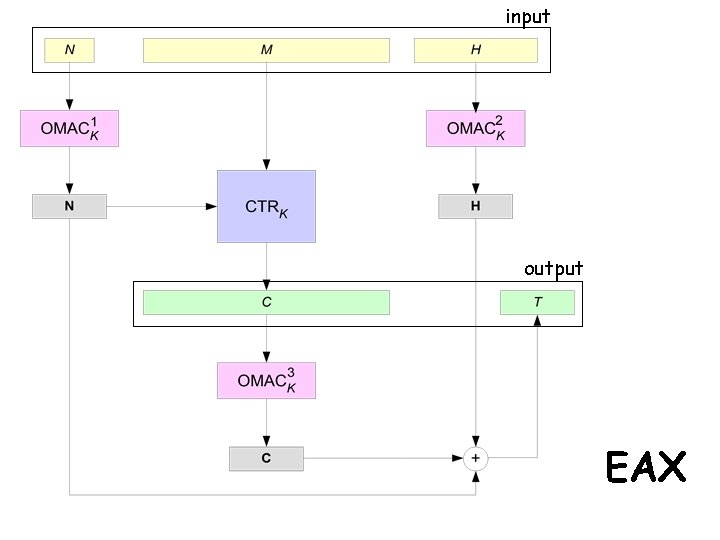
input output EAX
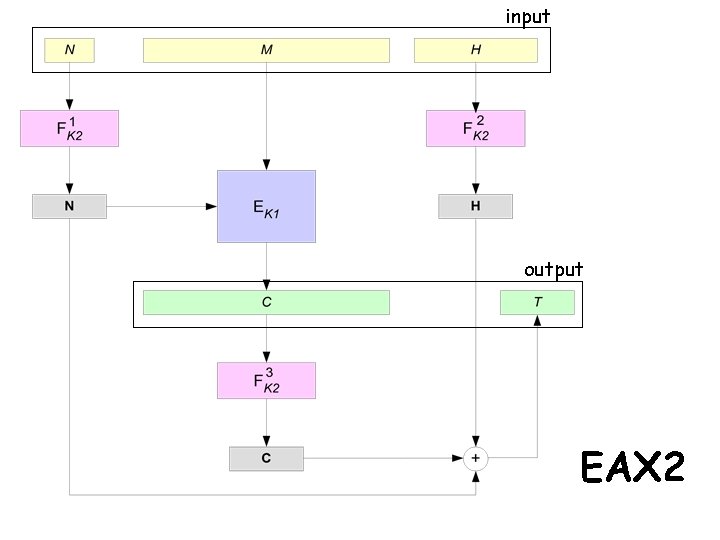
input output EAX 2
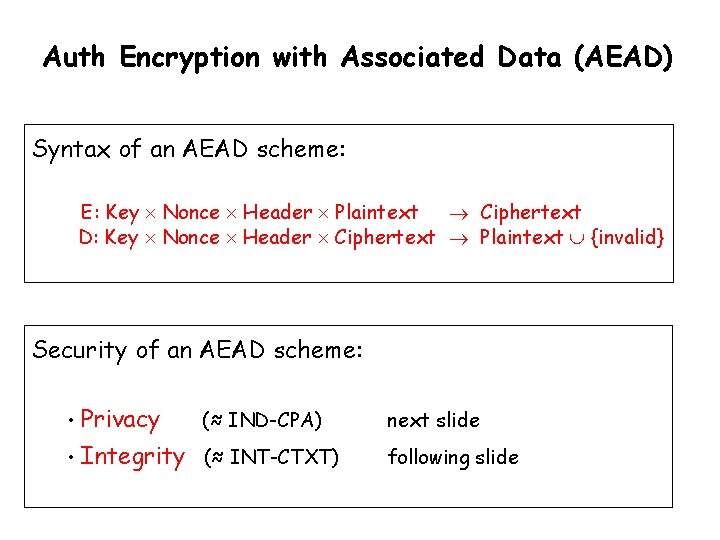
Auth Encryption with Associated Data (AEAD) Syntax of an AEAD scheme: E: Key ´ Nonce ´ Header ´ Plaintext ® Ciphertext D: Key ´ Nonce ´ Header ´ Ciphertext ® Plaintext È {invalid} Security of an AEAD scheme: • Privacy (≈ IND-CPA) • Integrity (≈ INT-CTXT) next slide following slide
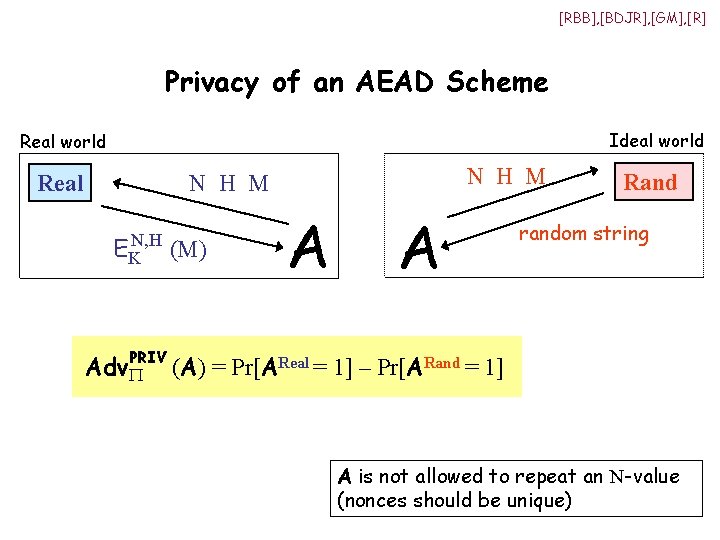
[RBB], [BDJR], [GM], [R] Privacy of an AEAD Scheme Ideal world Real N H M EKN, H (M) A A Rand random string Real = 1] – Pr[ARand = 1] Adv. PRIV (A) = Pr[A P A is not allowed to repeat an N-value (nonces should be unique)
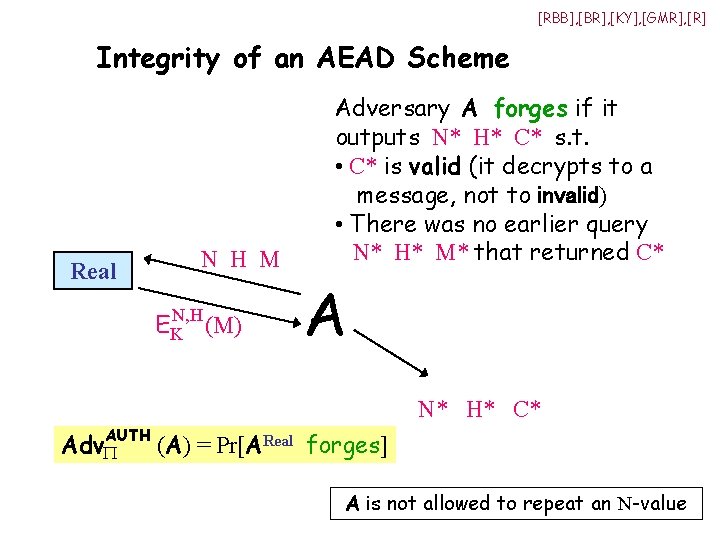
[RBB], [BR], [KY], [GMR], [R] Integrity of an AEAD Scheme Real N H M N, H EK (M) Adversary A forges if it outputs N* H* C* s. t. • C* is valid (it decrypts to a message, not to invalid) • There was no earlier query N* H* M* that returned C* A N* H* C* AUTH Adv. P (A) = Pr[AReal forges] A is not allowed to repeat an N-value
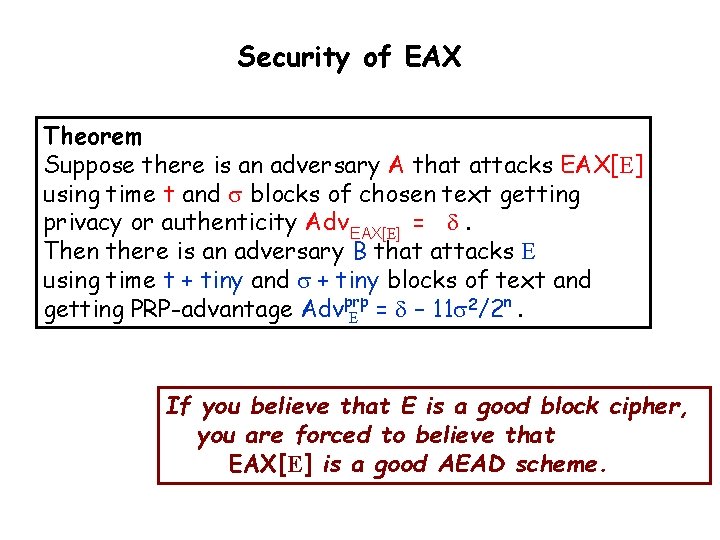
Security of EAX Theorem Suppose there is an adversary A that attacks EAX[E] using time t and s blocks of chosen text getting privacy or authenticity Adv EAX[E] = d. Then there is an adversary B that attacks E using time t + tiny and s + tiny blocks of text and 2/2 n. getting PRP-advantage Advprp = d – 11 s E If you believe that E is a good block cipher, you are forced to believe that EAX[E] is a good AEAD scheme.
Why use EAX? • EAX is secure • Provably secure, if underlying block cipher is secure • Single API for naïve programmers avoids many pitfalls (e. g. , poor IV handling, encrypt without auth, etc. ) • EAX is easy to use • One mode of operation provides everything you need • Nonces need only be non-repeating (don’t need to be random) • Nonces, headers, and messages can be of any bit length • EAX is good for performance • On-line: Can process streaming data on-the-fly • Can pre-process static headers • No encodings, no unaligned operations • Single key minimizes space and key-schedule operations • Caveat: EAX is 2 x slower than IAPM/OCB/XCBC • EAX is unpatented & free for all uses (as far as we know)
Questions?
- Slides: 17