
Eating Disorders Video Link Do You Think Im
- Slides: 14
Eating Disorders Video Link: Do You Think I'm Fat?
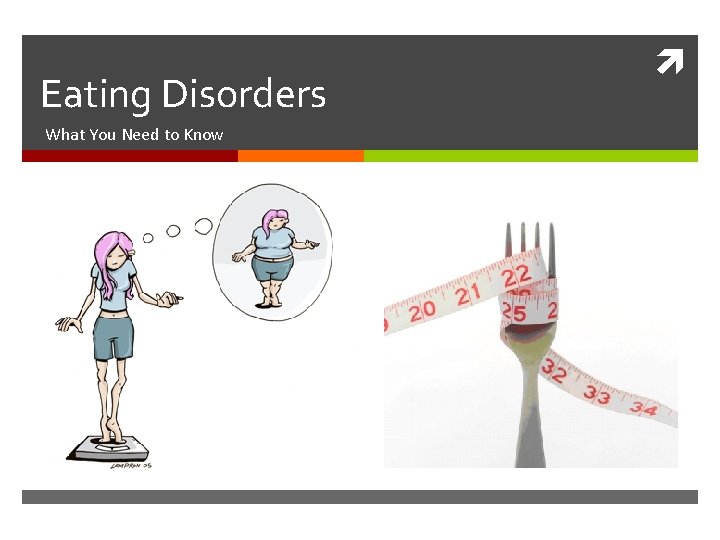
Eating Disorders What You Need to Know
What is an Eating Disorder? food , _______ It’s when a relationship between ______ weight and sometimes _____ exercise begins to take control of your thoughts and perhaps even your life. For some, an eating disorder is caused by using food as a way to deal with bad things that happen in their lives. For others, the eating disorder can stem from thinking that they are not pretty enough, skinny enough, etc. (more on this later). There are 3 main types of eating disorders. Do you know what they are?
Types of Eating Disorders ________: Anorexia (Nervosa) an eating disorder defined by very low body weight and not having realistic expectations of your body (body image). • Anorexics often are afraid to gain weight so they will avoid eating, throw up (purge), and sometimes exercise way too much!
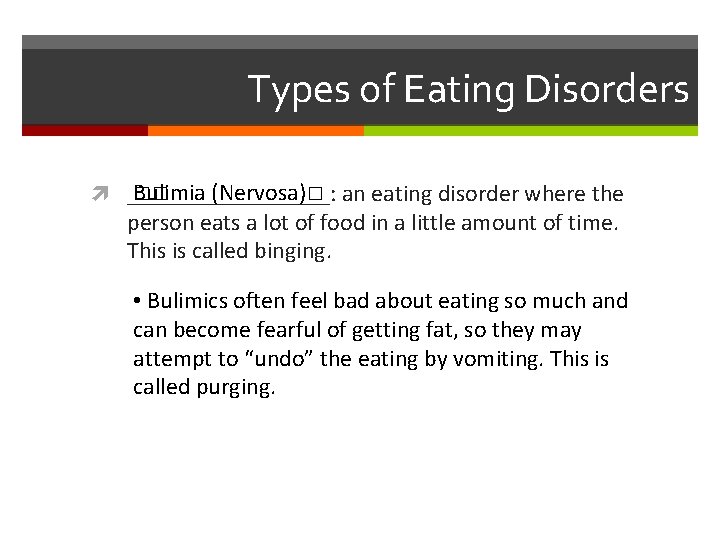
Types of Eating Disorders Bulimia (Nervosa)� an eating disorder where the �� _________: person eats a lot of food in a little amount of time. This is called binging. • Bulimics often feel bad about eating so much and can become fearful of getting fat, so they may attempt to “undo” the eating by vomiting. This is called purging.
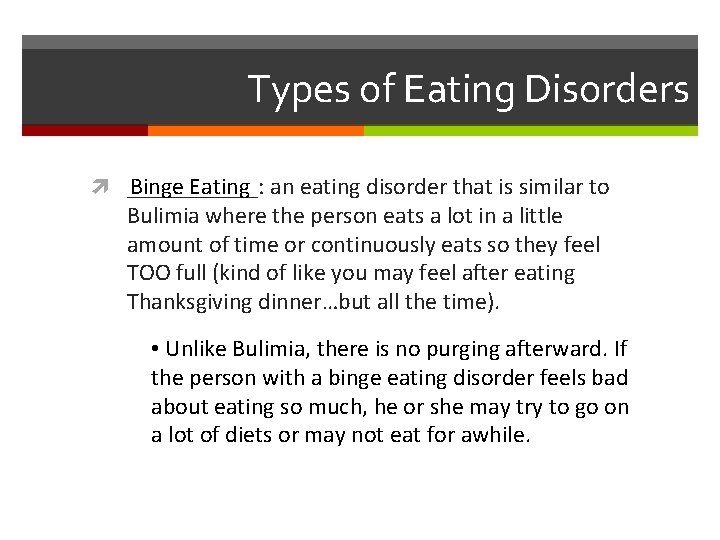
Types of Eating Disorders ______: Binge Eating an eating disorder that is similar to Bulimia where the person eats a lot in a little amount of time or continuously eats so they feel TOO full (kind of like you may feel after eating Thanksgiving dinner…but all the time). • Unlike Bulimia, there is no purging afterward. If the person with a binge eating disorder feels bad about eating so much, he or she may try to go on a lot of diets or may not eat for awhile.
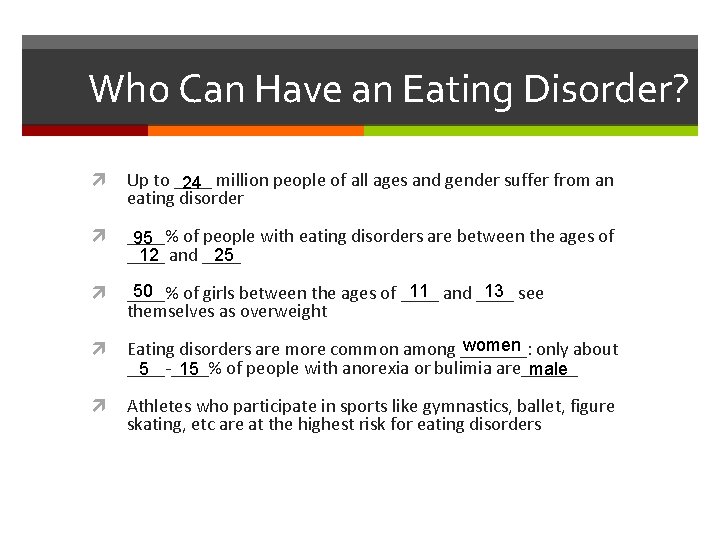
Who Can Have an Eating Disorder? Up to ____ 24 million people of all ages and gender suffer from an eating disorder ____% of people with eating disorders are between the ages of 95 ____ 12 and ____ 25 50 11 and ____ 13 see ____% of girls between the ages of ____ themselves as overweight women only about Eating disorders are more common among _______: ____-____% of people with anorexia or bulimia are______ 5 15 male Athletes who participate in sports like gymnastics, ballet, figure skating, etc are at the highest risk for eating disorders
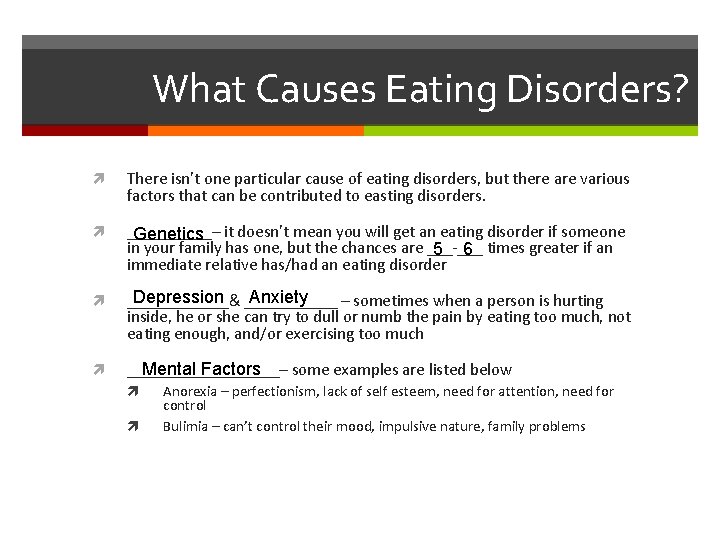
What Causes Eating Disorders? There isn’t one particular cause of eating disorders, but there are various factors that can be contributed to easting disorders. _____– Genetics it doesn’t mean you will get an eating disorder if someone in your family has one, but the chances are ___-___ 5 6 times greater if an immediate relative has/had an eating disorder Depression ______ Anxiety ______& – sometimes when a person is hurting inside, he or she can try to dull or numb the pain by eating too much, not eating enough, and/or exercising too much _________– some examples are listed below Mental Factors Anorexia – perfectionism, lack of self esteem, need for attention, need for control Bulimia – can’t control their mood, impulsive nature, family problems
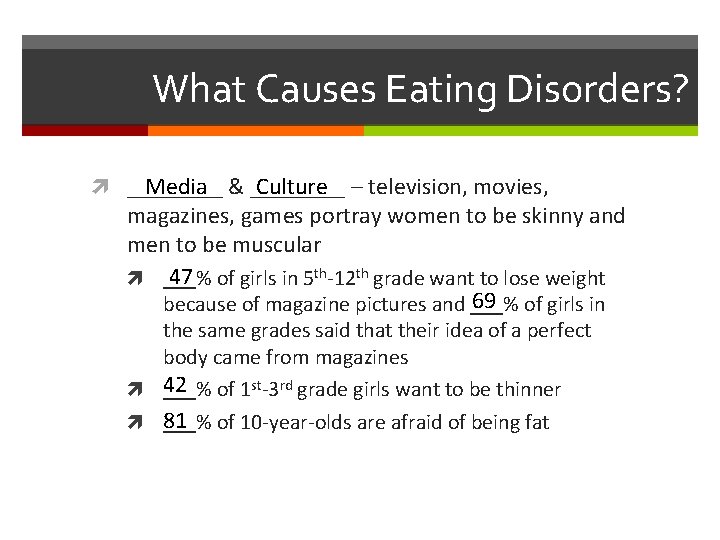
What Causes Eating Disorders? ____ Media & ____ Culture – television, movies, magazines, games portray women to be skinny and men to be muscular 47 of girls in 5 th-12 th grade want to lose weight ___% 69 of girls in because of magazine pictures and ___% the same grades said that their idea of a perfect body came from magazines 42 ___% of 1 st-3 rd grade girls want to be thinner 81 ___% of 10 -year-olds are afraid of being fat
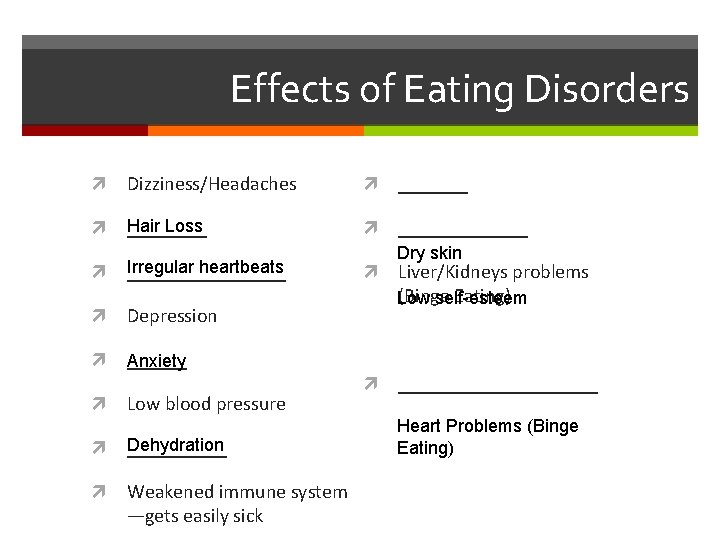
Effects of Eating Disorders Dizziness/Headaches _______ Hair Loss _____________ Irregular heartbeats ________ Depression ______ Anxiety Low blood pressure Dehydration _____ Weakened immune system —gets easily sick Dry skin Liver/Kidneys problems (Binge Eating) Low self-esteem __________ Heart Problems (Binge Eating)
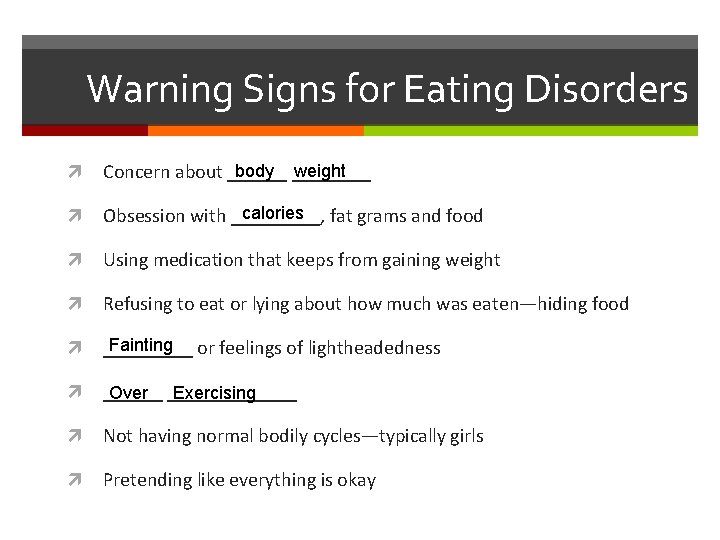
Warning Signs for Eating Disorders body ____ weight Concern about ______ calories fat grams and food Obsession with _____, Using medication that keeps from gaining weight Refusing to eat or lying about how much was eaten—hiding food Fainting or feelings of lightheadedness ______ Over _______ Exercising Not having normal bodily cycles—typically girls Pretending like everything is okay
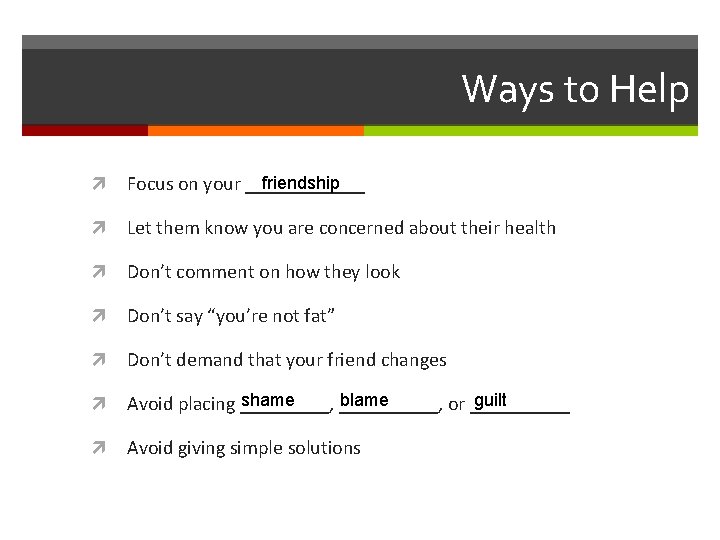
Ways to Help friendship Focus on your ______ Let them know you are concerned about their health Don’t comment on how they look Don’t say “you’re not fat” Don’t demand that your friend changes shame blame guilt Avoid placing _____, or _____ Avoid giving simple solutions
Relate Back to Our School Talk with a Teacher or one of us (Counselors) Know where to go…
Resources NEDIC (National Eating Disorder Information Center) http: //www. nedic. ca/index. shtml ANAD (National Association of Anorexia Nervosa and Associated Disorders) http: //www. anad. org/get-information/about-eating- disorders/