
Eating Competence in FirstGeneration Students at a Large
- Slides: 1
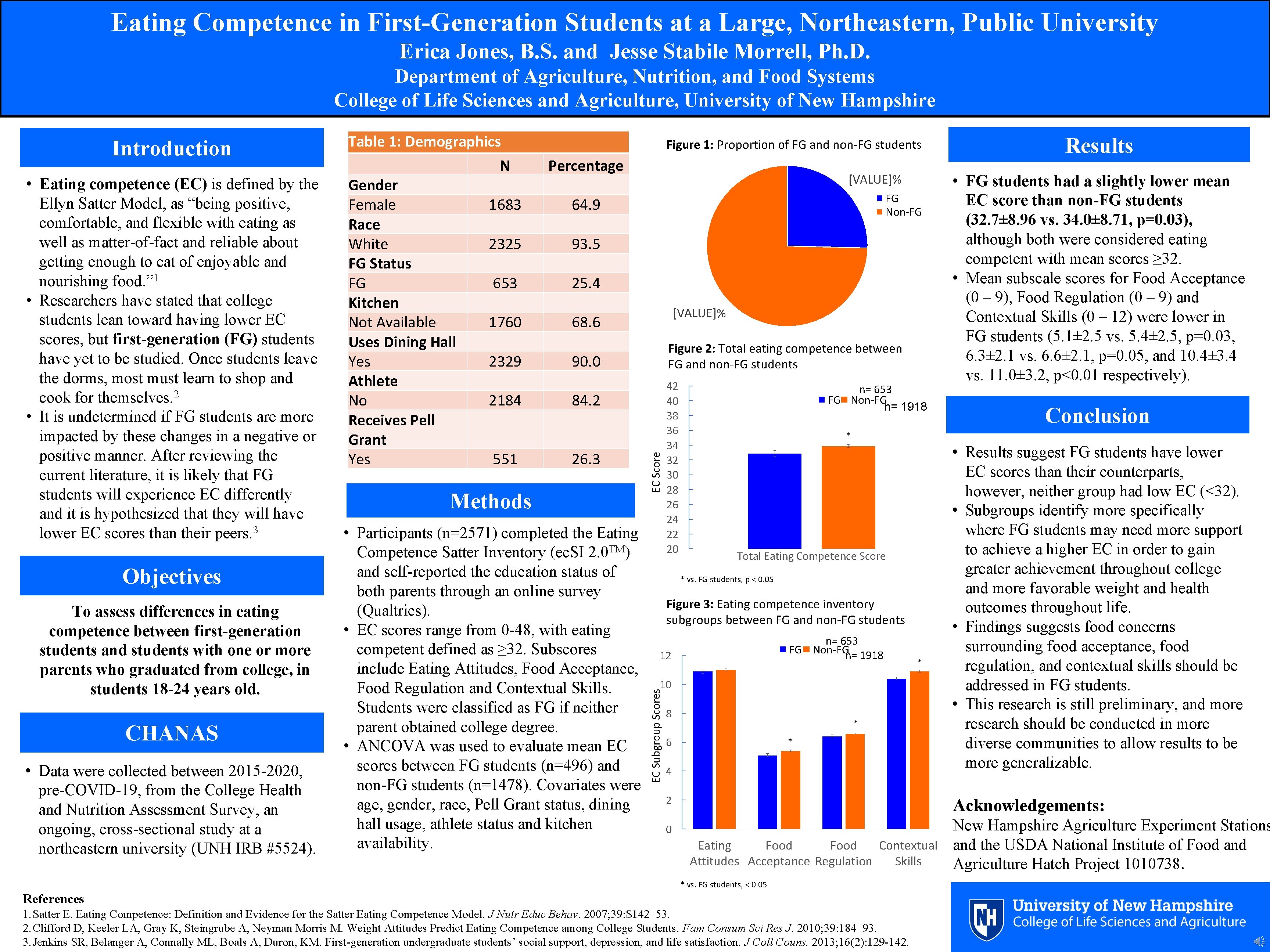
Eating Competence in First-Generation Students at a Large, Northeastern, Public University Erica Jones, B. S. and Jesse Stabile Morrell, Ph. D. Department of Agriculture, Nutrition, and Food Systems College of Life Sciences and Agriculture, University of New Hampshire Objectives To assess differences in eating competence between first-generation students and students with one or more parents who graduated from college, in students 18 -24 years old. CHANAS • Data were collected between 2015 -2020, pre-COVID-19, from the College Health and Nutrition Assessment Survey, an ongoing, cross-sectional study at a northeastern university (UNH IRB #5524). Gender Female Race White FG Status FG Kitchen Not Available Uses Dining Hall Yes Athlete No Receives Pell Grant Yes Percentage 1683 64. 9 2325 93. 5 653 25. 4 1760 2329 2184 551 [VALUE]% FG Non-FG [VALUE]% 68. 6 Figure 2: Total eating competence between FG and non-FG students 90. 0 84. 2 26. 3 Methods • Participants (n=2571) completed the Eating Competence Satter Inventory (ec. SI 2. 0 TM) and self-reported the education status of both parents through an online survey (Qualtrics). • EC scores range from 0 -48, with eating competent defined as ≥ 32. Subscores include Eating Attitudes, Food Acceptance, Food Regulation and Contextual Skills. Students were classified as FG if neither parent obtained college degree. • ANCOVA was used to evaluate mean EC scores between FG students (n=496) and non-FG students (n=1478). Covariates were age, gender, race, Pell Grant status, dining hall usage, athlete status and kitchen availability. EC Score • Eating competence (EC) is defined by the Ellyn Satter Model, as “being positive, comfortable, and flexible with eating as well as matter-of-fact and reliable about getting enough to eat of enjoyable and nourishing food. ” 1 • Researchers have stated that college students lean toward having lower EC scores, but first-generation (FG) students have yet to be studied. Once students leave the dorms, most must learn to shop and cook for themselves. 2 • It is undetermined if FG students are more impacted by these changes in a negative or positive manner. After reviewing the current literature, it is likely that FG students will experience EC differently and it is hypothesized that they will have lower EC scores than their peers. 3 N Figure 1: Proportion of FG and non-FG students 42 40 38 36 34 32 30 28 26 24 22 20 n= 653 FG Non-FG n= 1918 Total Eating Competence Score Figure 3: Eating competence inventory subgroups between FG and non-FG students n= 653 FG Non-FGn= 1918 12 10 8 * 6 * 4 2 0 Results • FG students had a slightly lower mean EC score than non-FG students (32. 7± 8. 96 vs. 34. 0± 8. 71, p=0. 03), although both were considered eating competent with mean scores ≥ 32. • Mean subscale scores for Food Acceptance (0 – 9), Food Regulation (0 – 9) and Contextual Skills (0 – 12) were lower in FG students (5. 1± 2. 5 vs. 5. 4± 2. 5, p=0. 03, 6. 3± 2. 1 vs. 6. 6± 2. 1, p=0. 05, and 10. 4± 3. 4 vs. 11. 0± 3. 2, p<0. 01 respectively). Conclusion * * vs. FG students, p < 0. 05 EC Subgroup Scores Introduction Table 1: Demographics * • Results suggest FG students have lower EC scores than their counterparts, however, neither group had low EC (<32). • Subgroups identify more specifically where FG students may need more support to achieve a higher EC in order to gain greater achievement throughout college and more favorable weight and health outcomes throughout life. • Findings suggests food concerns surrounding food acceptance, food regulation, and contextual skills should be addressed in FG students. • This research is still preliminary, and more research should be conducted in more diverse communities to allow results to be more generalizable. Acknowledgements: New Hampshire Agriculture Experiment Stations Eating Food Contextual and the USDA National Institute of Food and Attitudes Acceptance Regulation Skills Agriculture Hatch Project 1010738. * vs. FG students, < 0. 05 References 1. Satter E. Eating Competence: Definition and Evidence for the Satter Eating Competence Model. J Nutr Educ Behav. 2007; 39: S 142– 53. 2. Clifford D, Keeler LA, Gray K, Steingrube A, Neyman Morris M. Weight Attitudes Predict Eating Competence among College Students. Fam Consum Sci Res J. 2010; 39: 184– 93. 3. Jenkins SR, Belanger A, Connally ML, Boals A, Duron, KM. First-generation undergraduate students’ social support, depression, and life satisfaction. J Coll Couns. 2013; 16(2): 129 -142.