
Easy use of Distributed Tensor Flow Training on
Easy use of Distributed Tensor. Flow Training on supercomputing facilities Gonzalo Ferro, CESGA gferro@cesga. es IBERGRID 2018: Towards the European Open Science Cloud – EOSC. 11 th - 12 th October. Lisbon, ISCTE - University Institute of Lisbon (ISCTE-IUL) Fortissimo has received funding from the European Union’s H 2020 research and innovation programme under grant agreement No 680481
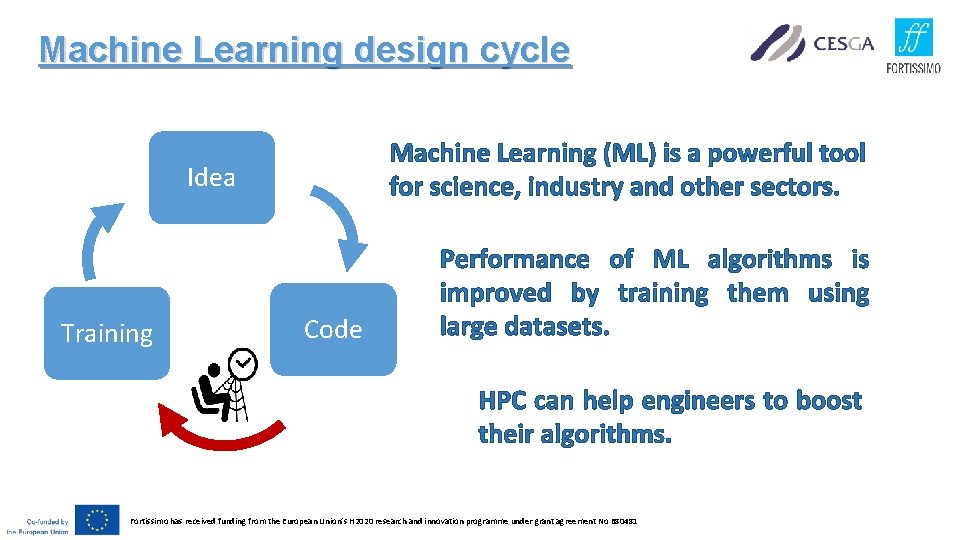
Machine Learning design cycle Machine Learning (ML) is a powerful tool for science, industry and other sectors. Idea Training Code Performance of ML algorithms is improved by training them using large datasets. HPC can help engineers to boost their algorithms. Fortissimo has received funding from the European Union’s H 2020 research and innovation programme under grant agreement No 680481
How exploit HPC for ML training? • Simultaneous Training. • Parallel Distributed Training. • Simultaneous + Parallel Distributed. Fortissimo has received funding from the European Union’s H 2020 research and innovation programme under grant agreement No 680481
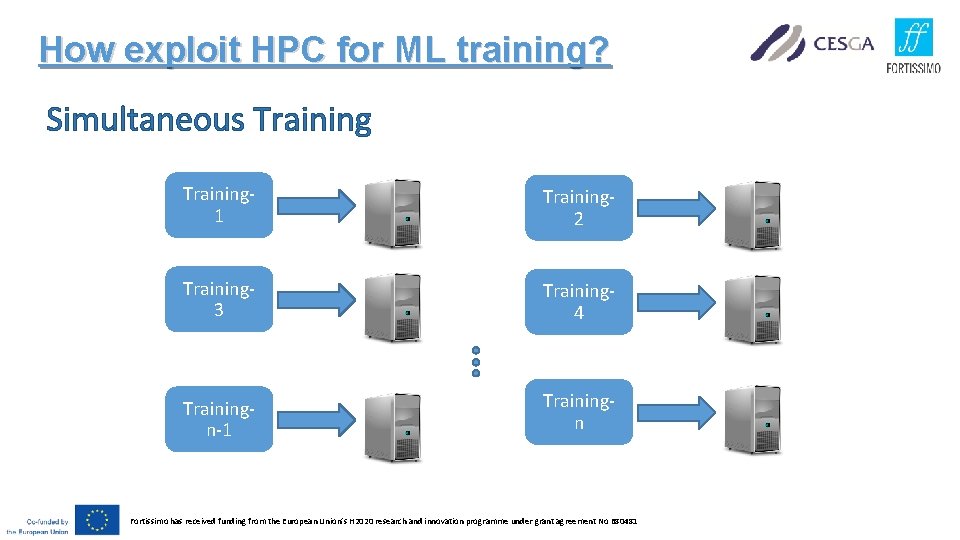
How exploit HPC for ML training? Simultaneous Training 1 Training 2 Training 3 Training 4 Trainingn-1 Trainingn Fortissimo has received funding from the European Union’s H 2020 research and innovation programme under grant agreement No 680481
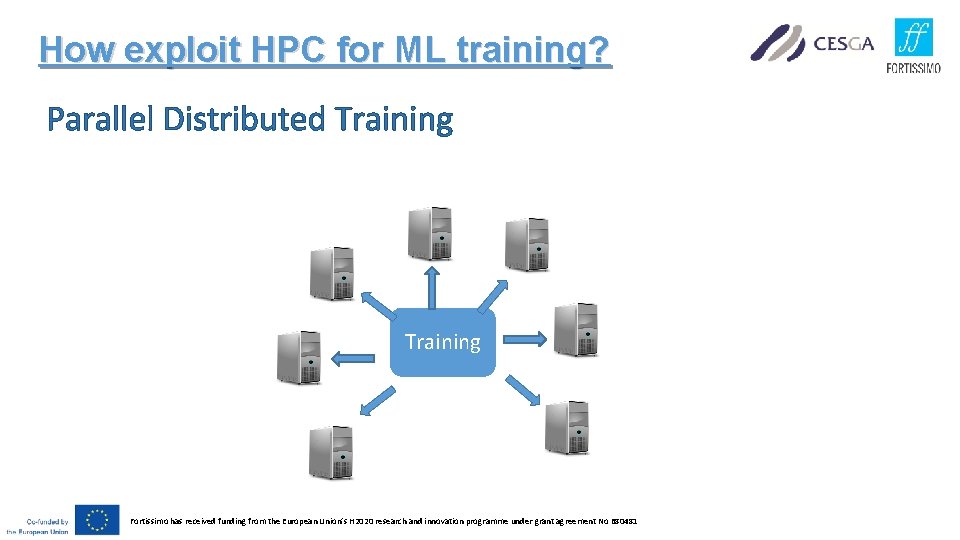
How exploit HPC for ML training? Parallel Distributed Training Fortissimo has received funding from the European Union’s H 2020 research and innovation programme under grant agreement No 680481
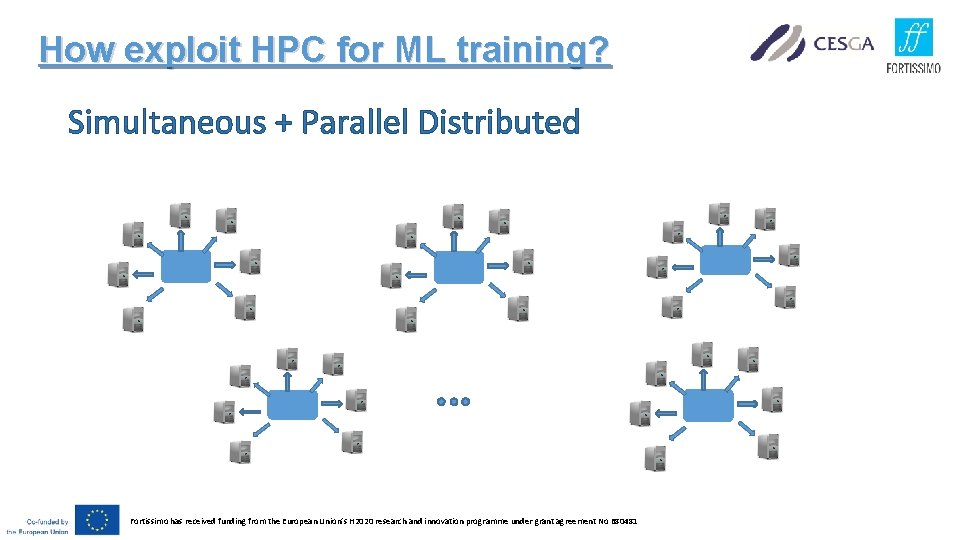
How exploit HPC for ML training? Simultaneous + Parallel Distributed Fortissimo has received funding from the European Union’s H 2020 research and innovation programme under grant agreement No 680481
How exploit HPC for ML training? • Simultaneous Training • Parallel Distributed Training • Simultaneous + Parallel Distributed Fortissimo has received funding from the European Union’s H 2020 research and innovation programme under grant agreement No 680481
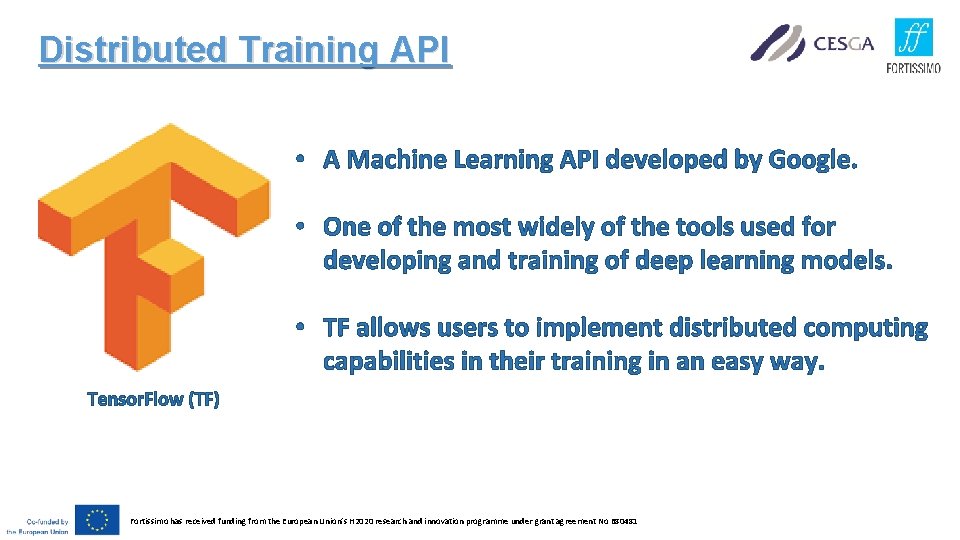
Distributed Training API • A Machine Learning API developed by Google. • One of the most widely of the tools used for developing and training of deep learning models. • TF allows users to implement distributed computing capabilities in their training in an easy way. Tensor. Flow (TF) Fortissimo has received funding from the European Union’s H 2020 research and innovation programme under grant agreement No 680481
Distributed Training API • A Machine Learning API developed by Google. • One of the most widely of the tools used for developing and training of deep learning models. • TF allows users to implement distributed computing capabilities in their training in an easy way. Tensor. Flow (TF) Fortissimo has received funding from the European Union’s H 2020 research and innovation programme under grant agreement No 680481
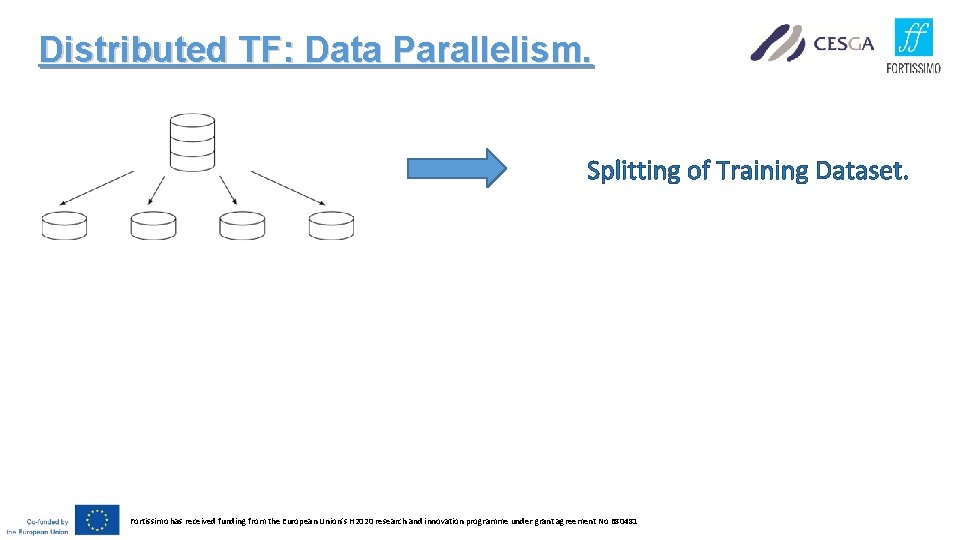
Distributed TF: Data Parallelism. Splitting of Training Dataset. Fortissimo has received funding from the European Union’s H 2020 research and innovation programme under grant agreement No 680481
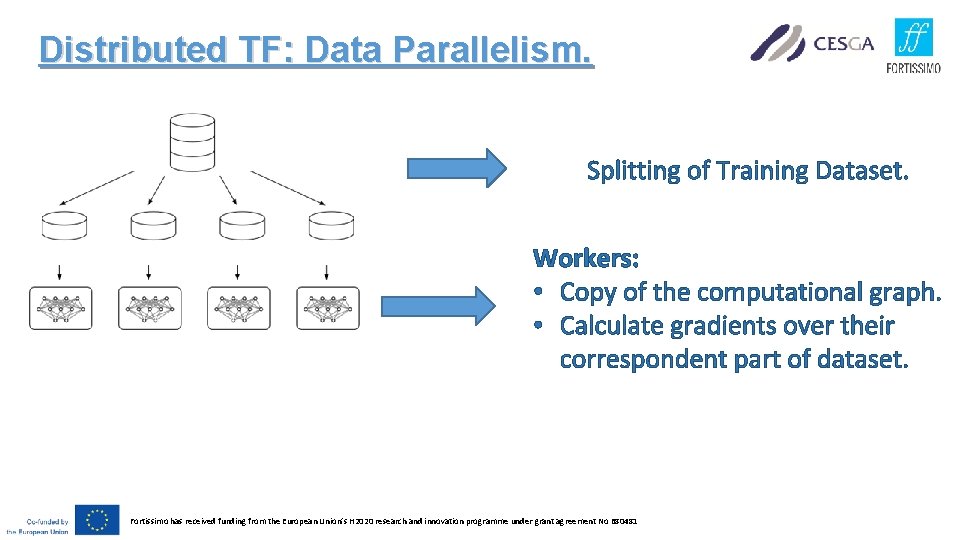
Distributed TF: Data Parallelism. Splitting of Training Dataset. Workers: • Copy of the computational graph. • Calculate gradients over their correspondent part of dataset. Fortissimo has received funding from the European Union’s H 2020 research and innovation programme under grant agreement No 680481
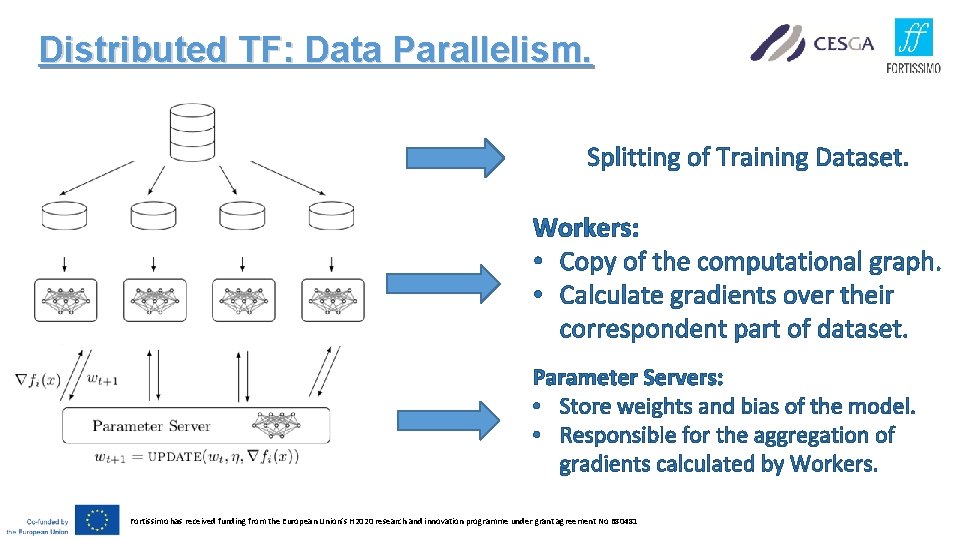
Distributed TF: Data Parallelism. Splitting of Training Dataset. Workers: • Copy of the computational graph. • Calculate gradients over their correspondent part of dataset. Parameter Servers: • Store weights and bias of the model. • Responsible for the aggregation of gradients calculated by Workers. Fortissimo has received funding from the European Union’s H 2020 research and innovation programme under grant agreement No 680481
Distributed TF: Queue system issues. Distributed TF is based on communication protocol called g. RPC. Fortissimo has received funding from the European Union’s H 2020 research and innovation programme under grant agreement No 680481
Distributed TF: Queue system issues. Distributed TF is based on communication protocol called g. RPC. CESGA Finis Terrae II (FT 2) uses Slurm for Resource Management. Fortissimo has received funding from the European Union’s H 2020 research and innovation programme under grant agreement No 680481
Distributed TF: Queue system issues. Distributed TF is based on communication protocol called g. RPC. CESGA Finis Terrae II (FT 2) uses Slurm for Resource Management. • Detected issues when deploying Distributed TF on FT 2: Fortissimo has received funding from the European Union’s H 2020 research and innovation programme under grant agreement No 680481
Distributed TF: Queue system issues. Distributed TF is based on communication protocol called g. RPC. CESGA Finis Terrae II (FT 2) uses Slurm for Resource Management. • Detected issues when deploying Distributed TF on FT 2: 1. Distributed TF needs Network Addresses (IP: Port) in advance. Fortissimo has received funding from the European Union’s H 2020 research and innovation programme under grant agreement No 680481
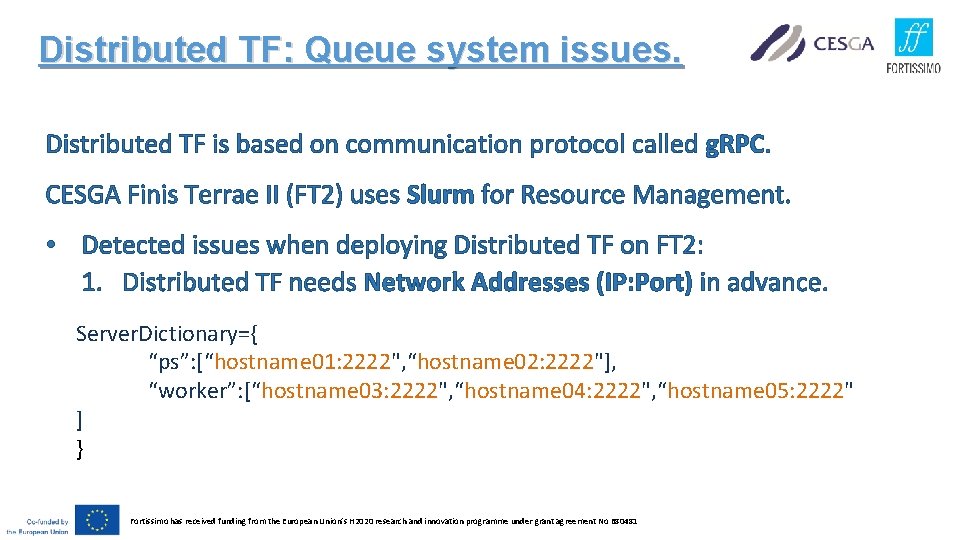
Distributed TF: Queue system issues. Distributed TF is based on communication protocol called g. RPC. CESGA Finis Terrae II (FT 2) uses Slurm for Resource Management. • Detected issues when deploying Distributed TF on FT 2: 1. Distributed TF needs Network Addresses (IP: Port) in advance. Server. Dictionary={ “ps”: [“hostname 01: 2222", “hostname 02: 2222"], “worker”: [“hostname 03: 2222", “hostname 04: 2222", “hostname 05: 2222" ] } Fortissimo has received funding from the European Union’s H 2020 research and innovation programme under grant agreement No 680481
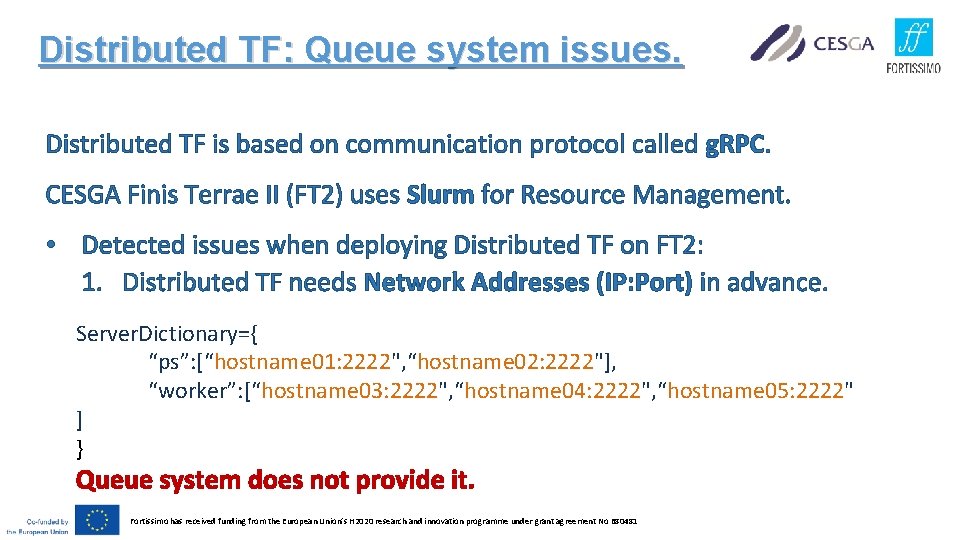
Distributed TF: Queue system issues. Distributed TF is based on communication protocol called g. RPC. CESGA Finis Terrae II (FT 2) uses Slurm for Resource Management. • Detected issues when deploying Distributed TF on FT 2: 1. Distributed TF needs Network Addresses (IP: Port) in advance. Server. Dictionary={ “ps”: [“hostname 01: 2222", “hostname 02: 2222"], “worker”: [“hostname 03: 2222", “hostname 04: 2222", “hostname 05: 2222" ] } Queue system does not provide it. Fortissimo has received funding from the European Union’s H 2020 research and innovation programme under grant agreement No 680481
Distributed TF: Queue system issues. Distributed TF is based on communication protocol called g. RPC. CESGA Finis Terrae II (FT 2) uses Slurm for Resource Management. • Detected issues when deploying Distributed TF on FT 2: 1. Distributed TF needs Network Addresses (IP: Port) in advance. Queue system does not provide it. 2. Distributed TF Parameter Servers run forever. Fortissimo has received funding from the European Union’s H 2020 research and innovation programme under grant agreement No 680481
Distributed TF: Queue system issues. Distributed TF is based on communication protocol called g. RPC. CESGA Finis Terrae II (FT 2) uses Slurm for Resource Management. • Detected issues when deploying Distributed TF on FT 2: 1. Distributed TF needs Network Addresses (IP: Port) in advance. Queue system does not provide it. 2. Distributed TF Parameter Servers run forever. HPC Resources are wasted. User or Queue system have to stop them. Fortissimo has received funding from the European Union’s H 2020 research and innovation programme under grant agreement No 680481
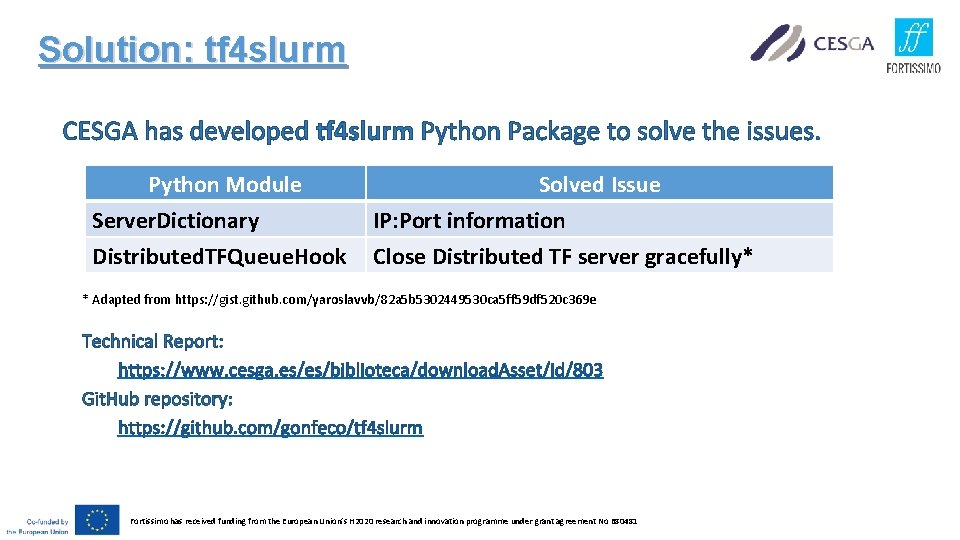
Solution: tf 4 slurm CESGA has developed tf 4 slurm Python Package to solve the issues. Python Module Server. Dictionary Distributed. TFQueue. Hook Solved Issue IP: Port information Close Distributed TF server gracefully* * Adapted from https: //gist. github. com/yaroslavvb/82 a 5 b 5302449530 ca 5 ff 59 df 520 c 369 e Technical Report: https: //www. cesga. es/es/biblioteca/download. Asset/id/803 Git. Hub repository: https: //github. com/gonfeco/tf 4 slurm Fortissimo has received funding from the European Union’s H 2020 research and innovation programme under grant agreement No 680481
tf 4 slurm: test with an Industrial Case Fortissimo H 2020 Project Experiment 707: Cyber-Physical Laser Metal Deposition (Cy. PLAM) Fortissimo has received funding from the European Union’s H 2020 research and innovation programme under grant agreement No 680481
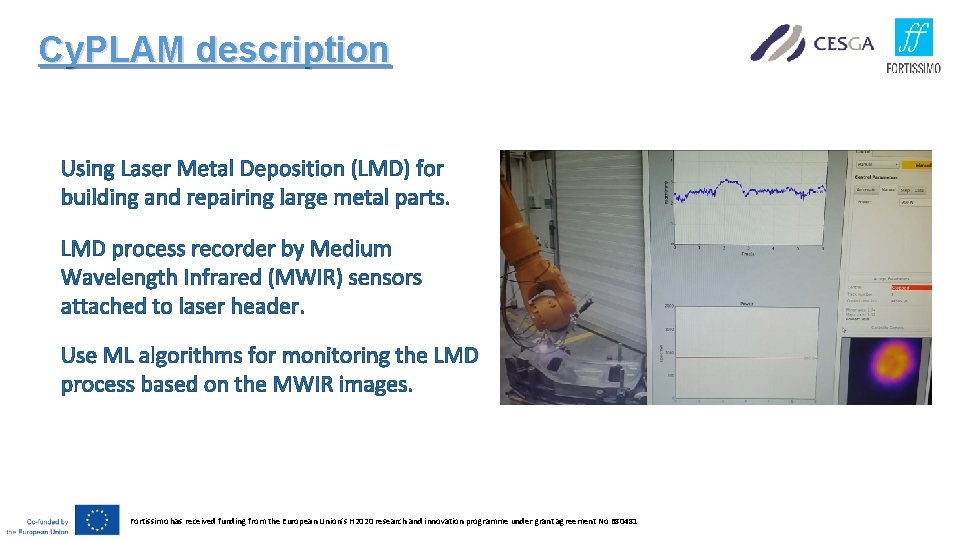
Cy. PLAM description Using Laser Metal Deposition (LMD) for building and repairing large metal parts. LMD process recorder by Medium Wavelength Infrared (MWIR) sensors attached to laser header. Use ML algorithms for monitoring the LMD process based on the MWIR images. Fortissimo has received funding from the European Union’s H 2020 research and innovation programme under grant agreement No 680481
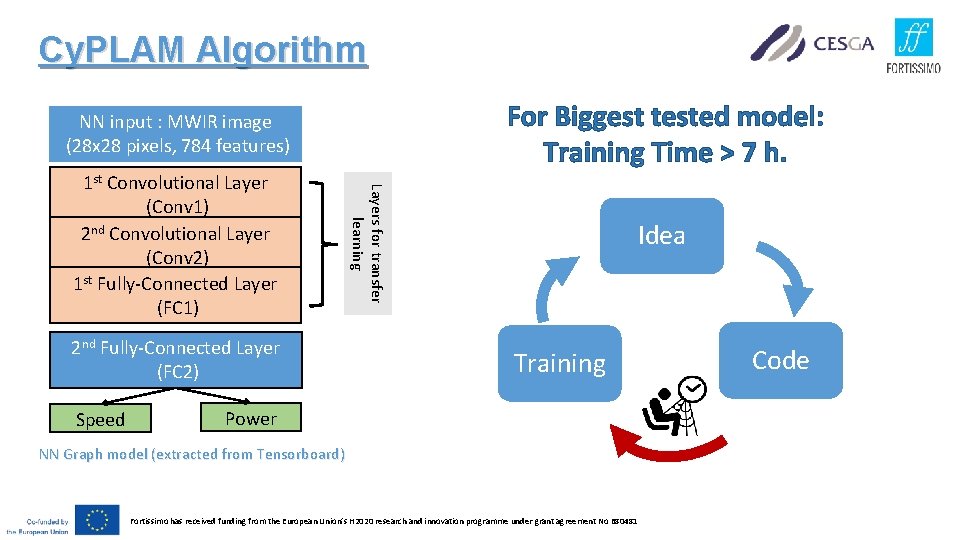
Cy. PLAM Algorithm For Biggest tested model: Training Time > 7 h. NN input : MWIR image (28 x 28 pixels, 784 features) 2 nd Fully-Connected Layer (FC 2) Speed Layers for transfer learning 1 st Convolutional Layer (Conv 1) 2 nd Convolutional Layer (Conv 2) 1 st Fully-Connected Layer (FC 1) Idea Training Power NN Graph model (extracted from Tensorboard) Fortissimo has received funding from the European Union’s H 2020 research and innovation programme under grant agreement No 680481 Code
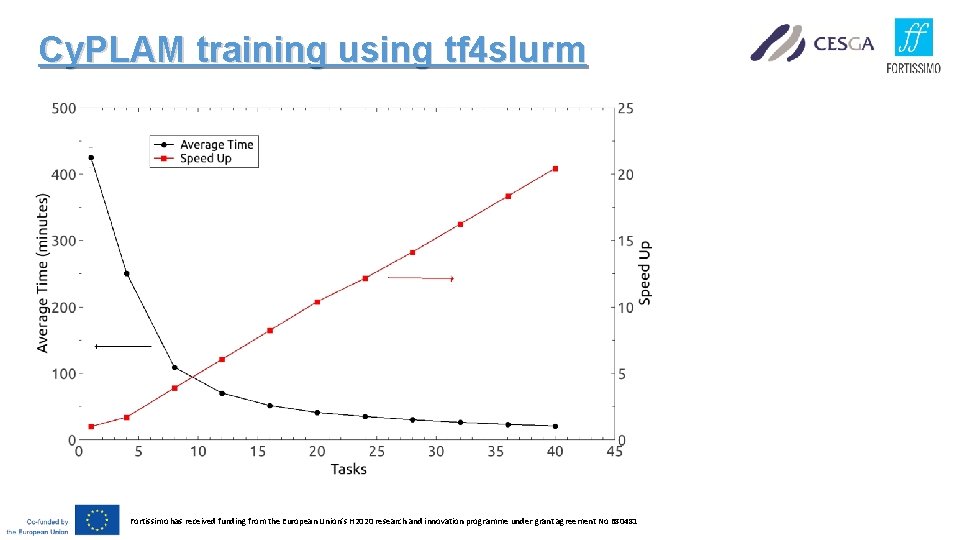
Cy. PLAM training using tf 4 slurm Fortissimo has received funding from the European Union’s H 2020 research and innovation programme under grant agreement No 680481
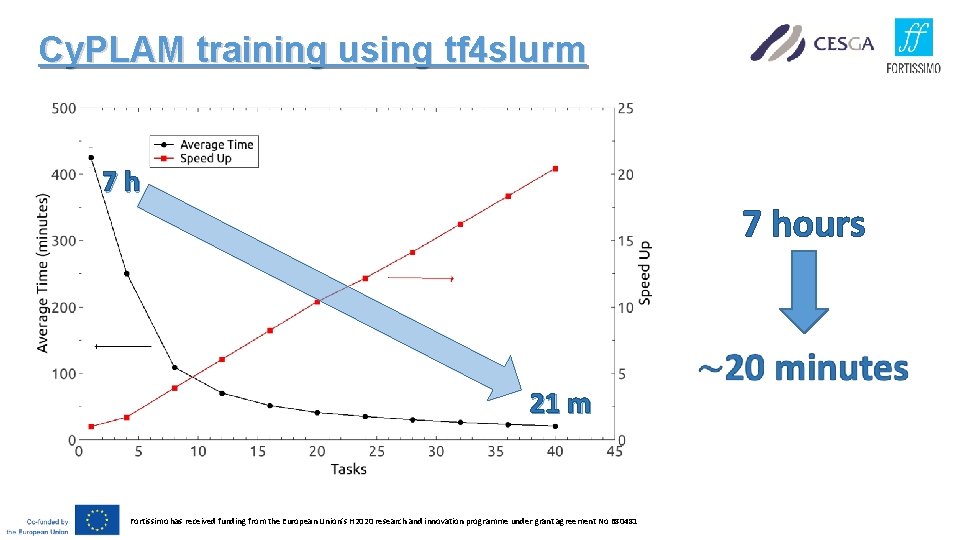
Cy. PLAM training using tf 4 slurm 7 h 7 hours 21 m Fortissimo has received funding from the European Union’s H 2020 research and innovation programme under grant agreement No 680481
Summary and Conclusions. • Several issues deploying Distributed Tensor. Flow on CESGA Finis Terrae II were detected: o Queue system does not provide mandatory IP: Port information in advance. o HPC Resources are wasted due to Parameter Servers running forever. • tf 4 slurm Python Package was developed to solve these detected issues. • tf 4 slurm was tested using an Industrial Case: o Largest training reduced from 7 hours to near 20 minutes. • HPC can greatly decrease the design time of ML algorithms boosting productivity. Fortissimo has received funding from the European Union’s H 2020 research and innovation programme under grant agreement No 680481
THANKS FOR YOUR ATTENTION !!! Technical Report: • https: //www. cesga. es/es/biblioteca/download. Asset/id/803 Git. Hub repository: • https: //github. com/gonfeco/tf 4 slurm Fortissimo has received funding from the European Union’s H 2020 research and innovation programme under grant agreement No 680481
- Slides: 28