
Eastern Carolina Council New Bern NC Utility Scale
Eastern Carolina Council New Bern, NC Utility Scale Solar Facilities February 13, 2020
NC Clean Energy Technology Center Major Program Areas: • • Renewable Energy Clean Power & Efficiency Clean Transportation Green Building • • Economic Development Energy Policy Workforce Development Education & Outreach • Created in 1988, operated by the College of Engineering at N. C. State University • Funded by the General Assembly though the state Department of Environmental Quality; plus federal and state grants, foundations, and service fees for consulting • Primary mission is to advance a sustainable energy economy by educating, demonstrating and providing support for clean energy technologies, practices, and policies

The Basics – NC’s Successful Solar Market What got us here?
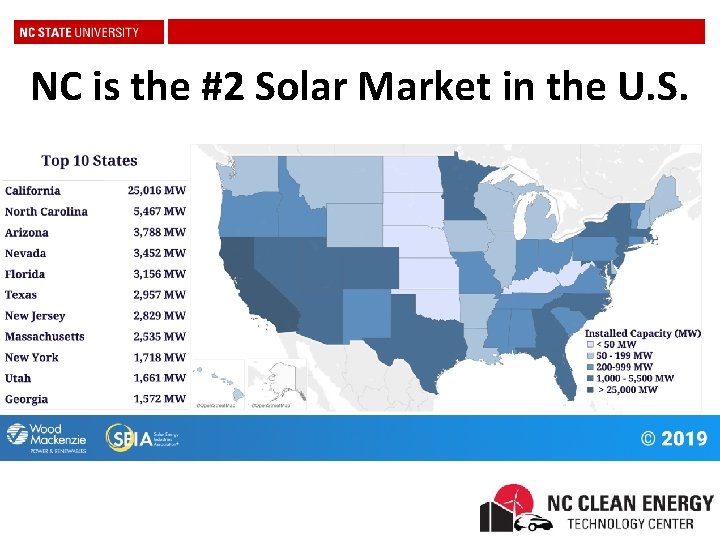
NC is the #2 Solar Market in the U. S.

Geographic Distribution Installed Solar in NC as of March 2018 Source: https: //energync. org/maps/ on March 18, 2018.
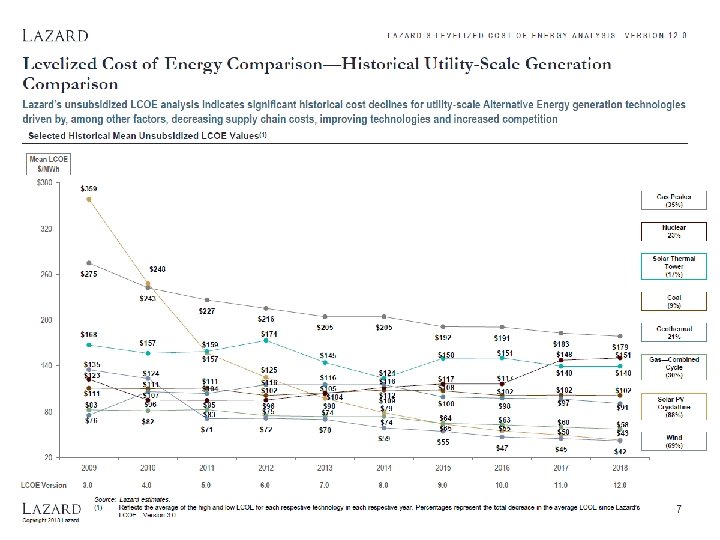
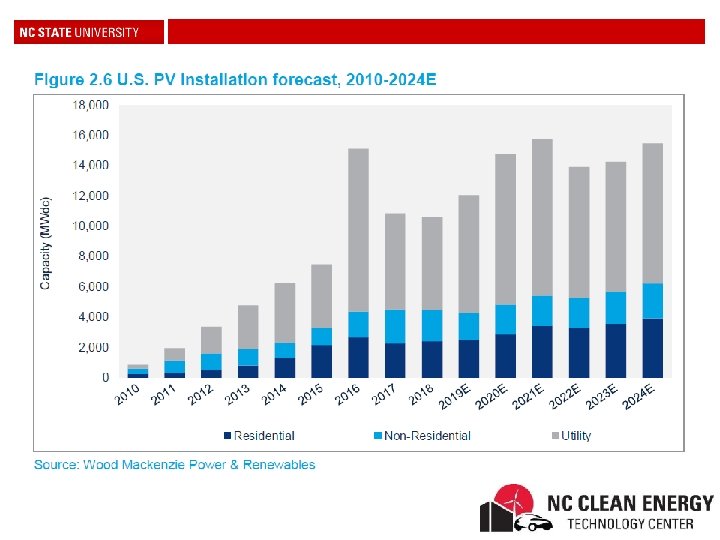
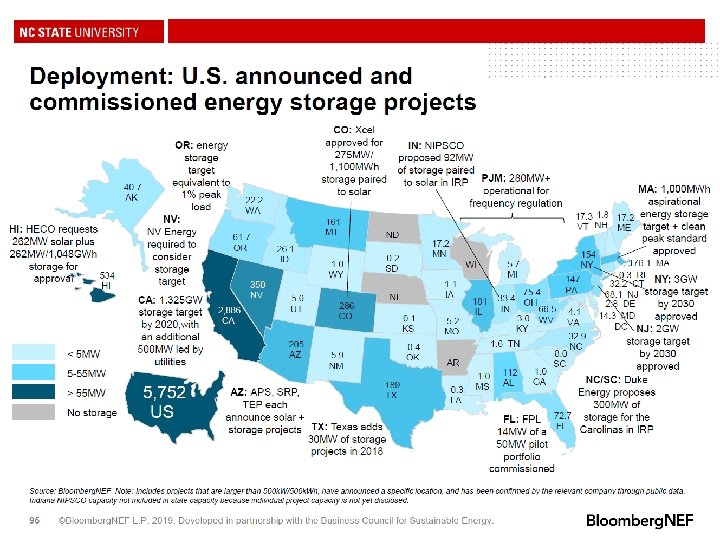
So What Drives Market Growth? • Costs continue to fall for solar and storage technologies • Scale continues to increase = falling prices • Consumer support (and demand) remains strong • Policy is supportive although trending toward normalization (incentives, IRP, RPS, etc. ) • Technology Convergence
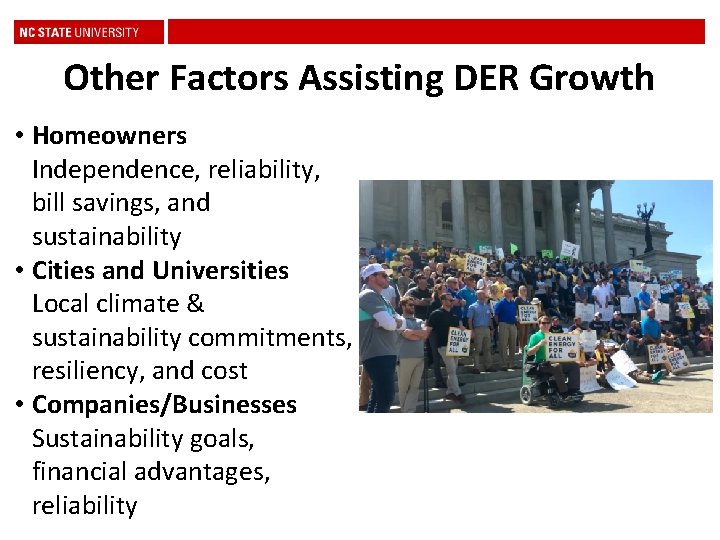
Other Factors Assisting DER Growth • Homeowners Independence, reliability, bill savings, and sustainability • Cities and Universities Local climate & sustainability commitments, resiliency, and cost • Companies/Businesses Sustainability goals, financial advantages, reliability
NC Solar Policy Drivers • NC Renewable Energy Tax Credit See www. dsireusa. org for more information on incentives • Tax credit of 35% of system cost, needs NC tax liability to use, taxable at federal level • Expired in Dec 2015 • Federal Investment Tax Credit (ITC) • Tax credit of 26% of system cost, droping from 30% to 10% by Dec 2022 • 15 -year Fixed Price Utility Power Purchase Agreements (PPA) • Federal law (PURPA) requires utilities to purchase renewable electricity, state utilities commission sets rules such as length of PPA contract, FP only available for up to 5 MW • Mostly eliminated by HB 589 in 2018 – Replaced with CPRE competitive procurement • NC REPS Law in 2007, with solar carve-out • Solar requirements fully met well in advance • 80% Property Tax abatement
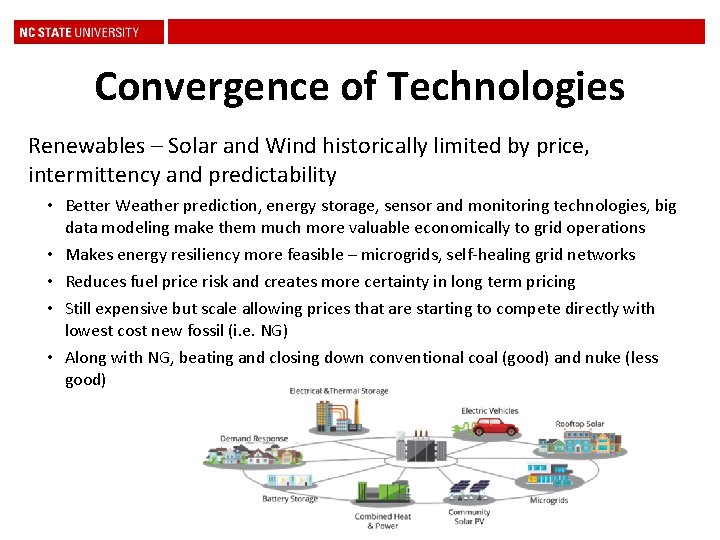
Convergence of Technologies Renewables – Solar and Wind historically limited by price, intermittency and predictability • Better Weather prediction, energy storage, sensor and monitoring technologies, big data modeling make them much more valuable economically to grid operations • Makes energy resiliency more feasible – microgrids, self-healing grid networks • Reduces fuel price risk and creates more certainty in long term pricing • Still expensive but scale allowing prices that are starting to compete directly with lowest cost new fossil (i. e. NG) • Along with NG, beating and closing down conventional coal (good) and nuke (less good)
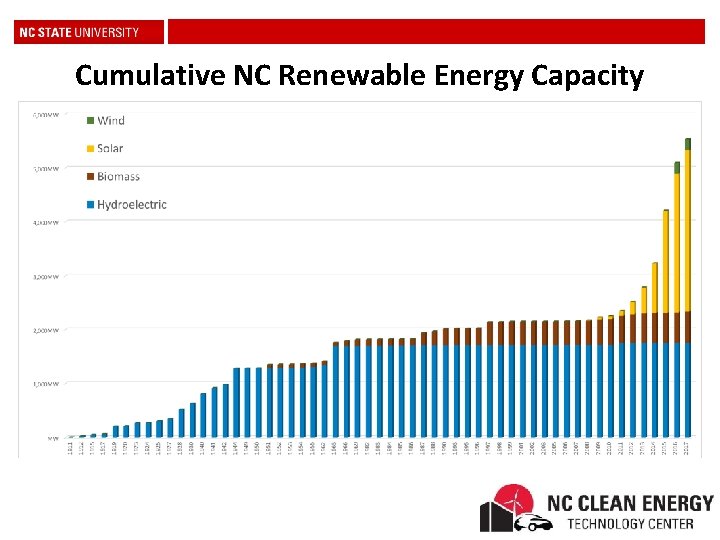
Cumulative NC Renewable Energy Capacity
Policymaker and Neighbor Concerns • Health & Safety Concerns • Toxicity, EMF/Radiation, Electric Shock, Fire • go. ncsu. edu/solar-health-and-safety • Aesthetics Concerns • Sound, Glare, Visual Impacts • Land Use & Land Impacts Concerns • Agricultural land tradeoffs, Returning the land to original state, Decommissioning • go. ncsu. edu/solar-and-ag • Local Economic and Regulatory Issues • Property Taxes, Permitting & Local Ordinances • Impact on property values – site and neighbors • Decommissioning and Recycling
2013 NC Template Solar Ordinance Key Working Group Members Not pictured: NC Solar Industry Representatives
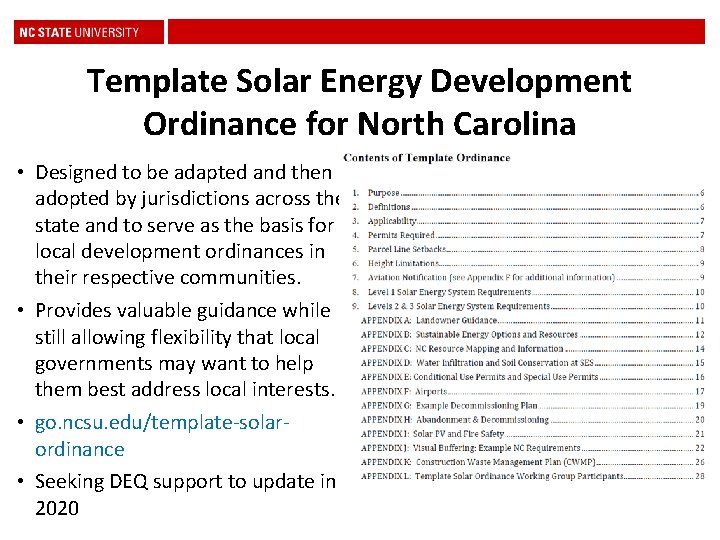
Template Solar Energy Development Ordinance for North Carolina • Designed to be adapted and then adopted by jurisdictions across the state and to serve as the basis for local development ordinances in their respective communities. • Provides valuable guidance while still allowing flexibility that local governments may want to help them best address local interests. • go. ncsu. edu/template-solarordinance • Seeking DEQ support to update in 2020
Current Topics for Larger Systems • Increasing Size and Scale • Decommissioning and Dealing with Economic Risks to Counties • Recycling Solar and Batteries • New Technology Synergies – Fitting the Pieces Together • Solar, Storage, EVs, Micro and Mini Grids • Increases the usefulness of solar • Increases the Reliability and Resiliency Opportunities
HB 329—Electric Vehicle Charging plus Wind/Solar Decommissioning & Small Hydroelectric Producers • Signed by Governor on July 19 • Compromise bill • Requires the Department of Environmental Quality (DEQ) to establish a program to govern the management of end-of-life PV (photovoltaic) modules and energy storage system batteries and decommissioning of utility-scale solar and wind projects by January 1 st, 2022. • Requires DEQ to establish a stakeholder process for development of the regulatory program within 60 days of the effective date of this bill
Common Health & Safety Concerns: Toxicity, EMF/Radiation, Electric Shock, Fire go. ncsu. edu/solar-health-andsafety
Toxicity • No operational air, water, or ground emissions • PV modules pass EPA Toxicity Characteristic Leaching Protocol test, so non-hazardous and landfill allowed • Silicon is non-toxic, some modules contain tiny amount of lead in solder • Cadmium Telluride (First Solar) contain cadmium, but in stable Cd. Te form safe from release, even in fire • PFAS/PFAF compounds – no problem expected but testing to be done • Inverters are Ro. HS compliant • Transformers use non-toxic mineral or vegetable oil • Batteries rare (so far)
EMF/Radiation • All electricity generates Electromagnetic Fields (EMF), it is all around us all day • Primary EMF emitter in solar farm is the few feet of wire between inverter and transformer • Levels diminish very rapidly with distance • At site perimeter (>100 ft), EMF is generally no higher than background levels
Common Aesthetics Concerns: Sound, Glare, Visual Impacts
Sound • Primary sound is from the inverters during daylight hours. • Similar quality and volume to a residential air conditioner outdoor unit • Sound dissipates quickly and can be screened, generally no louder than existing (quiet) rural background noises at site’s perimeter fence
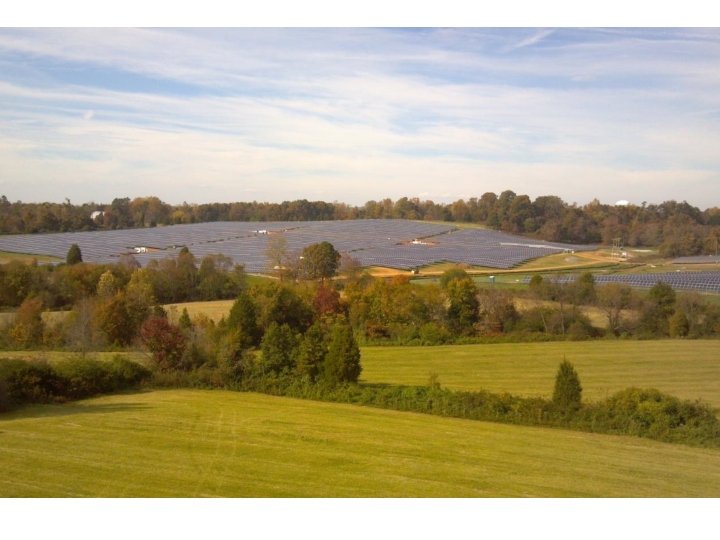
Don’t Like the Look • In flat territory, the PV panels can be easily blocked from view with existing tree cover and/or a planted vegetative buffer • Often planted at small size resulting in limited initial buffering • The more topography, the more difficult to screen from view
Local Economic Issues Property Taxes
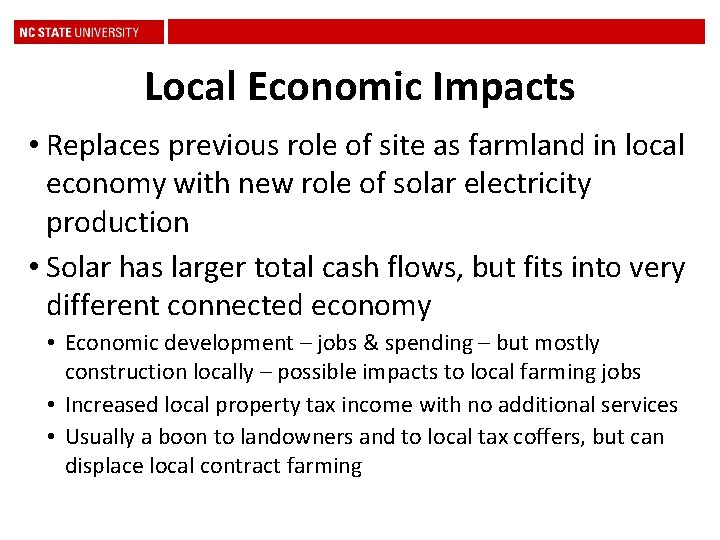
Local Economic Impacts • Replaces previous role of site as farmland in local economy with new role of solar electricity production • Solar has larger total cash flows, but fits into very different connected economy • Economic development – jobs & spending – but mostly construction locally – possible impacts to local farming jobs • Increased local property tax income with no additional services • Usually a boon to landowners and to local tax coffers, but can displace local contract farming
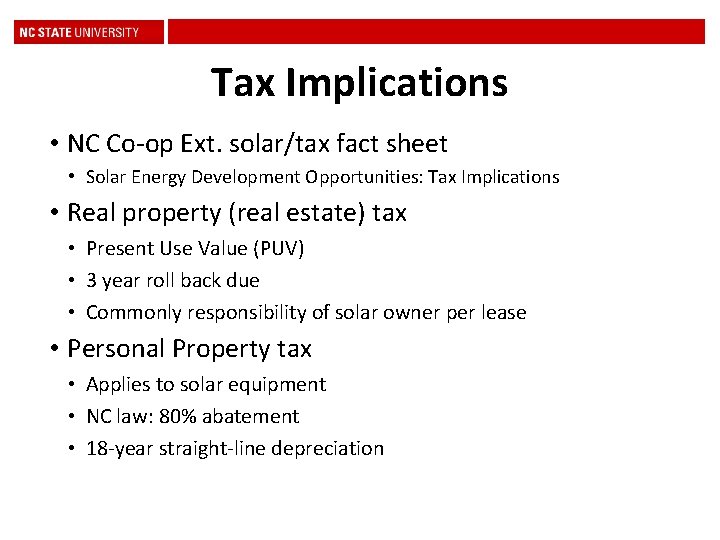
Tax Implications • NC Co-op Ext. solar/tax fact sheet • Solar Energy Development Opportunities: Tax Implications • Real property (real estate) tax • Present Use Value (PUV) • 3 year roll back due • Commonly responsibility of solar owner per lease • Personal Property tax • Applies to solar equipment • NC law: 80% abatement • 18 -year straight-line depreciation
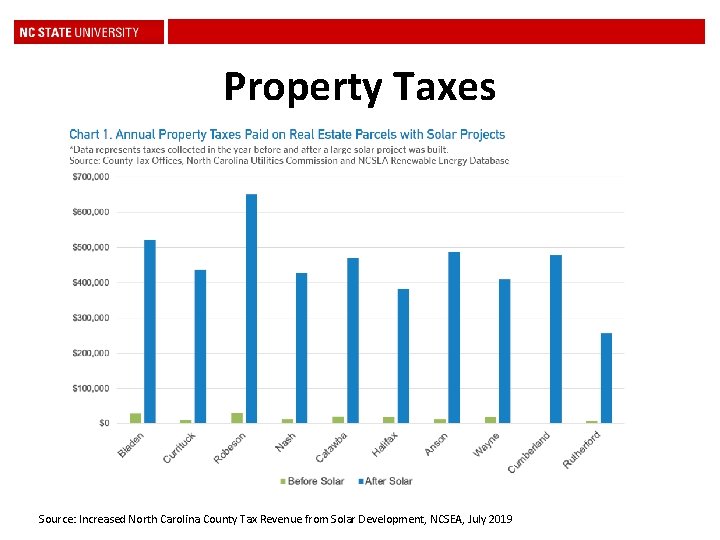
Property Taxes Source: Increased North Carolina County Tax Revenue from Solar Development, NCSEA, July 2019
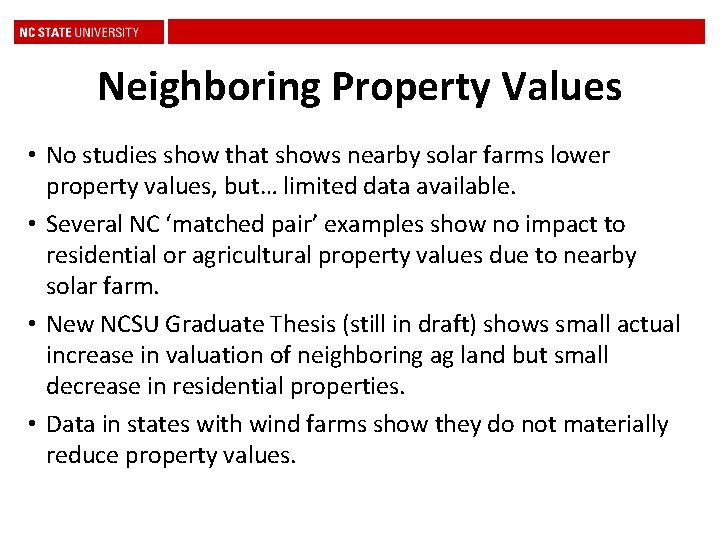
Neighboring Property Values • No studies show that shows nearby solar farms lower property values, but… limited data available. • Several NC ‘matched pair’ examples show no impact to residential or agricultural property values due to nearby solar farm. • New NCSU Graduate Thesis (still in draft) shows small actual increase in valuation of neighboring ag land but small decrease in residential properties. • Data in states with wind farms show they do not materially reduce property values.
Common Land Use & Land Impacts Concerns: Agricultural land tradeoffs, Returning the land to original state, Decommissioning go. ncsu. edu/solar-and-ag
Ag Impacts • Topsoil • Grading • Erosion • Compaction • Zinc & Aluminum • Soil for Crops after Solar • p. H, fertilizer
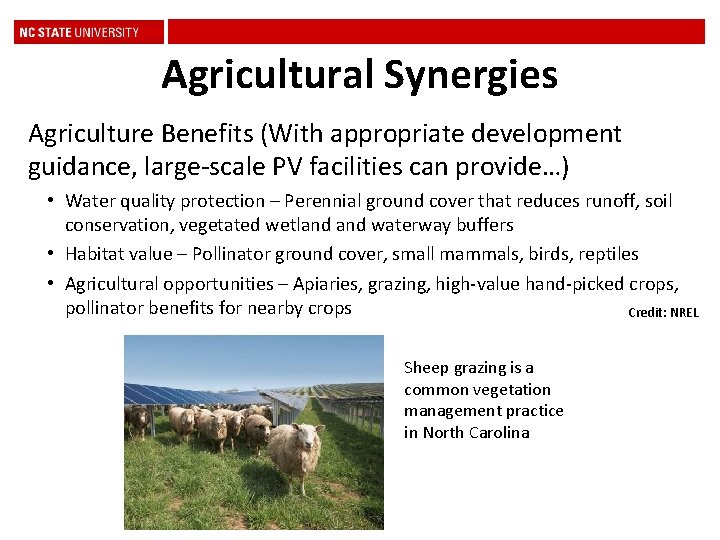
Agricultural Synergies Agriculture Benefits (With appropriate development guidance, large-scale PV facilities can provide…) • Water quality protection – Perennial ground cover that reduces runoff, soil conservation, vegetated wetland waterway buffers • Habitat value – Pollinator ground cover, small mammals, birds, reptiles • Agricultural opportunities – Apiaries, grazing, high-value hand-picked crops, pollinator benefits for nearby crops Credit: NREL Sheep grazing is a common vegetation management practice in North Carolina
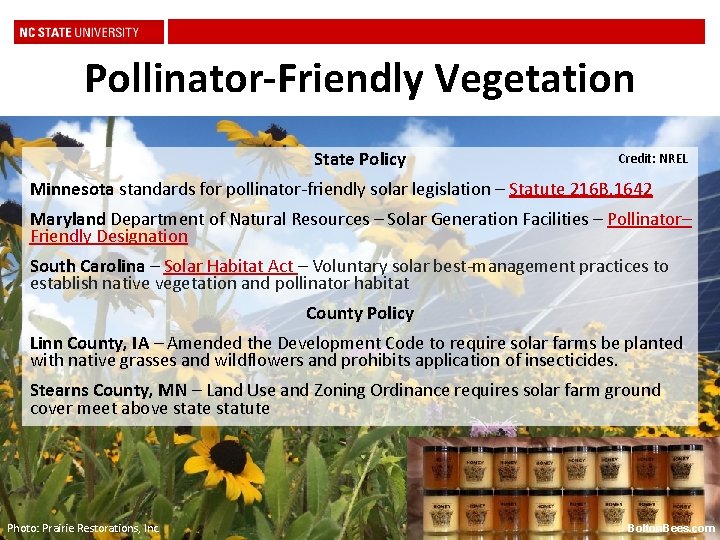
Pollinator-Friendly Vegetation State Policy Credit: NREL Minnesota standards for pollinator-friendly solar legislation – Statute 216 B. 1642 Maryland Department of Natural Resources – Solar Generation Facilities – Pollinator– Friendly Designation South Carolina – Solar Habitat Act – Voluntary solar best-management practices to establish native vegetation and pollinator habitat County Policy Linn County, IA – Amended the Development Code to require solar farms be planted with native grasses and wildflowers and prohibits application of insecticides. Stearns County, MN – Land Use and Zoning Ordinance requires solar farm ground cover meet above statute Photo: Prairie Restorations, Inc. Bolton. Bees. com

Pollinator-Friendly Vegetation • "North Carolina Technical Guidance for Native Plantings on Solar Sites" from the North Carolina Pollinator Conservation Alliance, October 2018. http: //ncpollinatoralliance. org/energy • NC Wildlife Resources Commission 2016 document, "Recommendations for Establishing Native Pollinator Habitat on Solar Farms in North Carolina" • NC chapter of The Nature Conservancy (TNC) January 2019, "Principles of Low Impact Solar Siting and Design" • National Renewable Energy Laboratory (NREL) Innovative Site Preparation and Impact Reductions on the Environment (In. SPIRE) project (https: //openei. org/wiki/In. SPIRE) • Fresh Energy, Center for Pollinators in Energy (https: //freshenergy. org/beeslovesolar/). Photo: Prairie Restorations, Inc. Bolton. Bees. com
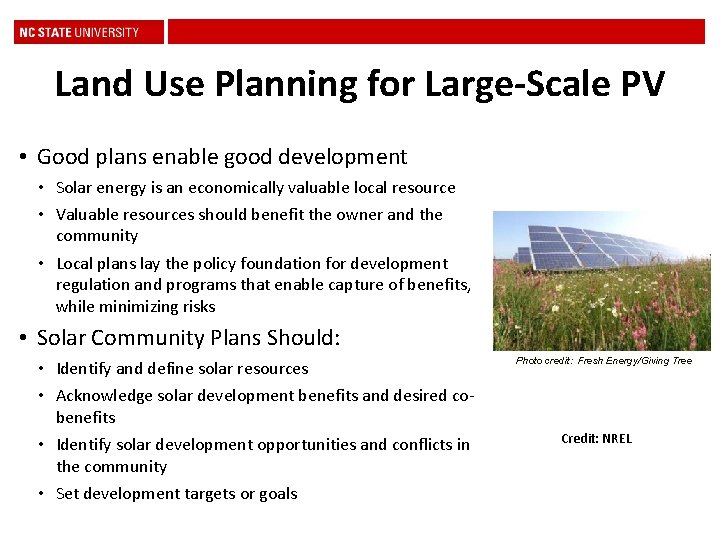
Land Use Planning for Large-Scale PV • Good plans enable good development • Solar energy is an economically valuable local resource • Valuable resources should benefit the owner and the community • Local plans lay the policy foundation for development regulation and programs that enable capture of benefits, while minimizing risks • Solar Community Plans Should: • Identify and define solar resources • Acknowledge solar development benefits and desired cobenefits • Identify solar development opportunities and conflicts in the community • Set development targets or goals Photo credit: Fresh Energy/Giving Tree Credit: NREL
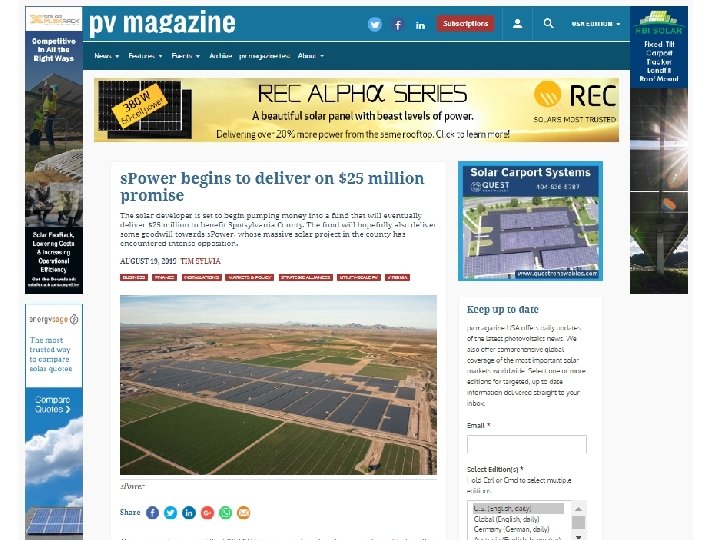

Lot Coverage, Impervious Surface • Zoning codes and development regulations can limit lot coverage on large lots. • Impervious surface calculations Ensure ground mount modules are not considered impervious if there is pervious surface beneath them (e. g. vegetation) http: //www. concordmonitor. com/solar-farm-concord-zoning-16692385 Best Practice Exempt principal use solar from lot coverage requirements, adjust impervious calculations. Walton EMC Cooperative Solar
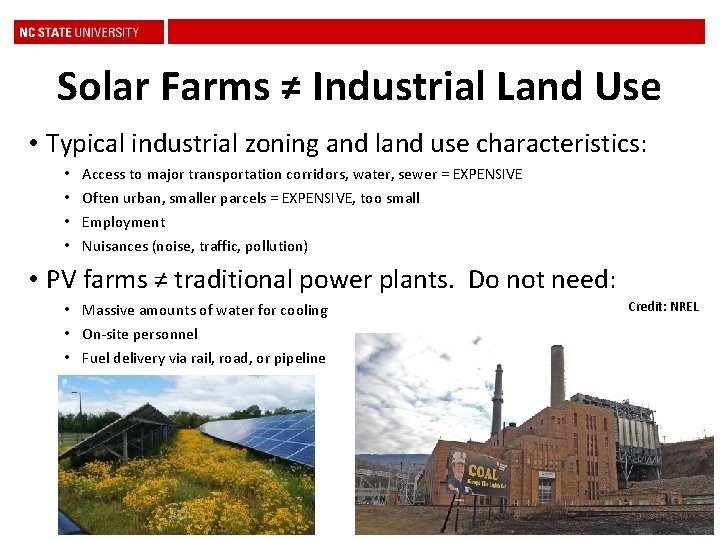
Solar Farms ≠ Industrial Land Use • Typical industrial zoning and land use characteristics: • • Access to major transportation corridors, water, sewer = EXPENSIVE Often urban, smaller parcels = EXPENSIVE, too small Employment Nuisances (noise, traffic, pollution) • PV farms ≠ traditional power plants. Do not need: • Massive amounts of water for cooling • On-site personnel • Fuel delivery via rail, road, or pipeline Credit: NREL
Decommissioning c. Decommissioning (see Appendix G for a sample decommissioning plan and Appendix H for example abandonment clause and information on decommissioning) i. A decommissioning plan signed by the party responsible for decommissioning and the landowner (if different) addressing the following shall be submitted with permit application. 1. Defined conditions upon which decommissioning will be initiated (i. e. end of land lease, no power production for 12 months, etc. ) 2. 3. 4. 5. 6. 7. Removal of all non-utility owned equipment, conduit, structures, fencing, roads, and foundations Restoration of property to condition prior to development of the SES. The timeframe for completion of decommissioning activities. Description of any agreement (e. g. lease) with landowner regarding decommissioning. The party currently responsible for decommissioning. Plans for updating this decommissioning plan. ii. Before final electrical inspection, provide evidence that the decommissioning plan was recorded with the Register of Deeds.
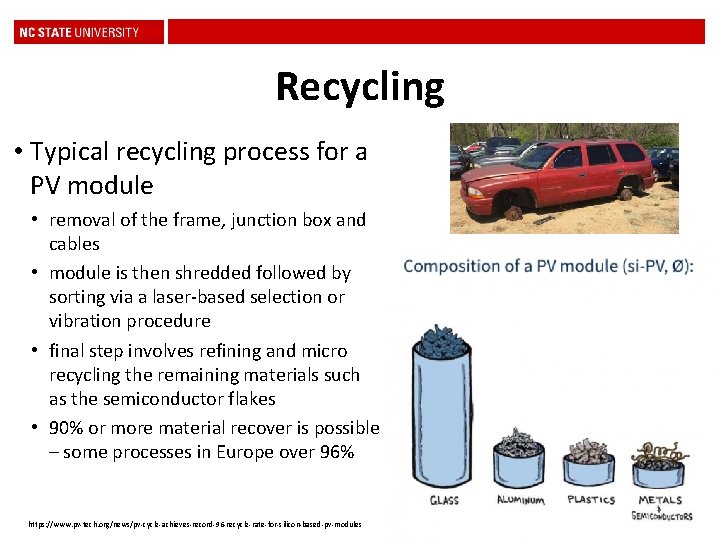
Recycling • Typical recycling process for a PV module • removal of the frame, junction box and cables • module is then shredded followed by sorting via a laser-based selection or vibration procedure • final step involves refining and micro recycling the remaining materials such as the semiconductor flakes • 90% or more material recover is possible – some processes in Europe over 96% https: //www. pv-tech. org/news/pv-cycle-achieves-record-96 -recycle-rate-for-silicon-based-pv-modules
Recycling • BUT… all kinds of PV technologies are suitable for recycling • silicon, Cd. Te, CIGS and flexible modules • Benefits include recovering raw materials & conserving natural resources • glass, aluminum, copper, plastics from the cables and junction box, certain semiconductors as well as silver can be recycled • Remember, PV modules pass EPA Toxicity Characteristic Leaching Protocol test, so non-hazardous and landfill allowed • Silicon is non-toxic, some modules contain tiny amount of lead in solder • Cadmium Telluride (First Solar) contain cadmium, but in stable Cd. Te form safe from release, even in fire https: //www. pv-tech. org/news/pv-cycle-achieves-record-96 -recycle-rate-for-silicon-based-pv-modules
Battery Storage • Operational safety requirements covered by fire, electrical, building codes, but some are still in development • Decommissioning and removal have more uncertainty given current state of knowledge, but are definitely more complicated that standard solar equipment • Should be monitored and eventually included in ordinance
NCSU Solar Information Resources • NC Clean Energy Technology Center – www. nccleantech. ncsu. edu • NC Cooperative Extension – www. ces. ncsu. edu & search for “solar” in the upper right: • • • What is Solar? Threshold Issues for Landowner Solar Leasing: Contract Terms Explained Solar and Wind Energy Development Opportunities: Tax Implications Solar Generation Property Taxation Solar Energy Resources for Local Government and Residents in North Carolina • Template Solar Energy Development Ordinance for North Carolina – go. ncsu. edu/template-solar-ordinance
Thanks! Stephen S. Kalland Executive Director NC Clean Energy Technology Center 919 -513 -1896 steve_kalland@ncsu. edu
- Slides: 45