
East Surrey CCG Patient Reference Group Dr Elango




- Slides: 61
East Surrey CCG Patient Reference Group Dr Elango Vijaykumar Clinical Chair ESCCG and Senior Partner Birchwood Medical Practice and introducing Yvette Robbins Lay Member ESCCG Governing Body
§ Welcome and housekeeping § New declarations of interest § Patient Reference Group Chair Update § Patient Reference Group – Alliance approach
Alliance wants all CCGs to sign up to three pledges; ü We will involve patients and public as much as possible ü Open and honest, clear and transparent communications - no spin ü Open door policy It is hoped that this will be followed by pledges from patients!
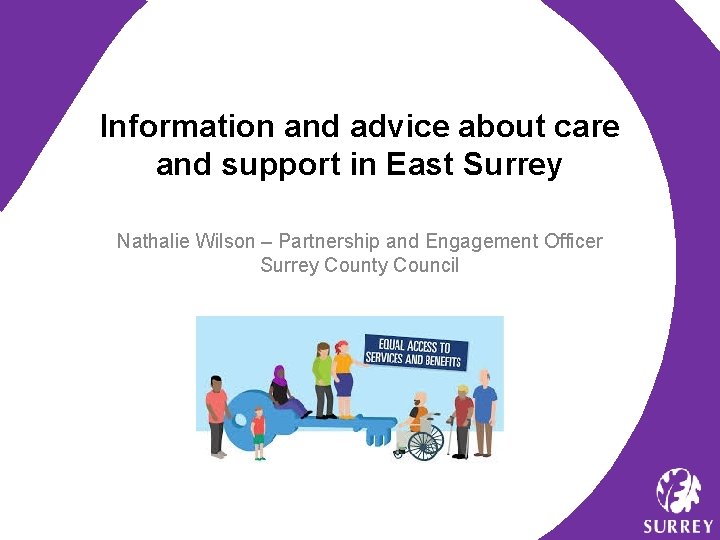
Information and advice about care and support in East Surrey Nathalie Wilson – Partnership and Engagement Officer Surrey County Council
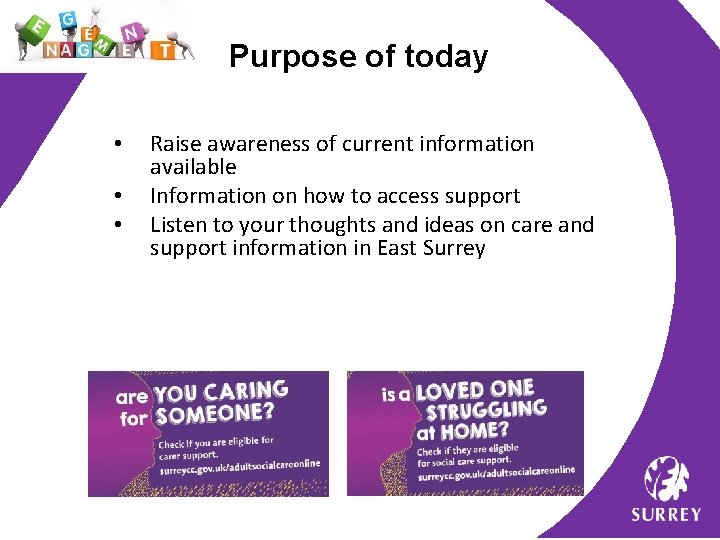
Purpose of today • • • Raise awareness of current information available Information on how to access support Listen to your thoughts and ideas on care and support information in East Surrey 5
What do we know? Finding information and advice about care and support is a challenge for our residents Do you agree? 6
Strategic direction • Surrey County Council working together with its partners to improve information and advice about care and support locally. • Care Act 2014 defines our legal requirements. • Information and advice strategy endorsed by Health and Wellbeing Board, which is Countywide and in partnership with various organisations such as the NHS, community, voluntary and faith sectors. • Focus on health settings based on residents’ needs and expectations 7
Some of the local priorities 1. Residents receive consistent, clear and accurate information on care and support. 2. Processes are developed to share information and best practice to ensure accurate information and signposting between organisations. 3. Local and national campaigns on care and support and public health are supported and joined up. 4. A consistent and proportionate monitoring tool is developed for organisations to review the effectiveness and monitor impact. 8
9
Local action plans • In each clinical commissioning group area, members of the Information and Engagement team are leading on developing local action plans with partners: – Seeking sign up to these local priorities and objectives – Agreeing what actions are needed to improve the local offer – Decide who needs to help achieve this – Decide how to agree actions – Agree best forum to monitor and progress or local action plan • System wide change including NHS, local councils, Surrey County Council, care providers, VCF and residents • Looking at short term realistic objectives as well as longer term vision 10
• • Over to you What do you understand by adult social care? Where do you go if you want information on how to access care and support for yourself and/or a loved one? What information do you want to access? Are you happy with how/ the information available? What information do you feel is missing? Are there particular geographical areas that are poorly served? Is the information accessible? 11
Thank you • Email: nathalie. wilson@surreycc. gov. uk • Telephone: 01483 517 1732 • Text/ SMS: 07805 809 032 12
On Wednesday 29 August 2018, we will jointly launch the Surrey Care Record. The Surrey Care Record is a secure, encrypted extract of records from health and social care providers that can be seen and used by authorised staff in the health and care system who are involved directly in your care. Sharing patient records brings a range of benefits for patients, including: • Less need to repeat your medical history or social care information every time you deal with a new member of staff or organisation • Clinical staff will be able to work with you to make the best decisions about your diagnosis, treatment and care plan • Care professionals will be able to find shared information when they need it, such as any test results, helping to avoid unnecessary appointments and further tests
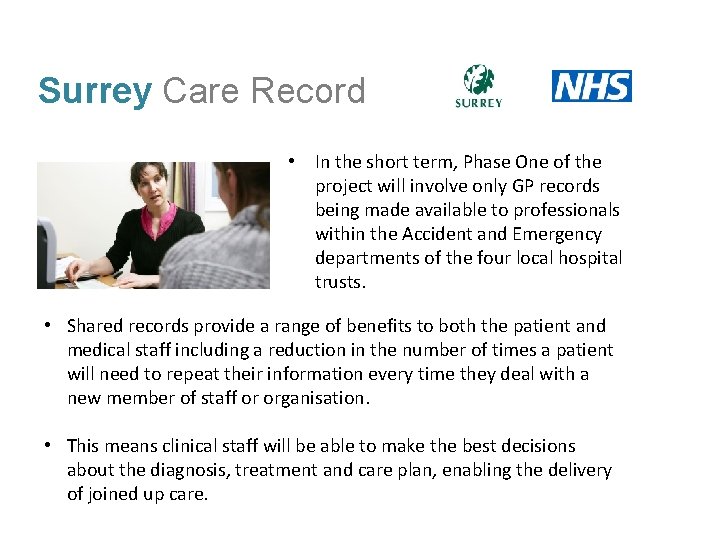
Surrey Care Record • In the short term, Phase One of the project will involve only GP records being made available to professionals within the Accident and Emergency departments of the four local hospital trusts. • Shared records provide a range of benefits to both the patient and medical staff including a reduction in the number of times a patient will need to repeat their information every time they deal with a new member of staff or organisation. • This means clinical staff will be able to make the best decisions about the diagnosis, treatment and care plan, enabling the delivery of joined up care.
What will the shared care record include? The record will contain summary information from your medical records held within local health and social care systems. This will include: • Your postcode, age, and details of your GP practice • Your NHS Number, any test results, medications, allergies Over the next two years or so it is expected that this will include relevant details from other organisations involved in your care, such as social care and mental health. Who will be able to see your records? Initially GPs and A&E professionals will have access to these records. In time, additional staff will include: hospital, mental health and community service clinicians, nurses and midwives, social workers, ambulance staff, carers and therapists.
Surrey Care Record The importance of Information Governance • All information sharing will be supported by appropriate Information Sharing Agreements • No patient information will be shared until all of the necessary agreements and controls are in place. • There will also be an audit trail for when data is accessed.
Your information will be stored securely on a protected NHS IT system. Authorised professionals involved in your care must have a legitimate reason to access your information and they will only be able to see the information needed to help with your treatment. If you don’t want your details shared…… You can opt out of sharing your Record at any time. • Call on 0300 200 1018 or • Text/SMS on 07527 182861 or • Email enquiries. surreycarerecord@nhs. net If you do want to opt out you will need to speak to your GP practice or any other organisation sharing information via the Surrey Care Record. Individual staff involved in your care will also ask for your permission before viewing your Record details, so you have control over which specific people can see it.
East Surrey CCG Patient Reference Group Dr Selvi Bangalore 21 June 2018
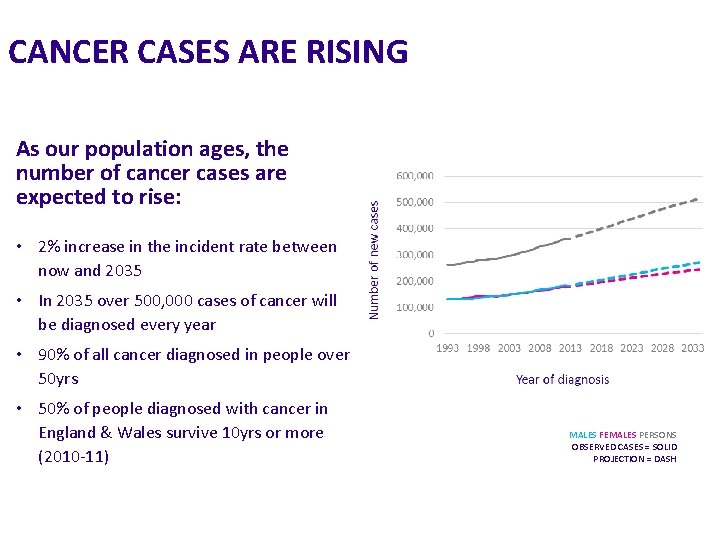
CANCER CASES ARE RISING As our population ages, the number of cancer cases are expected to rise: • 2% increase in the incident rate between now and 2035 • In 2035 over 500, 000 cases of cancer will be diagnosed every year • 90% of all cancer diagnosed in people over 50 yrs • 50% of people diagnosed with cancer in England & Wales survive 10 yrs or more (2010 -11) MALES FEMALES PERSONS OBSERVED CASES = SOLID PROJECTION = DASH
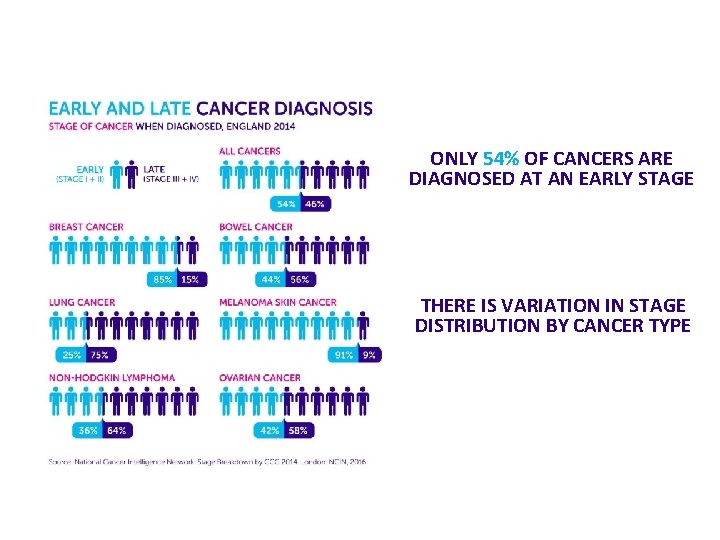
ONLY 54% OF CANCERS ARE DIAGNOSED AT AN EARLY STAGE THERE IS VARIATION IN STAGE DISTRIBUTION BY CANCER TYPE
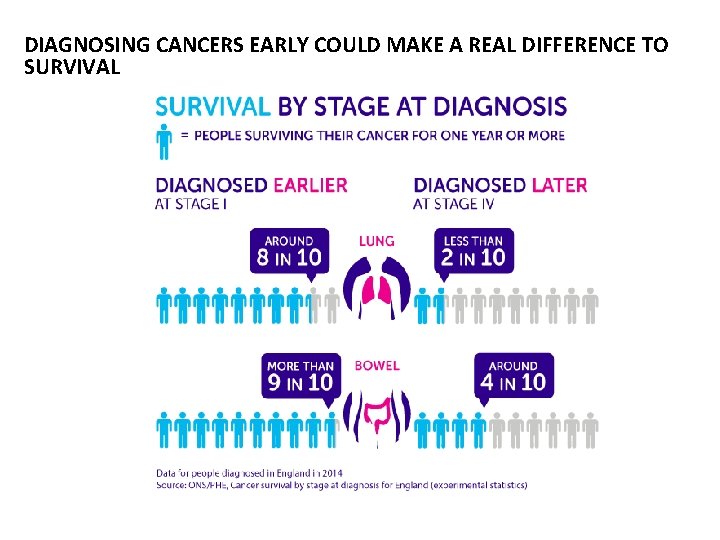
DIAGNOSING CANCERS EARLY COULD MAKE A REAL DIFFERENCE TO SURVIVAL
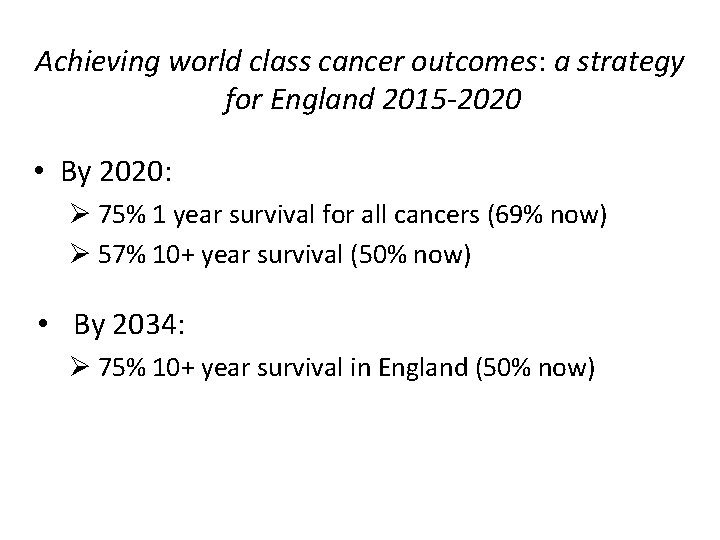
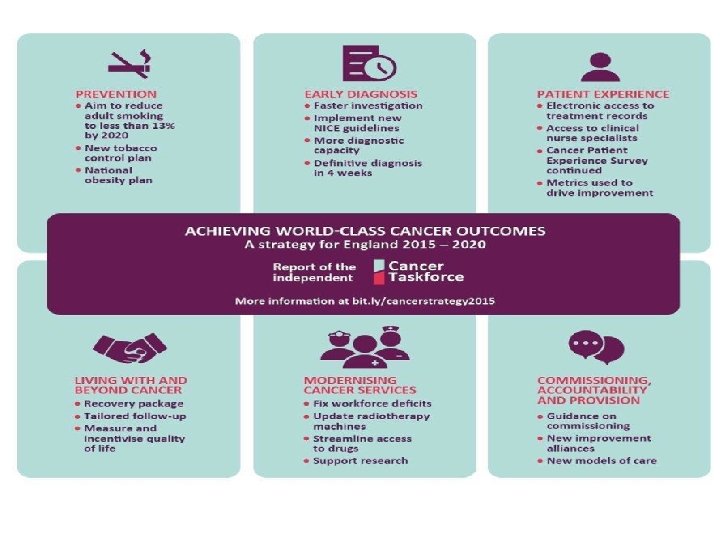
Achieving world class cancer outcomes: a strategy for England 2015 -2020 • By 2020: Ø 75% 1 year survival for all cancers (69% now) Ø 57% 10+ year survival (50% now) • By 2034: Ø 75% 10+ year survival in England (50% now)
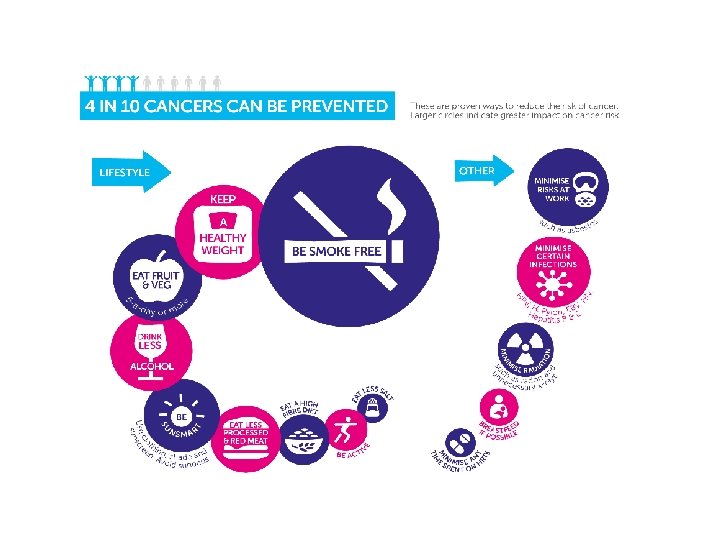
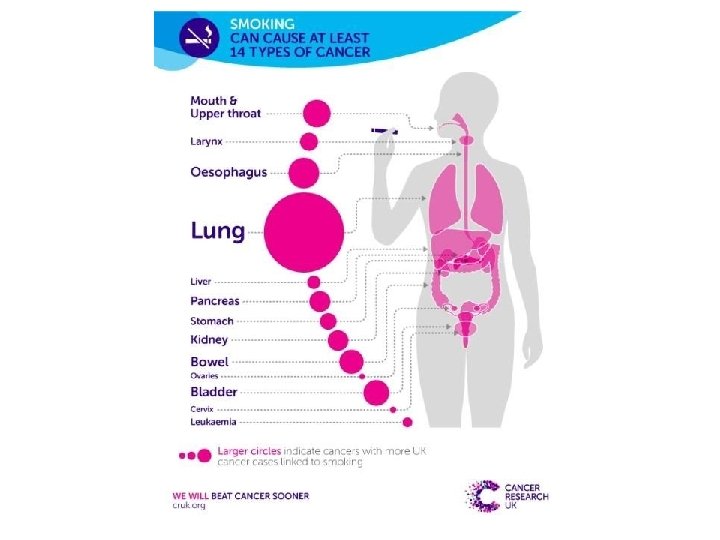
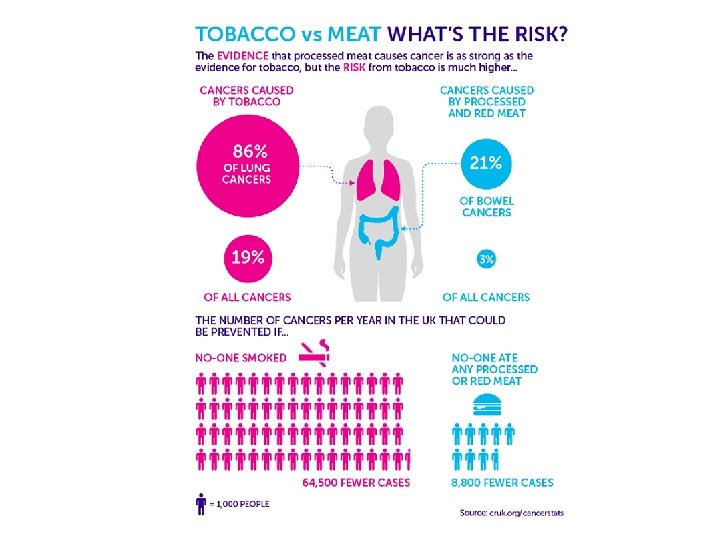
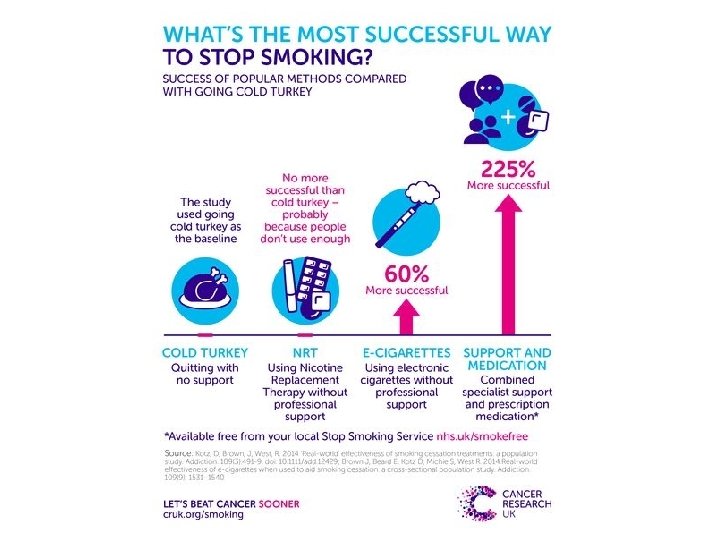
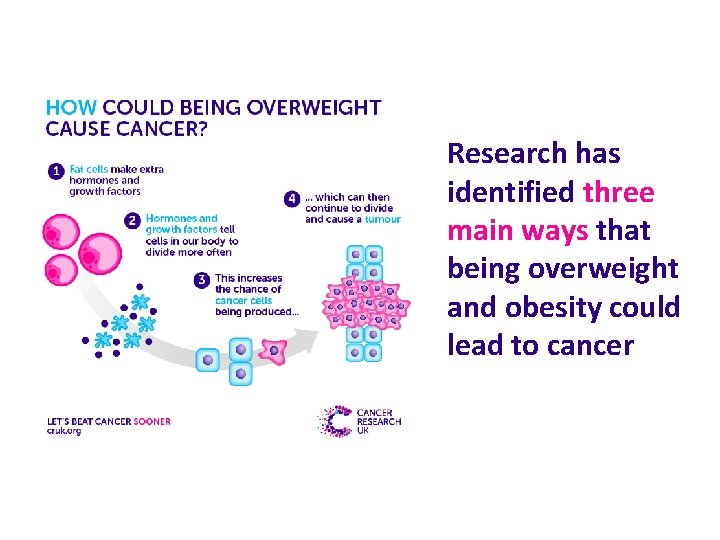
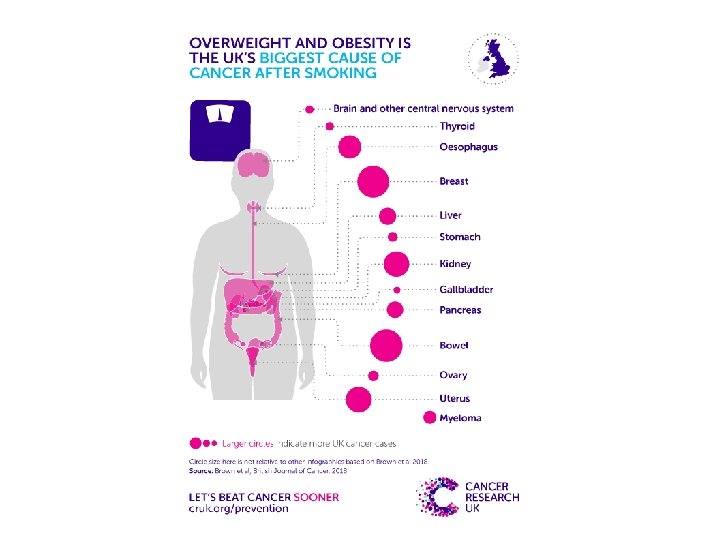
Research has identified three main ways that being overweight and obesity could lead to cancer
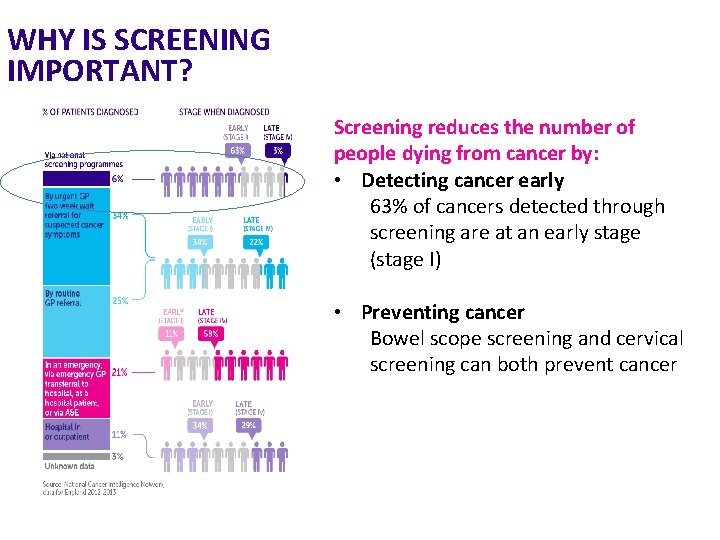
WHY IS SCREENING IMPORTANT? Screening reduces the number of people dying from cancer by: • Detecting cancer early 63% of cancers detected through screening are at an early stage (stage I) • Preventing cancer Bowel scope screening and cervical screening can both prevent cancer
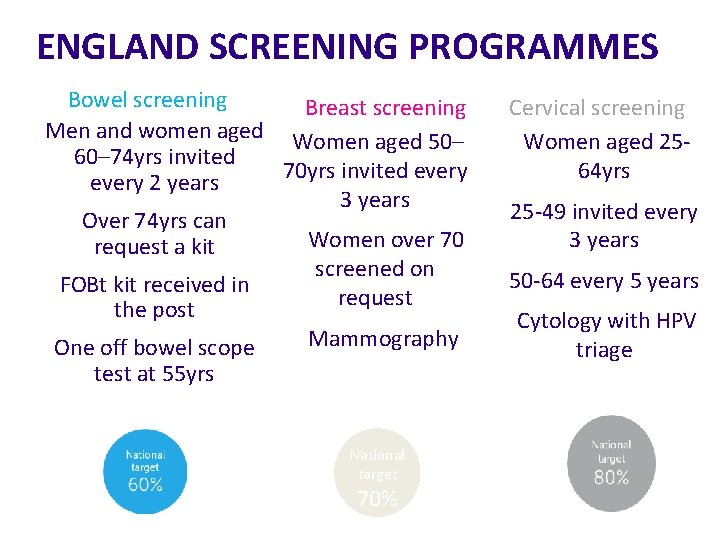
ENGLAND SCREENING PROGRAMMES Bowel screening Breast screening Men and women aged Women aged 50– 60– 74 yrs invited 70 yrs invited every 2 years 3 years Over 74 yrs can Women over 70 request a kit screened on FOBt kit received in request the post One off bowel scope Mammography test at 55 yrs National target 70% Cervical screening Women aged 2564 yrs 25 -49 invited every 3 years 50 -64 every 5 years Cytology with HPV triage
Public Heath England data GP practices and CCG level data 2016/17 • PHE Fingertips • National General Practice Profiles (Publically available information)
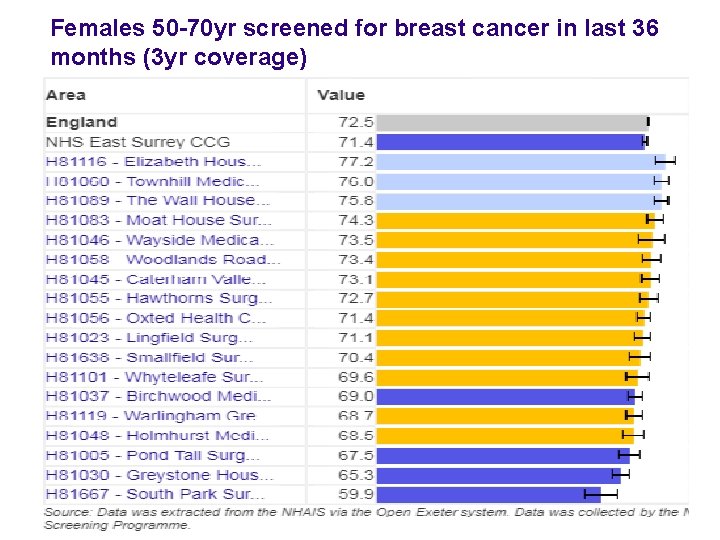
Females 50 -70 yr screened for breast cancer in last 36 months (3 yr coverage)
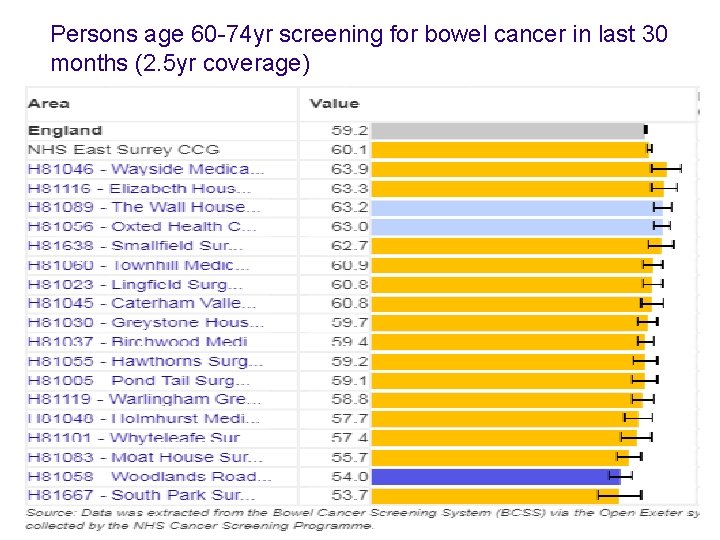
Persons age 60 -74 yr screening for bowel cancer in last 30 months (2. 5 yr coverage)
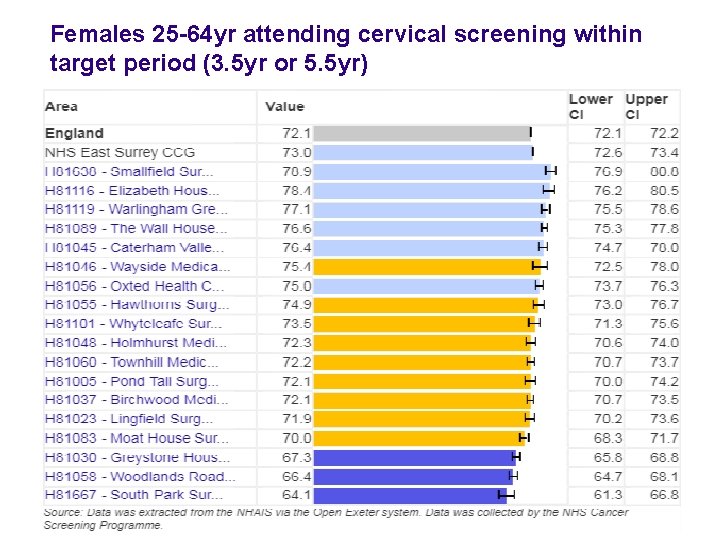
Females 25 -64 yr attending cervical screening within target period (3. 5 yr or 5. 5 yr)
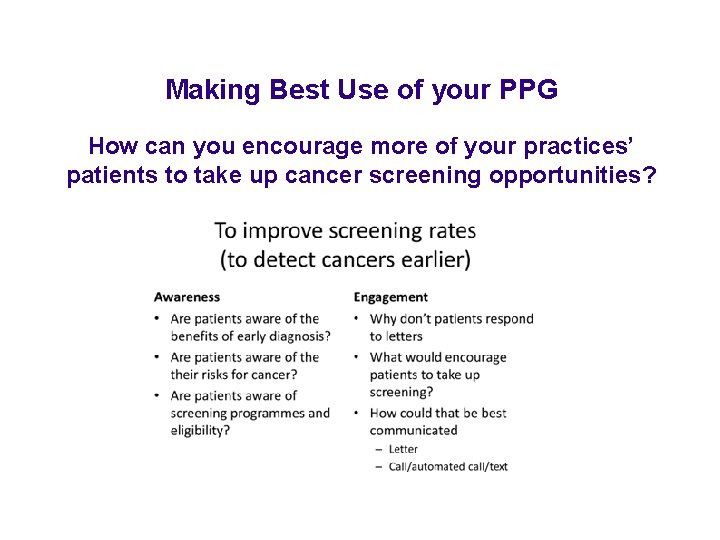
Making Best Use of your PPG How can you encourage more of your practices’ patients to take up cancer screening opportunities?
Thank you Dr Selvi Bangalore and Yvette Robbins
Around the PPGs and Break (networking opportunities)
Focus on finance: Addressing our financial challenge Dr Elango Vijaykumar Clinical Chair ESCCG
Our finances
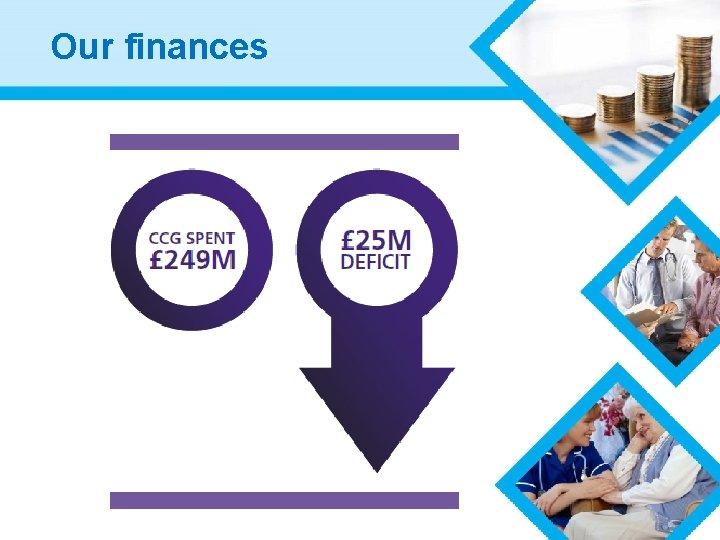
Our finances § The CCG incurred an in-year deficit of £ 24. 9 million in 2017 -18, which resulted in a cumulative deficit of £ 66. 9 million at March 2018. § This was a significant deterioration compared to the deficit control total of £ 6. 1 million set by NHS England, and the planned deficit of £ 16 million that the CCG agreed with NHS England at the start of the year. § The CCG remains under legal directions and financial special measures imposed by NHS England in previous years.
Our finances § We have a duty to ensure local services are being commissioned in a sustainable and affordable way and that we do not carry on spending more money than is available. § We have developed a financial recovery plan for the CCG and have committed to saving £ 7. 5 m by the end of the financial year § This will be a challenge and we have to be open and honest that it will require difficult decisions to be made about some services that are not considered to be cost effective.
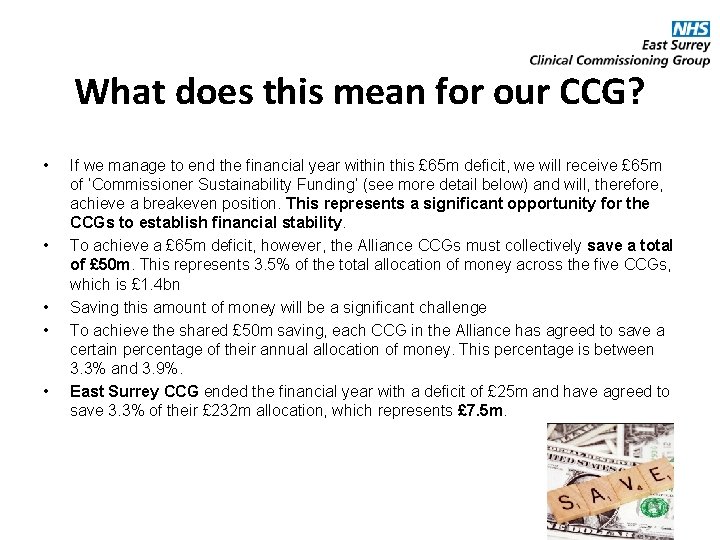
What does this mean for our CCG? • • • If we manage to end the financial year within this £ 65 m deficit, we will receive £ 65 m of ‘Commissioner Sustainability Funding’ (see more detail below) and will, therefore, achieve a breakeven position. This represents a significant opportunity for the CCGs to establish financial stability. To achieve a £ 65 m deficit, however, the Alliance CCGs must collectively save a total of £ 50 m. This represents 3. 5% of the total allocation of money across the five CCGs, which is £ 1. 4 bn Saving this amount of money will be a significant challenge To achieve the shared £ 50 m saving, each CCG in the Alliance has agreed to save a certain percentage of their annual allocation of money. This percentage is between 3. 3% and 3. 9%. East Surrey CCG ended the financial year with a deficit of £ 25 m and have agreed to save 3. 3% of their £ 232 m allocation, which represents £ 7. 5 m.
Engaging with public Yvette Robbins Lay Member Patient and Public Participation
Engaging with public § Will are launching the “Big Health and Care Conversation” § Want to talk to as many people as possible about the issues we face in health and care and to listen to what matters most to them and their experiences of using services § We will use the feedback to influence and shape our decision-making and future plans for transforming local services
Engaging with public The areas we will be focusing on are: § Finances § Developing a preventative approach to health and care § Improving children’s health and wellbeing § Promoting emotional wellbeing and mental health § Improving older adults’ health and wellbeing § Improving access to services § Sustainability and Transformation Partnership (STP)
Engaging with public The first Big Health and Care Conversation will take place on: § 31 August 2018, 1. 30 pm-4. 30 pm, at Nutfield Lodge, Nutfield Road, Redhill RH 1 4 ED § Everyone is welcome – just book a place by contacting Carol Rowley on 07827253111 or email carol. rowley 4@nhs. net
Clinically Effective Commissioning Carol Rowley Patient Reference Group 21 st June 2018
What is “clinically effective commissioning”? CEC is focussed on planned care across the STP area Rationale: to help the whole system balance resources & demand 1. Decide what the system will and won’t do (e. g. medicines, procedures or other treatments) based on a clinically led decision making process 2. Enact those choices in formal policies, embed them in systems 3. Keep those policies up to date and under continuous review to ensure they reflect any new clinical evidence and the needs of our local populations
Why do we need clinically effective commissioning? • If NHS resources (money, staff, beds, appointments, organs for transplantation) were not scarce, there would be no need to consider how to allocate them. It is the attempt to balance scarcity and the conflicting demands for finite resources which makes for a very difficult, debate. • The goal of resource allocation or Clinically Effective Commissioning is to make fair decisions. So, what is a fair decision? Unfortunately, there is no consensus on what "fair" means, and this is where the dilemma begins. • The NHS belongs to all of us. It would therefore seem right to include the wider community in deciding on how resources are allocated, and to check that the right questions are being asked when making these decisions.
• In the long term, the solution lies in a health and care system with a greater emphasis on prevention and care closer to home, relieving the pressures on our hospitals. • We are currently developing plans to transform services. • However, right now we must be open and honest about our financial situation and ensure that our patients, public and stakeholders recognise we need to make difficult decisions around services that are not considered to be cost effective. • As part of this, clinicians are currently reviewing all health and care services that have limited or no clinical benefit to patients to identify areas where money is not being spent as effectively as it should be. • Any decisions proposed as a result of this review will be based on whether a service is clinically effective and is a clinical priority, as well as input and feedback we have received from our local population.
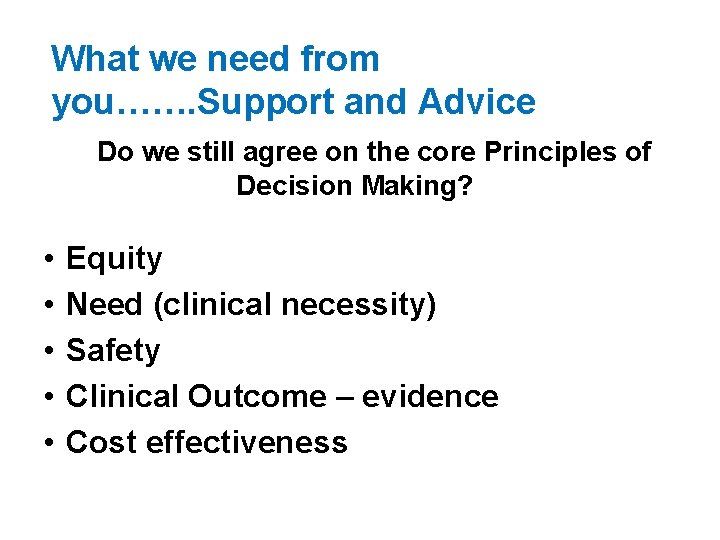
Decision Making Considerations • • • Equity Need (clinical necessity) Safety Clinical Outcome – evidence Cost effectiveness
What not to consider • • Age Social circumstances “Worth” or “Merit (earned)” Race • So called “self inflicted” illnesses
CEC Governance CCG commissioned, STP oversight There are 8 CCGs in the STP – they each commissioned the work as it is core business for CCGs CEC Programme is governed as follows: • Decisions to change must be made by the CCGs – clinical policies are ‘owned’ by each CCG – so each must come to their own decision, but work in common to arrive at the same result • Oversight is through the CEC Programme Board (all 8 CCGs are represented) • STP executive and clinical board oversight
Working towards common policies Common Policies - Objective There are 8 CCGs in the STP – and there at least 5 main versions of each clinical policy (this means that patients referred to the same hospital for the same treatment are subject to different threshold policies). The different policies mean that patients get different access and outcomes. If a common, revised policy can be established there will be: – Greater equality of access to treatments across the whole STP footprint – Improved outcomes for patients, as policies will be based on clinical evidence for effectiveness of treatment All policies are being reviewed and detailed assessment of evidence supporting the policy and the degree of difference between each policy is being assessed.
Work has started: CEC Group have started to look at proposed policies ü One of opportunity to achieve effectively zero balance ü Already approaching end of Q 1 financial Year 2018/19
What we need from you……. Support and Advice Do we still agree on the core Principles of Decision Making? • • • Equity Need (clinical necessity) Safety Clinical Outcome – evidence Cost effectiveness
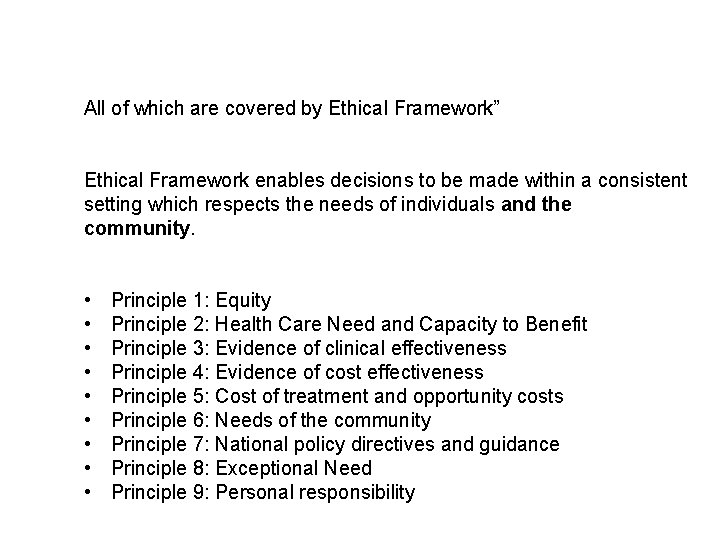
All of which are covered by Ethical Framework” Ethical Framework enables decisions to be made within a consistent setting which respects the needs of individuals and the community. • • • Principle 1: Equity Principle 2: Health Care Need and Capacity to Benefit Principle 3: Evidence of clinical effectiveness Principle 4: Evidence of cost effectiveness Principle 5: Cost of treatment and opportunity costs Principle 6: Needs of the community Principle 7: National policy directives and guidance Principle 8: Exceptional Need Principle 9: Personal responsibility
Support the principles of ethical decision making Identify who are the key stakeholders that we need to get the message to? Suggest what we need to say, and how? Volunteer - two small groups; one North (us) and one South- to review engagement and Equality Impact Assessments for any funding cuts/decommissions. We need one or two really good, patient/carer representatives. Draft TOR imminent (please see Carol after the meeting)