
Easing Data Collection Headaches Presented by Linda Kamer
Easing Data Collection Headaches Presented by Linda Kamer, RHIA River Valley Health Information Management Association November 3, 2017 © CGI Group Inc.
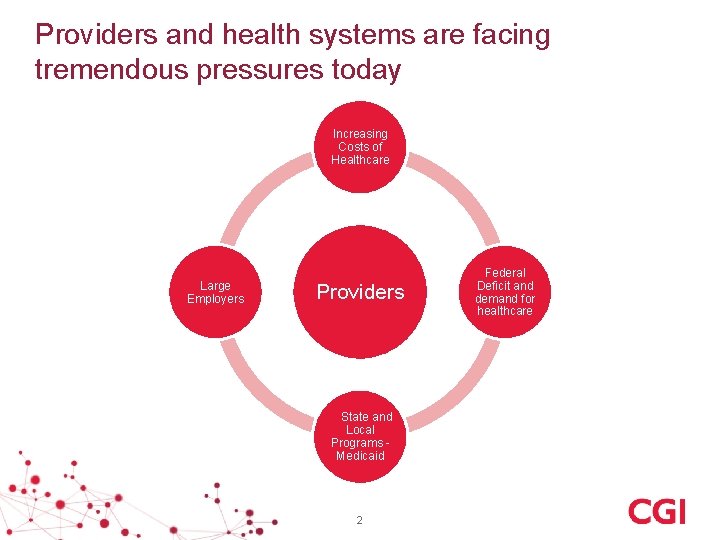
Providers and health systems are facing tremendous pressures today Increasing Costs of Healthcare Large Employers Providers State and Local Programs Medicaid 2 Federal Deficit and demand for healthcare
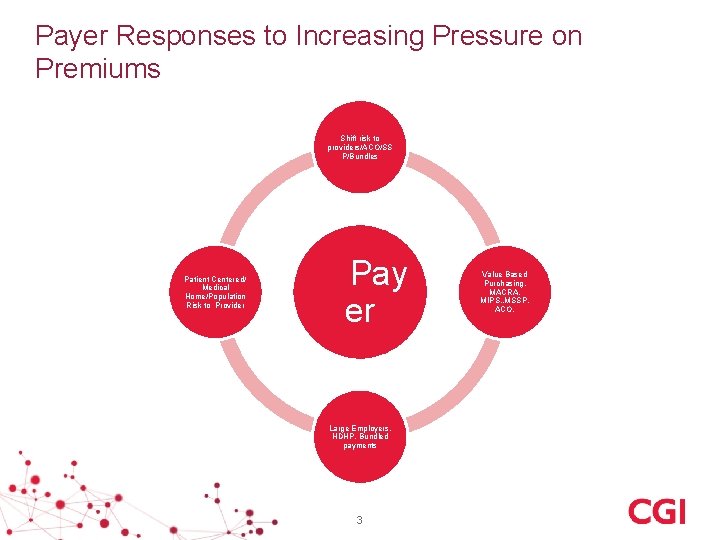
Payer Responses to Increasing Pressure on Premiums Shift risk to providers/ACO/SS P/Bundles Patient Centered/ Medical Home/Population Risk to Provider Pay er Large Employers, HDHP, Bundled payments 3 Value Based Purchasing, MACRA, MIPS, , MSSP, ACO,
Provider System Responses to Value-Based Purchasing Hospital based programs • Readmission reduction • Hospital-Acquired Condition reduction • Value-Based Purchasing (Patient satisfaction/ Safety/ Quality) • Bundled Payment initiatives with physicians • Direct to Employer contracting Risk-bearing entities (ACO and MSSP arrangements) • Medicare and Commercial MSSP arrangements • Capitated care contracts • Branded insurance products with local/national insurers Become an Insurer MACRA/MIPS for Physician Groups
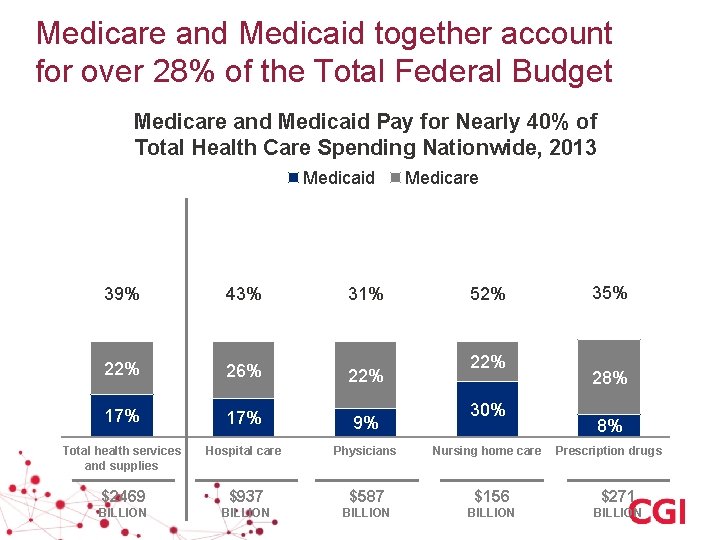
Medicare and Medicaid together account for over 28% of the Total Federal Budget Medicare and Medicaid Pay for Nearly 40% of Total Health Care Spending Nationwide, 2013 Medicaid 31% Medicare Column 1 43% 22% 26% 17% 9% Total health services and supplies Hospital care Physicians $2469 $937 $587 $156 $271 BILLION BILLION 22% 52% 35% 39% 22% 30% Nursing home care 28% 8% Prescription drugs
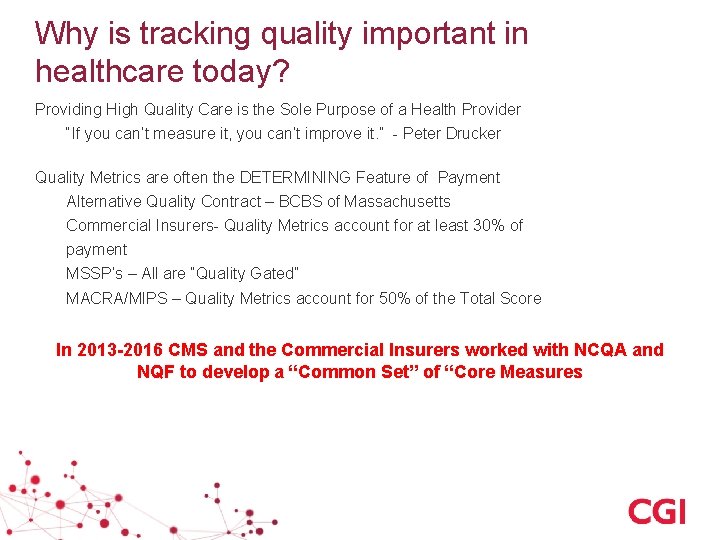
Why is tracking quality important in healthcare today? Providing High Quality Care is the Sole Purpose of a Health Provider “If you can’t measure it, you can’t improve it. ” - Peter Drucker Quality Metrics are often the DETERMINING Feature of Payment Alternative Quality Contract – BCBS of Massachusetts Commercial Insurers- Quality Metrics account for at least 30% of payment MSSP’s – All are “Quality Gated” MACRA/MIPS – Quality Metrics account for 50% of the Total Score In 2013 -2016 CMS and the Commercial Insurers worked with NCQA and NQF to develop a “Common Set” of “Core Measures
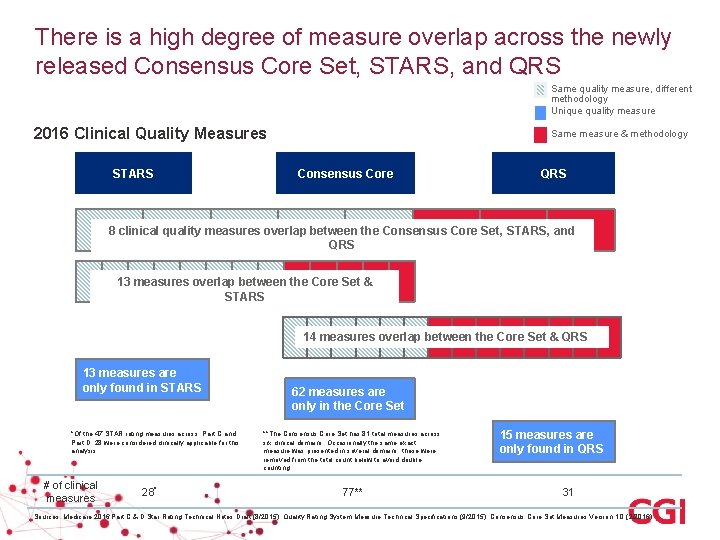
There is a high degree of measure overlap across the newly released Consensus Core Set, STARS, and QRS Same quality measure, different methodology Unique quality measure 2016 Clinical Quality Measures STARS Same measure & methodology Consensus Core QRS 8 clinical quality measures overlap between the Consensus Core Set, STARS, and QRS 13 measures overlap between the Core Set & STARS 14 measures overlap between the Core Set & QRS 13 measures are only found in STARS *Of the 47 STAR rating measures across Part C and Part D, 28 were considered clinically applicable for this analysis # of clinical measures 28* 62 measures are only in the Core Set **The Consensus Core Set has 81 total measures across six clinical domains. Occasionally the same exact measure was presented in several domains, these were removed from the total count below to avoid double counting 77** 15 measures are only found in QRS 31 Sources: Medicare 2016 Part C & D Star Rating Technical Notes Draft (8/2015), Quality Rating System Measure Technical Specifications (9/2015), Consensus Core Set Measures Version 1. 0 (2/2016).
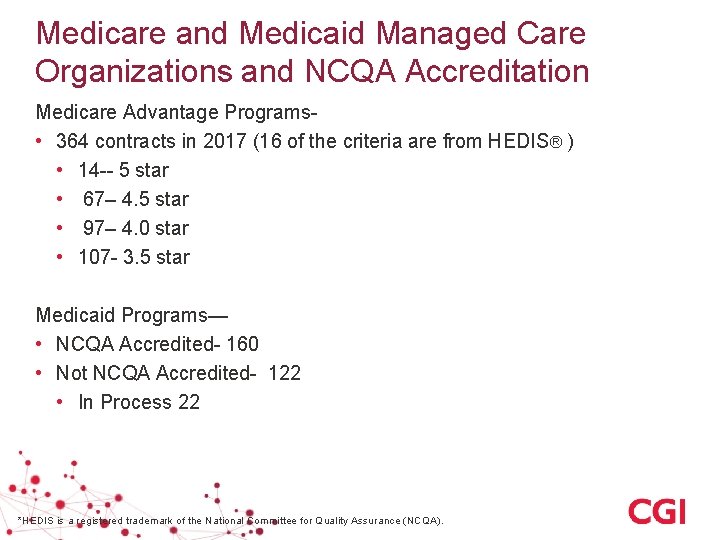
Medicare and Medicaid Managed Care Organizations and NCQA Accreditation Medicare Advantage Programs • 364 contracts in 2017 (16 of the criteria are from HEDIS® ) • 14 -- 5 star • 67– 4. 5 star • 97– 4. 0 star • 107 - 3. 5 star Medicaid Programs— • NCQA Accredited- 160 • Not NCQA Accredited- 122 • In Process 22 *HEDIS is a registered trademark of the National Committee for Quality Assurance (NCQA).
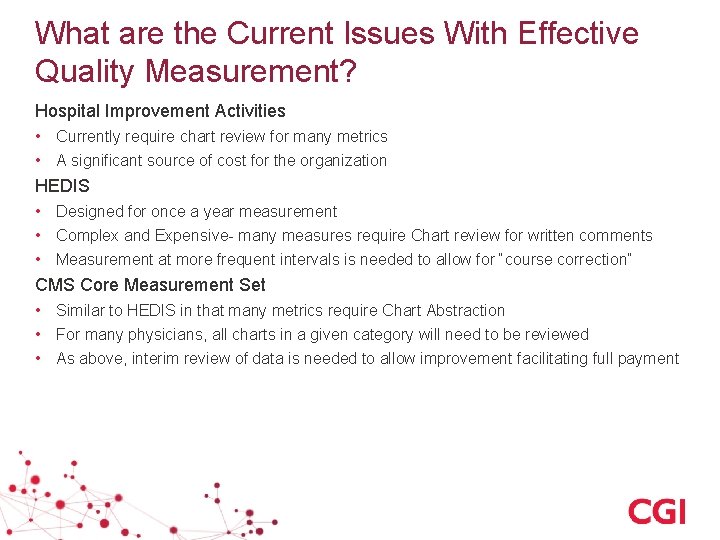
What are the Current Issues With Effective Quality Measurement? Hospital Improvement Activities • Currently require chart review for many metrics • A significant source of cost for the organization HEDIS • Designed for once a year measurement • Complex and Expensive- many measures require Chart review for written comments • Measurement at more frequent intervals is needed to allow for “course correction” CMS Core Measurement Set • Similar to HEDIS in that many metrics require Chart Abstraction • For many physicians, all charts in a given category will need to be reviewed • As above, interim review of data is needed to allow improvement facilitating full payment
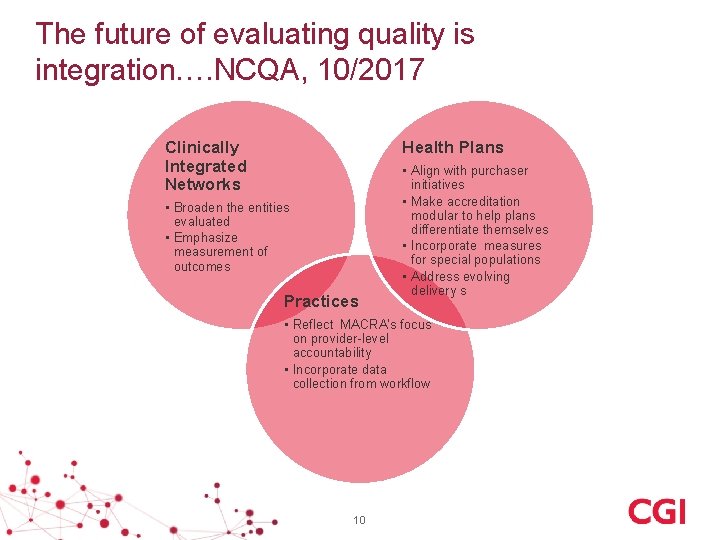
The future of evaluating quality is integration…. NCQA, 10/2017 Clinically Integrated Networks Health Plans • Broaden the entities evaluated • Emphasize measurement of outcomes Practices • Align with purchaser initiatives • Make accreditation modular to help plans differentiate themselves • Incorporate measures for special populations • Address evolving delivery s • Reflect MACRA’s focus on provider-level accountability • Incorporate data collection from workflow 10
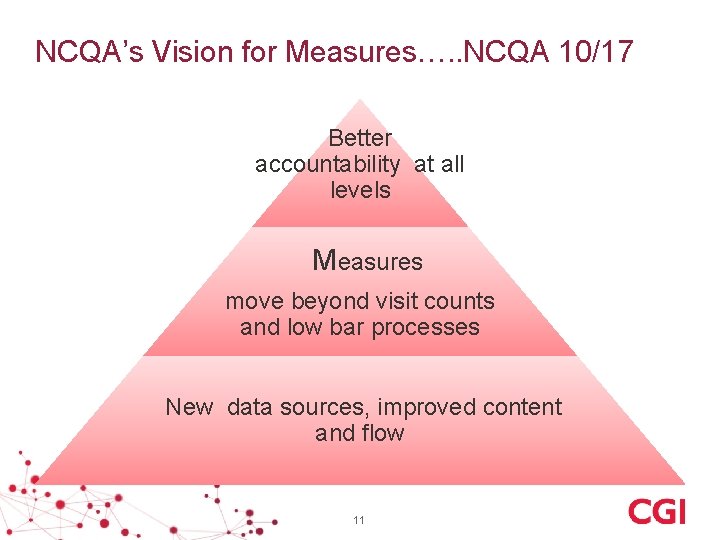
NCQA’s Vision for Measures…. . NCQA 10/17 Better accountability at all levels Measures move beyond visit counts and low bar processes New data sources, improved content and flow 11
Shift to Digital Measures…. . “Over the next 3 -5 years, NCQA will increasingly use available electronic clinical data to populate quality measures and reduce the burden associated with measure collection. ” NCQA, 10/17 12
NCQA Quality Measure Strategy…. NCQA 10/17 NCQA’s goals are to: • Reduce the burden associated with measure collection and reporting • Increase the relative importance of clinical quality measure reporting in our evaluation programs • Leverage existing practice workflows • Use available electronic data (including claims data) to populate quality measures 13
To Achieve these goals…. . NCQA 10/17 Align measures used for NCQA evaluation programs with existing federal, state and commercial programs • Build digital measures using new technical standards • Convert existing HEDIS® measures to digital measures • Utilize available sources of electronic data (e. g. , EHRs, qualified clinical data registries, health information exchanges, data intermediaries, all-payer claims databases) • Expand the breadth and use of NCQA e. Measure Certification • Introduce new a new distribution methodology for digital specifications of HEDIS® measures 14
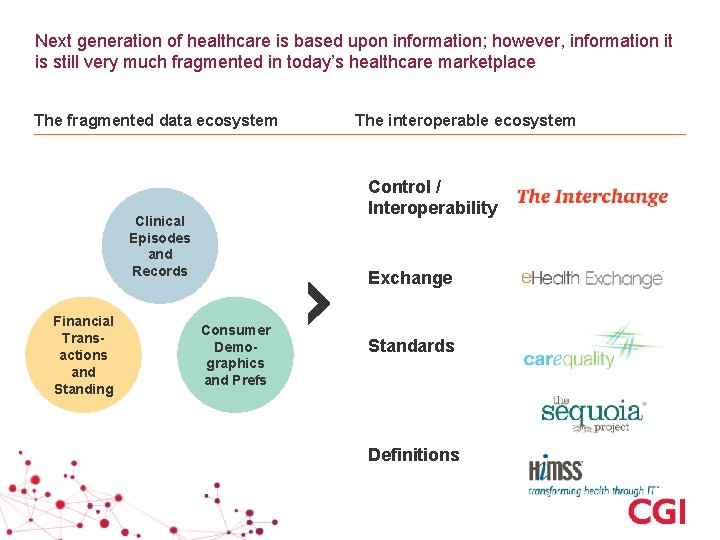
Next generation of healthcare is based upon information; however, information it is still very much fragmented in today’s healthcare marketplace The fragmented data ecosystem Control / Interoperability Clinical Episodes and Records Financial Transactions and Standing The interoperable ecosystem Exchange Consumer Demographics and Prefs Standards Definitions
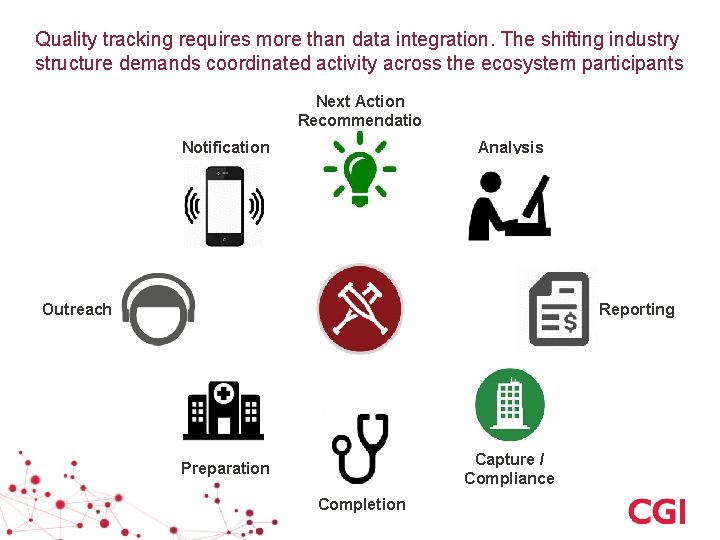
Quality tracking requires more than data integration. The shifting industry structure demands coordinated activity across the ecosystem participants Notification Next Action Recommendatio n Analysis Outreach Reporting Capture / Compliance Preparation Completion
What’s next? The Integration Fabric is baseline healthcare ecosystem connectivity. Additional artificial intelligence capabilities are required to support quality tracking…. . Oliver Wyaman, 8/2017 17

Role of technology in Quality Review Task Bots Meta Bots IQ Bots Artificial Intelligence (AI) • Replicate process actions • Leverage API-level integrations • Leverage unstructured data • Combines smart data & smart algorithms • Perform presentationlayer actions taken by humans • Share automations with Task bots • Capable of making decisions • Decision making based on machine learning • Ideal for multi-skill processes • Learn and adapt over time • Capable of executing multi-step processes Repetitive, rules-based Relatively complex and tasks relying on structured scalable processes data Simple, repetitive tasks Managing through fuzzy rules and processing unstructured data Complexity Language interaction, processing and dealing with high amounts of unstructured data Complex, bespoke multisystem
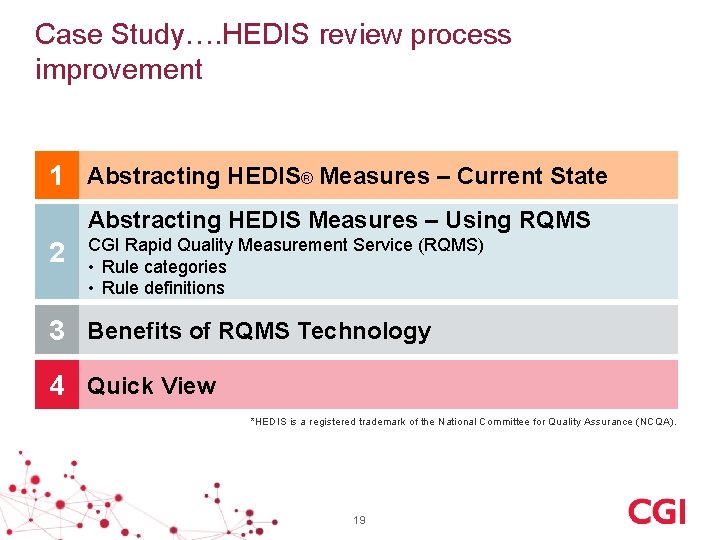
Case Study…. HEDIS review process improvement 1 Abstracting HEDIS® Measures – Current State Abstracting HEDIS Measures – Using RQMS 2 CGI Rapid Quality Measurement Service (RQMS) • Rule categories • Rule definitions 3 Benefits of RQMS Technology 4 Quick View *HEDIS is a registered trademark of the National Committee for Quality Assurance (NCQA). 19
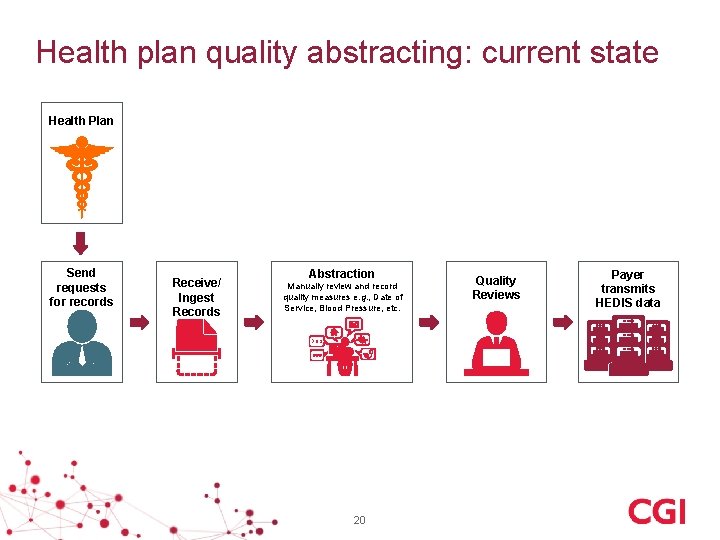
Health plan quality abstracting: current state Health Plan Send requests for records Receive/ Ingest Records Abstraction Manually review and record quality measures e. g. , Date of Service, Blood Pressure, etc. DOS 20 Quality Reviews Payer transmits HEDIS data
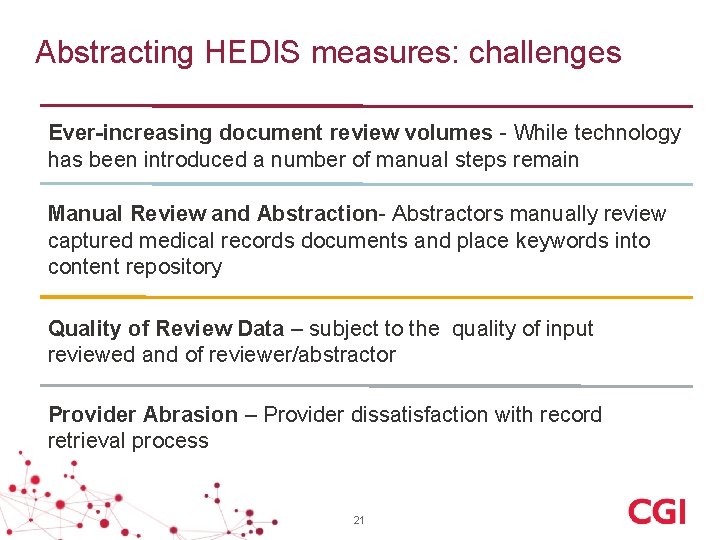
Abstracting HEDIS measures: challenges Ever-increasing document review volumes - While technology has been introduced a number of manual steps remain Manual Review and Abstraction- Abstractors manually review captured medical records documents and place keywords into content repository Quality of Review Data – subject to the quality of input reviewed and of reviewer/abstractor Provider Abrasion – Provider dissatisfaction with record retrieval process 21
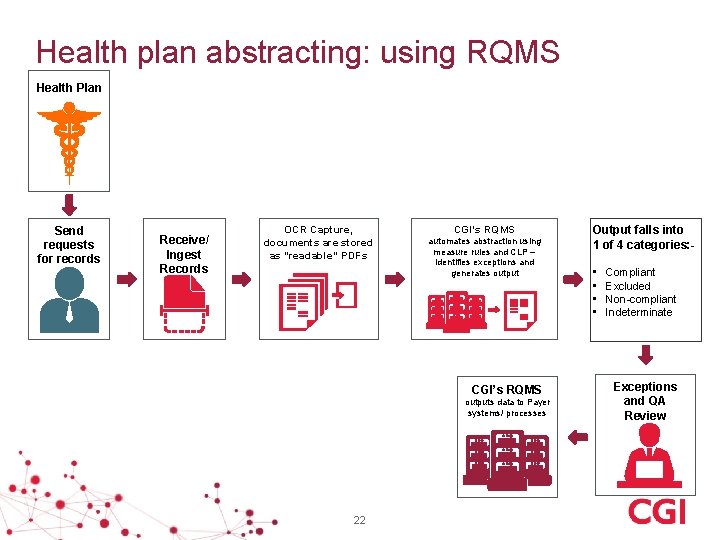
Health plan abstracting: using RQMS Health Plan Send requests for records Receive/ Ingest Records OCR Capture, documents are stored as “readable” PDFs CGI’s RQMS automates abstraction using measure rules and CLP – identifies exceptions and generates output CGI’s RQMS outputs data to Payer systems/ processes 22 Output falls into 1 of 4 categories: • • Compliant Excluded Non-compliant Indeterminate Exceptions and QA Review
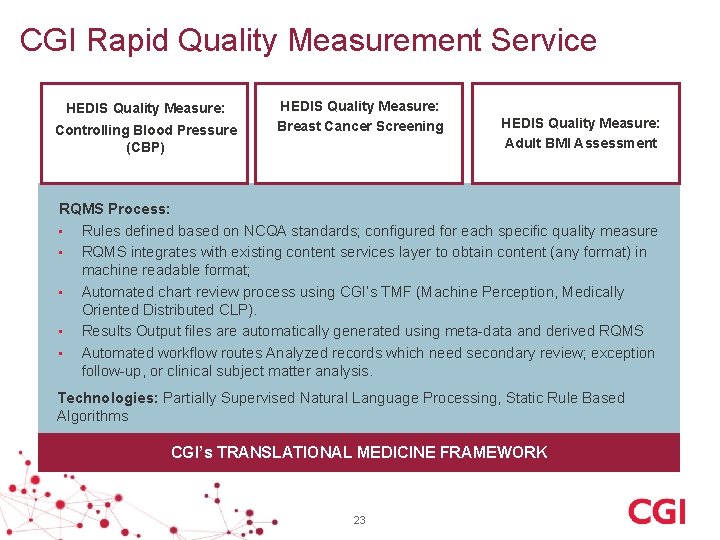
CGI Rapid Quality Measurement Service HEDIS Quality Measure: Controlling Blood Pressure (CBP) HEDIS Quality Measure: Breast Cancer Screening HEDIS Quality Measure: Adult BMI Assessment RQMS Process: • Rules defined based on NCQA standards; configured for each specific quality measure • RQMS integrates with existing content services layer to obtain content (any format) in machine readable format; • Automated chart review process using CGI’s TMF (Machine Perception, Medically Oriented Distributed CLP). • Results Output files are automatically generated using meta-data and derived RQMS • Automated workflow routes Analyzed records which need secondary review; exception follow-up, or clinical subject matter analysis. Technologies: Partially Supervised Natural Language Processing, Static Rule Based Algorithms CGI’s TRANSLATIONAL MEDICINE FRAMEWORK 23
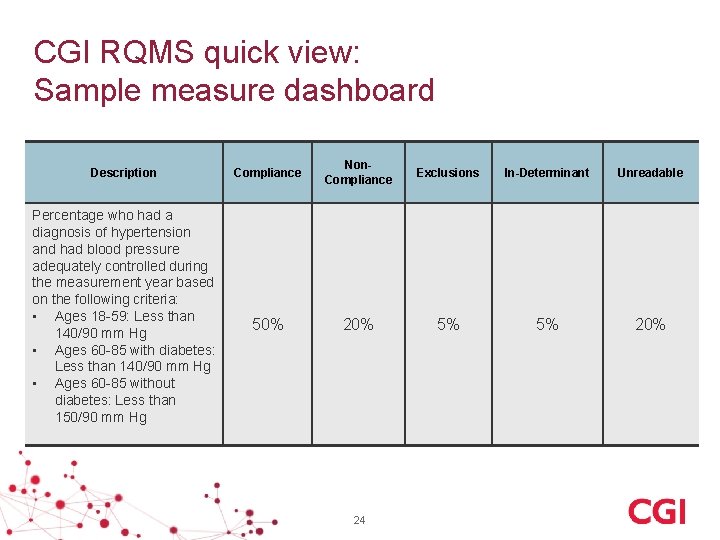
CGI RQMS quick view: Sample measure dashboard Description Percentage who had a diagnosis of hypertension and had blood pressure adequately controlled during the measurement year based on the following criteria: • Ages 18 -59: Less than 140/90 mm Hg • Ages 60 -85 with diabetes: Less than 140/90 mm Hg • Ages 60 -85 without diabetes: Less than 150/90 mm Hg Compliance Non. Compliance Exclusions In-Determinant Unreadable 50% 20% 5% 5% 20% 24
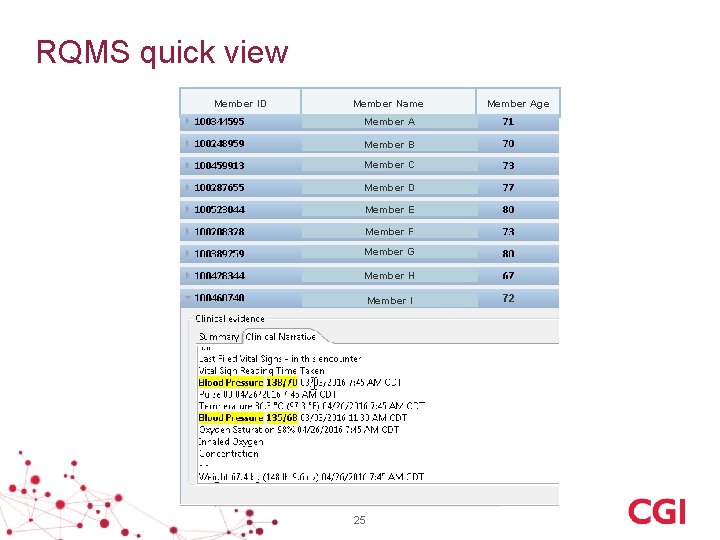
RQMS quick view Member ID Member Name Member Age Member A Member B Member C Member D Member E Member F Member G Member H Member I 25 72
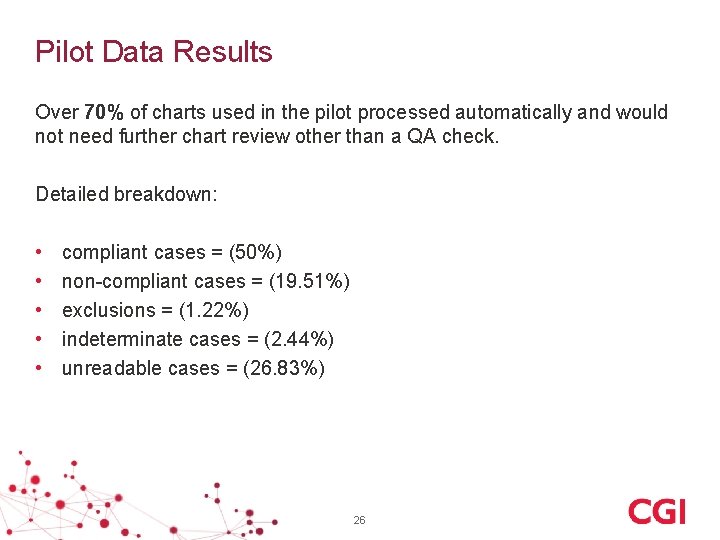
Pilot Data Results Over 70% of charts used in the pilot processed automatically and would not need further chart review other than a QA check. Detailed breakdown: • • • compliant cases = (50%) non-compliant cases = (19. 51%) exclusions = (1. 22%) indeterminate cases = (2. 44%) unreadable cases = (26. 83%) 26
RQMS benefits for healthcare payers: CGI RQMS Natural Language Processing (CLP) engine decreases end-to-end completion time Leveraging RQMS for multiple measures reduces provider abrasion Allows abstractors to focus on exceptions and over-read rather than every page - resulting in improved resource utilization 27
RQMS benefits for healthcare payers (continued): Streamlines the ability to exchange records and manage integration Integrates with existing ECM infrastructure and processes; vendor neutral Output and reports are generated automatically; electronic output feeds downstream processes and systems 28
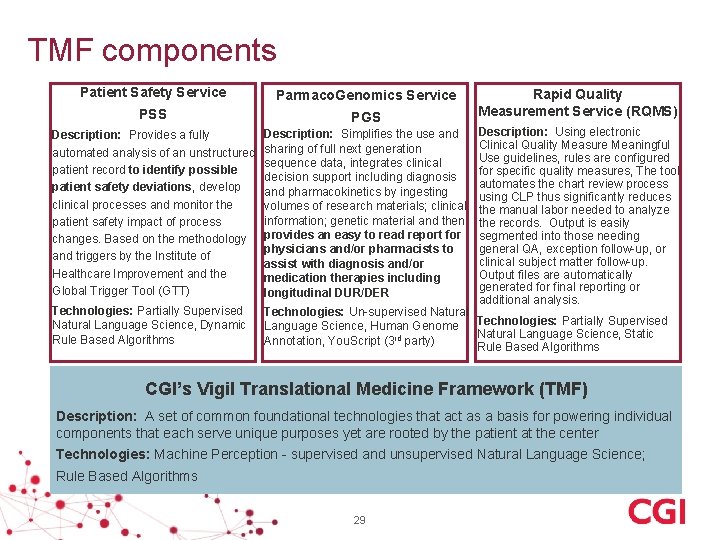
TMF components Patient Safety Service Parmaco. Genomics Service PSS PGS Description: Provides a fully automated analysis of an unstructured patient record to identify possible patient safety deviations, develop clinical processes and monitor the patient safety impact of process changes. Based on the methodology and triggers by the Institute of Healthcare Improvement and the Global Trigger Tool (GTT) Description: Simplifies the use and sharing of full next generation sequence data, integrates clinical decision support including diagnosis and pharmacokinetics by ingesting volumes of research materials; clinical information; genetic material and then provides an easy to read report for physicians and/or pharmacists to assist with diagnosis and/or medication therapies including longitudinal DUR/DER Technologies: Partially Supervised Natural Language Science, Dynamic Rule Based Algorithms Technologies: Un-supervised Natural Technologies: Partially Supervised Language Science, Human Genome Natural Language Science, Static Annotation, You. Script (3 rd party) Rule Based Algorithms Rapid Quality Measurement Service (RQMS) Description: Using electronic Clinical Quality Measure Meaningful Use guidelines, rules are configured for specific quality measures, The tool automates the chart review process using CLP thus significantly reduces the manual labor needed to analyze the records. Output is easily segmented into those needing general QA, exception follow-up, or clinical subject matter follow-up. Output files are automatically generated for final reporting or additional analysis. CGI’s Vigil Translational Medicine Framework (TMF) Description: A set of common foundational technologies that act as a basis for powering individual components that each serve unique purposes yet are rooted by the patient at the center Technologies: Machine Perception - supervised and unsupervised Natural Language Science; Rule Based Algorithms 29
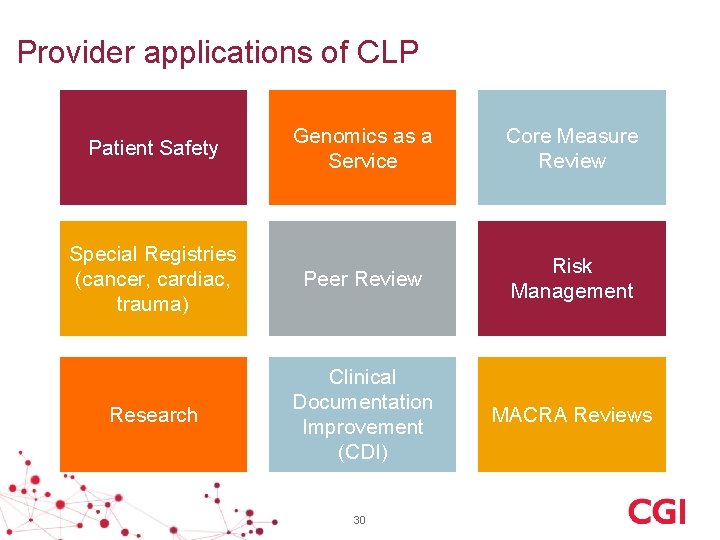
Provider applications of CLP Patient Safety Genomics as a Service Core Measure Review Special Registries (cancer, cardiac, trauma) Peer Review Risk Management Research Clinical Documentation Improvement (CDI) MACRA Reviews 30
Questions? 31

Connect with CGI experts Contact us to schedule a meeting John George Director, Consulting Services CGI Health Solutions john. george@cgi. com Linda Kamer Sr. Healthcare Consultant linda. kamer@cgi. com www. cgi. com/health 32
- Slides: 32