
Easements and compensation in light of legislation and

- Slides: 23
Easements and compensation in light of legislation and case law Abdelwahed El Idrissi 28 November 2019
Introduction #CLPA 2019 The subject of easements and the principle of compensation or non-compensation relating to it set out a sensitive theme. The issues related to real estate/land ownership are numerous and various. These issues are the subject of enormous litigation. Actions for annulment for abuse of power or compensation in connection with easements are increasing in administrative courts.
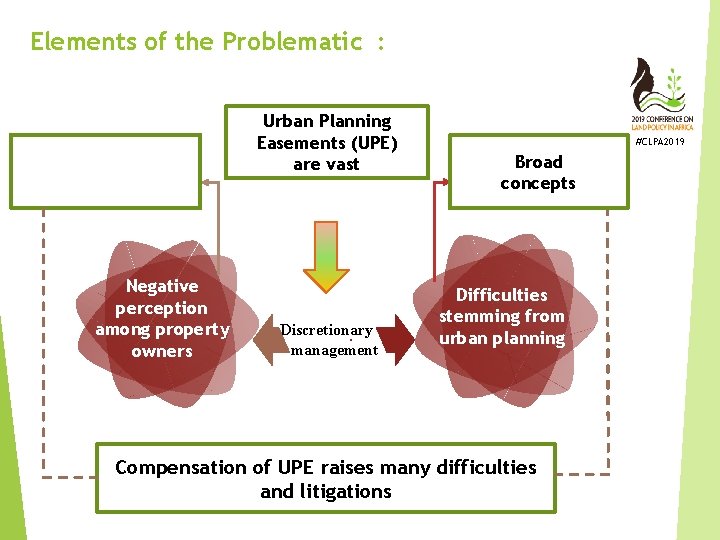
Elements of the Problematic : Easements restrict property rights Negative perception among property owners Urban Planning Easements (UPE) are vast #CLPA 2019 Broad concepts Difficulties stemming from urban planning Discretionary management Compensation of UPE raises many difficulties and litigations
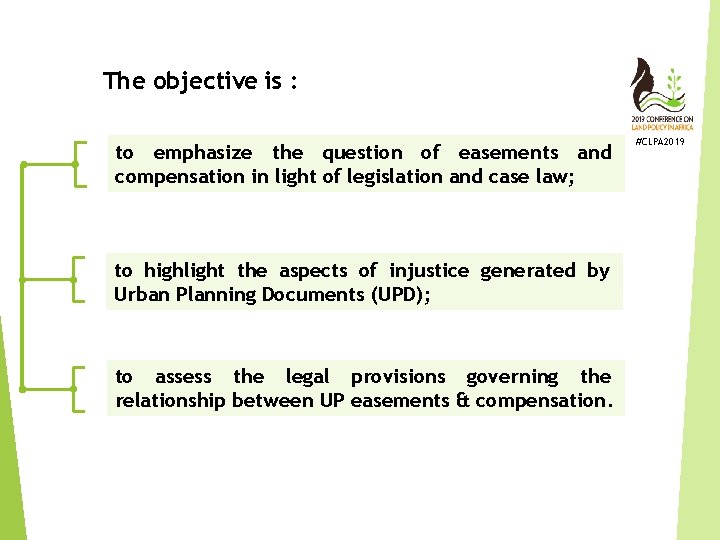
The objective is : to emphasize the question of easements and compensation in light of legislation and case law; to highlight the aspects of injustice generated by Urban Planning Documents (UPD); to assess the legal provisions governing the relationship between UP easements & compensation. #CLPA 2019
CONTENTS #CLPA 2019 I- Easement: concept and typology II- The question of compensation related to easements and jurisprudential framework
#CLPA 2019 I- Easement: concept and typology
I- Easement: concept and typology The right of ownership gives its holder the freedom to enjoy and dispose of the property. This right is absolute in accordance with the law. It is not possible to damage property except for reasons of public interest. The easement thus constitutes a restriction under the law or regulations on the exercise of the right of ownership. #CLPA 2019
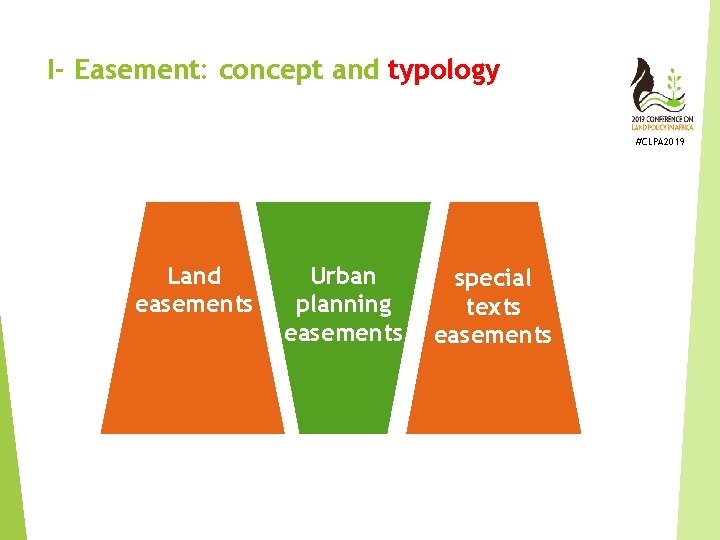
I- Easement: concept and typology #CLPA 2019 Land easements Urban planning easements special texts easements
I- Easement: concept and typology An easement can be defined, in land law, as a charge imposed on a parcel for the use and the benefit of another ownership. It derives either from the natural situation of the premises, or from obligations imposed by law, or from agreements between the owners. The land easement can be derived from: the location of the site, such as the general principle of free natural water flow on the lower bottoms; the law, as it is the case with the provisions relating to common ownership (wall, common pit). Hence, the respect of neighbourhood relations and right of way; the owners' agreements. #CLPA 2019
Easements established by special texts: Multiple are easements that are created by the legislator in order to protect, manage and operate the public domain. Such is the case of easements related to various networks (electricity, telephone, . . . ). Others are enacted for reasons of decency and tranquility, such as the protection zones around cemeteries. #CLPA 2019
It is obvious that this type of easement is in the common interest and applies to private land bordering on it. We can mention : easements linked to military sites and installations. The law establishes zones in which all construction is prohibited and all agricultural activities are prohibited. easements relating to aeronautical and air navigation zones. The law defines zones where no construction or raising is permitted in order to ensure visibility and avoid any risk for aircraft. isolation easements around the cemeteries. The law sets zones of 30, 70 and 200 m. In the first, no wells may be dug or any construction raised. In the other two, the construction is subject to restrictive measures. #CLPA 2019
Easements relating to historical monuments and sites, which, after their classification according to a regulatory procedure, are subject to protective measures. The issuance of the permit to build or to parcel out, by the competent authority, on neighbouring landholdings is subject to the opinion of the government authority in charge of cultural affairs. #CLPA 2019
Urban planning easements: Intrinsically, urban planning legislation includes #CLPA 2019 a number of rules and provisions limiting the right of ownership and use of the land. These easements are vast. They can prohibit or only frame a land use (height limitation, fixing the minimum building plot, conditions of establishment. . . ). Laws n° 12 -90 relating to urban planning, 25 -90 relating to allotments and housing groups as well as the dahir of 25 June 1960 relating to the development of rural agglomerations constitute the main urban planning texts.
Urban Planning documents (UPD) : ‒ Master Plan as a major tool of urban planning. ‒ Zoning plan is a median urban planning document. ‒ The Development Plan remains the most important tool. ‒ Plan for Rural Agglomerations The PDs continue to reflect a prescriptive and normative planning. ‒ The use of zoning as an unavoidable technique in urban planning. ‒ This logic continues to generate inequalities, spatial divisions and social distances. #CLPA 2019
UPD : set the general use of the land by locating areas subject to easements such as non- aedificandi areas where no construction can be raised, nonaltius tolendi where no height elevation is permitted. establish different easements, indicating the locations reserved to the infrastructure and public facilities. lay down the rules applicable to construction. Easements are established for the sake of hygiene, traffic, aesthetics, safety and public health. #CLPA 2019
#CLPA 2019 II- The question of compensation related to easements and jurisprudential framework
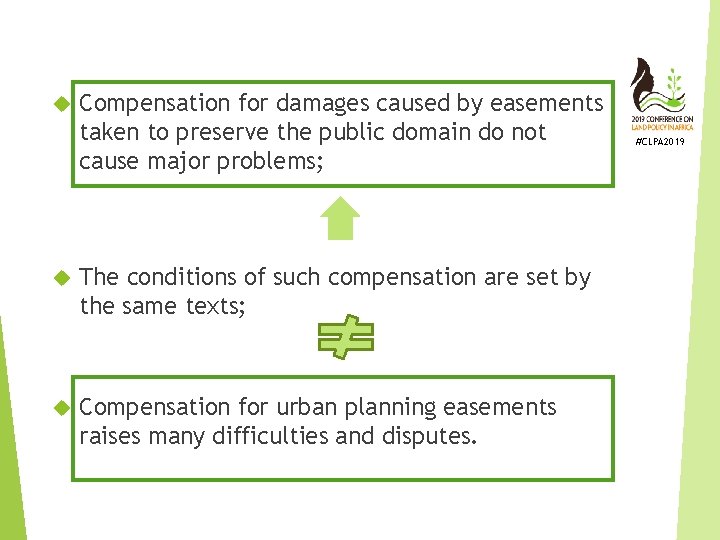
Compensation for damages caused by easements taken to preserve the public domain do not cause major problems; The conditions of such compensation are set by the same texts; Compensation for urban planning easements raises many difficulties and disputes. #CLPA 2019
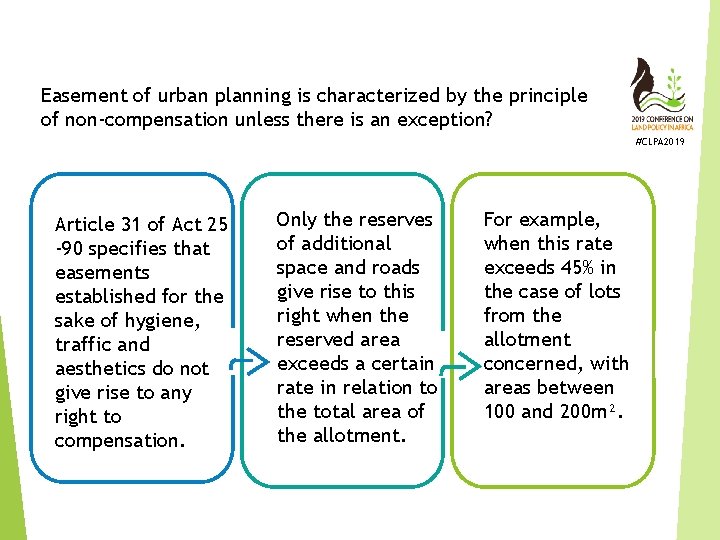
Easement of urban planning is characterized by the principle of non-compensation unless there is an exception? #CLPA 2019 Article 31 of Act 25 -90 specifies that easements established for the sake of hygiene, traffic and aesthetics do not give rise to any right to compensation. Only the reserves of additional space and roads give rise to this right when the reserved area exceeds a certain rate in relation to the total area of the allotment. For example, when this rate exceeds 45% in the case of lots from the allotment concerned, with areas between 100 and 200 m².
Under article 84 of Act 12 -90, easements established in terms of safety, hygiene and aesthetics do not involve any compensation unless it results from these easements: an infringement of acquired rights, a modification of the previous state of the premises determining direct, material and certain damage. The said indemnity shall be fixed either amicably or by legal means. The legal framework in force has opted for broad concepts such as safety, aesthetics, health, etc. , which can be used in a discretionary manner. Obviously, it is easy to apply these concepts to various measures. #CLPA 2019
Case law has tried to delimit interpretations of the law. It is worth highlighting the conclusions of some judgments that are considered interesting: the building permit issued without compliance with an assent is null and void. This conclusion is deduced from the judgment of the Oujda administrative Court, which considered the building permit in an aedificandi zone relating to the easement of a military barracks to be obsolete even if the petitioner obtained it from the president of the municipal council. The administrative judge of Fez considered that the allotment permit issued by the President of the Municipal Council on land bordering a classified historical monument, without having obtained the assent of the Department of Cultural Affairs, is null and void. #CLPA 2019
The State is not subject to criminal law, but is civilly liable for damages it causes as a result of irregular material acts. The administrative judge of Rabat considered that the work under taken by the administration on other people's land without observing the procedure in force is an abuse of power. The work carried out by the public administration outside the law can not be demolished and obviously gives the right to compensation, in order to preserve public funds. The administrative judge followed this logic in the case of an appeal against the municipality, which carried out a procedure without having observed the regulatory procedure. #CLPA 2019
Conclusion Pending effective measures of land justice, the rationalisation of the procedure for drawing up UPDs, #CLPA 2019 easement continues to give rise to mitigations concerning claims for compensation and annulment for abuse of power. This theme deserves multiple investigations in the legal and social field. It raises a wide range of questions relating to the rule of law in urban planning, the purposes of urbanism and management and the principles of land equity. It is unacceptable that an UPD should be a source of enrichment for some and impoverishment for others according to unfair issues.
#CLPA 2019 Thank you Abdelwahed El Idrissi a. recherche@gmail. com