
Earthworm distribution Soil microbiology Lyndon Fernandes Department of
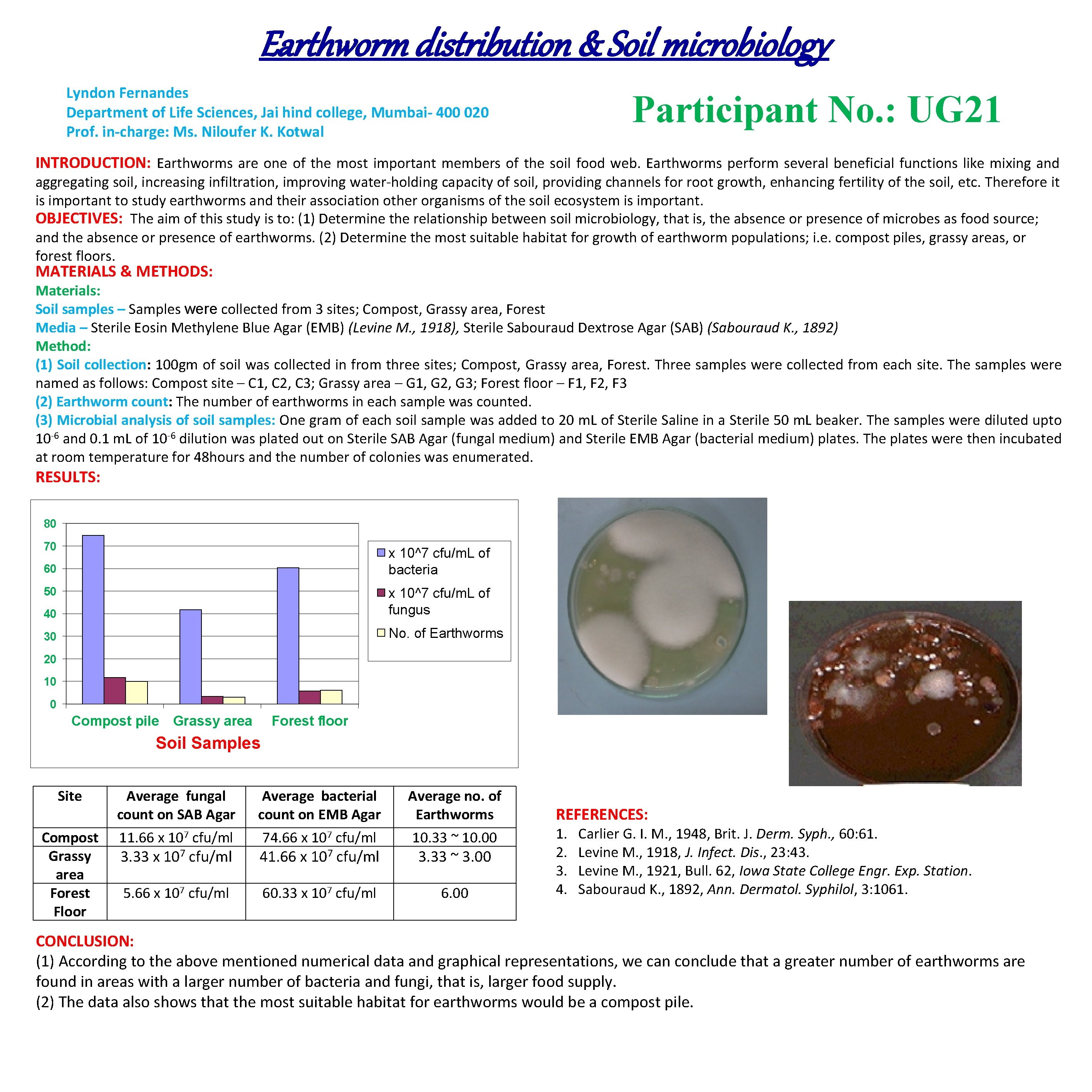
Earthworm distribution & Soil microbiology Lyndon Fernandes Department of Life Sciences, Jai hind college, Mumbai- 400 020 Prof. in-charge: Ms. Niloufer K. Kotwal Participant No. : UG 21 INTRODUCTION: Earthworms are one of the most important members of the soil food web. Earthworms perform several beneficial functions like mixing and aggregating soil, increasing infiltration, improving water-holding capacity of soil, providing channels for root growth, enhancing fertility of the soil, etc. Therefore it is important to study earthworms and their association other organisms of the soil ecosystem is important. OBJECTIVES: The aim of this study is to: (1) Determine the relationship between soil microbiology, that is, the absence or presence of microbes as food source; and the absence or presence of earthworms. (2) Determine the most suitable habitat for growth of earthworm populations; i. e. compost piles, grassy areas, or forest floors. MATERIALS & METHODS: Materials: Soil samples – Samples were collected from 3 sites; Compost, Grassy area, Forest Media – Sterile Eosin Methylene Blue Agar (EMB) (Levine M. , 1918), Sterile Sabouraud Dextrose Agar (SAB) (Sabouraud K. , 1892) Method: (1) Soil collection: 100 gm of soil was collected in from three sites; Compost, Grassy area, Forest. Three samples were collected from each site. The samples were named as follows: Compost site – C 1, C 2, C 3; Grassy area – G 1, G 2, G 3; Forest floor – F 1, F 2, F 3 (2) Earthworm count: The number of earthworms in each sample was counted. (3) Microbial analysis of soil samples: One gram of each soil sample was added to 20 m. L of Sterile Saline in a Sterile 50 m. L beaker. The samples were diluted upto 10 -6 and 0. 1 m. L of 10 -6 dilution was plated out on Sterile SAB Agar (fungal medium) and Sterile EMB Agar (bacterial medium) plates. The plates were then incubated at room temperature for 48 hours and the number of colonies was enumerated. RESULTS: 80 70 x 10^7 cfu/m. L of bacteria 60 50 40 x 10^7 cfu/m. L of fungus 30 No. of Earthworms 20 10 0 Compost pile Grassy area Forest floor Soil Samples Site Compost Grassy area Forest Floor Average fungal count on SAB Agar 11. 66 x 107 cfu/ml Average bacterial count on EMB Agar 74. 66 x 107 cfu/ml Average no. of Earthworms 10. 33 ~ 10. 00 5. 66 x 107 cfu/ml 60. 33 x 107 cfu/ml 6. 00 3. 33 x 107 cfu/ml 41. 66 x 107 cfu/ml 3. 33 ~ 3. 00 REFERENCES: 1. 2. 3. 4. Carlier G. I. M. , 1948, Brit. J. Derm. Syph. , 60: 61. Levine M. , 1918, J. Infect. Dis. , 23: 43. Levine M. , 1921, Bull. 62, Iowa State College Engr. Exp. Station. Sabouraud K. , 1892, Ann. Dermatol. Syphilol, 3: 1061. CONCLUSION: (1) According to the above mentioned numerical data and graphical representations, we can conclude that a greater number of earthworms are found in areas with a larger number of bacteria and fungi, that is, larger food supply. (2) The data also shows that the most suitable habitat for earthworms would be a compost pile.
- Slides: 1