
Earths Topography Topography Topography refers to the shape
- Slides: 35
Earth’s Topography
Topography ► Topography refers to the shape of the Earth’s surface, including an area’s elevation, relief, and landforms ► The surface of the Earth is changed by ►Weather conditions ►Running water ►Earthquakes and volcanoes ►People
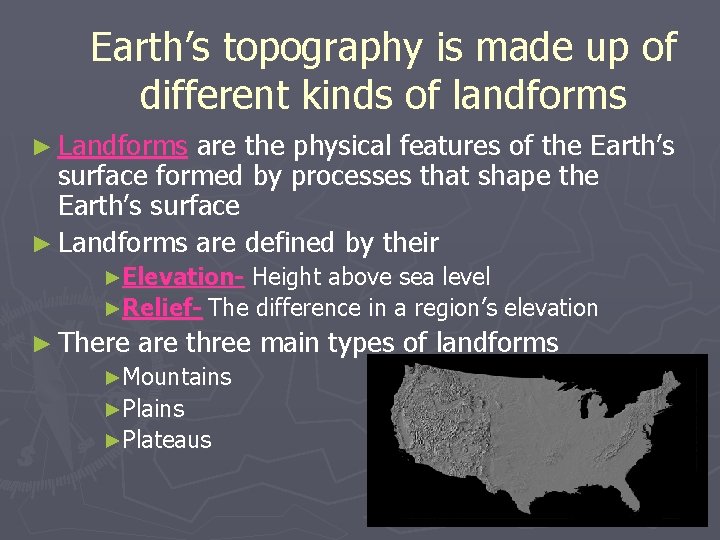
Earth’s topography is made up of different kinds of landforms ► Landforms are the physical features of the Earth’s surface formed by processes that shape the Earth’s surface ► Landforms are defined by their ►Elevation- Height above sea level ►Relief- The difference in a region’s elevation ► There are three ►Mountains ►Plateaus main types of landforms
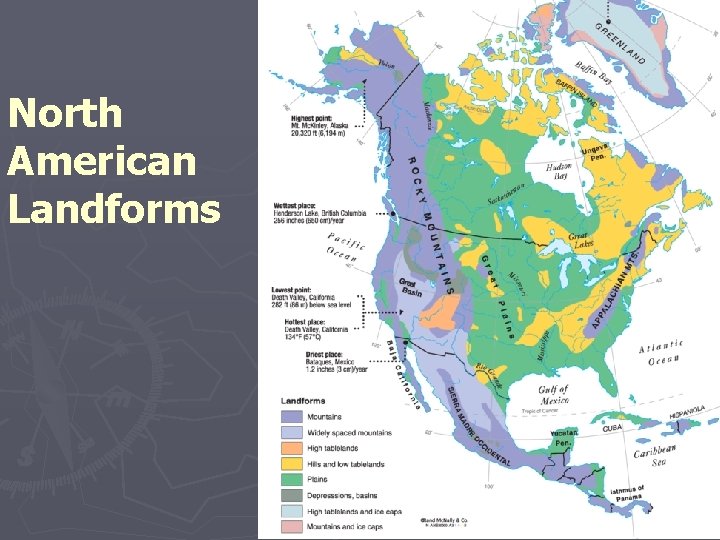
North American Landforms
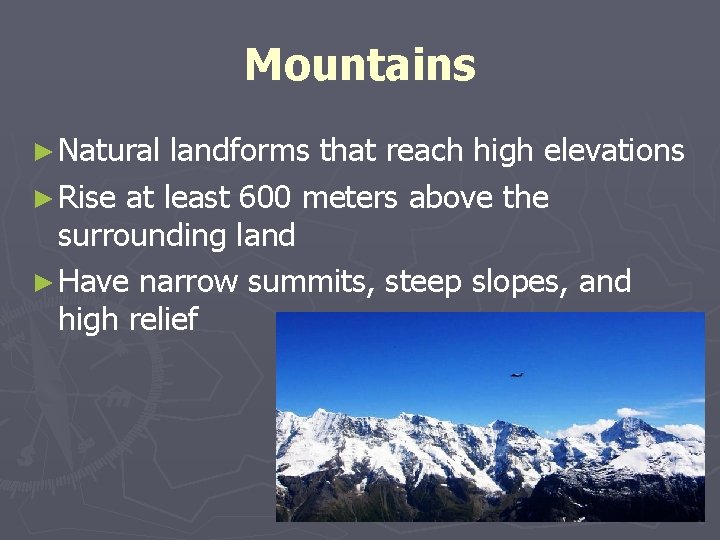
Mountains ► Natural landforms that reach high elevations ► Rise at least 600 meters above the surrounding land ► Have narrow summits, steep slopes, and high relief
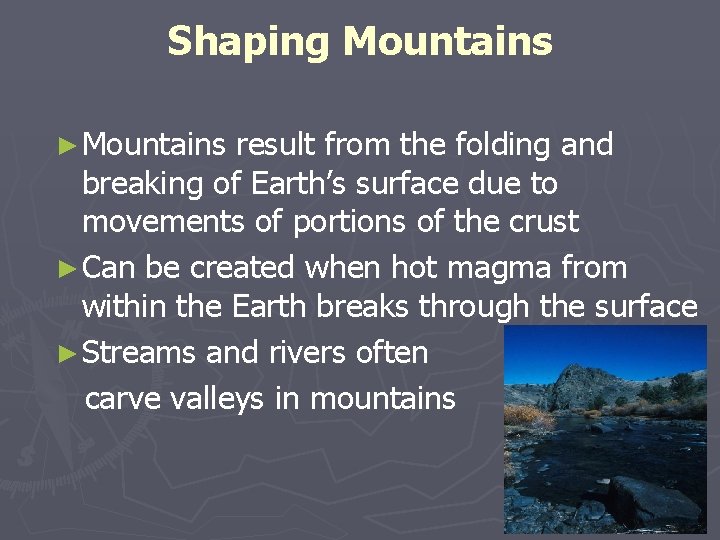
Shaping Mountains ► Mountains result from the folding and breaking of Earth’s surface due to movements of portions of the crust ► Can be created when hot magma from within the Earth breaks through the surface ► Streams and rivers often carve valleys in mountains
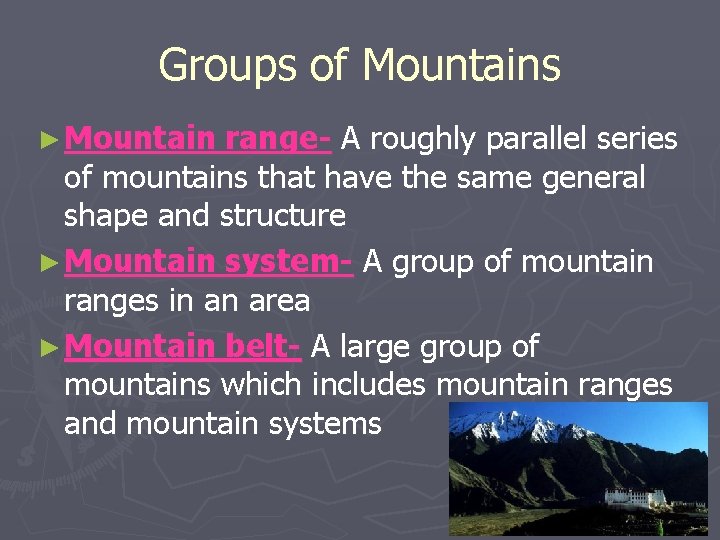
Groups of Mountains ► Mountain range- A roughly parallel series of mountains that have the same general shape and structure ► Mountain system- A group of mountain ranges in an area ► Mountain belt- A large group of mountains which includes mountain ranges and mountain systems
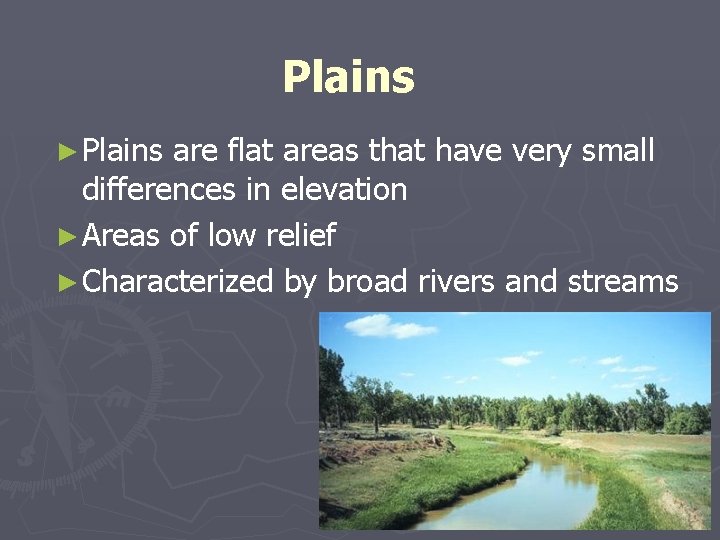
Plains ► Plains are flat areas that have very small differences in elevation ► Areas of low relief ► Characterized by broad rivers and streams
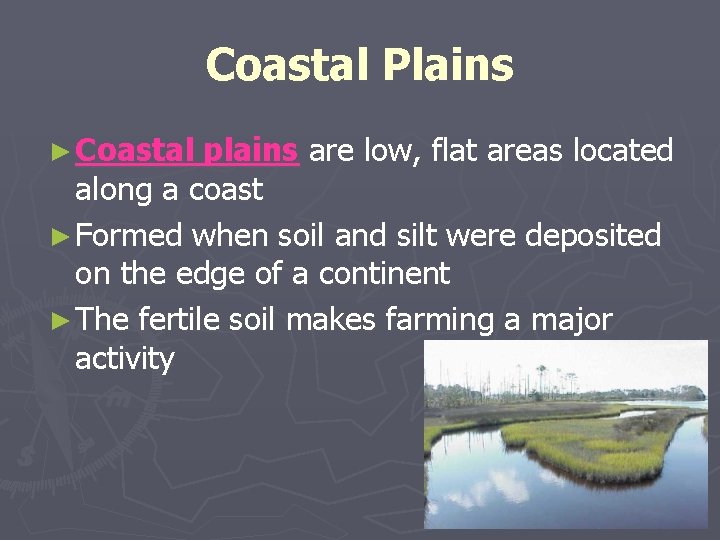
Coastal Plains ► Coastal plains are low, flat areas located along a coast ► Formed when soil and silt were deposited on the edge of a continent ► The fertile soil makes farming a major activity
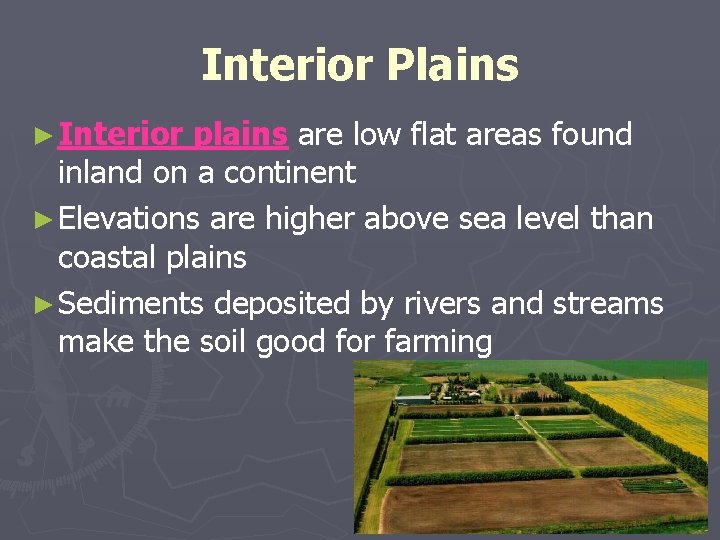
Interior Plains ► Interior plains are low flat areas found inland on a continent ► Elevations are higher above sea level than coastal plains ► Sediments deposited by rivers and streams make the soil good for farming
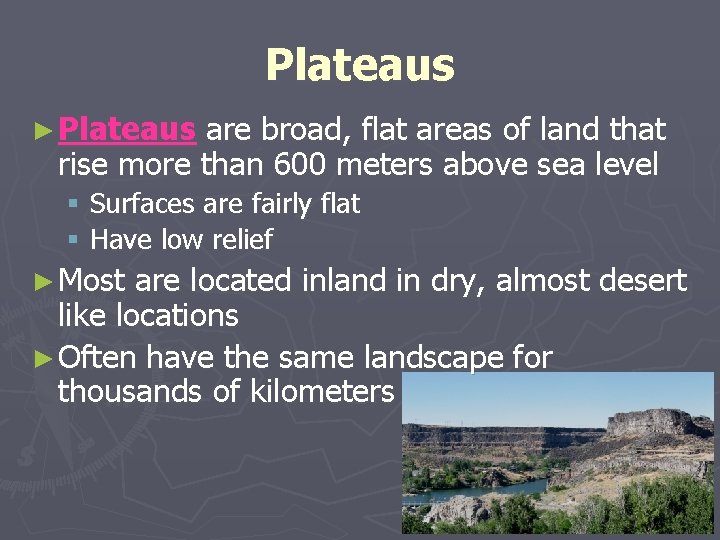
Plateaus ► Plateaus are broad, flat areas of land that rise more than 600 meters above sea level § Surfaces are fairly flat § Have low relief ► Most are located inland in dry, almost desert like locations ► Often have the same landscape for thousands of kilometers
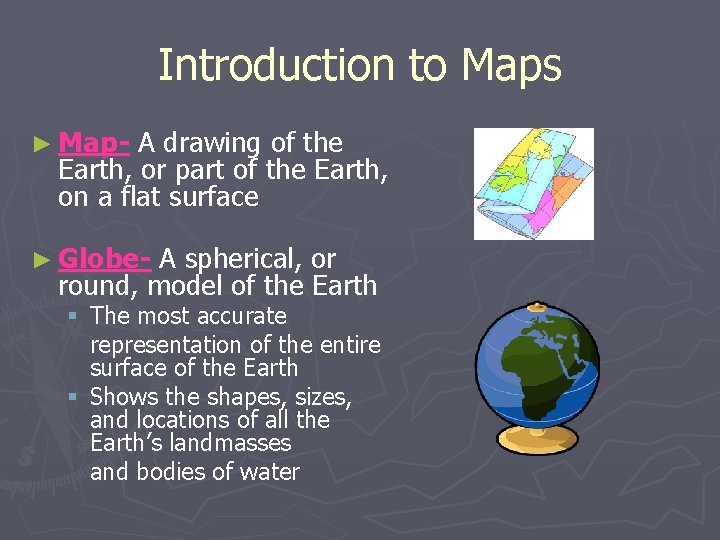
Introduction to Maps ► Map- A drawing of the Earth, or part of the Earth, on a flat surface ► Globe- A spherical, or round, model of the Earth § The most accurate representation of the entire surface of the Earth § Shows the shapes, sizes, and locations of all the Earth’s landmasses and bodies of water
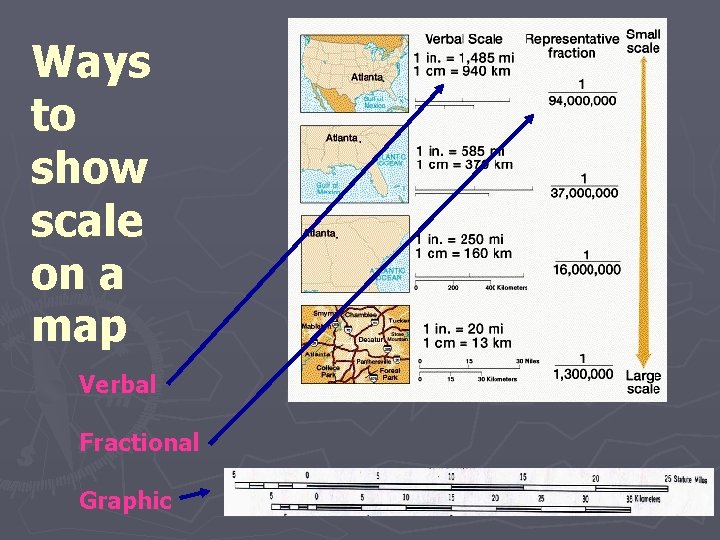
Map Scales ► Both maps and globes are drawn to scale ► The scale compares distances on a map or globe to actual distances on the earth’s surface ► The more closely the map approaches the land in size, the larger the scale will be
Ways to show scale on a map Verbal Fractional Graphic
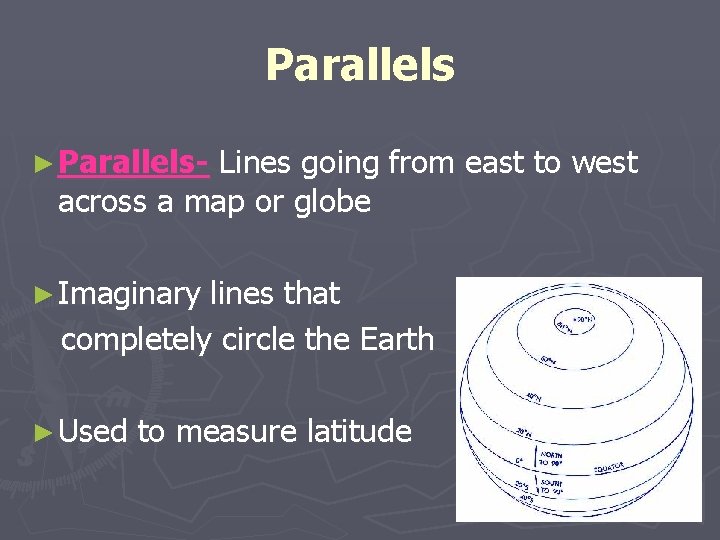
Parallels ► Parallels- Lines going from east to west across a map or globe ► Imaginary lines that completely circle the Earth ► Used to measure latitude
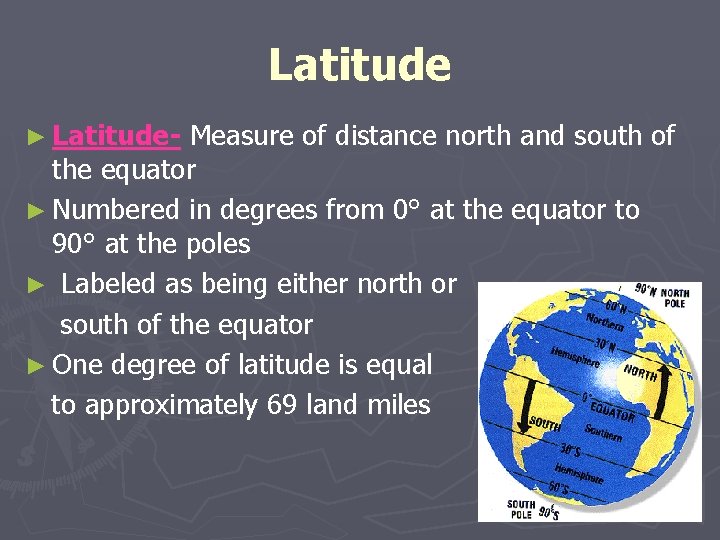
Latitude ► Latitude- Measure of distance north and south of the equator ► Numbered in degrees from 0° at the equator to 90° at the poles ► Labeled as being either north or south of the equator ► One degree of latitude is equal to approximately 69 land miles
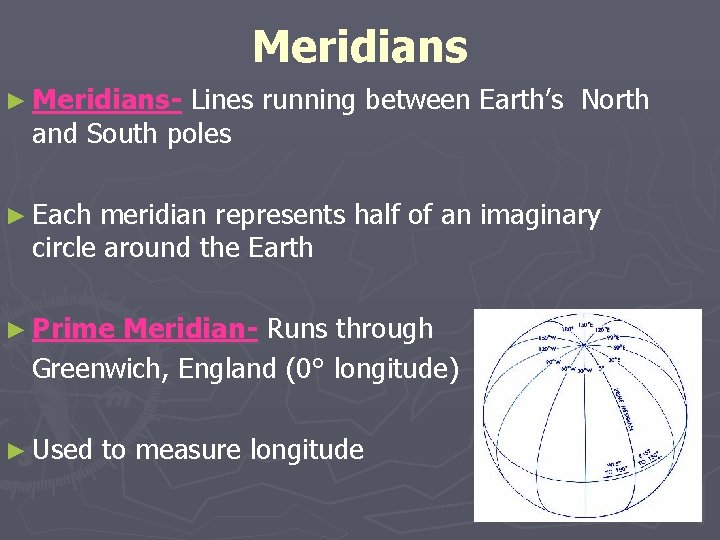
Meridians ► Meridians- Lines running between Earth’s North and South poles ► Each meridian represents half of an imaginary circle around the Earth ► Prime Meridian- Runs through Greenwich, England (0° longitude) ► Used to measure longitude
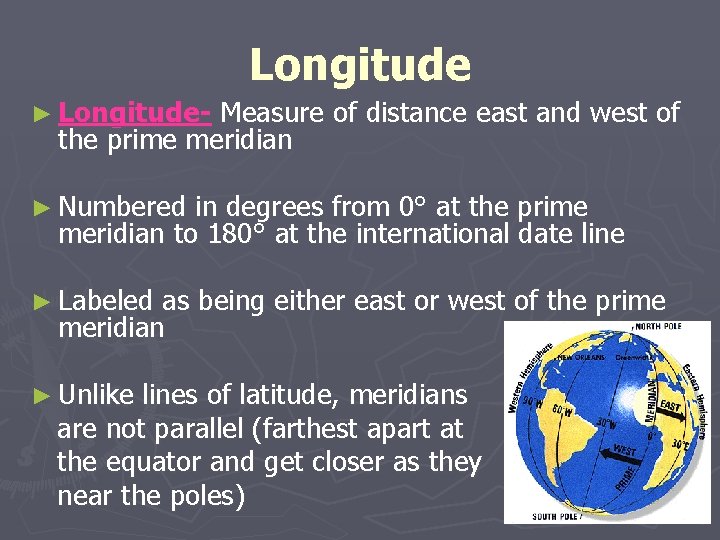
Longitude ► Longitude- Measure of distance east and west of the prime meridian ► Numbered in degrees from 0° at the prime meridian to 180° at the international date line ► Labeled as being either east or west of the prime meridian ► Unlike lines of latitude, meridians are not parallel (farthest apart at the equator and get closer as they near the poles)
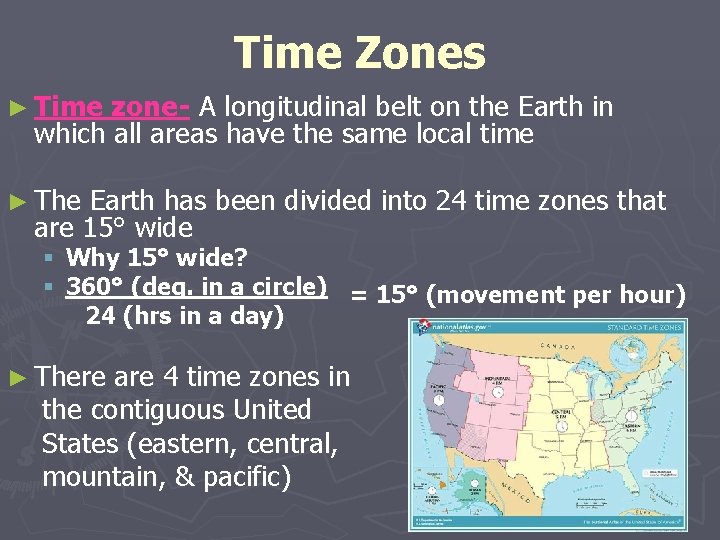
Time Zones ► Time zone- A longitudinal belt on the Earth in which all areas have the same local time ► The Earth has been divided into 24 time zones that are 15° wide § Why 15° wide? § 360° (deg. in a circle) = 15° (movement per hour) 24 (hrs in a day) ► There are 4 time zones in the contiguous United States (eastern, central, mountain, & pacific)
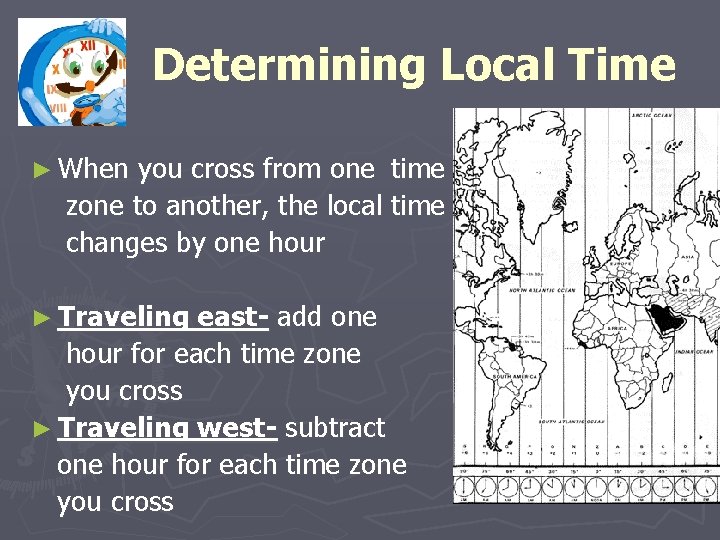
Determining Local Time ► When you cross from one time zone to another, the local time changes by one hour ► Traveling east- add one hour for each time zone you cross ► Traveling west- subtract one hour for each time zone you cross
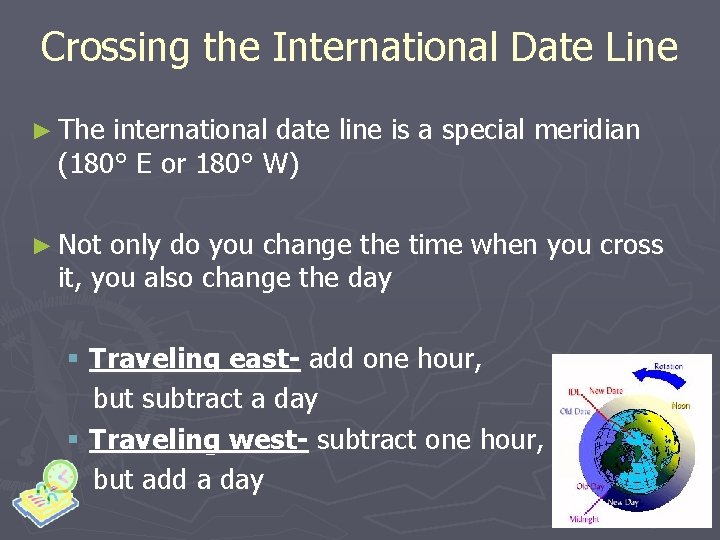
Crossing the International Date Line ► The international date line is a special meridian (180° E or 180° W) ► Not only do you change the time when you cross it, you also change the day § Traveling east- add one hour, but subtract a day § Traveling west- subtract one hour, but add a day
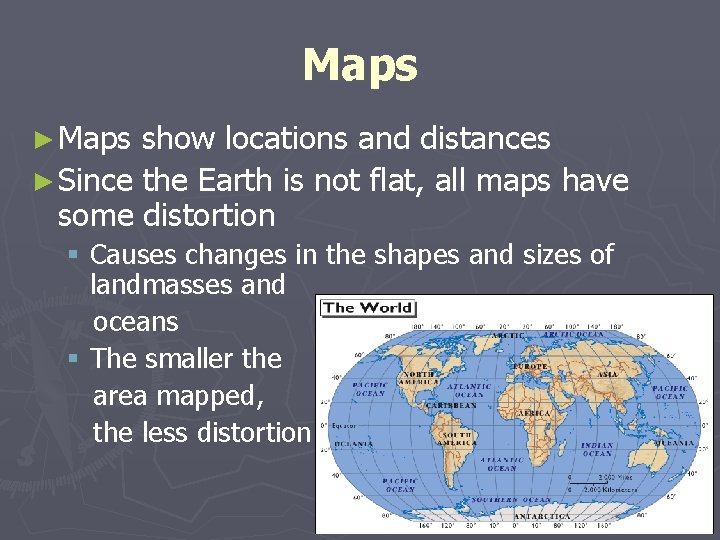
Maps ► Maps show locations and distances ► Since the Earth is not flat, all maps have some distortion § Causes changes in the shapes and sizes of landmasses and oceans § The smaller the area mapped, the less distortion
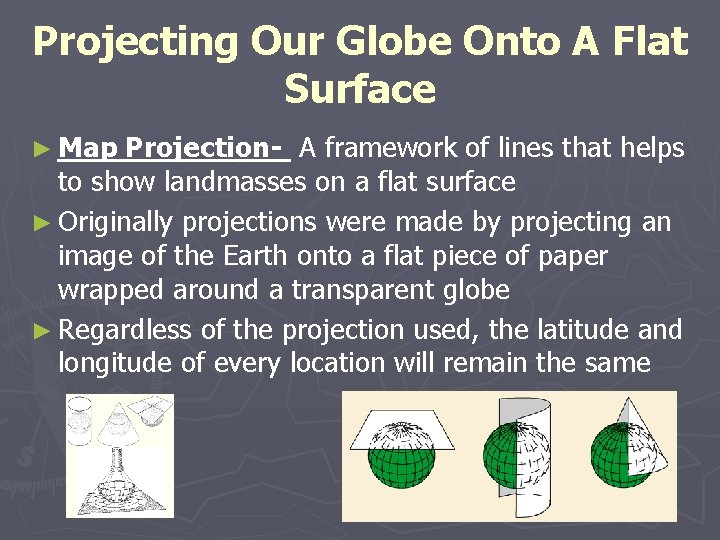
Projecting Our Globe Onto A Flat Surface ► Map Projection- A framework of lines that helps to show landmasses on a flat surface ► Originally projections were made by projecting an image of the Earth onto a flat piece of paper wrapped around a transparent globe ► Regardless of the projection used, the latitude and longitude of every location will remain the same
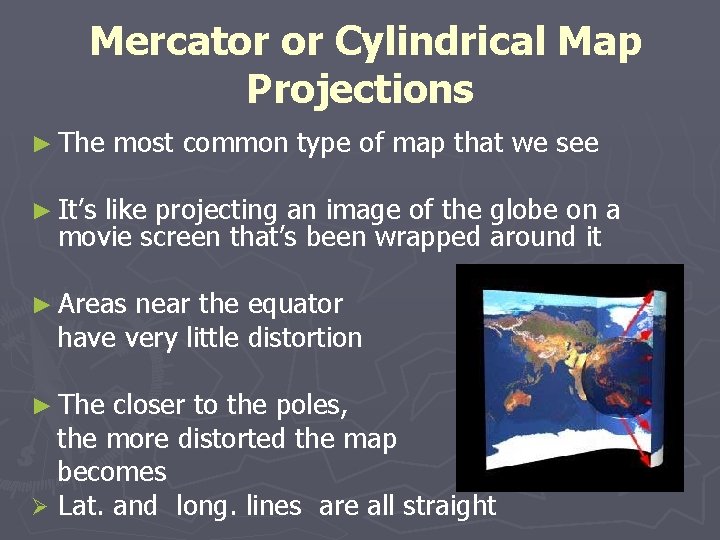
Mercator or Cylindrical Map Projections ► The most common type of map that we see ► It’s like projecting an image of the globe on a movie screen that’s been wrapped around it ► Areas near the equator have very little distortion ► The closer to the poles, the more distorted the map becomes Ø Lat. and long. lines are all straight
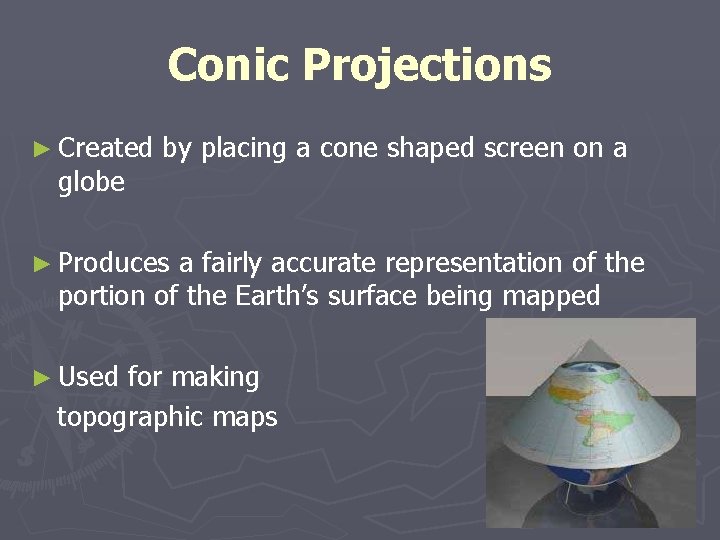
Conic Projections ► Created globe by placing a cone shaped screen on a ► Produces a fairly accurate representation of the portion of the Earth’s surface being mapped ► Used for making topographic maps
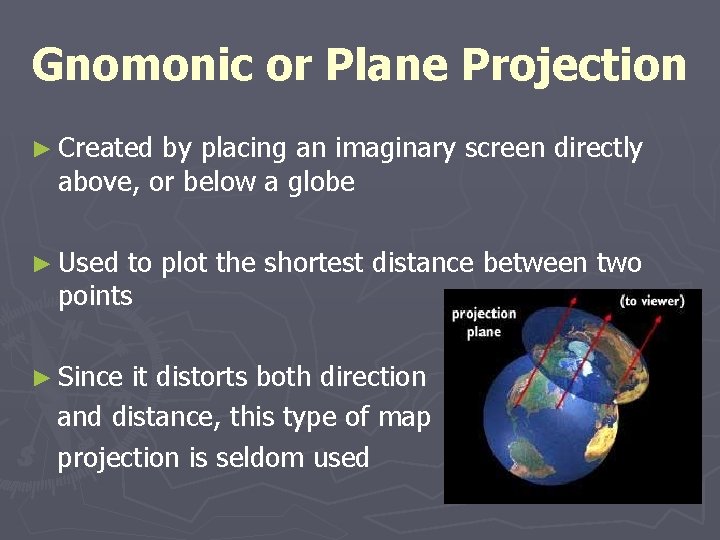
Gnomonic or Plane Projection ► Created by placing an imaginary screen directly above, or below a globe ► Used to plot the shortest distance between two points ► Since it distorts both direction and distance, this type of map projection is seldom used
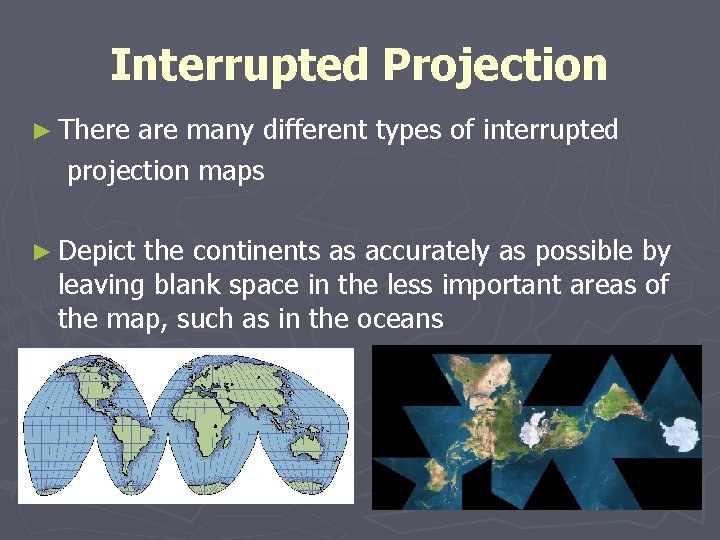
Interrupted Projection ► There are many different types of interrupted projection maps ► Depict the continents as accurately as possible by leaving blank space in the less important areas of the map, such as in the oceans
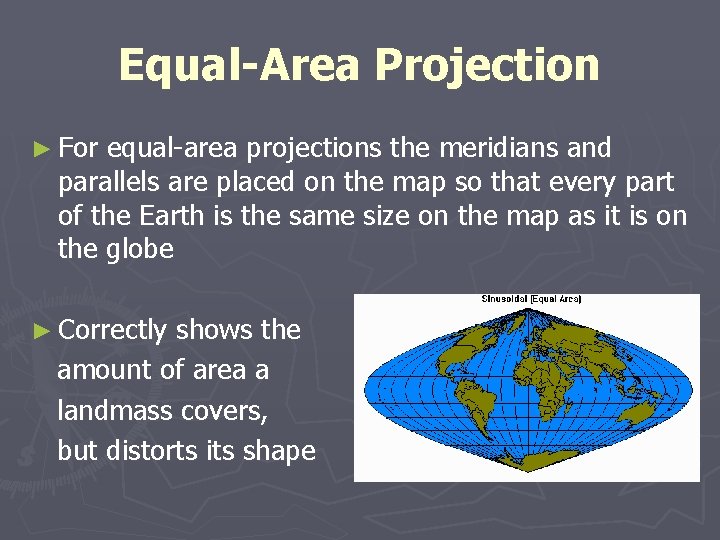
Equal-Area Projection ► For equal-area projections the meridians and parallels are placed on the map so that every part of the Earth is the same size on the map as it is on the globe ► Correctly shows the amount of area a landmass covers, but distorts its shape
Computer Mapping ► With computers, cartographers can store, process, and display maps electronically ► Computers produce maps using data from many sources, including satellites and the Global Positioning System ► Satellite images- Pictures of the land surface based on computer data collected from satellites in space ► Global Positioning System (GPS)- Method of finding latitude, longitude, and elevation of points on Earth’s surface using a network of satellites
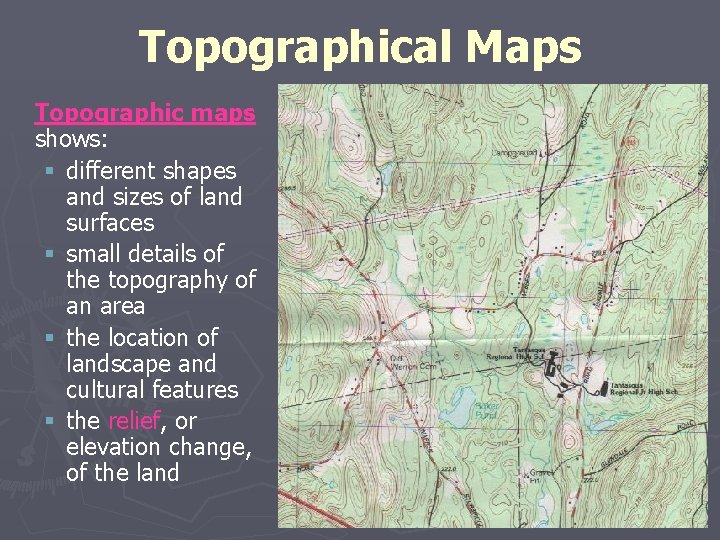
Topographical Maps Topographic maps shows: § different shapes and sizes of land surfaces § small details of the topography of an area § the location of landscape and cultural features § the relief, or elevation change, of the land
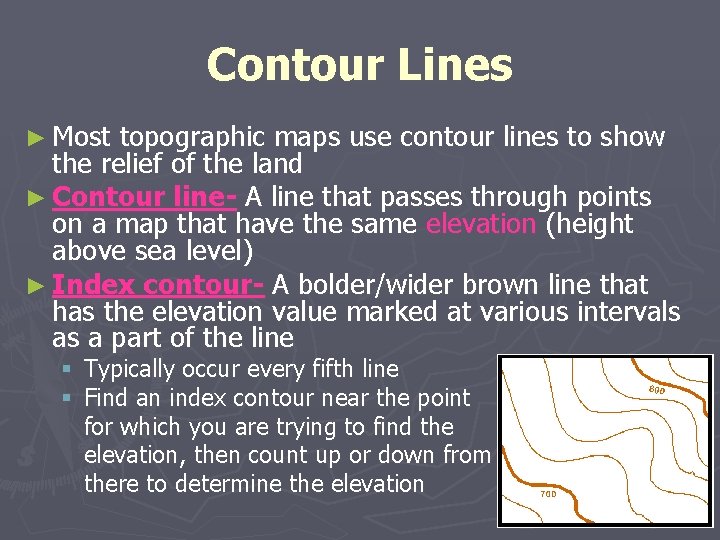
Contour Lines ► Most topographic maps use contour lines to show the relief of the land ► Contour line- A line that passes through points on a map that have the same elevation (height above sea level) ► Index contour- A bolder/wider brown line that has the elevation value marked at various intervals as a part of the line § Typically occur every fifth line § Find an index contour near the point for which you are trying to find the elevation, then count up or down from there to determine the elevation
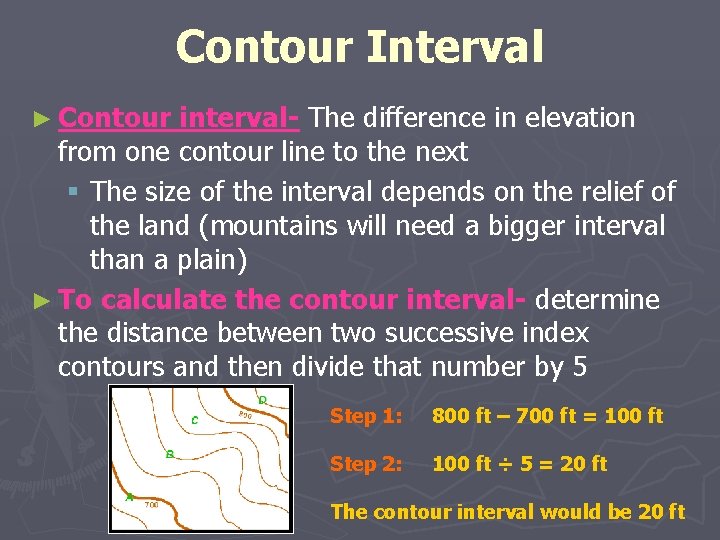
Contour Interval ► Contour interval- The difference in elevation from one contour line to the next § The size of the interval depends on the relief of the land (mountains will need a bigger interval than a plain) ► To calculate the contour interval- determine the distance between two successive index contours and then divide that number by 5 Step 1: 800 ft – 700 ft = 100 ft Step 2: 100 ft ÷ 5 = 20 ft The contour interval would be 20 ft
Rules for using contour lines 1. 2. 3. 4. 5. 6. 7. Contour lines never cross or intersect Closely spaced lines represent a steep slope Contours spaced far apart represent a gentle slope Contour lines form V’s that point upstream, or in a direction opposite the flow of the stream Contours form closed loops around hilltops or depressions Short dashes called hachures are used to indicate a depression All contour lines either close or extend to the edge of a map
Mapping Etiquette To make reading and using a map easier, all maps should have a: § Title- to know what you’re looking at § Compass rose or north facing arrow- to determine direction § Map scale- to determine distance § Map key (or legend)- to explain symbols used § A way to determine the contour interval on topographic maps
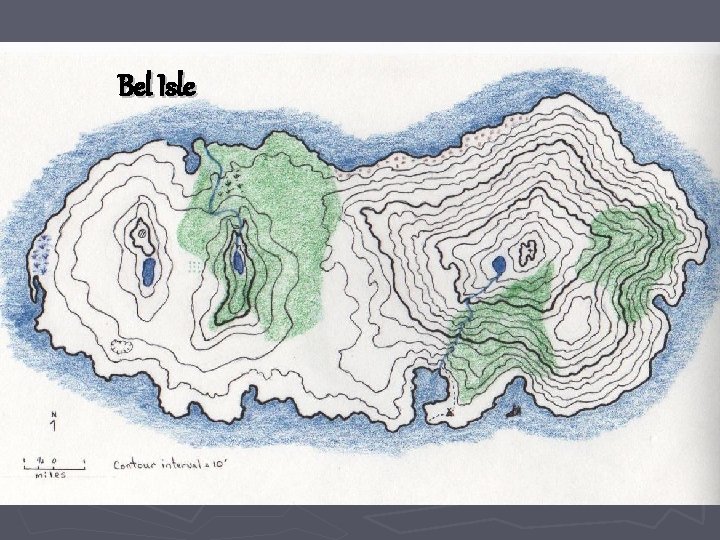
Bel Isle