
Earths Origins 4 6 billion years ago Earth

Earth’s Origins 4. 6 billion years ago Earth was a planetesimal developing into a planetoid The only gasses present were Hydrogen and Helium No magnetic field Meteorite bombardment continued for over 500 million years aided Earth’s growth.
Earth’s Origins Meteorites contained rock-forming elements (Mg, Si, Fe, Al, Ca, Ni) non-condensable elements (H, He, O, C, Ne, N, S, Ar, P).
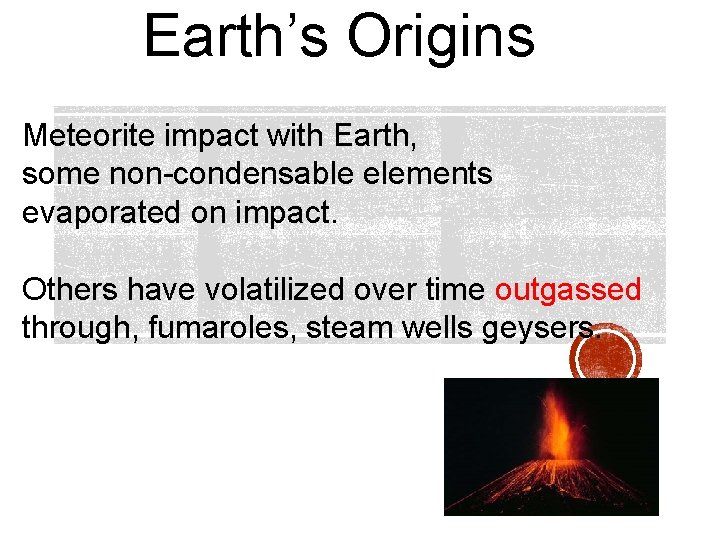
Earth’s Origins Meteorite impact with Earth, some non-condensable elements evaporated on impact. Others have volatilized over time outgassed through, fumaroles, steam wells geysers.
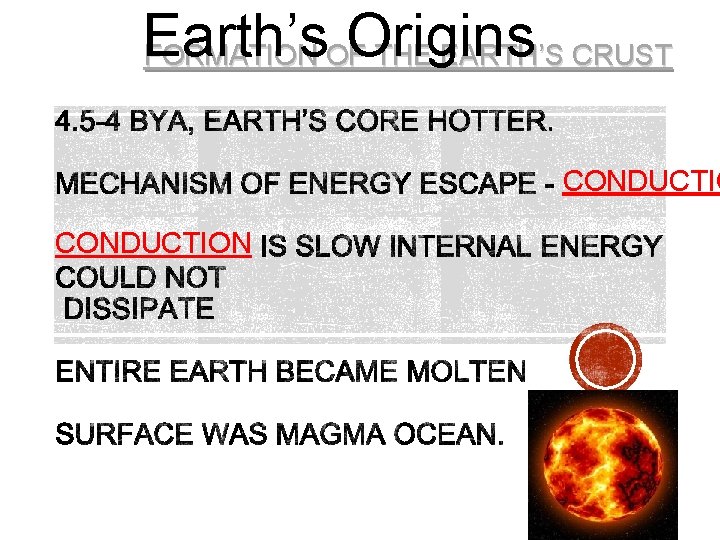
Earth’s Origins FORMATION OF THE EARTH’S CRUST CONDUCTION
Earth’s Origins FORMATION OF THE EARTH’S CRUST CONVECTION ALL 0 WED MORE ENERGY TO BE RELEASED. THIS PERMITTED COOLING OF THE SURFACE FORMING EARTH’S CRUST 3. 8 – 4. 3 BYA


1. Crust A. Thin outer layer B. Varies in thickness 1. 70 km in some mountainous regions 2. Less than in oceanic regions
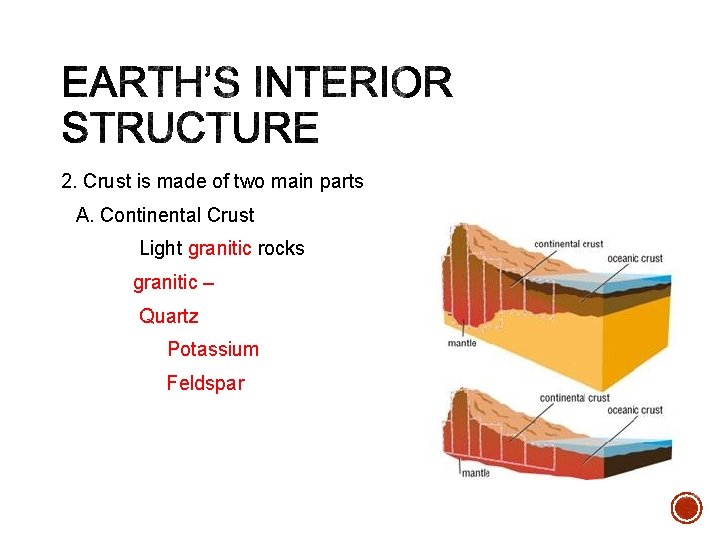
2. Crust is made of two main parts A. Continental Crust Light granitic rocks granitic – Quartz Potassium Feldspar

2. Crust is made of two main parts B. Oceanic Crust. Heavier basaltic composition Plagioclase feldspar pyroxene
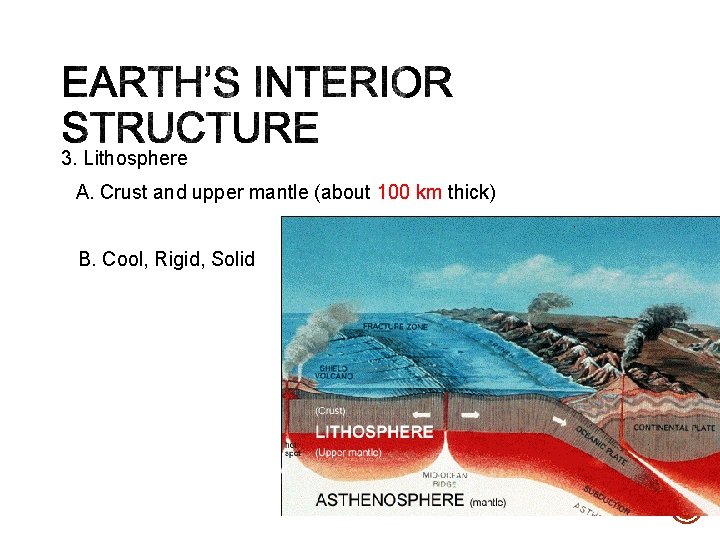
3. Lithosphere A. Crust and upper mantle (about 100 km thick) B. Cool, Rigid, Solid
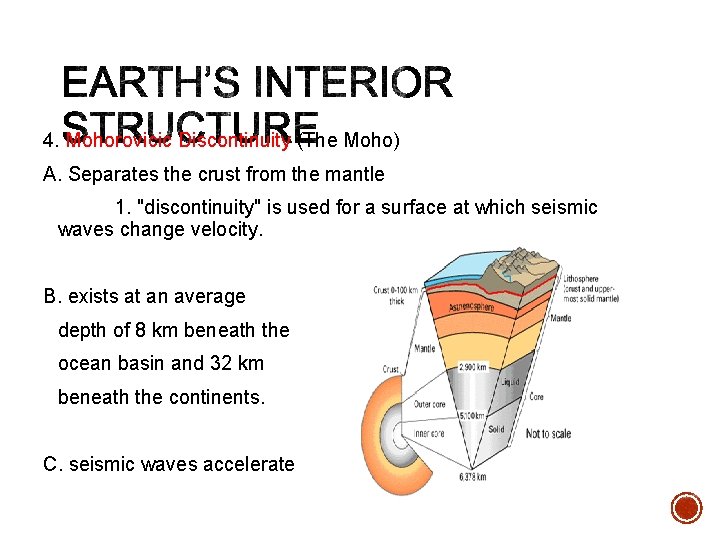
4. Mohorovicic Discontinuity (The Moho) A. Separates the crust from the mantle 1. "discontinuity" is used for a surface at which seismic waves change velocity. B. exists at an average depth of 8 km beneath the ocean basin and 32 km beneath the continents. C. seismic waves accelerate
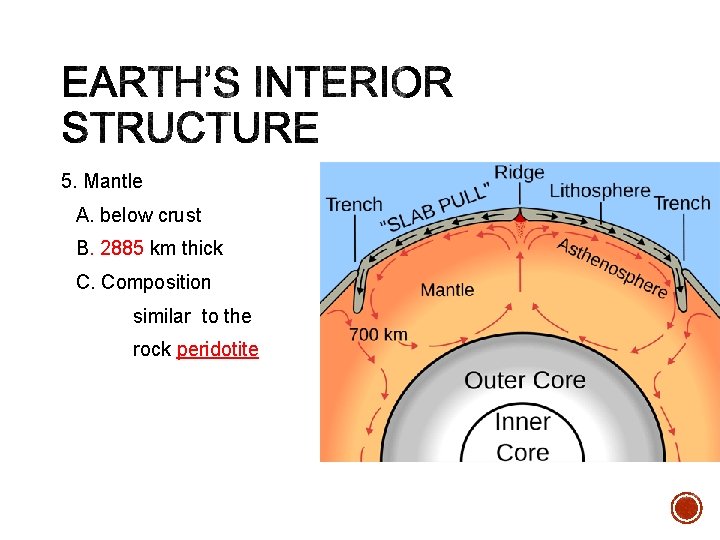
5. Mantle A. below crust B. 2885 km thick C. Composition similar to the rock peridotite
6. Asthenosphere A. Upper Mantle B. Depth of 100 to 350 Km C. Hot, weak rock D. Easily deformed E. Up to 10% is molten F. Key to the explanation of plate movement
7. Outer Core A. Below mantle B. 2270 km thick C. Mobile liquid D. Does not transmit S waves from Earthquakes E. Mainly iron and nickel composition F. Related to Earth’s magnetic field
EARTH’S INTERIOR STRUCTURE 8. Inner Core A. 1216 km Radius B. Solid C. Iron and Nickel composition D. High Density
§ Increase in gravity § Increasing pressure in the center creating solid metallic inner core § Release of pressure moving out from the center § allows for a molten outer core § Generates the magnetic field § Less dense materials “floated” to the top (crust)


Physical Structure of the Earth (5 Layers) Lithosphere- rigid outer layer (crust) Asthenosphere- solid rock that flows slowly (like hot asphalt) Mesosphere- middle layer Outer Core- liquid layer Inner Core- solid, very dense


1. 1. 70 2. 5 3. 75 4. 57
2. 1. granitic 2. basaltic 3. granular 4. crushed
3. 1. Mantle and inner core 2. Crust and lower mantle 3. Mantle and atmosphere 4. Crust and upper mantle
4. 1. accelerate 2. decelerate 3. stop 4. Reflect upwards
5. 1. granite 2. basalt 3. peridotite 4. quartz
6. 1. Sauronsphere 2. Atmosphere 3. Lithosphere 4. Asthenosphere
7. 1. Liquid 2. Solid 3. Gas 4. Plasma
8. 1. Iron & Basalt 2. Granite & Nickel 3. Iron & Nickel 4. Basalt & Granite

- Slides: 32