
Earths Moon The Earths natural satellite Simple Facts
- Slides: 24
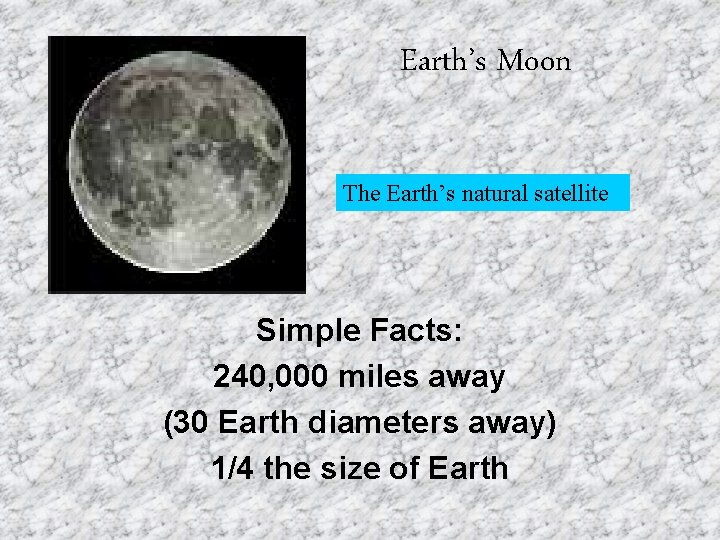
Earth’s Moon The Earth’s natural satellite Simple Facts: 240, 000 miles away (30 Earth diameters away) 1/4 the size of Earth
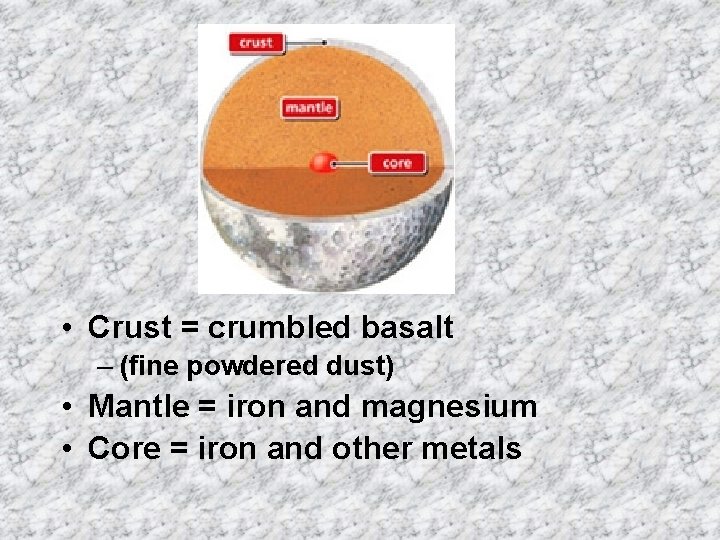
More Moon Facts • • The moon is Earth’s natural satellite its light source is the sun It has 3 layers: crust, mantle and core We can only see one side of the moon from earth • It took the astronauts 3 days to reach the moon
• Crust = crumbled basalt – (fine powdered dust) • Mantle = iron and magnesium • Core = iron and other metals
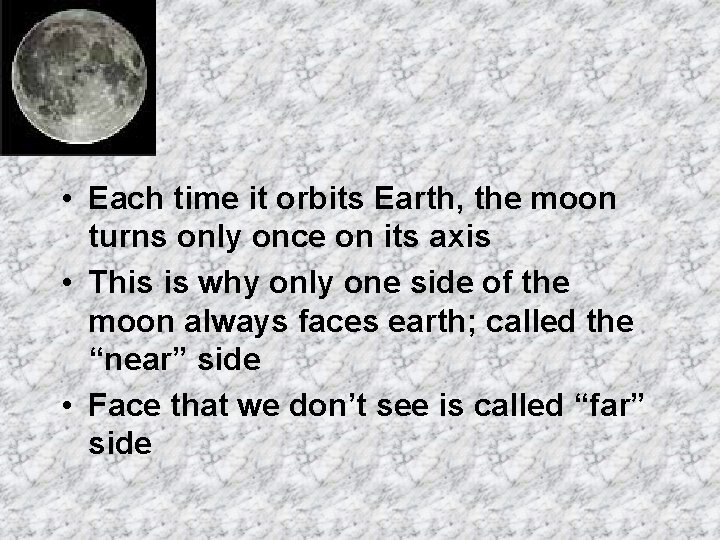
• Each time it orbits Earth, the moon turns only once on its axis • This is why only one side of the moon always faces earth; called the “near” side • Face that we don’t see is called “far” side
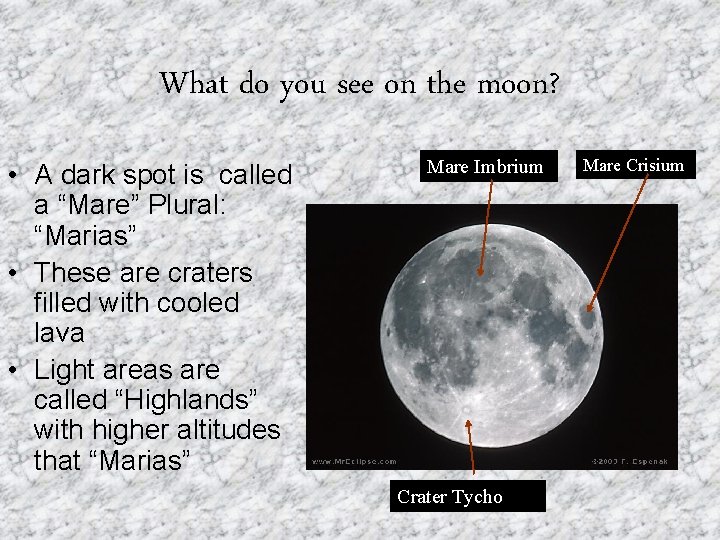
What do you see on the moon? • A dark spot is called a “Mare” Plural: “Marias” • These are craters filled with cooled lava • Light areas are called “Highlands” with higher altitudes that “Marias” Mare Imbrium Crater Tycho Mare Crisium
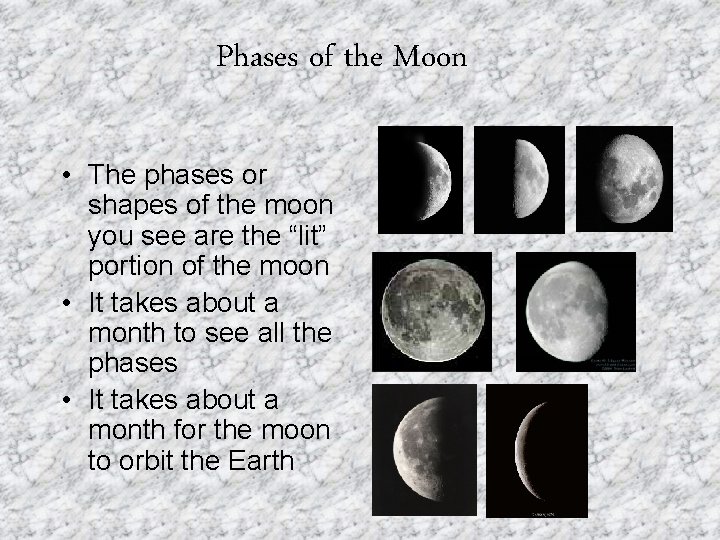
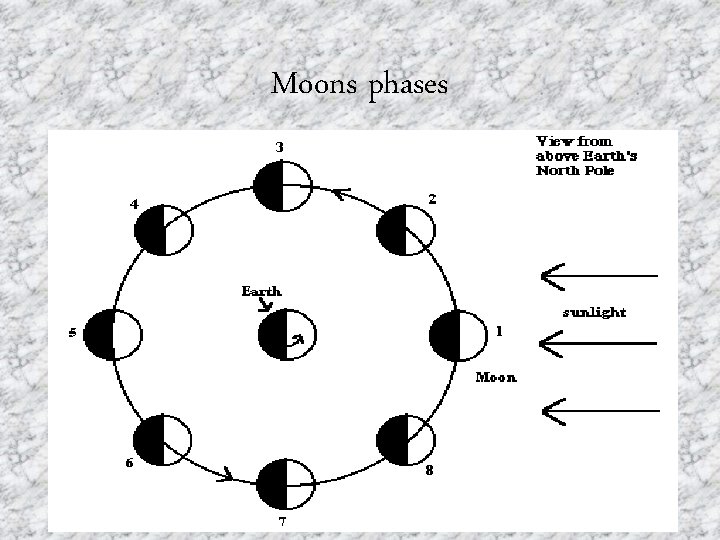
Phases of the Moon • The phases or shapes of the moon you see are the “lit” portion of the moon • It takes about a month to see all the phases • It takes about a month for the moon to orbit the Earth
Moons phases
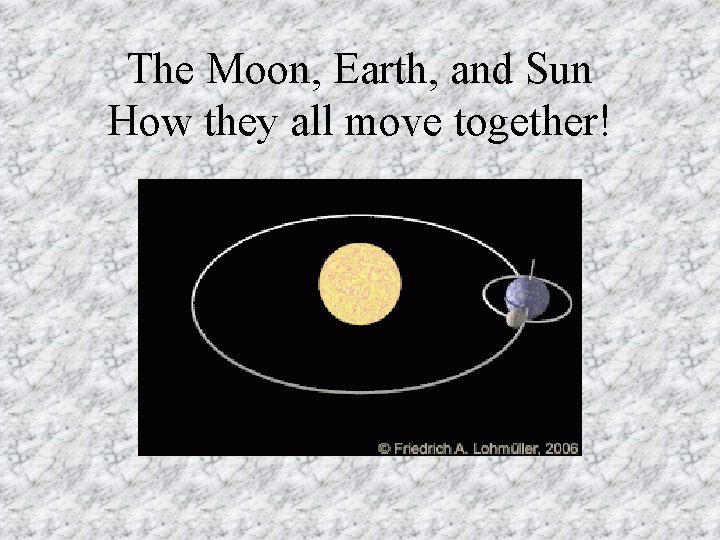
The Moon, Earth, and Sun How they all move together!
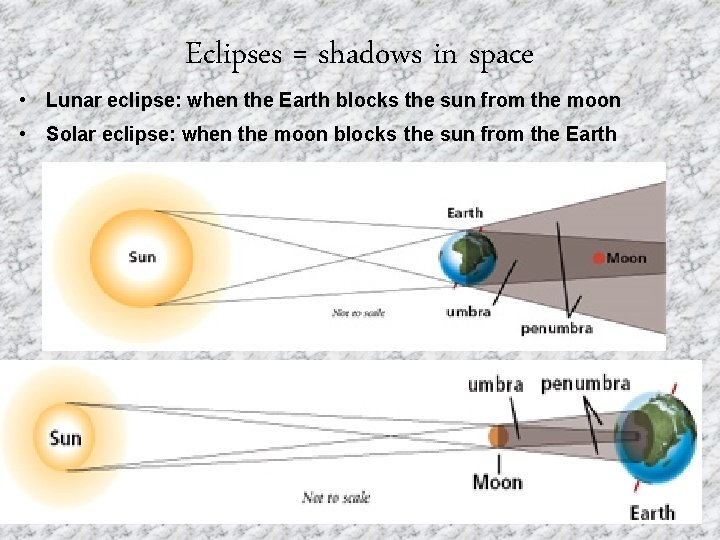
Eclipses = shadows in space • Lunar eclipse: when the Earth blocks the sun from the moon • Solar eclipse: when the moon blocks the sun from the Earth
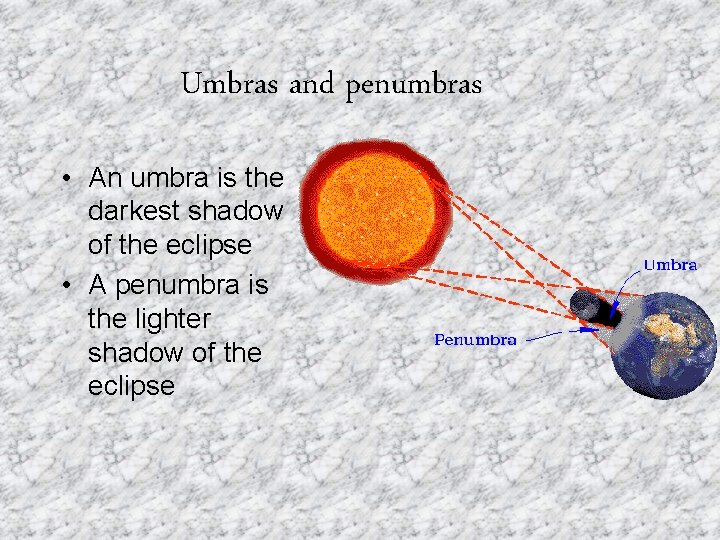
Umbras and penumbras • An umbra is the darkest shadow of the eclipse • A penumbra is the lighter shadow of the eclipse
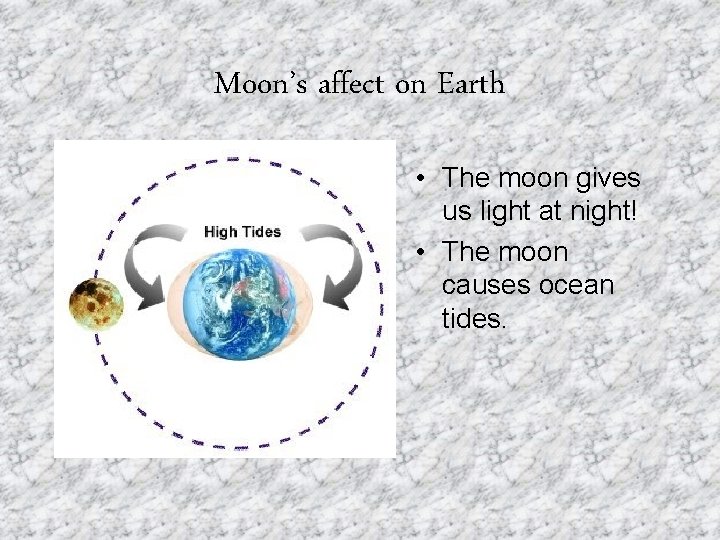
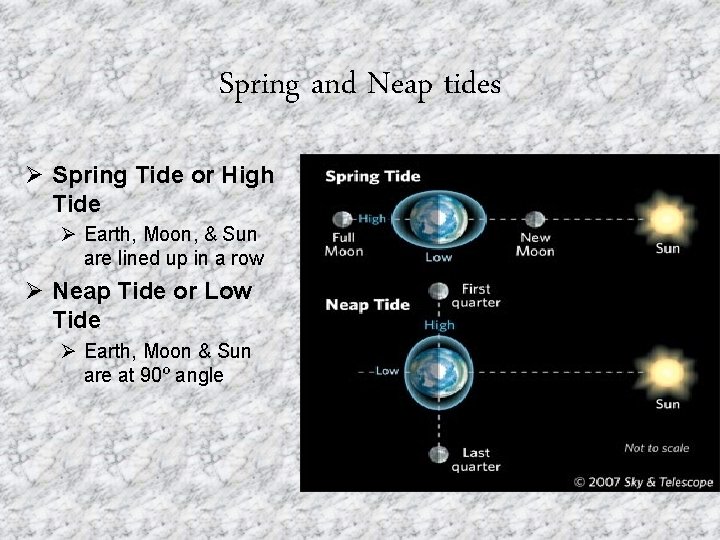
Moon’s affect on Earth • The moon gives us light at night! • The moon causes ocean tides.
Spring and Neap tides Ø Spring Tide or High Tide Ø Earth, Moon, & Sun are lined up in a row Ø Neap Tide or Low Tide Ø Earth, Moon & Sun are at 90º angle
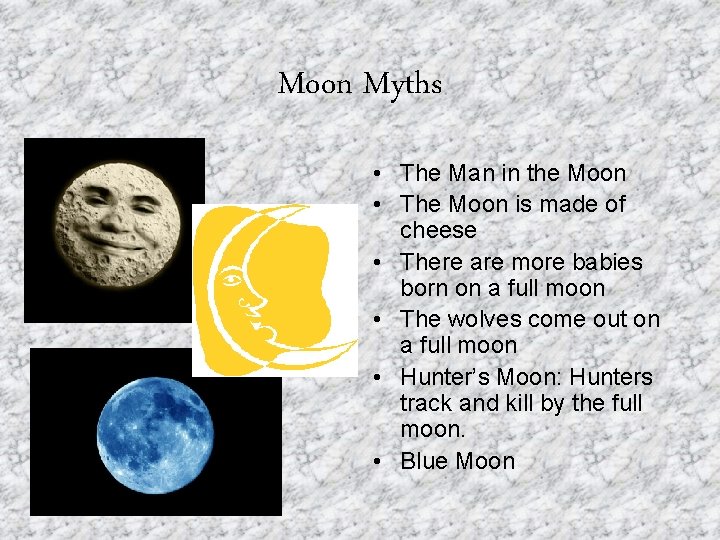
Moon Myths • The Man in the Moon • The Moon is made of cheese • There are more babies born on a full moon • The wolves come out on a full moon • Hunter’s Moon: Hunters track and kill by the full moon. • Blue Moon
Moon Quiz 1. How long does it take for the Moon to orbit Earth? a. 1 year b. 1 month c. 1 week
2. What do we call the “dark” spots on the Moon? a) Highlands b) Holes c) Marias
3. Why do we always see only one side of the moon? a) Because the moon does not rotate b) Because the moon revolves around the Earth c) The moon always keeps one side facing its planet: Earth.
4. The Moon’s structure consists of: a) 2 layers: crust and core b) 3 layers: crust, mantle and core c) 4 layers: moon dust, crust, mantle and core
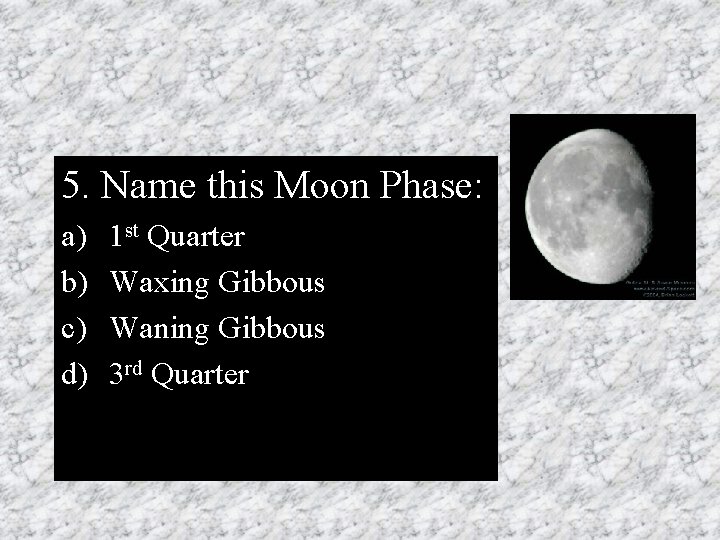
5. Name this Moon Phase: a) b) c) d) 1 st Quarter Waxing Gibbous Waning Gibbous 3 rd Quarter
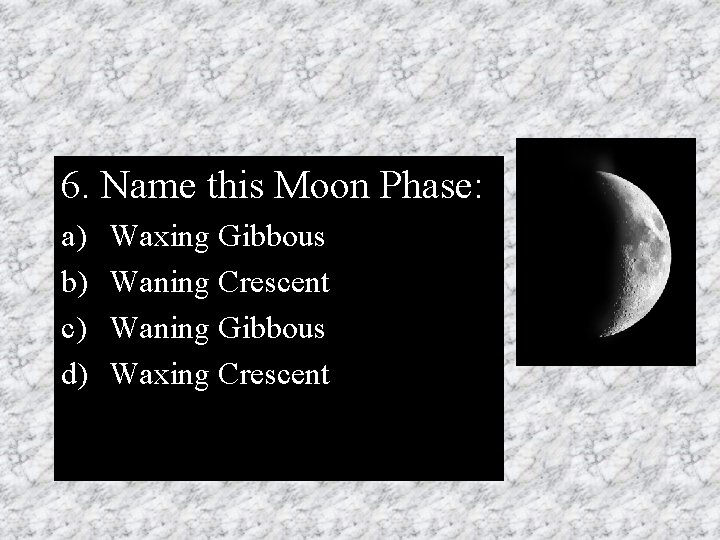
6. Name this Moon Phase: a) b) c) d) Waxing Gibbous Waning Crescent Waning Gibbous Waxing Crescent
7. When the Earth blocks the sunlight from the Moon this is a: a) Lunar Eclipse b) Solar Eclipse
8. The dark shadow from an eclipse is called a: a) Penumbra b) Umbra
9. How many tides do we have per day? a) b) c) d) 2 4 3 1
10. If you sat on the beach in California for the entire day, how many “high” tides would you see? a) 2 b) 3 c) 1