
Earths Magnetosphere A very quick introduction Weichao Tu
![What’s inside? – Inner Magnetosphere • Ring Current [Kavanagh et al. , 1968] –](https://slidetodoc.com/presentation_image_h2/12bfd68280b72d26160316e6859ae532/image-10.jpg "What’s inside? – Inner Magnetosphere • Ring Current [Kavanagh et al. , 1968] –")
![Variations of Plasmapause Location EUV Imager of IMAGE [Baker et al. , 2004]](https://slidetodoc.com/presentation_image_h2/12bfd68280b72d26160316e6859ae532/image-14.jpg "Variations of Plasmapause Location EUV Imager of IMAGE [Baker et al. , 2004]")

- Slides: 26
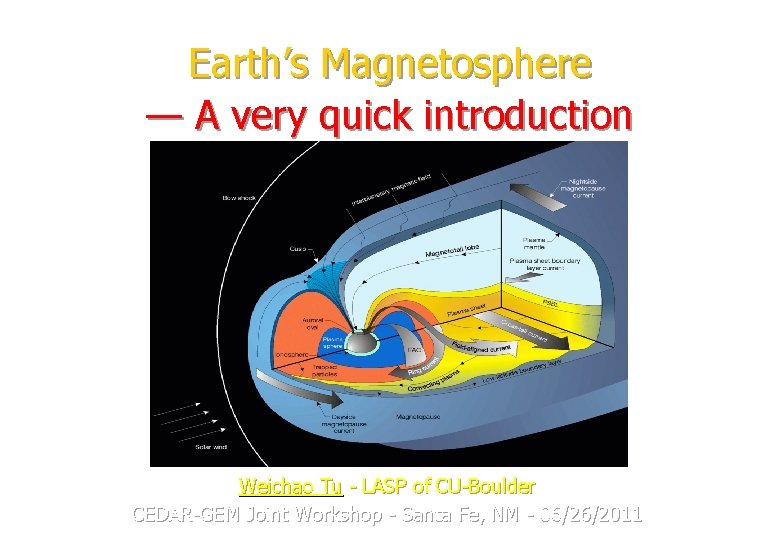
Earth’s Magnetosphere — A very quick introduction Weichao Tu - LASP of CU-Boulder CEDAR-GEM Joint Workshop - Santa Fe, NM - 06/26/2011
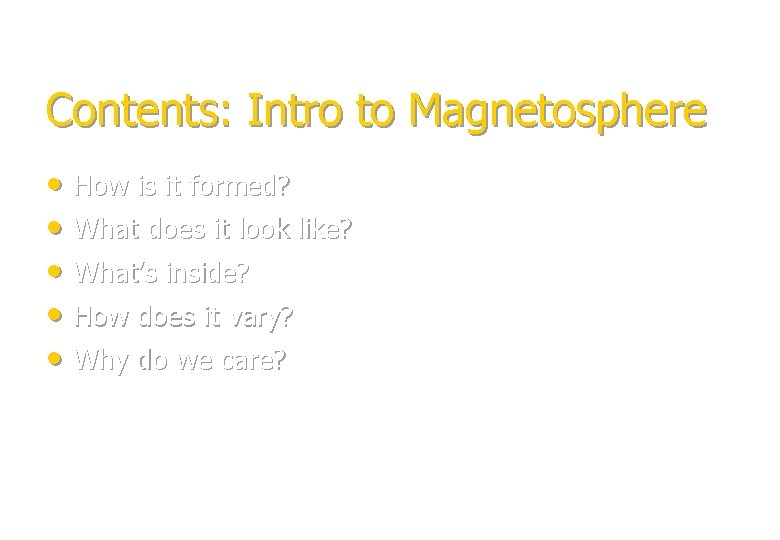
Contents: Intro to Magnetosphere • How is it formed? • What does it look like? • What’s inside? • How does it vary? • Why do we care?
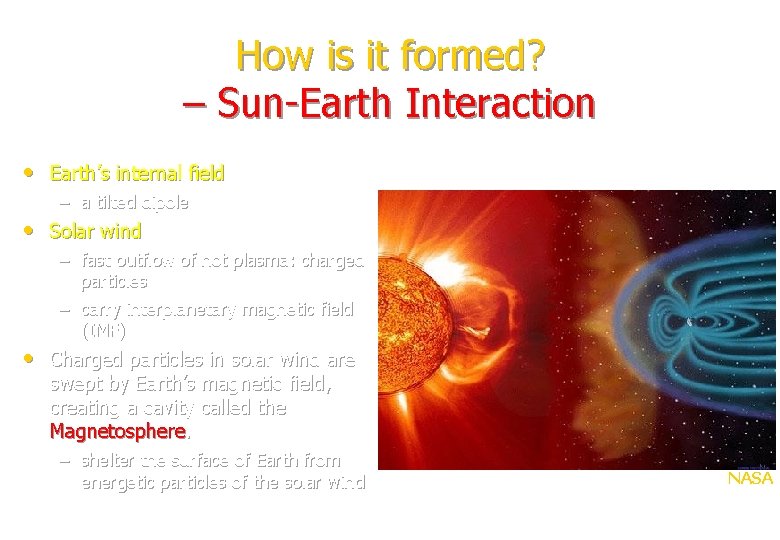
How is it formed? – Sun-Earth Interaction • Earth’s internal field – a tilted dipole • Solar wind – fast outflow of hot plasma: charged particles – carry interplanetary magnetic field (IMF) • Charged particles in solar wind are swept by Earth’s magnetic field, creating a cavity called the Magnetosphere. – shelter the surface of Earth from energetic particles of the solar wind NASA
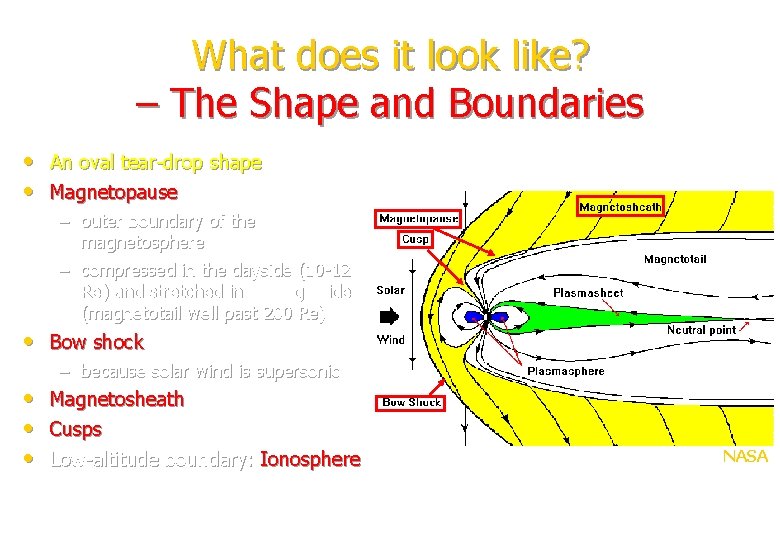
What does it look like? – The Shape and Boundaries • An oval tear-drop shape • Magnetopause – outer boundary of the magnetosphere – compressed in the dayside (10 -12 Re) and stretched in the nightside (magnetotail well past 200 Re) • Bow shock – because solar wind is supersonic • Magnetosheath • Cusps • Low-altitude boundary: Ionosphere NASA
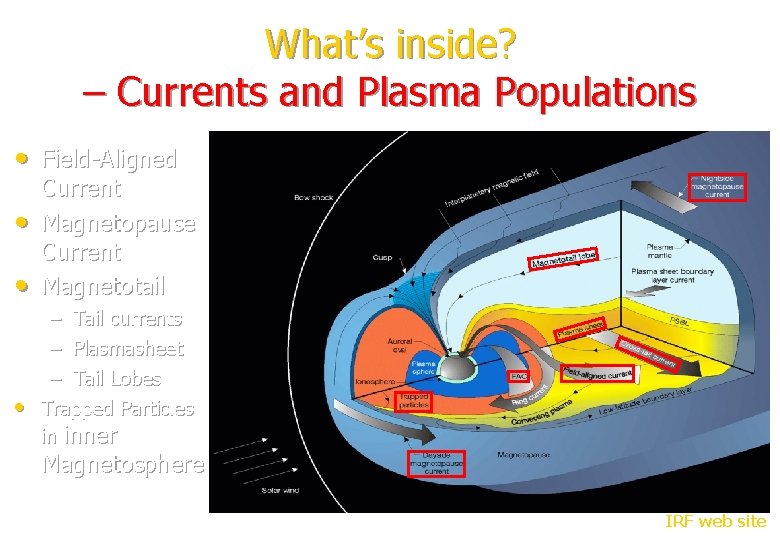
What’s inside? – Currents and Plasma Populations • Field-Aligned • • Current Magnetopause Current Magnetotail – Tail currents – Plasmasheet – Tail Lobes • Trapped Particles in inner Magnetosphere IRF web site
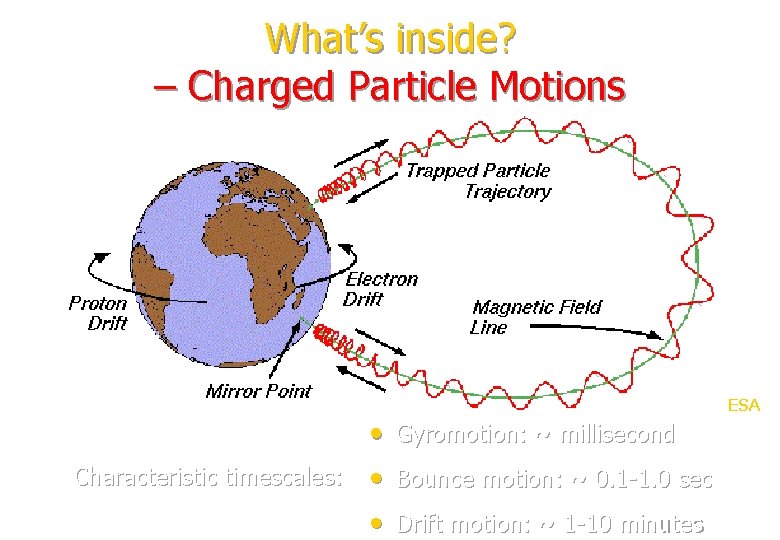
What’s inside? – Charged Particle Motions • Gyromotion: ~ millisecond Characteristic timescales: • Bounce motion: ~ 0. 1 -1. 0 sec • Drift motion: ~ 1 -10 minutes ESA
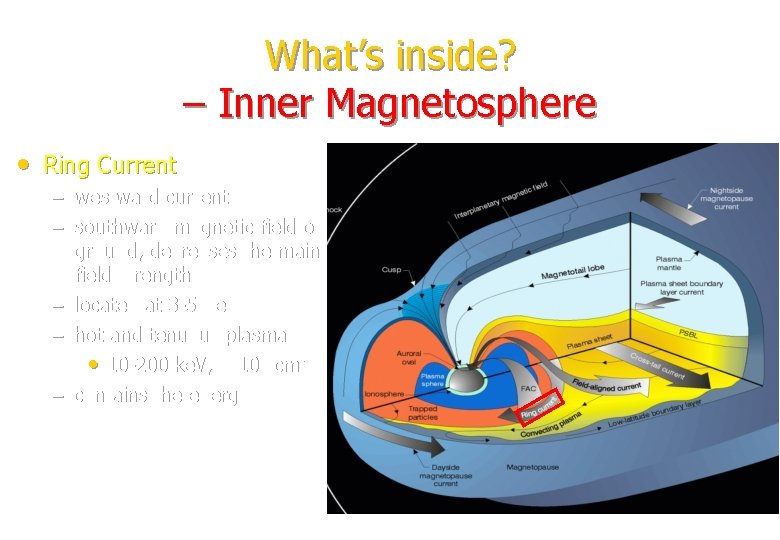
What’s inside? – Inner Magnetosphere • Ring Current – westward current – southward magnetic field on ground, decreases the main field strength – located at 3 -5 Re – hot and tenuous plasma • 10 -200 ke. V, 1 -10 s cm-3 – contains the energy
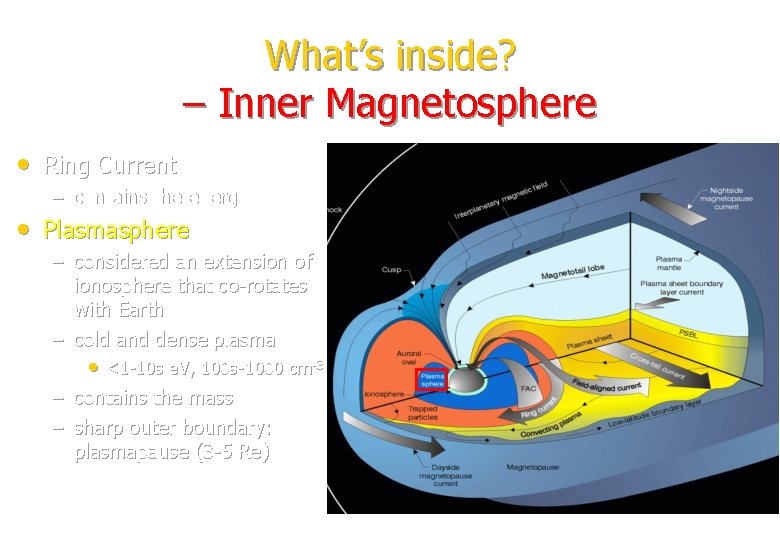
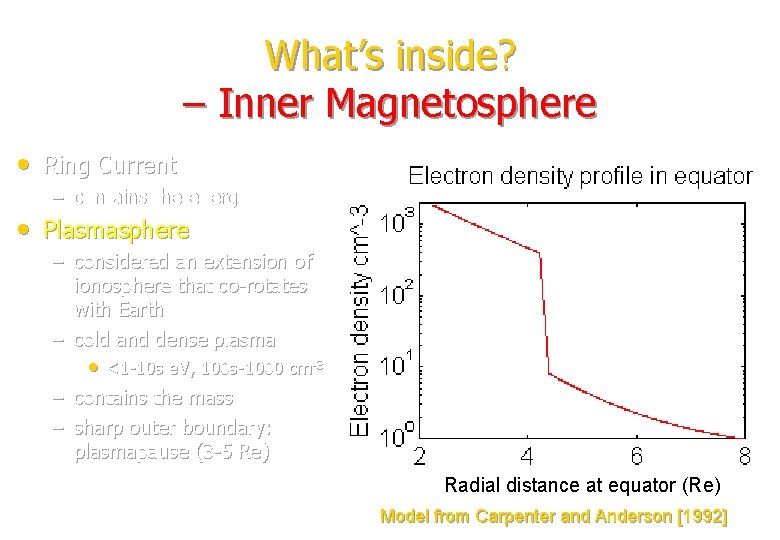
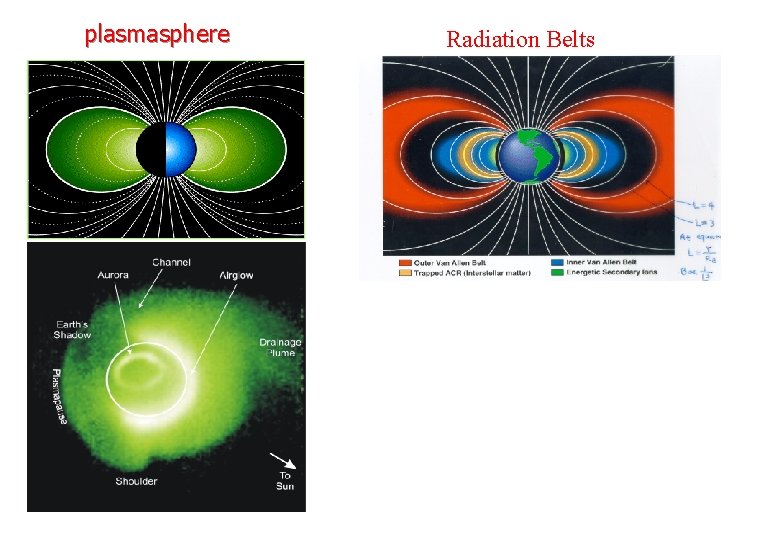
What’s inside? – Inner Magnetosphere • Ring Current – contains the energy • Plasmasphere – considered an extension of ionosphere that co-rotates with Earth – cold and dense plasma • <1 -10 s e. V, 100 s-1000 cm-3 – contains the mass – sharp outer boundary: plasmapause (3 -5 Re)
What’s inside? – Inner Magnetosphere • Ring Current – contains the energy • Plasmasphere – considered an extension of ionosphere that co-rotates with Earth – cold and dense plasma • <1 -10 s e. V, 100 s-1000 cm-3 – contains the mass – sharp outer boundary: plasmapause (3 -5 Re) Radial distance at equator (Re) Model from Carpenter and Anderson [1992]
What’s inside? – Inner Magnetosphere • Ring Current [Kavanagh et al. , 1968] – contains the energy • Plasmasphere – considered an extension of ionosphere that co-rotates with Earth – cold and dense plasma • <1 -10 s e. V, 100 s-1000 cm-3 – contains the mass – sharp outer boundary: plasmapause (3 -5 Re) “Separatrix”: where co-rotational electric field balances convection electric field
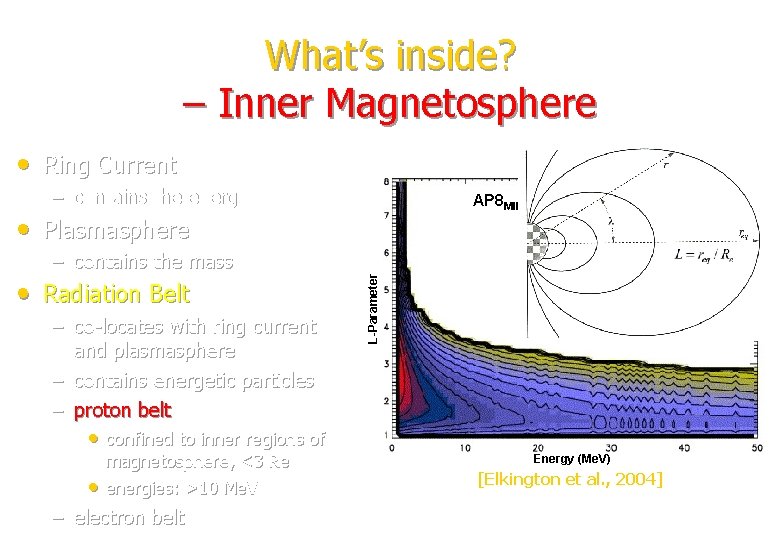
What’s inside? – Inner Magnetosphere • Ring Current – contains the energy AP 8 MIN Proton Distribution • Plasmasphere • Radiation Belt – co-locates with ring current and plasmasphere – contains energetic particles – proton belt L-Parameter – contains the mass • confined to inner regions of • magnetosphere, <3 Re energies: >10 Me. V – electron belt Energy (Me. V) [Elkington et al. , 2004]
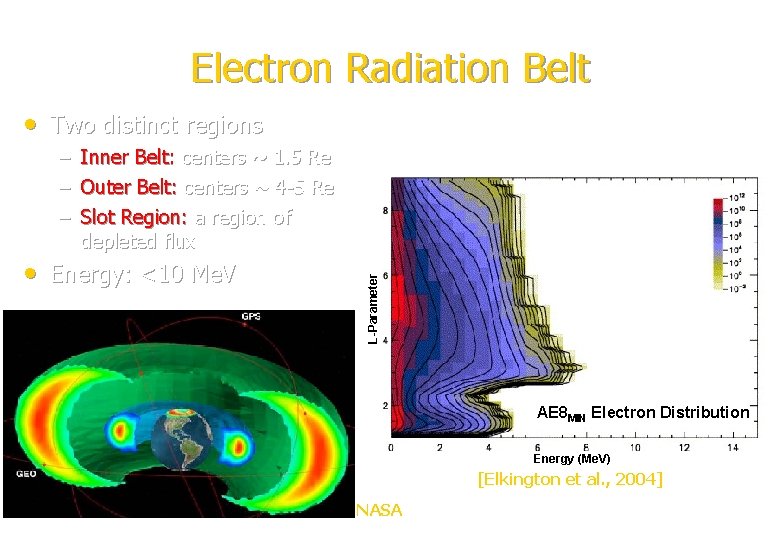
Electron Radiation Belt • Two distinct regions • Energy: <10 Me. V L-Parameter – Inner Belt: centers ~ 1. 5 Re – Outer Belt: centers ~ 4 -5 Re – Slot Region: a region of depleted flux AE 8 MIN Electron Distribution Energy (Me. V) [Elkington et al. , 2004] NASA
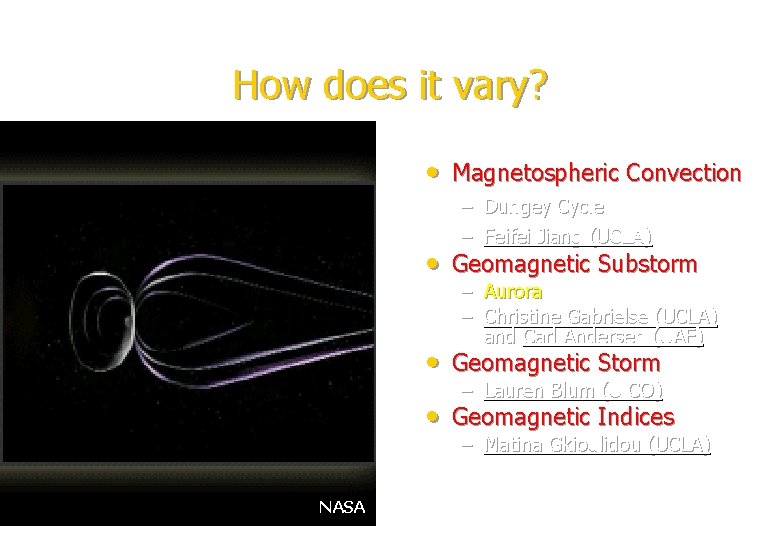
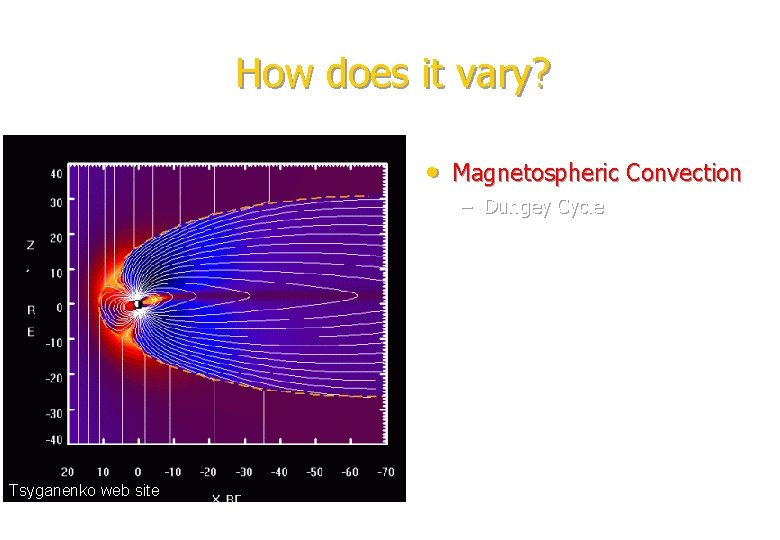
How does it vary? • Magnetospheric Convection – Dungey Cycle – Feifei Jiang (UCLA) • Geomagnetic Substorm – Aurora – Christine Gabrielse (UCLA) and Carl Andersen (UAF) • Geomagnetic Storm – Lauren Blum (U CO) • Geomagnetic Indices – Matina Gkioulidou (UCLA) NASA
Variations of Plasmapause Location EUV Imager of IMAGE [Baker et al. , 2004]
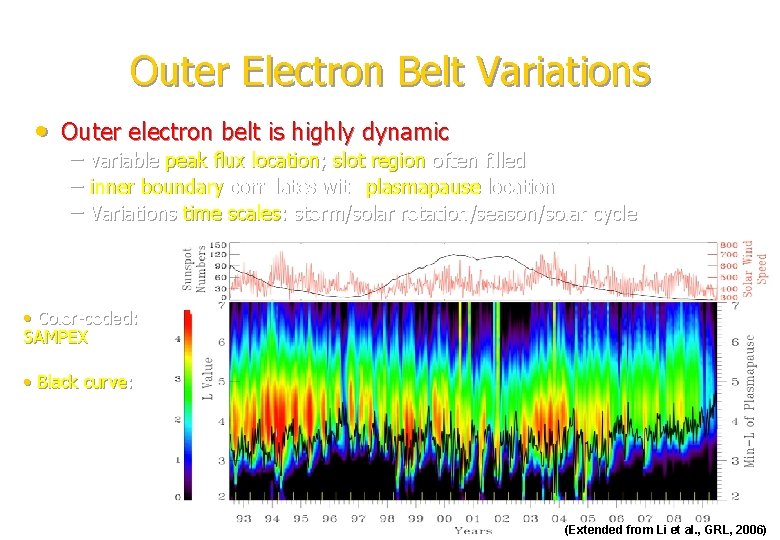
Outer Electron Belt Variations • Outer electron belt is highly dynamic – variable peak flux location; slot region often filled – inner boundary correlates with plasmapause location – Variations time scales: storm/solar rotation/season/solar cycle • Color-coded: SAMPEX 2 -6 Me. V electron flux. • Black curve: plasmapause location from an empirical model [O’Brien and Moldwin, 2003] (Extended from Li et al. , GRL, 2006)
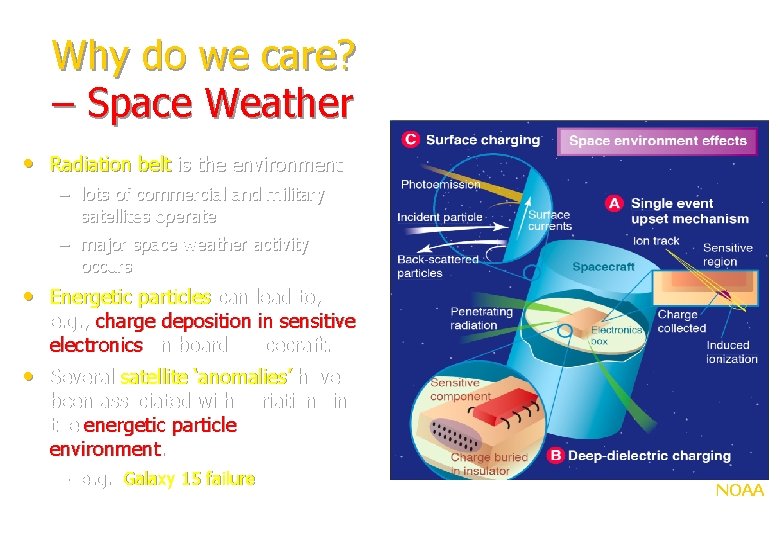
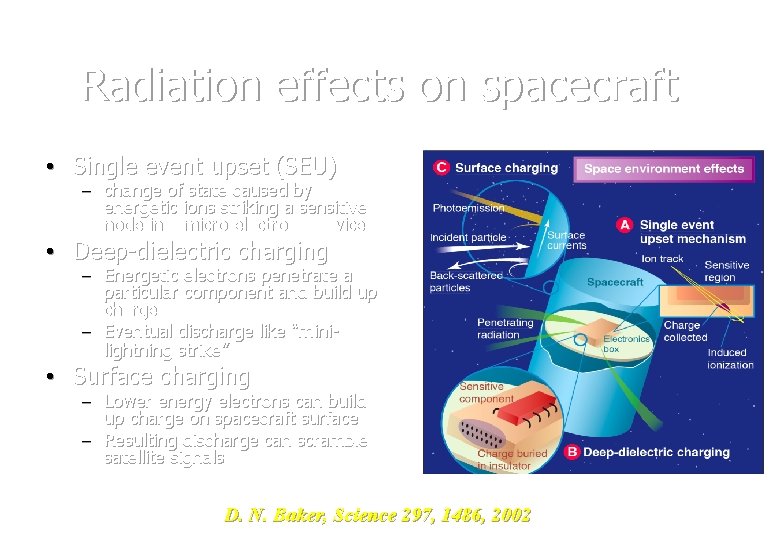
Why do we care? – Space Weather • Radiation belt is the environment – lots of commercial and military satellites operate – major space weather activity occurs • Energetic particles can lead to, e. g. , charge deposition in sensitive electronics on board spacecraft. • Several satellite ‘anomalies’ have been associated with variations in the energetic particle environment. – e. g. , Galaxy 15 failure NOAA
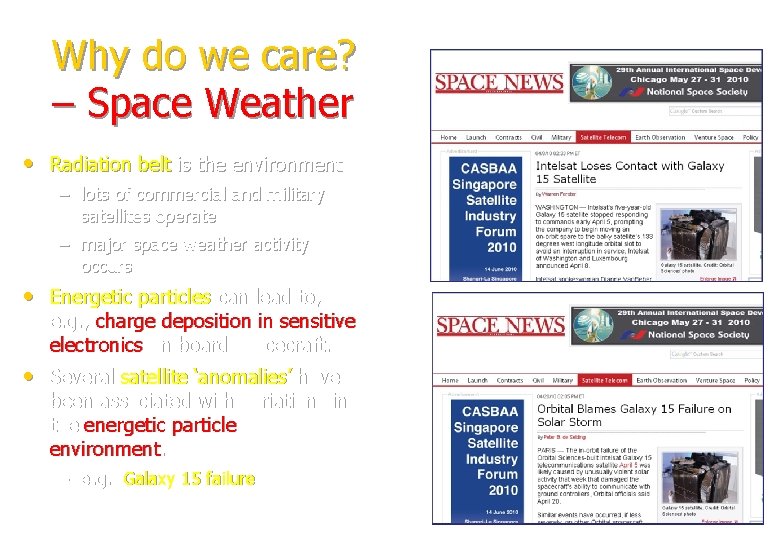
Why do we care? – Space Weather • Radiation belt is the environment – lots of commercial and military satellites operate – major space weather activity occurs • Energetic particles can lead to, e. g. , charge deposition in sensitive electronics on board spacecraft. • Several satellite ‘anomalies’ have been associated with variations in the energetic particle environment. – e. g. , Galaxy 15 failure
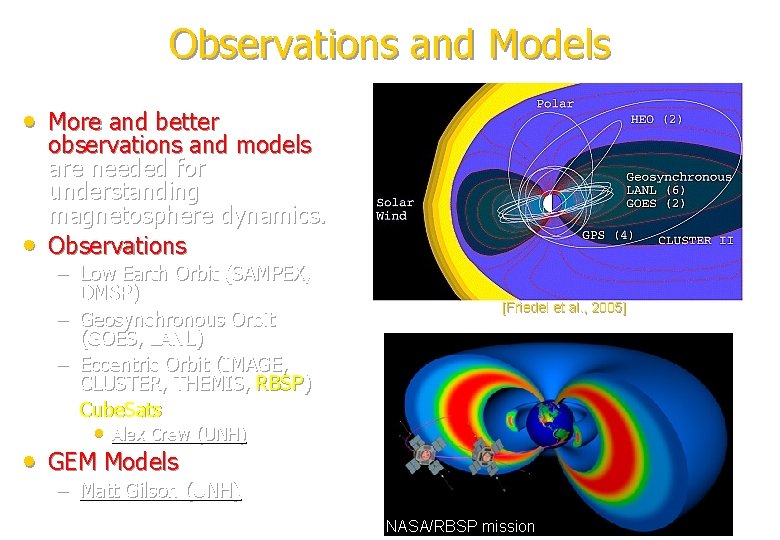
Observations and Models • More and better • observations and models are needed for understanding magnetosphere dynamics. Observations – Low Earth Orbit (SAMPEX, DMSP) – Geosynchronous Orbit (GOES, LANL) – Eccentric Orbit (IMAGE, CLUSTER, THEMIS, RBSP) – Cube. Sats [Friedel et al. , 2005] • Alex Crew (UNH) • GEM Models – Matt Gilson (UNH) NASA/RBSP mission
Thank you!
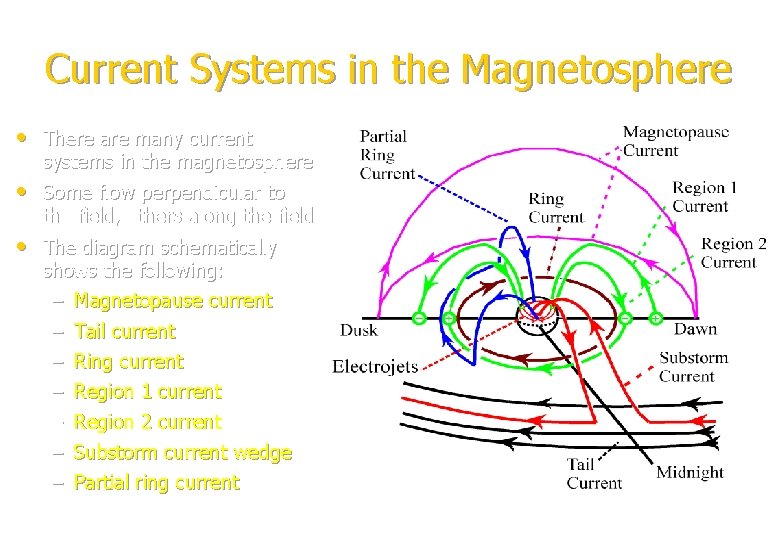
Current Systems in the Magnetosphere • There are many current systems in the magnetosphere • Some flow perpendicular to the field, others along the field • The diagram schematically shows the following: – Magnetopause current – – – Tail current Ring current Region 1 current Region 2 current Substorm current wedge Partial ring current
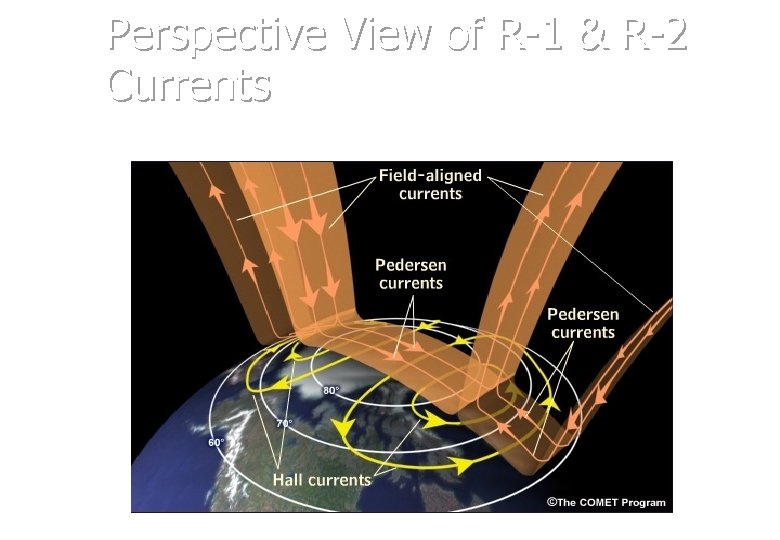
Perspective View of R-1 & R-2 Currents
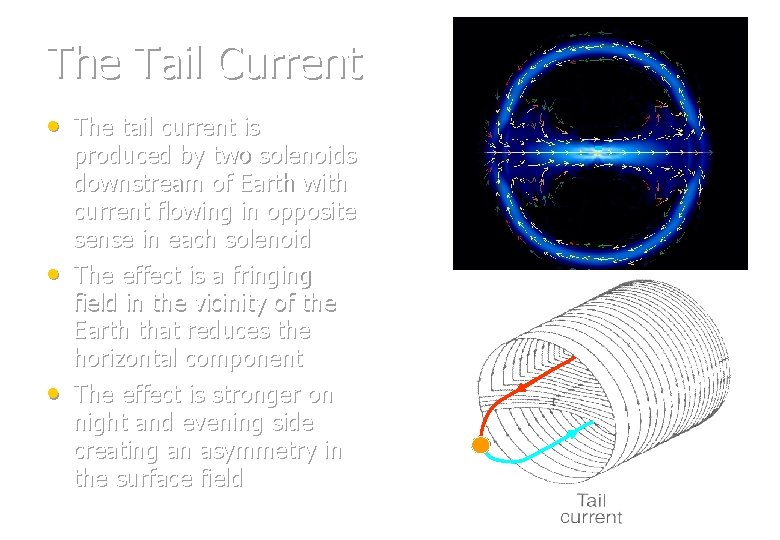
The Tail Current • The tail current is • • produced by two solenoids downstream of Earth with current flowing in opposite sense in each solenoid The effect is a fringing field in the vicinity of the Earth that reduces the horizontal component The effect is stronger on night and evening side creating an asymmetry in the surface field
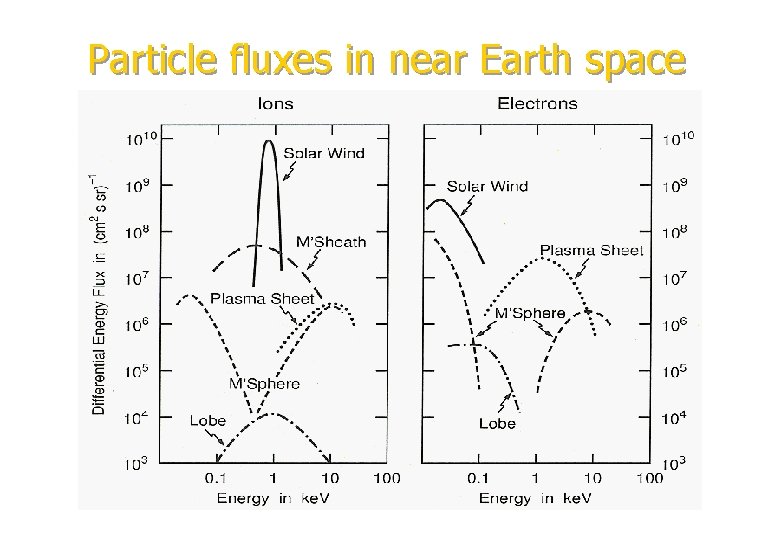
Particle fluxes in near Earth space
plasmasphere Radiation Belts (from the Extreme Ultraviolet Imager of IMAGE) (Sandel et al. , 2003)
How does it vary? • Magnetospheric Convection – Dungey Cycle Tsyganenko web site
Radiation effects on spacecraft • Single event upset (SEU) – change of state caused by energetic ions striking a sensitive node in a micro-electronic device • Deep-dielectric charging – Energetic electrons penetrate a particular component and build up charge – Eventual discharge like “minilightning strike” • Surface charging – Lower energy electrons can build up charge on spacecraft surface – Resulting discharge can scramble satellite signals D. N. Baker, Science 297, 1486, 2002 26