
Earths History Chapter 12 13 2 Opposing Beliefs
Earth’s History Chapter 12 & 13
2 Opposing Beliefs n Catastrophism – belief that certain geologic changes were because of catastrophes rather than gradual changes. n Uniformitarianism – belief that geologic forces & processes that we observe today have been around throughout Earth’s history. (James Hutton, Theory of the Earth)
Attempts of Aging the Earth n n Xenophanes (570 -470 BC) – realized that fossils were the remains of ancient life, therefore Earth is old. Herodotus (450 BC) – dug into the Nile River bank and counted the layers. Yearly flood adds additional layer of sediment. Count de Buffon (1779) – compared the Earth to a ball of cooling iron. John Joly (1899) – compared the ocean’s salinity to the amount of salt entering the oceans.
…. William Thompson, AKA Lord Kelvin (1897) – measured the rate of heat flow out of Earth’s surface to say that Earth was between 20 & 40 myo. Blow to geologists and biologists b/c of rock and fossil record. n At the beginning of the 20 th century Ernest Rutherford first explained radioactivity. (Provides means of determining Earth’s age) n

Relative Dating n n Tells us the sequence in which events occurred, not how long ago they occurred. Few basic principles had to be discovered and applied in order to establish relative time scale:
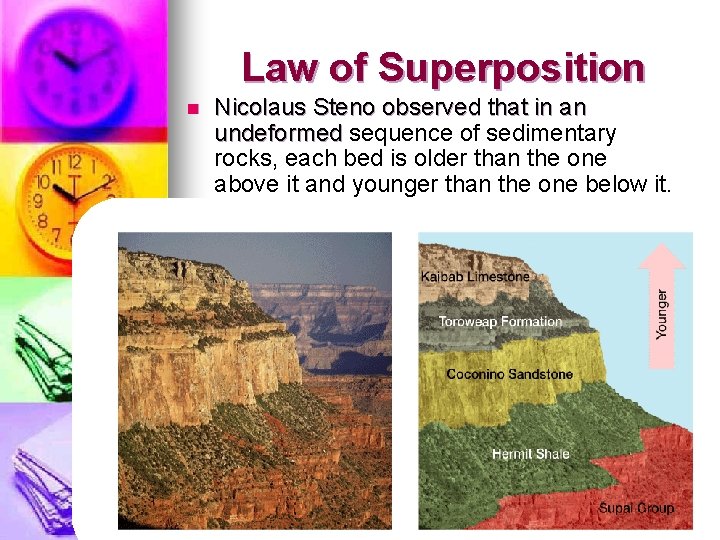
Law of Superposition n Nicolaus Steno observed that in an undeformed sequence of sedimentary rocks, each bed is older than the one above it and younger than the one below it.
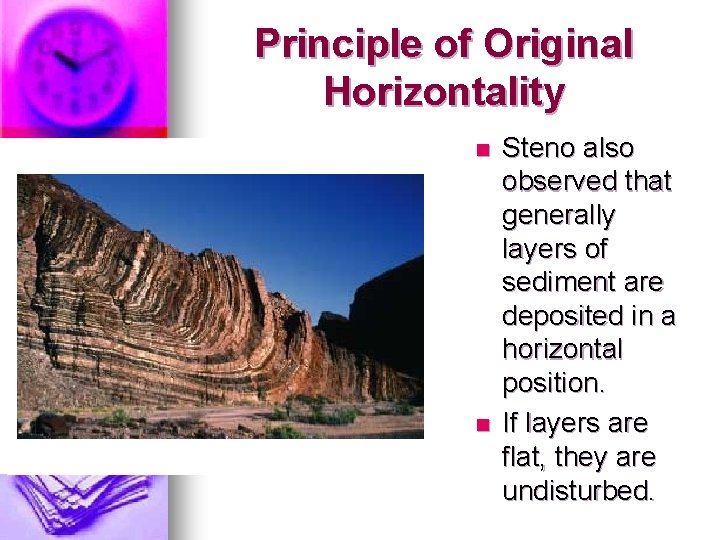
Principle of Original Horizontality n n Steno also observed that generally layers of sediment are deposited in a horizontal position. If layers are flat, they are undisturbed.
Principle of Cross. Cutting Relationships n Steno’s 3 rd observation states that when a fault cuts through , or when magma intrudes other rocks and crystallizes, we assume that the fault or intrusion is younger than the rocks.
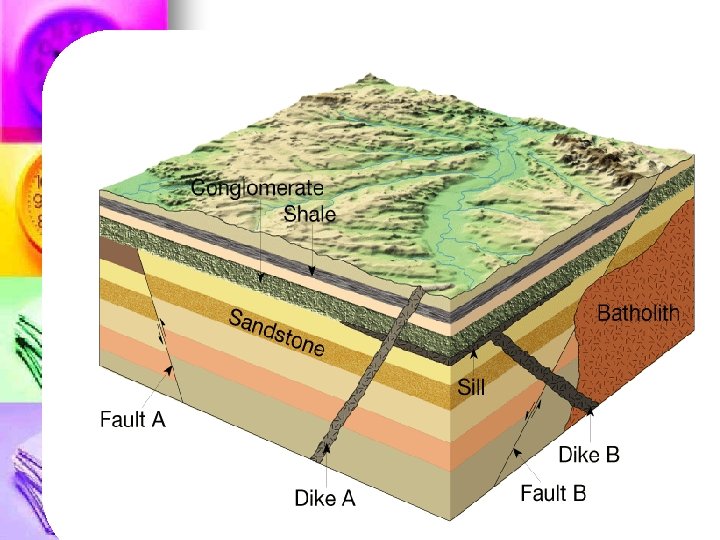
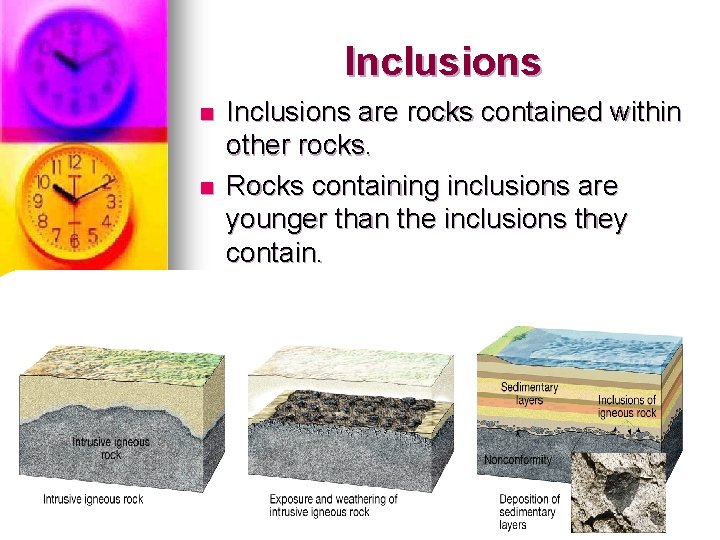
Inclusions n n Inclusions are rocks contained within other rocks. Rocks containing inclusions are younger than the inclusions they contain.
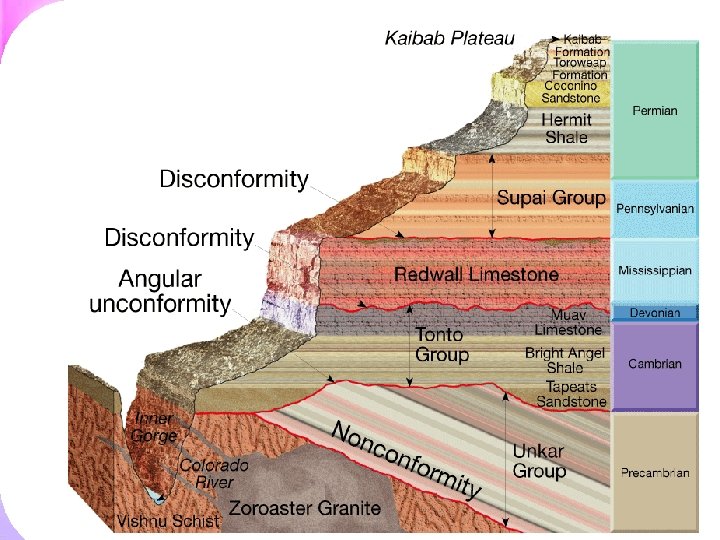
Unconformities Represents a period of time that deposition stopped, erosion removed previously formed rocks, and then deposition resumed. n Helps us identify significant geologic events. n 3 types of unconformities: angular unconformities, disconformities, and nonconformities. n
…… An angular unconformity indicates that during the pause in deposition, a period of deformation (folding or tilting) and erosion occurred. Disconformities are more common. These occur where 2 sedimentary layers are separated by an erosional surface. Nonconformities mean the erosional surface separates older metamorphic or intrusive igneous rocks from younger sedimentary rocks.
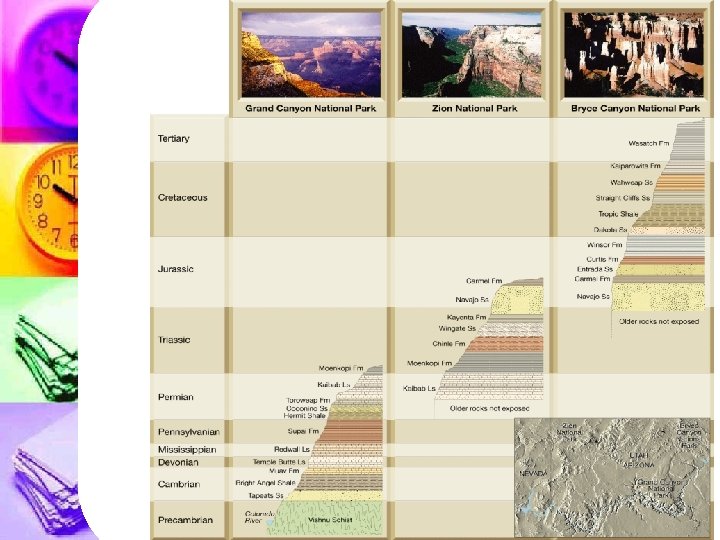
Correlation Matching similar rocks of the same age in different areas. n Helps to make a more complete view of the geologic history in an area. n
Fossils: Remains of Ancient Life Helps in rock correlation as well as learning past environments. n The type of fossil formed is determined by the conditions which the organism died and how it was buried. n
Unaltered Remains have not been altered or changed much over time. n Include teeth, bones, and shells n Very uncommon to find animals in entirety. n
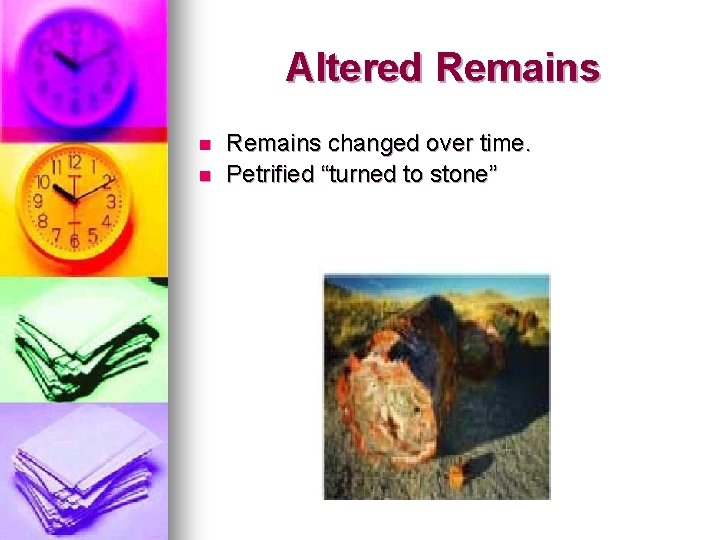
Altered Remains n n Remains changed over time. Petrified “turned to stone”
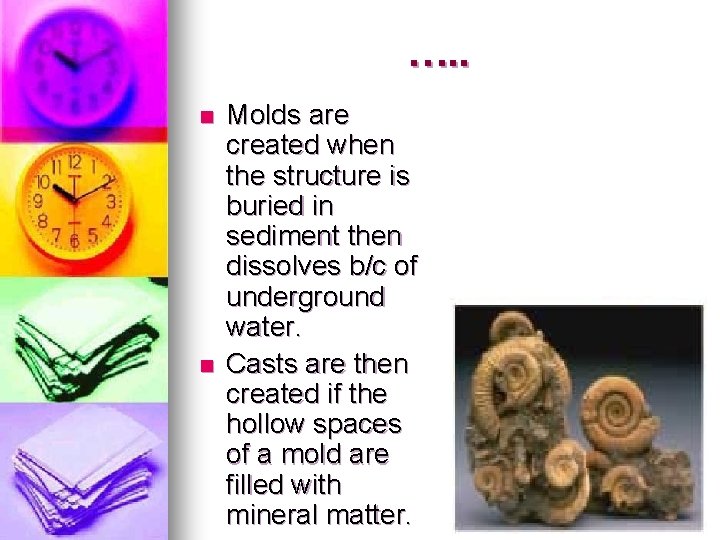
…. . n n Molds are created when the structure is buried in sediment then dissolves b/c of underground water. Casts are then created if the hollow spaces of a mold are filled with mineral matter.
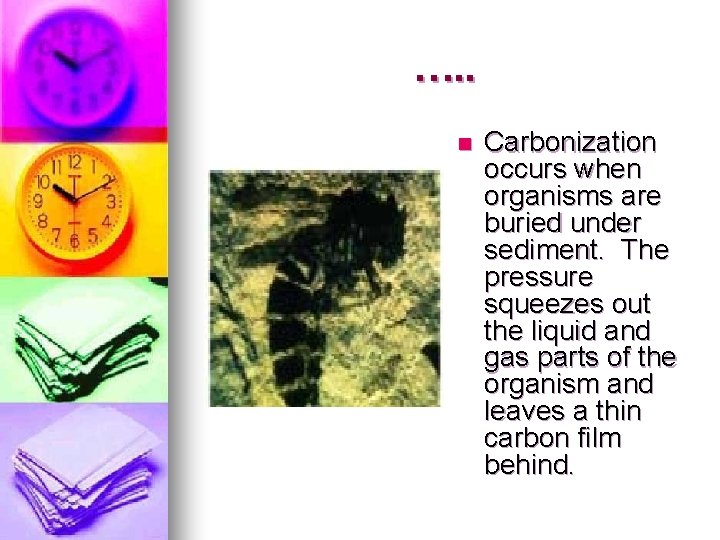
…. . n Carbonization occurs when organisms are buried under sediment. The pressure squeezes out the liquid and gas parts of the organism and leaves a thin carbon film behind.
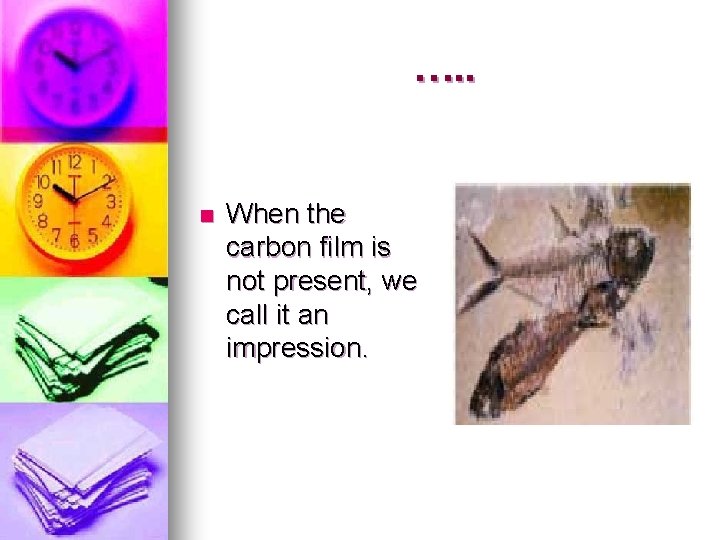
…. . n When the carbon film is not present, we call it an impression.
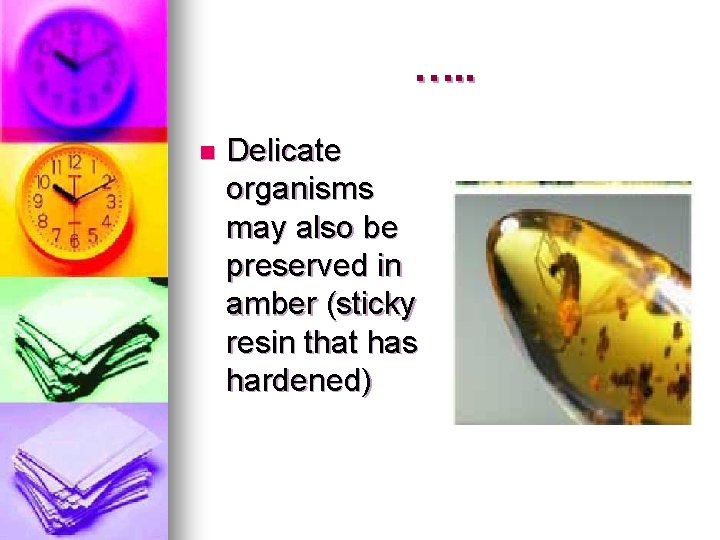
…. . n Delicate organisms may also be preserved in amber (sticky resin that has hardened)
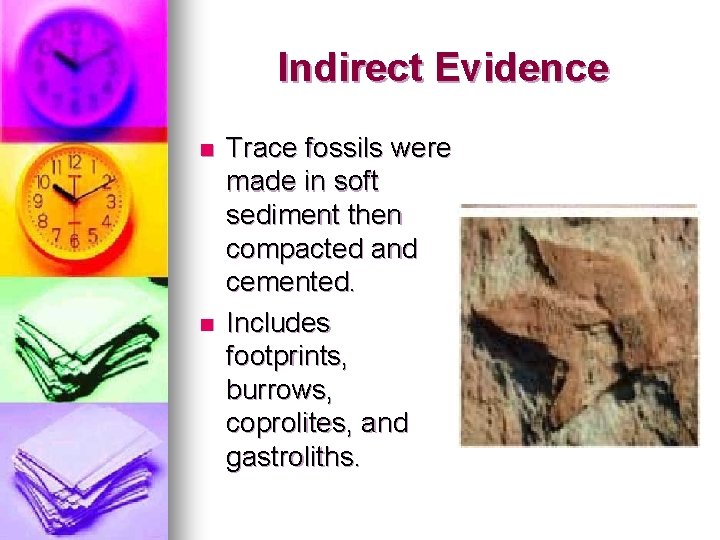
Indirect Evidence n n Trace fossils were made in soft sediment then compacted and cemented. Includes footprints, burrows, coprolites, and gastroliths.
Conditions for Preservation n 2 conditions are important for preservation: • Rapid burial • Possession of hard parts
Fossil Succession Any time period can be recognized by its fossil content b/c fossils occur in a certain order. n For example, age of trilobites, age of fish, age of reptiles, and age of mammals is found in the same order on all continents. n
…. . Index fossils are widespread, cover a small span of time, and occur in large amounts. n Fossils can also help interpret and describe ancient environments. n
Quick Review Protons, Neutrons, & Electrons n Atomic Number n Mass Number n Isotopes n
Radioactivity n The spontaneous decay (break apart) of certain nuclei that do not have a strong bond.
Radioactivity Usually happens to unstable or radioactive isotopes of an element – parent material. n The result of decay is daughter products. n Decay continues until a stable or non-radioactive isotope is formed. n
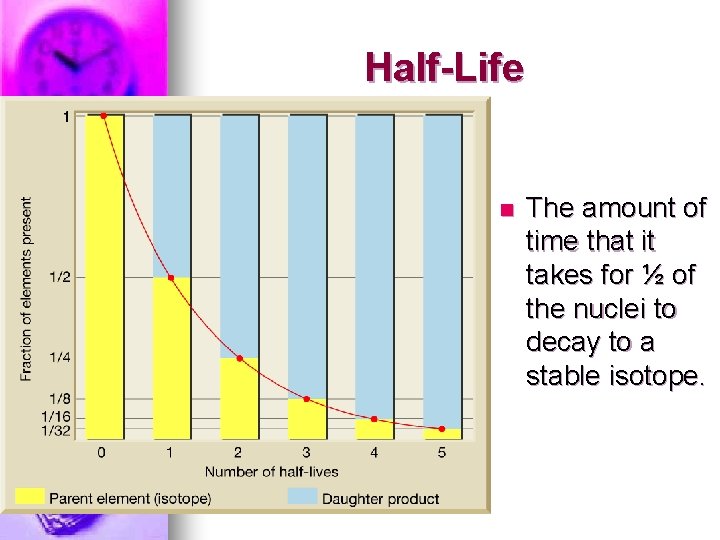
Half-Life n The amount of time that it takes for ½ of the nuclei to decay to a stable isotope.
Radiometric Dating Each radioactive isotope has been decaying at a constant rate since the formation of the rocks in which it occurs. n The daughter material has been increasing at the same rate that the parent material decays. n
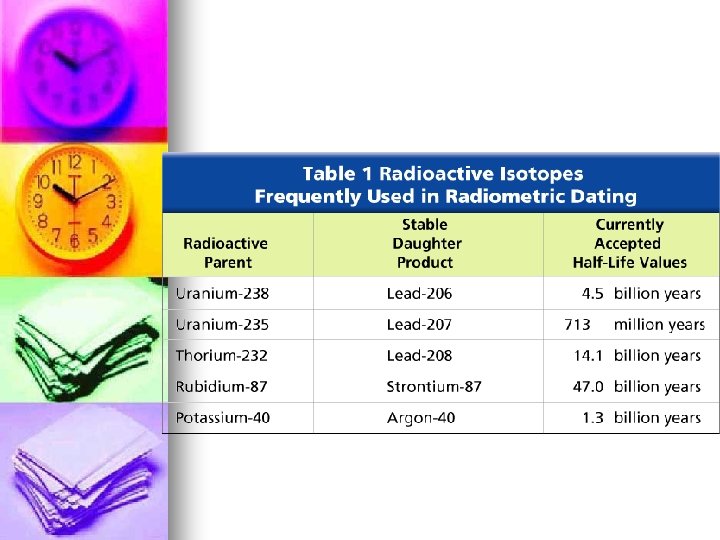
Carbon Dating n n When an organism dies, the amount of Carbon-14 it contains gradually decreases as it decays. By comparing the ratio of carbon-14 to carbon-12 in a sample, radiocarbon dates can be determined. Half-life of Carbon-14 is only 5730 years, so we can use it to date up to 75, 000 years.
Importance of Radioactivity n n Radioactive Dating has helped scientists to date rocks to 4 byo and meteorites to 4. 6 byo. Radiometric dating has supported the ideas of James Hutton, Charles Darwin, and others who inferred that geologic time must be immense.
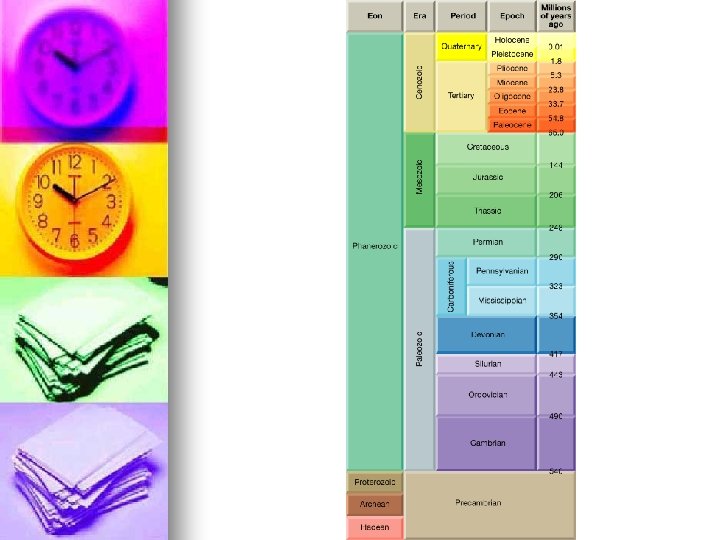
Era Presentations: Precambrian Paleozoic Mesozoic Cenozoic
- Slides: 36