
Earthquakes Lab 6 Concepts n Diastrophism n n
Earthquakes Lab 6
Concepts n Diastrophism n n Types & causes of stress 5 types of folds 5 types of faults Earthquakes n n n Focus, epicenter Types of energy waves Methods of measuring earthquakes Determining the magnitude of an earthquake Determining the epicenter of an earthquake Real-world example: New Madrid Fault
Diastrophism n Definition: deformation of earth’s crust n Deformation without movement n n n Jointing: Fracture of rock without displacement Affects resistance of rock to erosion (weakens) Deformation with movement n n Folding: bending rock without breakage Faulting: fracture of rock with displacement (either vertical or horizontal movement)
Diastrophism Types & Cause of Stress n 3 Types of Stress n n Compressional: Rocks move together (convergent motion) Tensional: Opposite movement (divergent motion) Shearing: Tearing (transform motion) Causes of stress n n Confining pressure Temperature q Extreme heat folds the rock without breakage q Extreme cold fractures the rock Strength/Composition of rock Time
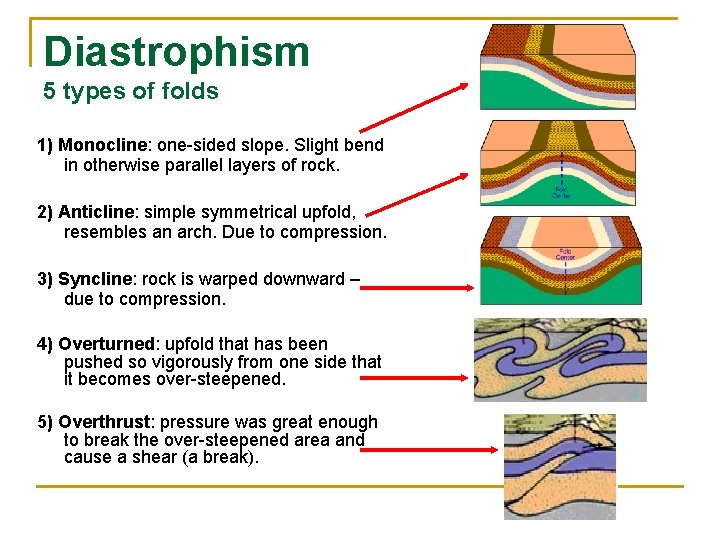
Diastrophism 5 types of folds 1) Monocline: one-sided slope. Slight bend in otherwise parallel layers of rock. 2) Anticline: simple symmetrical upfold, resembles an arch. Due to compression. 3) Syncline: rock is warped downward – due to compression. 4) Overturned: upfold that has been pushed so vigorously from one side that it becomes over-steepened. 5) Overthrust: pressure was great enough to break the over-steepened area and cause a shear (a break).
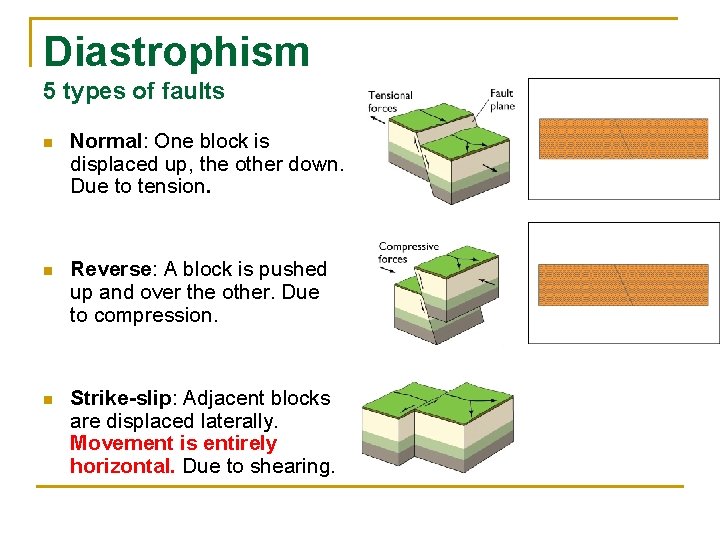
Diastrophism 5 types of faults n Normal: One block is displaced up, the other down. Due to tension. n Reverse: A block is pushed up and over the other. Due to compression. n Strike-slip: Adjacent blocks are displaced laterally. Movement is entirely horizontal. Due to shearing.
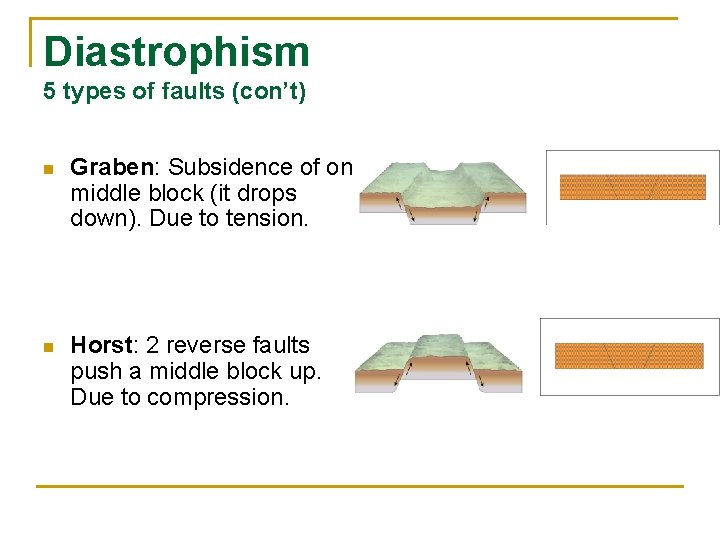
Diastrophism 5 types of faults (con’t) n Graben: Subsidence of one middle block (it drops down). Due to tension. n Horst: 2 reverse faults push a middle block up. Due to compression.
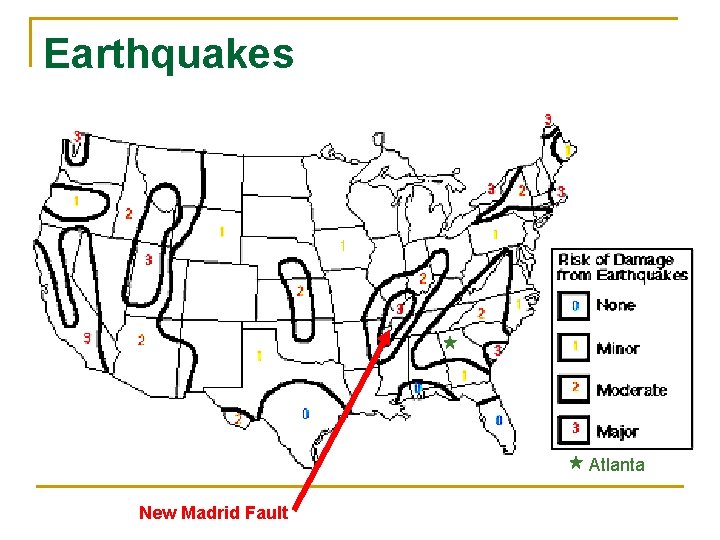
Earthquakes Atlanta New Madrid Fault
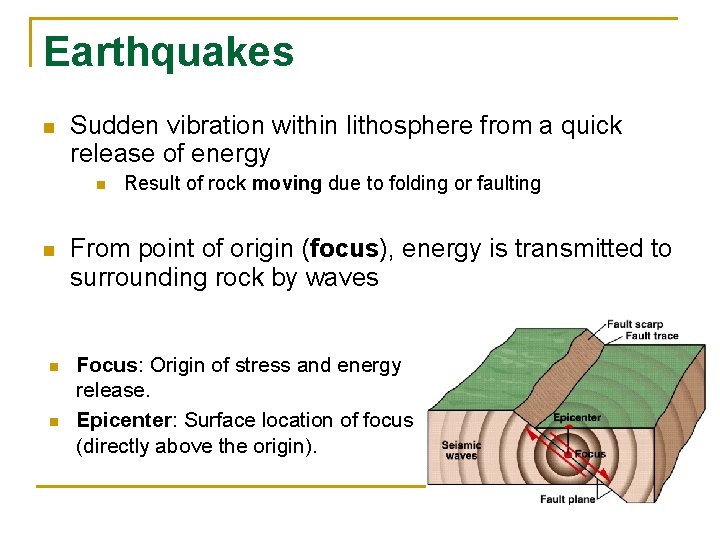
Earthquakes n Sudden vibration within lithosphere from a quick release of energy n n Result of rock moving due to folding or faulting From point of origin (focus), energy is transmitted to surrounding rock by waves Focus: Origin of stress and energy release. Epicenter: Surface location of focus (directly above the origin).
Earthquakes Types of Energy Waves n Body Waves n Occur first. These are the initial waves emitted from the earthquake. These occur in a specific order. § § n 1 st wave: Primary “P” wave. 2 nd wave: Secondary “S” wave. Surface Waves n Occur after the body waves. These affect the surface of the earth (we typically feel these). § § Type 1: Love wave. Type 2: Rayleigh wave.
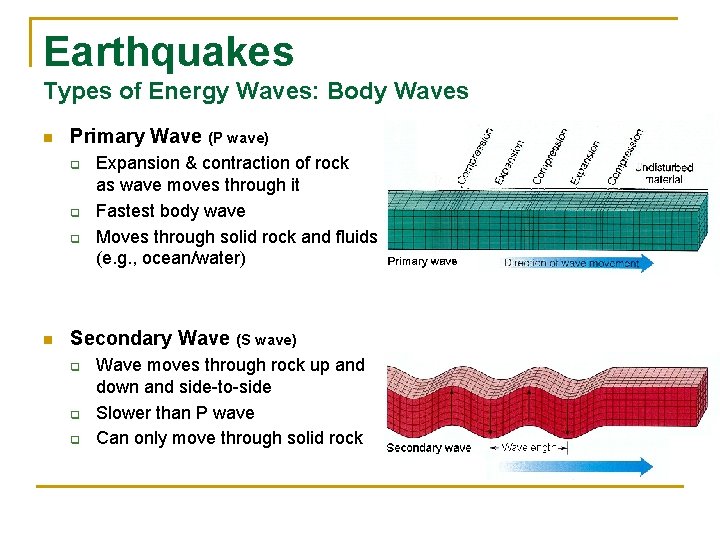
Earthquakes Types of Energy Waves: Body Waves n Primary Wave (P wave) q q q n Expansion & contraction of rock as wave moves through it Fastest body wave Moves through solid rock and fluids (e. g. , ocean/water) Secondary Wave (S wave) q q q Wave moves through rock up and down and side-to-side Slower than P wave Can only move through solid rock
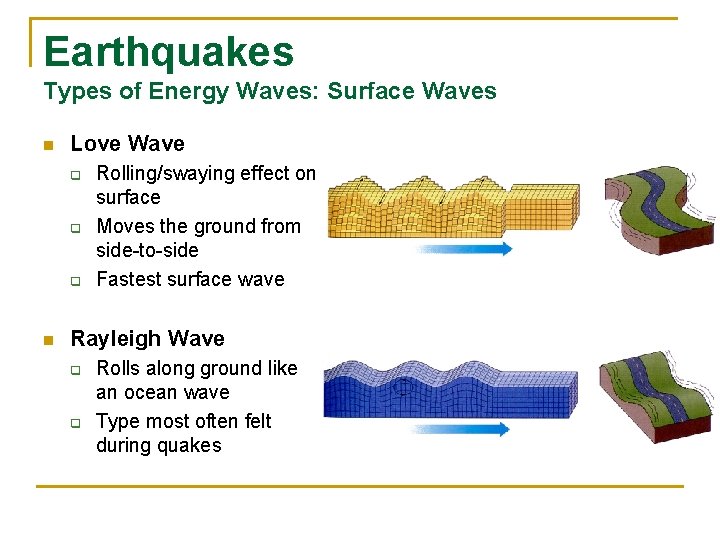
Earthquakes Types of Energy Waves: Surface Waves n Love Wave q q q n Rolling/swaying effect on surface Moves the ground from side-to-side Fastest surface wave Rayleigh Wave q q Rolls along ground like an ocean wave Type most often felt during quakes
Earthquakes Methods of measuring earthquakes n Modified Mercalli Intensity Scale q q n Measures “intensity” of earthquake (e. g. , the amount of shaking felt and the damage done). Very subjective: depends on the viewer’s description of the earthquake event! Based on observations. Richter Scale q q Measures the “magnitude” of earthquake (the energy waves released). Based on readings from a seismograph, and examining the actual energy waves.
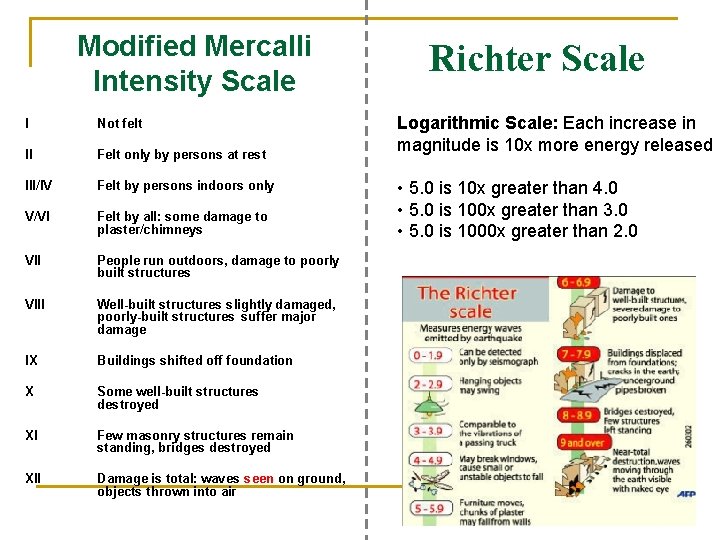
Modified Mercalli Intensity Scale I Not felt II Felt only by persons at rest III/IV Felt by persons indoors only V/VI Felt by all: some damage to plaster/chimneys VII People run outdoors, damage to poorly built structures VIII Well-built structures slightly damaged, poorly-built structures suffer major damage IX Buildings shifted off foundation X Some well-built structures destroyed XI Few masonry structures remain standing, bridges destroyed XII Damage is total: waves seen on ground, objects thrown into air Richter Scale Logarithmic Scale: Each increase in magnitude is 10 x more energy released • 5. 0 is 10 x greater than 4. 0 • 5. 0 is 100 x greater than 3. 0 • 5. 0 is 1000 x greater than 2. 0
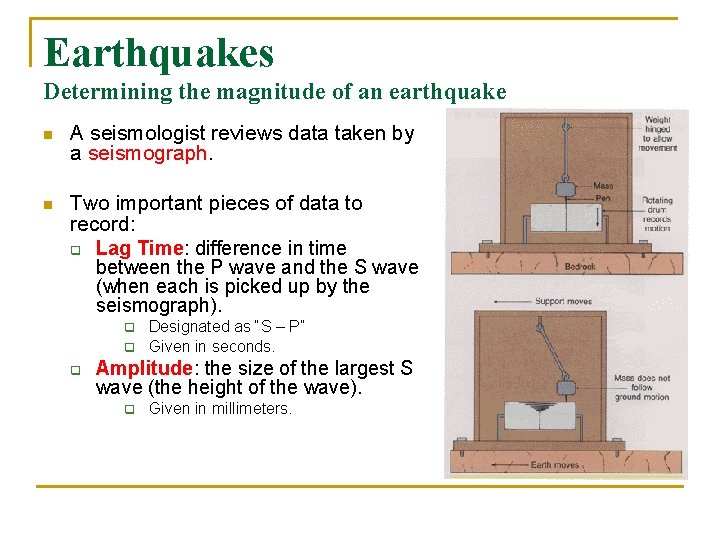
Earthquakes Determining the magnitude of an earthquake n A seismologist reviews data taken by a seismograph. n Two important pieces of data to record: q Lag Time: difference in time between the P wave and the S wave (when each is picked up by the seismograph). q q q Designated as “S – P” Given in seconds. Amplitude: the size of the largest S wave (the height of the wave). q Given in millimeters.
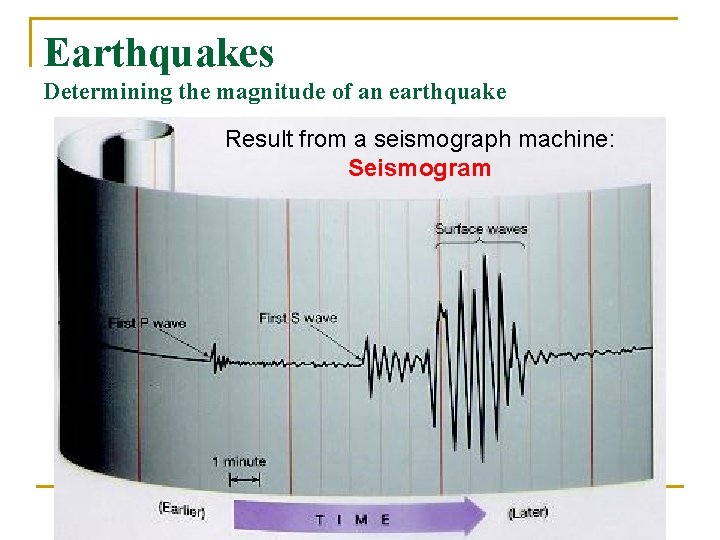
Earthquakes Determining the magnitude of an earthquake Result from a seismograph machine: Seismogram
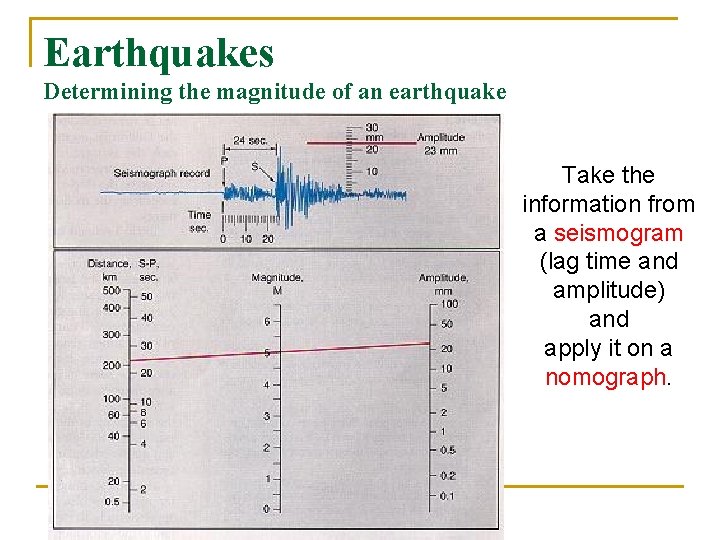
Earthquakes Determining the magnitude of an earthquake Take the information from a seismogram (lag time and amplitude) and apply it on a nomograph.
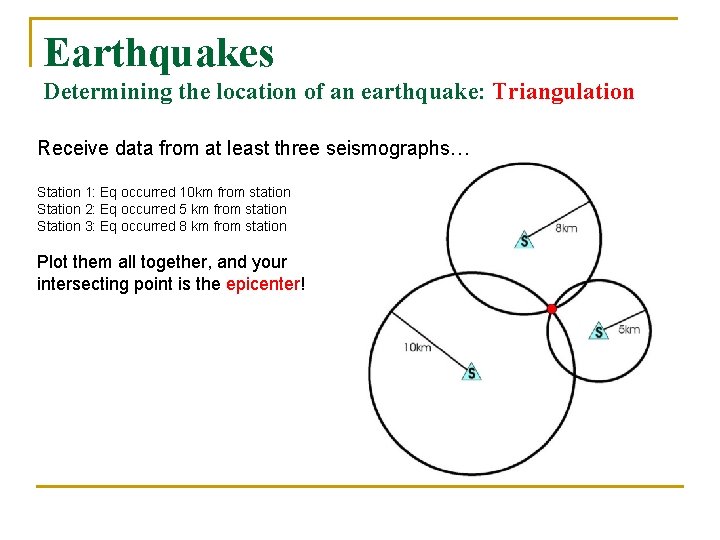
Earthquakes Determining the location of an earthquake: Triangulation Receive data from at least three seismographs… Station 1: Eq occurred 10 km from station Station 2: Eq occurred 5 km from station Station 3: Eq occurred 8 km from station Plot them all together, and your intersecting point is the epicenter!
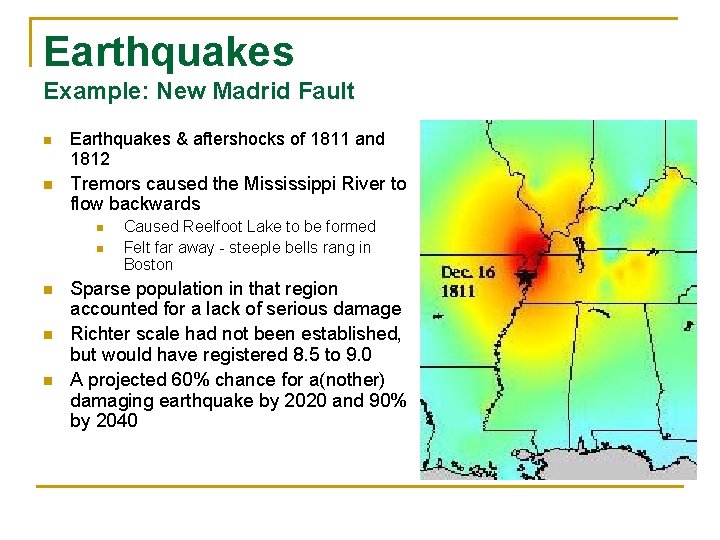
Earthquakes Example: New Madrid Fault n Earthquakes & aftershocks of 1811 and 1812 n Tremors caused the Mississippi River to flow backwards n n n Caused Reelfoot Lake to be formed Felt far away - steeple bells rang in Boston Sparse population in that region accounted for a lack of serious damage Richter scale had not been established, but would have registered 8. 5 to 9. 0 A projected 60% chance for a(nother) damaging earthquake by 2020 and 90% by 2040
- Slides: 19