
Earthquakes and the Earths Interior an investigation using
- Slides: 30
Earthquakes and the Earth's Interior an investigation using human subjects College of Central Florida KT Kim
Earthquake • Seismology – study of earthquakes and Earth’s interior using seismic waves
Earthquake • Stress (Force) causes rock to deform • Three types of deformation – Elastic deformation (Vibration, wave propagation) – Plastic deformation (Folds) – Fracturing (Faults)
Earthquake • Earthquake – sudden motion or trembling caused by the abrupt release of energy – Slippage: minor movement (aseismic, fault creep) – Fracture: larger movement (seismic)
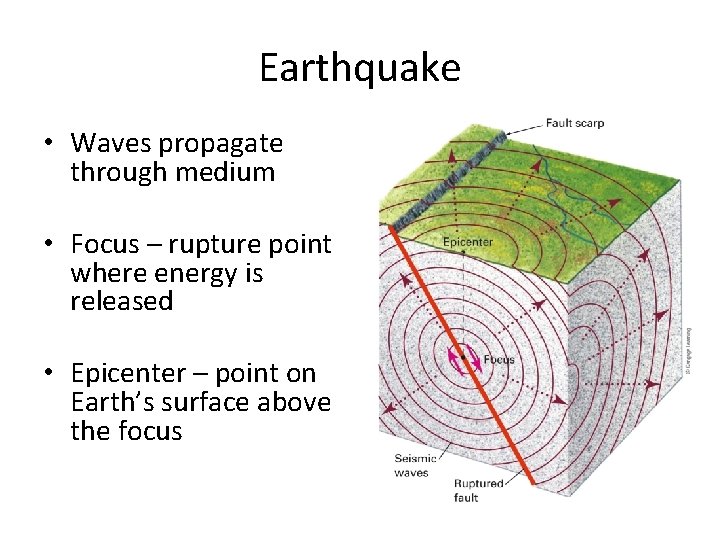
Earthquake • Waves propagate through medium • Focus – rupture point where energy is released • Epicenter – point on Earth’s surface above the focus
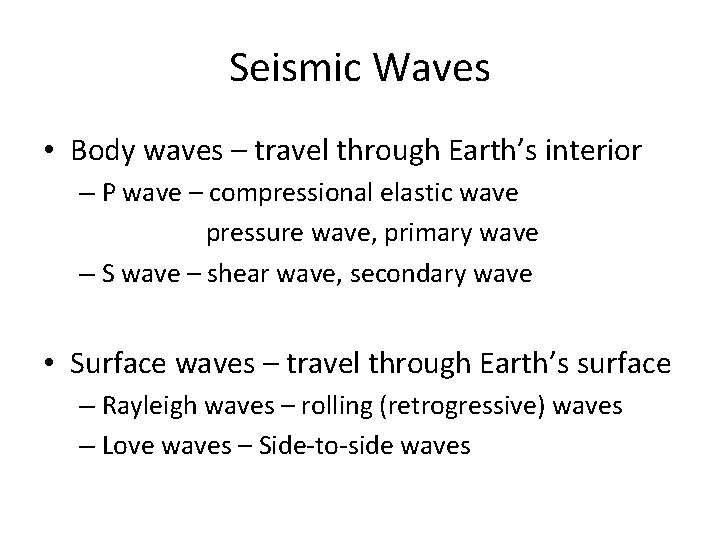
Seismic Waves • Body waves – travel through Earth’s interior – P wave – compressional elastic wave pressure wave, primary wave – S wave – shear wave, secondary wave • Surface waves – travel through Earth’s surface – Rayleigh waves – rolling (retrogressive) waves – Love waves – Side-to-side waves
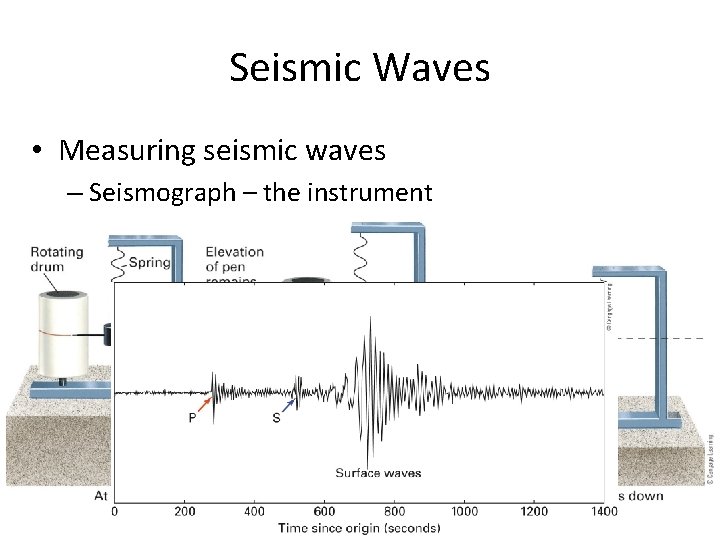
Seismic Waves • Measuring seismic waves – Seismograph – the instrument – Seismogram – the record it makes • Measurement of earthquake strength – Mercalli scale – measures damage – Richter scale – measures energy – Moment-magnitude – measures energy as a function of movement and fault surface area
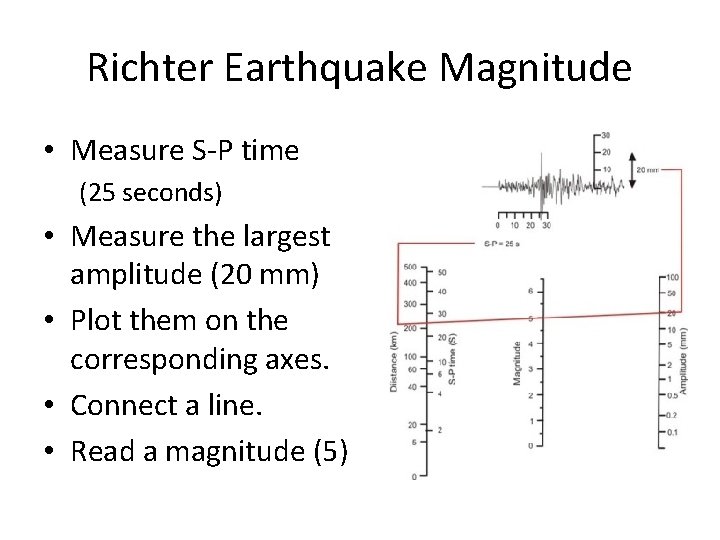
Richter Earthquake Magnitude • Measure S-P time (25 seconds) • Measure the largest amplitude (20 mm) • Plot them on the corresponding axes. • Connect a line. • Read a magnitude (5)
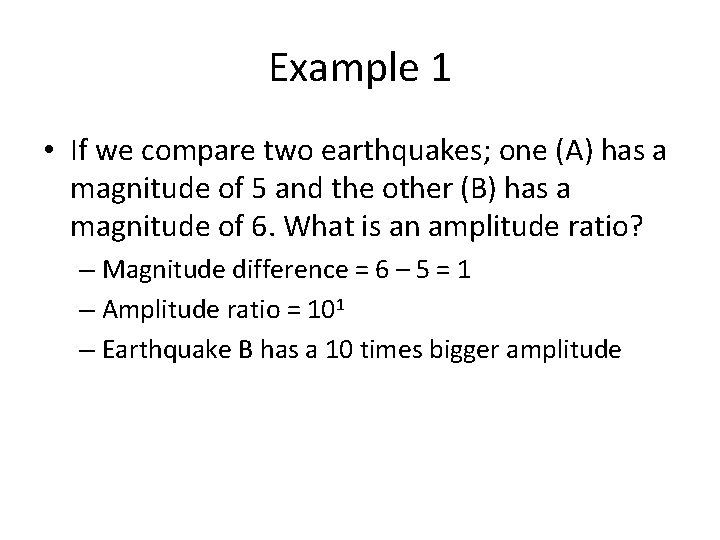
Example 1 • If we compare two earthquakes; one (A) has a magnitude of 5 and the other (B) has a magnitude of 6. What is an amplitude ratio? – Magnitude difference = 6 – 5 = 1 – Amplitude ratio = 101 – Earthquake B has a 10 times bigger amplitude
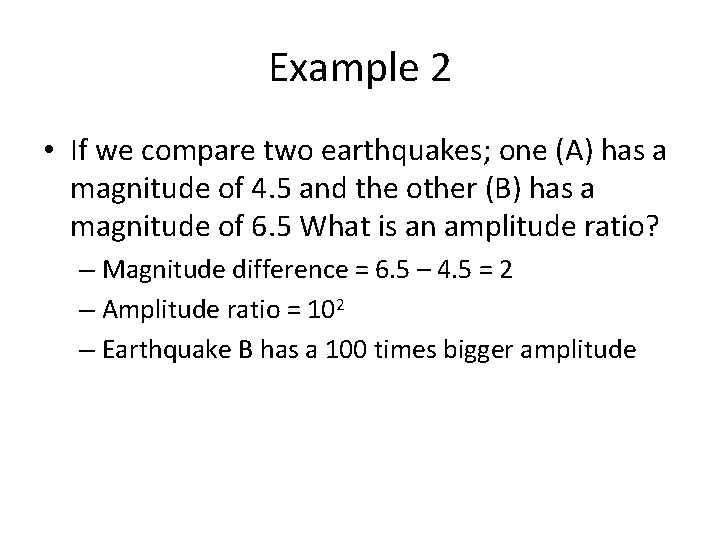
Example 2 • If we compare two earthquakes; one (A) has a magnitude of 4. 5 and the other (B) has a magnitude of 6. 5 What is an amplitude ratio? – Magnitude difference = 6. 5 – 4. 5 = 2 – Amplitude ratio = 102 – Earthquake B has a 100 times bigger amplitude
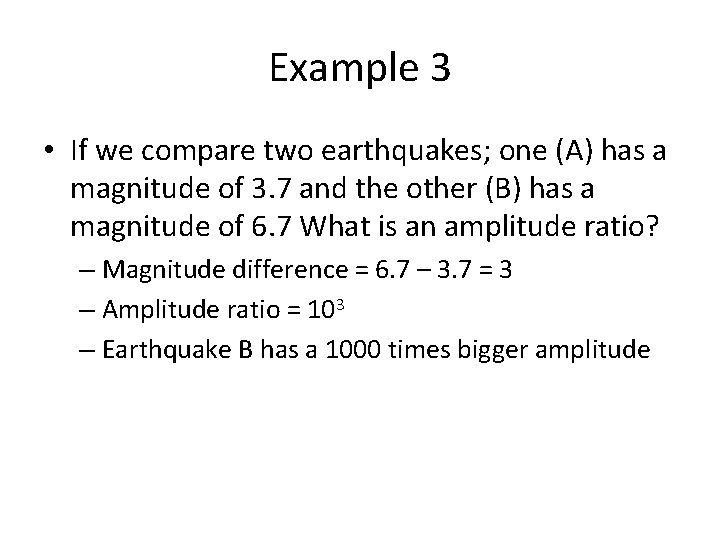
Example 3 • If we compare two earthquakes; one (A) has a magnitude of 3. 7 and the other (B) has a magnitude of 6. 7 What is an amplitude ratio? – Magnitude difference = 6. 7 – 3. 7 = 3 – Amplitude ratio = 103 – Earthquake B has a 1000 times bigger amplitude
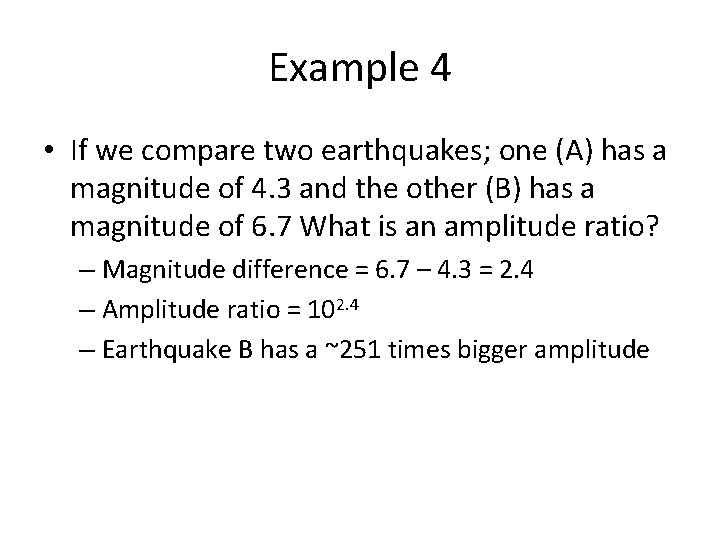
Example 4 • If we compare two earthquakes; one (A) has a magnitude of 4. 3 and the other (B) has a magnitude of 6. 7 What is an amplitude ratio? – Magnitude difference = 6. 7 – 4. 3 = 2. 4 – Amplitude ratio = 102. 4 – Earthquake B has a ~251 times bigger amplitude
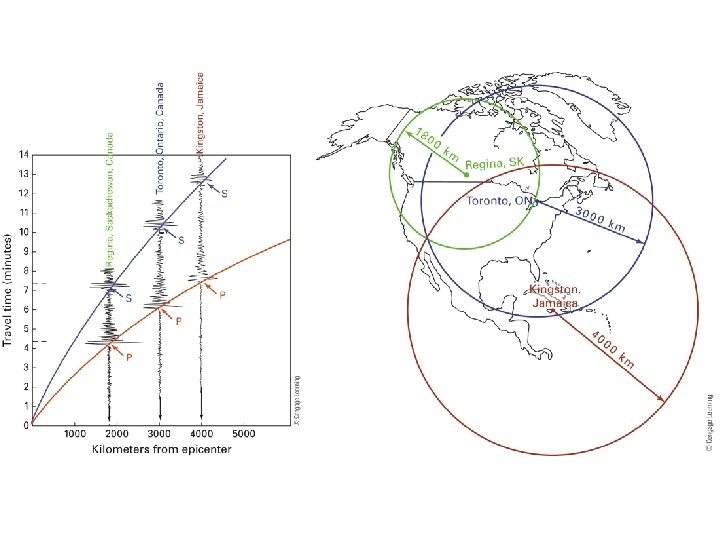
Locating Earthquakes • P and S waves travel at different speeds – Allows calculation of distance – Time-travel curve • Distance from multiple observations finds a location – Three seismographs
Earthquakes & Tectonic Plates • Where do earthquakes occur? – Convergent boundaries – Divergent boundaries – Transform fault boundaries – Plate interiors
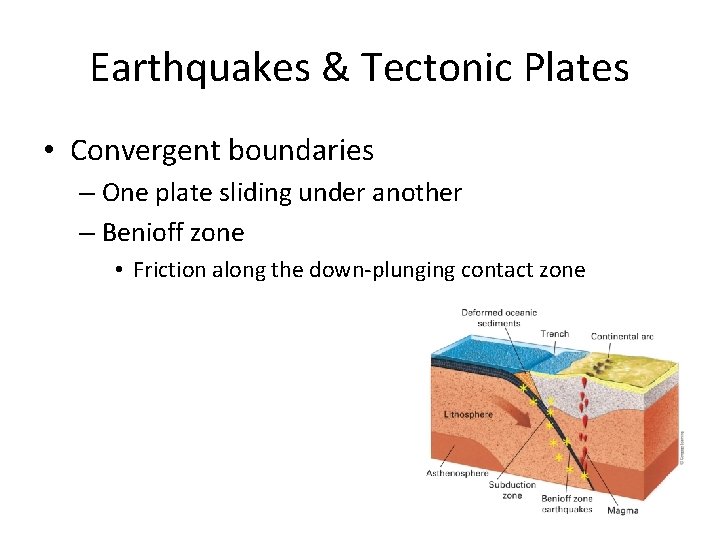
Earthquakes & Tectonic Plates • Convergent boundaries – One plate sliding under another – Benioff zone • Friction along the down-plunging contact zone
Earthquakes & Tectonic Plates • Divergent boundaries – Friction along sliding blocks – Mainly shallow
Earthquakes & Tectonic Plates • Transform boundaries – Offsets ridge system – San Andreas fault zone • • Strike-slip fault Fault is vertical Plate motion along the line of the fault Fault creep
Earthquakes & Tectonic Plates • Plate interiors - infrequent – 1811~12 in New Mardrid, MO – Area is still seeing deformation
Earthquake Hazard & Mitigation • Rock and soil – varying responses – Bedrock – Soil type – Topography – Liquefaction • Soil water content • Water table
Earthquake Hazard & Mitigation • Construction design and earthquake damage – Regulation of location and materials – Framing materials – Effects of affluence
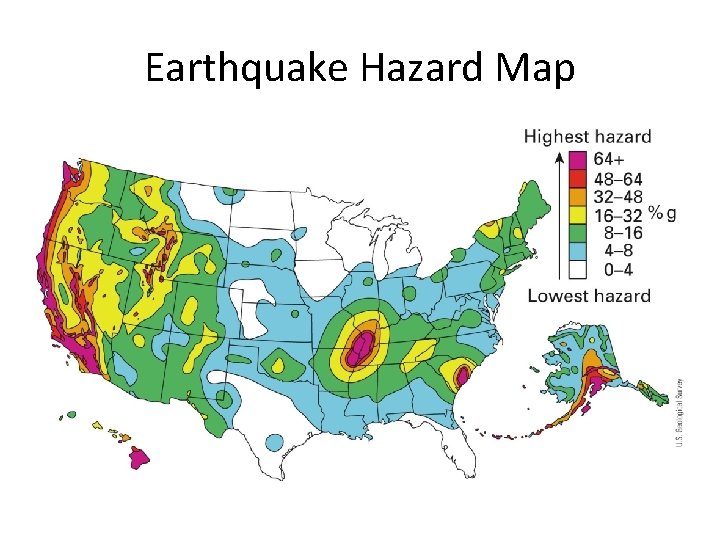
Earthquake Hazard Map
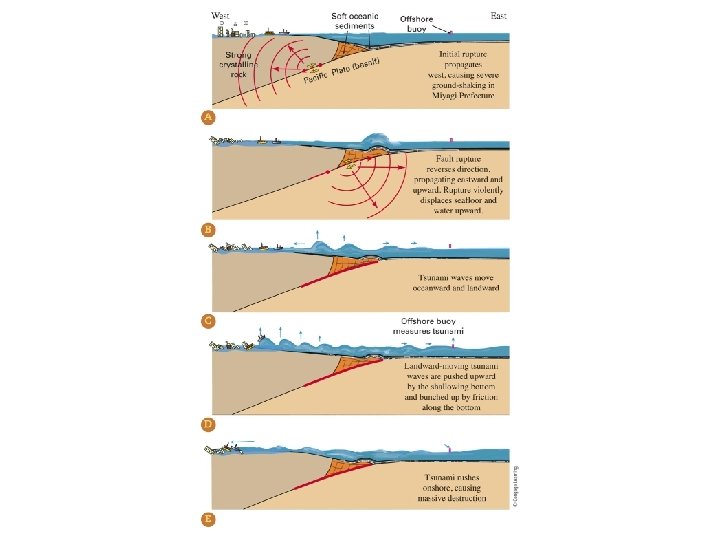
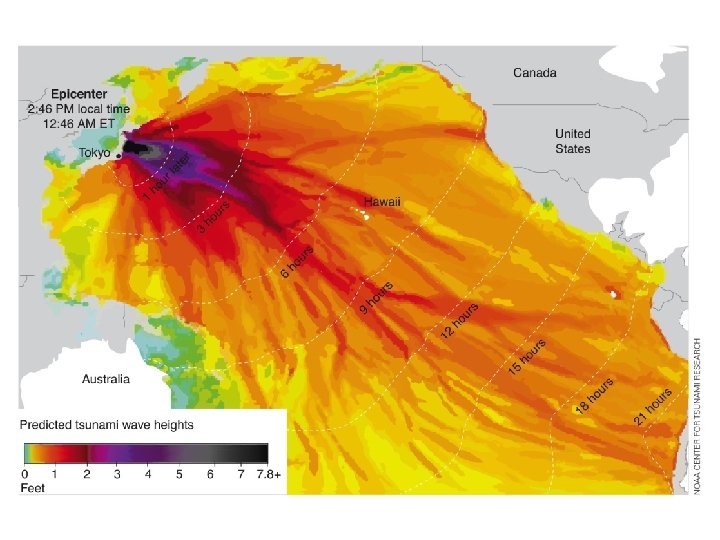
Tsunami • • Seismic sea wave Undersea fault motion Far-traveling wave Coastal hazard • Sumatra earthquake (2004) • Tohoku earthquake in Japan (2011)
Earthquake Prediction • Long-term prediction – Tells where earthquakes are likely to occur • Short-term prediction – Place and Time – Foreshocks – Aftershocks – Monitoring – China, Japan
Earth’s Interior • Wave behavior – In homogeneous media, wave propagate equally in all directions – Velocity depends on the nature of material waves are traveling through – Waves refract (bend) when moving from one material to another
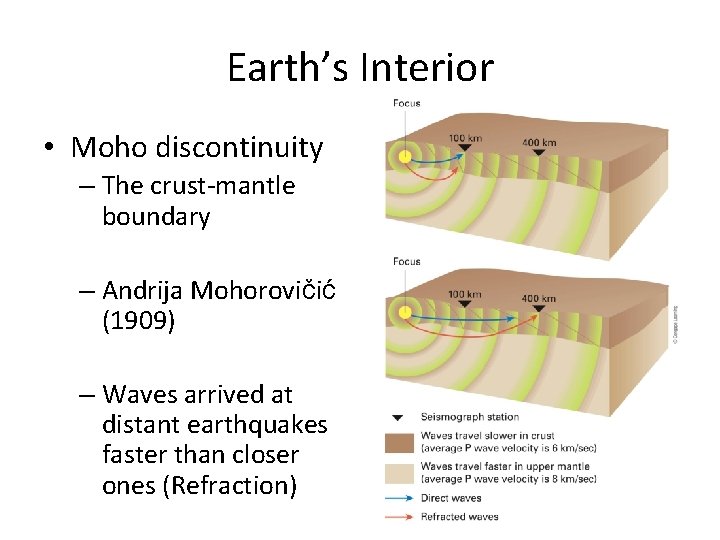
Earth’s Interior • Moho discontinuity – The crust-mantle boundary – Andrija Mohorovičić (1909) – Waves arrived at distant earthquakes faster than closer ones (Refraction)
Earth’s Interior • Structure of the mantle – 2900 km think – 660 discontinuity – 80 % of Earth’s volume
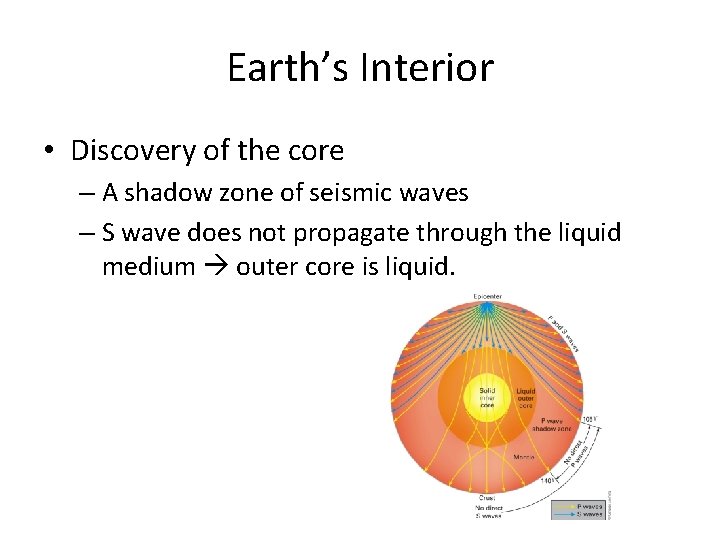
Earth’s Interior • Discovery of the core – A shadow zone of seismic waves – S wave does not propagate through the liquid medium outer core is liquid.