
Earthquakes and Seismic waves CHAPTER 6 LESSON 2
- Slides: 9
Earthquakes and Seismic waves CHAPTER 6 LESSON 2
What are Seismic Waves? Seismic waves are waves of energy produced at the focus of an earthquake as elastic strain is released. Seismic waves travel outward in all directions from the focus of an earthquake. The amount of energy carried by seismic waves decreases as the waves move away from the focus. This is because rocks absorb some energy as the seismic waves pass through them. The epicenter of an earthquake is the point on earth’s surface directly above the focus of the earthquake.
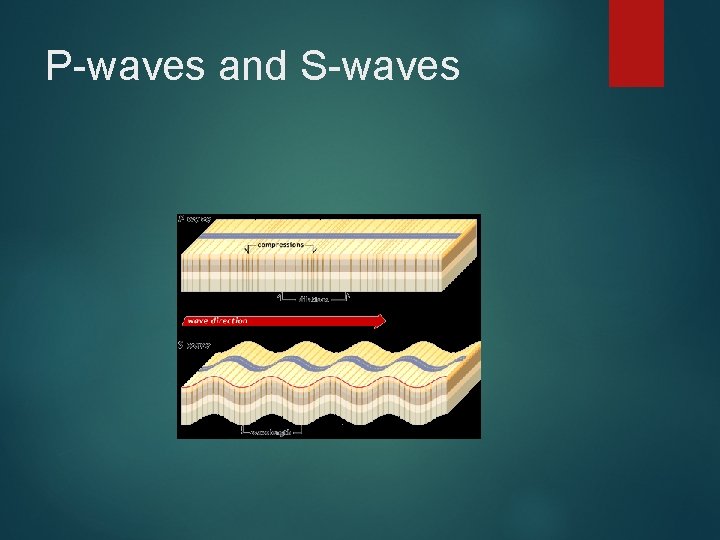
Types of Seismic Waves There are three different types of seismic waves: primary waves, secondary waves, and surface waves. Primary waves are compressional waves that move rocks and other matter parallel to the direction the wave is travelling. Primary waves are the fastest seismic waves. Secondary waves are shearing waves that move rocks and other matter back and forth perpendicular to the direction the waves are travelling. Secondary waves travel about 60 percent as fast as P-waves.
Start Video at 1: 30 http: //education-portal. com/academy/lesson/usingseismic-waves-to-study-earthquakes. html#lesson
P-waves and S-waves
Some of the energy from P-waves and S-waves that reach Earth’s surface can be trapped in the upper areas of Earth’s crust to form surface waves. Surface waves are the slowest type of seismic wave. Surface waves usually cause stronger shaking than P-waves or Swaves, and they are often the most destructive type of seismic wave.
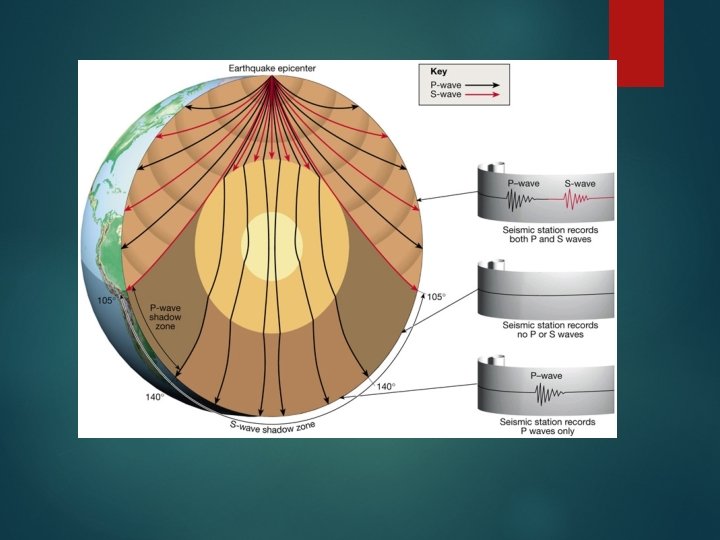
Using Seismic Wave Data A seismologist is a scientist who studies earthquakes. The farther you are from the focus of an earthquake, the farther S-waves will be behind P-waves. Seismic waves change speed and direction when the material through which they are travelling changes. Observing the paths of seismic waves can help scientists to understand what kind of materials make up Earth’s interior.
The shadow zone is a portion of earth that does not receive any seismic waves from a particular earthquake. Because S-waves cannot move through liquid and P-waves would be bent by a liquid, scientists think earth’s outer core is liquid and causes the shadow zone.