
Earthquakes A preview of Earthquakes and Tsunamis What
- Slides: 32
Earthquakes
A preview of Earthquakes and Tsunamis
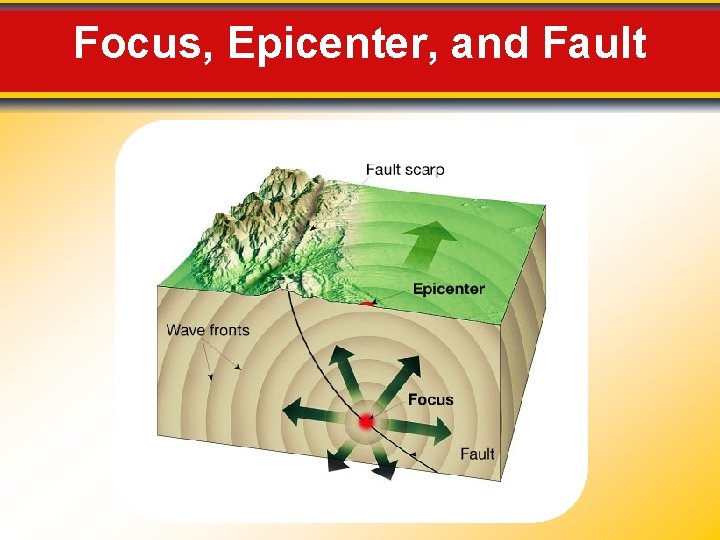
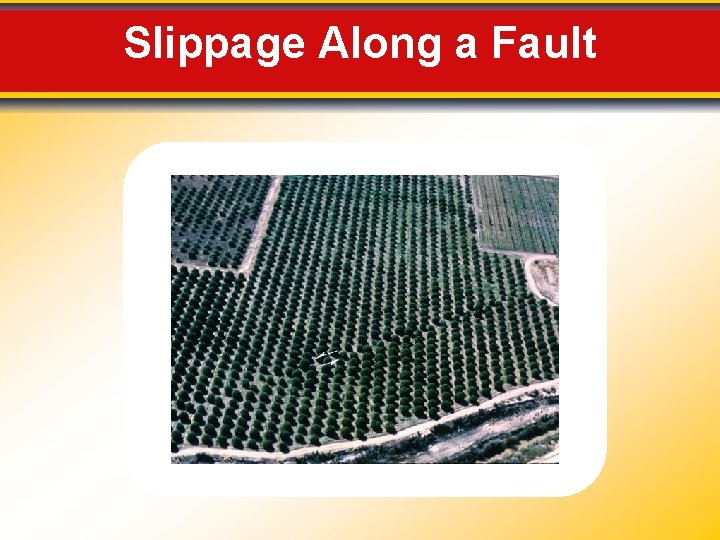
What Is an Earthquake? Earthquakes Def: An earthquake is the vibration of Earth made by the rapid release of energy 3 parts of an EQ: • 1 - Focus is the point within Earth where the earthquake starts, given by a #: 90 km deep • 2 - Epicenter is the location on the surface directly above the focus, given by a name like say Los Angeles CA, Livonia Mi or Yolo Island • Faults are fractures or breaks in Earth where movement has occurred. Ex- most famous in the U. S…… San Andreas Fault in California
Focus, Epicenter, and Fault
Slippage Along a Fault
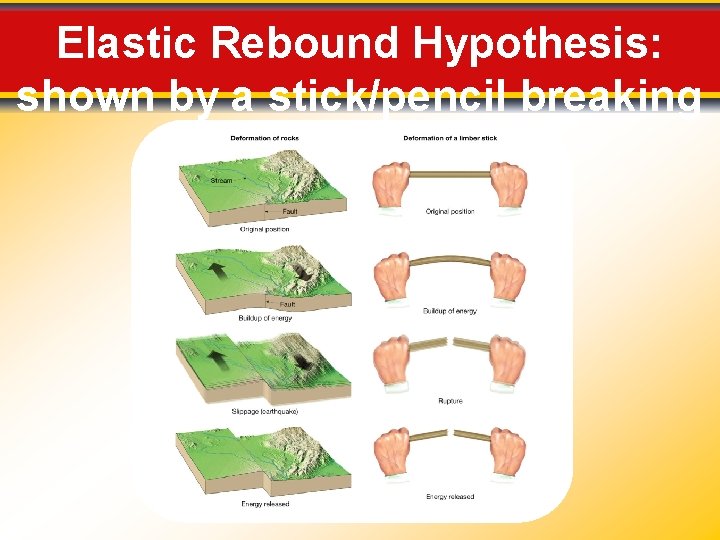
What Is an Earthquake? Cause of Earthquakes Elastic Rebound Hypothesis • Most earthquakes are produced by the rapid release of elastic energy stored as plates or rock slide next to and get “caught” on, each other. Ex- stretching a rubber band or bending a pencil until it breaks…. ∙ When that strength of the rock/pencil is exceeded, it suddenly breaks, causing the vibrations of an earthquake.
Elastic Rebound Hypothesis: shown by a stick/pencil breaking
8. 1 What Is an Earthquake? “Shocks” Aftershocks and Foreshocks • An aftershock is a small earthquake that follows the main earthquake. “after” • A foreshock is a small earthquake that often precedes a major earthquake. “before” --Both of these are always smaller than the real earthquake itself. The foreshocks are a lot smaller but the aftershocks can be closer to the original number on the scale, but still smaller than original quake.
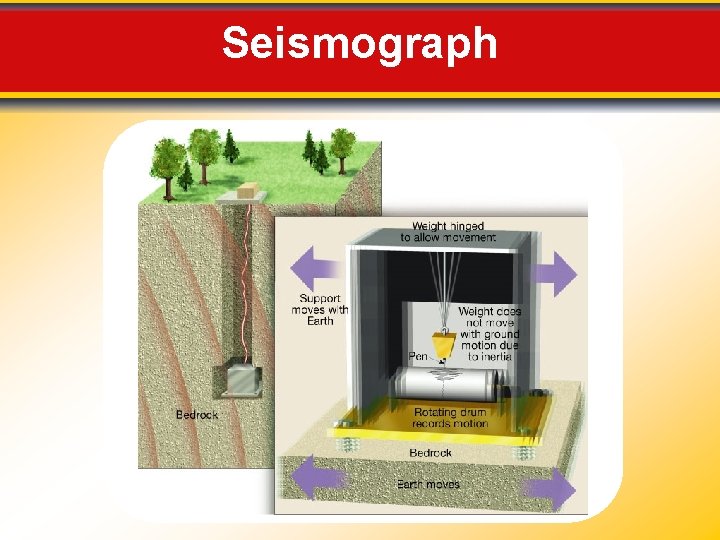
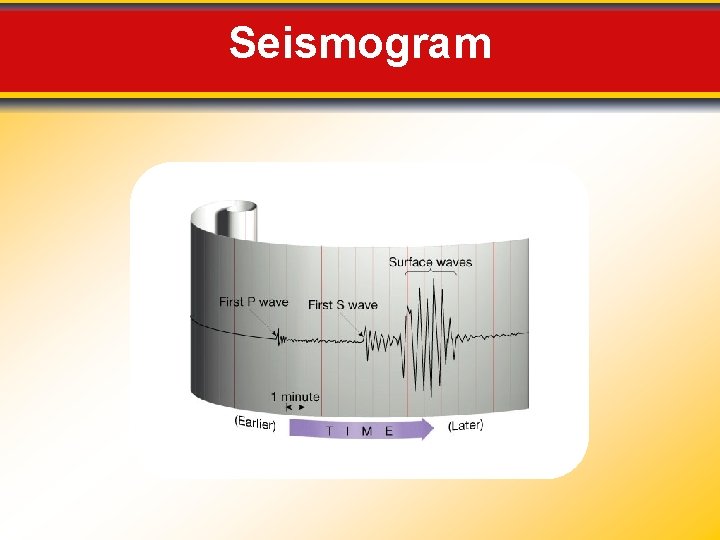
Measuring Earthquakes Measuring the Quake: Seismographs are instruments or machine that records earthquake waves. Seismograms are traces or marks on a paper of amplified, electronically recorded ground motion made by the EQ
Seismograph
Seismogram
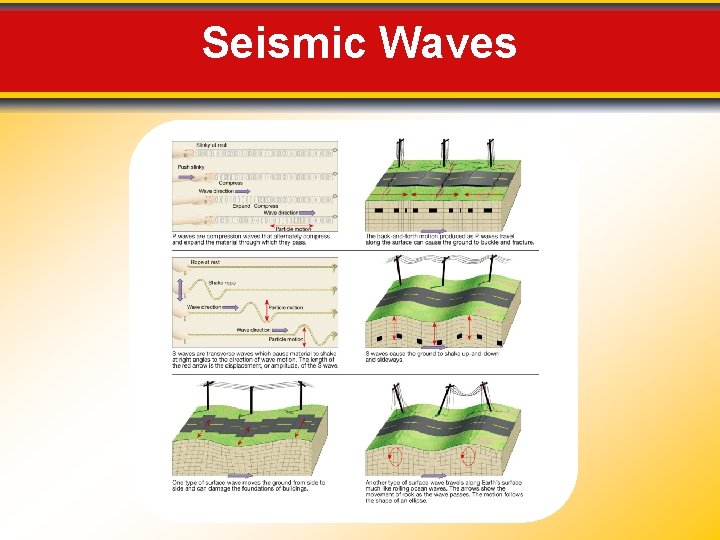
Earthquakes Waves 3 types of Earthquake Waves 2 Body Waves-inside Earth-1 on surface • Identified as P waves or S waves • #1 - P waves = Primary Waves - Are push-pull waves that push (compress) and pull (expand). The first uplift you feel in an EQ - Travel through solids, liquids, and gases - Are the fastest waves - Move faster and different directions in more dense material…mantle+core
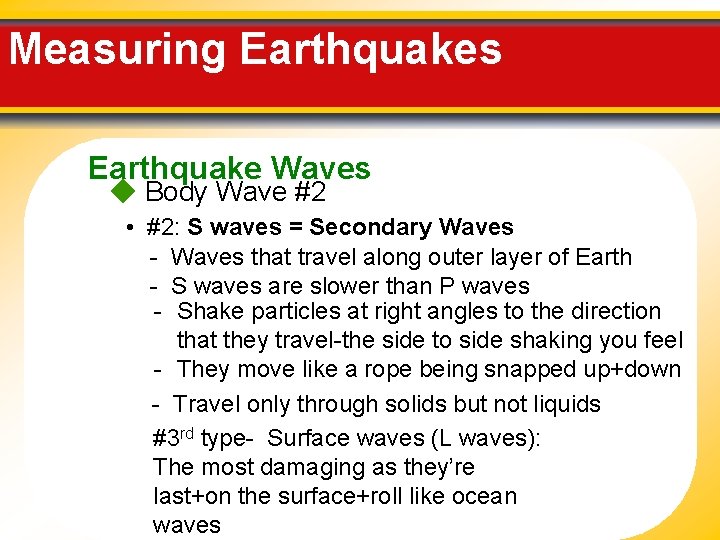
Measuring Earthquakes Earthquake Waves Body Wave #2 • #2: S waves = Secondary Waves - Waves that travel along outer layer of Earth - S waves are slower than P waves - Shake particles at right angles to the direction that they travel-the side to side shaking you feel - They move like a rope being snapped up+down - Travel only through solids but not liquids #3 rd type- Surface waves (L waves): The most damaging as they’re last+on the surface+roll like ocean waves
Seismic Waves
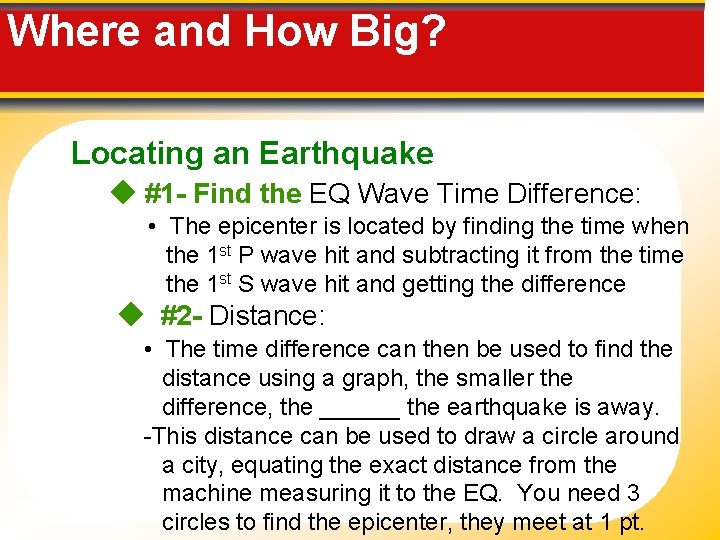
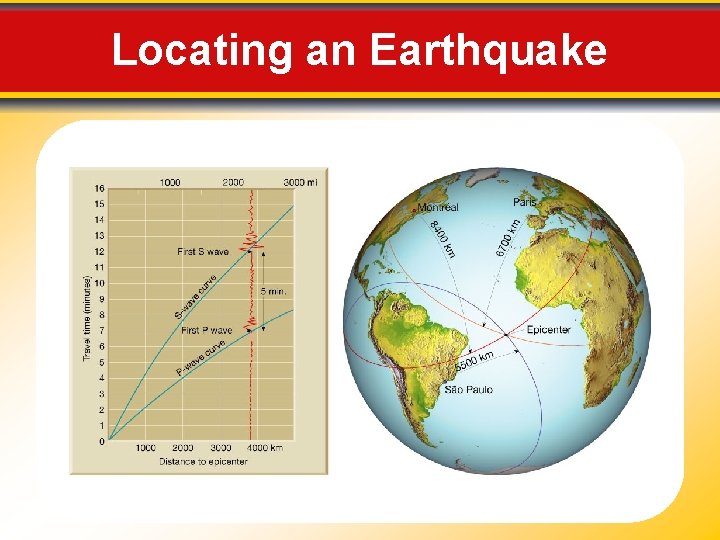
Where and How Big? Locating an Earthquake #1 - Find the EQ Wave Time Difference: • The epicenter is located by finding the time when the 1 st P wave hit and subtracting it from the time the 1 st S wave hit and getting the difference #2 - Distance: • The time difference can then be used to find the distance using a graph, the smaller the difference, the ______ the earthquake is away. -This distance can be used to draw a circle around a city, equating the exact distance from the machine measuring it to the EQ. You need 3 circles to find the epicenter, they meet at 1 pt.
Locating an Earthquake
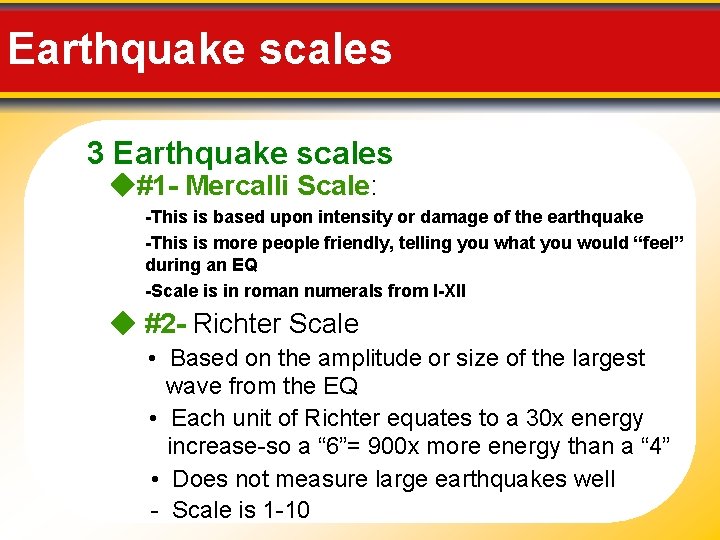
Earthquake scales 3 Earthquake scales #1 - Mercalli Scale: -This is based upon intensity or damage of the earthquake -This is more people friendly, telling you what you would “feel” during an EQ -Scale is in roman numerals from I-XII #2 - Richter Scale • Based on the amplitude or size of the largest wave from the EQ • Each unit of Richter equates to a 30 x energy increase-so a “ 6”= 900 x more energy than a “ 4” • Does not measure large earthquakes well - Scale is 1 -10
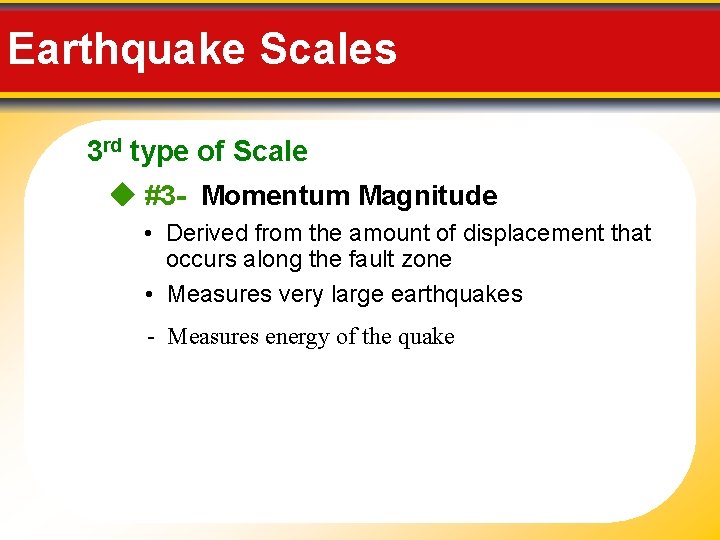
Earthquake Scales 3 rd type of Scale #3 - Momentum Magnitude • Derived from the amount of displacement that occurs along the fault zone • Measures very large earthquakes - Measures energy of the quake
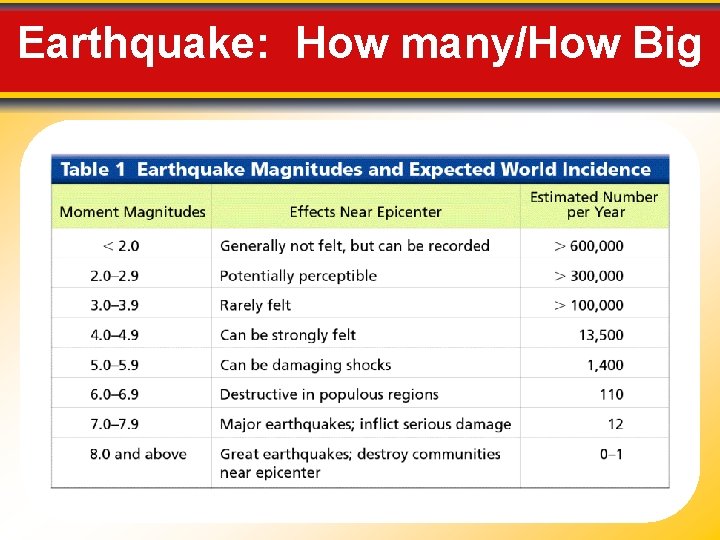
Earthquake: How many/How Big
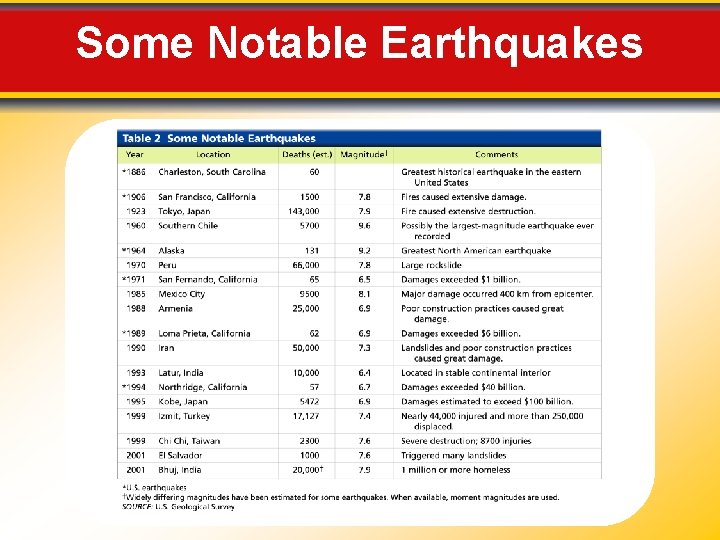
Some Notable Earthquakes
Earthquake Damage http: //www. theguardian. com/world/ video/2015/apr/30/nepalearthquake-kathmandu-cctv-video
Destruction from Earthquakes Seismic Vibrations Building Design • Factors that determine structural damage - Intensity of the earthquake - Unreinforced stone or brick buildings are the most serious safety threats - Nature of the material upon which the structure rests - The design of the structure
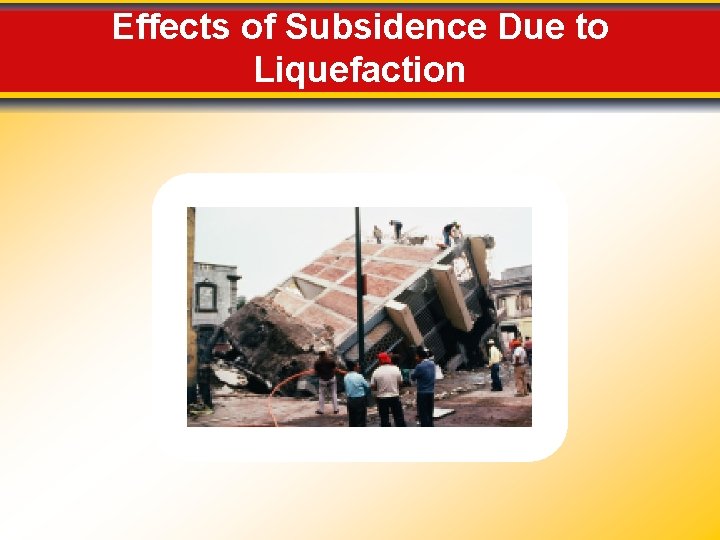
Destruction from Earthquakes Seismic Vibrations cause: Liquefaction • Saturated material turns fluid • Underground objects may float to surface as less dense liquid rises to the surface -Material can be shaken so hard it turns to liquid
Effects of Subsidence Due to Liquefaction
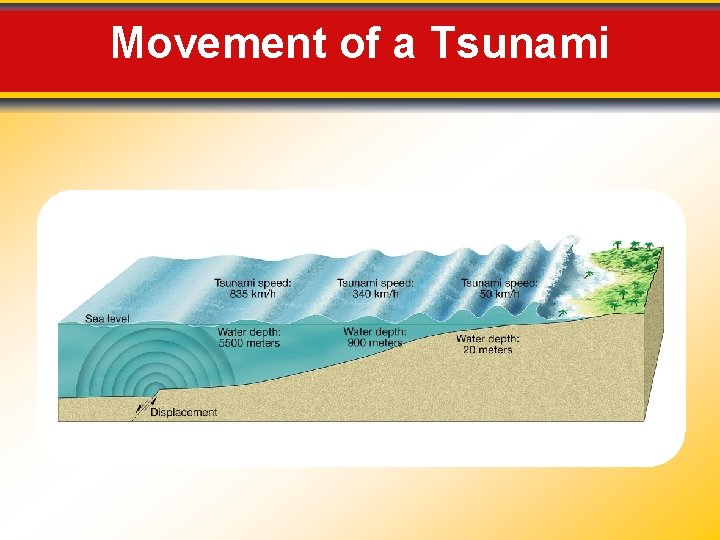
Destruction from Earthquakes Tsunamis Cause of Tsunamis • A tsunami triggered by an earthquake occurs where a slab of the ocean floor is displaced vertically along a fault. • A tsunami also can occur when the vibration of a quake sets an underwater landslide into motion. • Tsunami is the Japanese word for “seismic sea wave. ”
Movement of a Tsunami
Destruction from Earthquakes #1 Disaster spawned by an EQ: Tsunami Warning System • There are warning systems in the Pacific Ocean and now in the Indian Ocean but only after 2004 tsunami that killed ¼ of a million people. There was no Indian Ocean tsunami warning system before that. Atlantic Ocean? ? ? https: //www. youtube. com/watch? v=c. Ybxf. Cj 7 F 1 Y -High ground is the only place to go for tsunami safety. Warning signs are 1 - EQ: ) 2 -ocean water receding backward at the coastline
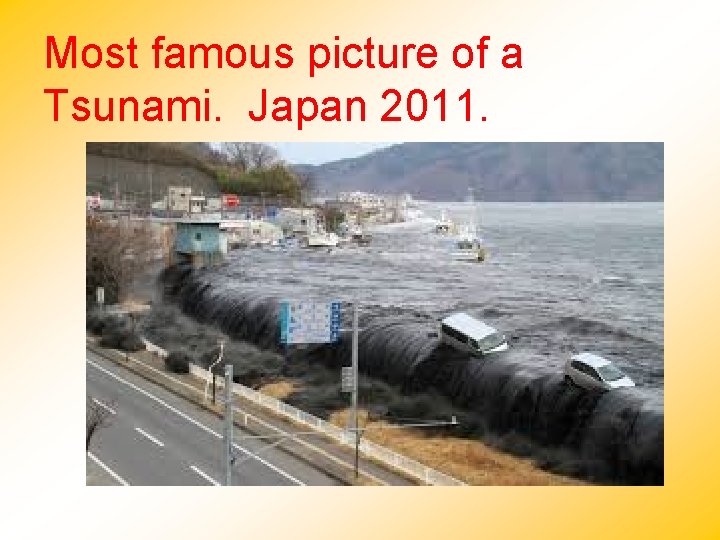
Most famous picture of a Tsunami. Japan 2011.
8. 3 Destruction from Earthquakes Other Disasters from EQ’s: #2 - Landslides • With many earthquakes, the greatest damage to structures is from landslides and ground subsidence, or the sinking of the ground triggered by vibrations. #3 - Fires • In the San Francisco earthquake of 1906, most of the destruction was caused by fires that started when gas and electrical lines were cut.
Prediction: Never have yet Predicting Earthquakes Short-Range Predictions • So far, we can’t Long-Range Forecasts • So far, we can’t…but we have used the idea of seismic gaps which look at the history of the area and if the area is overdue for a quake…hence the articles written about “The Big One” that LA/San Andreas Fault should have “soon. ”
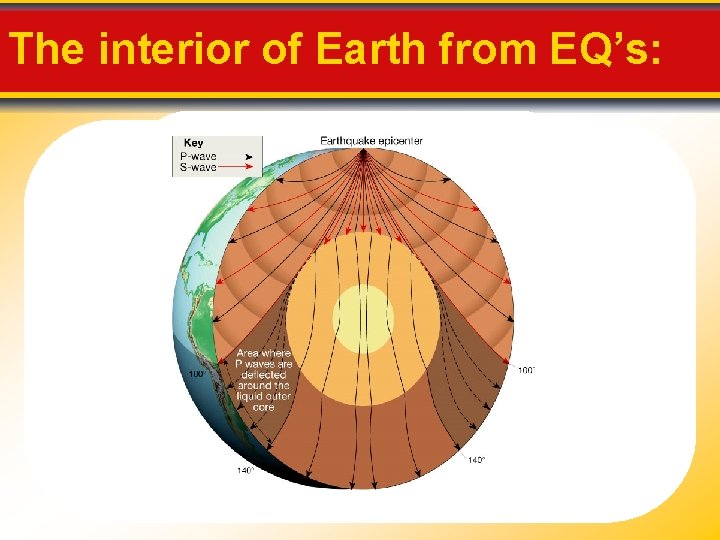
The interior of Earth from EQ’s:
8. 4 Earth’s Layered Structure Discovering Earth’s Layers Moho • Velocity of seismic waves increases abruptly below 50 km of depth • Separates crust from underlying mantle Shadow Zone • Absence of P waves from about 105 degrees to 140 degrees around the globe from an earthquake • Can be explained if Earth contains a core composed of materials unlike the overlying mantle