
Earthquake Precursors Radon Gas BY EMILY DAZ EPSC
Earthquake Precursors: Radon Gas BY: EMILY DAZÉ EPSC 330
Context -A polarizing subject: is short-term earthquake prediction even possible? -A useful short-term prediction should: occur early enough for sufficient evacuation, anticipate location, magnitude and probability of occurrence. -Successful predictions can save lives -the concept of accumulated stresses Khilyuk, L. F. (2000).
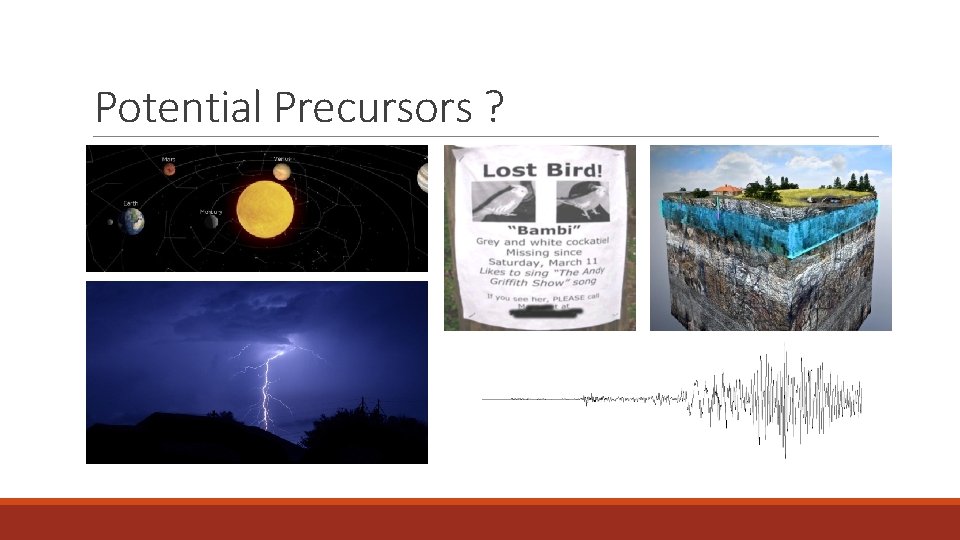
Potential Precursors ?
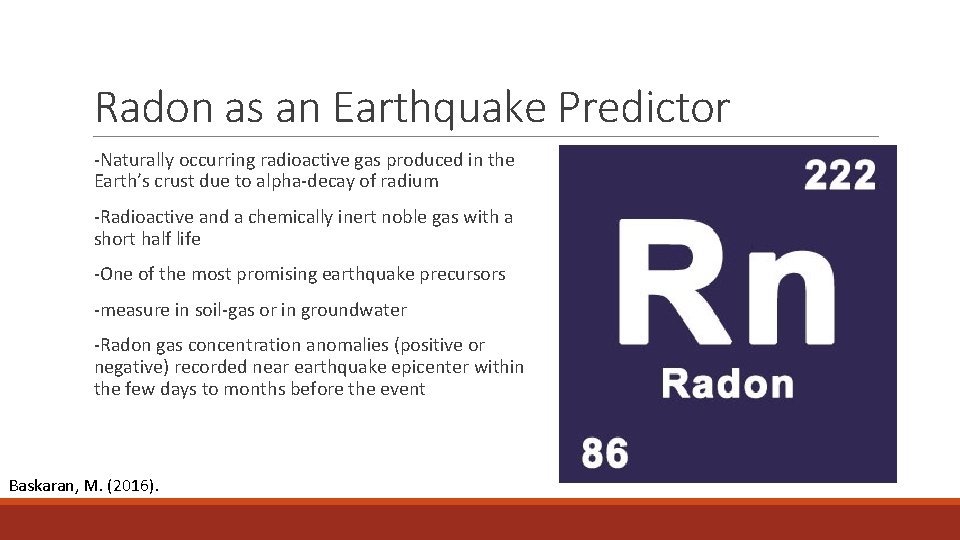
Radon as an Earthquake Predictor -Naturally occurring radioactive gas produced in the Earth’s crust due to alpha-decay of radium -Radioactive and a chemically inert noble gas with a short half life -One of the most promising earthquake precursors -measure in soil-gas or in groundwater -Radon gas concentration anomalies (positive or negative) recorded near earthquake epicenter within the few days to months before the event Baskaran, M. (2016).
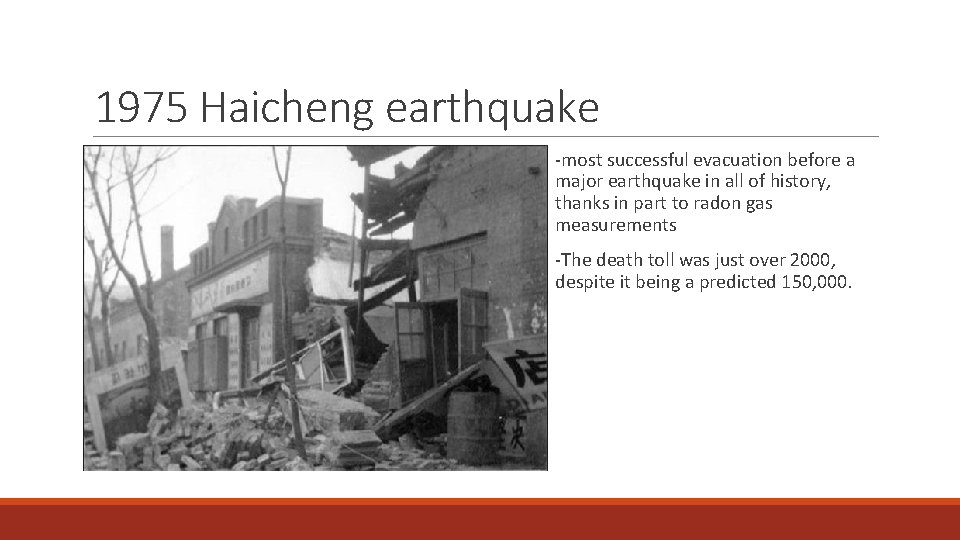
1975 Haicheng earthquake -most successful evacuation before a major earthquake in all of history, thanks in part to radon gas measurements -The death toll was just over 2000, despite it being a predicted 150, 000.
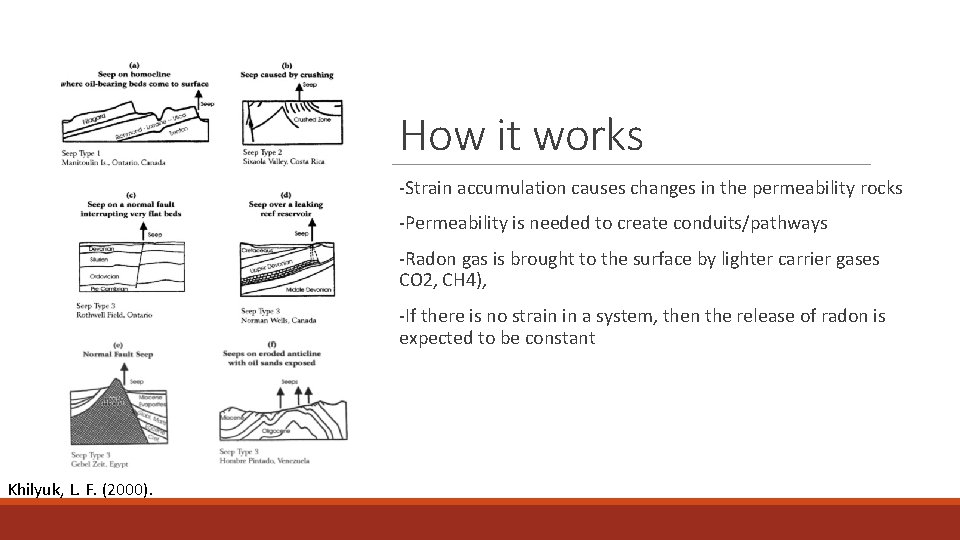
How it works -Strain accumulation causes changes in the permeability rocks -Permeability is needed to create conduits/pathways -Radon gas is brought to the surface by lighter carrier gases CO 2, CH 4), -If there is no strain in a system, then the release of radon is expected to be constant Khilyuk, L. F. (2000).
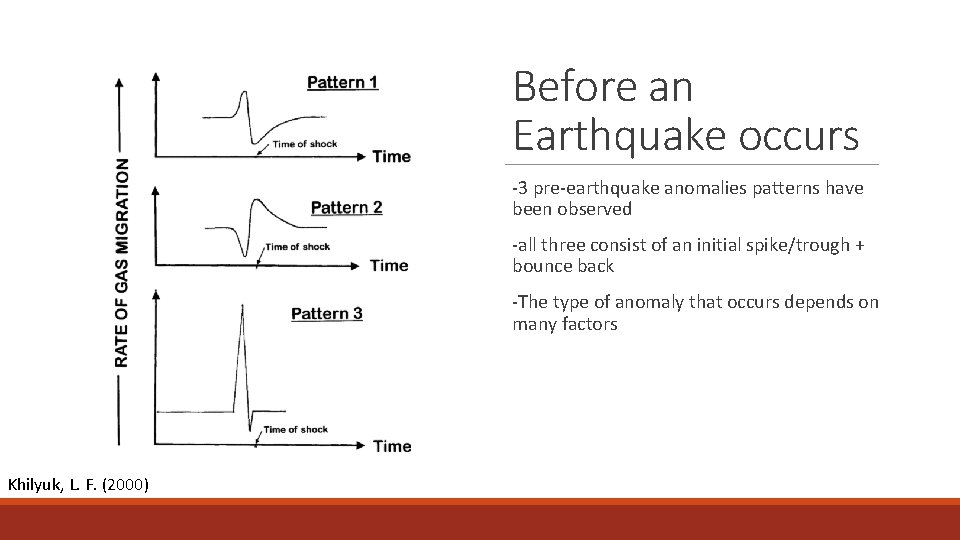
Before an Earthquake occurs -3 pre-earthquake anomalies patterns have been observed -all three consist of an initial spike/trough + bounce back -The type of anomaly that occurs depends on many factors Khilyuk, L. F. (2000)
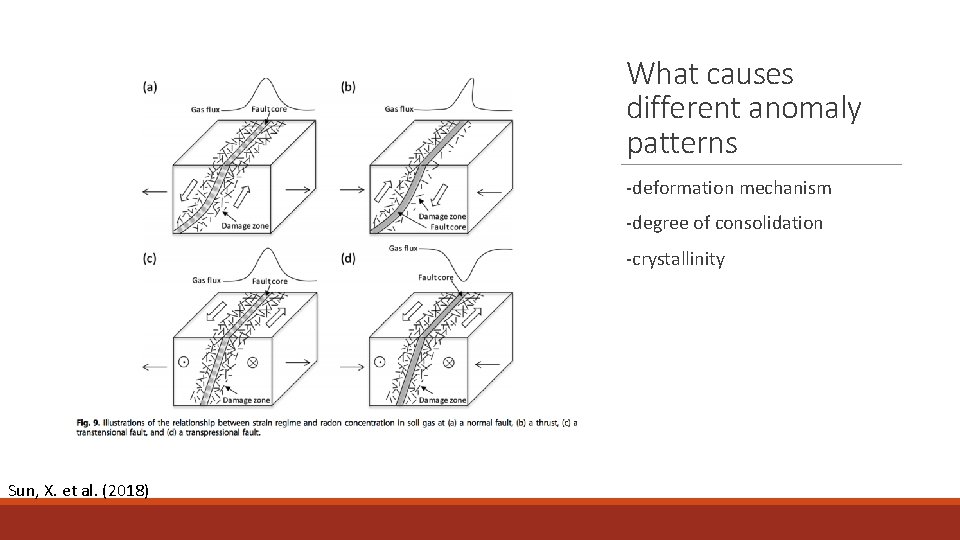
What causes different anomaly patterns -deformation mechanism -degree of consolidation -crystallinity Sun, X. et al. (2018)
Issues + Questions for the future - heterogeneous state of the Earth. -inaccessibility of the fault zone to direct measurement -un-earthquake related causes are rarely excluded -how radon gas emissions relate to earthquake magnitude -how conduits change temporally preceding an earthquake (what are the controls)
Conclusion -Who knows if we will ever be able to use radon gas emissions to rigorously predict earthquakes -The only consensus we have is that radon activities in surface soil air, gas and groundwater CAN vary prior to, during and post- earthquake activity

References Baskaran, M. (2016). Radon: a tracer for geological, geophysical and geochemical studies. (Ch. 10) S. l. : Springer International Publishing Switzerland. Geller, R. , Jackson, D. , Kagan, Y. , & Mulargia F. (1997). Earthquakes Cannot be Predicted. Science, 275(5306), 1606. http: //doi. org/10. 1126/science. 275. 5306. 1616 Jaishi, H. P. , Singh, S. , Tiwari, R. P. , & Tiwari, R. C. (2014). Temporal variation of soil radon and thoron concentrations in Mizoram (India), associated with earthquakes. Natural Hazards, 72(2), 443– 454. http: //doi. org/10. 1007/s 11069 -013 -1020 -4 Khilyuk, L. F. (2000). Gas migration: events preceding earthquakes. Houston: Gulf. Anonymous. (1977). Prediction of the Haicheng earthquake. Eos, Transactions American Geophysical Union, 58(5). http: //doi. org/10. 1029/eo 058 i 005 p 00236 Rayleigh, B. , Bennet G. , Craig H. (1977). Prediction of the Haicheng Earthquake: Trans-American Geophysical Union 58(5), 236 -272. Singh, M. , Ramola, R. , Singh, B. , & Singh, S. (1991). Subsurface Soil Gas Radon Changes Associated With Earthquakes. International Journal of Radiation Applications & Instrumentation, 19(1), 417– 420. http: //doi. org/ 10. 1016/1359 -0189(91)90229 -B Sun, X. , Yang, P. , Xiang, Y. , Si, X. , & Liu, D. (2018). Across-fault distributions of radon concentrations in soil gas for different tectonic environments. Geosciences Journal, 22(2), 227– 239. http: //doi. org/10. 1007/s 12303 -017 -0028 -2 Wyss, M. (1997). Cannot Earthquakes Be Predicted? Science, 278(5337), 487– 490. http: //doi. org/10. 1126/science. 278. 5337. 487
- Slides: 11