
Earth Systems Structures and Processes 8 E 1















- Slides: 45
Earth Systems, Structures and Processes 8. E. 1. 2 Summarize evidence that Earth’s oceans are a reservoir of nutrients, minerals, dissolved gases, and life forms:
1. Earth’s Oceans More than 70% of the Earth’s surface is covered by ocean water. Most of the ocean floor has not been explored because it is so vast and deep.
2. Earth’s Oceans There are many similarities in features between the ocean floor and land.
3. One Ocean • Earth’s oceans are often split into 5 different ones: – Atlantic – Pacific – Indian – Southern – Arctic
4. One Ocean • There is actually one continuous ocean
5. One Ocean • Ocean Basin – Part of Earth’s surface that is covered by ocean water.
6. One Ocean • Pacific is largest and deepest ocean • Arctic is coldest and shallowest ocean – Mostly covered in ice
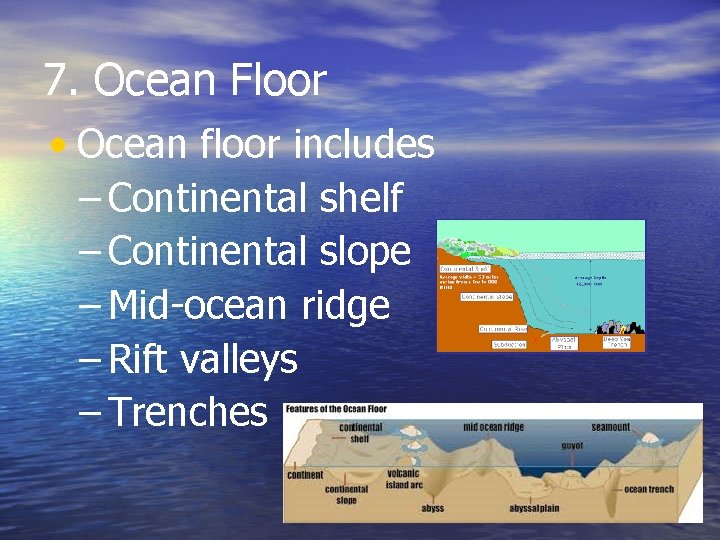
7. Ocean Floor • Ocean floor includes – Continental shelf – Continental slope – Mid-ocean ridge – Rift valleys – Trenches
8. Ocean Floor • Most of the ocean is dark, flat area called the Abyssal plain • Ocean trench is a large V-shaped valley
9. Ocean Floor • Mid-ocean ridges are underwater mountain ranges – Some of the mountain ranges reach above the water to form islands. • Ocean floor mapping video
10. Ocean Composition • Most of the Earth’s water is not drinkable (potable) because of the salt. – Why can’t we drink salt water? • Underwater volcanoes also add salt. – Why is ocean water salty?
11. Ocean Composition • Even though the ocean is fed by fresh water, because of the salt left behind in evaporation, the fresh water quickly becomes salty.
12. Ocean Composition • Salinity – The saltiness of a body of water – In an ocean, it averages about 3. 5% • This means that about 3 -4% of the water is made up of dissolved salt • Rather than H 2 O only for the water, it is actually: – H 2 O with about 3 -4% Na. Cl
13. Ocean Composition • Salinity – Salinity levels are lower where fresh water flows into the ocean and higher where there is a greater rate of evaporation • Such as near the Equator
14. Ocean Resources • The ocean has been used as a source of food for centuries. – Fishing is a major industry in North Carolina • Swordfish Scallops • Tuna Oysters • Flounder Crab • Shrimp
15. Ocean Resources • Food resources are often threatened by pollution – The release of an unwanted substance into the environment – Oil spills
16. Ocean Resources • Taking too many resources before they can reproduces is called Overfishing • Sustainable Resources
17. Marine Ecosystems and Estuaries • Almost half of the known species on Earth live in the ocean – That number could be greater due to the vast unknown of the ocean depths – Ocean Depths
18. The Ocean’s Producers • Marine(Ocean) producers are important to all life on Earth
19. The Ocean’s Producers • Main producers are algae and phytoplankton – They live in the upper regions of the ocean and get enough light for photosynthesis • Light can not reach deeper into the ocean so there are no producers at deeper levels.
20. The Ocean’s Producers • Marine food web
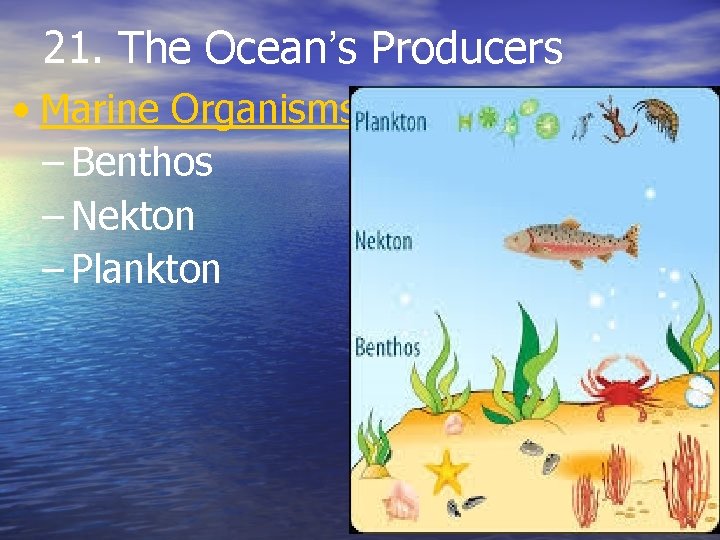
21. The Ocean’s Producers • Marine Organisms – Benthos – Nekton – Plankton
22. The Ocean’s Producers • Populations of producers can be affected by ocean currents – These are called Upwellings • Carries cold water from the deep in the ocean up the surface
23. The Ocean’s Producers • Populations of producers can be affected by ocean currents – This water is rich in nutrients from the ocean floor – Producers use the nutrients to increase populations
24. Marine Ecosystems • There are three major ecosystems – The Shore – The Open Ocean – The Deep Ocean – Really annoying but very informative video!
25. Marine Ecosystems • The Shore (Intertidal Zone) – The part of the ocean nearest the land – With shallow water, light can reach the bottom of the ocean
26. Marine Ecosystems • The Shore (Intertidal Zone) – Waves create a lot of motion in this area moving sand mud – Tides rise and fall and some creatures thrive such as clams, mussels and worms
27. Marine Ecosystems • The Open Ocean – The vast area of top ocean level that expands from shore to shore – This expands as deep as light is allowed to filter down • The sun warms the water at these depths
28. Marine Ecosystems • The Open Ocean – Light is bright enough for photosynthesis – Some of the organisms that thrive here are jellyfish, fish and squid
29. Marine Ecosystems • The Deep Ocean – Thousands of meters below the ocean’s surface • The water is very cold – Openings in the ocean floor release heat called hydrothermal vents – Small ecosystems exist around these vents
30. Marine Ecosystems • The Deep Ocean – They rely on organisms called autotrophs that make their own food No light filters down so photosynthesis can not take place
31. Marine Ecosystems • The Deep Ocean – Because of this, chemosynthesistakes place ❖Process of using energy stored in chemical bonds
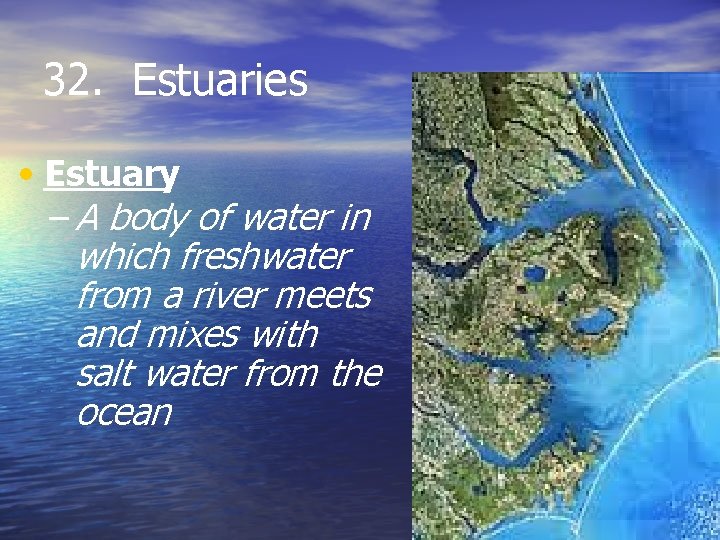
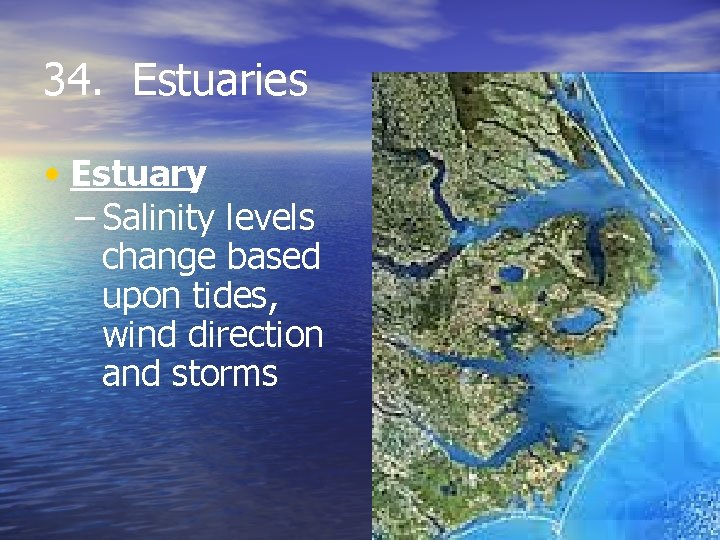
32. Estuaries • Estuary – A body of water in which freshwater from a river meets and mixes with salt water from the ocean
33. Estuaries • Estuary – Known as inlets, bays, harbors, lagoons and sounds • Examples are Boston Harbor, Chesapeake Bay, Pamlico Sound, and Albemarle Sound
34. Estuaries • Estuary – Salinity levels change based upon tides, wind direction and storms
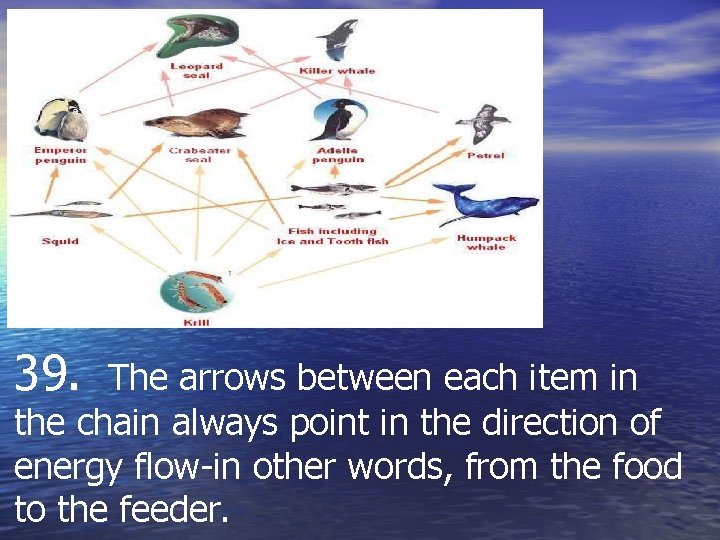
35. Estuaries • Often protected from ocean waves by land features. – Barrier Islands, Reefs, Sand spits – Rich in nutrients, dissolved oxygen, and minerals – Can be used a nurseries for many animals including some ocean animals that come to breed
36. Neuse River • Kayaking • Lower Neuse River 1 • Lower Neuse River 2 • Rachel Carson Reserve
37. The arrows between each item in the chain always point in the direction of energy flow- in other words, from the food to the feeder.
38. A food web is a model that shows all the possible feeding relationships between organisms living in an ecosystem.
39. The arrows between each item in the chain always point in the direction of energy flow-in other words, from the food to the feeder.
40. What is a keystone species? • Keystone Species: a species that has a greater-than-expected effect on an ecosystem; if it is removed from the environment, the entire ecosystem is affected dramatically (sometimes, it completely “collapses”).
41. What is a keystone species? – Many keystone species are top predators (killer whales, starfish, wolves, bears)
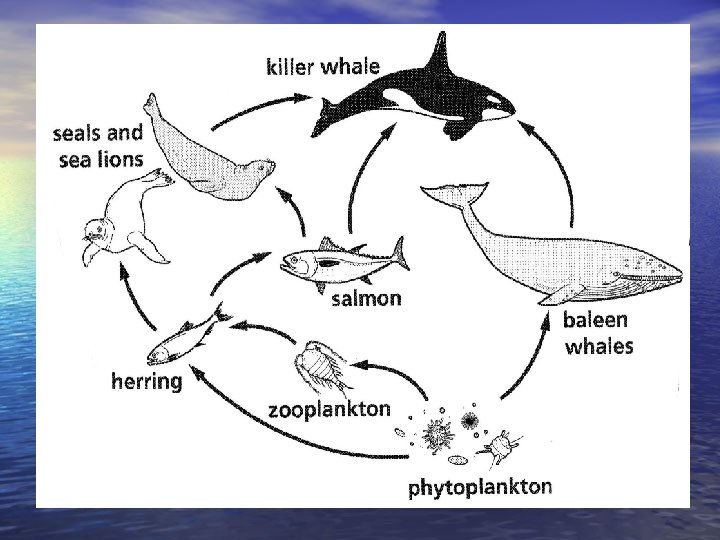
42. What is a keystone species? – Example: In the food web above, killer whales are the keystone species. If they are removed from the environment, there will be too many salmon, which will provide more food for the seals and sea lions who’s population will increase, then seals and sea lions along with salmon will eat all of the herring, which will lead to too many zooplankton, which will eat all of the phytoplankton, which will lead to not enough food for the baleen whale (and less oxygen).
Classwork Create a chart or list of who eats what in the food web. Use previous slides to make the chart or list. ● Must list at least 10 different organisms and what they eat. ● Write producers in green ● Write consumers in black ● Write keystones in red