
Earth System Science Partnership IHDP WCRP IGBP Diversitas
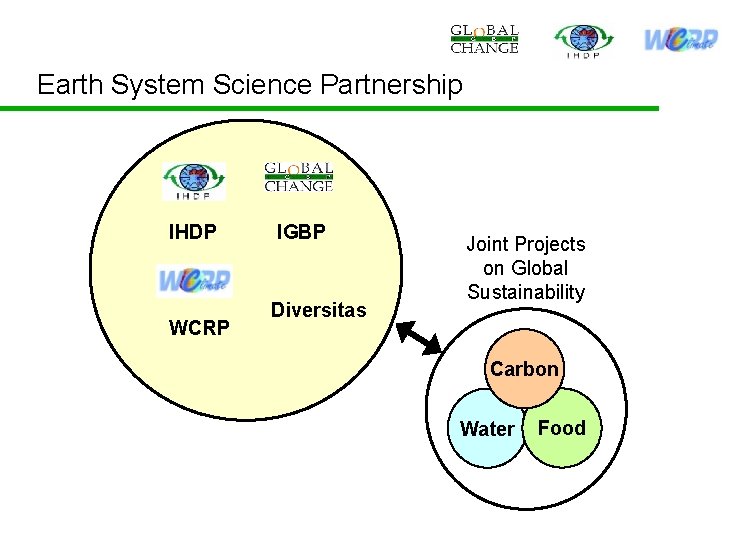
Earth System Science Partnership IHDP WCRP IGBP Diversitas Joint Projects on Global Sustainability Carbon Water Food
A partnership of three global environmental change programs September 2002
Global Carbon Project Mandate u Synthesis of knowledge of the global carbon cycle, within a coherent research framework u Coupling the biophysical and human dimensions of the global carbon cycle u Coordination of regional and national carbon programs in the context of a global effort
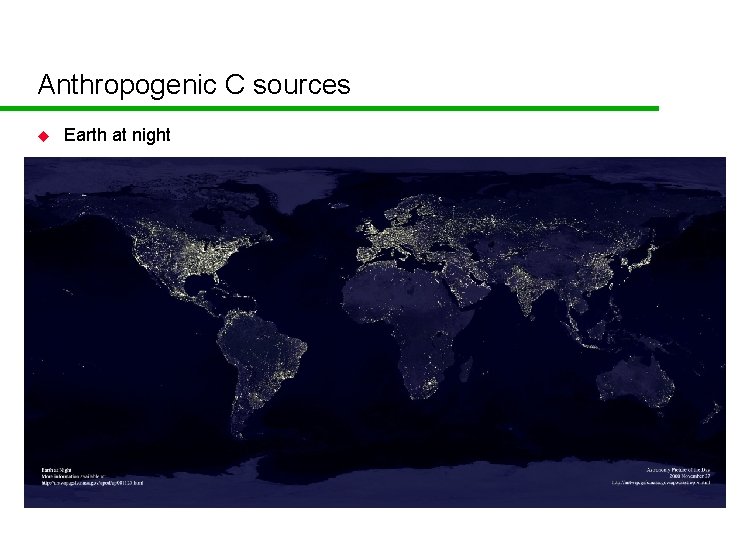
Anthropogenic C sources u Earth at night
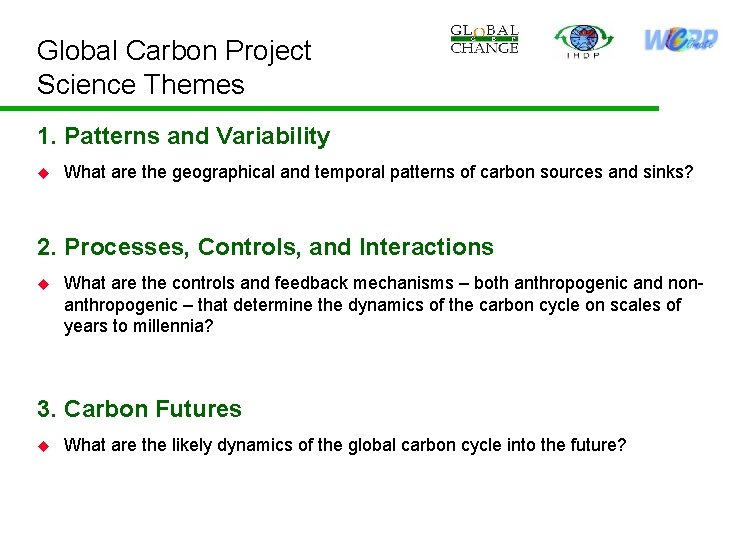
Global Carbon Project Science Themes 1. Patterns and Variability u What are the geographical and temporal patterns of carbon sources and sinks? 2. Processes, Controls, and Interactions u What are the controls and feedback mechanisms – both anthropogenic and nonanthropogenic – that determine the dynamics of the carbon cycle on scales of years to millennia? 3. Carbon Futures u What are the likely dynamics of the global carbon cycle into the future?
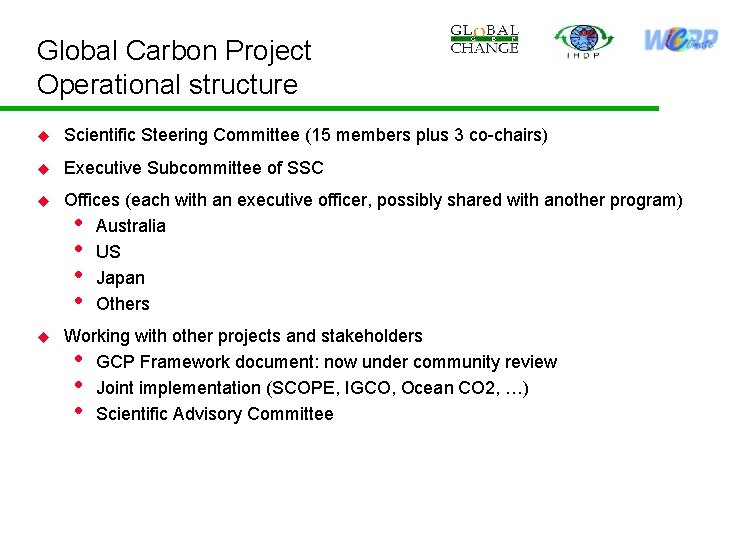
Global Carbon Project Operational structure u Scientific Steering Committee (15 members plus 3 co-chairs) u Executive Subcommittee of SSC u Offices (each with an executive officer, possibly shared with another program) • Australia • US • Japan • Others u Working with other projects and stakeholders • GCP Framework document: now under community review • Joint implementation (SCOPE, IGCO, Ocean CO 2, …) • Scientific Advisory Committee
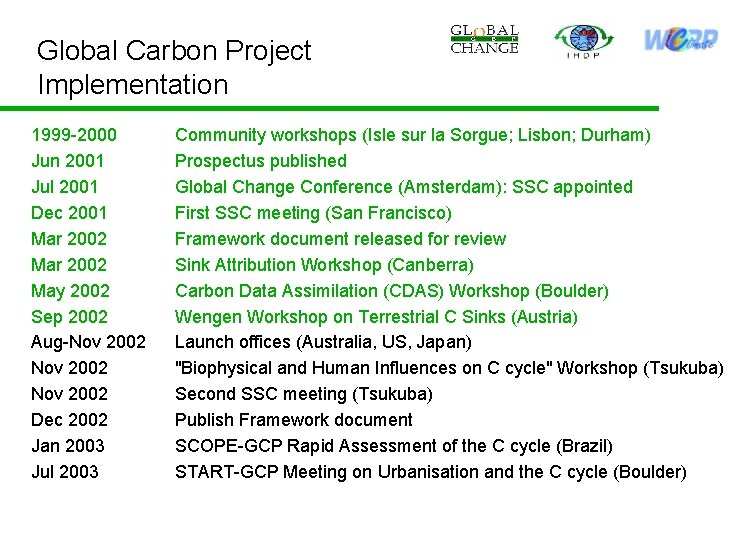
Global Carbon Project Implementation 1999 -2000 Jun 2001 Jul 2001 Dec 2001 Mar 2002 May 2002 Sep 2002 Aug-Nov 2002 Dec 2002 Jan 2003 Jul 2003 Community workshops (Isle sur la Sorgue; Lisbon; Durham) Prospectus published Global Change Conference (Amsterdam): SSC appointed First SSC meeting (San Francisco) Framework document released for review Sink Attribution Workshop (Canberra) Carbon Data Assimilation (CDAS) Workshop (Boulder) Wengen Workshop on Terrestrial C Sinks (Austria) Launch offices (Australia, US, Japan) "Biophysical and Human Influences on C cycle" Workshop (Tsukuba) Second SSC meeting (Tsukuba) Publish Framework document SCOPE-GCP Rapid Assessment of the C cycle (Brazil) START-GCP Meeting on Urbanisation and the C cycle (Boulder)
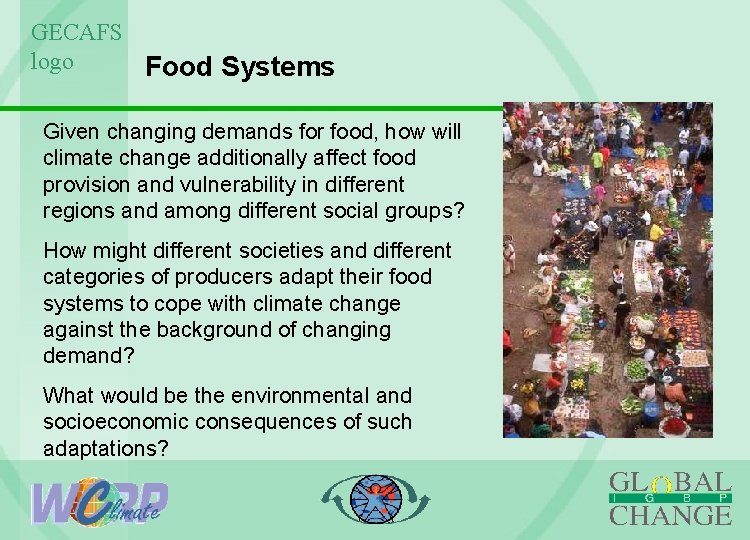
GECAFS logo Food Systems Given changing demands for food, how will climate change additionally affect food provision and vulnerability in different regions and among different social groups? How might different societies and different categories of producers adapt their food systems to cope with climate change against the background of changing demand? What would be the environmental and socioeconomic consequences of such adaptations?
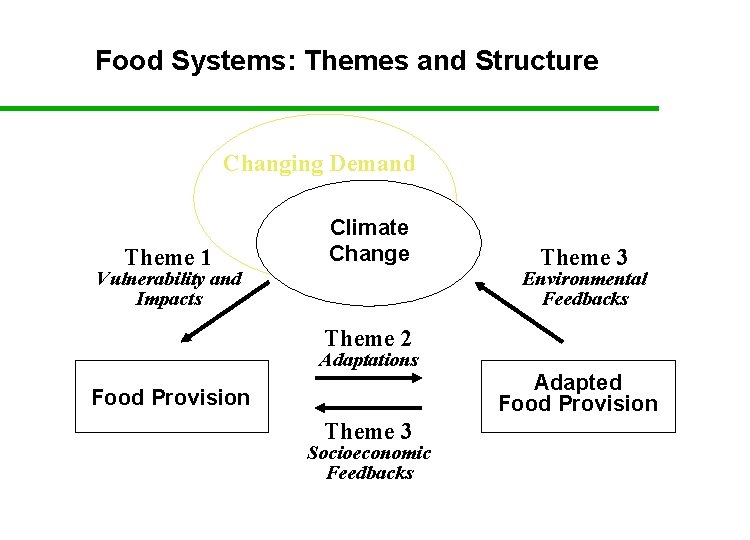
Food Systems: Themes and Structure Changing Demand Theme 1 Climate Change Vulnerability and Impacts Theme 3 Environmental Feedbacks Theme 2 Adaptations Food Provision Theme 3 Socioeconomic Feedbacks Adapted Food Provision
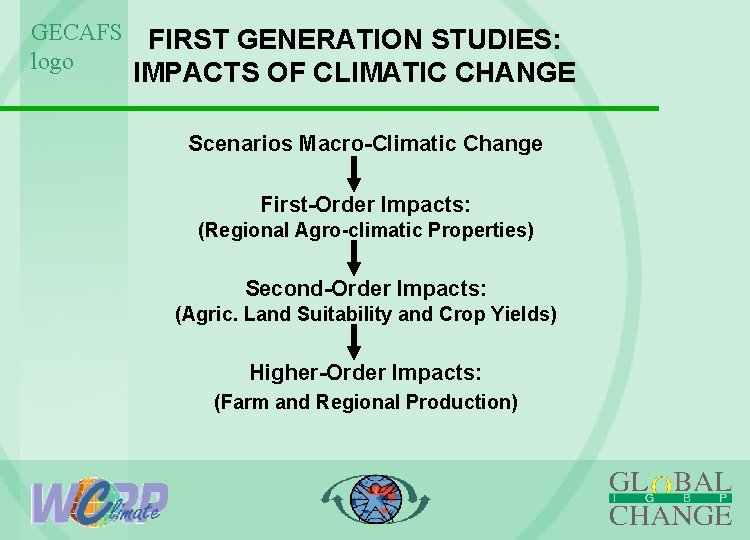
GECAFS logo FIRST GENERATION STUDIES: IMPACTS OF CLIMATIC CHANGE Scenarios Macro-Climatic Change First-Order Impacts: (Regional Agro-climatic Properties) Second-Order Impacts: (Agric. Land Suitability and Crop Yields) Higher-Order Impacts: (Farm and Regional Production)
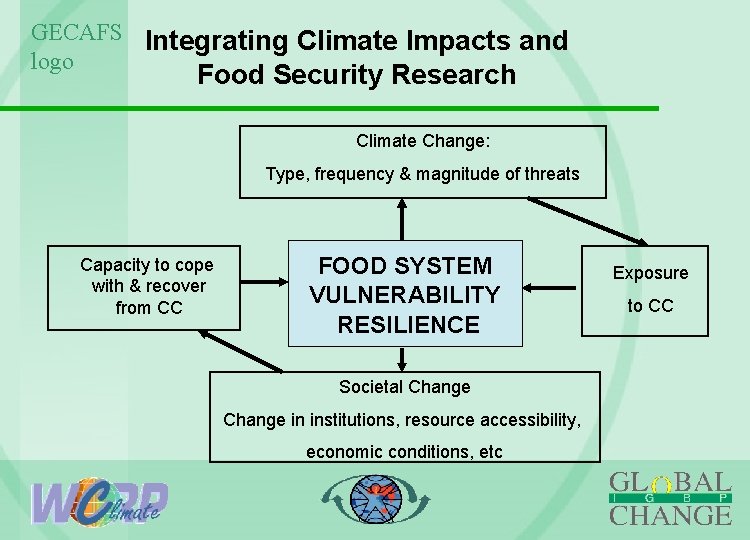
GECAFS Integrating Climate Impacts and logo Food Security Research Climate Change: Type, frequency & magnitude of threats Capacity to cope with & recover from CC FOOD SYSTEM VULNERABILITY RESILIENCE Societal Change in institutions, resource accessibility, economic conditions, etc Exposure to CC
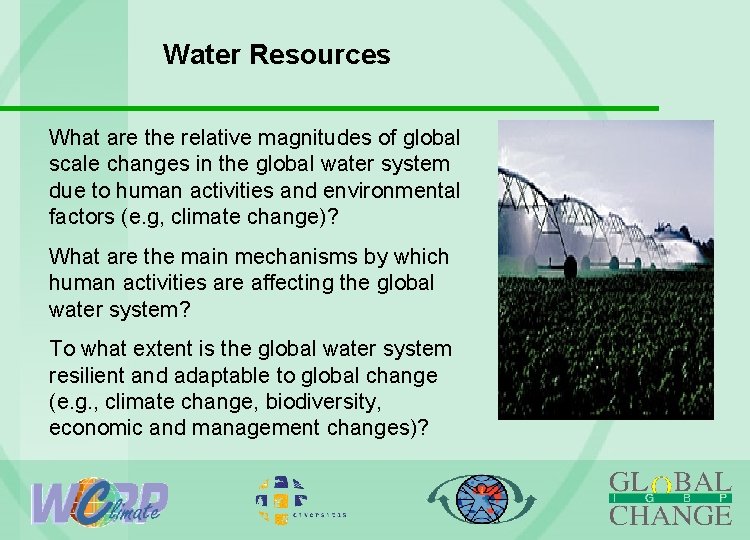
Water Resources What are the relative magnitudes of global scale changes in the global water system due to human activities and environmental factors (e. g, climate change)? What are the main mechanisms by which human activities are affecting the global water system? To what extent is the global water system resilient and adaptable to global change (e. g. , climate change, biodiversity, economic and management changes)? Image needed
- Slides: 13