
Earth System Science in the Community Program Overview
- Slides: 16
Earth System Science in the Community Program Overview 1
What is Earth. Comm? n High School Earth Science Curriculum ¨ Earth Systems ¨ Inquiry-based ¨ Community-based 2
Driven by: n National Science Education Standards n Benchmarks for Science Literacy (AAAS). (NAS). 3
Program Development: n Developed by Earth science experts and classroom teachers through the American Geological Institute. n Funded by the National Science Foundation and AGI Foundation n Published by It’s About Time. 4
Teacher Support: n Materials kits, one per module. n Teacher guides. n Web sites with local resources. n Professional development. 5
Earth. Comm Students: n Learn Earth science principles through a systems approach. n Learn by engaging in scientific inquiry and scientific investigations. 6
Earth. Comm Students: n Use the geoscience in their communities as a springboard to launching investigations. n Access existing data and generate their own data sets to explore questions. 7
Earth Systems: The n The n Atmosphere. Biosphere. Cryosphere. Geosphere. Hydrosphere. 8
Program Structure: 5 Modules n 3 Chapters per Module n 5 -7 Activities per chapter n 9
Module and Chapter Structure: n Module ¨ Three Chapters ¨ Each has a community related problem n Chapter ¨ Getting Started ¨ Scenario ¨ Chapter Challenge ¨ Assessment Criteria ¨ Activities (5 -7) 10
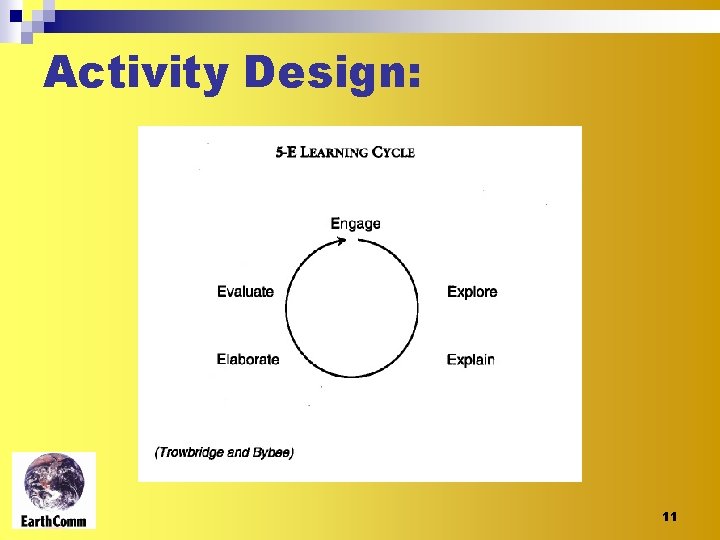
Activity Design: 11
Activity Structure: n n n n n Goals Think About It Investigate Reflecting on the Activity and the Challenge Digging Deeper Check Your Understanding and Applying What You Have Learned Preparing for the Chapter Challenge Inquiring Further 12
Teacher Guide: n Module flow, goals and objectives. n Background information. n Correlation to National Standards. n Preparation and materials needed. 13
Teacher Guide: n Detailed teaching and assessment tips. n Blackline masters of key diagrams. n Assessment rubrics and exams. 14
Assessment: Chapter Pre-Assessment n Activity Pre-Assessments n Embedded Assessments n Rubrics for Chapter Reports n Alternative Assessments n 15
The Five Modules: Earth’s Dynamic Geosphere n Earth’s Fluid Spheres n Earth’s Natural Resources n Earth System Evolution n Understanding Your Environment n 16