
Earth Science Introduction 1 1 What is Earth

- Slides: 18
Earth Science Introduction 1. 1 What is Earth Science? 1. 2 Paths to Discovery 1. 3 Birth of a Theory “The Big Bang” -Gaia & Tragedy of the Commons
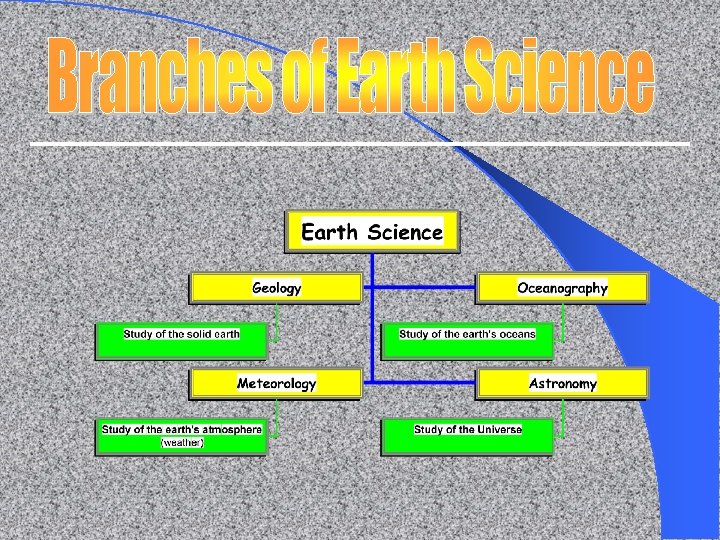
“The study of the earth and how it interacts with itself and the universe around it. ”
1. 2 Scientific Methods Scientific Method: A series of planned steps to help solve a problem.
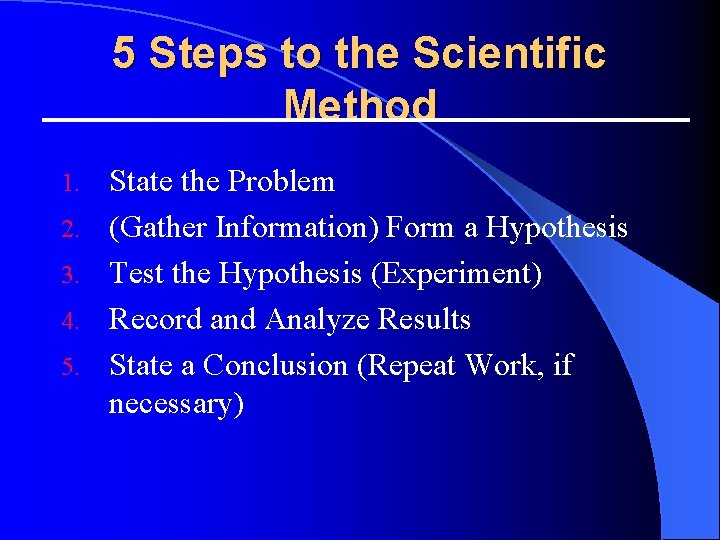
5 Steps to the Scientific Method 1. 2. 3. 4. 5. State the Problem (Gather Information) Form a Hypothesis Test the Hypothesis (Experiment) Record and Analyze Results State a Conclusion (Repeat Work, if necessary)
l True variables – Essential conditions – Conditions that fundamentally affect the phenomenon l Independent variables – True variables that can be directly manipulated l Dependent variables – True variables that change because independent variables change
1. 3 THEORY VS. LAW Theory: A hypothesis or a set of hypotheses that is supported by the results of experimentation and observation. Scientific Law: A rule that correctly describes a natural phenomenon.
Meteorite-Impact Hypothesis l. A huge meteorite crashed into the earth 65 million years ago. Dust from the impact blocked out the sun and led to the extinction of the dinosaurs. l The meteorite is estimated to have been 10 km in diameter.
The Big Bang Theory A description of how the universe began l The – Theory states that: “Billions of years ago, all the matter and energy in the universe was compressed into an extremely small volume. Then about 17 billion years ago, a sudden event sent all the matter and energy hurtling outward in a giant cloud. As the cloud expanded, some of the matter gathered into a clumps that evolved into galaxies. ”
Supporting Evidence of the BIG BANG THEORY l Light Effect: l – Spectrum of Light – Tells scientists what elements are – Wavelength in different stars. – Scientists can also tell how far away stars are and if they are moving farther away. – Heating elements makes them give off a Bright-Line Spectrum. l Spectroscope: RED SHIFT Doppler Effect: – Close objects- short wavelengths – Far away objects- long wavelengths l Background Radiation: – Low levels of energy distributed throughout the galaxy.
Gaia. Theory l Long ago the Greeks gave to the Earth the name Gaia or, for short, Ge. – In those days, science and theology were one and science, although less precise, had soul. l The Gaia Theory is an ecological hypothesis proposing that the biosphere and the physical components of the Earth (atmosphere, cryosphere, hydrosphere and lithosphere) are closely integrated to form a complex interacting system that maintains the climatic and biogeochemical conditions on Earth in a preferred homeostasis.
Gaia Theory In a phrase, “life maintains conditions suitable for its own survival. ” l In this respect, the living system of Earth can be thought of analogous to the workings of any individual organism that regulates body temperature, blood salinity, etc. l For instance, even though the luminosity of the sun – the Earth’s heat source – has increased by about 30 percent since life began almost four billion years ago, the living system has reacted as a whole to maintain temperatures at levels suitable for life. l Gaia video: https: //vimeo. com/70203687 l
Tragedy of the Commons Garrett Hardin’s: KEY ASSUMPTIONS AND PROBLEM FORMULATION: l 1. The world is biophysically finite. – The more people there are, the less each person's share must be. – Technology (ie, agricultural) cannot fundamentally alter this. – We can't both maximize the number of people and satisfy every desire or "good" of everyone. – Practically, biophysical limits dictate we must both stabilize population, and make hard choices about which "goods" are to be sought. – Both steps will generate opposition, since many people will have to relinquish something.
Tragedy of the Commons Garrett Hardin’s: KEY ASSUMPTIONS AND PROBLEM FORMULATION: l 2. Over-population is an example of the tragedy of the commons (To. C). – Commons are un-owned or commonly-held "pool" resources that are "free, " or not allocated by markets. – Hardin's To. C model assumes that individuals are shortterm, self-interested "rational" actors, seeking to maximize their own gains. – Such actors will exploit commons (have more babies, add more cattle to pastures, pollute the air) as long as they believe the costs to them individually are less than the benefits.
Tragedy of the Commons Garrett Hardin’s: KEY ASSUMPTIONS AND PROBLEM FORMULATION: l 2. Over-population is an example of the tragedy of the commons (To. C). – The system of welfare insulates individuals from bearing the full costs of over-reproducing. – When every individual believes and behaves in this manner, commons are quickly filled, degraded, and ruined along with their erst-while exploiters. – A laissez-faire system (letting individuals choose as they like) will not "as if by an invisible hand" solve overpopulation.
Tragedy of the Commons Garrett Hardin’s: KEY ASSUMPTIONS AND PROBLEM FORMULATION: l 3. The "commons" system for breeding must be abandoned (as it has been for other resources). – In other words, something must restrain individual reproduction. . . – but it must not be individual conscience; appealing to conscience will only result in fewer people with conscience in the population (assuming here that it is genetic, or perfectly transmitted by learning). – It should be accomplished by "mutual coercion mutually agreed upon. "
Tragedy of the Commons Garrett Hardin’s: KEY ASSUMPTIONS AND PROBLEM FORMULATION: l 3. The "commons" system for breeding must be abandoned (as it has been for other resources). – Sacrificing freedom to breed will obtain for us other more important freedoms which will otherwise be lost. – "Coercive" restrictions on breeding could take a number of forms. – The "right" to determine the size of one's family must be rescinded. – This will protect the conscientious traits in the population.
Tragedy of the Commons Garrett Hardin’s: KEY ASSUMPTIONS AND PROBLEM FORMULATION: l 4. The problem is then to gain peoples' consent to a system of coercion. – People will consent if they understand the dire consequences of letting the population growth rate be set only by individuals' choices. – Educating all people about the To. C, its consequences, and the alternatives to it, is necessary. – Then various restraints and incentives for low reproduction can and must be instituted. l Tragedy of the Commons: https: //youtu. be/WYA 1 y 405 JW 0