
Earth Science Division Advancements in Lightning Severe Storm
- Slides: 59
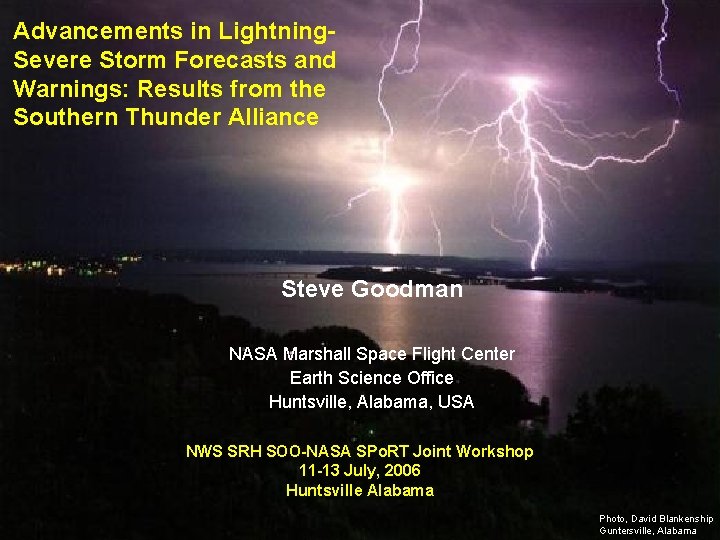
Earth Science Division Advancements in Lightning. Severe Storm Forecasts and Warnings: Results from the Southern Thunder Alliance National Aeronautics and Space Administration Steve Goodman NASA Marshall Space Flight Center Earth Science Office Huntsville, Alabama, USA 10/28/2021 NWS SRH SOO-NASA SPo. RT Joint Workshop 11 -13 July, 2006 Huntsville Alabama NWS SOO-NASA SPo. RT 1 Photo, David Blankenship Workshop 11 -13, July, 2006 Guntersville, Alabama
Earth Science Division National Aeronautics and Space Administration Outline of Presentation • Motivation and Background • Science and Technology Infusion – GOES-R Geostationary Lightning Mapper (GLM) – VHF Lightning Mapping – Nowcasting-Warning Decision Making – WRF Forecasts of Thunderstorm Initiation and Lightning Threat • Current Plans and the Way Forward 10/28/2021 2 NWS SOO-NASA SPo. RT Workshop 11 -13, July, 2006
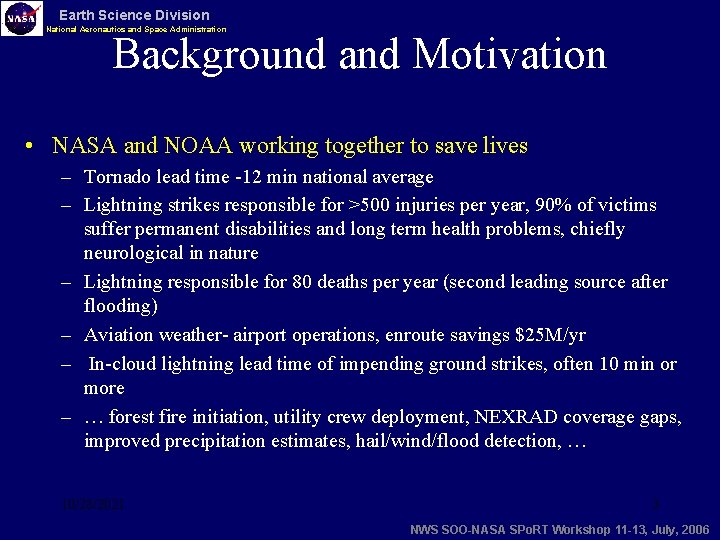
Earth Science Division National Aeronautics and Space Administration Background and Motivation • NASA and NOAA working together to save lives – Tornado lead time -12 min national average – Lightning strikes responsible for >500 injuries per year, 90% of victims suffer permanent disabilities and long term health problems, chiefly neurological in nature – Lightning responsible for 80 deaths per year (second leading source after flooding) – Aviation weather- airport operations, enroute savings $25 M/yr – In-cloud lightning lead time of impending ground strikes, often 10 min or more – … forest fire initiation, utility crew deployment, NEXRAD coverage gaps, improved precipitation estimates, hail/wind/flood detection, … 10/28/2021 3 NWS SOO-NASA SPo. RT Workshop 11 -13, July, 2006
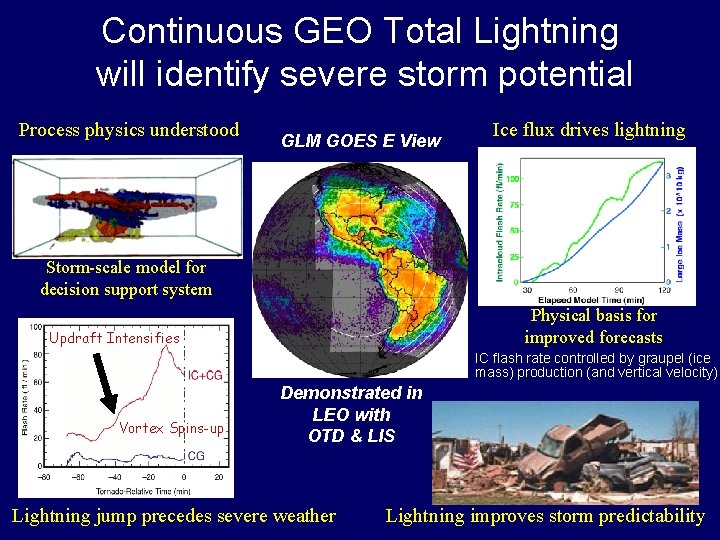
Continuous GEO Total Lightning will identify severe storm potential Process physics understood GLM GOES E View Ice flux drives lightning Storm-scale model for decision support system Physical basis for improved forecasts Updraft Intensifies IC flash rate controlled by graupel (ice mass) production (and vertical velocity) Vortex Spins-up Demonstrated in LEO with OTD & LIS Lightning jump precedes severe weather Lightning improves storm predictability
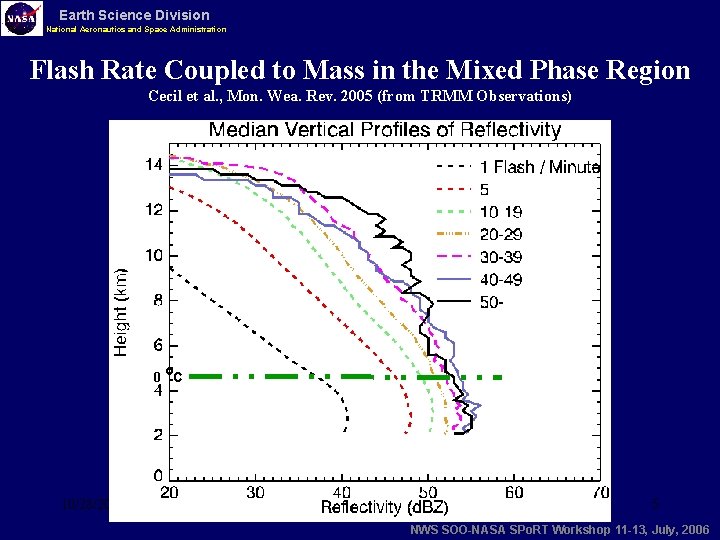
Earth Science Division National Aeronautics and Space Administration Flash Rate Coupled to Mass in the Mixed Phase Region Cecil et al. , Mon. Wea. Rev. 2005 (from TRMM Observations) 0 o. C 10/28/2021 5 NWS SOO-NASA SPo. RT Workshop 11 -13, July, 2006
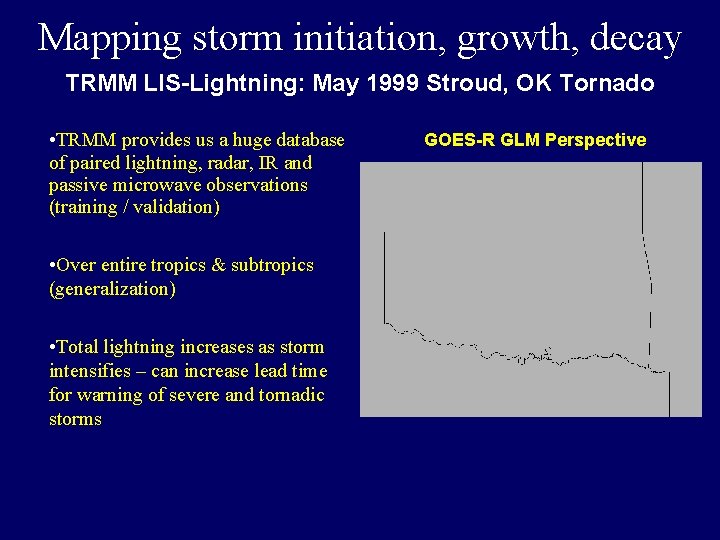
Mapping storm initiation, growth, decay TRMM LIS-Lightning: May 1999 Stroud, OK Tornado • TRMM provides us a huge database of paired lightning, radar, IR and passive microwave observations (training / validation) • Over entire tropics & subtropics (generalization) • Total lightning increases as storm intensifies – can increase lead time for warning of severe and tornadic storms GOES-R GLM Perspective
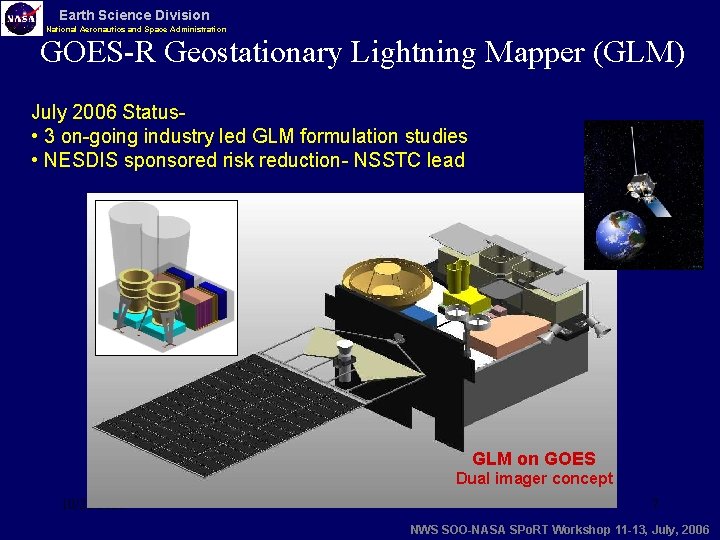
Earth Science Division National Aeronautics and Space Administration GOES-R Geostationary Lightning Mapper (GLM) July 2006 Status • 3 on-going industry led GLM formulation studies • NESDIS sponsored risk reduction- NSSTC lead GLM on GOES Dual imager concept 10/28/2021 7 NWS SOO-NASA SPo. RT Workshop 11 -13, July, 2006
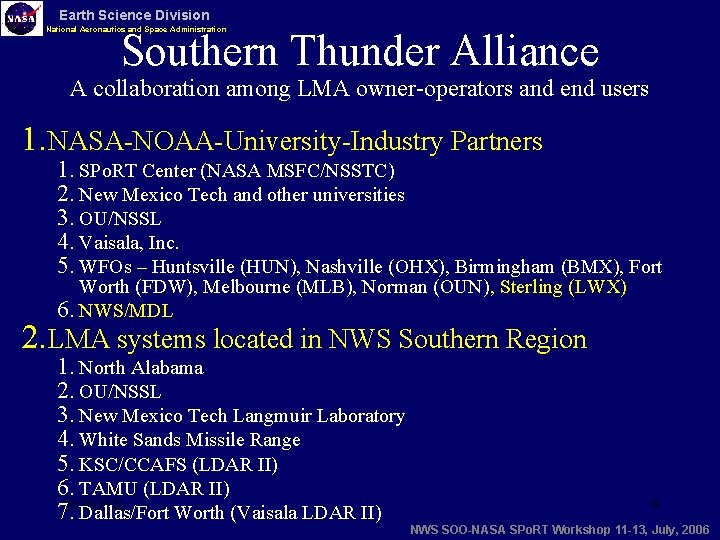
Earth Science Division National Aeronautics and Space Administration Southern Thunder Alliance A collaboration among LMA owner-operators and end users 1. NASA-NOAA-University-Industry Partners 1. SPo. RT Center (NASA MSFC/NSSTC) 2. New Mexico Tech and other universities 3. OU/NSSL 4. Vaisala, Inc. 5. WFOs – Huntsville (HUN), Nashville (OHX), Birmingham (BMX), Fort Worth (FDW), Melbourne (MLB), Norman (OUN), Sterling (LWX) 6. NWS/MDL 2. LMA systems located in NWS Southern Region 1. North Alabama 2. OU/NSSL 3. New Mexico Tech Langmuir Laboratory 4. White Sands Missile Range 5. KSC/CCAFS (LDAR II) 6. TAMU (LDAR II) 10/28/2021 7. Dallas/Fort Worth (Vaisala LDAR II) 8 NWS SOO-NASA SPo. RT Workshop 11 -13, July, 2006
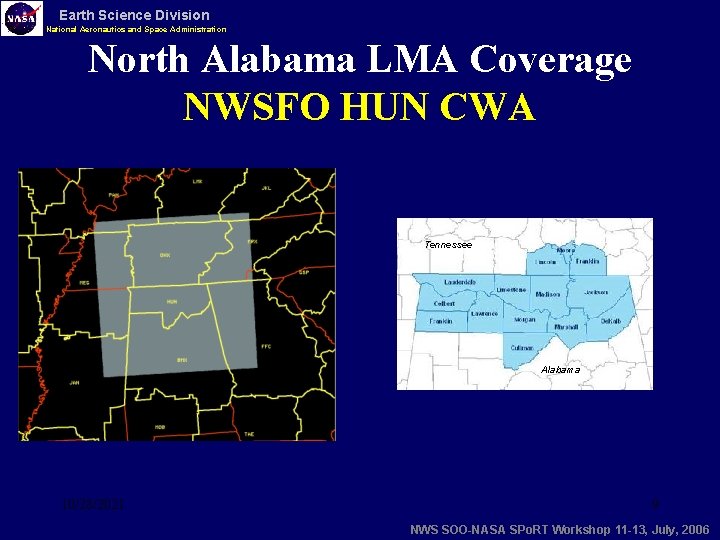
Earth Science Division National Aeronautics and Space Administration North Alabama LMA Coverage NWSFO HUN CWA Tennessee Alabama 10/28/2021 9 NWS SOO-NASA SPo. RT Workshop 11 -13, July, 2006
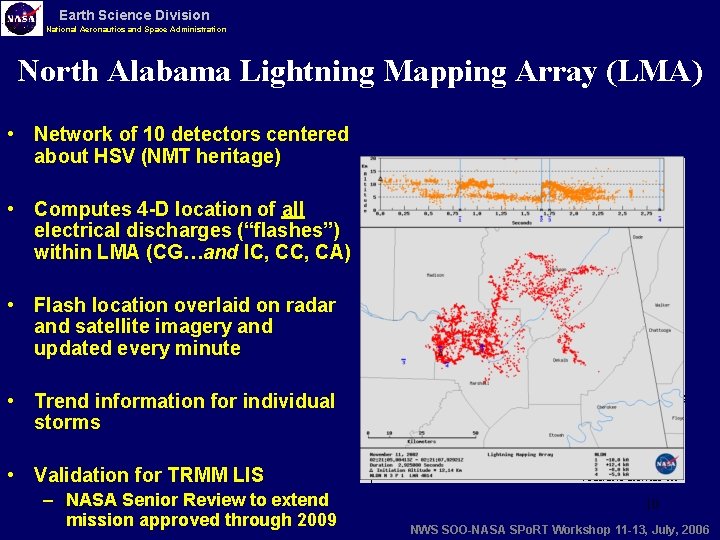
Earth Science Division National Aeronautics and Space Administration North Alabama Lightning Mapping Array (LMA) • Network of 10 detectors centered about HSV (NMT heritage) • Computes 4 -D location of all electrical discharges (“flashes”) within LMA (CG…and IC, CA) • Flash location overlaid on radar and satellite imagery and updated every minute • Trend information for individual storms • Validation for TRMM LIS – 10/28/2021 NASA Senior Review to extend mission approved through 2009 10 NWS SOO-NASA SPo. RT Workshop 11 -13, July, 2006
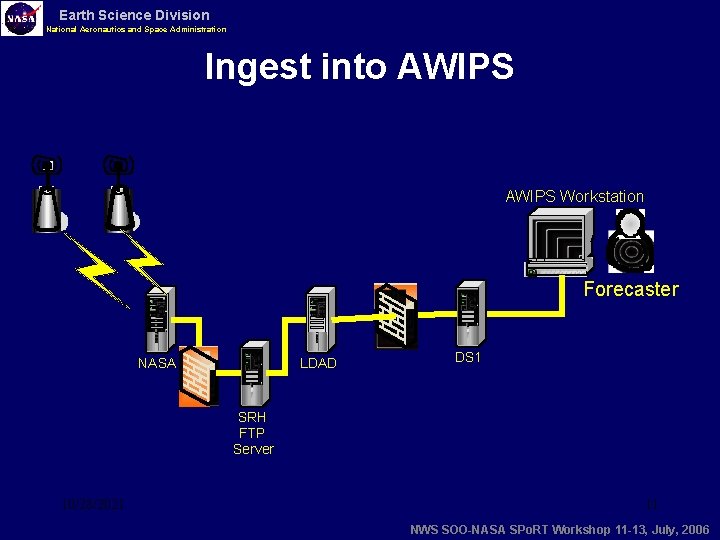
Earth Science Division National Aeronautics and Space Administration Ingest into AWIPS Workstation Forecaster NASA LDAD DS 1 SRH FTP Server 10/28/2021 11 NWS SOO-NASA SPo. RT Workshop 11 -13, July, 2006
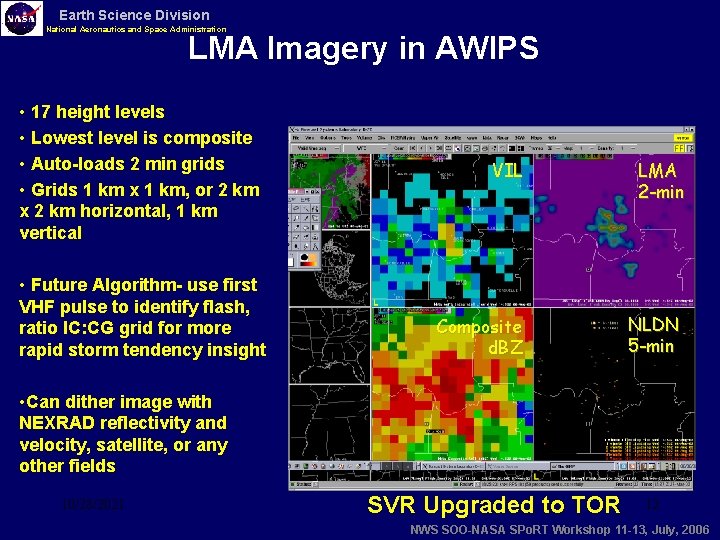
Earth Science Division National Aeronautics and Space Administration LMA Imagery in AWIPS • 17 height levels • Lowest level is composite • Auto-loads 2 min grids • Grids 1 km x 1 km, or 2 km x 2 km horizontal, 1 km vertical • Future Algorithm- use first VHF pulse to identify flash, ratio IC: CG grid for more rapid storm tendency insight VIL LMA 2 -min Composite d. BZ NLDN 5 -min • Can dither image with NEXRAD reflectivity and velocity, satellite, or any other fields 10/28/2021 SVR Upgraded to TOR 12 NWS SOO-NASA SPo. RT Workshop 11 -13, July, 2006
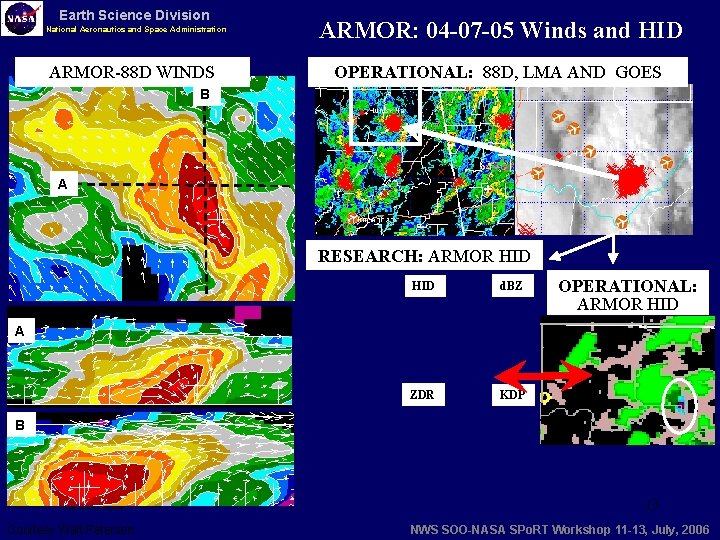
Earth Science Division National Aeronautics and Space Administration ARMOR-88 D WINDS ARMOR: 04 -07 -05 Winds and HID OPERATIONAL: 88 D, LMA AND GOES B A RESEARCH: ARMOR HID d. BZ ZDR KDP OPERATIONAL: ARMOR HID A B 10/28/2021 Courtesy Walt Petersen 13 NWS SOO-NASA SPo. RT Workshop 11 -13, July, 2006
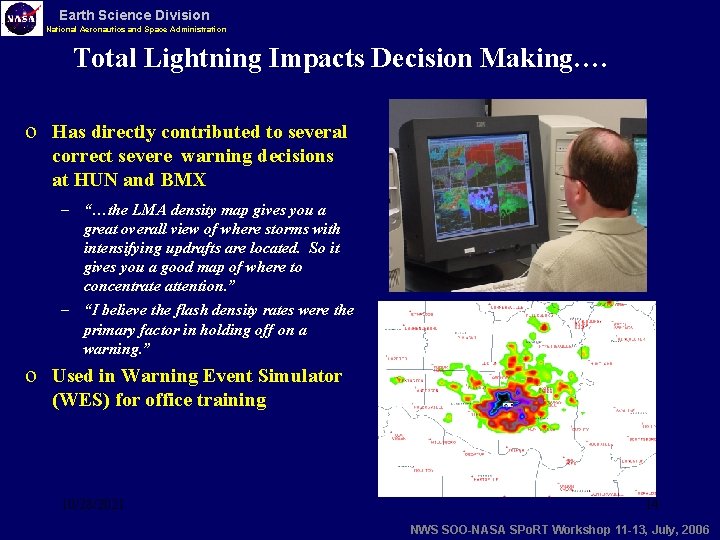
Earth Science Division National Aeronautics and Space Administration Total Lightning Impacts Decision Making…. o Has directly contributed to several correct severe warning decisions at HUN and BMX – “…the LMA density map gives you a great overall view of where storms with intensifying updrafts are located. So it gives you a good map of where to concentrate attention. ” – “I believe the flash density rates were the primary factor in holding off on a warning. ” o Used in Warning Event Simulator (WES) for office training 10/28/2021 14 NWS SOO-NASA SPo. RT Workshop 11 -13, July, 2006
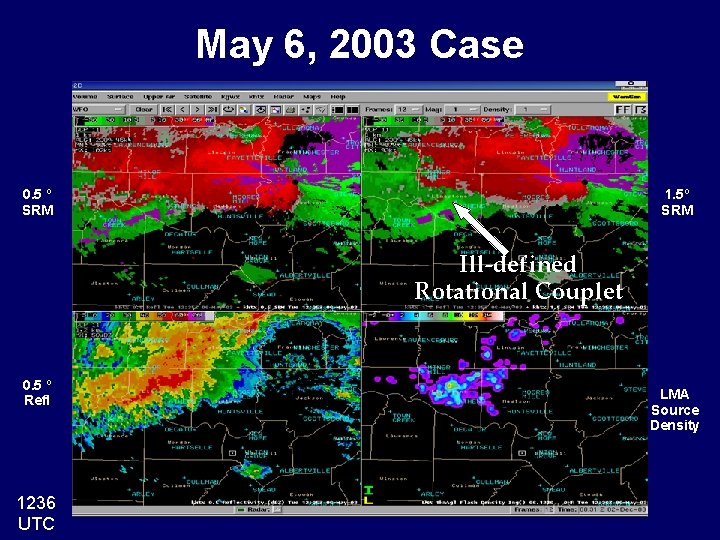
May 6, 2003 Case 0. 5 º SRM 1. 5º SRM Ill-defined Rotational Couplet 0. 5 º Refl 1236 UTC LMA Source Density
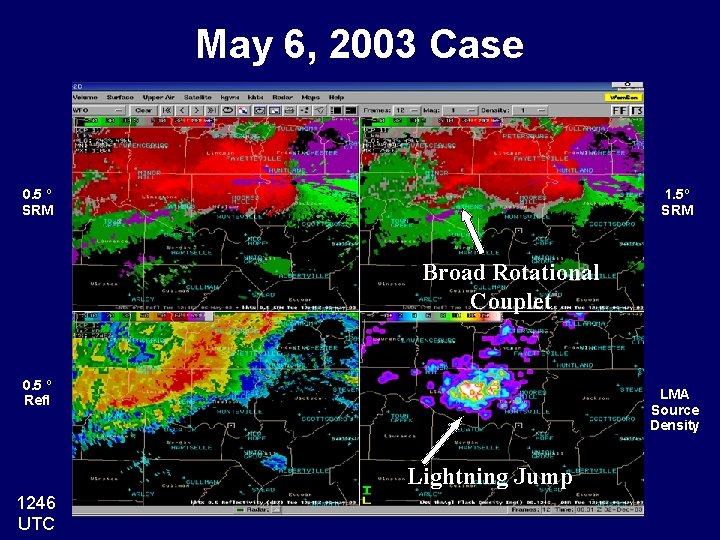
May 6, 2003 Case 0. 5 º SRM 1. 5º SRM Broad Rotational Couplet 0. 5 º Refl LMA Source Density Lightning Jump 1246 UTC
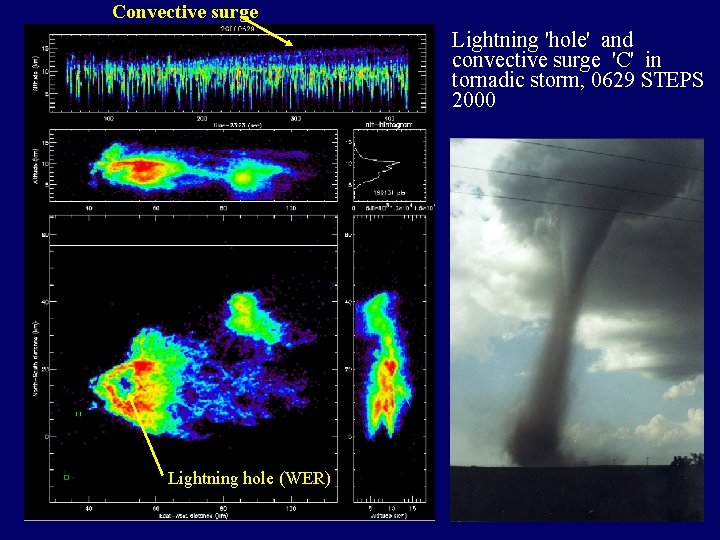
Convective surge Lightning 'hole' and convective surge 'C' in tornadic storm, 0629 STEPS 2000 Lightning hole (WER)
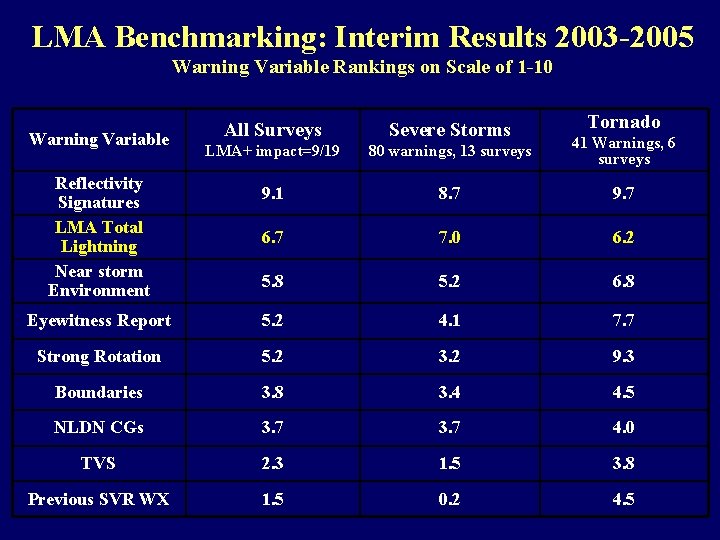
LMA Benchmarking: Interim Results 2003 -2005 Warning Variable Rankings on Scale of 1 -10 Tornado All Surveys Severe Storms LMA+ impact=9/19 80 warnings, 13 surveys 41 Warnings, 6 surveys 9. 1 8. 7 9. 7 6. 7 7. 0 6. 2 5. 8 5. 2 6. 8 Eyewitness Report 5. 2 4. 1 7. 7 Strong Rotation 5. 2 3. 2 9. 3 Boundaries 3. 8 3. 4 4. 5 NLDN CGs 3. 7 4. 0 TVS 2. 3 1. 5 3. 8 Previous SVR WX 1. 5 0. 2 4. 5 Warning Variable Reflectivity Signatures LMA Total Lightning Near storm Environment
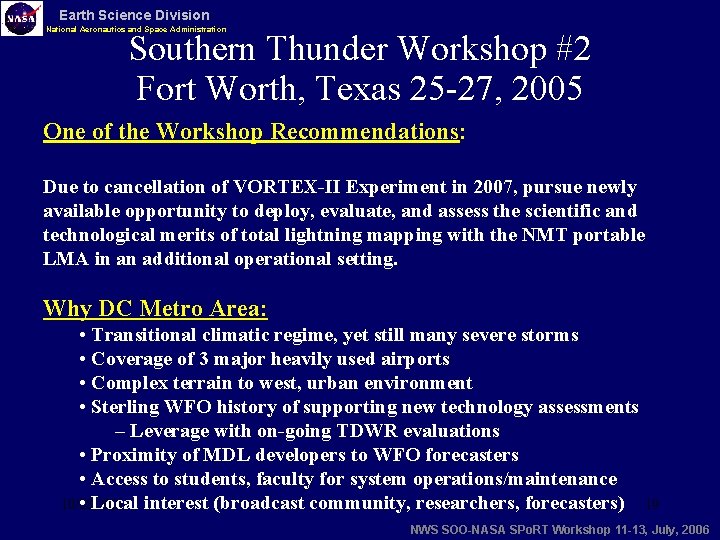
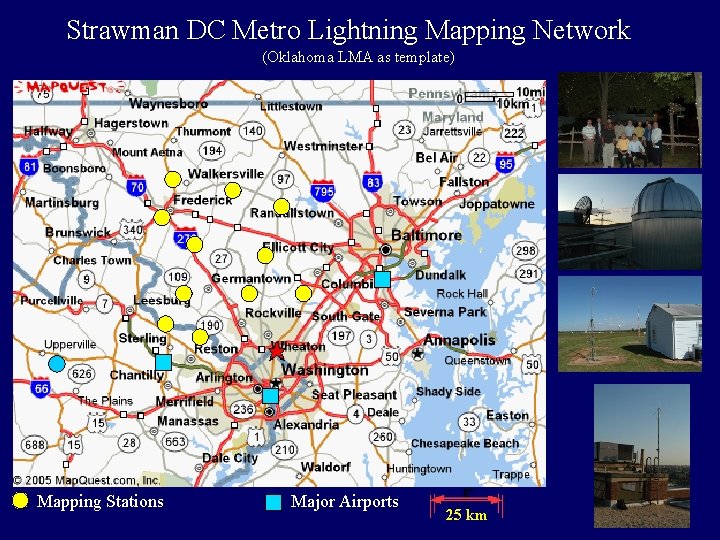
Earth Science Division National Aeronautics and Space Administration Southern Thunder Workshop #2 Fort Worth, Texas 25 -27, 2005 One of the Workshop Recommendations: Due to cancellation of VORTEX-II Experiment in 2007, pursue newly available opportunity to deploy, evaluate, and assess the scientific and technological merits of total lightning mapping with the NMT portable LMA in an additional operational setting. Why DC Metro Area: • Transitional climatic regime, yet still many severe storms • Coverage of 3 major heavily used airports • Complex terrain to west, urban environment • Sterling WFO history of supporting new technology assessments – Leverage with on-going TDWR evaluations • Proximity of MDL developers to WFO forecasters • Access to students, faculty for system operations/maintenance 10/28/2021 • Local interest (broadcast community, researchers, forecasters) 19 NWS SOO-NASA SPo. RT Workshop 11 -13, July, 2006
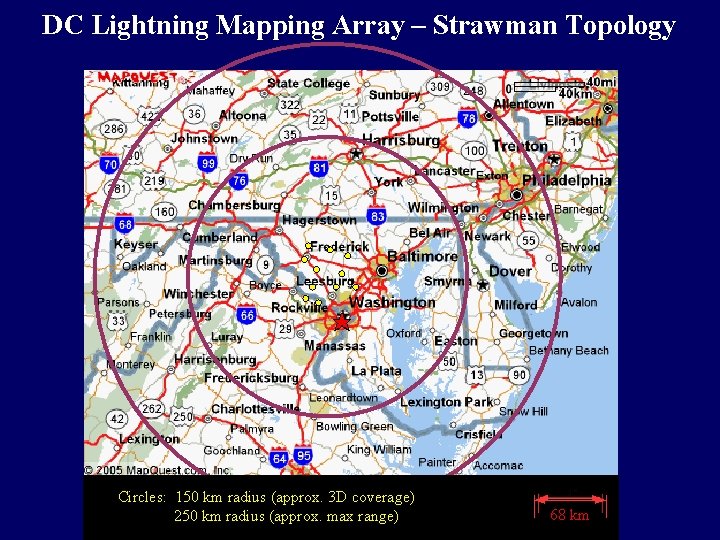
DC Lightning Mapping Array – Strawman Topology Circles: 150 km radius (approx. 3 D coverage) 250 km radius (approx. max range) 68 km
Strawman DC Metro Lightning Mapping Network (Oklahoma LMA as template) Mapping Stations Major Airports 25 km
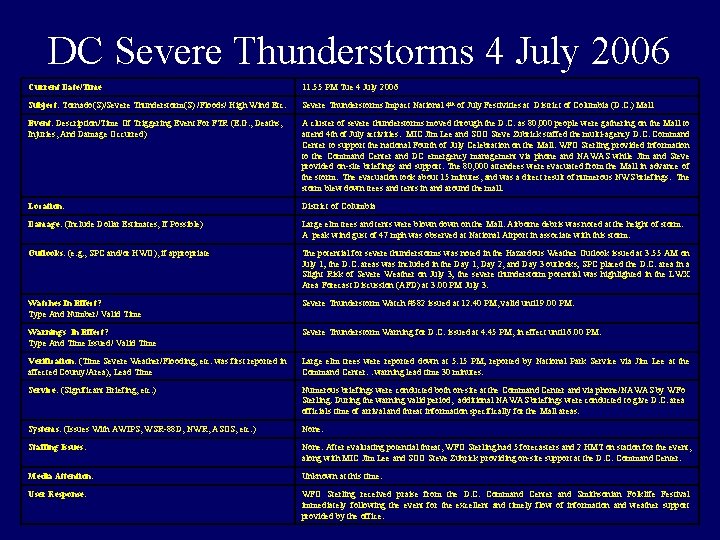
DC Severe Thunderstorms 4 July 2006 Current Date/Time 11: 55 PM Tue 4 July 2006 Subject: Tornado(S)/Severe Thunderstorm(S) /Floods/ High Wind Etc. Severe Thunderstorms Impact National 4 th of July Festivities at District of Columbia (D. C. ) Mall Event: Description/Time Of Triggering Event For FTR (E. G. , Deaths, Injuries, And Damage Occurred) A cluster of severe thunderstorms moved through the D. C. as 80, 000 people were gathering on the Mall to attend 4 th of July activities. MIC Jim Lee and SOO Steve Zubrick staffed the multi-agency D. C. Command Center to support the national Fourth of July Celebration on the Mall. WFO Sterling provided information to the Command Center and DC emergency management via phone and NAWAS while Jim and Steve provided on-site briefings and support. The 80, 000 attendees were evacuated from the Mall in advance of the storm. The evacuation took about 15 minutes, and was a direct result of numerous NWS briefings. The storm blew down trees and tents in and around the mall. Location: District of Columbia Damage: (Include Dollar Estimates, If Possible) Large elm trees and tents were blown down on the Mall. Airborne debris was noted at the height of storm. A peak wind gust of 47 mph was observed at National Airport in associate with this storm. Outlooks: (e. g. , SPC and/or HWO), if appropriate The potential for severe thunderstorms was noted in the Hazardous Weather Outlook issued at 3: 55 AM on July 1; the D. C. areas was included in the Day 1, Day 2, and Day 3 outlooks; SPC placed the D. C. area in a Slight Risk of Severe Weather on July 3; the severe thunderstorm potential was highlighted in the LWX Area Forecast Discussion (AFD) at 3: 00 PM July 3. Watches In Effect? Type And Number/ Valid Time Severe Thunderstorm Watch #582 issued at 12: 40 PM, valid until 9: 00 PM. Warnings In Effect? Type And Time Issued/ Valid Time Severe Thunderstorm Warning for D. C. issued at 4: 45 PM, in effect until 6: 00 PM. Verification: (Time Severe Weather/Flooding, etc. was first reported in affected County/Area); Lead Time Large elm trees were reported down at 5: 15 PM; reported by National Park Service via Jim Lee at the Command Center…warning lead time 30 minutes. Service: (Significant Briefing, etc. ) Numerous briefings were conducted both on-site at the Command Center and via phone/NAWAS by WFo Sterling. During the warning valid period, additional NAWAS briefings were conducted to give D. C. area officials time of arrival and threat information specifically for the Mall areas. Systems: (Issues With AWIPS, WSR-88 D, NWR, ASOS, etc. ) None. Staffing Issues: None. After evaluating potential threat, WFO Sterling had 5 forecasters and 2 HMT on station for the event, along with MIC Jim Lee and SOO Steve Zubrick providing on-site support at the D. C. Command Center. Media Attention: Unknown at this time. User Response: WFO Sterling received praise from the D. C. Command Center and Smithsonian Folklife Festival immediately following the event for the excellent and timely flow of information and weather support provided by the office.
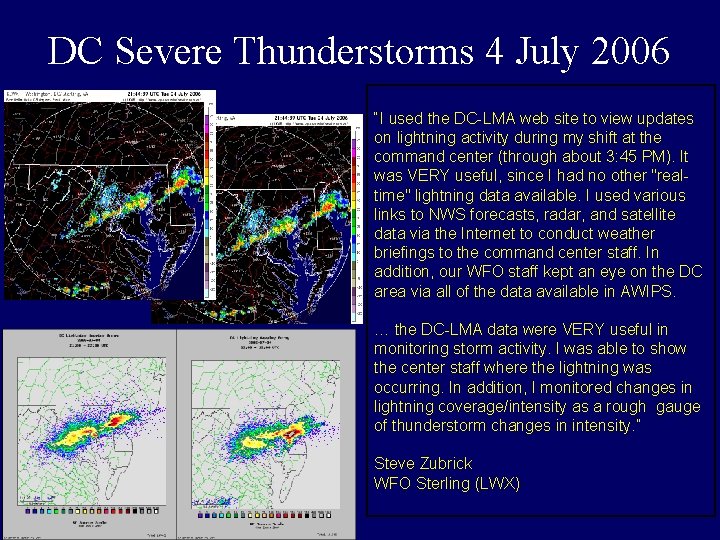
DC Severe Thunderstorms 4 July 2006 “I used the DC-LMA web site to view updates on lightning activity during my shift at the command center (through about 3: 45 PM). It was VERY useful, since I had no other "realtime" lightning data available. I used various links to NWS forecasts, radar, and satellite data via the Internet to conduct weather briefings to the command center staff. In addition, our WFO staff kept an eye on the DC area via all of the data available in AWIPS. … the DC-LMA data were VERY useful in monitoring storm activity. I was able to show the center staff where the lightning was occurring. In addition, I monitored changes in lightning coverage/intensity as a rough gauge of thunderstorm changes in intensity. ” Steve Zubrick WFO Sterling (LWX)
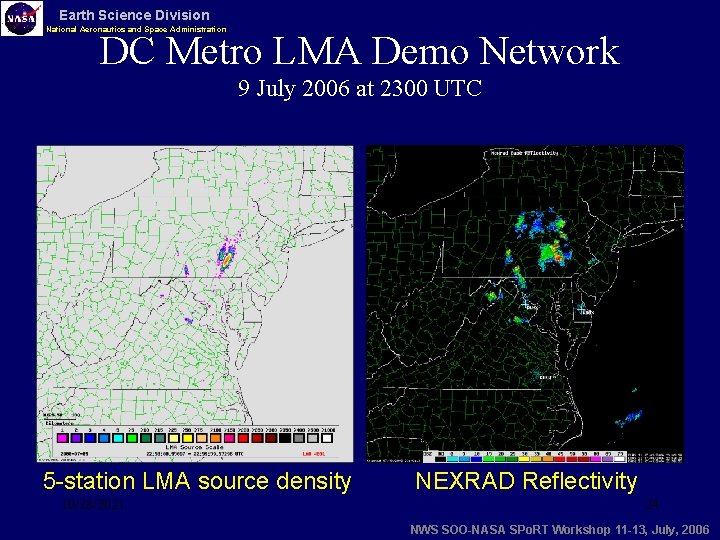
Earth Science Division National Aeronautics and Space Administration DC Metro LMA Demo Network 9 July 2006 at 2300 UTC 5 -station LMA source density 10/28/2021 NEXRAD Reflectivity 24 NWS SOO-NASA SPo. RT Workshop 11 -13, July, 2006
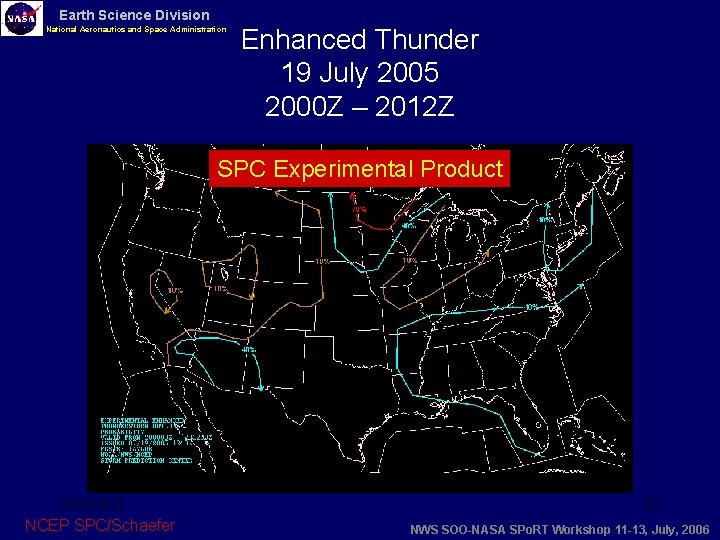
Earth Science Division National Aeronautics and Space Administration Enhanced Thunder 19 July 2005 2000 Z – 2012 Z SPC Experimental Product 10/28/2021 NCEP SPC/Schaefer 25 NWS SOO-NASA SPo. RT Workshop 11 -13, July, 2006
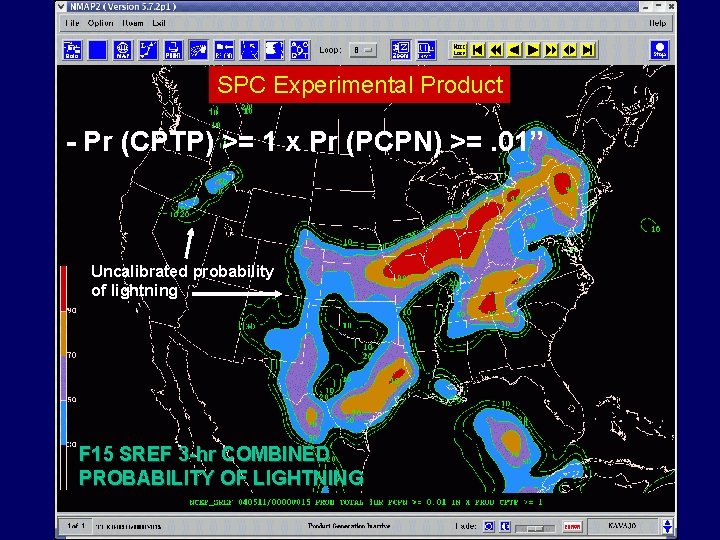
SPC Experimental Product - Pr (CPTP) >= 1 x Pr (PCPN) >=. 01” Uncalibrated probability of lightning F 15 SREF 3 -hr COMBINED PROBABILITY OF LIGHTNING
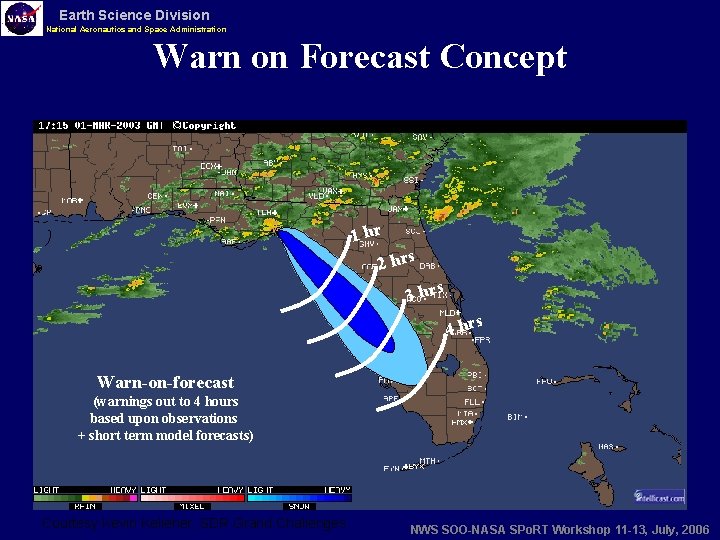
Earth Science Division National Aeronautics and Space Administration Warn on Forecast Concept 1 hr 2 hrs 3 hrs 4 hrs Warn-on-forecast (warnings out to 4 hours based upon observations + short term model forecasts) 10/28/2021 Courtesy Kevin Kelleher, SDR Grand Challenges 27 NWS SOO-NASA SPo. RT Workshop 11 -13, July, 2006
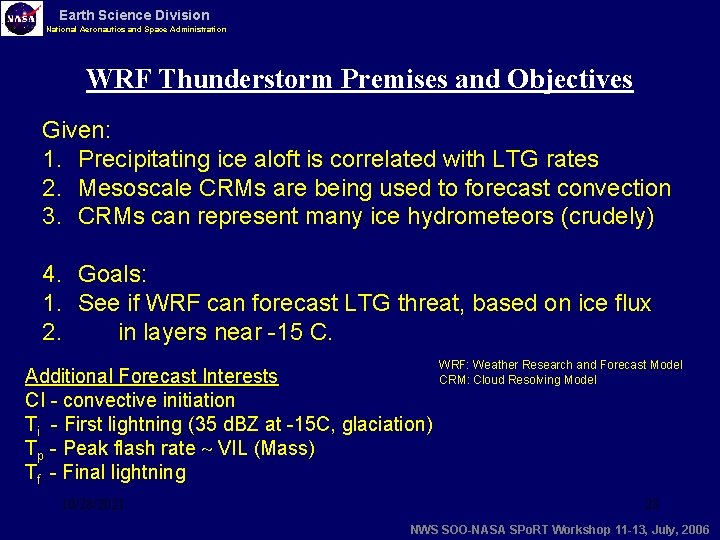
Earth Science Division National Aeronautics and Space Administration WRF Thunderstorm Premises and Objectives Given: 1. Precipitating ice aloft is correlated with LTG rates 2. Mesoscale CRMs are being used to forecast convection 3. CRMs can represent many ice hydrometeors (crudely) 4. Goals: 1. See if WRF can forecast LTG threat, based on ice flux 2. in layers near -15 C. Additional Forecast Interests CI - convective initiation Ti - First lightning (35 d. BZ at -15 C, glaciation) Tp - Peak flash rate ~ VIL (Mass) Tf - Final lightning 10/28/2021 WRF: Weather Research and Forecast Model CRM: Cloud Resolving Model 28 NWS SOO-NASA SPo. RT Workshop 11 -13, July, 2006
Earth Science Division National Aeronautics and Space Administration WRF Thunderstorm and Lightning Forecasts: Methodology 1. 2. 2. 3. 3. 4. 5. 5. 6. Use high-resolution (2 -4 km) WRF simulations to prognose convection Develop diagnostics from model output fields to serve as a proxy for LTG Create 0 -6 h forecasts of LTG threat based on WRF data Compare WRF forecasts with actual reflectivity and LTG and other observations using HSV area assets Subjectively and objectively evaluate WRF capabilities forecasting LTG 10/28/2021 29 NWS SOO-NASA SPo. RT Workshop 11 -13, July, 2006
Earth Science Division National Aeronautics and Space Administration WRF Thunderstorm and Lightning Forecasts: 10 December 2004 10/28/2021 30 NWS SOO-NASA SPo. RT Workshop 11 -13, July, 2006
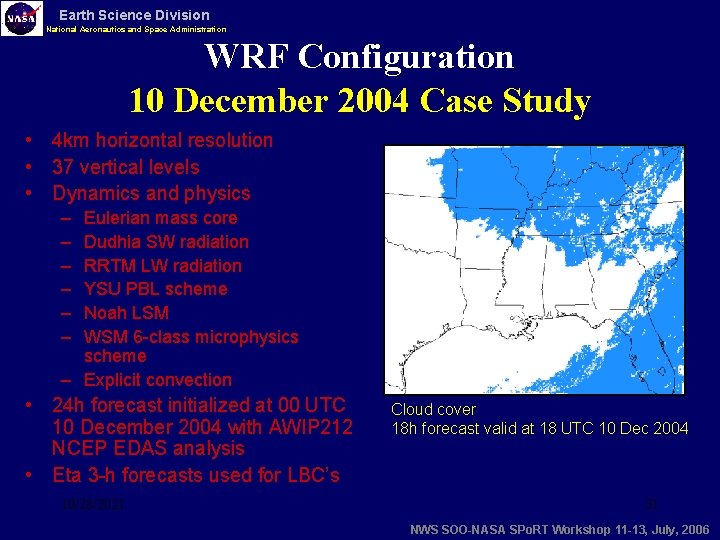
Earth Science Division National Aeronautics and Space Administration WRF Configuration 10 December 2004 Case Study • 4 km horizontal resolution • 37 vertical levels • Dynamics and physics – – – Eulerian mass core Dudhia SW radiation RRTM LW radiation YSU PBL scheme Noah LSM WSM 6 -class microphysics scheme – Explicit convection • 24 h forecast initialized at 00 UTC 10 December 2004 with AWIP 212 NCEP EDAS analysis • Eta 3 -h forecasts used for LBC’s 10/28/2021 Cloud cover 18 h forecast valid at 18 UTC 10 Dec 2004 31 NWS SOO-NASA SPo. RT Workshop 11 -13, July, 2006
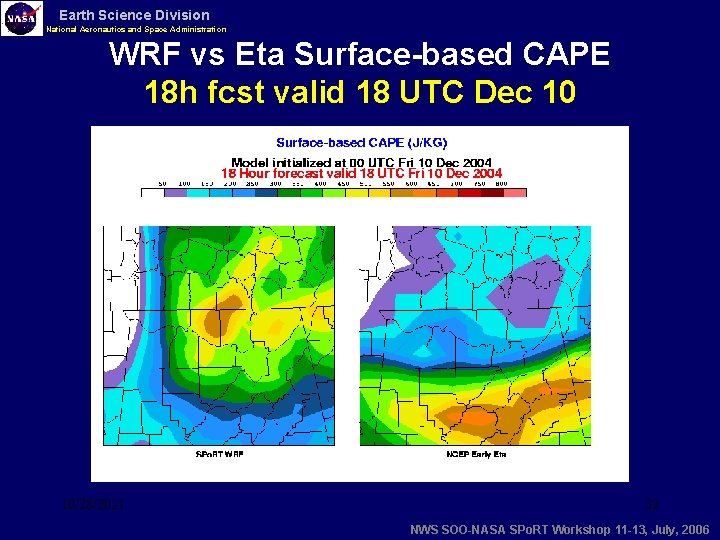
Earth Science Division National Aeronautics and Space Administration WRF vs Eta Surface-based CAPE 18 h fcst valid 18 UTC Dec 10 10/28/2021 32 NWS SOO-NASA SPo. RT Workshop 11 -13, July, 2006
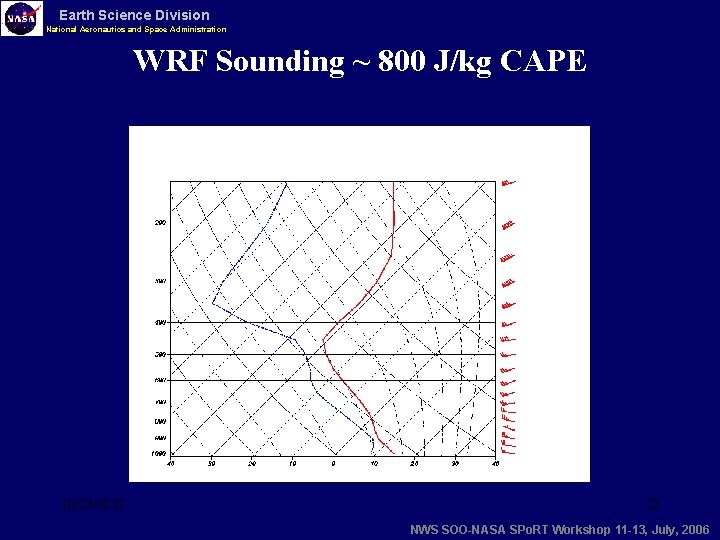
Earth Science Division National Aeronautics and Space Administration WRF Sounding ~ 800 J/kg CAPE 10/28/2021 33 NWS SOO-NASA SPo. RT Workshop 11 -13, July, 2006
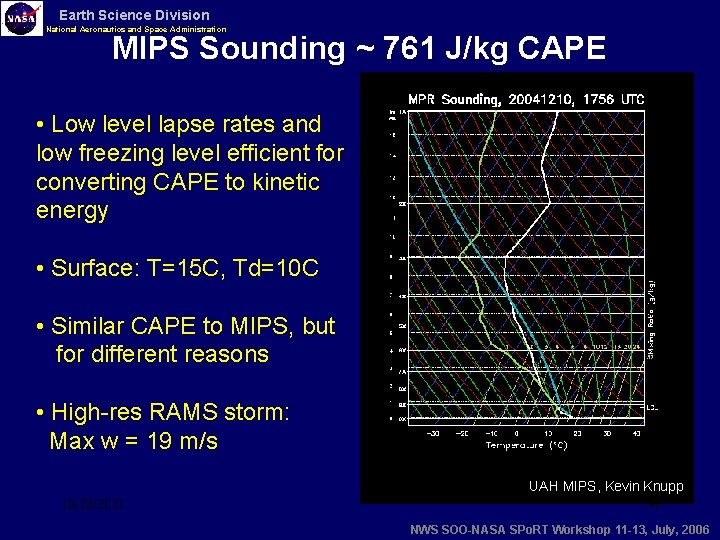
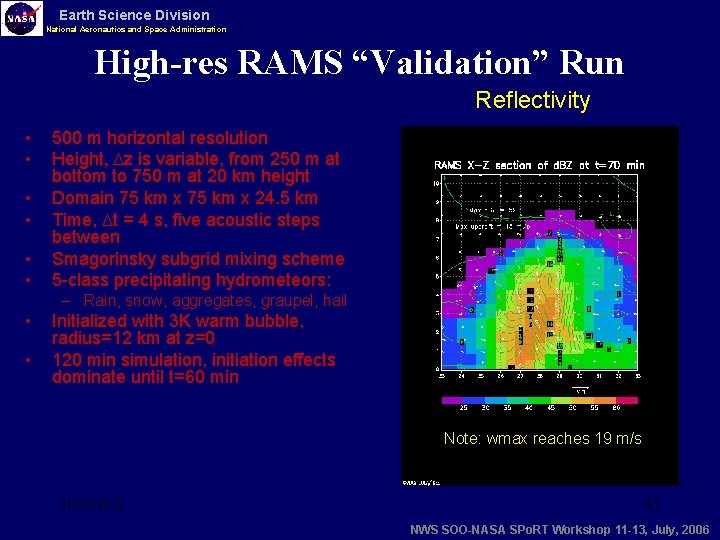
Earth Science Division National Aeronautics and Space Administration MIPS Sounding ~ 761 J/kg CAPE • Low level lapse rates and low freezing level efficient for converting CAPE to kinetic energy • Surface: T=15 C, Td=10 C • Similar CAPE to MIPS, but for different reasons • High-res RAMS storm: Max w = 19 m/s 10/28/2021 UAH MIPS, Kevin Knupp 34 NWS SOO-NASA SPo. RT Workshop 11 -13, July, 2006
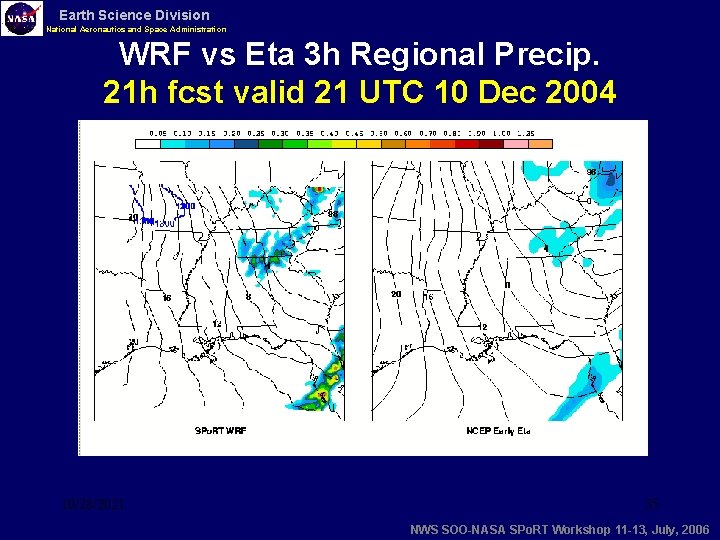
Earth Science Division National Aeronautics and Space Administration WRF vs Eta 3 h Regional Precip. 21 h fcst valid 21 UTC 10 Dec 2004 10/28/2021 35 NWS SOO-NASA SPo. RT Workshop 11 -13, July, 2006
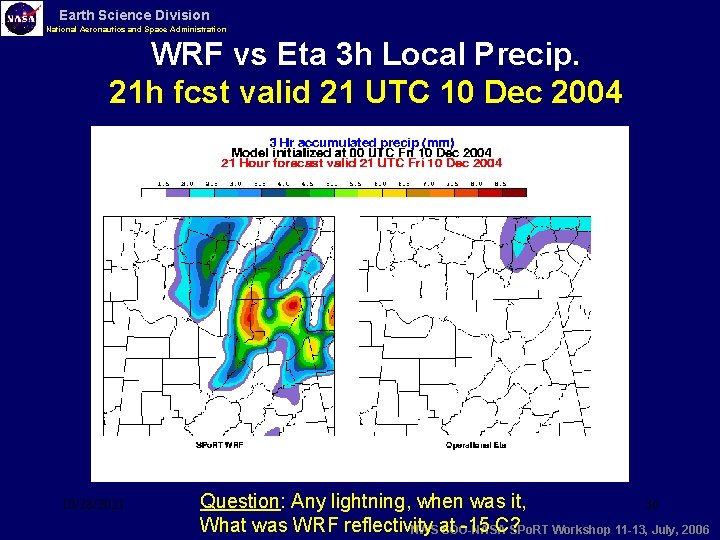
Earth Science Division National Aeronautics and Space Administration WRF vs Eta 3 h Local Precip. 21 h fcst valid 21 UTC 10 Dec 2004 10/28/2021 Question: Any lightning, when was it, 36 What was WRF reflectivity -15 C? NWSat SOO-NASA SPo. RT Workshop 11 -13, July, 2006
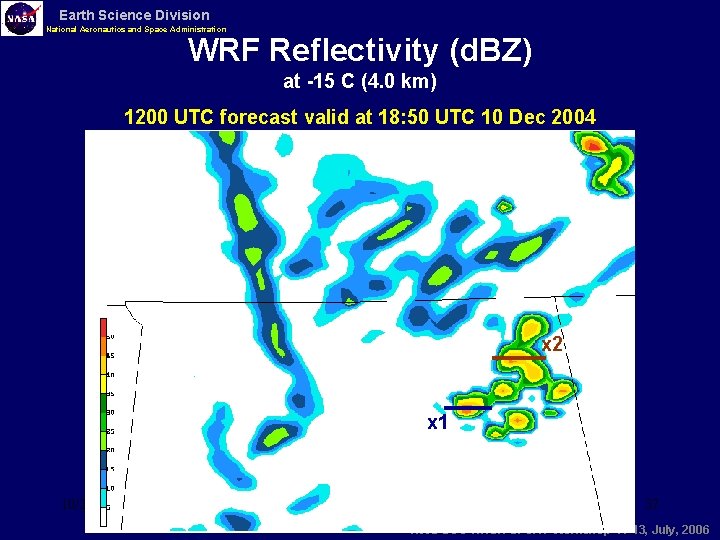
Earth Science Division National Aeronautics and Space Administration WRF Reflectivity (d. BZ) at -15 C (4. 0 km) 1200 UTC forecast valid at 18: 50 UTC 10 Dec 2004 x 2 x 1 10/28/2021 37 NWS SOO-NASA SPo. RT Workshop 11 -13, July, 2006
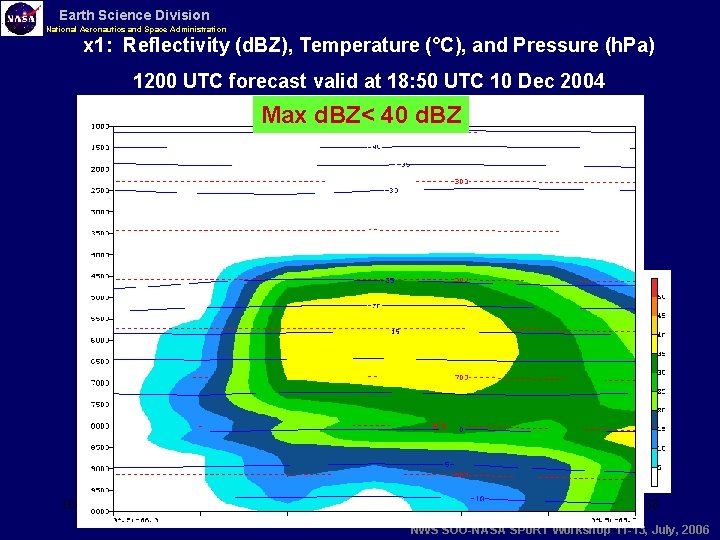
Earth Science Division National Aeronautics and Space Administration x 1: Reflectivity (d. BZ), Temperature (°C), and Pressure (h. Pa) 1200 UTC forecast valid at 18: 50 UTC 10 Dec 2004 Max d. BZ< 40 d. BZ 10/28/2021 38 NWS SOO-NASA SPo. RT Workshop 11 -13, July, 2006
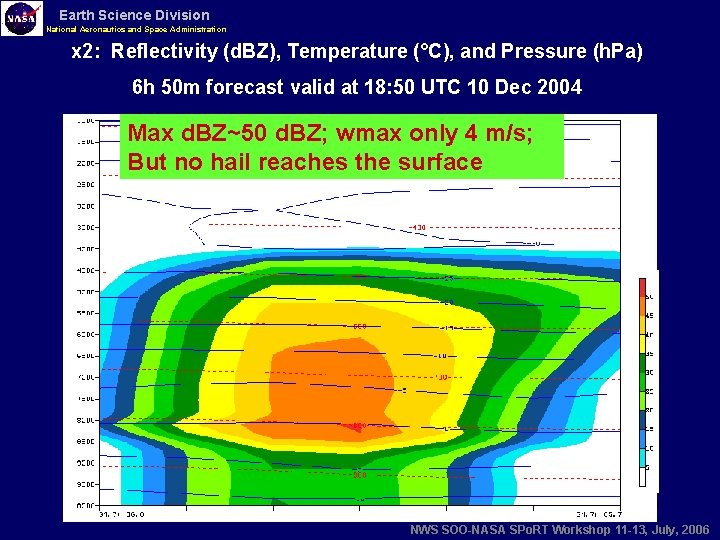
Earth Science Division National Aeronautics and Space Administration x 2: Reflectivity (d. BZ), Temperature (°C), and Pressure (h. Pa) 6 h 50 m forecast valid at 18: 50 UTC 10 Dec 2004 Max d. BZ~50 d. BZ; wmax only 4 m/s; But no hail reaches the surface 10/28/2021 39 NWS SOO-NASA SPo. RT Workshop 11 -13, July, 2006
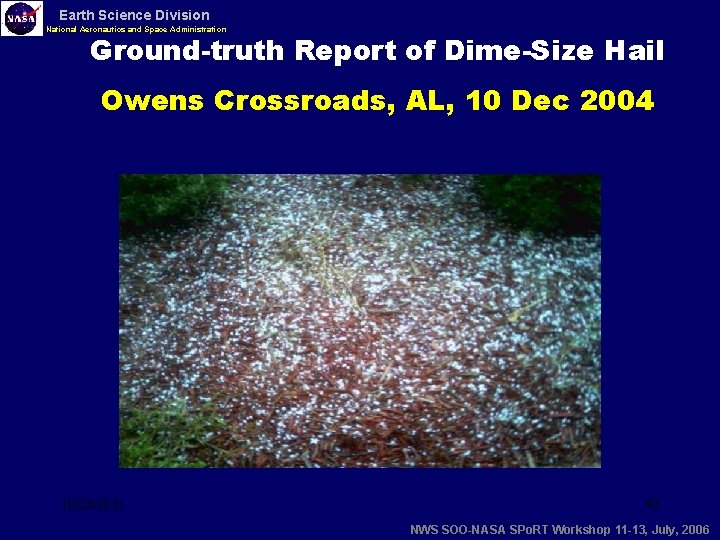
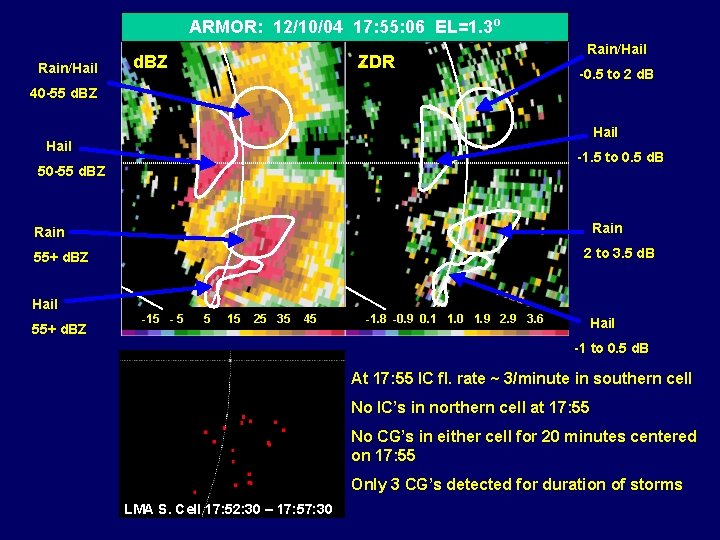
Earth Science Division National Aeronautics and Space Administration Ground-truth Report of Dime-Size Hail Owens Crossroads, AL, 10 Dec 2004 10/28/2021 40 NWS SOO-NASA SPo. RT Workshop 11 -13, July, 2006
ARMOR: 12/10/04 17: 55: 06 EL=1. 3 o Rain/Hail d. BZ ZDR Rain/Hail -0. 5 to 2 d. B 40 -55 d. BZ Hail -1. 5 to 0. 5 d. B 50 -55 d. BZ Rain 2 to 3. 5 d. B 55+ d. BZ Hail 55+ d. BZ -15 - 5 5 15 25 35 45 -1. 8 -0. 9 0. 1 1. 0 1. 9 2. 9 3. 6 Hail -1 to 0. 5 d. B At 17: 55 IC fl. rate ~ 3/minute in southern cell No IC’s in northern cell at 17: 55 No CG’s in either cell for 20 minutes centered on 17: 55 Only 3 CG’s detected for duration of storms LMA S. Cell 17: 52: 30 – 17: 57: 30
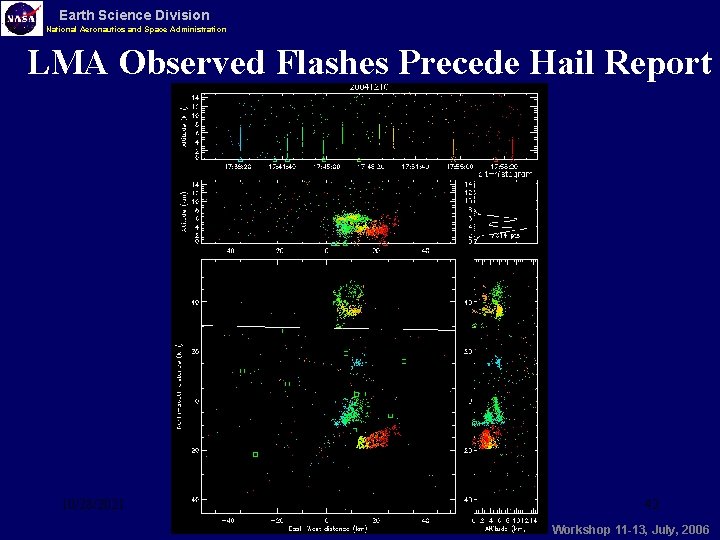
Earth Science Division National Aeronautics and Space Administration LMA Observed Flashes Precede Hail Report 10/28/2021 42 NWS SOO-NASA SPo. RT Workshop 11 -13, July, 2006
Earth Science Division National Aeronautics and Space Administration High-res RAMS “Validation” Run Reflectivity • • • 500 m horizontal resolution Height, Dz is variable, from 250 m at bottom to 750 m at 20 km height Domain 75 km x 24. 5 km Time, Dt = 4 s, five acoustic steps between Smagorinsky subgrid mixing scheme 5 -class precipitating hydrometeors: – Rain, snow, aggregates, graupel, hail • • Initialized with 3 K warm bubble, radius=12 km at z=0 120 min simulation, initiation effects dominate until t=60 min Note: wmax reaches 19 m/s 10/28/2021 43 NWS SOO-NASA SPo. RT Workshop 11 -13, July, 2006
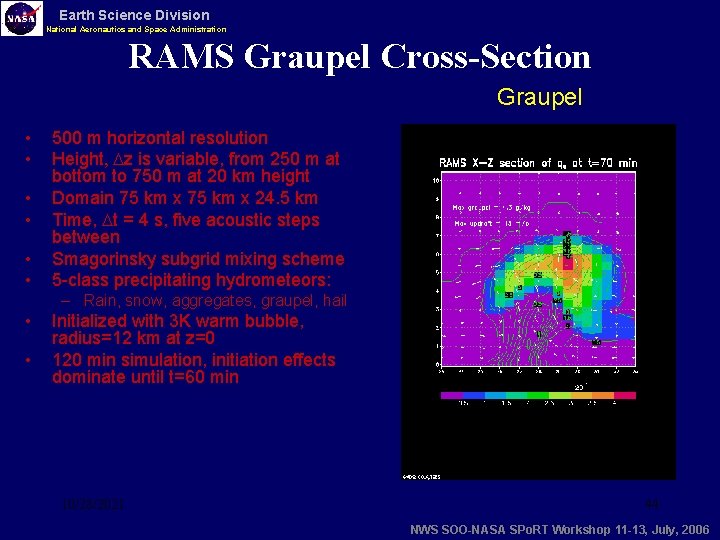
Earth Science Division National Aeronautics and Space Administration RAMS Graupel Cross-Section Graupel • • • 500 m horizontal resolution Height, Dz is variable, from 250 m at bottom to 750 m at 20 km height Domain 75 km x 24. 5 km Time, Dt = 4 s, five acoustic steps between Smagorinsky subgrid mixing scheme 5 -class precipitating hydrometeors: – Rain, snow, aggregates, graupel, hail • • Initialized with 3 K warm bubble, radius=12 km at z=0 120 min simulation, initiation effects dominate until t=60 min 10/28/2021 44 NWS SOO-NASA SPo. RT Workshop 11 -13, July, 2006
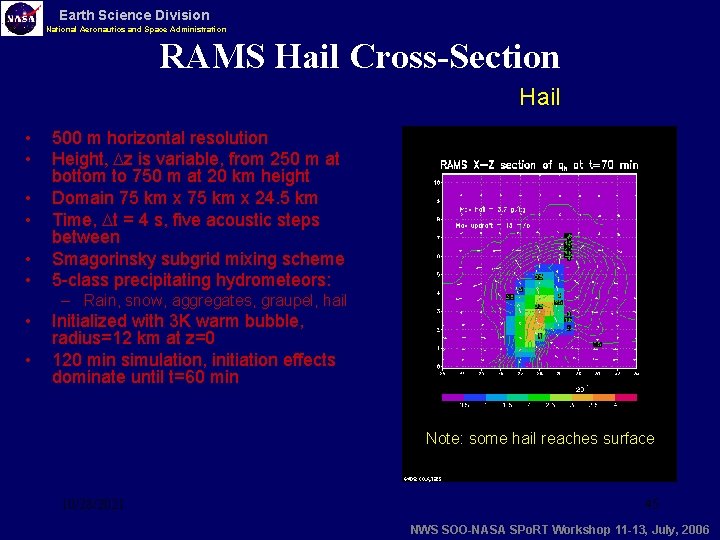
Earth Science Division National Aeronautics and Space Administration RAMS Hail Cross-Section Hail • • • 500 m horizontal resolution Height, Dz is variable, from 250 m at bottom to 750 m at 20 km height Domain 75 km x 24. 5 km Time, Dt = 4 s, five acoustic steps between Smagorinsky subgrid mixing scheme 5 -class precipitating hydrometeors: – Rain, snow, aggregates, graupel, hail • • Initialized with 3 K warm bubble, radius=12 km at z=0 120 min simulation, initiation effects dominate until t=60 min Note: some hail reaches surface 10/28/2021 45 NWS SOO-NASA SPo. RT Workshop 11 -13, July, 2006
Earth Science Division National Aeronautics and Space Administration WRF Thunderstorm and Lightning Forecasts: 22 April 2005 10/28/2021 46 NWS SOO-NASA SPo. RT Workshop 11 -13, July, 2006
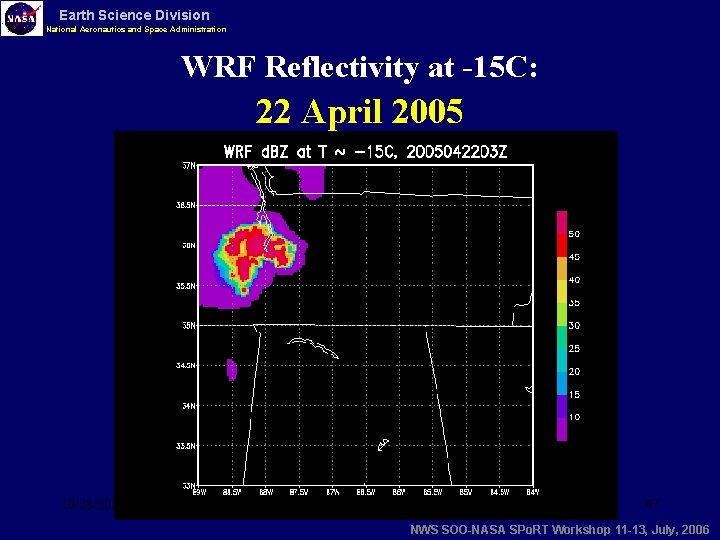
Earth Science Division National Aeronautics and Space Administration WRF Reflectivity at -15 C: 22 April 2005 10/28/2021 47 NWS SOO-NASA SPo. RT Workshop 11 -13, July, 2006
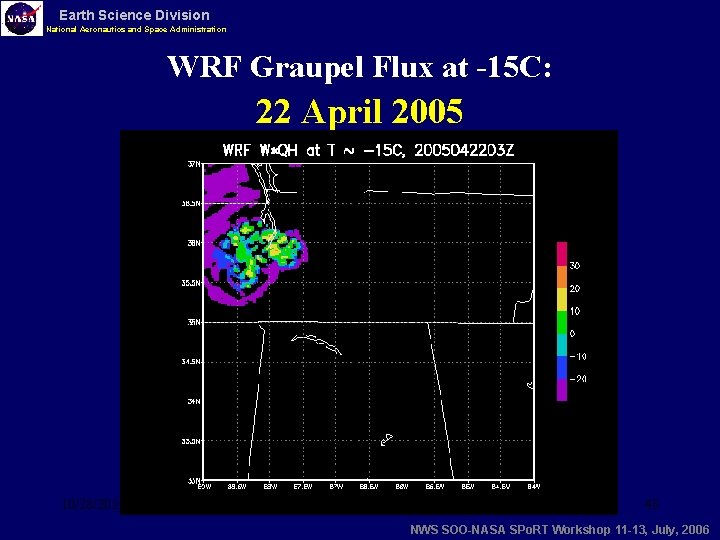
Earth Science Division National Aeronautics and Space Administration WRF Graupel Flux at -15 C: 22 April 2005 10/28/2021 48 NWS SOO-NASA SPo. RT Workshop 11 -13, July, 2006
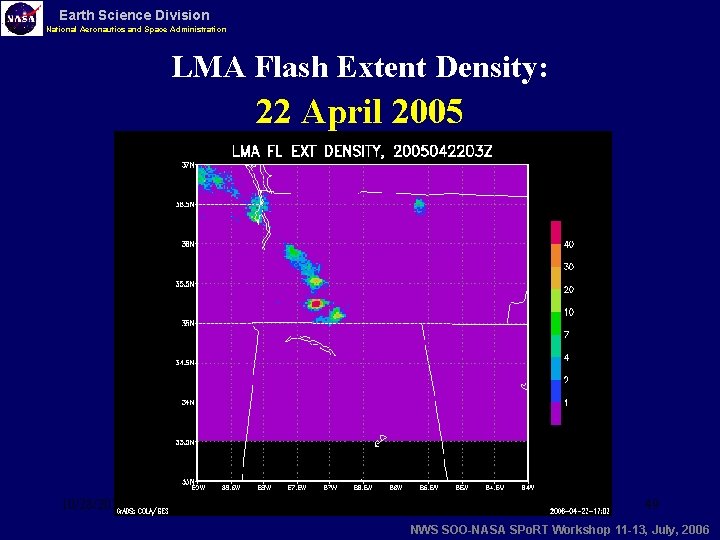
Earth Science Division National Aeronautics and Space Administration LMA Flash Extent Density: 22 April 2005 10/28/2021 49 NWS SOO-NASA SPo. RT Workshop 11 -13, July, 2006
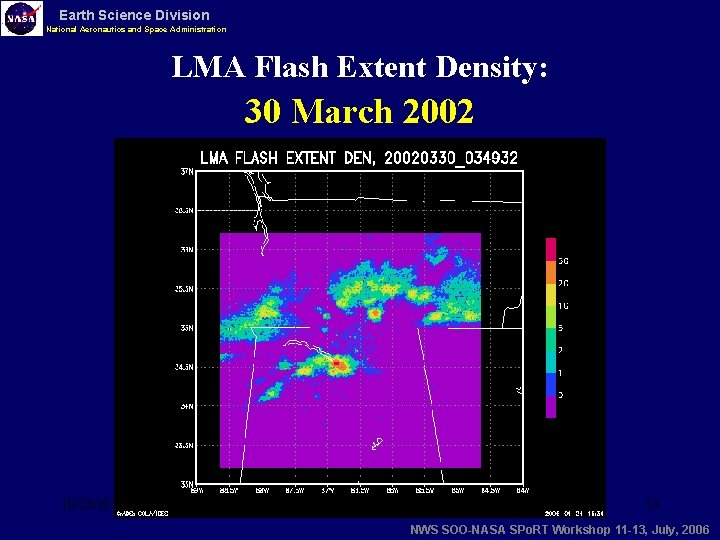
Earth Science Division National Aeronautics and Space Administration WRF Thunderstorm and Lightning Forecasts: 30 March 2002 10/28/2021 50 NWS SOO-NASA SPo. RT Workshop 11 -13, July, 2006
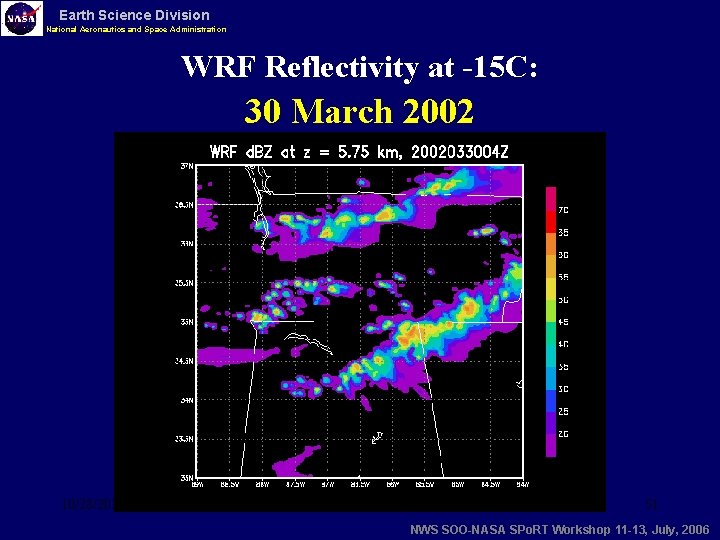
Earth Science Division National Aeronautics and Space Administration WRF Reflectivity at -15 C: 30 March 2002 10/28/2021 51 NWS SOO-NASA SPo. RT Workshop 11 -13, July, 2006
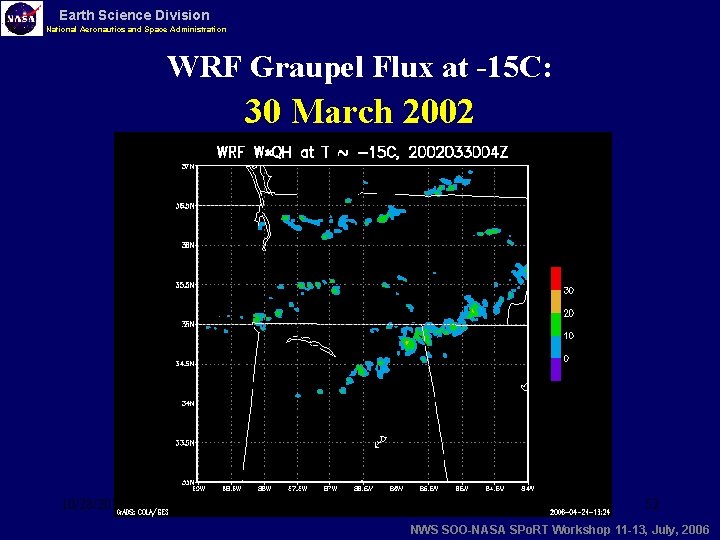
Earth Science Division National Aeronautics and Space Administration WRF Graupel Flux at -15 C: 30 March 2002 10/28/2021 52 NWS SOO-NASA SPo. RT Workshop 11 -13, July, 2006
Earth Science Division National Aeronautics and Space Administration LMA Flash Extent Density: 30 March 2002 10/28/2021 53 NWS SOO-NASA SPo. RT Workshop 11 -13, July, 2006
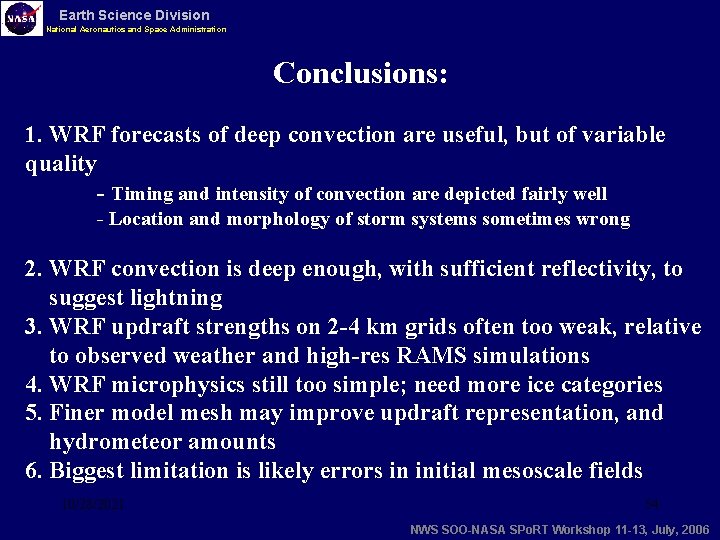
Earth Science Division National Aeronautics and Space Administration Conclusions: 1. WRF forecasts of deep convection are useful, but of variable quality - Timing and intensity of convection are depicted fairly well - Location and morphology of storm systems sometimes wrong 2. WRF convection is deep enough, with sufficient reflectivity, to suggest lightning 3. WRF updraft strengths on 2 -4 km grids often too weak, relative to observed weather and high-res RAMS simulations 4. WRF microphysics still too simple; need more ice categories 5. Finer model mesh may improve updraft representation, and hydrometeor amounts 6. Biggest limitation is likely errors in initial mesoscale fields 10/28/2021 54 NWS SOO-NASA SPo. RT Workshop 11 -13, July, 2006
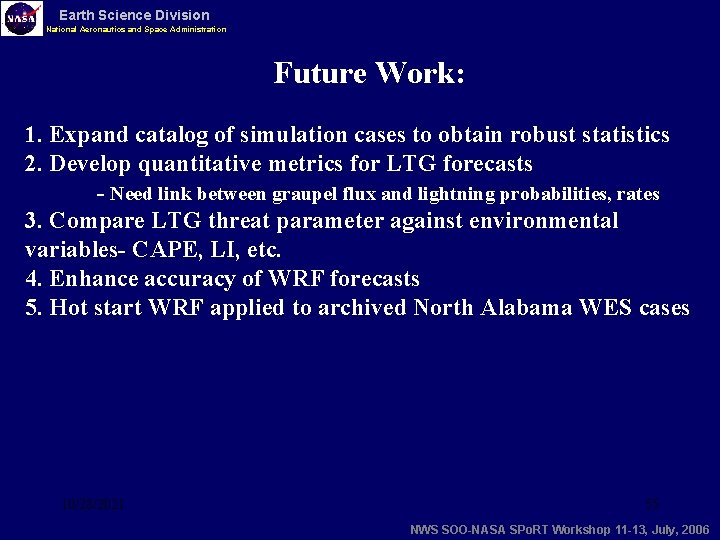
Earth Science Division National Aeronautics and Space Administration Future Work: 1. Expand catalog of simulation cases to obtain robust statistics 2. Develop quantitative metrics for LTG forecasts - Need link between graupel flux and lightning probabilities, rates 3. Compare LTG threat parameter against environmental variables- CAPE, LI, etc. 4. Enhance accuracy of WRF forecasts 5. Hot start WRF applied to archived North Alabama WES cases 10/28/2021 55 NWS SOO-NASA SPo. RT Workshop 11 -13, July, 2006
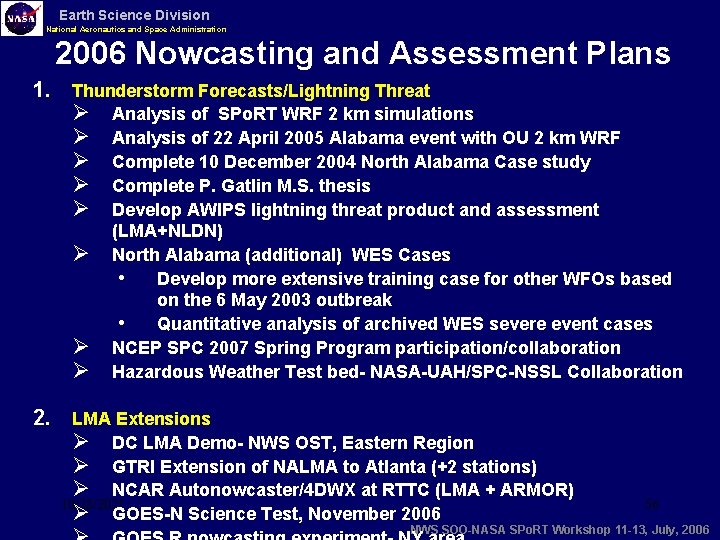
Earth Science Division National Aeronautics and Space Administration 2006 Nowcasting and Assessment Plans 1. Thunderstorm Forecasts/Lightning Threat Ø Analysis of SPo. RT WRF 2 km simulations Ø Analysis of 22 April 2005 Alabama event with OU 2 km WRF Ø Complete 10 December 2004 North Alabama Case study Ø Complete P. Gatlin M. S. thesis Ø Develop AWIPS lightning threat product and assessment Ø Ø Ø (LMA+NLDN) North Alabama (additional) WES Cases • Develop more extensive training case for other WFOs based on the 6 May 2003 outbreak • Quantitative analysis of archived WES severe event cases NCEP SPC 2007 Spring Program participation/collaboration Hazardous Weather Test bed- NASA-UAH/SPC-NSSL Collaboration 2. LMA Extensions Ø DC LMA Demo- NWS OST, Eastern Region Ø GTRI Extension of NALMA to Atlanta (+2 stations) Ø NCAR Autonowcaster/4 DWX at RTTC (LMA + ARMOR) 10/28/2021 Ø GOES-N Science Test, November 2006 56 NWS SOO-NASA SPo. RT Workshop 11 -13, July, 2006
Earth Science Division National Aeronautics and Space Administration Key Elements to Successful Transition Ø Shared interest to improve forecasts by infusing new technology and applying emerging research techniques Ø Identify goals and objectives of collaboration • Improve warning decision making • Increased confidence and situational awareness • Increase lead time, reduce false alarms • Lightning hazard forecast and warning Ø Need to have advocates in the WFOs 10/28/2021 57 NWS SOO-NASA SPo. RT Workshop 11 -13, July, 2006
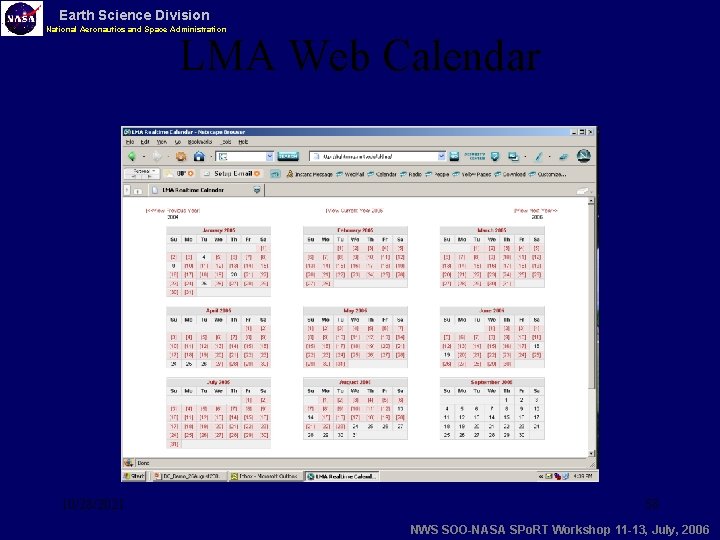
Earth Science Division National Aeronautics and Space Administration LMA Web Calendar 10/28/2021 58 NWS SOO-NASA SPo. RT Workshop 11 -13, July, 2006
Earth Science Division National Aeronautics and Space Administration Web Sites Ø http: //weather. msfc. nasa. gov (SPo. RT, Workshops) Ø http: //branch. nsstc. nasa. gov (North AL, DC Metro LMA) Ø http: //lightning. nmt. edu (OK LMA) 10/28/2021 59 NWS SOO-NASA SPo. RT Workshop 11 -13, July, 2006