
Earth Science Chapter 22 The Atmosphere Earth Science
- Slides: 12
Earth Science Chapter 22 The Atmosphere
Earth Science Chapter 22: The Atmosphere: Atmospheric Circulation EQ: What is the Coriolis effect? What the global patterns of air circulation and their associated wind belts? What affects local wind patterns?
Chapter 22 Section 3 Atmospheric Circulation Objectives • Explain the Coriolis effect. • Describe the global patterns of air circulation, and name three global wind belts. • Identify two factors that form local wind patterns. Chapter menu Resources Copyright © by Holt, Rinehart and Winston. All rights reserved.
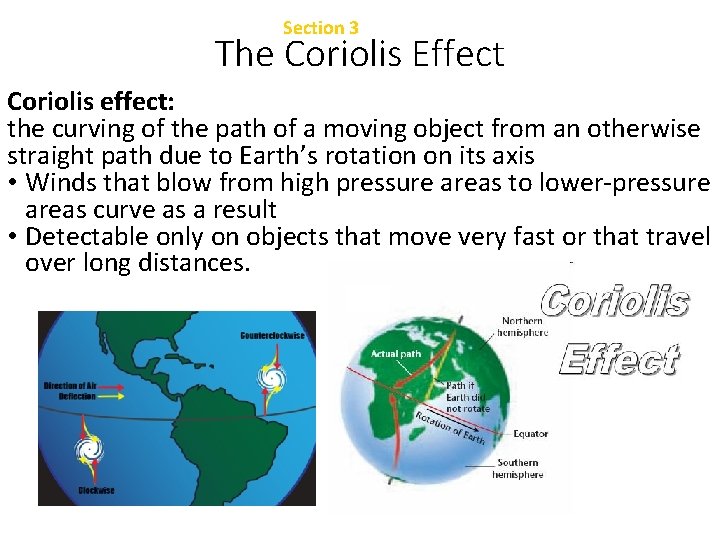
Chapter 22 Section 3 Atmospheric Circulation The Coriolis Effect Coriolis effect: the curving of the path of a moving object from an otherwise straight path due to Earth’s rotation on its axis • Winds that blow from high pressure areas to lower-pressure areas curve as a result • Detectable only on objects that move very fast or that travel over long distances.
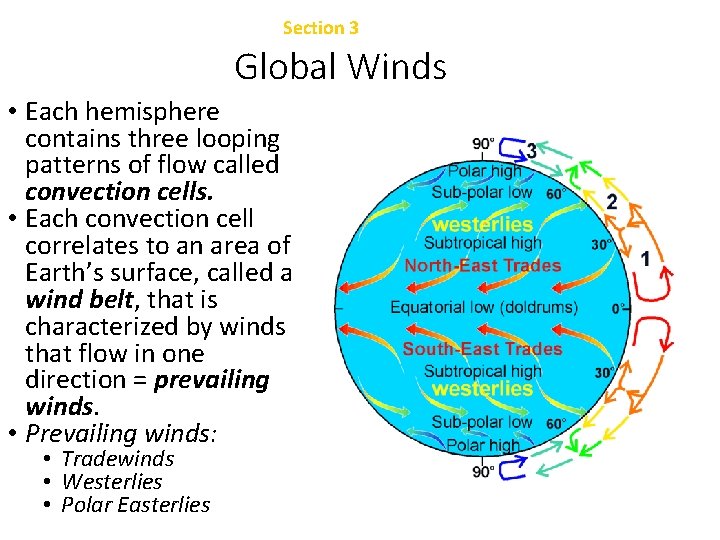
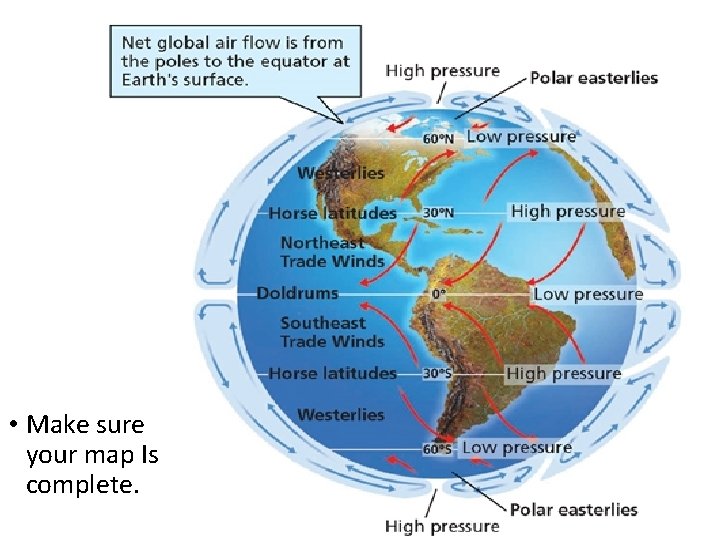
Chapter 22 Section 3 Atmospheric Circulation Global Winds • Each hemisphere contains three looping patterns of flow called convection cells. • Each convection cell correlates to an area of Earth’s surface, called a wind belt, that is characterized by winds that flow in one direction = prevailing winds. • Prevailing winds: • Tradewinds • Westerlies • Polar Easterlies
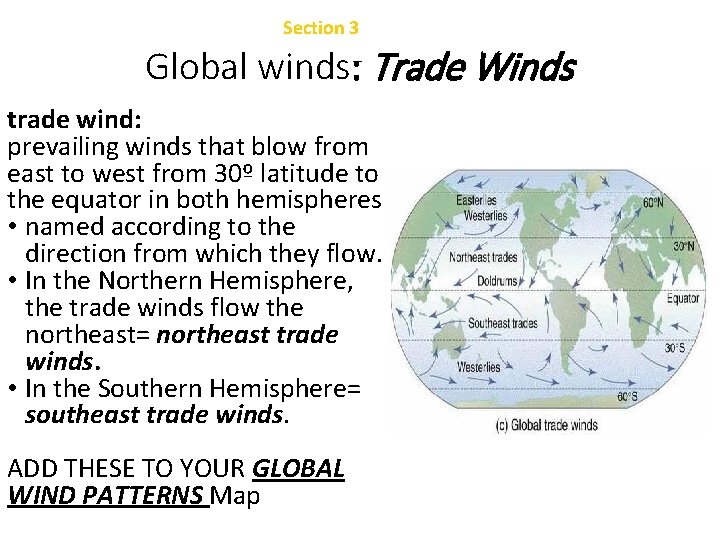
Chapter 22 Section 3 Atmospheric Circulation Global winds: Trade Winds trade wind: prevailing winds that blow from east to west from 30º latitude to the equator in both hemispheres • named according to the direction from which they flow. • In the Northern Hemisphere, the trade winds flow the northeast= northeast trade winds. • In the Southern Hemisphere= southeast trade winds. ADD THESE TO YOUR GLOBAL WIND PATTERNS Map
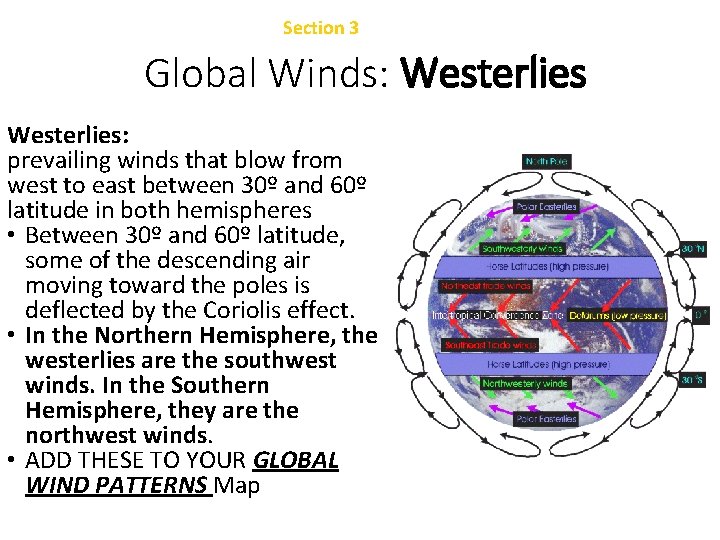
Chapter 22 Section 3 Atmospheric Circulation Global Winds: Westerlies: prevailing winds that blow from west to east between 30º and 60º latitude in both hemispheres • Between 30º and 60º latitude, some of the descending air moving toward the poles is deflected by the Coriolis effect. • In the Northern Hemisphere, the westerlies are the southwest winds. In the Southern Hemisphere, they are the northwest winds. • ADD THESE TO YOUR GLOBAL WIND PATTERNS Map
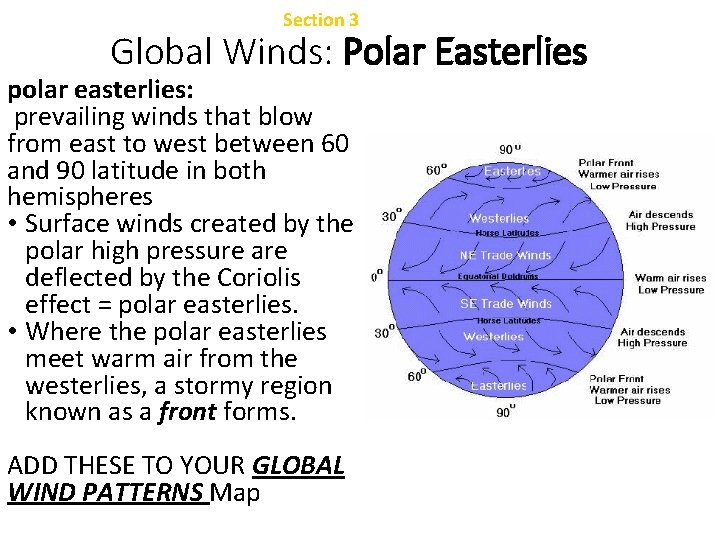
Chapter 22 Section 3 Atmospheric Circulation Global Winds: Polar Easterlies polar easterlies: prevailing winds that blow from east to west between 60 and 90 latitude in both hemispheres • Surface winds created by the polar high pressure are deflected by the Coriolis effect = polar easterlies. • Where the polar easterlies meet warm air from the westerlies, a stormy region known as a front forms. ADD THESE TO YOUR GLOBAL WIND PATTERNS Map
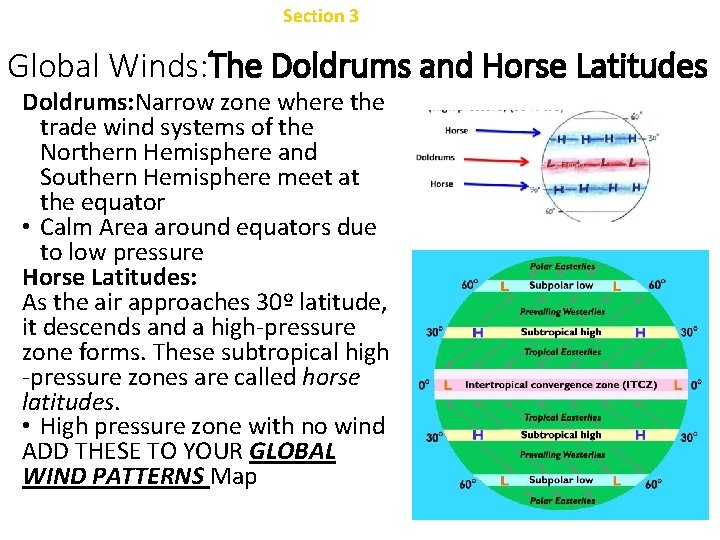
Chapter 22 Section 3 Atmospheric Circulation Global Winds: The Doldrums and Horse Latitudes Doldrums: Narrow zone where the trade wind systems of the Northern Hemisphere and Southern Hemisphere meet at the equator • Calm Area around equators due to low pressure Horse Latitudes: As the air approaches 30º latitude, it descends and a high-pressure zone forms. These subtropical high -pressure zones are called horse latitudes. • High pressure zone with no wind ADD THESE TO YOUR GLOBAL WIND PATTERNS Map
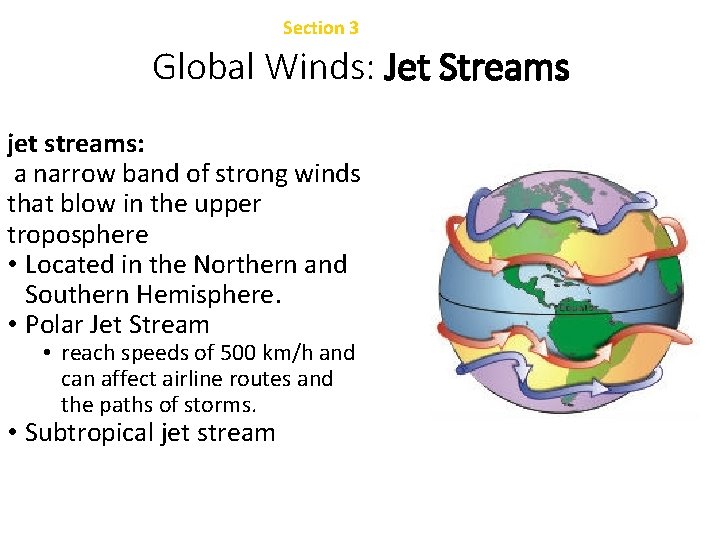
Chapter 22 Section 3 Atmospheric Circulation Global Winds: Jet Streams jet streams: a narrow band of strong winds that blow in the upper troposphere • Located in the Northern and Southern Hemisphere. • Polar Jet Stream • reach speeds of 500 km/h and can affect airline routes and the paths of storms. • Subtropical jet stream.
Chapter 22 • Make sure your map Is complete. Section 3 Atmospheric Circulation
Chapter 22 Local Winds Section 3 Local Winds: • Movement of air are also influenced by local conditions, and local temperature variations • not part of the global wind belts. • Equal areas of land water may receive the same amount of energy from the sun. However, land surfaces heat up faster than water surfaces do. Breeze: Gentle winds that extend over distances of less than 100 km • Sea Breeze: The cool wind moving from water to land • Land Breeze: Replaces sea breeze when the land cools more rapidly than water does at night • Mountain Breeze: At night, the mountains cool more quickly than the valleys do, so cool air descends from the mountain peaks to create • Areas near mountains may experience a warm afternoon that turns to a cold evening soon after sunset. • Valley Breeze: warm air from the valleys moves upslope