
Earth Science An overview of the Solar System
- Slides: 33
Earth Science An overview of the Solar System
Earth Science An overview of the In Solar System the beginning, God created the heavens and the earth. The earth was without form and void, and darkness was over the face of the deep. And the Spirit of God was hovering over the face of the waters (Genesis 1: 1 -2).
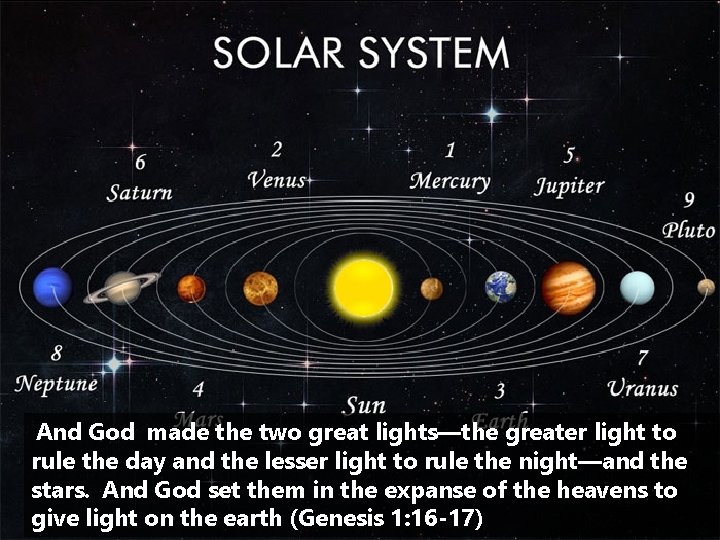
And God made the two great lights—the greater light to rule the day and the lesser light to rule the night—and the stars. And God set them in the expanse of the heavens to give light on the earth (Genesis 1: 16 -17)
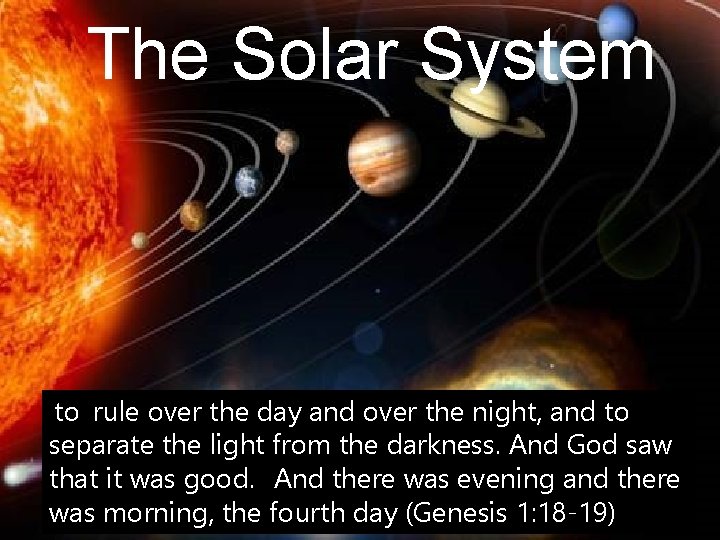
The Solar System to rule over the day and over the night, and to separate the light from the darkness. And God saw that it was good. And there was evening and there was morning, the fourth day (Genesis 1: 18 -19)
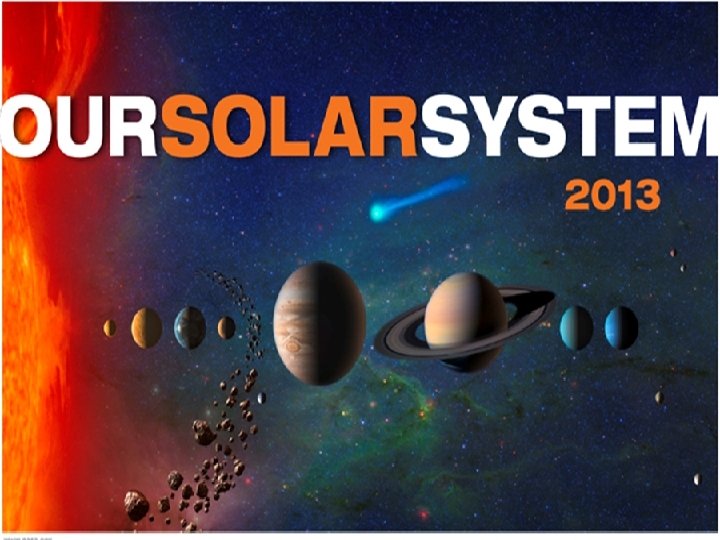
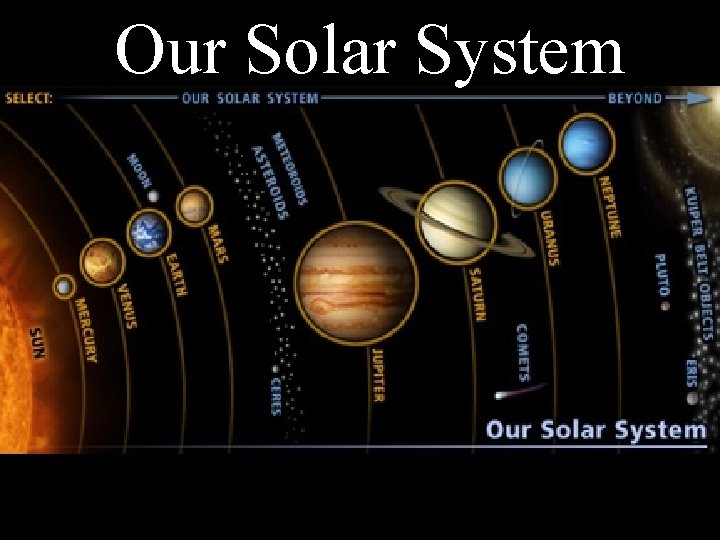
Our Solar System
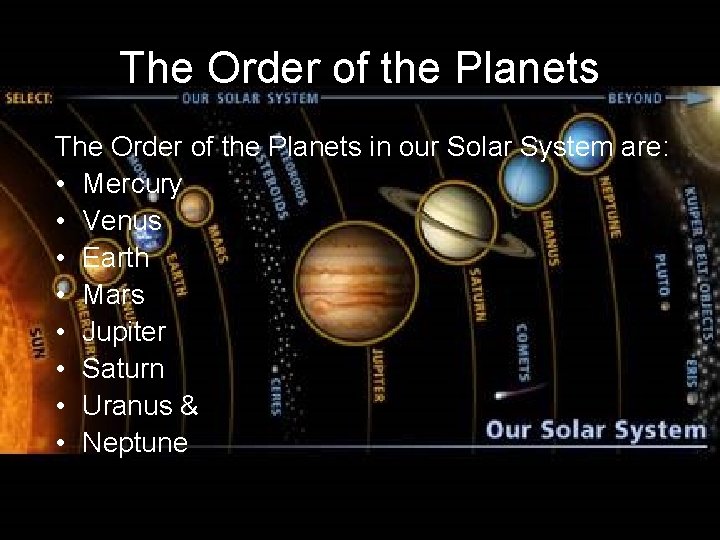
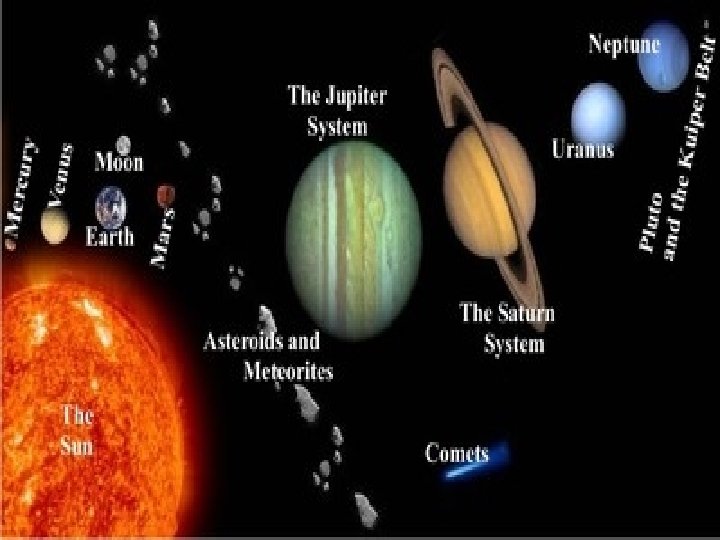
The Order of the Planets in our Solar System are: • Mercury • Venus • Earth • Mars • Jupiter • Saturn • Uranus & • Neptune
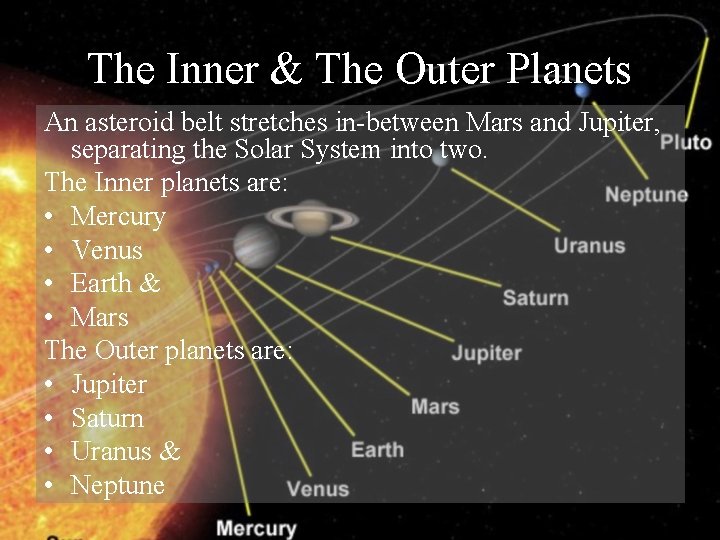
The Inner & The Outer Planets An asteroid belt stretches in-between Mars and Jupiter, separating the Solar System into two. The Inner planets are: • Mercury • Venus • Earth & • Mars The Outer planets are: • Jupiter • Saturn • Uranus & • Neptune
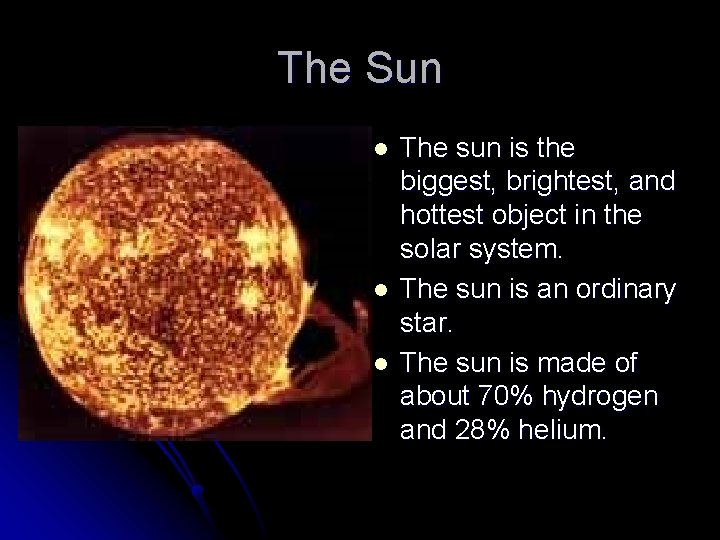
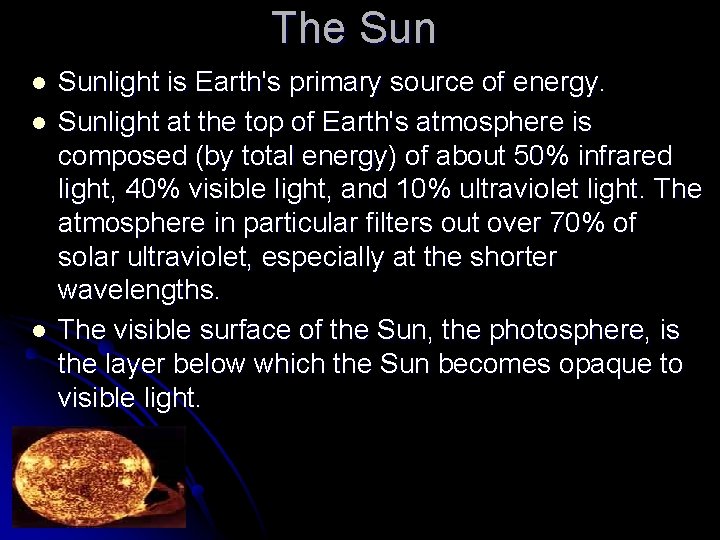
The Sun l l l The sun is the biggest, brightest, and hottest object in the solar system. The sun is an ordinary star. The sun is made of about 70% hydrogen and 28% helium.
The Sun l l l Sunlight is Earth's primary source of energy. Sunlight at the top of Earth's atmosphere is composed (by total energy) of about 50% infrared light, 40% visible light, and 10% ultraviolet light. The atmosphere in particular filters out over 70% of solar ultraviolet, especially at the shorter wavelengths. The visible surface of the Sun, the photosphere, is the layer below which the Sun becomes opaque to visible light.
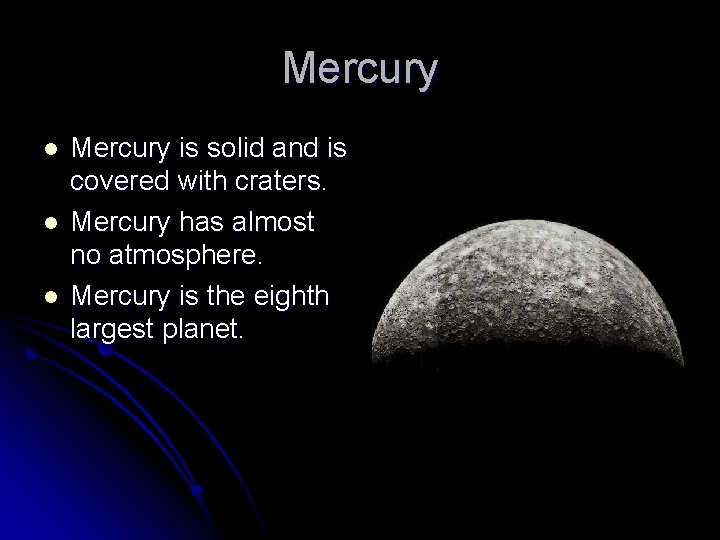
Mercury l l l Mercury is solid and is covered with craters. Mercury has almost no atmosphere. Mercury is the eighth largest planet.
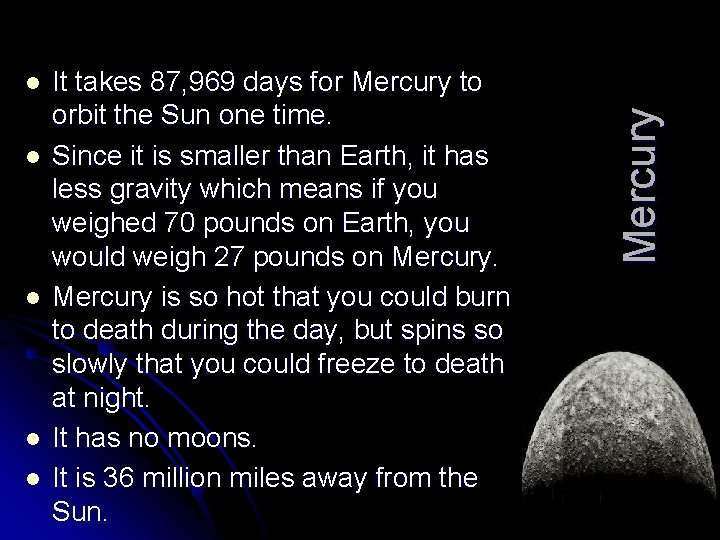
l l It takes 87, 969 days for Mercury to orbit the Sun one time. Since it is smaller than Earth, it has less gravity which means if you weighed 70 pounds on Earth, you would weigh 27 pounds on Mercury is so hot that you could burn to death during the day, but spins so slowly that you could freeze to death at night. It has no moons. It is 36 million miles away from the Sun. Mercury l
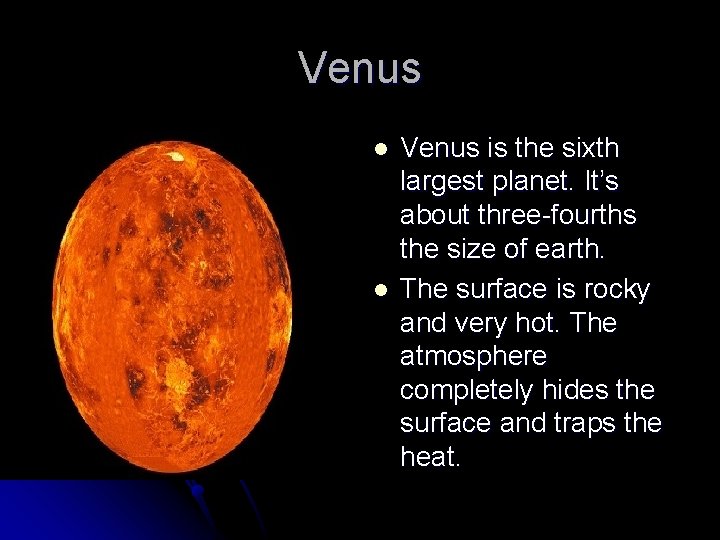
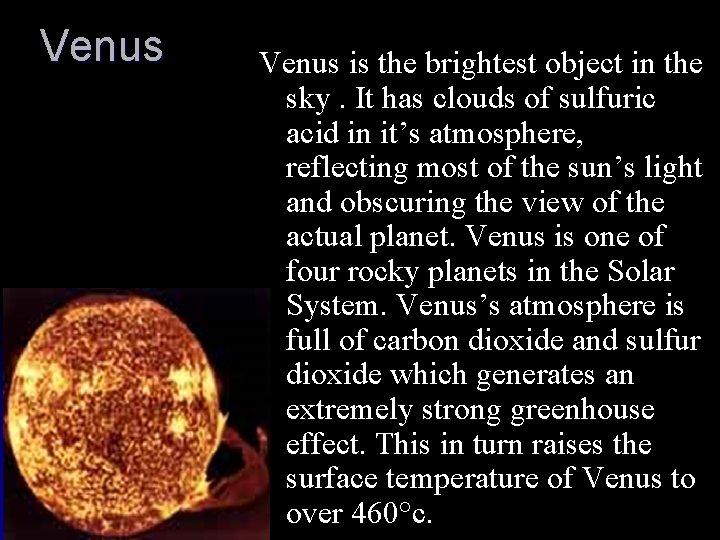
Venus l l Venus is the sixth largest planet. It’s about three-fourths the size of earth. The surface is rocky and very hot. The atmosphere completely hides the surface and traps the heat.
Venus is the brightest object in the sky. It has clouds of sulfuric acid in it’s atmosphere, reflecting most of the sun’s light and obscuring the view of the actual planet. Venus is one of four rocky planets in the Solar System. Venus’s atmosphere is full of carbon dioxide and sulfur dioxide which generates an extremely strong greenhouse effect. This in turn raises the surface temperature of Venus to over 460°c.
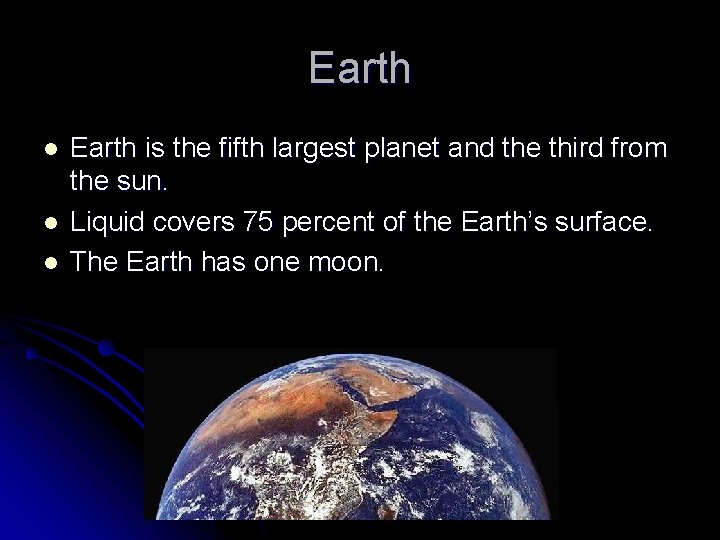
Earth l l l Earth is the fifth largest planet and the third from the sun. Liquid covers 75 percent of the Earth’s surface. The Earth has one moon.
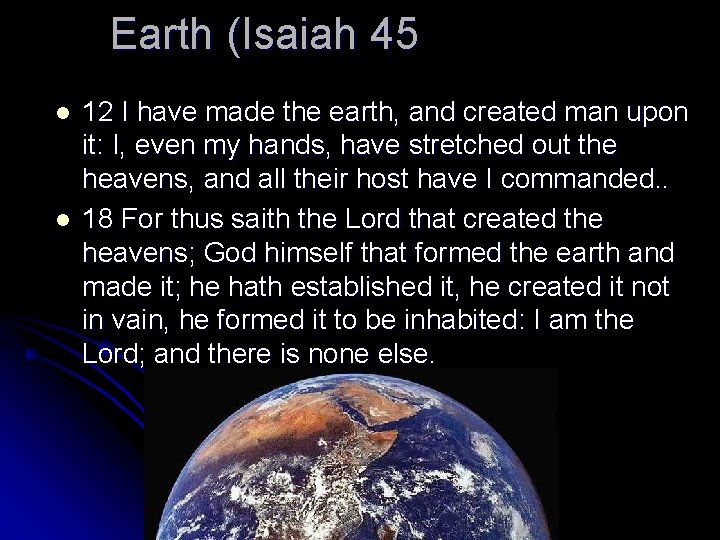
Earth (Isaiah 45 l l 12 I have made the earth, and created man upon it: I, even my hands, have stretched out the heavens, and all their host have I commanded. . 18 For thus saith the Lord that created the heavens; God himself that formed the earth and made it; he hath established it, he created it not in vain, he formed it to be inhabited: I am the Lord; and there is none else.
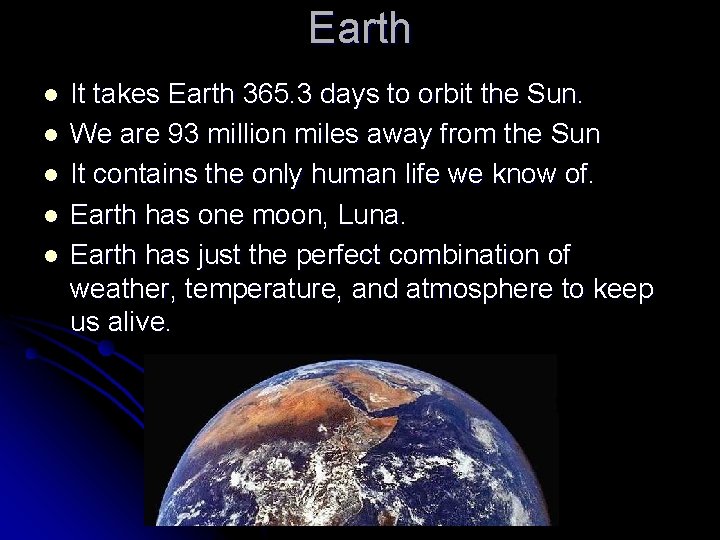
Earth l l l It takes Earth 365. 3 days to orbit the Sun. We are 93 million miles away from the Sun It contains the only human life we know of. Earth has one moon, Luna. Earth has just the perfect combination of weather, temperature, and atmosphere to keep us alive.
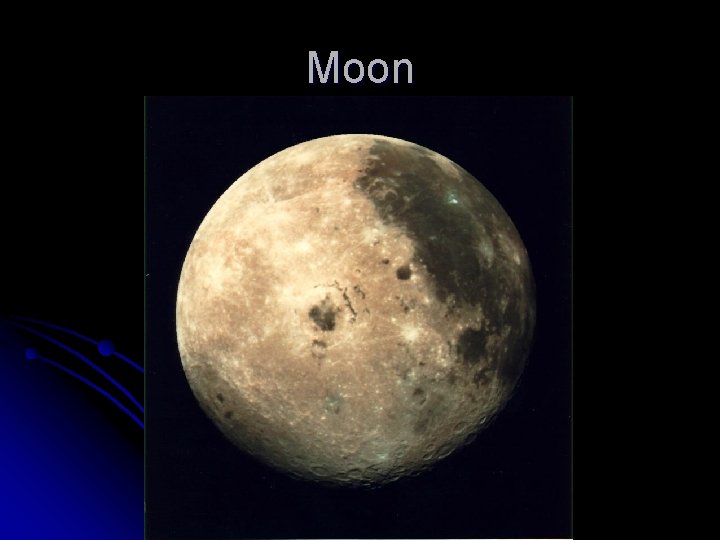
Moon
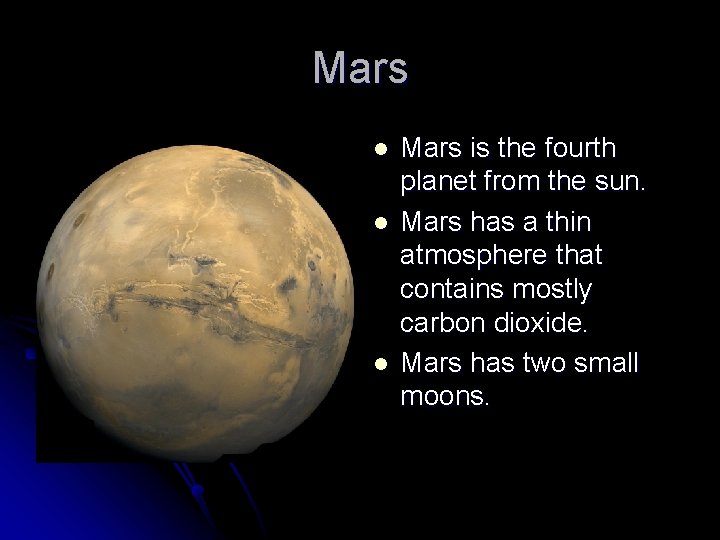
Mars l l l Mars is the fourth planet from the sun. Mars has a thin atmosphere that contains mostly carbon dioxide. Mars has two small moons.
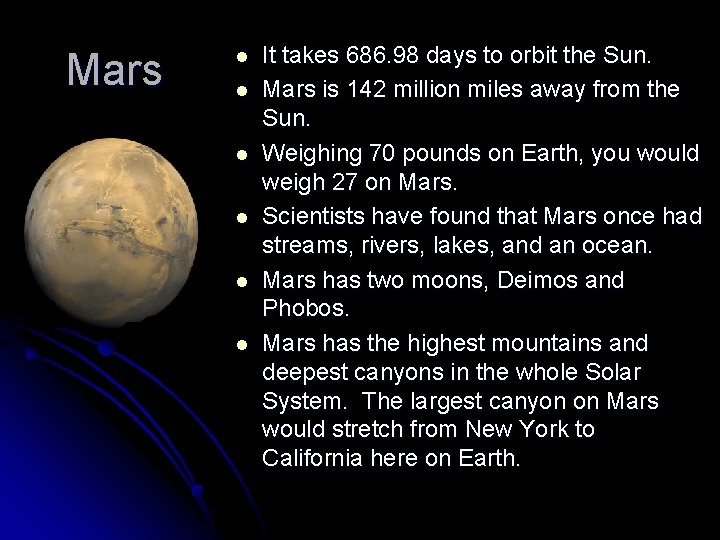
Mars l l l It takes 686. 98 days to orbit the Sun. Mars is 142 million miles away from the Sun. Weighing 70 pounds on Earth, you would weigh 27 on Mars. Scientists have found that Mars once had streams, rivers, lakes, and an ocean. Mars has two moons, Deimos and Phobos. Mars has the highest mountains and deepest canyons in the whole Solar System. The largest canyon on Mars would stretch from New York to California here on Earth.
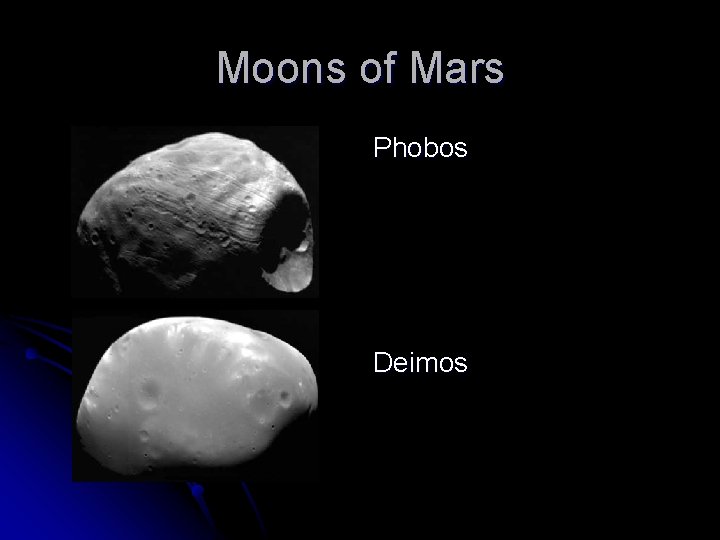
Moons of Mars Phobos Deimos
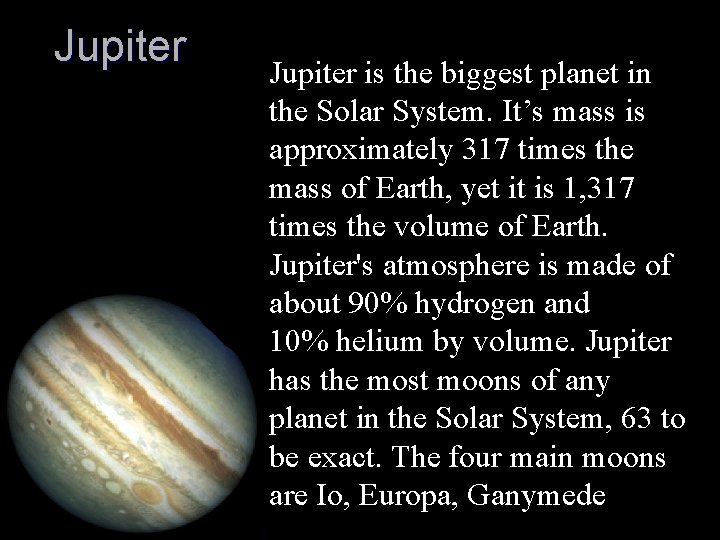
Jupiter is the biggest planet in the Solar System. It’s mass is approximately 317 times the mass of Earth, yet it is 1, 317 times the volume of Earth. Jupiter's atmosphere is made of about 90% hydrogen and 10% helium by volume. Jupiter has the most moons of any planet in the Solar System, 63 to be exact. The four main moons are Io, Europa, Ganymede
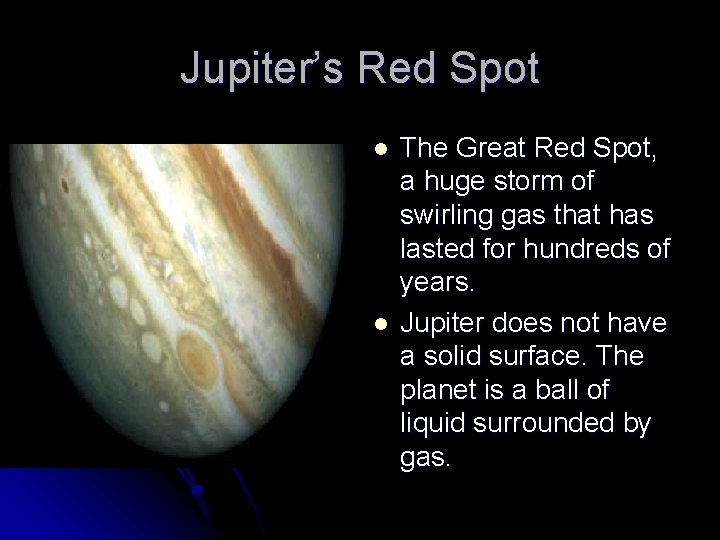
Jupiter’s Red Spot l l The Great Red Spot, a huge storm of swirling gas that has lasted for hundreds of years. Jupiter does not have a solid surface. The planet is a ball of liquid surrounded by gas.
Moons of Jupiter has four large Galilean moons, twelve smaller named moons and twentythree more recently discovered but not named moons. We’ll take a look at the four large Galilean moons which were first observed by Galileo in 1610.
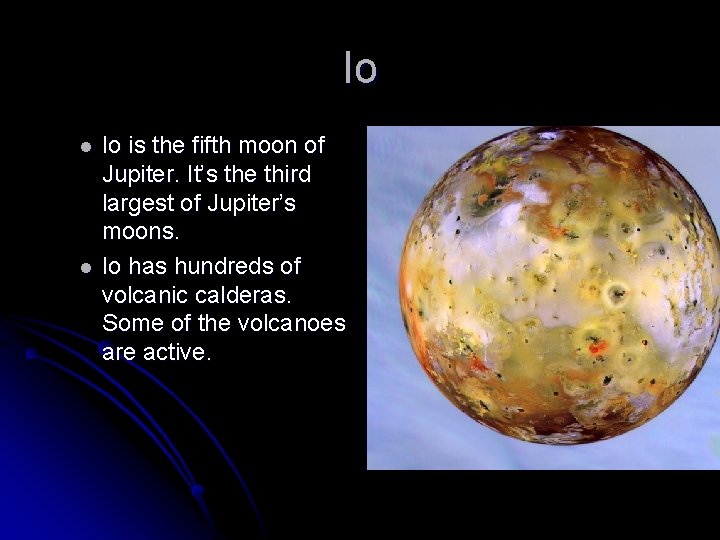
Io l l Io is the fifth moon of Jupiter. It’s the third largest of Jupiter’s moons. Io has hundreds of volcanic calderas. Some of the volcanoes are active.
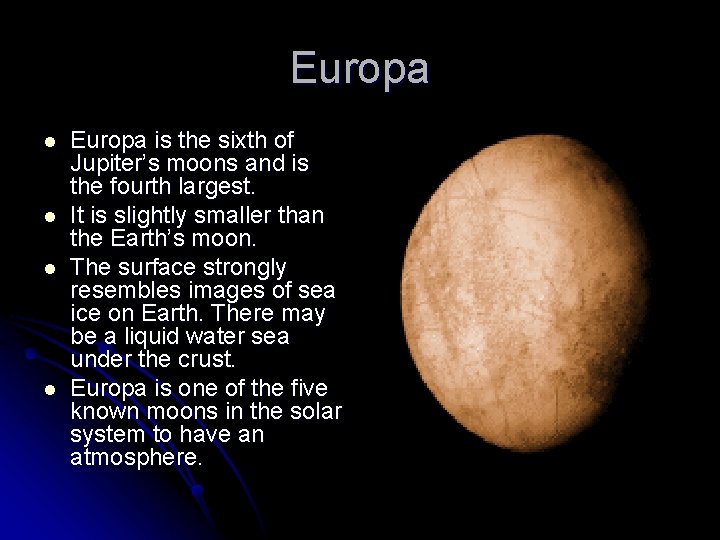
Europa l l Europa is the sixth of Jupiter’s moons and is the fourth largest. It is slightly smaller than the Earth’s moon. The surface strongly resembles images of sea ice on Earth. There may be a liquid water sea under the crust. Europa is one of the five known moons in the solar system to have an atmosphere.
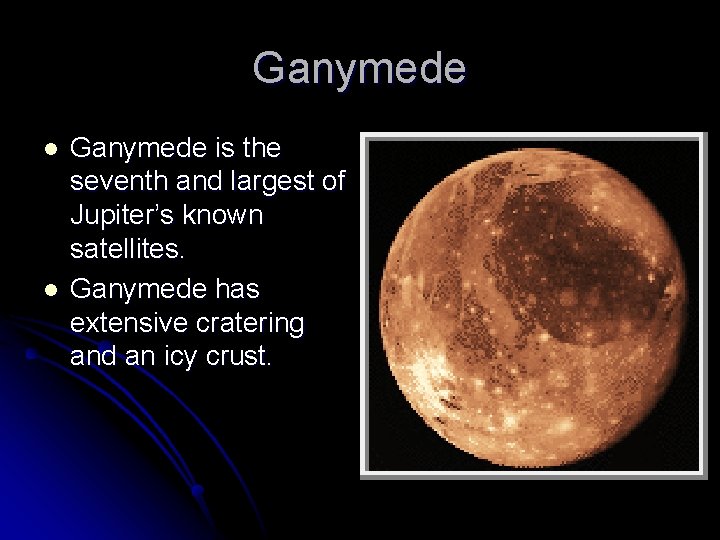
Ganymede l l Ganymede is the seventh and largest of Jupiter’s known satellites. Ganymede has extensive cratering and an icy crust.
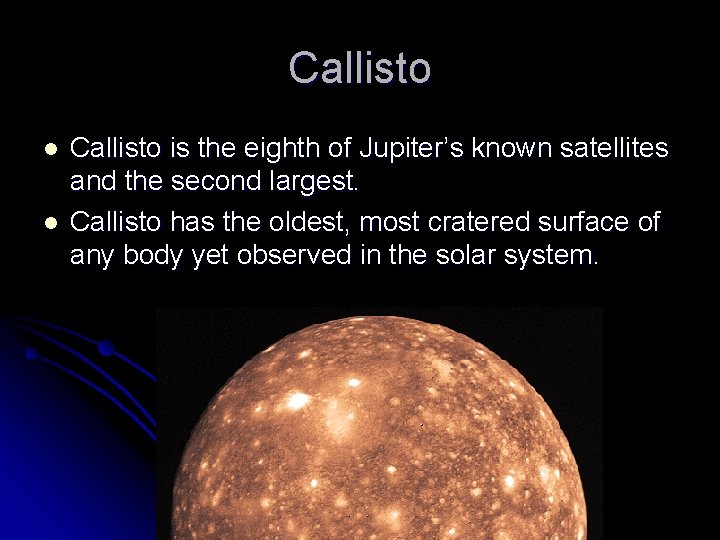
Callisto l l Callisto is the eighth of Jupiter’s known satellites and the second largest. Callisto has the oldest, most cratered surface of any body yet observed in the solar system.
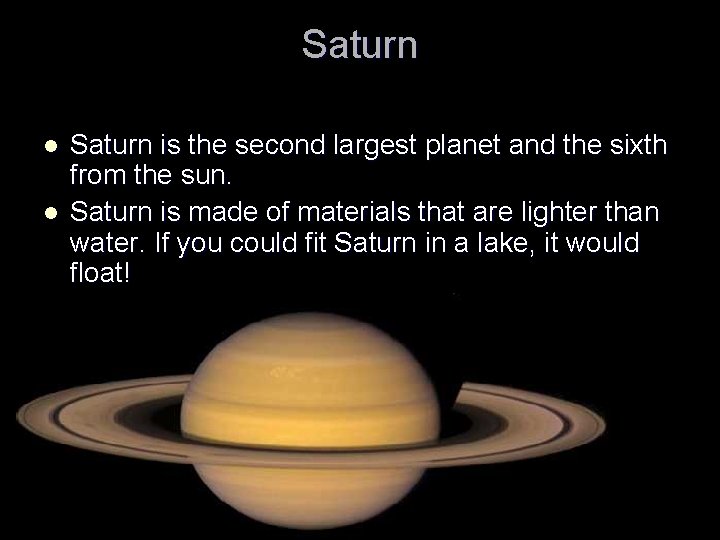
Saturn l l Saturn is the second largest planet and the sixth from the sun. Saturn is made of materials that are lighter than water. If you could fit Saturn in a lake, it would float!
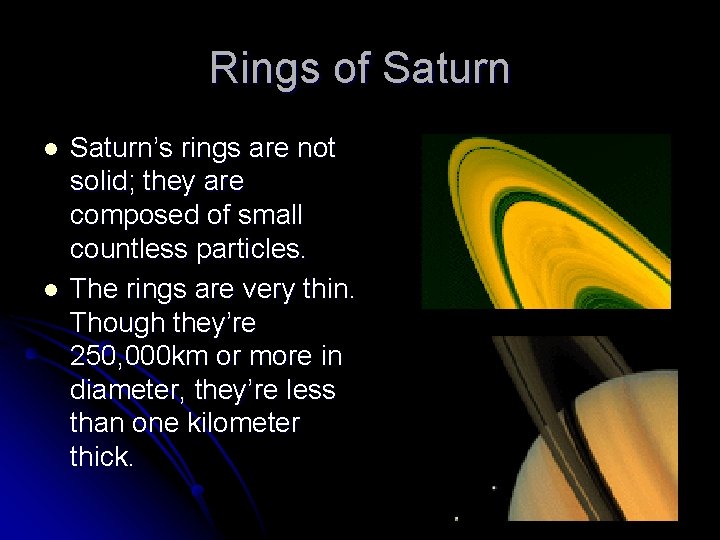
Rings of Saturn l l Saturn’s rings are not solid; they are composed of small countless particles. The rings are very thin. Though they’re 250, 000 km or more in diameter, they’re less than one kilometer thick.
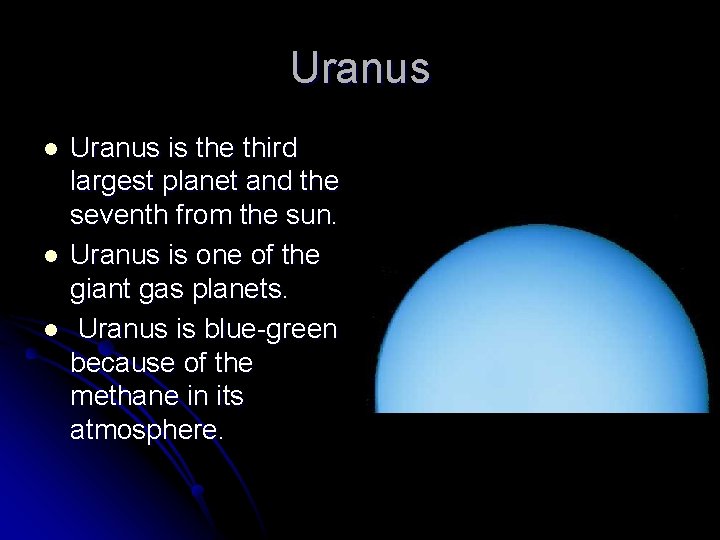
Uranus l l l Uranus is the third largest planet and the seventh from the sun. Uranus is one of the giant gas planets. Uranus is blue-green because of the methane in its atmosphere.
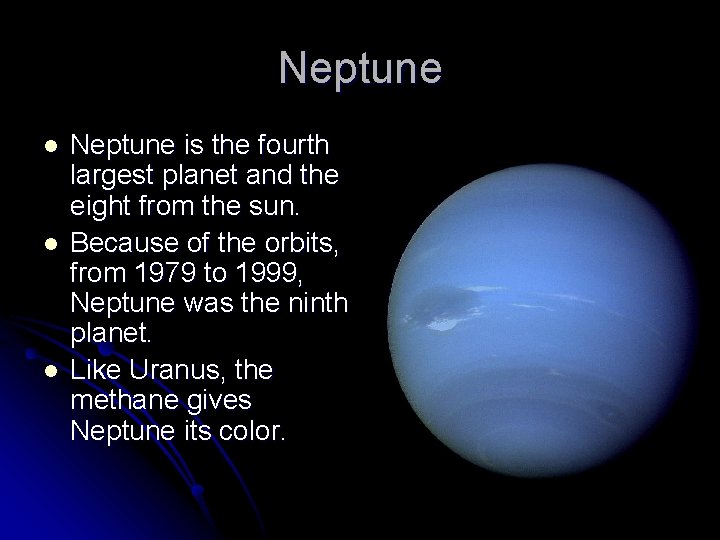
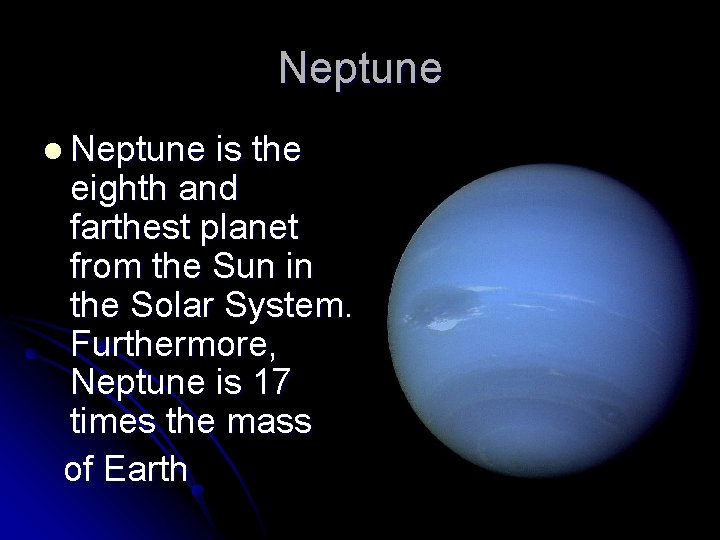
Neptune l l l Neptune is the fourth largest planet and the eight from the sun. Because of the orbits, from 1979 to 1999, Neptune was the ninth planet. Like Uranus, the methane gives Neptune its color.
Neptune l Neptune is the eighth and farthest planet from the Sun in the Solar System. Furthermore, Neptune is 17 times the mass of Earth