
Earth Moon System I Earths Motions A Earth
- Slides: 26
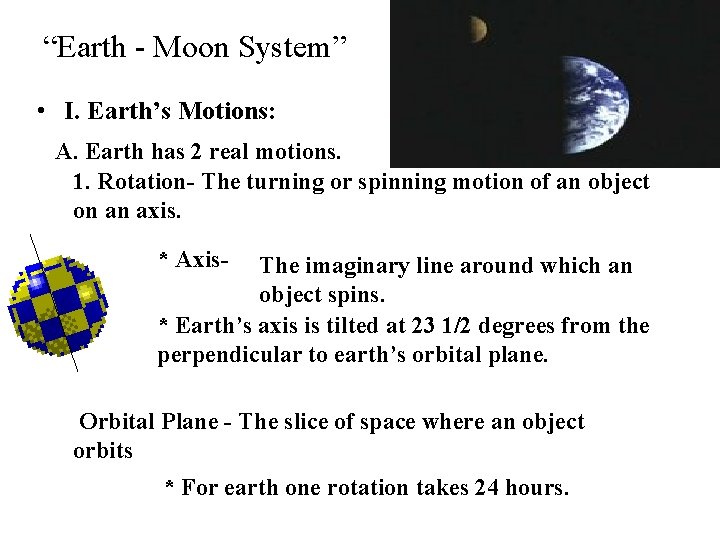
“Earth - Moon System” • I. Earth’s Motions: A. Earth has 2 real motions. 1. Rotation- The turning or spinning motion of an object on an axis. * Axis- The imaginary line around which an object spins. * Earth’s axis is tilted at 23 1/2 degrees from the perpendicular to earth’s orbital plane. Orbital Plane - The slice of space where an object orbits * For earth one rotation takes 24 hours.
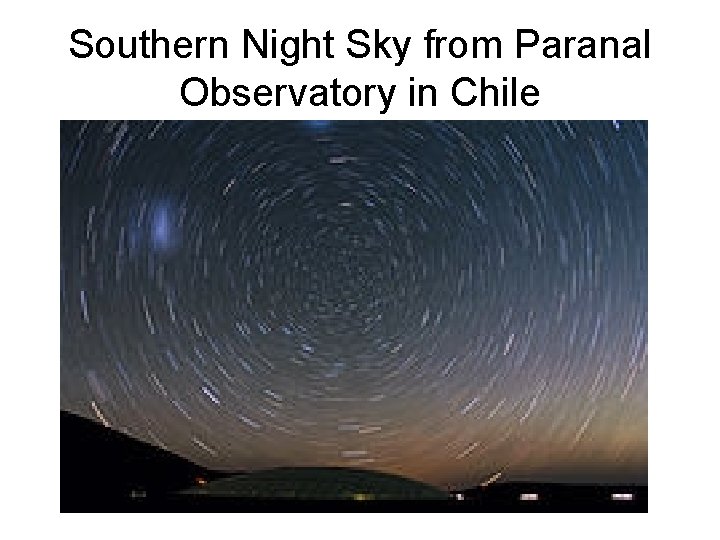
Southern Night Sky from Paranal Observatory in Chile
“Earth - Moon System” • I. Earth’s Motions: A. Earth has 2 real motions. 1. Rotation- The turning or spinning motion of an object on an axis. * Axis- The imaginary line around which an object spins. * Earth’s axis is tilted at 23 1/2 degrees from the perpendicular to earth’s orbital plane. A. ) Orbital Plane - The slice of space where an object orbits. * For earth one rotation takes 24 hours.
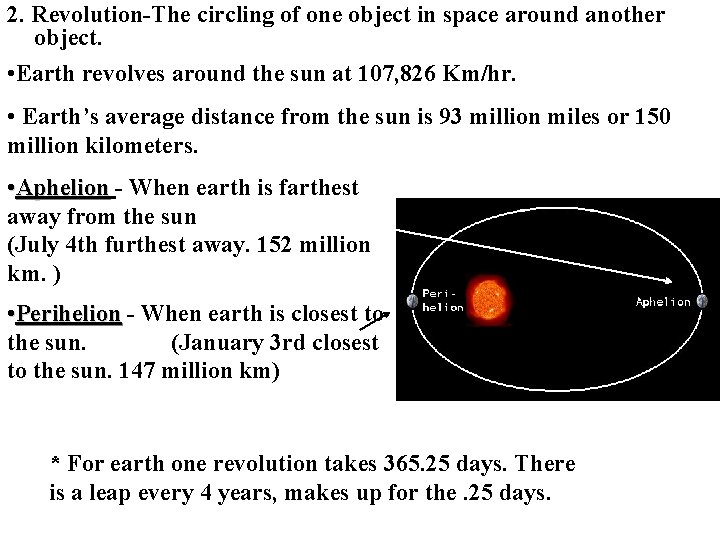
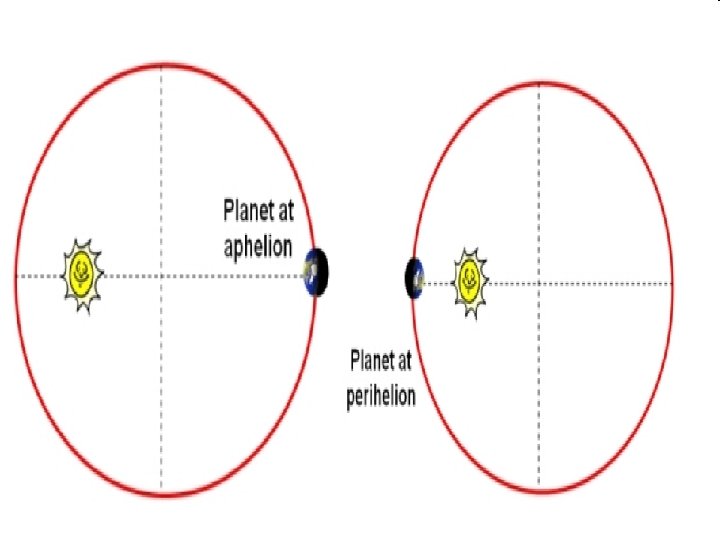
2. Revolution-The circling of one object in space around another object. • Earth revolves around the sun at 107, 826 Km/hr. • Earth’s average distance from the sun is 93 million miles or 150 million kilometers. • Aphelion - When earth is farthest away from the sun (July 4 th furthest away. 152 million km. ) • Perihelion - When earth is closest to the sun. (January 3 rd closest to the sun. 147 million km) * For earth one revolution takes 365. 25 days. There is a leap every 4 years, makes up for the. 25 days.
Sidereal vs. Synodic Motion (10 pts. ) 1. Read through quietly to establish troublesome vocabulary. 2. Read aloud together 3. Highlight/underline key points for questions 4. Answer questions. • Answer each question using 3 -4 sentences.
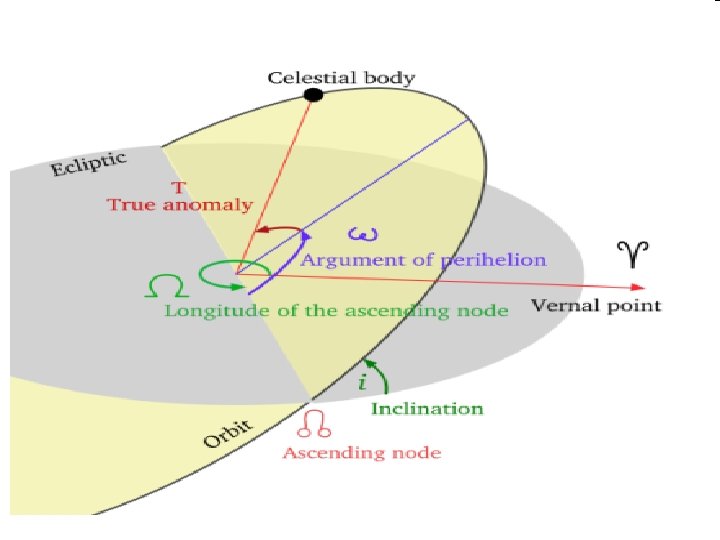
Sidereal vs. Synodic Motion (10 pts. ) • Words we don’t know: • Ecliptic - the great circle formed by the intersection of the plane of the earth's orbit with the celestial sphere; the apparent annual path of the sun in space. • Precession - A slow circular movement of the earth's axis around the pole of the ecliptic
Sidereal v. Synodic • More words we didn’t know: • Gregorian - relating to Pope Gregory XIII or the Gregorian calendar • Vernal Equinox - the time when daylight is equal to nighttime in spring, on about March 20 in the northern hemisphere and September 22 in the southern hemisphere. • Meridian - a circle of constant longitude passing through a given place on the earth's surface and the north/south poles.
Sidereal vs. Synodic Motion (10 pts. ) 1. Which one, Sidereal or Synodic, is used to define our day here on Earth? Describe it. (1 pt. ) 2. Which one do you believe should be used to define our day here on Earth? Why? (3 pts. ) 3. Should we have a leap year? Why or why not? (3 pts. ) 4. How many years have been leap years since 0 A. D. ? (3 pts. ) • Answer each question using 3 -4 sentences.
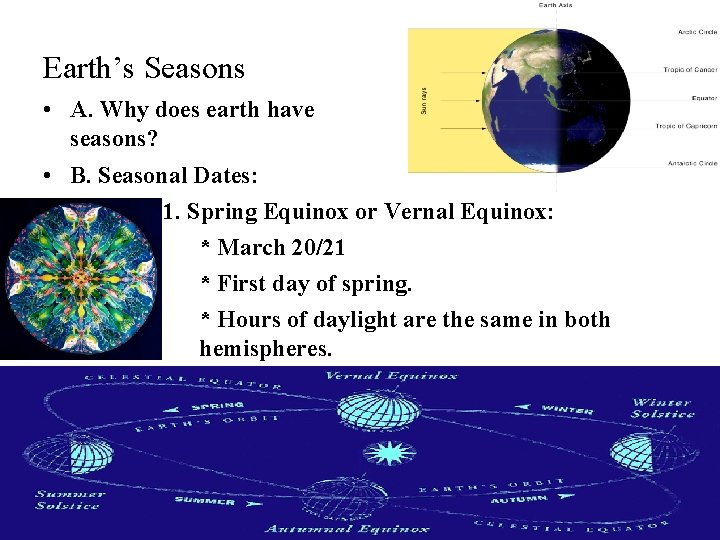
Earth’s Seasons • A. Why does earth have seasons? • B. Seasonal Dates: 1. Spring Equinox or Vernal Equinox: * March 20/21 * First day of spring. * Hours of daylight are the same in both hemispheres.
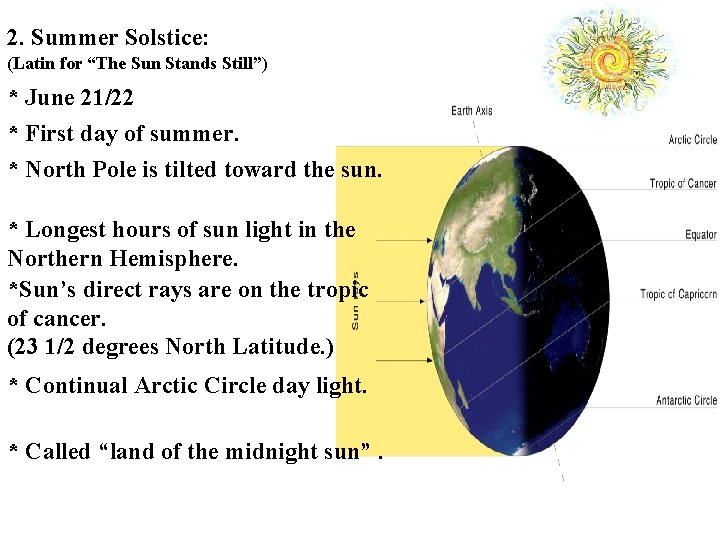
2. Summer Solstice: (Latin for “The Sun Stands Still”) * June 21/22 * First day of summer. * North Pole is tilted toward the sun. * Longest hours of sun light in the Northern Hemisphere. *Sun’s direct rays are on the tropic of cancer. (23 1/2 degrees North Latitude. ) * Continual Arctic Circle day light. * Called “land of the midnight sun”.
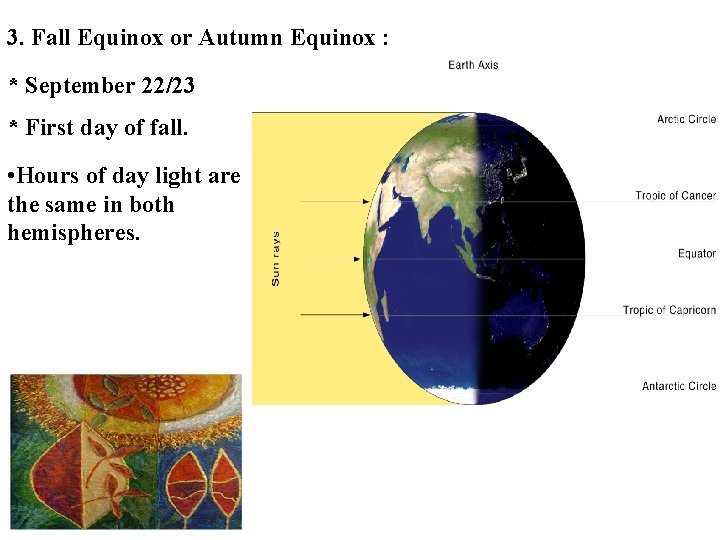
3. Fall Equinox or Autumn Equinox : * September 22/23 * First day of fall. • Hours of day light are the same in both hemispheres.
Stop and Think • Should we still use daylight savings time?
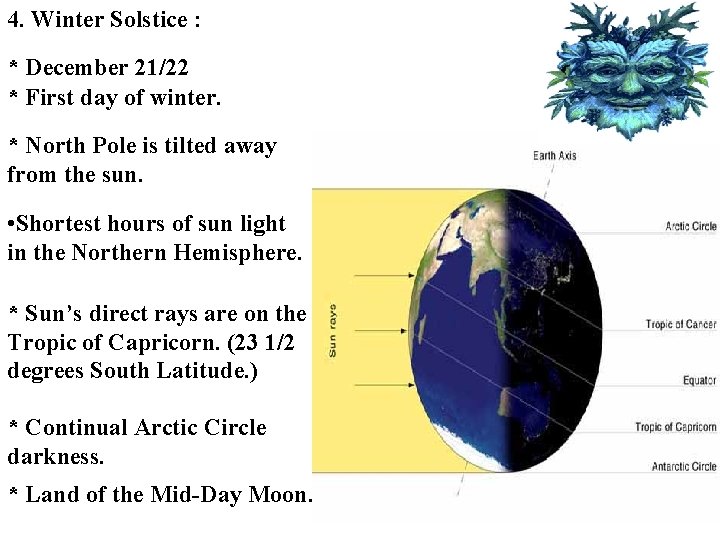
4. Winter Solstice : * December 21/22 * First day of winter. * North Pole is tilted away from the sun. • Shortest hours of sun light in the Northern Hemisphere. * Sun’s direct rays are on the Tropic of Capricorn. (23 1/2 degrees South Latitude. ) * Continual Arctic Circle darkness. * Land of the Mid-Day Moon.
Stop and Think • What if there were no seasons?
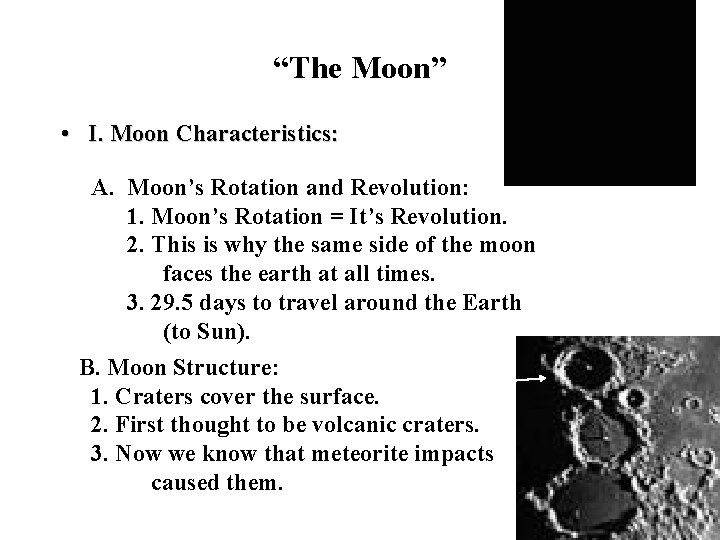
“The Moon” • I. Moon Characteristics: A. Moon’s Rotation and Revolution: 1. Moon’s Rotation = It’s Revolution. 2. This is why the same side of the moon faces the earth at all times. 3. 29. 5 days to travel around the Earth (to Sun). B. Moon Structure: 1. Craters cover the surface. 2. First thought to be volcanic craters. 3. Now we know that meteorite impacts caused them.
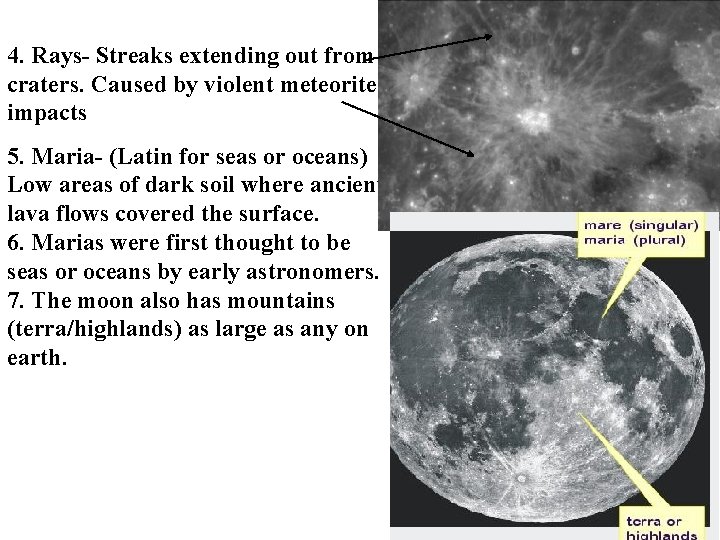
4. Rays- Streaks extending out from craters. Caused by violent meteorite impacts 5. Maria- (Latin for seas or oceans) Low areas of dark soil where ancient lava flows covered the surface. 6. Marias were first thought to be seas or oceans by early astronomers. 7. The moon also has mountains (terra/highlands) as large as any on earth.
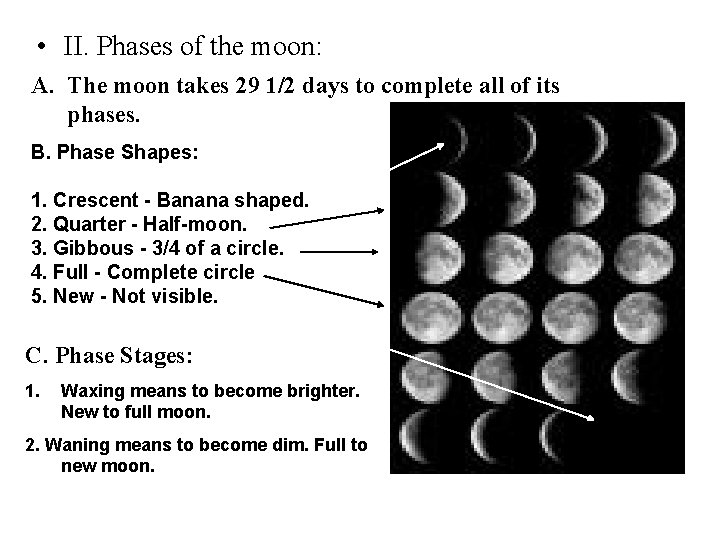
• II. Phases of the moon: A. The moon takes 29 1/2 days to complete all of its phases. B. Phase Shapes: 1. Crescent - Banana shaped. 2. Quarter - Half-moon. 3. Gibbous - 3/4 of a circle. 4. Full - Complete circle 5. New - Not visible. C. Phase Stages: 1. Waxing means to become brighter. New to full moon. 2. Waning means to become dim. Full to new moon.
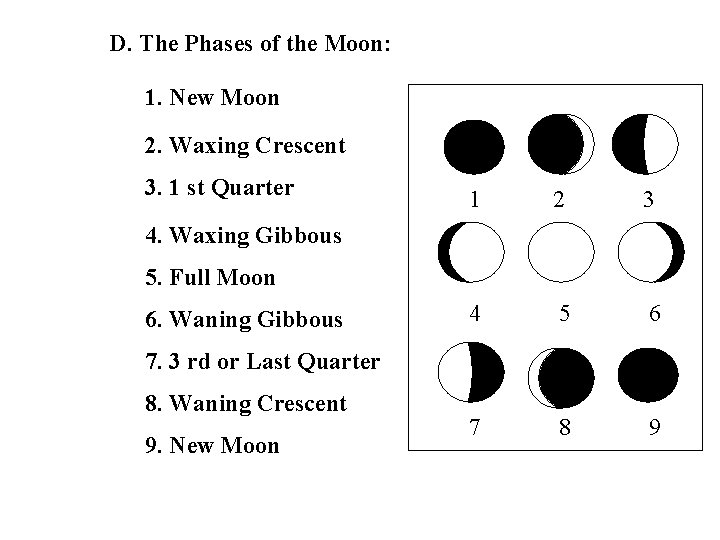
D. The Phases of the Moon: 1. New Moon 2. Waxing Crescent 3. 1 st Quarter 1 2 3 4 5 6 7 8 9 4. Waxing Gibbous 5. Full Moon 6. Waning Gibbous 7. 3 rd or Last Quarter 8. Waning Crescent 9. New Moon
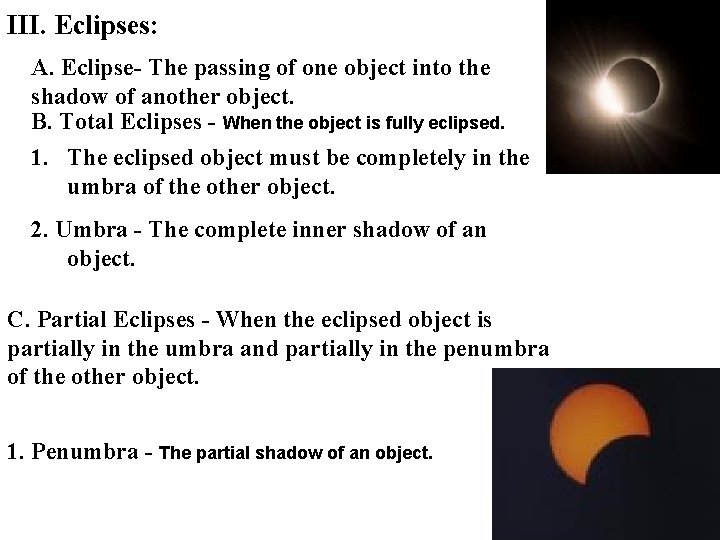
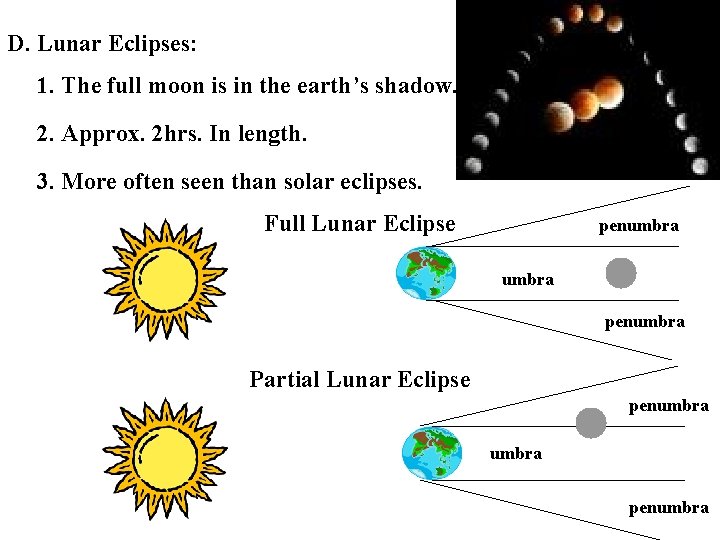
III. Eclipses: A. Eclipse- The passing of one object into the shadow of another object. B. Total Eclipses - When the object is fully eclipsed. 1. The eclipsed object must be completely in the umbra of the other object. 2. Umbra - The complete inner shadow of an object. C. Partial Eclipses - When the eclipsed object is partially in the umbra and partially in the penumbra of the other object. 1. Penumbra - The partial shadow of an object.
D. Lunar Eclipses: 1. The full moon is in the earth’s shadow. 2. Approx. 2 hrs. In length. 3. More often seen than solar eclipses. Full Lunar Eclipse penumbra Partial Lunar Eclipse penumbra
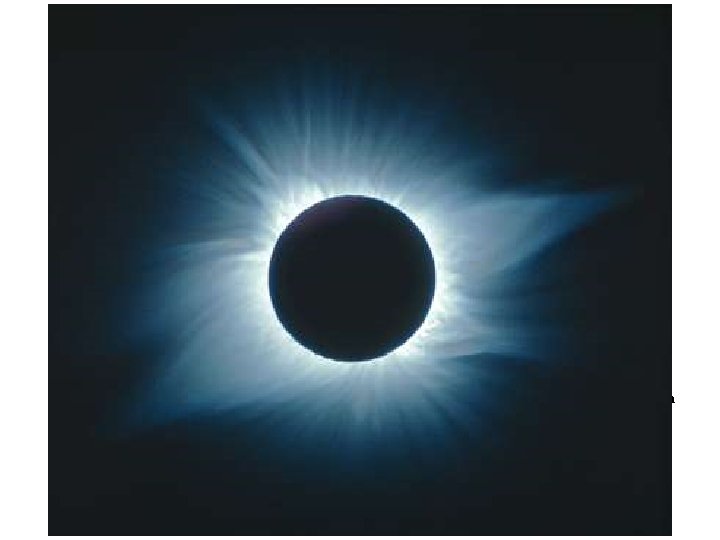
E. Solar Eclipses: 1. The earth is in the shadow of the new moon. 2. Length from 4 - 8 minutes. 3. Less often observed than lunar eclipses. 4. Very bright, dangerous eclipse. 5. Never look directly at it. 6. Brightest part of the sun (the corona) can be seen. (Will permanently damage the eyes. ) Full & Partial Solar Eclipse umbra penumbra
• IV. The Moon’s Origin: The Fission Theory: The Moon was once part of the Earth and somehow separated from the Earth early in the history of the Solar System. The present Pacific Ocean basin is the most popular site for the part of the Earth from which the Moon came. The CAPTURE Theory: The Moon was formed somewhere else, and was later captured by the gravitational field of the Earth. The (CO-ACCRETION) : The Moon and the Earth condensed together from the original nebula that formed the Solar System. The COLLISION RING Theory: An object the size of Mars struck the earth, ejecting large volumes of matter. A disk of orbiting material was formed, and this matter eventually condensed to form the Moon in orbit around the Earth.
• V. Tides: A. Tides- The periodic rise and fall of the ocean due gravitational pull of the Moon and Sun. 1. ) When the ocean levels are highest it is said to be high tide, and when they are the lowest it said to be low tide. to the is B. Tidal Range- Is the difference in water level high tide and low tide. between C. The moon effects tides more than the Sun closer to the Earth. because it is D. Because of this, the Sun either increases the Moon or decreases the effect of the
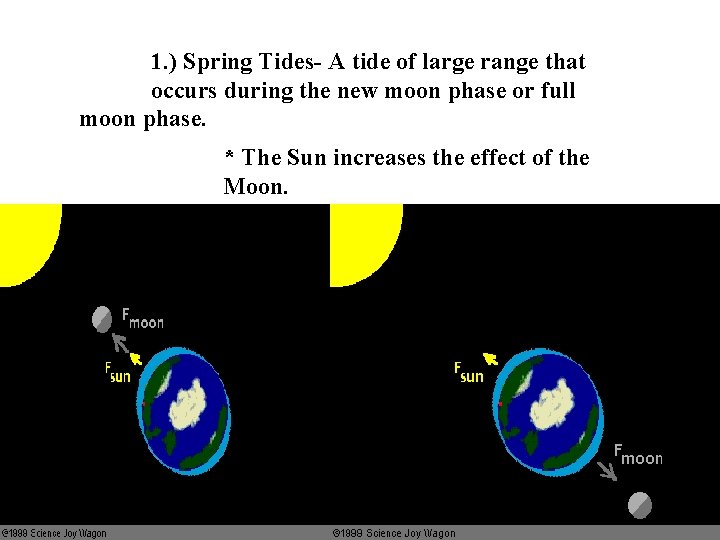
1. ) Spring Tides- A tide of large range that occurs during the new moon phase or full moon phase. * The Sun increases the effect of the Moon.
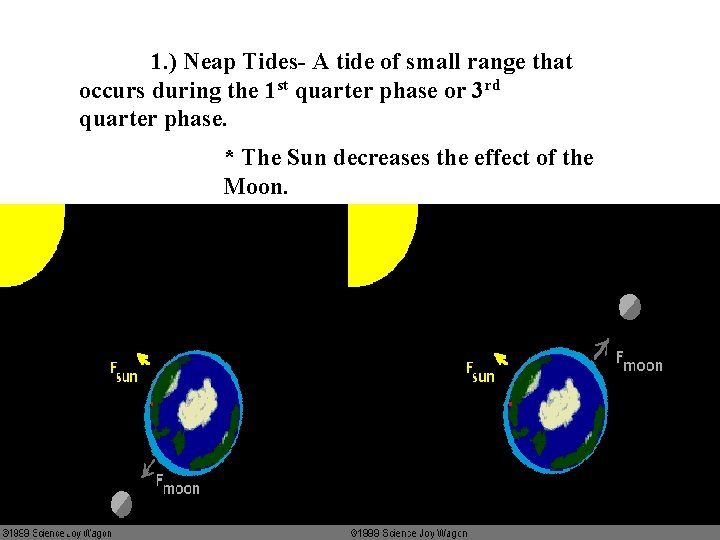
1. ) Neap Tides- A tide of small range that occurs during the 1 st quarter phase or 3 rd quarter phase. * The Sun decreases the effect of the Moon.