
EARTH MATERIALS OPTICS AND MINERALS Wave Terms FREQUENCY
![Wave Terms FREQUENCY (f) number of cycles per unit time [units = Hertz (Hz)]](https://slidetodoc.com/presentation_image_h/2048aa4fce7970ffed5506eba61a8461/image-2.jpg "Wave Terms FREQUENCY (f) number of cycles per unit time [units = Hertz (Hz)]")


- Slides: 34
EARTH MATERIALS OPTICS AND MINERALS
Wave Terms FREQUENCY (f) number of cycles per unit time [units = Hertz (Hz)] 1 Hz = 1 cycle/s T = 1/f; f = 1/T; T f = 1
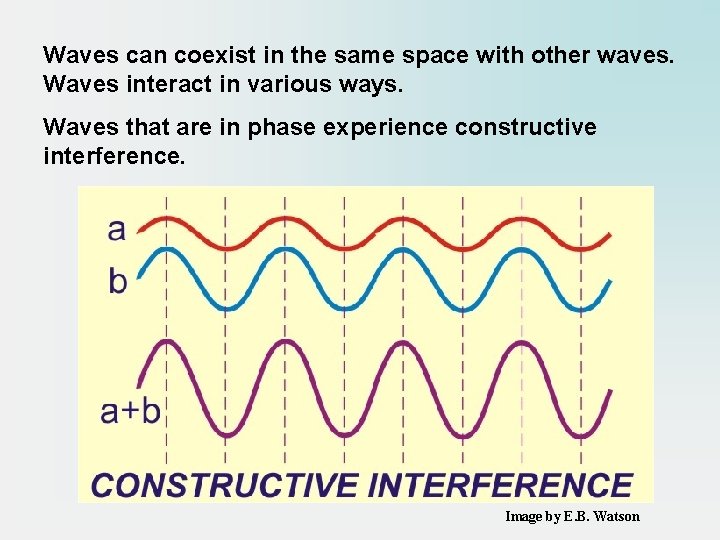
Waves can coexist in the same space with other waves. Waves interact in various ways. Waves that are in phase experience constructive interference. Image by E. B. Watson
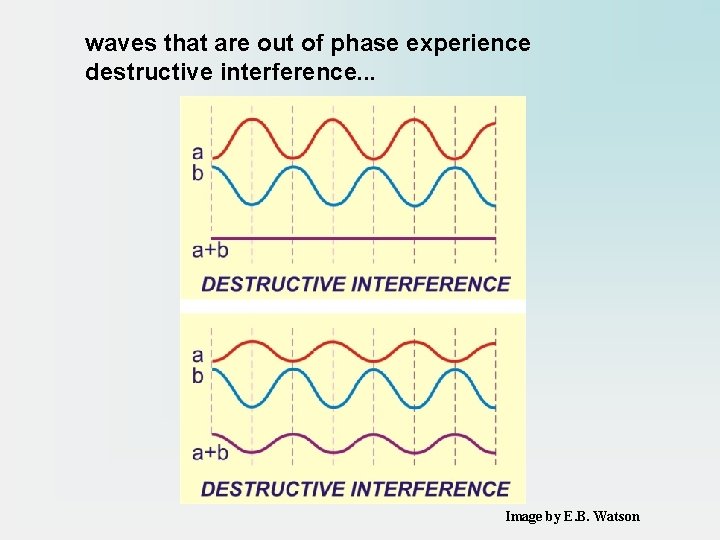
waves that are out of phase experience destructive interference. . . Image by E. B. Watson
Objects radiate light because of their high temperatures - incandescent light (EM) is produced whenever a charge is accelerated by an external force. . . electromagnetic wave model Image by E. B. Watson
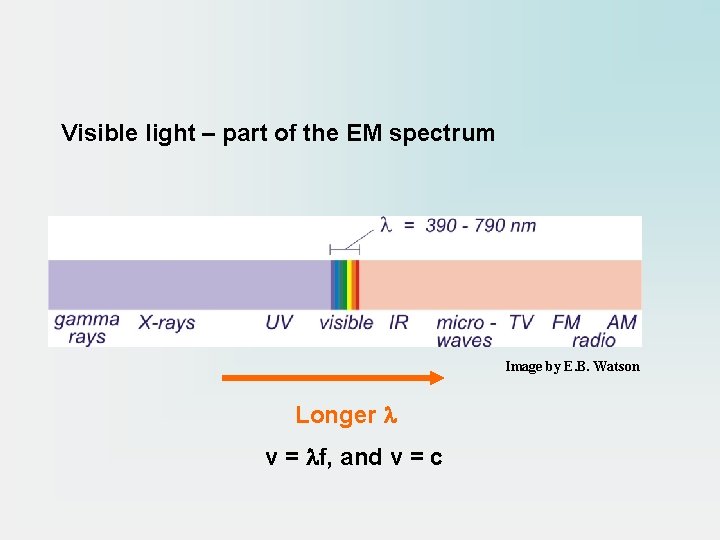
Visible light – part of the EM spectrum Image by E. B. Watson Longer l v = lf, and v = c
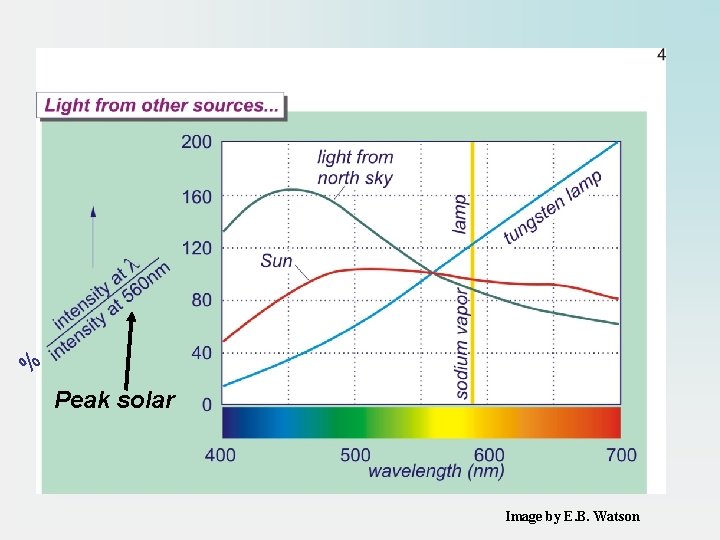
% Peak solar Image by E. B. Watson
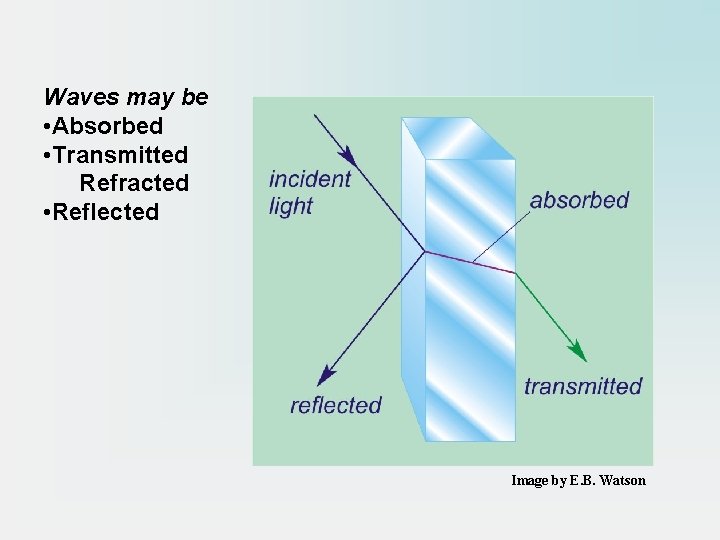
Waves may be • Absorbed • Transmitted Refracted • Reflected Image by E. B. Watson
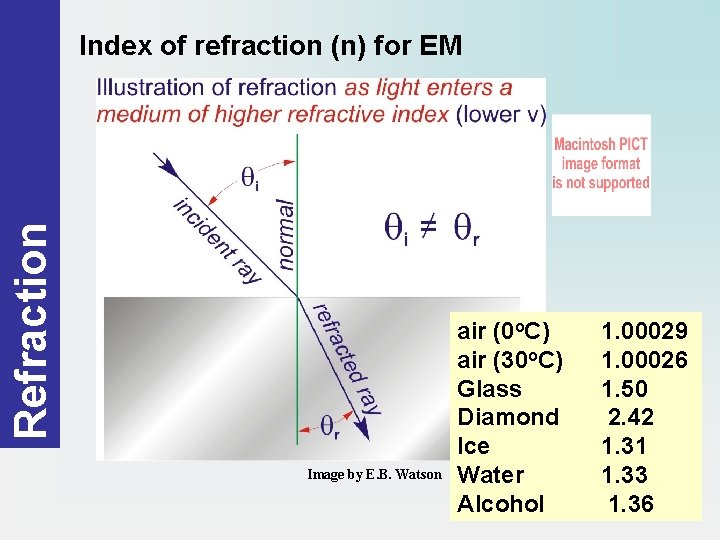
Refraction Index of refraction (n) for EM Image by E. B. Watson air (0 o. C) air (30 o. C) Glass Diamond Ice Water Alcohol 1. 00029 1. 00026 1. 50 2. 42 1. 31 1. 33 1. 36
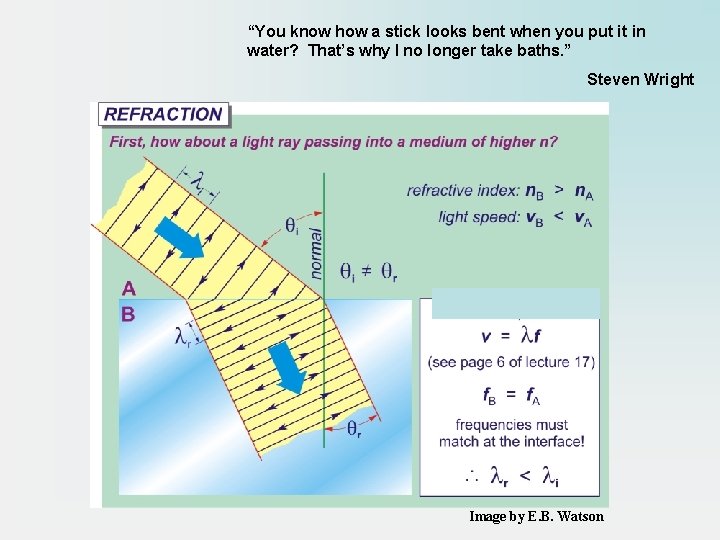
“You know how a stick looks bent when you put it in water? That’s why I no longer take baths. ” Steven Wright Image by E. B. Watson
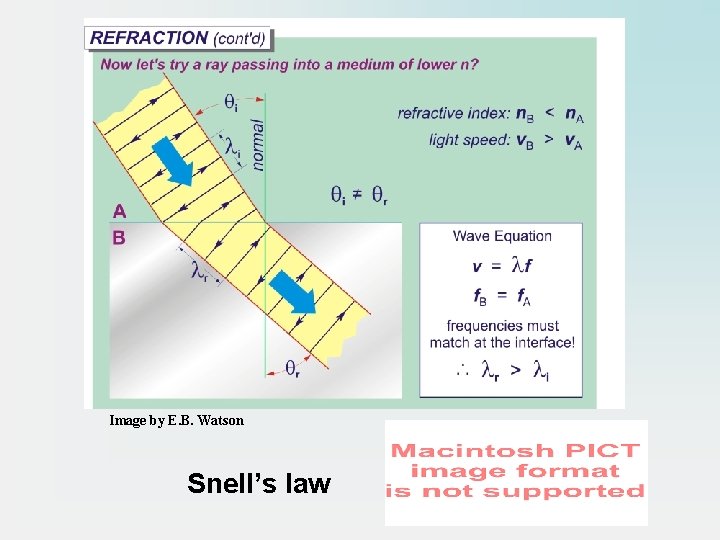
Image by E. B. Watson Snell’s law
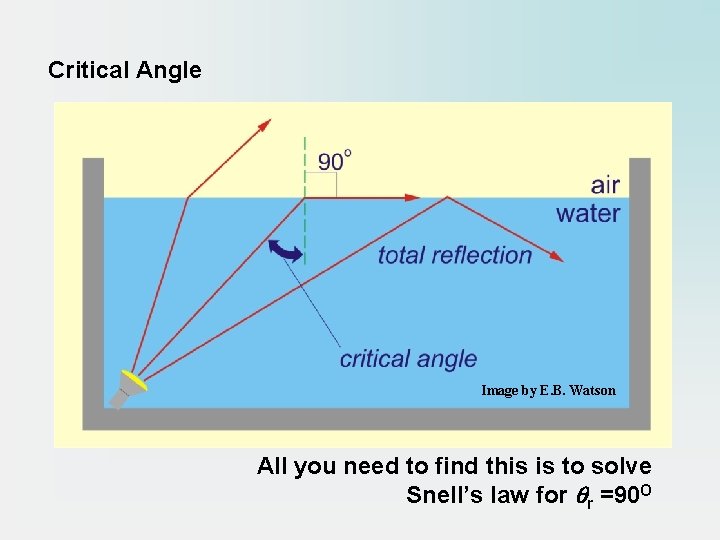
Critical Angle Image by E. B. Watson All you need to find this is to solve Snell’s law for qr =90 O
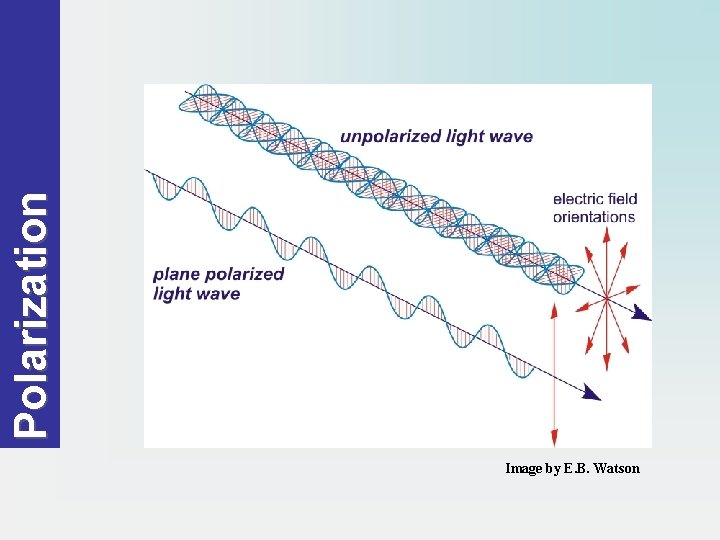
Polarization Image by E. B. Watson
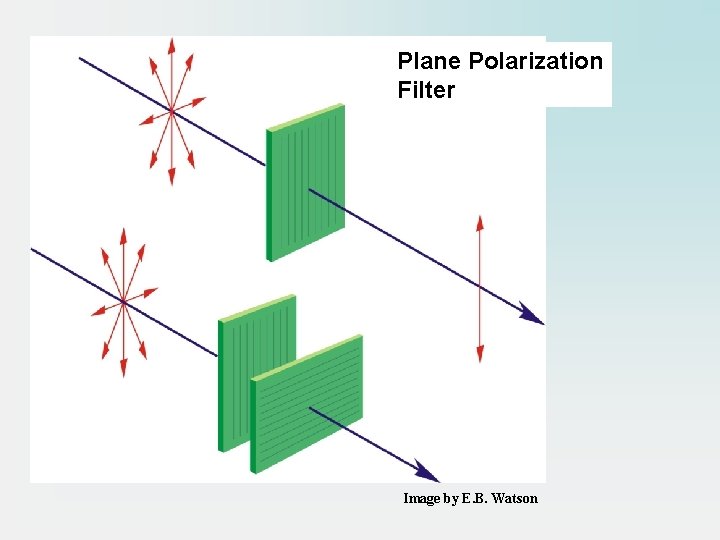
Plane Polarization Filter Image by E. B. Watson
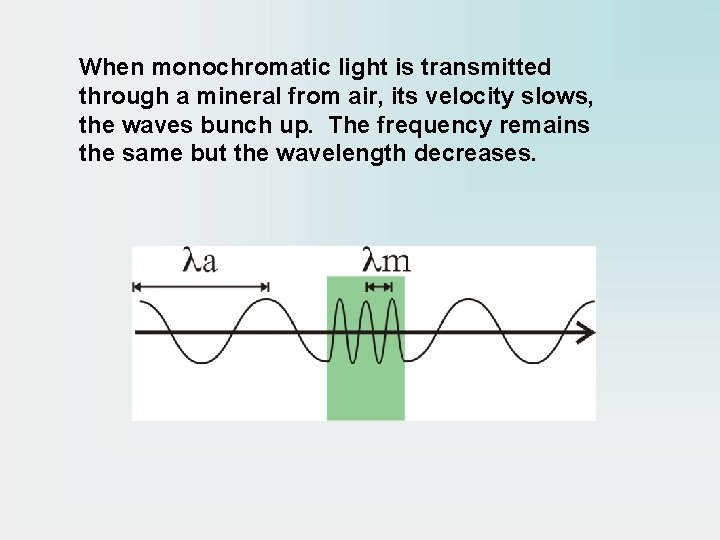
When monochromatic light is transmitted through a mineral from air, its velocity slows, the waves bunch up. The frequency remains the same but the wavelength decreases.
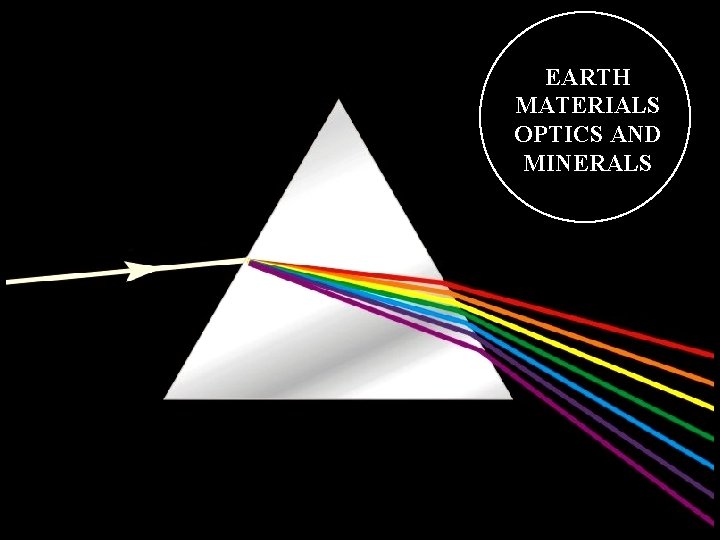
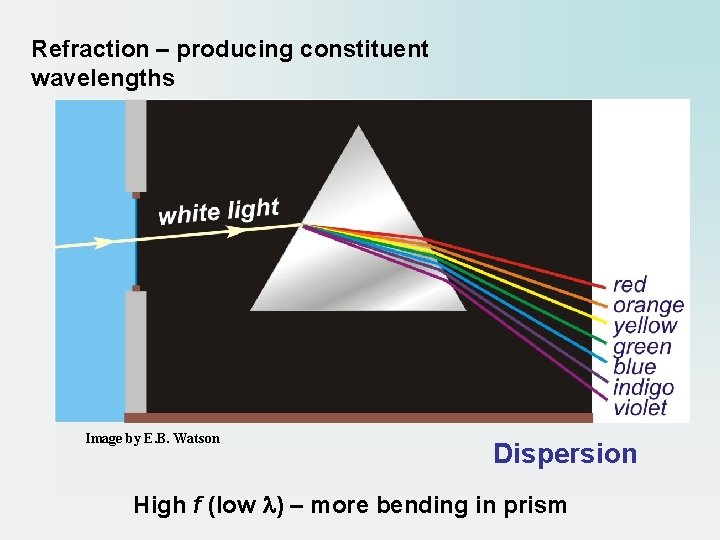
Refraction – producing constituent wavelengths Image by E. B. Watson Dispersion High f (low l) – more bending in prism
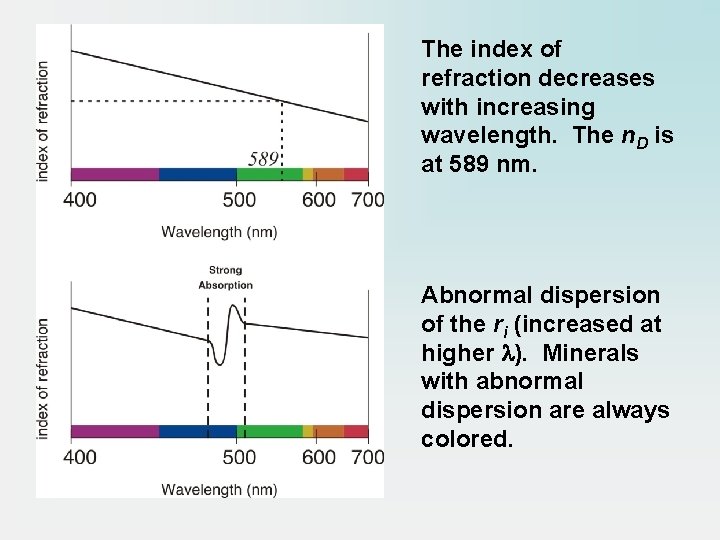
The index of refraction decreases with increasing wavelength. The n. D is at 589 nm. Abnormal dispersion of the ri (increased at higher l). Minerals with abnormal dispersion are always colored.
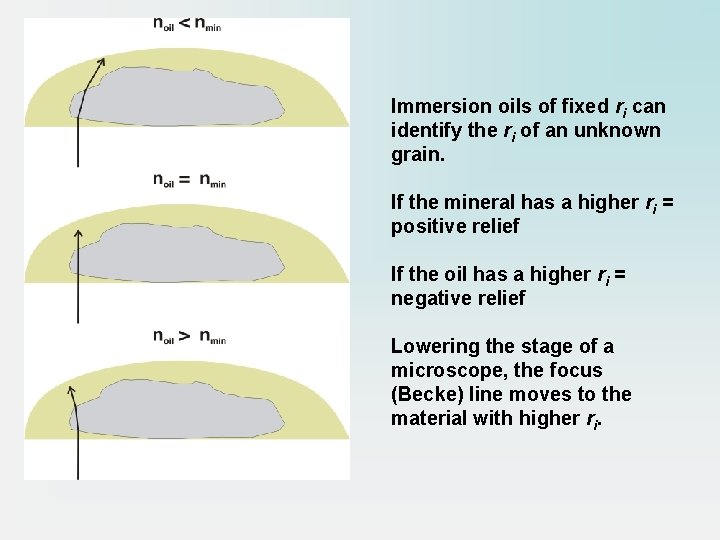
Immersion oils of fixed ri can identify the ri of an unknown grain. If the mineral has a higher ri = positive relief If the oil has a higher ri = negative relief Lowering the stage of a microscope, the focus (Becke) line moves to the material with higher ri.
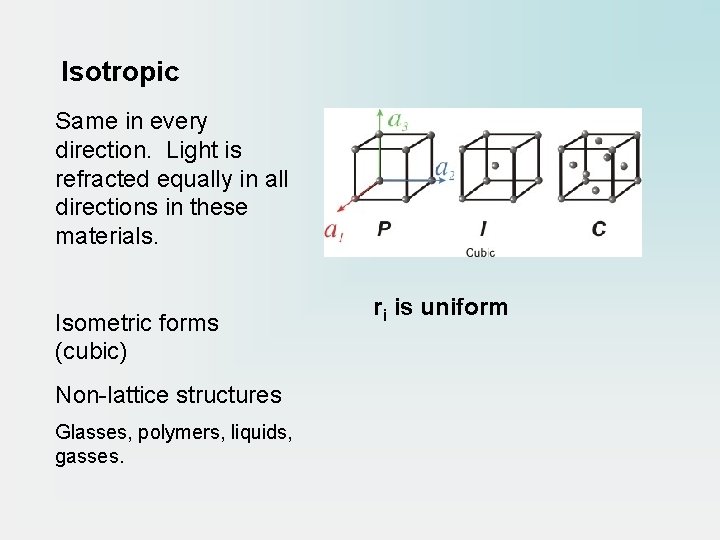
Isotropic Same in every direction. Light is refracted equally in all directions in these materials. Isometric forms (cubic) Non-lattice structures Glasses, polymers, liquids, gasses. ri is uniform
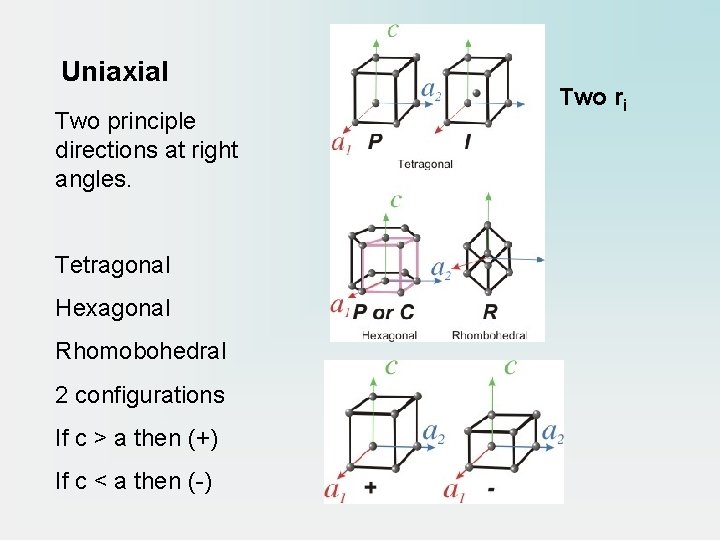
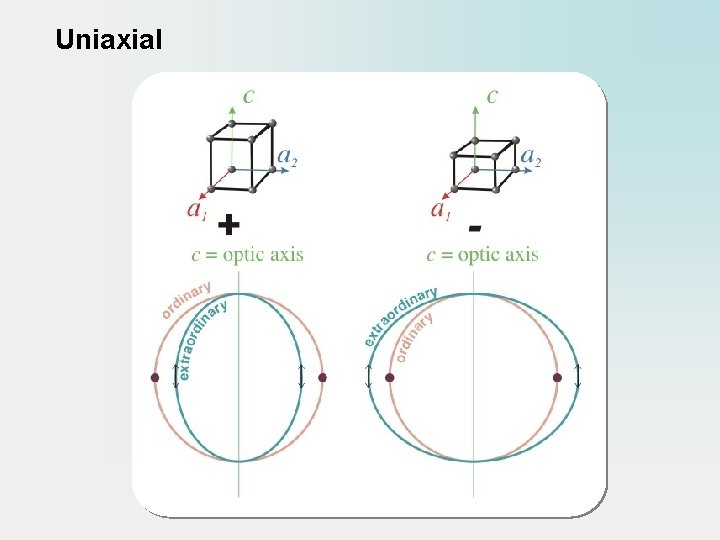
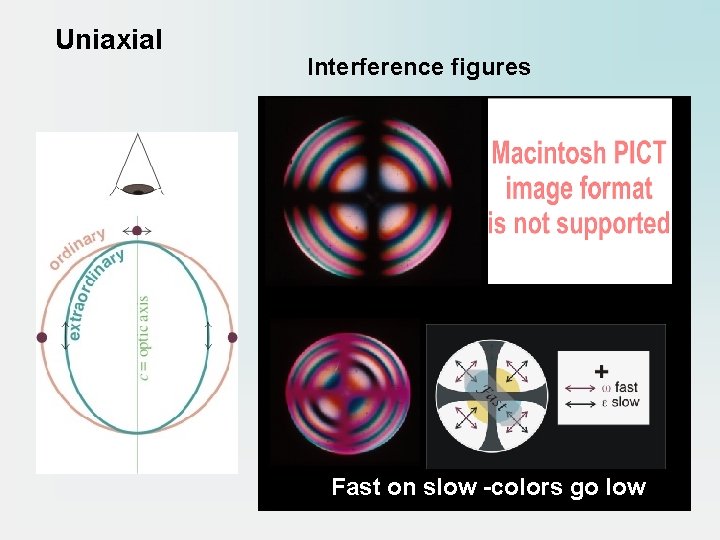
Uniaxial Two principle directions at right angles. Tetragonal Hexagonal Rhomobohedral 2 configurations If c > a then (+) If c < a then (-) Two ri
Uniaxial • Those with atoms equally spaced along two axes, elongated in the third. • Requires two raypaths, one in the close packed plane, one perpendicular. The ordinary ( ) ray and the extraordinary ( ) ray • If the extraordinary ray is the slow ray, then the mineral is optically positive • If the extraordinary ray is the fast ray, then the mineral is optically negative.
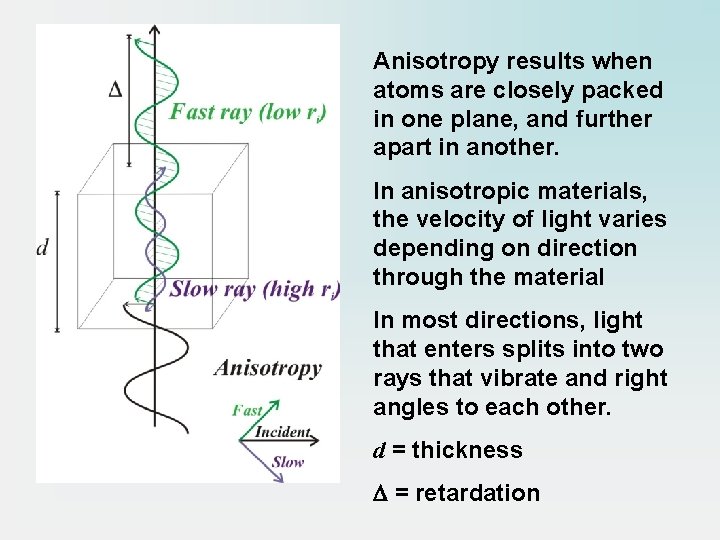
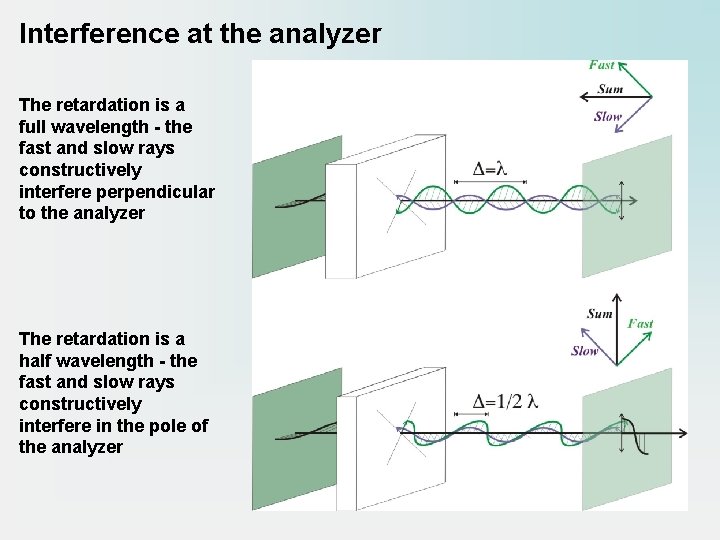
Anisotropy results when atoms are closely packed in one plane, and further apart in another. In anisotropic materials, the velocity of light varies depending on direction through the material In most directions, light that enters splits into two rays that vibrate and right angles to each other. d = thickness D = retardation
Interference at the analyzer The retardation is a full wavelength - the fast and slow rays constructively interfere perpendicular to the analyzer The retardation is a half wavelength - the fast and slow rays constructively interfere in the pole of the analyzer
Michel-Levy Interference Color Chart Nikon Microscopes
Color Interference (birefringence)
Uniaxial
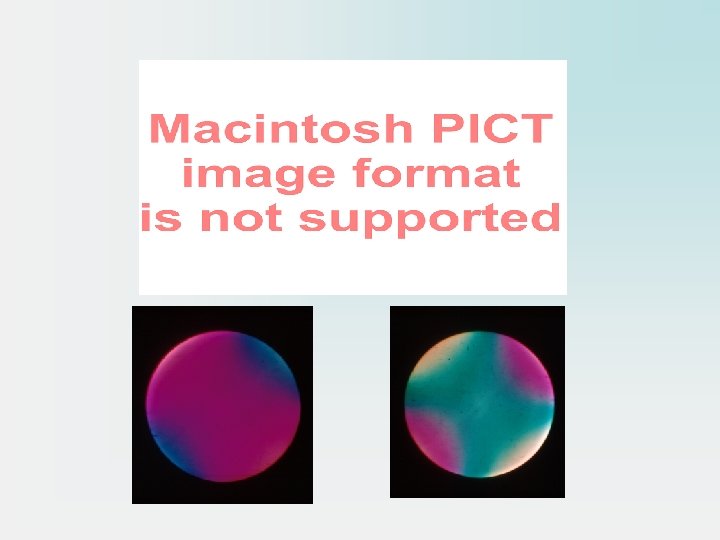
Uniaxial Interference figures Fast on slow -colors go low
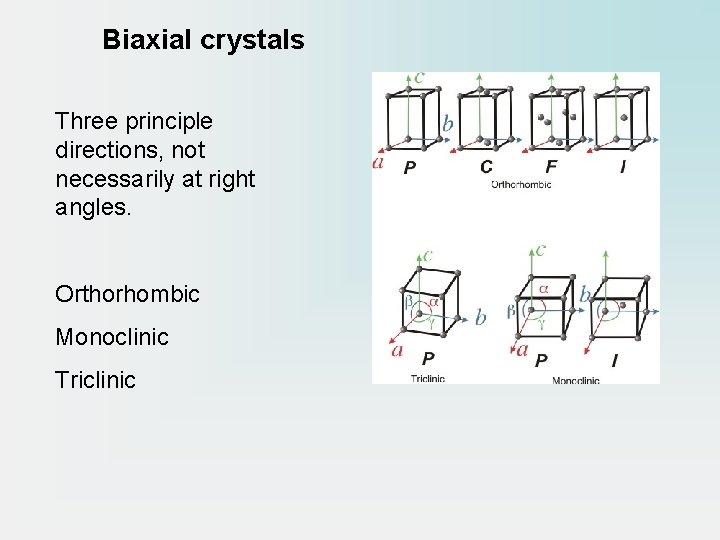
Biaxial crystals Three principle directions, not necessarily at right angles. Orthorhombic Monoclinic Triclinic
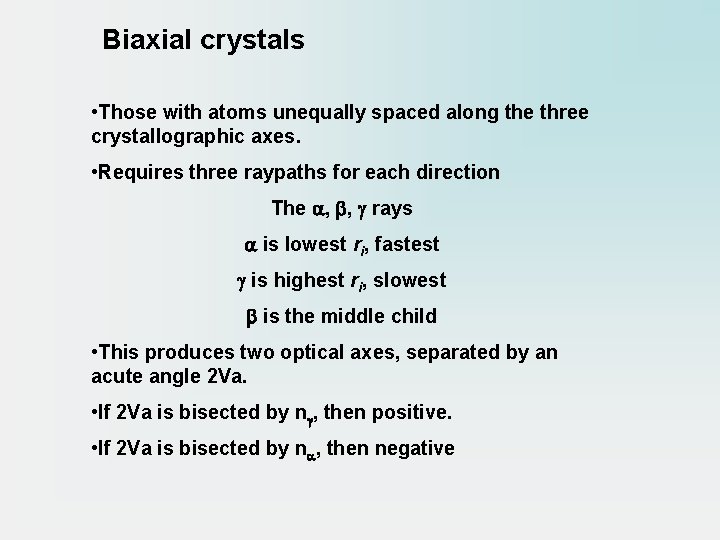
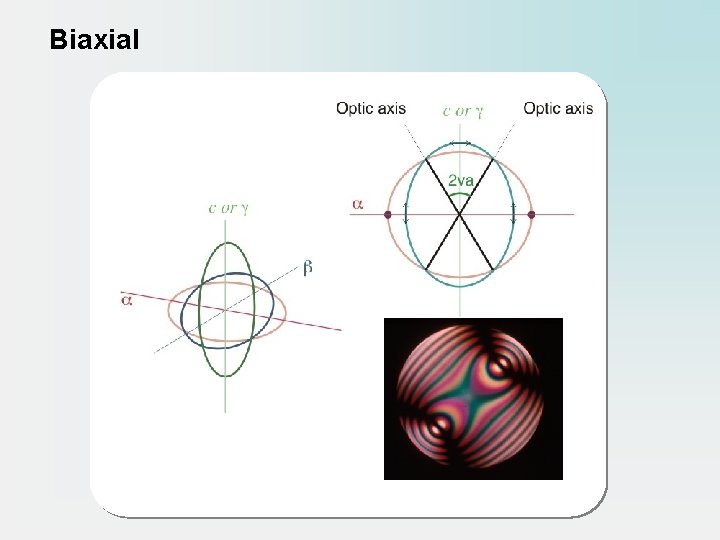
Biaxial crystals • Those with atoms unequally spaced along the three crystallographic axes. • Requires three raypaths for each direction The a, b, g rays a is lowest ri, fastest g is highest ri, slowest b is the middle child • This produces two optical axes, separated by an acute angle 2 Va. • If 2 Va is bisected by ng, then positive. • If 2 Va is bisected by na, then negative
Biaxial
http: //www. brocku. ca/earthsciences/people/gfinn/optical/bxsign 1. htm
http: //edafologia. ugr. es/optmine/xplconos/fbtallaw. htm
Minerals retard light relative to air Light is refracted as a function of the velocity difference. Polarization eliminates all but one vibration direction Isotropic materials have only one velocity - no interference Uniaxial minerals have two raypath velocities optic axis is on c and exhibit interference Biaxial minerals have three raypath velocities - two optic axes and exhibit interference