
Earth in Space Origin of Earth and Solar




- Slides: 35
Earth in Space • Origin of Earth and Solar system – 4. 6 Billion years ago – huge cloud of gases and dust starts to compress – Nuclear fusion starts and our sun is born – Remainder of cloud condenses to form planets of our solar system
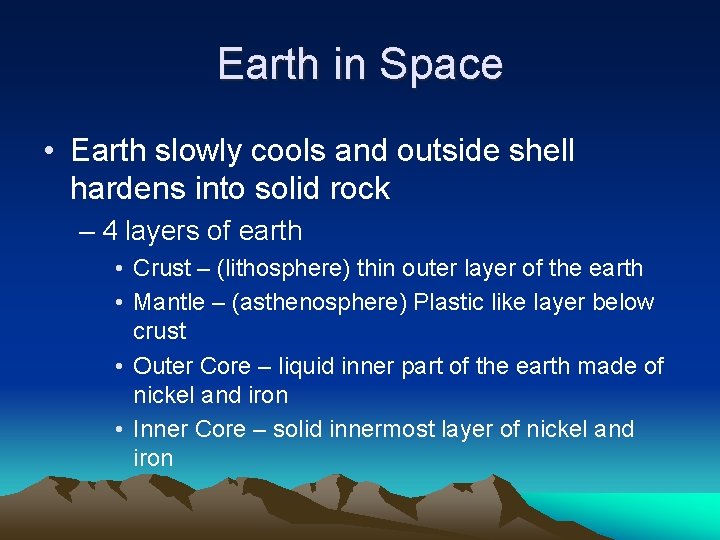
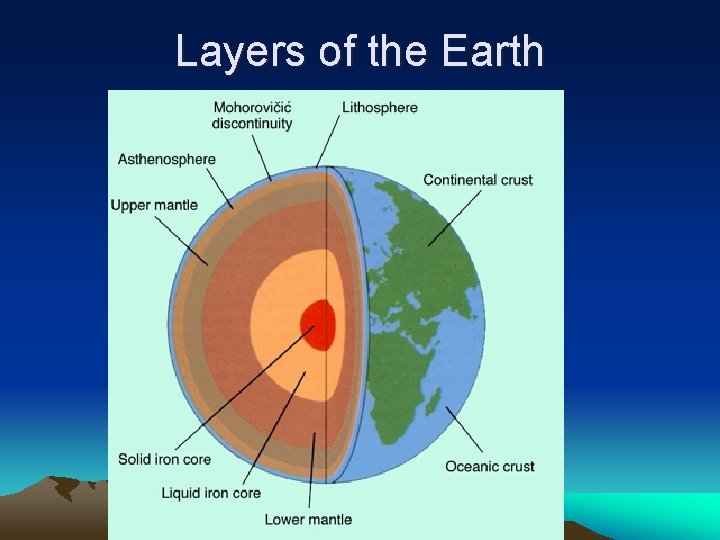
Earth in Space • Earth slowly cools and outside shell hardens into solid rock – 4 layers of earth • Crust – (lithosphere) thin outer layer of the earth • Mantle – (asthenosphere) Plastic like layer below crust • Outer Core – liquid inner part of the earth made of nickel and iron • Inner Core – solid innermost layer of nickel and iron
Layers of the Earth
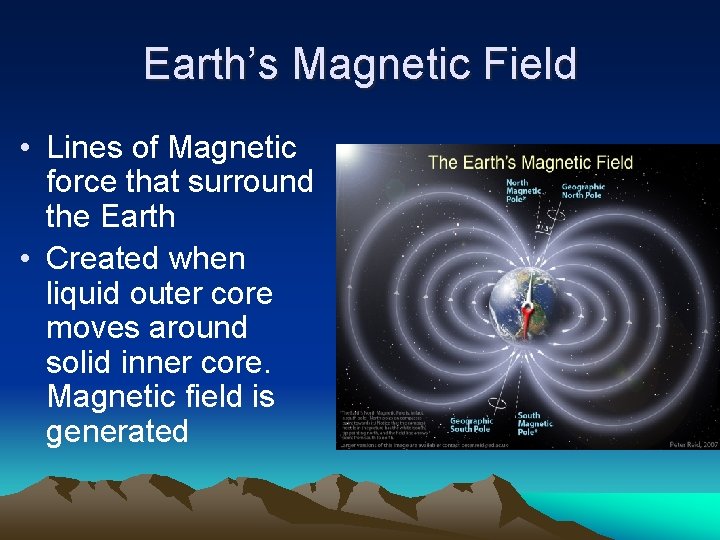
Earth’s Magnetic Field • Lines of Magnetic force that surround the Earth • Created when liquid outer core moves around solid inner core. Magnetic field is generated
Earth’ Rotation • It take the earth 24 hours to rotate 360 degrees (one day). • Rotation causes the apparent motion of the sun to move across the sky from east to west.
Earth’s • Earth Spinning on it’s Rotation axis – Evidence • Focalt Pendulum – A freely swinging pendulum will appear to change it’s direction of swing (video) • Coriolis effect – moving objects in the Northern Hemisphere will appear to curve to the right (video)
Focult Pendulum video
Coriolis Effect Video
Coriolis Effect Video
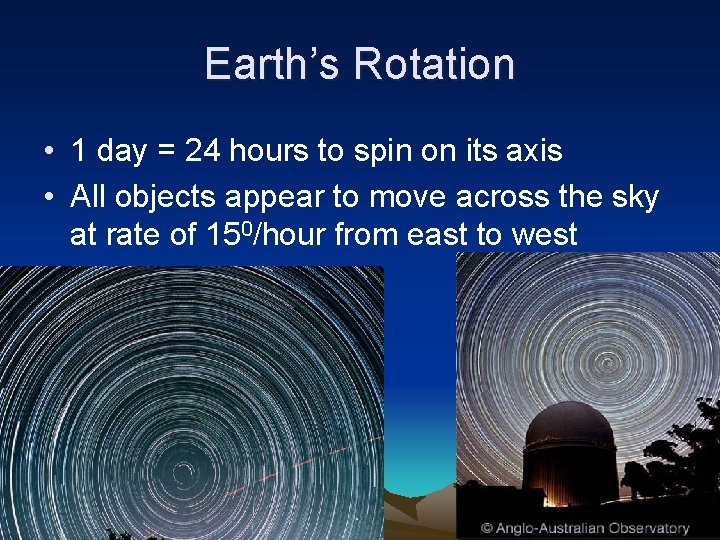
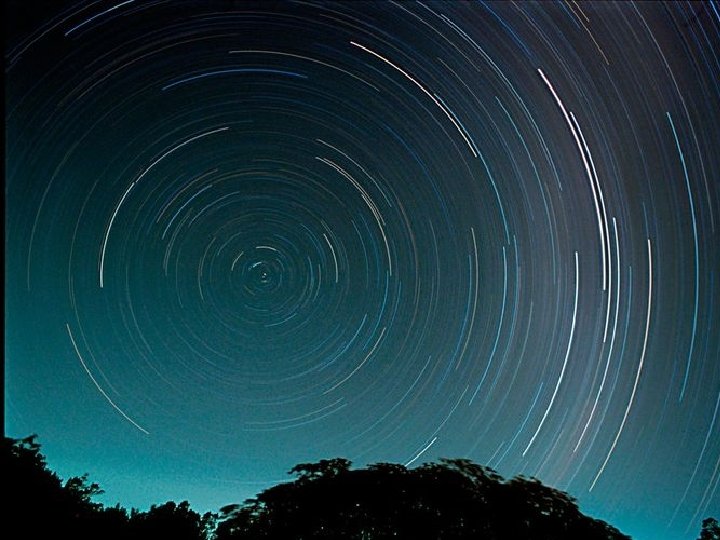
Earth’s Rotation • 1 day = 24 hours to spin on its axis • All objects appear to move across the sky at rate of 150/hour from east to west
Tilt of the Earth’s Axis • The earth’s axis is tilted at an angle of 23½ degrees compared to the sun – This causes the seasons – This causes the difference in daylight and darkness throughout the year
Earth’s Revolution • • Orbit around the sun 365 ¼ days to make one complete orbit The earth orbits in an elliptical orbit Distance from the sun and earth’s orbital speed changes during the year in a cyclic manner
Earths Revolution • It take the earth 365. 25 days to revolve around the sun once (one year). • Like its rotational motion on its axis, the earth moves in a counter-clockwise direction around the sun.
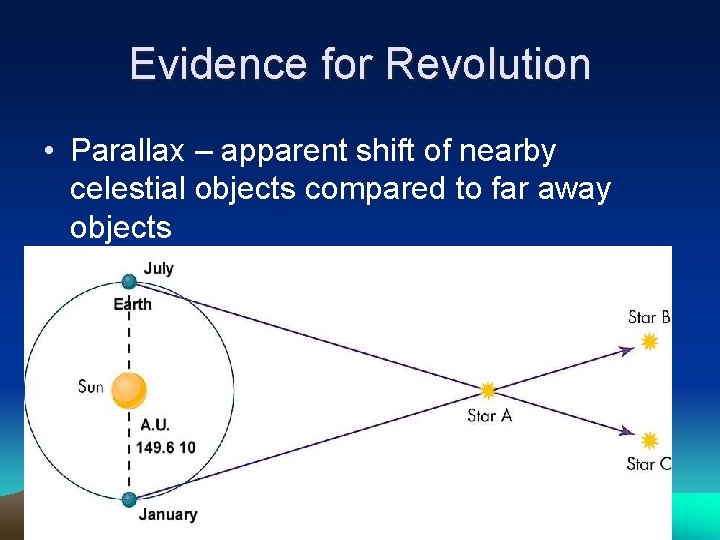
Evidence for Revolution • Parallax – apparent shift of nearby celestial objects compared to far away objects
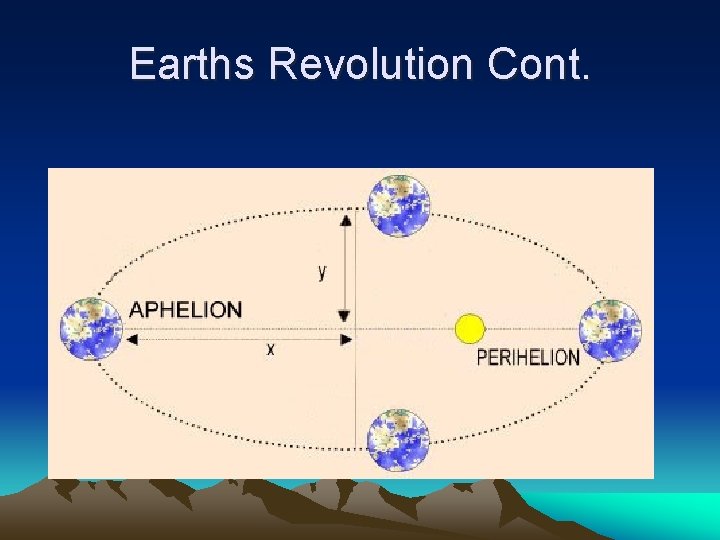
Evidence for elliptical orbit • The apparent diameter of the sun changes in a cyclic manner throughout the year – Closer – looks larger – Farther – Looks smaller • Earth moves faster when it is closer to the sun and slower when it is farther away due to change in gravitational pull
Earth’s Revolution Cont.
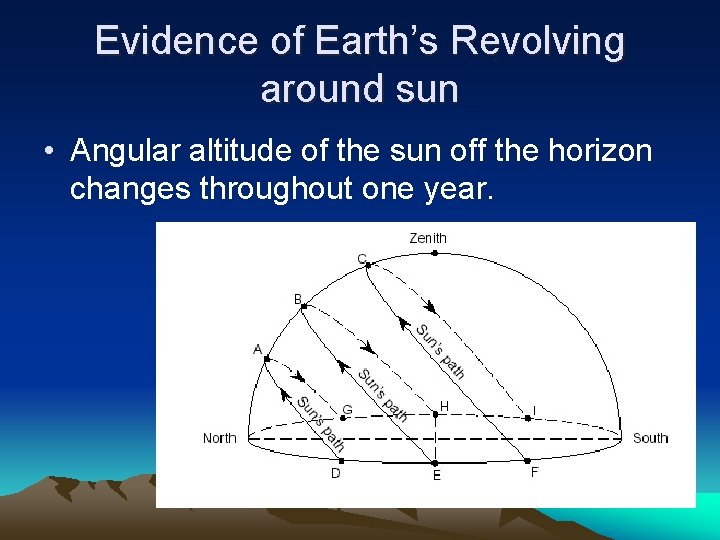
Evidence of Earth’s Revolving around sun • Angular altitude of the sun off the horizon changes throughout one year.
Suns path throughout the year • Path of the sun depends on the time of the year !!!!!!! • In Winter the sun rises south of east and sets the same distance south of west • In the summer the sun rises north of east and sets north of west • Spring and fall the sun rises directly due east and sets directly due west
Earths Revolution Aphelion – Longest distance between earth and sun (on or about July 4 th ) • Perihelion – Shortest distance between earth and sun (on or about Jan 2 nd).
Earths Revolution Cont.
Seasons • Seasons are caused by the earth’s tilt (23. 5 degrees) and the revolving of the earth around the sun.
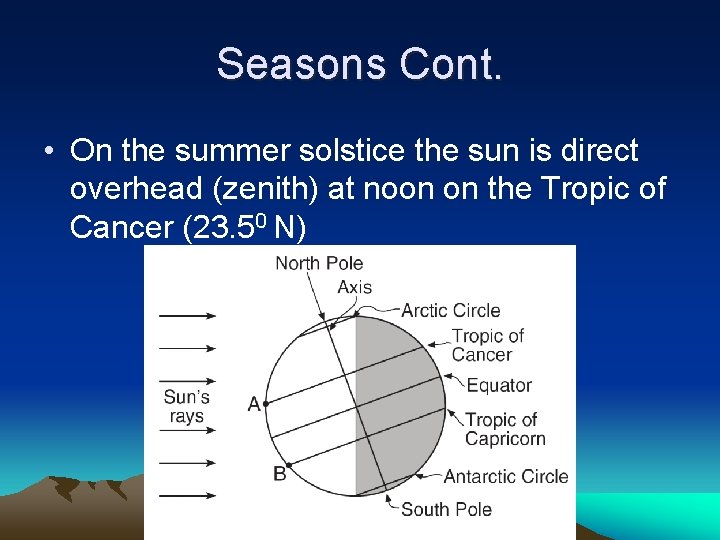
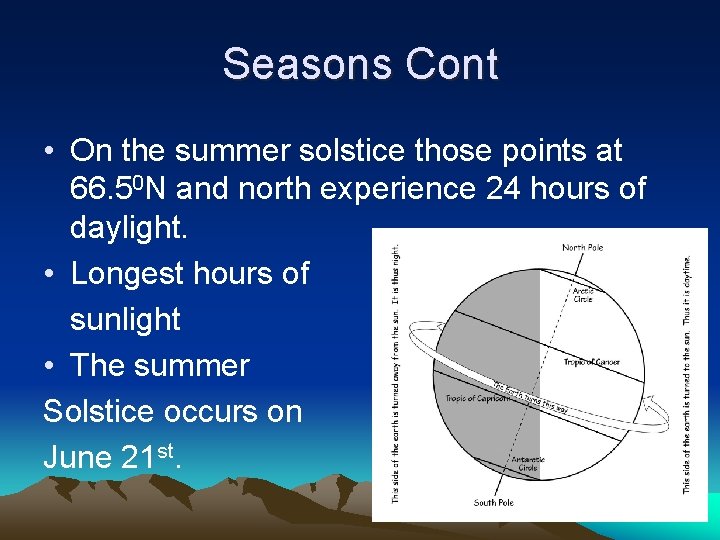
Seasons Cont. • On the summer solstice the sun is direct overhead (zenith) at noon on the Tropic of Cancer (23. 50 N)
• Midnight Sun Video • http: //www. youtube. com/watch? v=ndl. QNic Oeso
Seasons Cont • On the summer solstice those points at 66. 50 N and north experience 24 hours of daylight. • Longest hours of sunlight • The summer Solstice occurs on June 21 st.
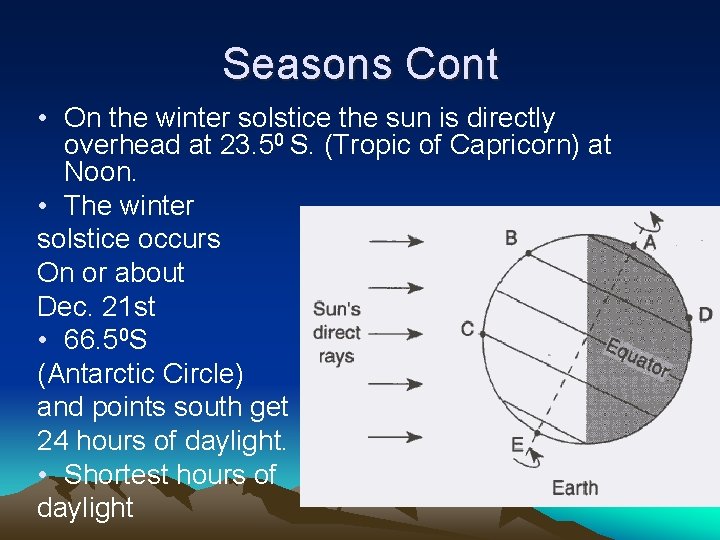
Seasons Cont • On the winter solstice the sun is directly overhead at 23. 50 S. (Tropic of Capricorn) at Noon. • The winter solstice occurs On or about Dec. 21 st • 66. 50 S (Antarctic Circle) and points south get 24 hours of daylight. • Shortest hours of daylight
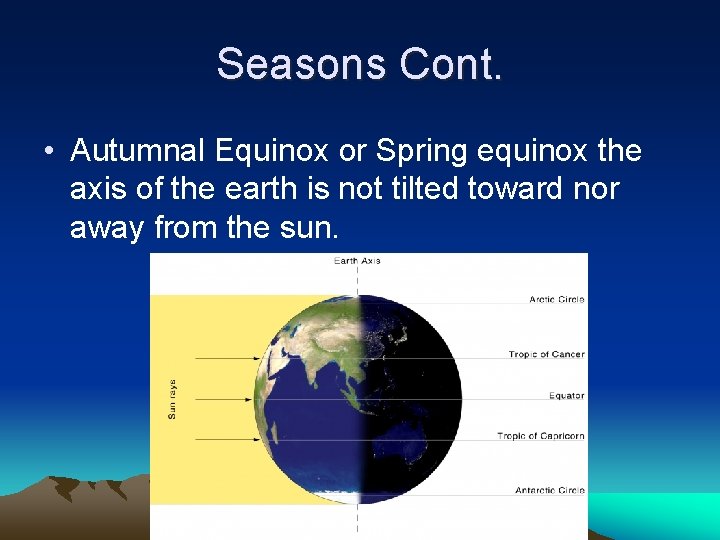
Seasons Cont Vernal Equinox (1 st day of spring) – Occurs on or around March 21 st. • Sun directly overhead at Equator Autumnal Equinox (1 st day of Autumn) – Occurs on around Sep. 22 nd • Sun directly overhead at Equator
Season Cont. • On the equinoxes the sun is directly over head at Noon at the equator only (why only the equator? ) • All points on earth receive 12 hours of darkness and 12 hours of daylight on the equinoxes.
Seasons Cont. • Autumnal Equinox or Spring equinox the axis of the earth is not tilted toward nor away from the sun.
Seasons • The sun is never directly overhead in New York State!!!!!!
• Seasons video • http: //www. youtube. com/watch? v=WLRA 8 7 TKXLM
Sun lines • Tropic of cancer – Furthest point north of the equator that will receive direct (900) rays • Tropic of Capricorn - Furthest point south of the equator that will receive direct (900) rays • Equator – Separates earth into north and south hemispheres
Sun lines • Arctic circle – The furthest point away from the pole that will receive at least 1 total day of darkness or daylight during the year • Antarctic circle - The furthest point away from the pole that will receive at least 1 total day of darkness or daylight during the year
Questions 1. At what latitude is the sun directly overhead on June 21 st 2. At what latitude is the sun directly overhead on December 21 st 3. At what latitude is the sun directly overhead on march 21 st 4. What are the names of these dates? ? 5. Where will the sun rise tomorrow? Be specific.
Questions 6. How many days a year is the sun directly overhead in New York State? 7. What time of day do you have the longest shadow? 8. What day at noon would you have the shortest shadow? 9. Why is there no sunlight at the North Pole on December 21 st?