
Earth History Table of Contents NEXT TEST STARTS
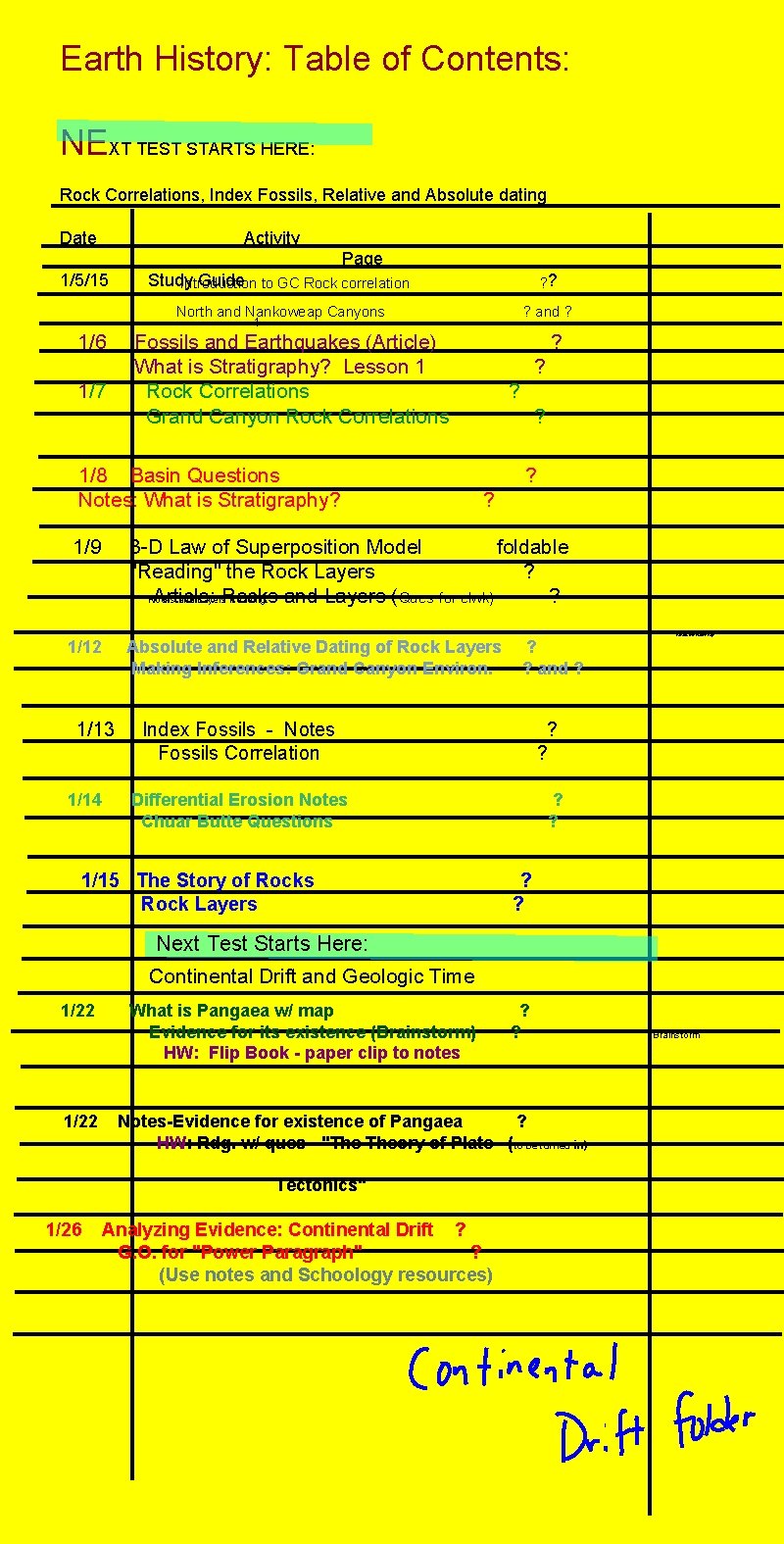
Earth History: Table of Contents: NEXT TEST STARTS HERE: Rock Correlations, Index Fossils, Relative and Absolute dating Date Activity Page 1/5/15 Study Guide to GC Rock correlation Introduction ? ? North and Nankoweap Canyons ? and ? 1 1/6 1/7 Fossils and Earthquakes (Article) What is Stratigraphy? Lesson 1 Rock Correlations Grand Canyon Rock Correlations 1/8 Basin Questions Notes: What is Stratigraphy? 1/9 ? ? ? 3 -D Law of Superposition Model foldable "Reading" the Rock Layers ? Rocks and Layers Reading Article: Rocks and Layers (Ques for clwk) ? 1/12 1/13 1/14 Absolute and Relative Dating of Rock Layers Making Inferences: Grand Canyon Environ. ? ? and ? Index Fossils - Notes Fossils Correlation ? ? Differential Erosion Notes Chuar Butte Questions 1/15 The Story of Rocks Rock Layers Absolute/Relative Age ? ? Next Test Starts Here: Continental Drift and Geologic Time 1/22 What is Pangaea w/ map Evidence for its existence (Brainstorm) HW: Flip Book - paper clip to notes Notes-Evidence for existence of Pangaea ? HW: Rdg. w/ ques - "The Theory of Plate (to be turned in) Tectonics" 1/26 ? ? Analyzing Evidence: Continental Drift ? G. O. for "Power Paragraph" ? (Use notes and Schoology resources) Brainstorm
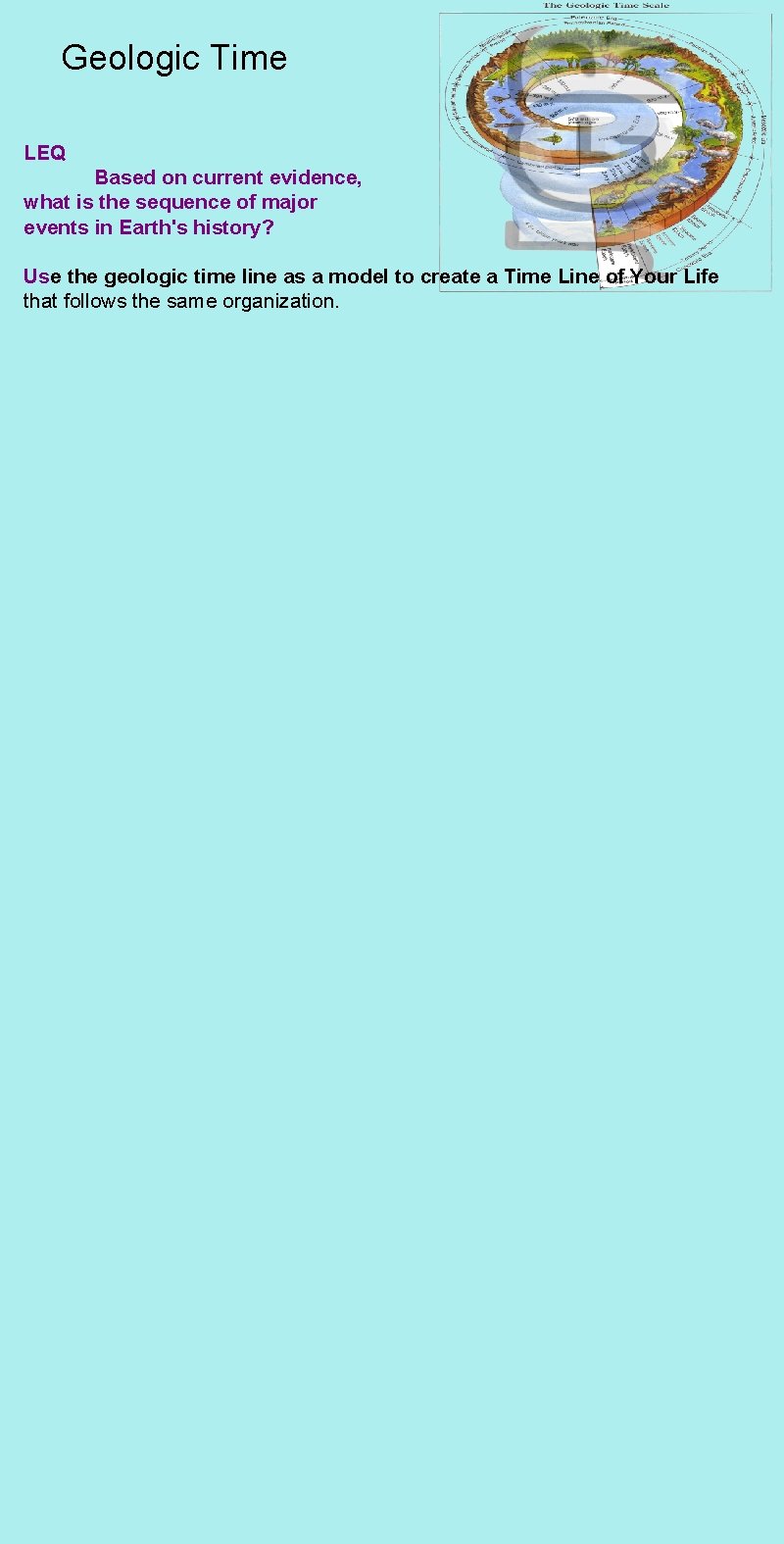
Geologic Time LEQ Based on current evidence, what is the sequence of major events in Earth's history? Use the geologic time line as a model to create a Time Line of Your Life that follows the same organization.
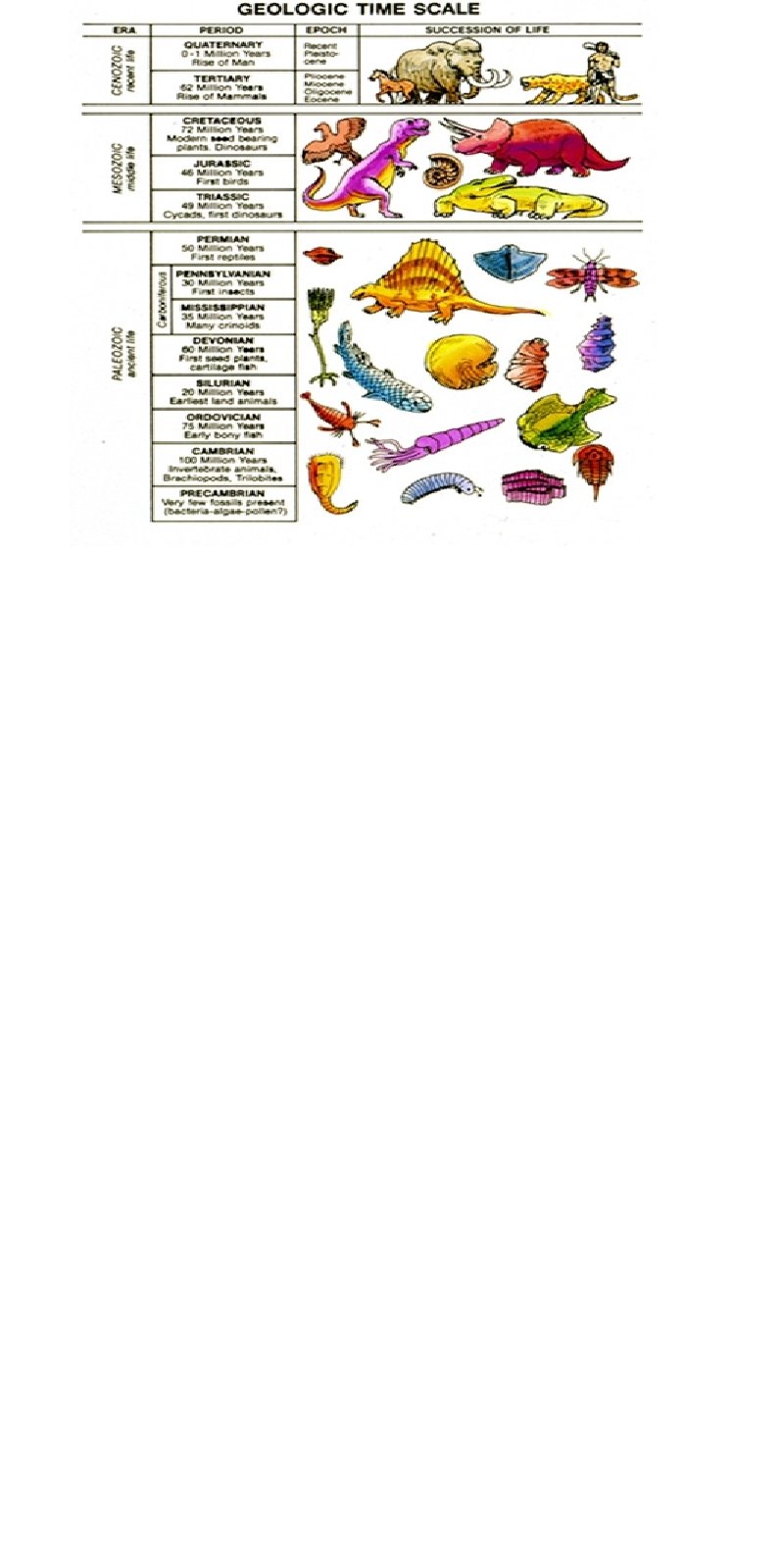
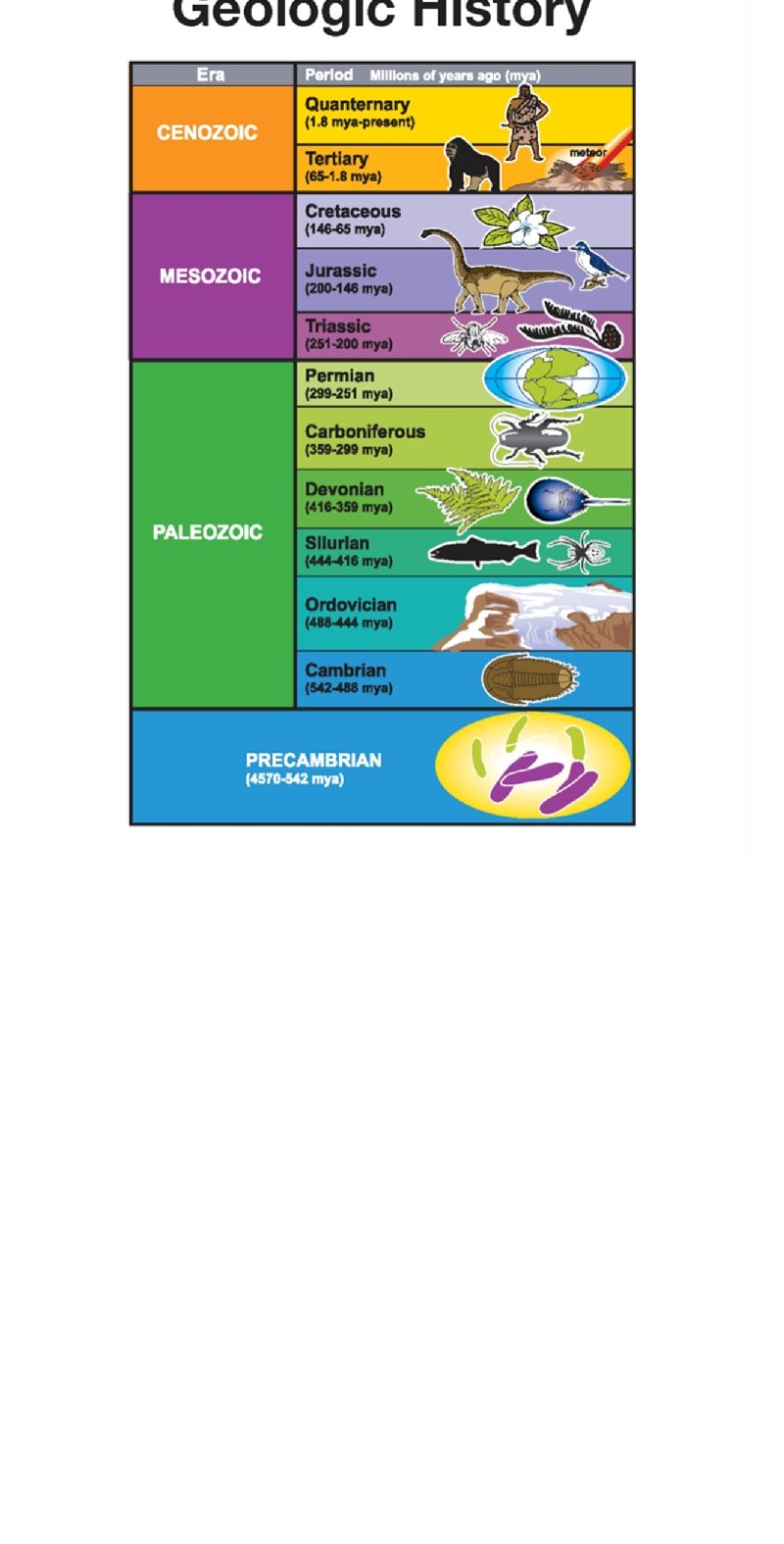
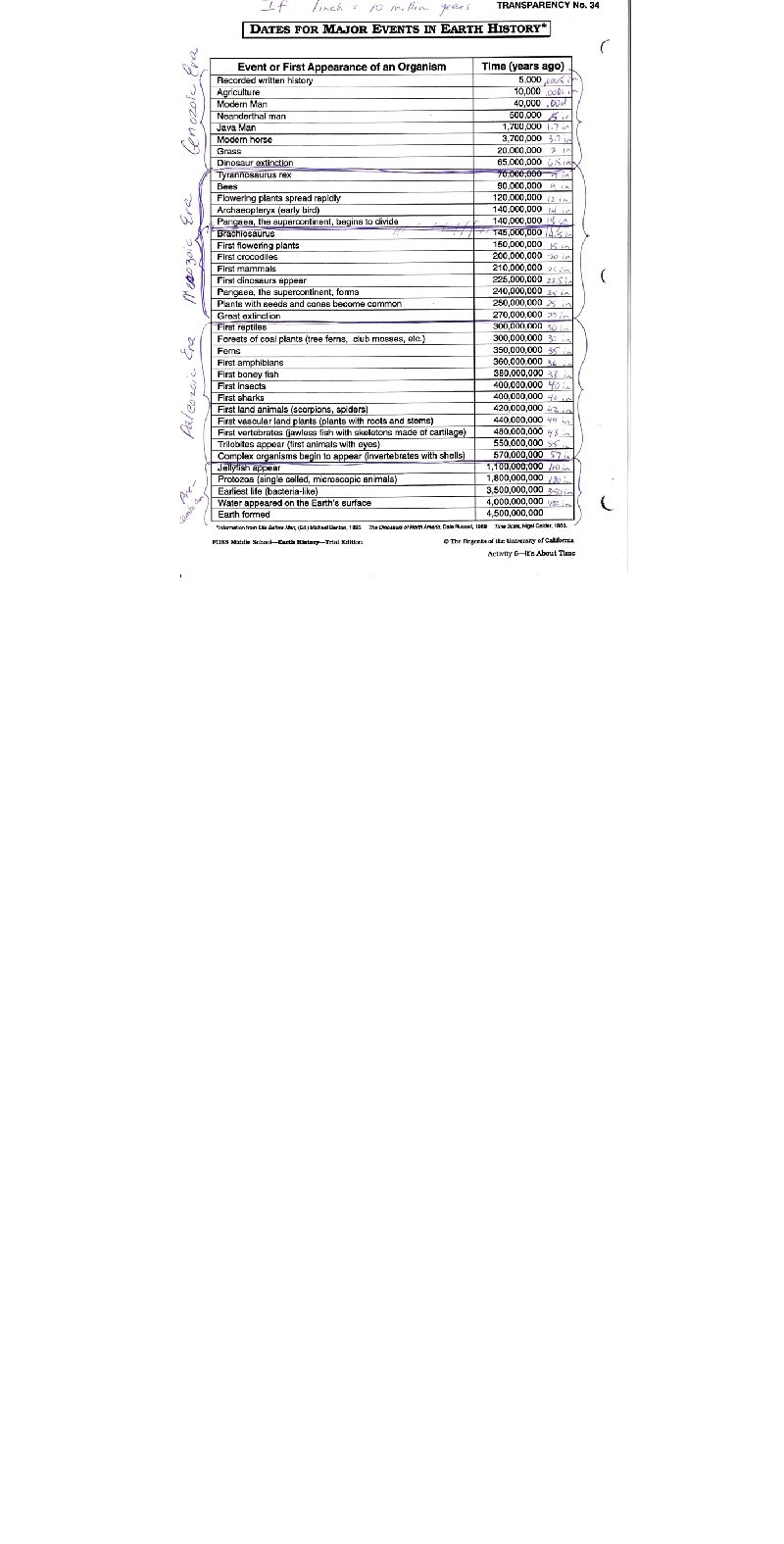
Activating Strategy Look at the Geologic Time Scale with your partner. Write 5 observations: 1. 2. 3. 4. 5. Based on your observations, how do you think the divisions were determined?
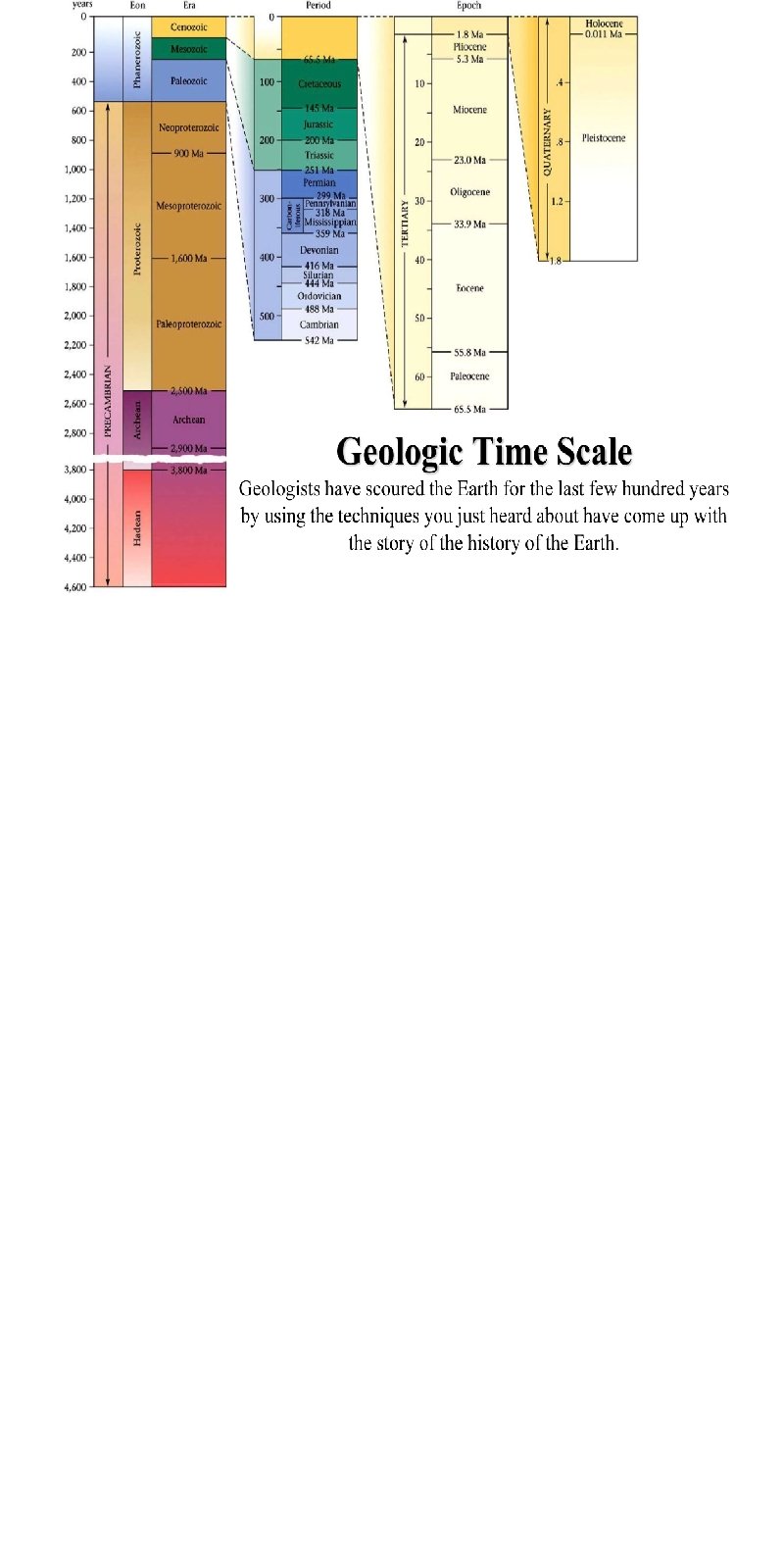
The geologic time scale (GTS) is a system of chronological measurement that relates stratigraphy to time, and is used by geologists, paleontologists, and other Earth scientists to describe the timing and relationships between events that have occurred throughout Earth's history.
Taking a closer look at the Geologic Time Scale Use the laminated chart to complete the question sheet.
The Evolution of Life in 60 Seconds https: //www. youtube. com/watch? v=YXSEyttbl. MI&x-ytts=1421914688&feature=player_embedded&x-yt-cl=84503534
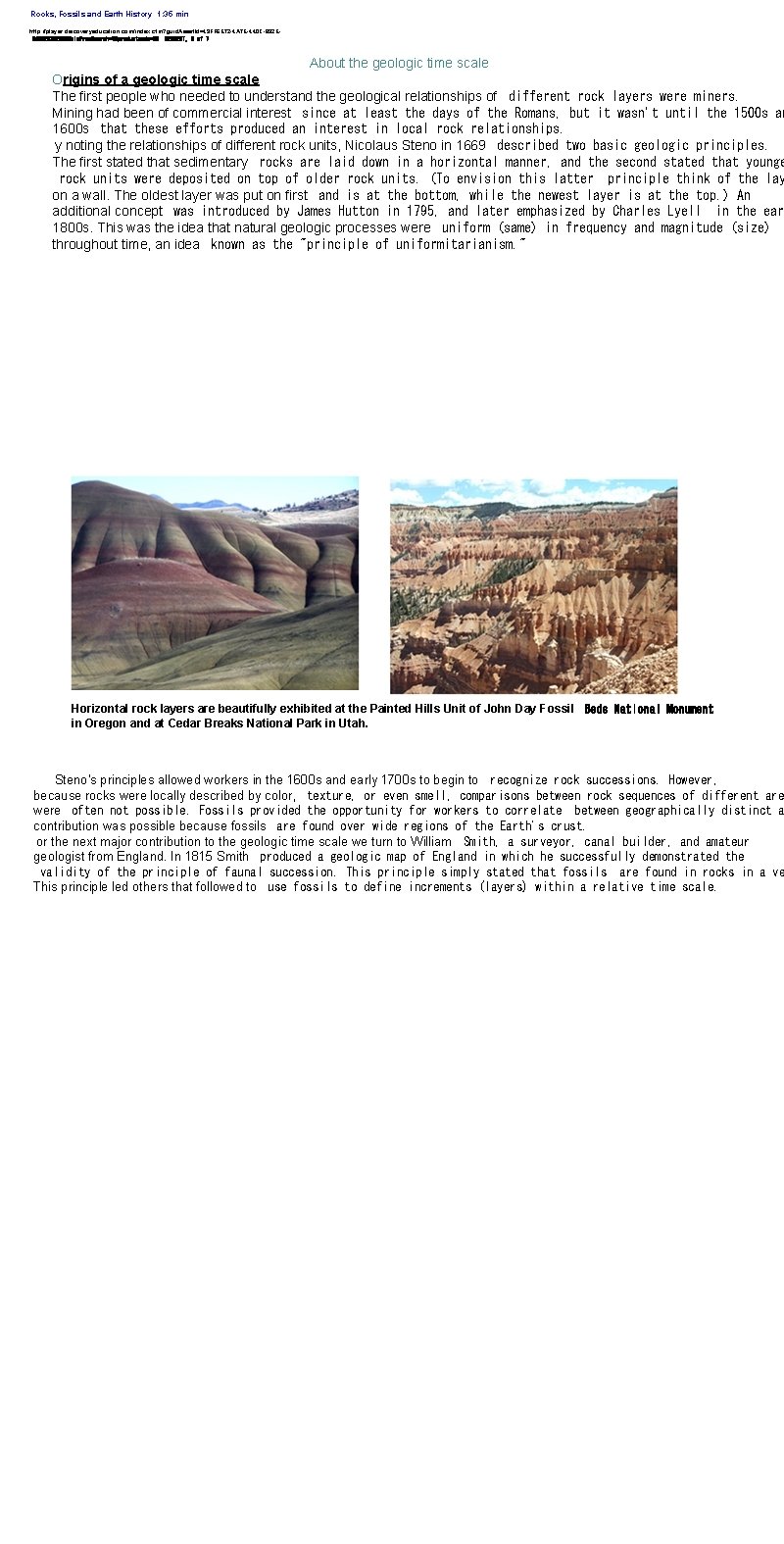
Rocks, Fossils and Earth History 1: 35 min http: //player. discoveryeducation. com/index. cfm? guid. Asset. Id=49 FF 6 E 72 -4 A 7 E-440 C-892 E CA 0 CE 63 CEDC 0&bln. From. Search=1&productcode=US SEGMENT, 6 of 7 About the geologic time scale Origins of a geologic time scale The first people who needed to understand the geological relationships of different rock layers were miners. Mining had been of commercial interest since at least the days of the Romans, but it wasn't until the 1500 s an 1600 s that these efforts produced an interest in local rock relationships. y noting the relationships of different rock units, Nicolaus Steno in 1669 described two basic geologic principles. The first stated that sedimentary rocks are laid down in a horizontal manner, and the second stated that younge rock units were deposited on top of older rock units. (To envision this latter principle think of the lay on a wall. The oldest layer was put on first and is at the bottom, while the newest layer is at the top. ) An additional concept was introduced by James Hutton in 1795, and later emphasized by Charles Lyell in the earl 1800 s. This was the idea that natural geologic processes were uniform (same) in frequency and magnitude (size) throughout time, an idea known as the "principle of uniformitarianism. " Horizontal rock layers are beautifully exhibited at the Painted Hills Unit of John Day Fossil Beds National Monument in Oregon and at Cedar Breaks National Park in Utah. Steno's principles allowed workers in the 1600 s and early 1700 s to begin to recognize rock successions. However, because rocks were locally described by color, texture, or even smell, comparisons between rock sequences of different are were often not possible. Fossils provided the opportunity for workers to correlate between geographically distinct a contribution was possible because fossils are found over wide regions of the Earth's crust. or the next major contribution to the geologic time scale we turn to William Smith, a surveyor, canal builder, and amateur geologist from England. In 1815 Smith produced a geologic map of England in which he successfully demonstrated the validity of the principle of faunal succession. This principle simply stated that fossils are found in rocks in a ve This principle led others that followed to use fossils to define increments (layers) within a relative time scale.
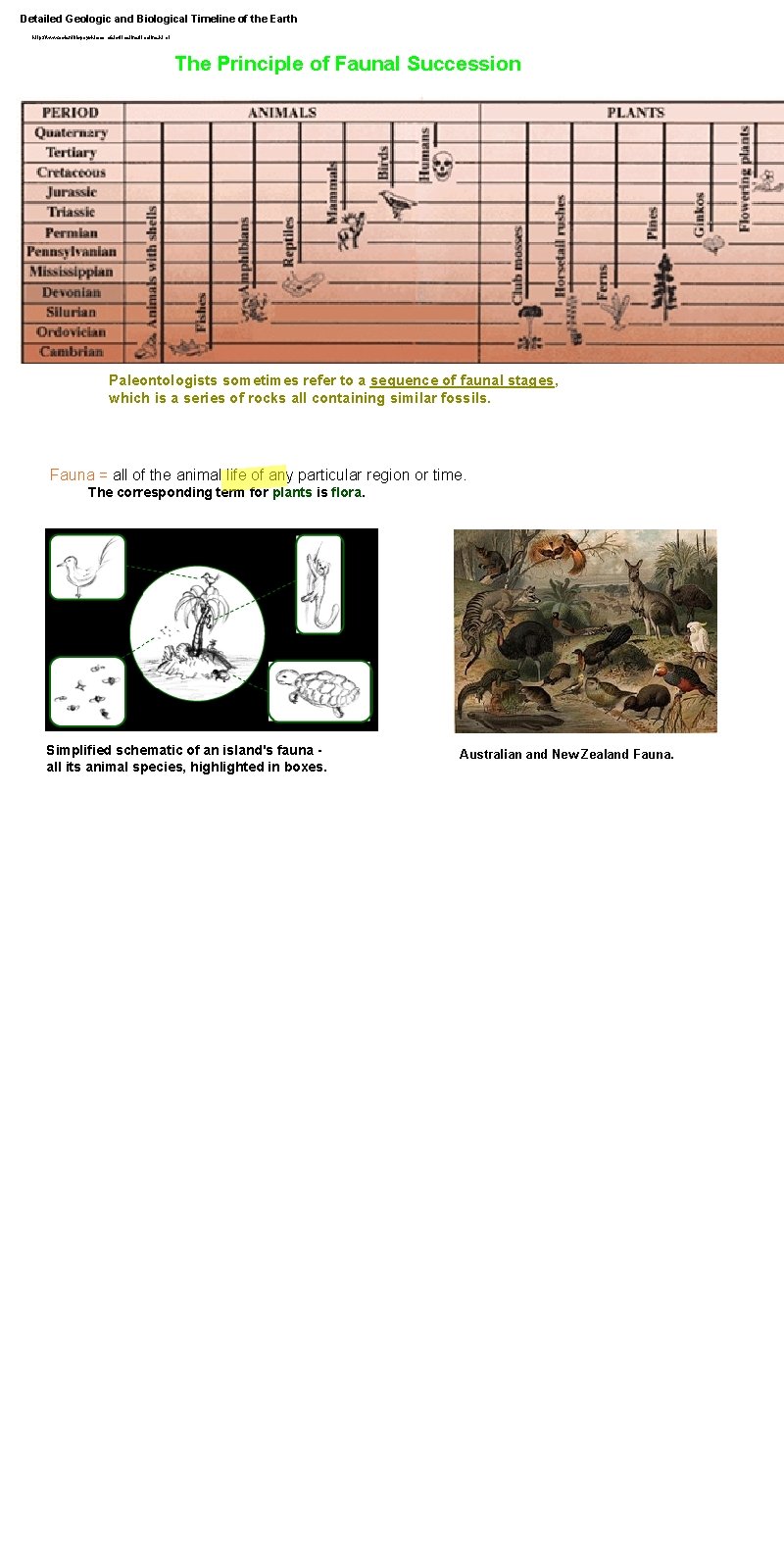
Detailed Geologic and Biological Timeline of the Earth http: //www. scientificpsychic. com/etc/timeline. html The Principle of Faunal Succession Paleontologists sometimes refer to a sequence of faunal stages, which is a series of rocks all containing similar fossils. Fauna = all of the animal life of any particular region or time. The corresponding term for plants is flora. Simplified schematic of an island's fauna all its animal species, highlighted in boxes. Australian and New Zealand Fauna.
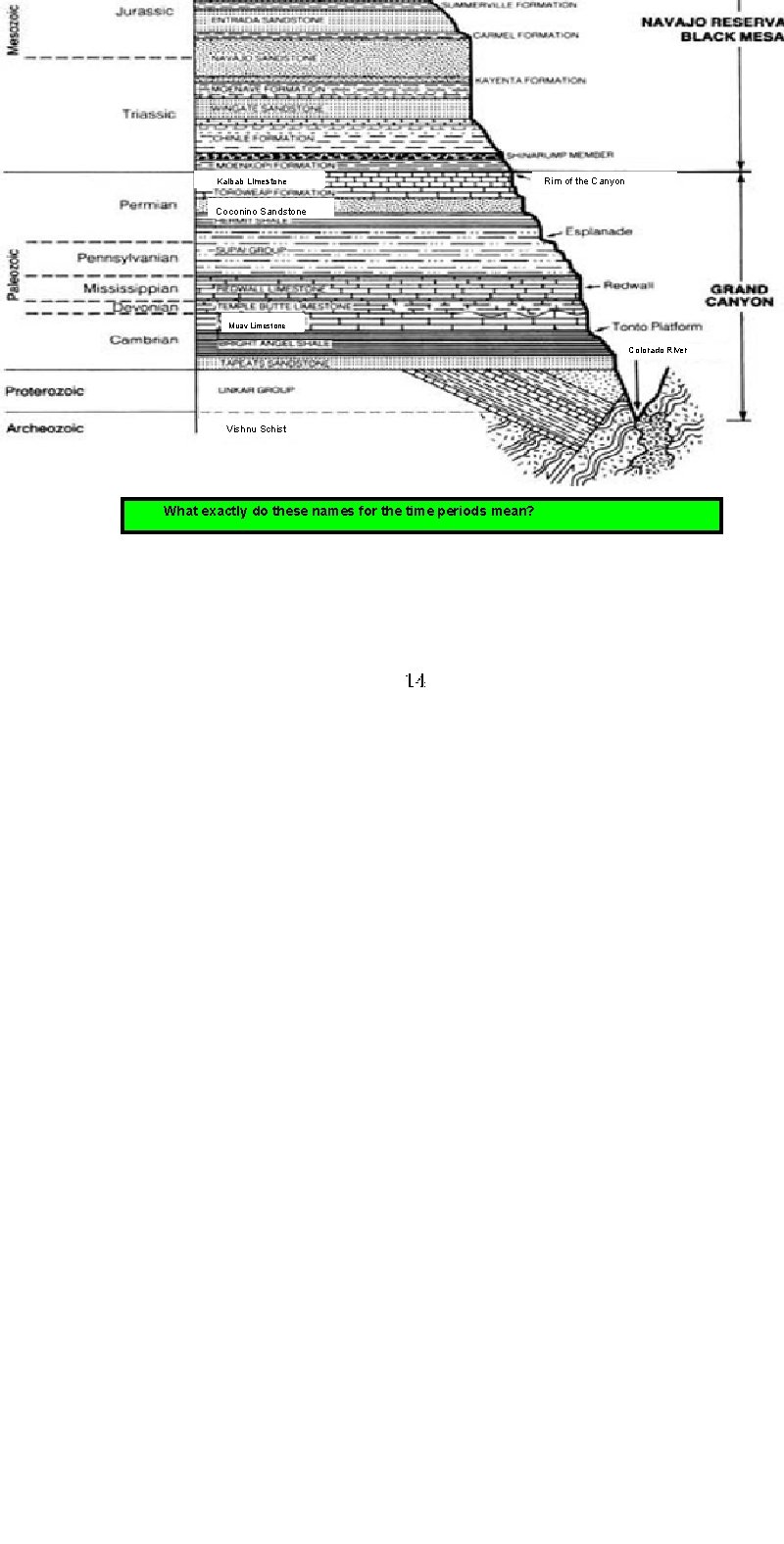
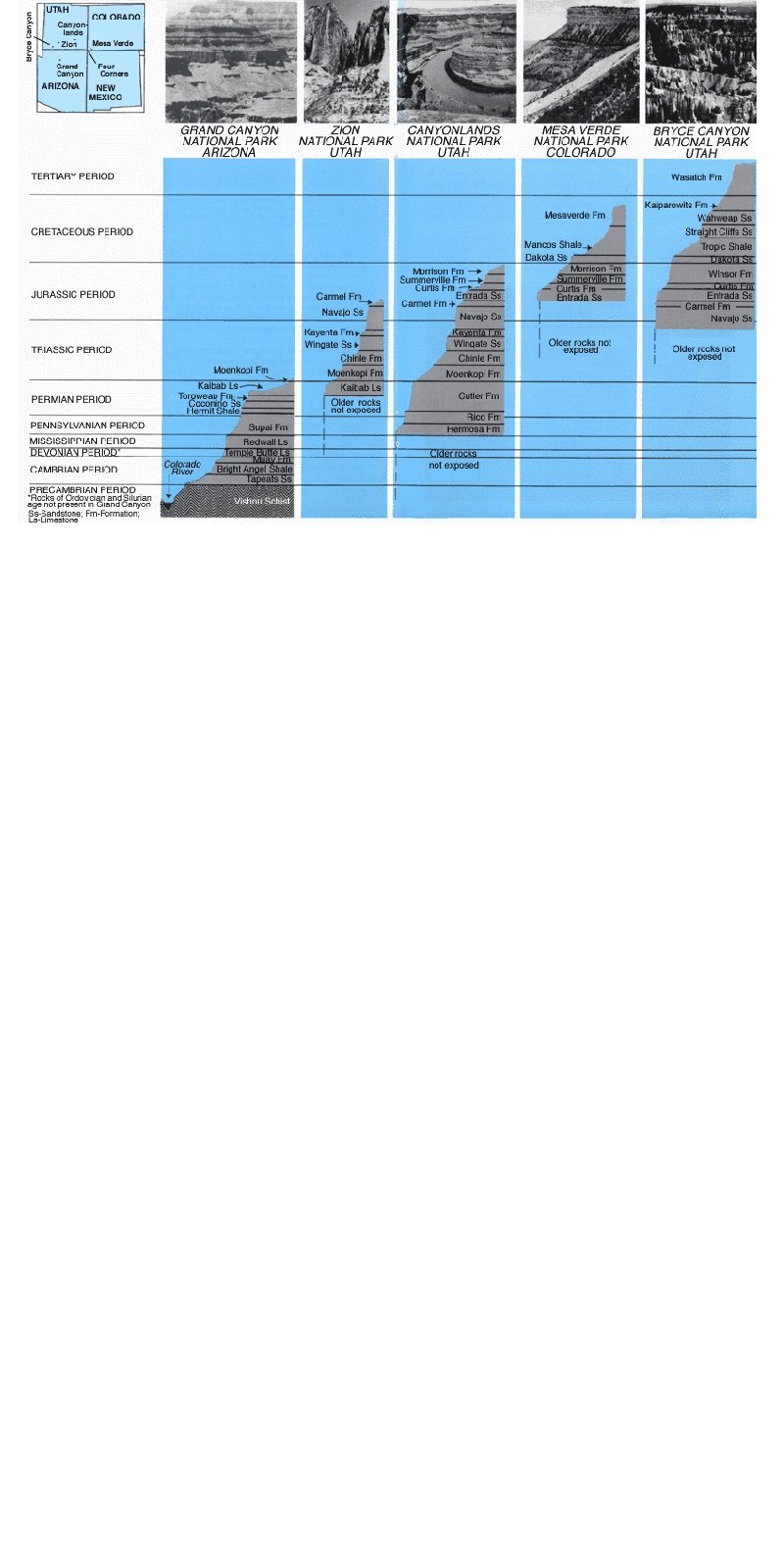
Kaibab Limestone Rim of the Canyon Coconino Sandstone Muav Limestone Colorado River Vishnu Schist What exactly do these names for the time periods mean?

Understanding Geologic Time (really good) http: //www. ucmp. berkeley. edu/education/explorations/tours/geotime/gtpage 10. html Geologic Time Scale Slide Share http: //www. slideshare. net/search/slideshow? searchfrom=header&q=geologic+time+scale http: //www. slideshare. net/seamonr/prehistory-early-life 2 http: //www. slideshare. net/Miss. Wander/geologic-time-scale-9 Geologic Time http: //www. msnucleus. org/membership/html/jh/earth/stratigraphy/lesson 3/stratigraphy 3 a. html Geologic Time Scale http: //pubs. usgs. gov/gip/fossils/scale. html Clock of Eras - Geologic Time http: //www. fossils-facts-and-finds. com/clock_of_eras. html his clock represents the time the Earth has been in existence, about 4. 5 billion years. So one hour would represent 375, 000 years passing. On our standard clock we have second hands that measure seconds, minute hands that measure minutes, and hour hands that measure hours. On this clock our hand measures Eras. As it passes around the clock, it colors the clock as it marks off the eras. Each new color represents a new era. The colors on the clock will remind us of how the earth was forming and how life was taking shape on the planet. The colors as used on the clock relate to the location of the life that was present during the time. So the Paleozoic Era is blue because life was primarily in the seas, the Mesozoic is brown because life moved to the land, and the Cenozoic is green because of the fresh new life: the mammals. The Clock of Eras has been modified several times already and will continue to change over time as scientists learn more and more information through their research and discovery. http: //www. geology. wisc. edu/~museum/Time. Scale. pdf
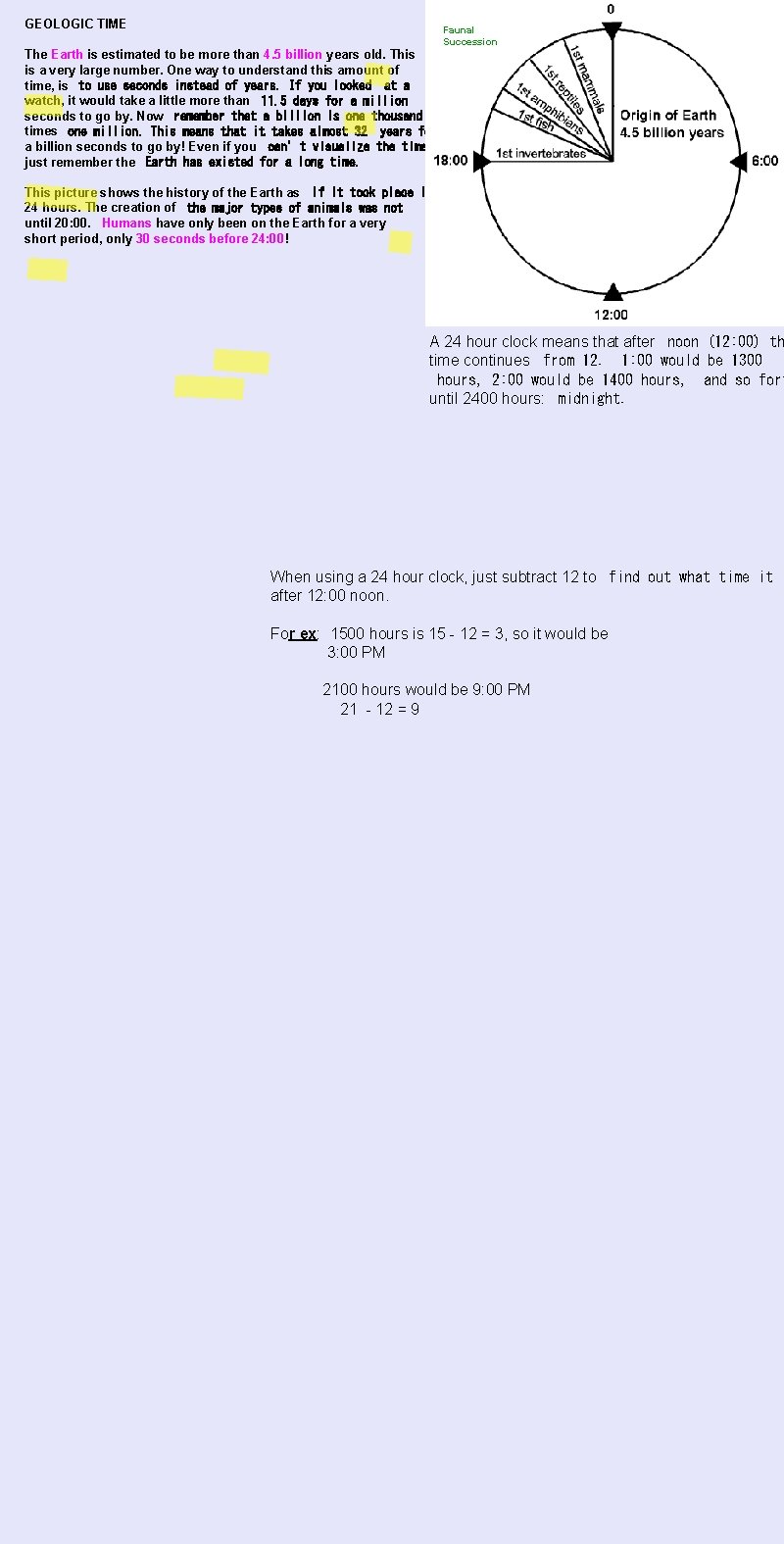
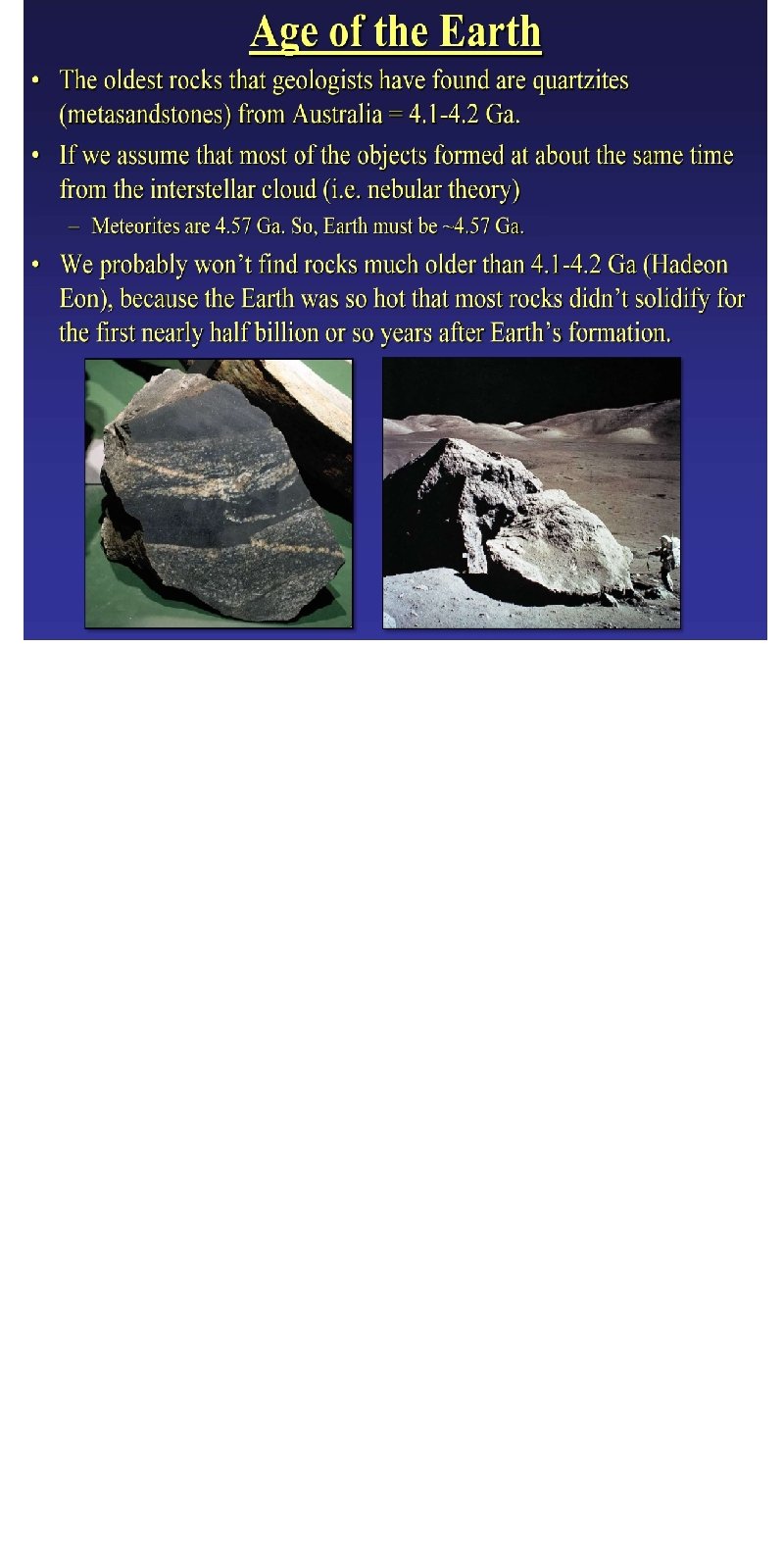
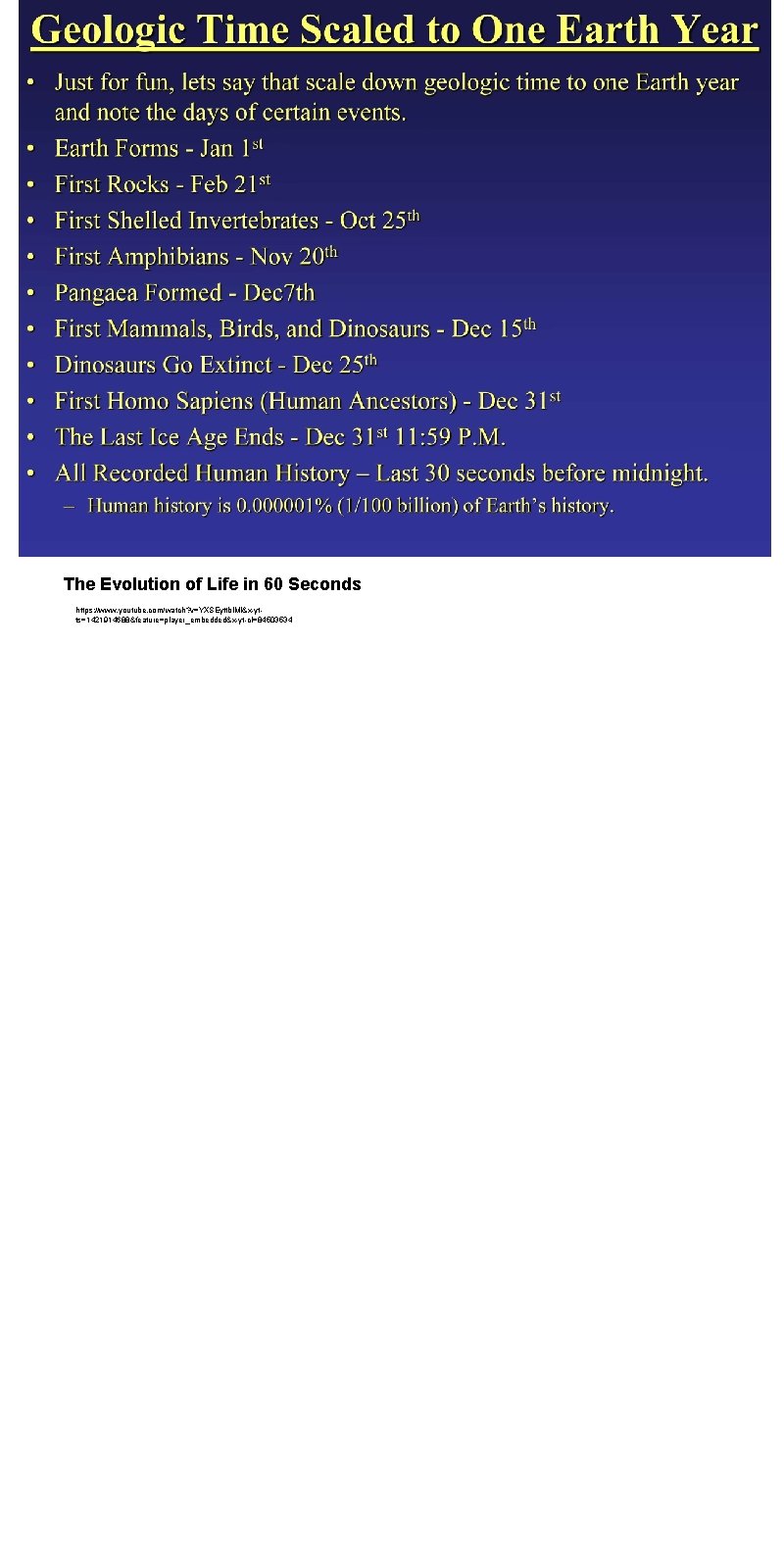
GEOLOGIC TIME Faunal Succession The Earth is estimated to be more than 4. 5 billion years old. This is a very large number. One way to understand this amount of time, is to use seconds instead of years. If you looked at a watch, it would take a little more than 11. 5 days for a million seconds to go by. Now remember that a billion is one thousand times one million. This means that it takes almost 32 years for a billion seconds to go by! Even if you can’t visualize the time, just remember the Earth has existed for a long time. This picture shows the history of the Earth as if it took place in 24 hours. The creation of the major types of animals was not until 20: 00. Humans have only been on the Earth for a very short period, only 30 seconds before 24: 00! A 24 hour clock means that after noon (12: 00) th time continues from 12. 1: 00 would be 1300 hours, 2: 00 would be 1400 hours, and so fort until 2400 hours: midnight. When using a 24 hour clock, just subtract 12 to find out what time it i after 12: 00 noon. For ex: 1500 hours is 15 - 12 = 3, so it would be 3: 00 PM 2100 hours would be 9: 00 PM 21 - 12 = 9
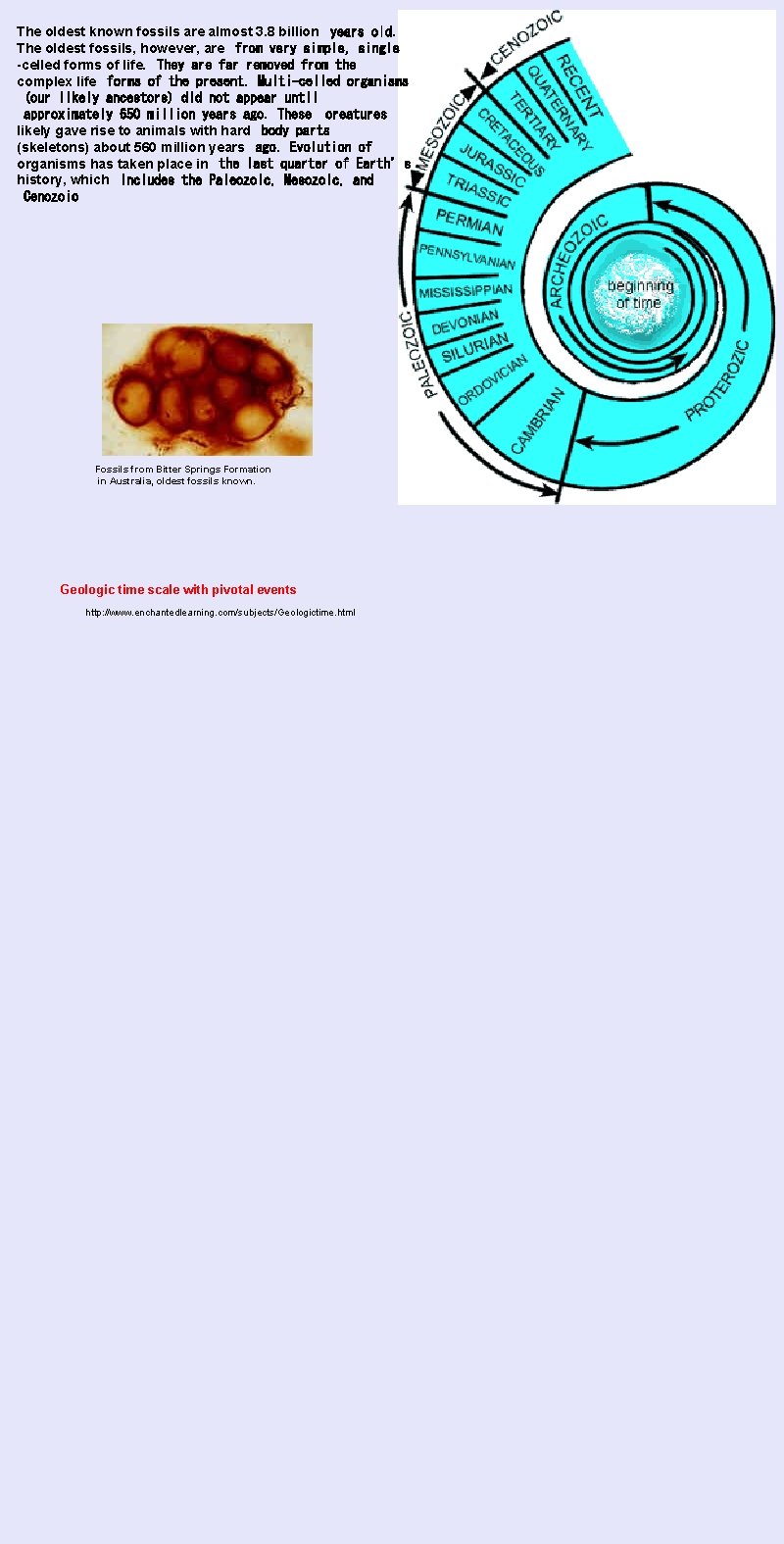
The oldest known fossils are almost 3. 8 billion years old. The oldest fossils, however, are from very simple, single -celled forms of life. They are far removed from the complex life forms of the present. Multi-celled organisms (our likely ancestors) did not appear until approximately 650 million years ago. These creatures likely gave rise to animals with hard body parts (skeletons) about 560 million years ago. Evolution of organisms has taken place in the last quarter of Earth’s history, which includes the Paleozoic, Mesozoic, and Cenozoic Fossils from Bitter Springs Formation in Australia, oldest fossils known. Geologic time scale with pivotal events http: //www. enchantedlearning. com/subjects/Geologictime. html
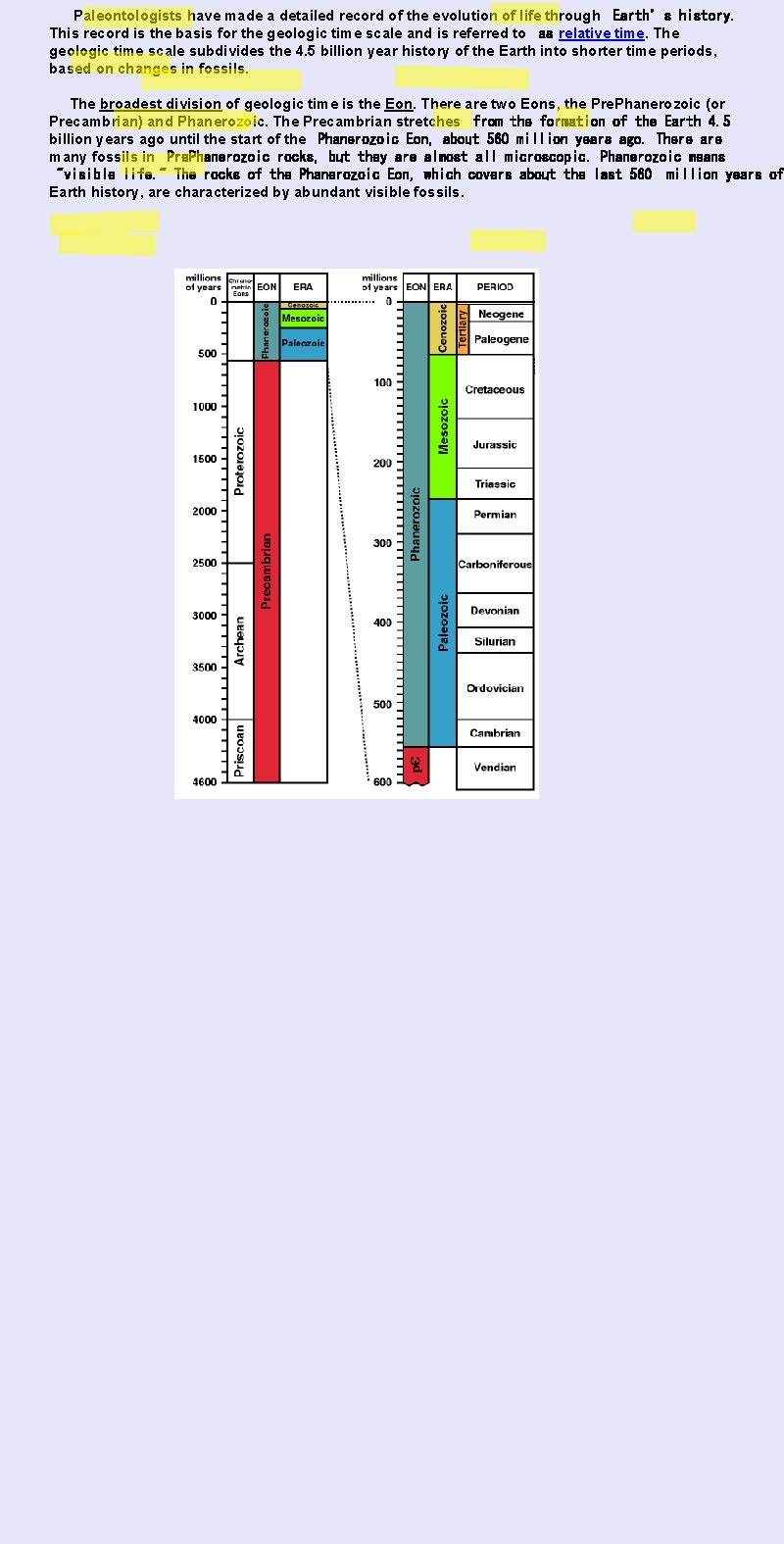
Paleontologists have made a detailed record of the evolution of life through Earth’s history. This record is the basis for the geologic time scale and is referred to as relative time. The geologic time scale subdivides the 4. 5 billion year history of the Earth into shorter time periods, based on changes in fossils. The broadest division of geologic time is the Eon. There are two Eons, the Pre. Phanerozoic (or Precambrian) and Phanerozoic. The Precambrian stretches from the formation of the Earth 4. 5 billion years ago until the start of the Phanerozoic Eon, about 560 million years ago. There are many fossils in Pre. Phanerozoic rocks, but they are almost all microscopic. Phanerozoic means "visible life. " The rocks of the Phanerozoic Eon, which covers about the last 560 million years of Earth history, are characterized by abundant visible fossils.
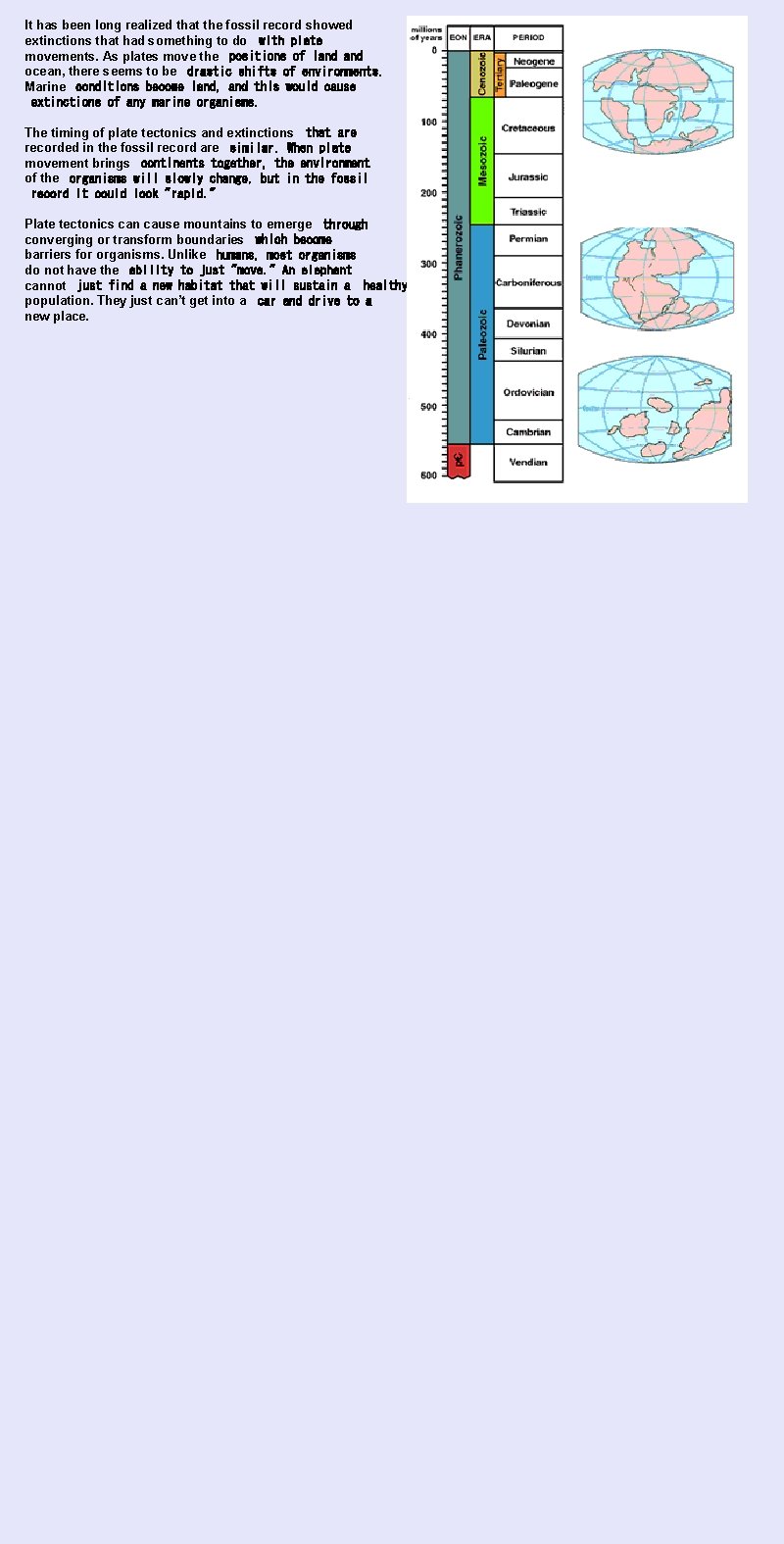
It has been long realized that the fossil record showed extinctions that had something to do with plate movements. As plates move the positions of land ocean, there seems to be drastic shifts of environments. Marine conditions become land, and this would cause extinctions of any marine organisms. The timing of plate tectonics and extinctions that are recorded in the fossil record are similar. When plate movement brings continents together, the environment of the organisms will slowly change, but in the fossil record it could look "rapid. " Plate tectonics can cause mountains to emerge through converging or transform boundaries which become barriers for organisms. Unlike humans, most organisms do not have the ability to just "move. " An elephant cannot just find a new habitat that will sustain a healthy population. They just can’t get into a car and drive to a new place.
Precambrian

Brain Break: Ice Age: Continental Drift http: //www. pinterest. com/pin/199988039676427668/ https: //video. search. yahoo. com/video/play? p=ice+age+shuffle+youtub e&vid=b 1 a 377 b 80 ade 821478 fa 30783 f 3 e 7 a 82&l=&turl=http%3 A%2 F% 2 Fts 2. mm. bing. net%2 Fth%3 Fid%3 DVN. 608050683878379249%26 pid %3 D 15. 1&rurl=https%3 A%2 F%2 Fwww. pinterest. com%2 Fpin%2 F 1999 88039676427668%2 F&tit=The+Sid+Shuffle++Ice+Age%3 A+Continental+Drift&c=23&sigr=11 h 11 lvua&sigt=11 cr 25 q nr&sigi=11 rjia 2 vt&ct=n&fr 2=p%3 As%2 Cv%3 Av%2 Cm%3 Asa&b=31&h simp=yhs-001&hspart=mozilla&tt=b
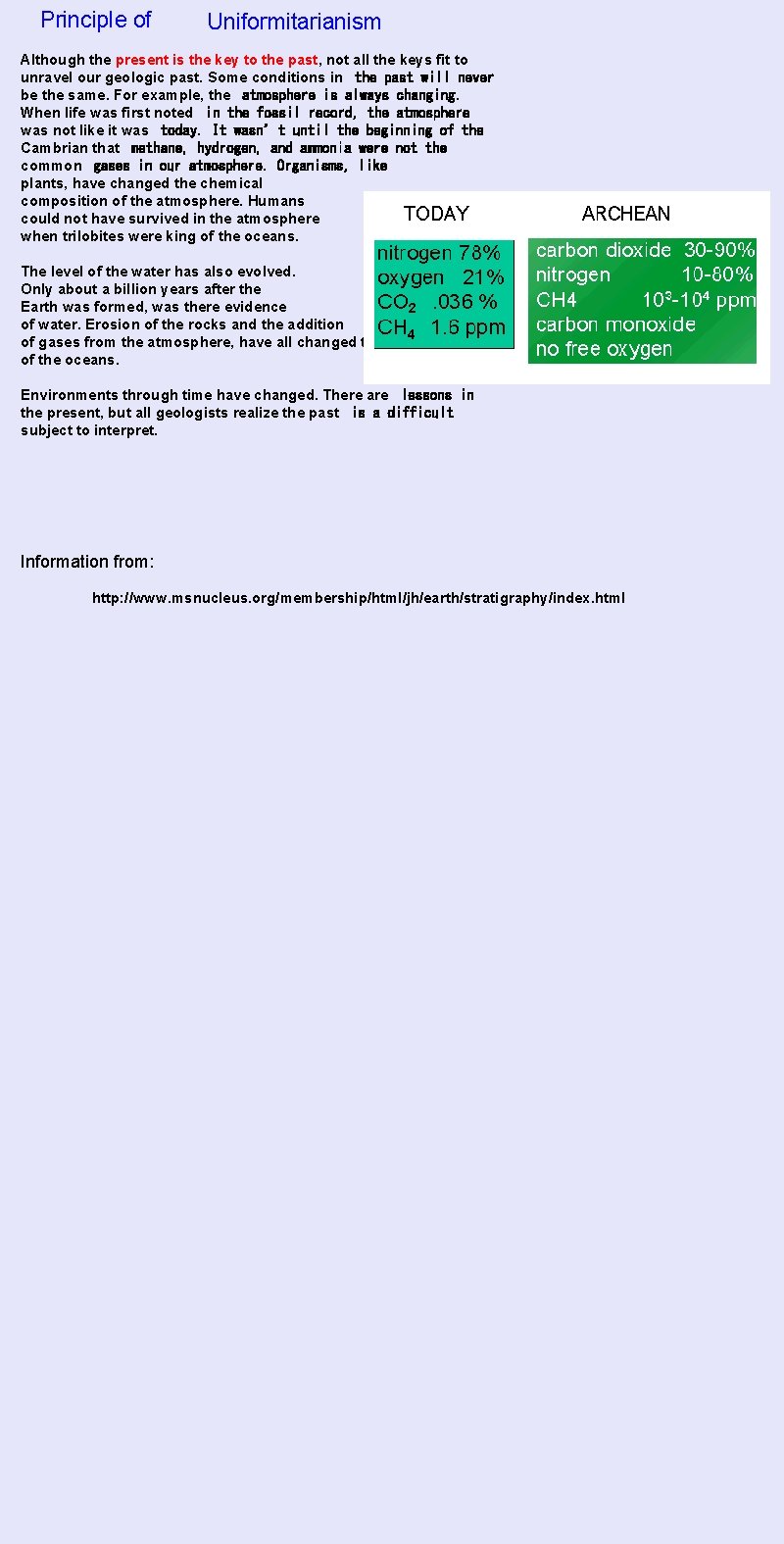
Principle of Uniformitarianism Although the present is the key to the past, not all the keys fit to unravel our geologic past. Some conditions in the past will never be the same. For example, the atmosphere is always changing. When life was first noted in the fossil record, the atmosphere was not like it was today. It wasn’t until the beginning of the Cambrian that methane, hydrogen, and ammonia were not the common gases in our atmosphere. Organisms, like plants, have changed the chemical composition of the atmosphere. Humans could not have survived in the atmosphere when trilobites were king of the oceans. The level of the water has also evolved. Only about a billion years after the Earth was formed, was there evidence of water. Erosion of the rocks and the addition of gases from the atmosphere, have all changed the composition of the oceans. Environments through time have changed. There are lessons in the present, but all geologists realize the past is a difficult subject to interpret. Information from: http: //www. msnucleus. org/membership/html/jh/earth/stratigraphy/index. html
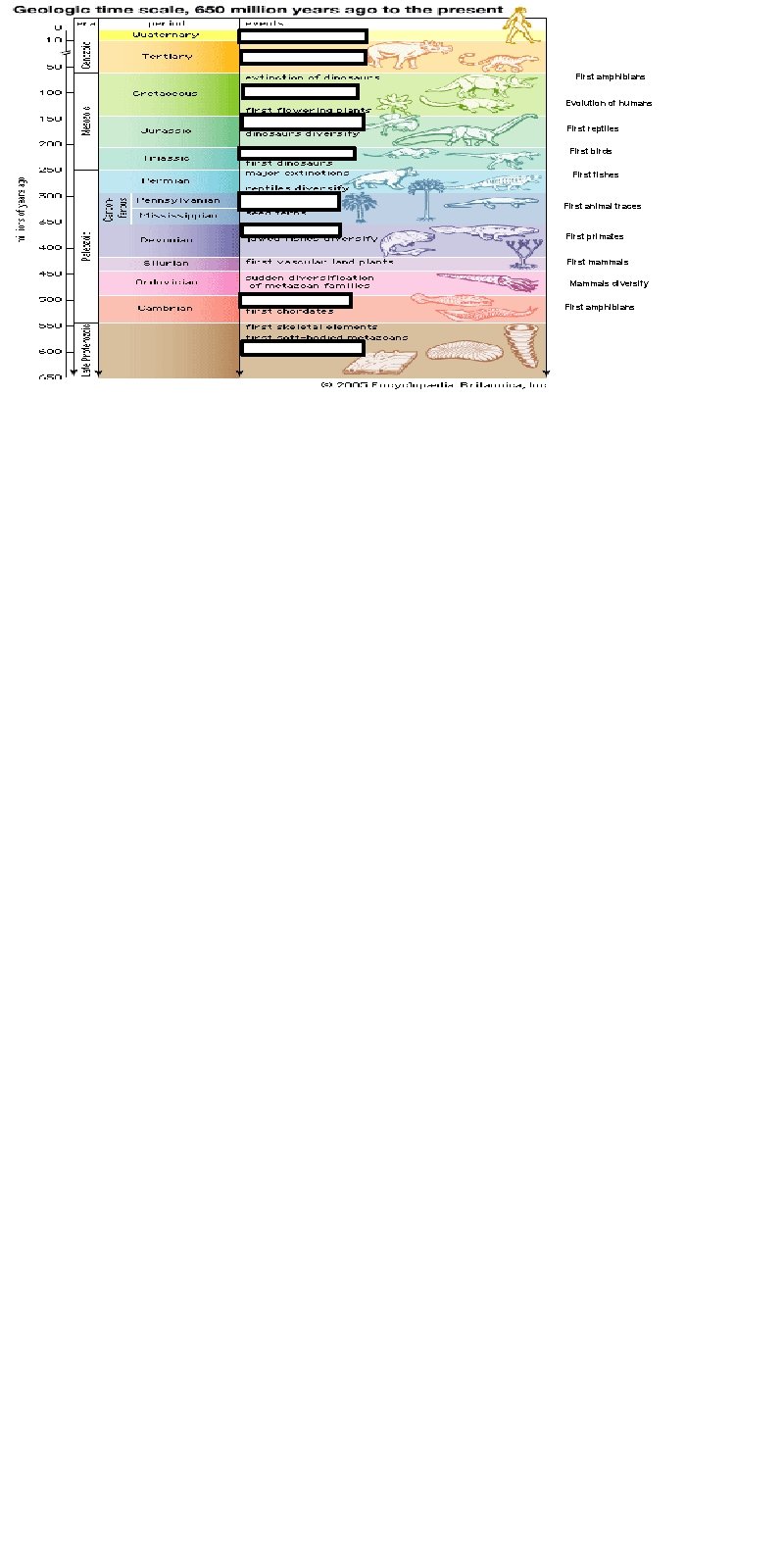
First amphibians Evolution of humans First reptiles First birds First fishes First animal traces First primates First mammals Mammals diversify First amphibians
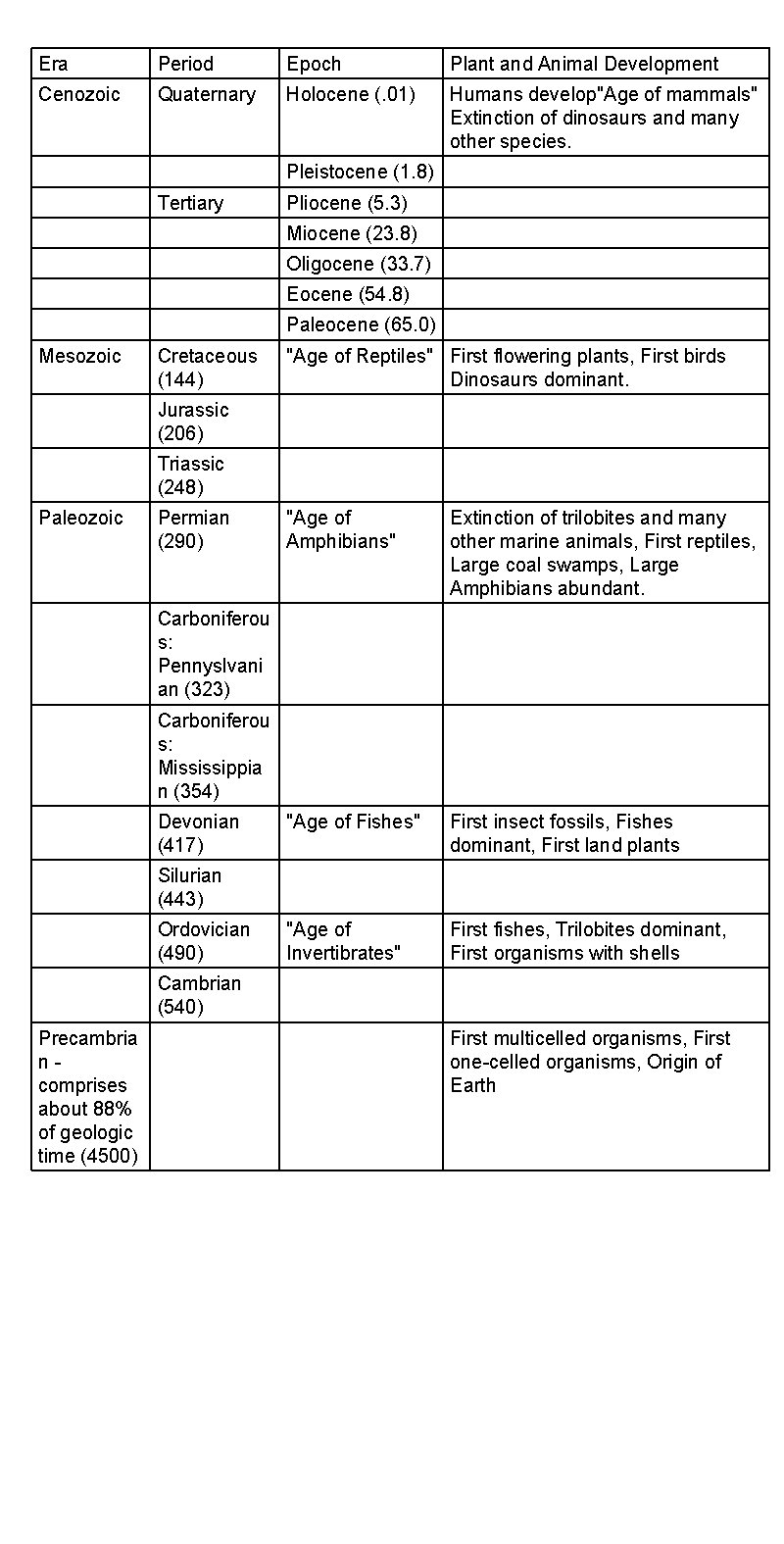
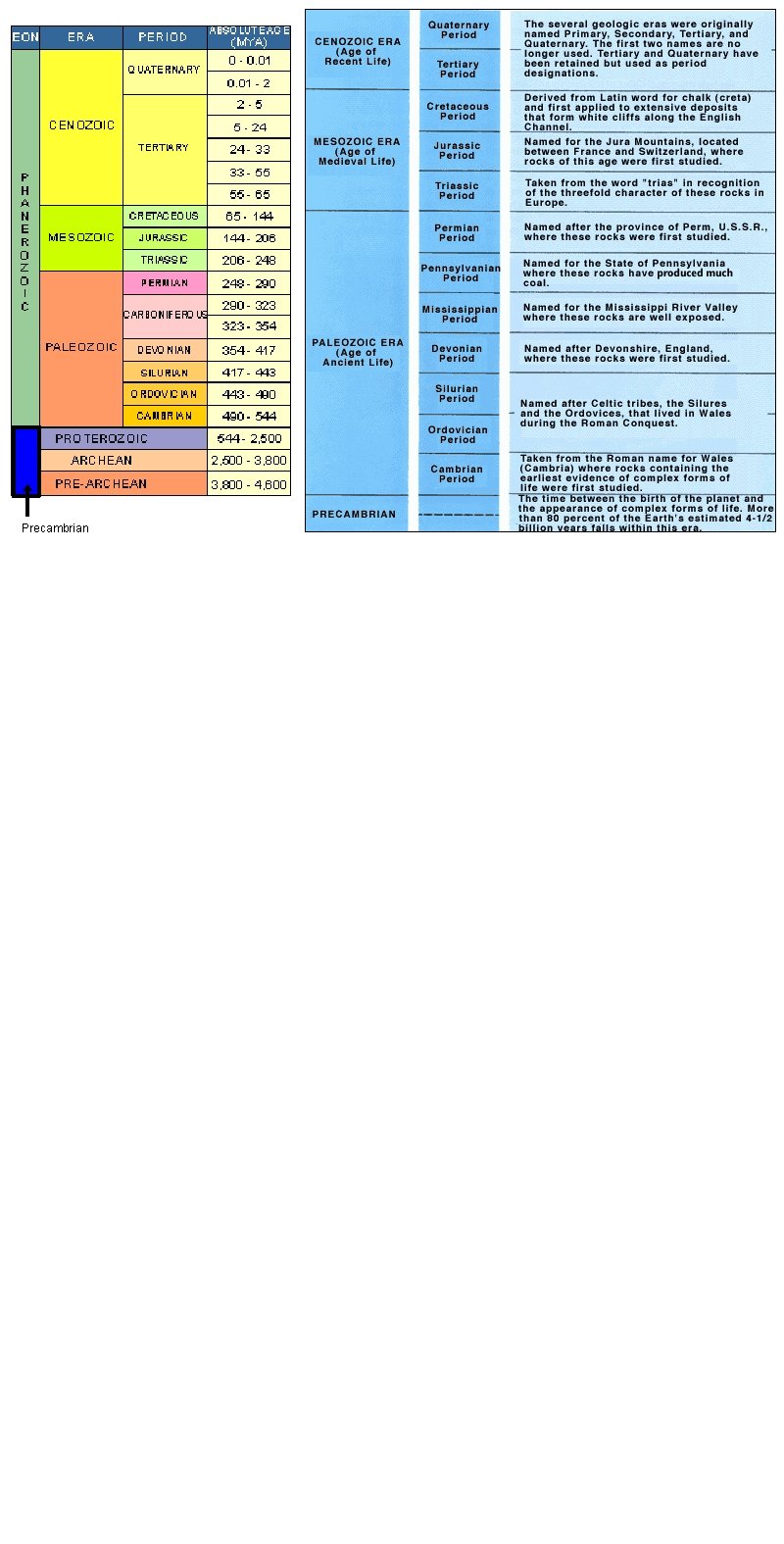
Era Period Epoch Plant and Animal Development Cenozoic Quaternary Holocene (. 01) Humans develop"Age of mammals" Extinction of dinosaurs and many other species. Pleistocene (1. 8) Tertiary Pliocene (5. 3) Miocene (23. 8) Oligocene (33. 7) Eocene (54. 8) Paleocene (65. 0) Mesozoic Cretaceous (144) "Age of Reptiles" First flowering plants, First birds Dinosaurs dominant. Jurassic (206) Triassic (248) Paleozoic Permian (290) "Age of Amphibians" Extinction of trilobites and many other marine animals, First reptiles, Large coal swamps, Large Amphibians abundant. "Age of Fishes" First insect fossils, Fishes dominant, First land plants "Age of Invertibrates" First fishes, Trilobites dominant, First organisms with shells Carboniferou s: Pennyslvani an (323) Carboniferou s: Mississippia n (354) Devonian (417) Silurian (443) Ordovician (490) Cambrian (540) Precambria ncomprises about 88% of geologic time (4500) First multicelled organisms, First one-celled organisms, Origin of Earth

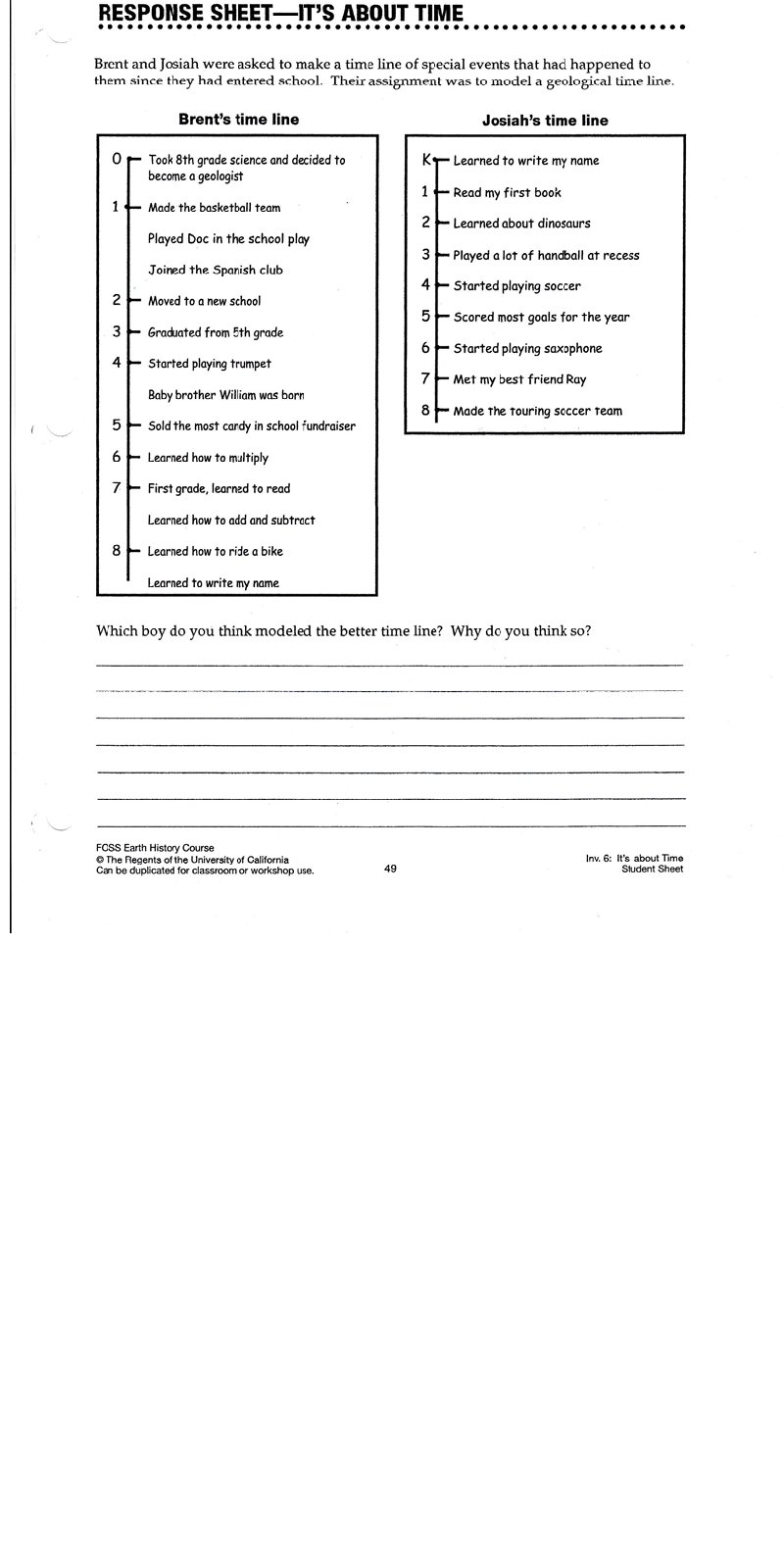
Personal time line http: //www. ucmp. berkeley. edu/fosrec/Scotchmoor. Time. html Modeling the Geologic Time Line with events from your life Events in your life Telling history of below. the Earth requires placing events in sequence that reference canfirstbein given Look at the events listed Arrange them in order, by placing the number 1 in frontso of the event that occurred your lifeto a the number 2 and/or for the second, and sotime forth. at which each event occurred. This helps to make sense out of the enormous relative numerical ___ When you started 2 nd grade. expanse of time that has elapsed since the origin of the Earth ___ When you were born. ___ When you started kindergarten. ___ When you learned to ride a bike. ___ When you learned to walk. ___ When you learned to read. ___ When you lost your first tooth. ___ Today's date. ___ When you started middle school. ___ The first Christmas you can remember. ___ When you got your first middle school report card. On the Worksheet, write these events in the right side the column Sequential Time. Write the 1. Look at the events listed below. Arrange these events incolumn order, - Label byplacing events so that the most recent event is at the top and the number 1 in front of the event that occurred first in your life, a number 2 for the second, and so fort event the occurred first is at bottom of the list. Space out the events so that you fill the whole column bottom Events in your Lifeto top. Your list is now similar to what a geologist might refer to ___ When you started second grade as a Sequential time line used to describe the relative time __ When you were born relationships between events. For example: I learned to ride a bike after I started Kindergarten. __ When you started kindergarten __ When you learned to ride a bike __ When you learned to walk __ When you learned to read __ When you lost your first tooth __ Today's date __ When you started Middle School __ The first Christmas you remember in detail __ When you got your first Middle School Report Card
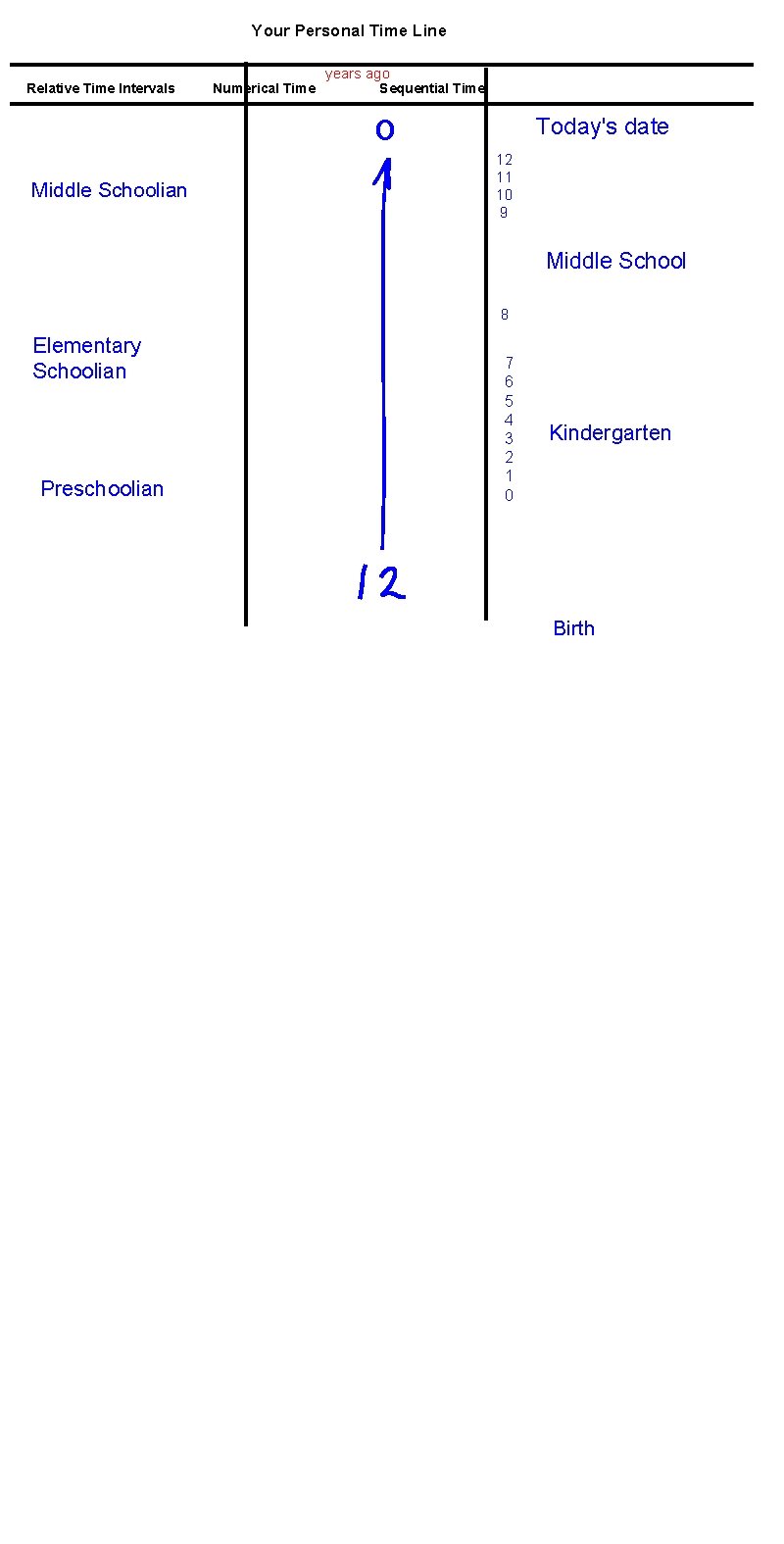
Your Personal Time Line Relative Time Intervals Numerical Time years ago Sequential Time o Middle Schoolian Today's date 12 11 10 9 Middle School 8 Elementary Schoolian Preschoolian 7 6 5 4 3 2 1 0 Kindergarten Birth
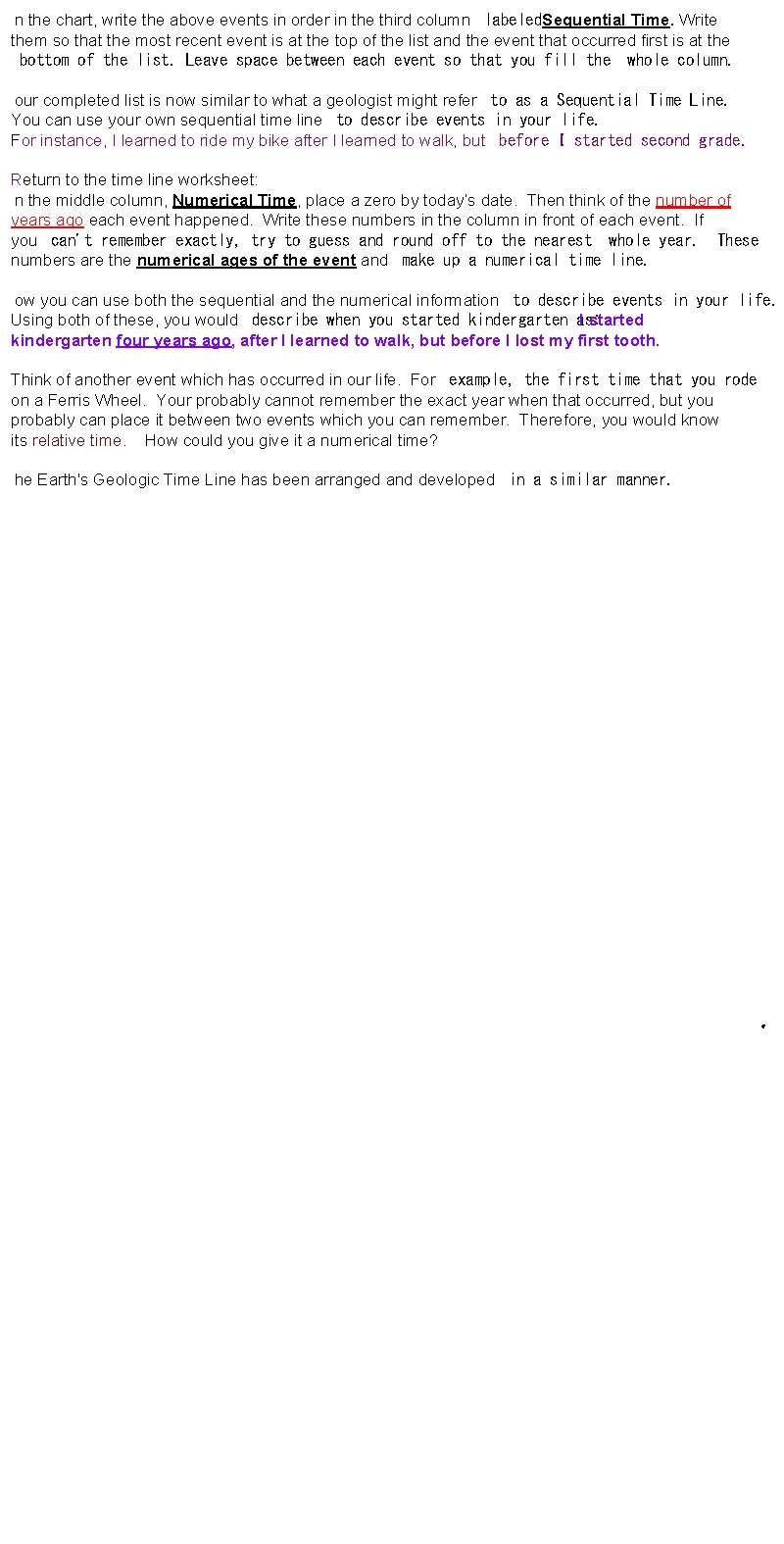
n the chart, write the above events in order in the third column labeled. Sequential Time. Write them so that the most recent event is at the top of the list and the event that occurred first is at the bottom of the list. Leave space between each event so that you fill the whole column. our completed list is now similar to what a geologist might refer to as a Sequential Time Line. You can use your own sequential time line to describe events in your life. For instance, I learned to ride my bike after I learned to walk, but before I started second grade. Return to the time line worksheet: n the middle column, Numerical Time, place a zero by today’s date. Then think of the number of years ago each event happened. Write these numbers in the column in front of each event. If you can't remember exactly, try to guess and round off to the nearest whole year. These numbers are the numerical ages of the event and make up a numerical time line. ow you can use both the sequential and the numerical information to describe events in your life. Using both of these, you would describe when you started kindergarten as: I started kindergarten four years ago, after I learned to walk, but before I lost my first tooth. Think of another event which has occurred in our life. For example, the first time that you rode on a Ferris Wheel. Your probably cannot remember the exact year when that occurred, but you probably can place it between two events which you can remember. Therefore, you would know its relative time. How could you give it a numerical time? he Earth's Geologic Time Line has been arranged and developed in a similar manner.
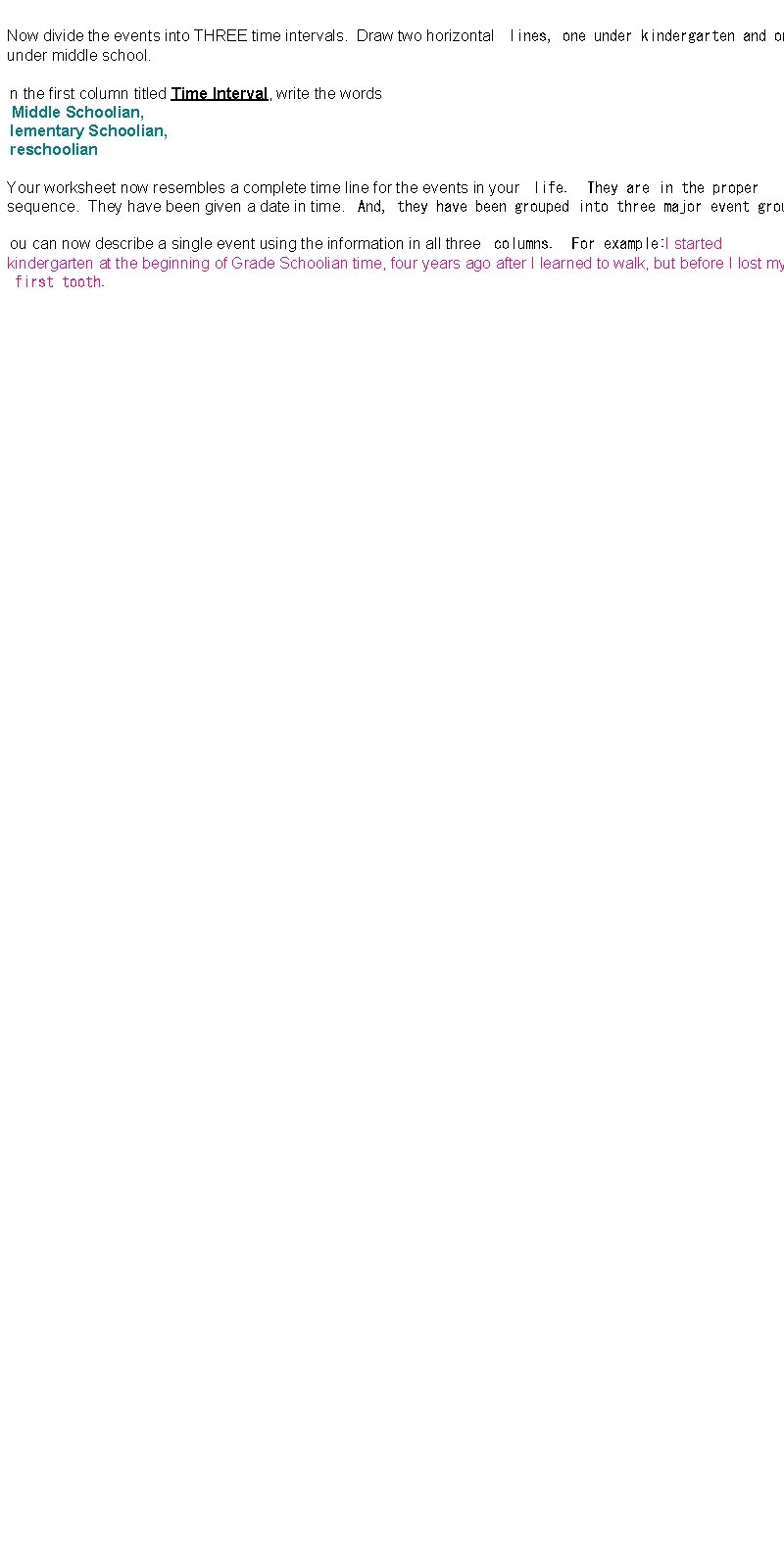
Now divide the events into THREE time intervals. Draw two horizontal lines, one under kindergarten and on under middle school. n the first column titled Time Interval, write the words Middle Schoolian, lementary Schoolian, reschoolian Your worksheet now resembles a complete time line for the events in your life. They are in the proper sequence. They have been given a date in time. And, they have been grouped into three major event grou ou can now describe a single event using the information in all three columns. For example: I started kindergarten at the beginning of Grade Schoolian time, four years ago after I learned to walk, but before I lost my first tooth.
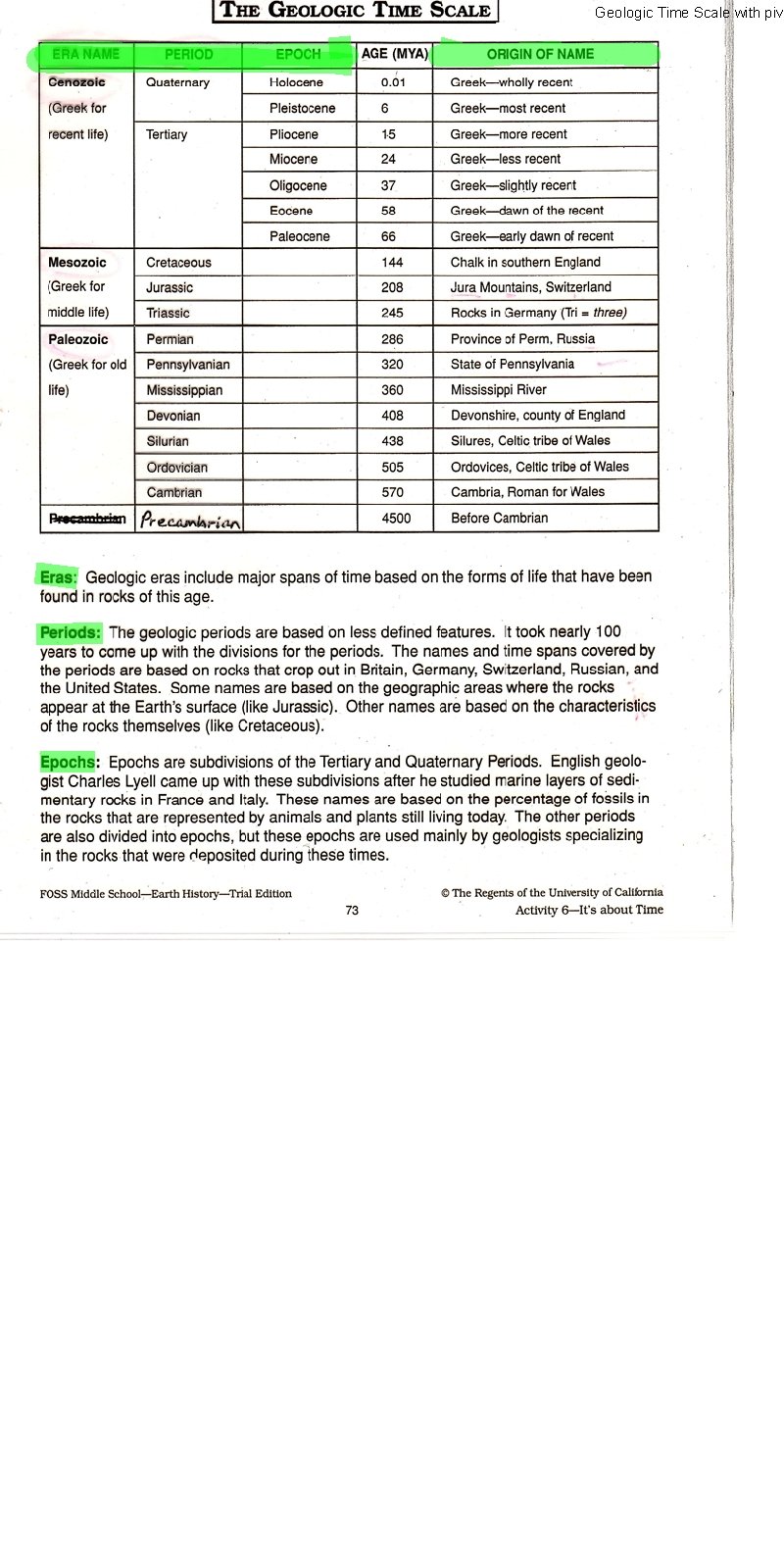
Geologic Time Scale with pivo
Checking for Understanding Stand up. . . walk around as the music plays. When the music stops. . . form a group of three with people who are closest to you. . . HI FIVE in your group of 3. Person with the birthday closest to today's date will go first in the Rally Robin. . . Topic: One thing you know about Geologic Time. Go around until time is called

http: //www. ucmp. berkeley. edu/education/explorations/tours/geotime/gtpage 2 a. html The Big Idea about the Geologic Time Scale: Eons Eras Periods Epochs The Modern Geologic Time Scale documents periods of geologic time relative to one another, and has been continuously developed and updated. In addition to the relative dating of periods in Earth's history for which w have rocks preserved, geologists are now able to assign absolute age dates by using radioactive decay. In the Geologic Time Scale, time is generally divided on the basis when certain animals and plants appeared. Geologists beginning in the late 1700's recognized that fossils appeared in an orderly fashion in stratigraphic units (rock layers). Two major divisions were formed, these large divisions are called eons. The majority of fossils, however, did not match with modern groups of more advanced animals. This led to the classification three major eras within the eon that was populated with advanced life forms. These eras were referred to as Paleozoic (meaning ancient life), the Mesozoic (meaning middle life), and the Cenozoic (meaning recent Using a variety of techniques and dating methods, geologists have been able to determine the age of the Earth, as well as major eras, periods, and epochs within Earth's history. These dates are used to study, among other things, how the environment and animal/plant life are changing on Earth.
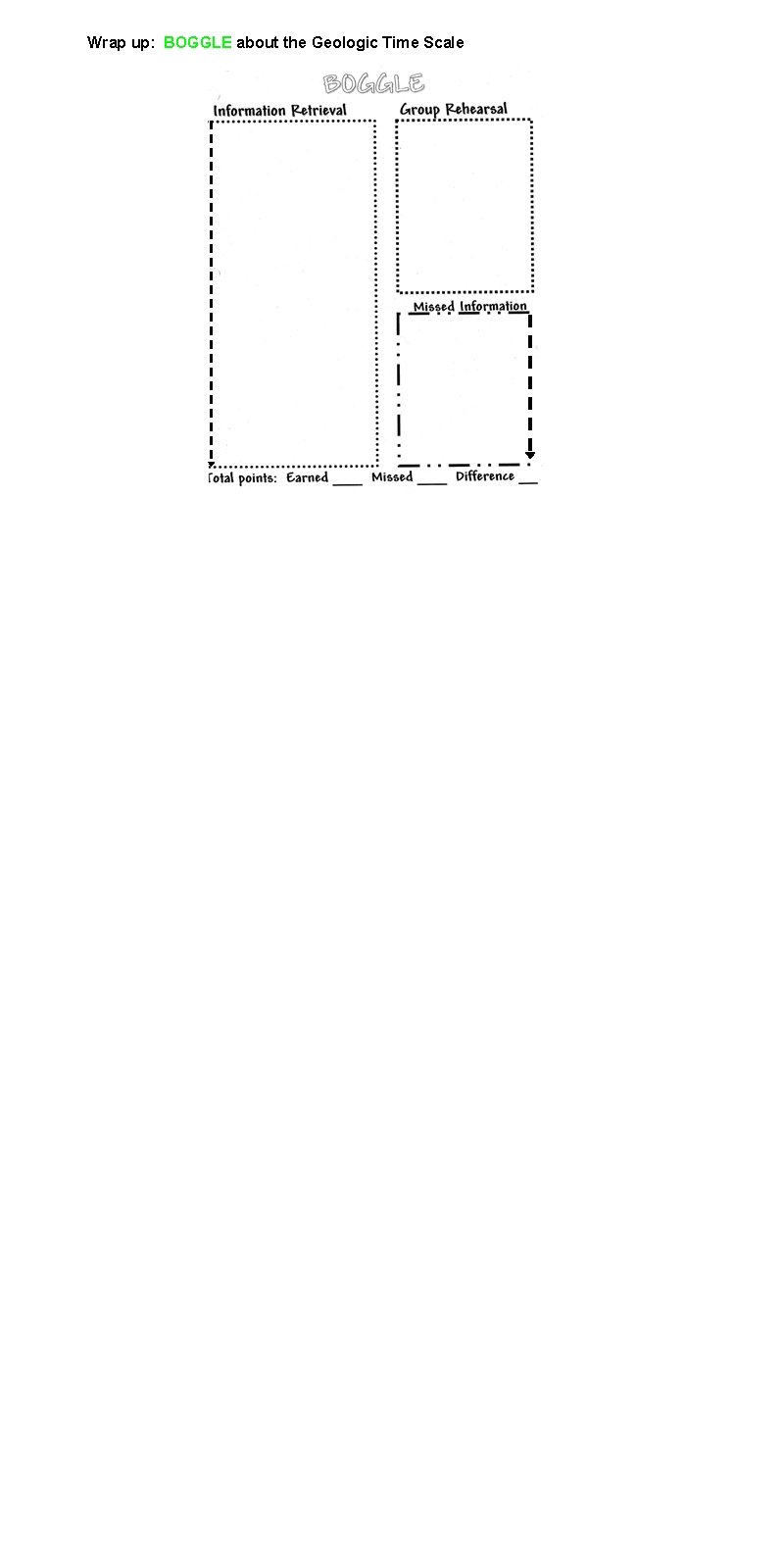
Wrap up: BOGGLE about the Geologic Time Scale


Attachments Geologic Time Scale with pivotal events. docx
- Slides: 37