
Earth History Eons largest time division Eons determined

- Slides: 17
Earth History
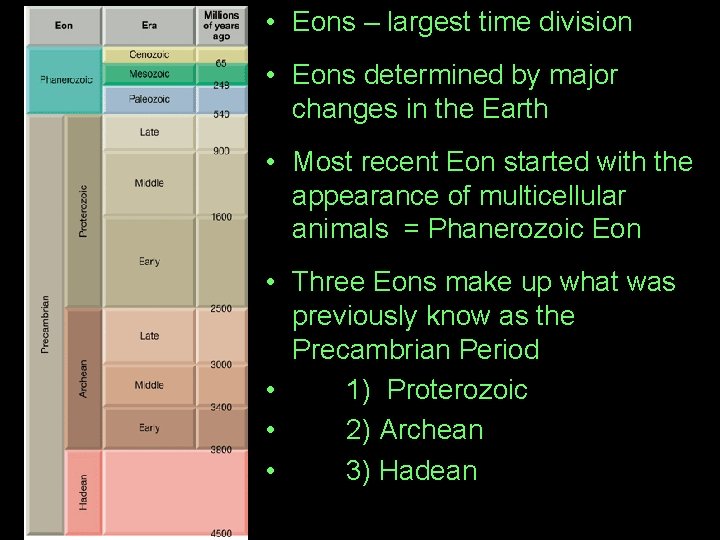
• Eons – largest time division • Eons determined by major changes in the Earth • Most recent Eon started with the appearance of multicellular animals = Phanerozoic Eon • Three Eons make up what was previously know as the Precambrian Period • 1) Proterozoic • 2) Archean • 3) Hadean
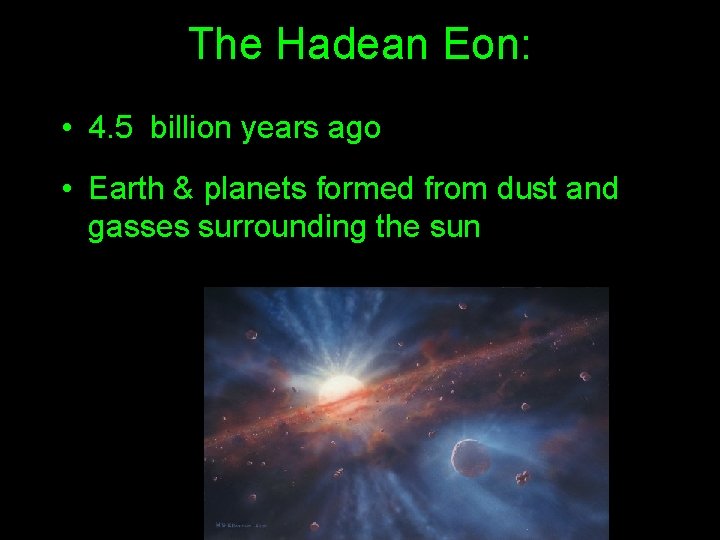
The Hadean Eon: • 4. 5 billion years ago • Earth & planets formed from dust and gasses surrounding the sun
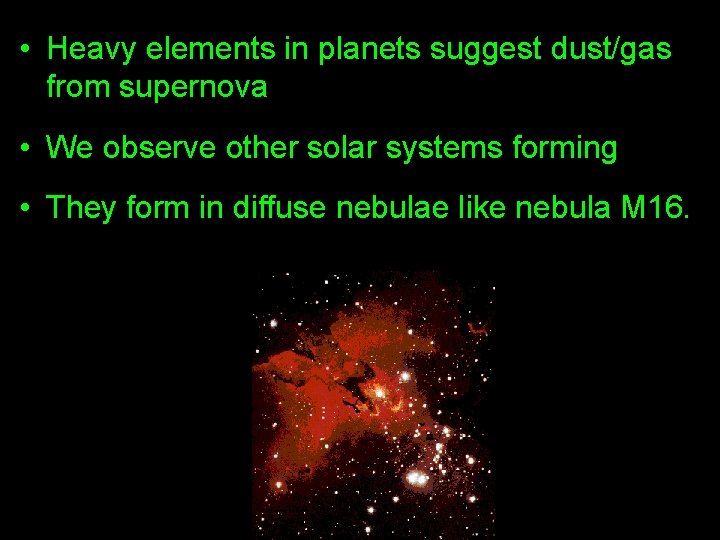
• Heavy elements in planets suggest dust/gas from supernova • We observe other solar systems forming • They form in diffuse nebulae like nebula M 16.
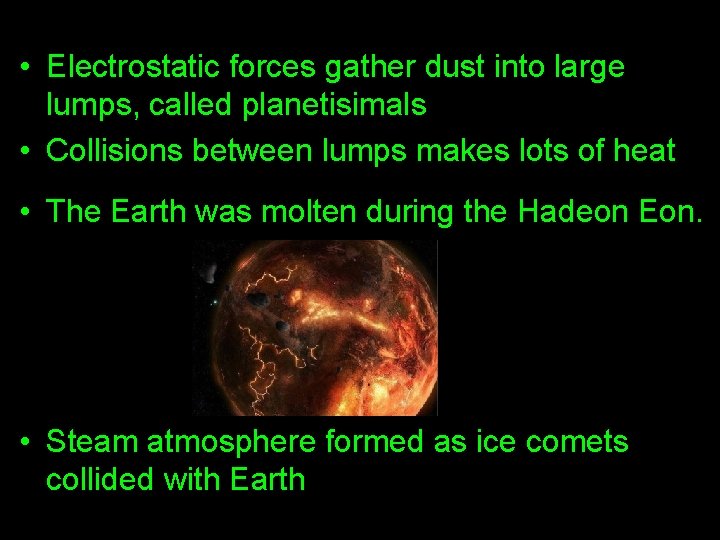
• Electrostatic forces gather dust into large lumps, called planetisimals • Collisions between lumps makes lots of heat • The Earth was molten during the Hadeon Eon. • Steam atmosphere formed as ice comets collided with Earth
• After most planetisimals had become part of a planet, …. . fewer collisions • Earth’s temperature dropped below 1, 000 C • First rocks formed as crust cooled • The oldest Earth rocks currently known are 3. 8 billion years old. • The oldest meteorites and lunar rocks are about 4. 5 billion years old • Erosion and plate tectonics have probably destroyed all of the Earth rocks older than 3. 8 billion years.
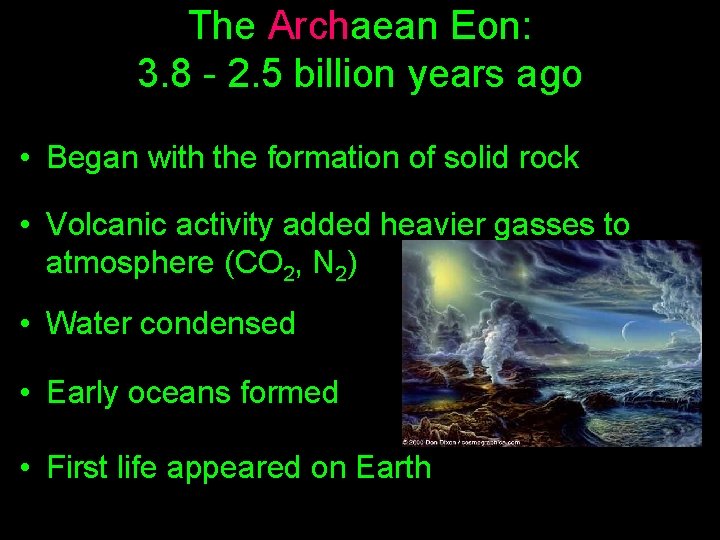
The Archaean Eon: 3. 8 - 2. 5 billion years ago • Began with the formation of solid rock • Volcanic activity added heavier gasses to atmosphere (CO 2, N 2) • Water condensed • Early oceans formed • First life appeared on Earth
Archean Atmosphere • (CO 2, H 2 O, N 2, CO, H 2 S, HCl) Still present in modern atmosphere Rare in modern atmosphere What’s missing? No free oxygen O 2…. . so no ozone either O 3
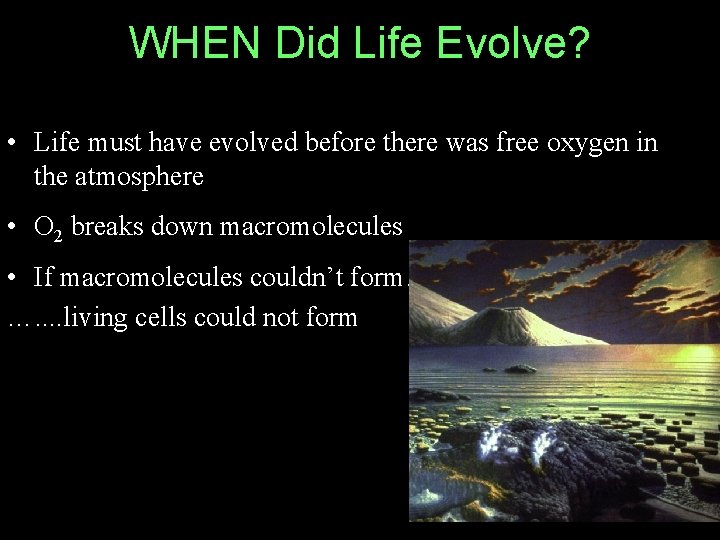
WHEN Did Life Evolve? • Life must have evolved before there was free oxygen in the atmosphere • O 2 breaks down macromolecules • If macromolecules couldn’t form…. …. . living cells could not form
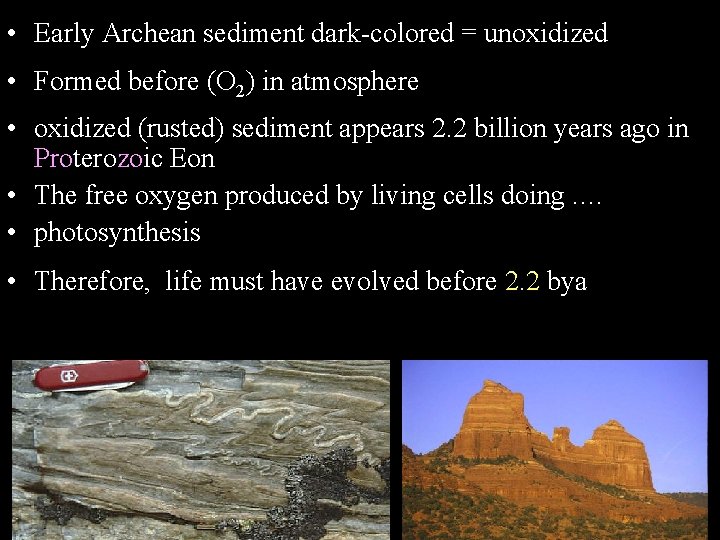
• Early Archean sediment dark-colored = unoxidized • Formed before (O 2) in atmosphere • oxidized (rusted) sediment appears 2. 2 billion years ago in Proterozoic Eon • The free oxygen produced by living cells doing. … • photosynthesis • Therefore, life must have evolved before 2. 2 bya
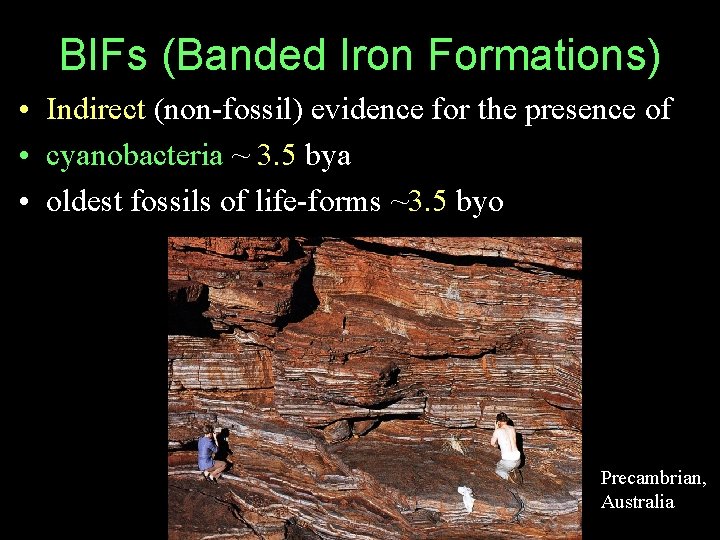
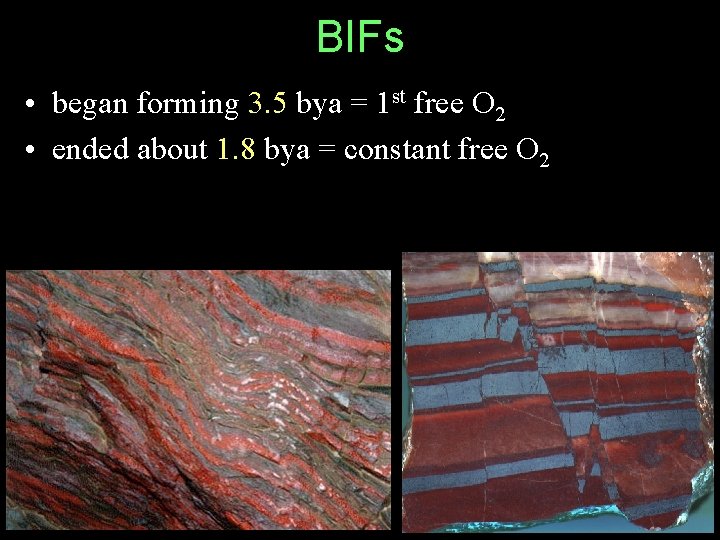
BIFs (Banded Iron Formations) • Indirect (non-fossil) evidence for the presence of • cyanobacteria ~ 3. 5 bya • oldest fossils of life-forms ~3. 5 byo Precambrian, Australia
Banded Iron Formations Created • iron dissolves in anaerobic water • when iron bonds to O 2 it becomes solid • the solid sinks to the ocean floor is deposited in layers • Layers of oxidized iron are red
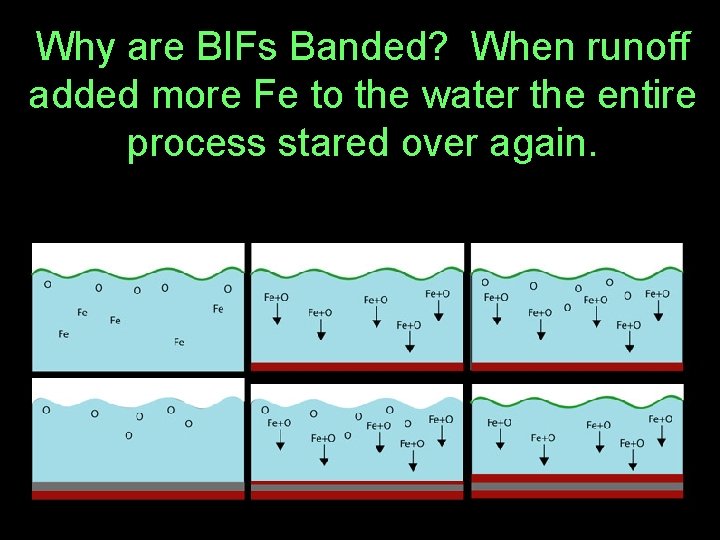
Why are BIFs Banded? When runoff added more Fe to the water the entire process stared over again.
What Likely Happened • O 2 made by cyanobacteria at ocean surface • O 2 toxic to them • but not if the O 2 was removed by bonding with iron (Fe) • Oceans contained dissolved iron
BIFs • began forming 3. 5 bya = 1 st free O 2 • ended about 1. 8 bya = constant free O 2
The Proterozoic Eon: 2. 5 -. 54 billion years ago major geologic changes • Earths crust fuse into large continents • End of BIFs…… • Oxygen resistant Cyanobacteria (early proterozoic) • Diversification of bacteria • First Eukaryotes appear ( protists) • Ediacaran fauna appear (soft invertebrates)
Phanerozioc Eon 540 million years ago -present • • 540 mya =. 54 bya Began with the Cambrian explosion of multicellular animal species and complex land plants