
Earth Earth 1 How big is the Earth
Earth
Earth 1. How big is the Earth? a) b) 2. 3. 4. 5. 6. 7. 8. Diameter Circumference How far is the Earth from the Sun? What do we call the gas layer? What do we call the water layer? How much of the water layer is fresh or salt water? How much of our water is ice on Earth? What do we call the land layer? Collect 10 other facts about the Earth using search engines.
Project Build the Sun, Earth, and Moon 1. Figure out diameter of Sun, Earth, and Moon 2. Determine the scale you want to use (only one scale for your model) Examples 1. 1000 miles = ___ centimeter 2. 2000 miles = ___ centimeter 3. 4. 5. 6. 7. 8. Draw 2 discuss for each body Cut half way across discuss and put together Color discs Investigate orbit of the Earth and the Moon Determine distance apart using your scale Practice movement

Background Material § Size of Earth – Diameter 12, 740 km § 8000 miles § Distance from North to South Pole – Circumference 40, 075 km § § § 25, 000 miles Distance around the earth Equator – imaginary line around the earth that divides it into 2 hemispheres, Northern and Southern – Distance from the Sun § 150, 000 km = 93, 000 miles § AU = Astronomical Unit (distance between the sun and the earth)
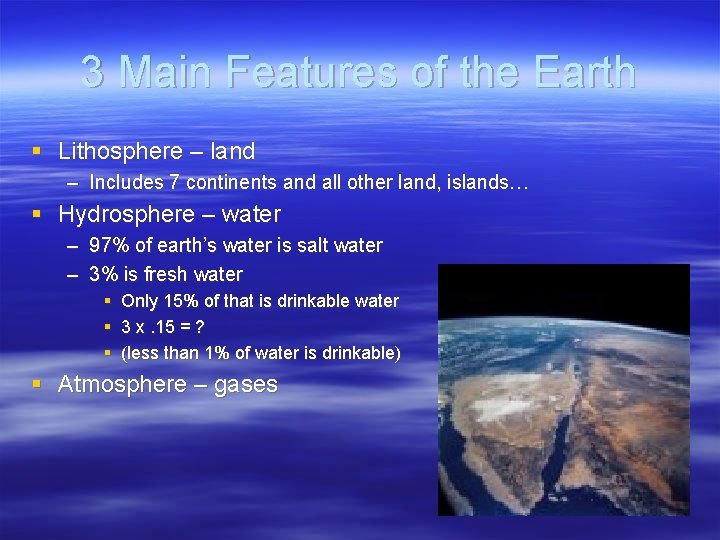
3 Main Features of the Earth § Lithosphere – land – Includes 7 continents and all other land, islands… § Hydrosphere – water – 97% of earth’s water is salt water – 3% is fresh water § Only 15% of that is drinkable water § 3 x. 15 = ? § (less than 1% of water is drinkable) § Atmosphere – gases
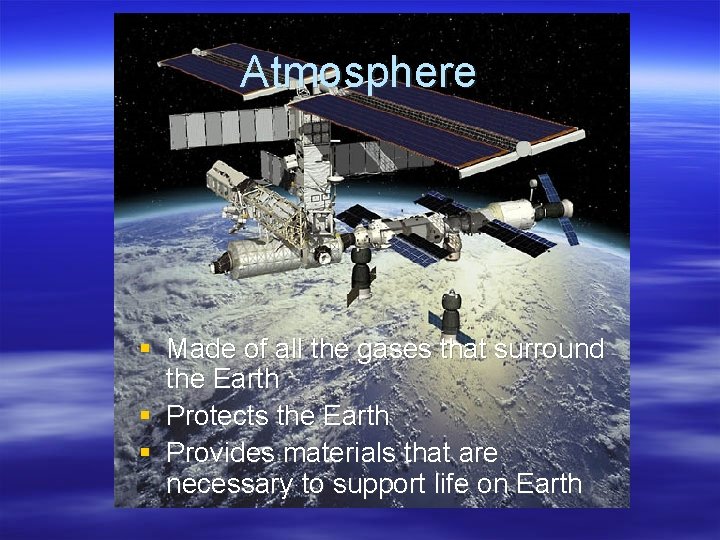
Atmosphere § Made of all the gases that surround the Earth § Protects the Earth § Provides materials that are necessary to support life on Earth
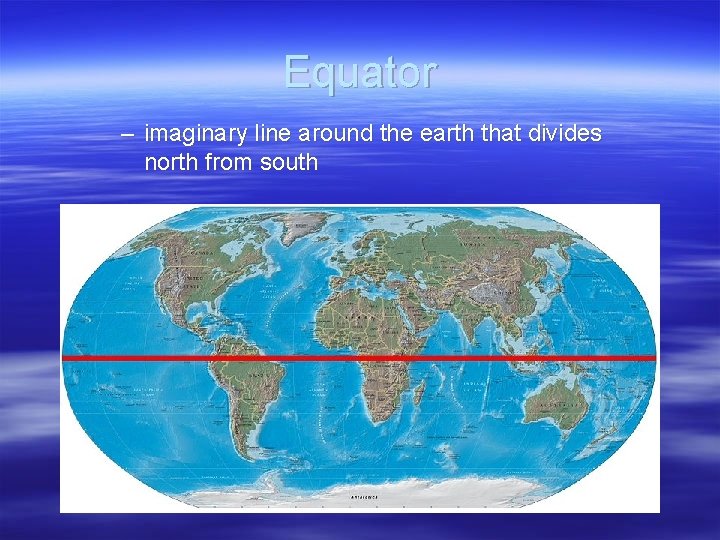
Equator – imaginary line around the earth that divides north from south
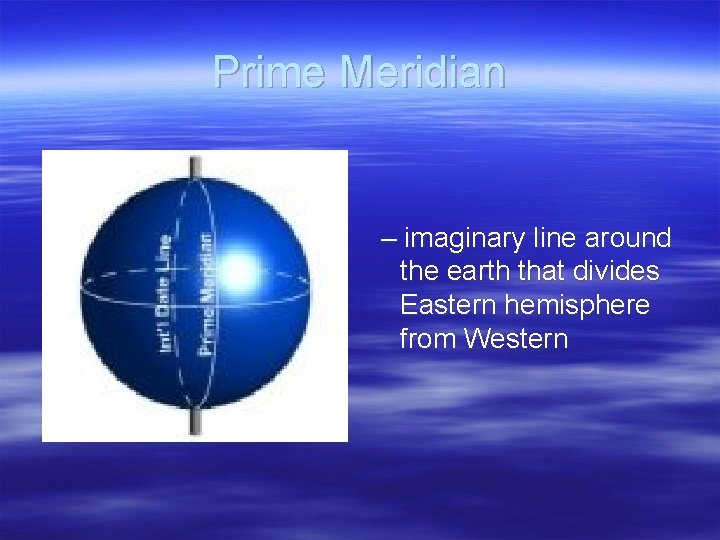
Prime Meridian – imaginary line around the earth that divides Eastern hemisphere from Western
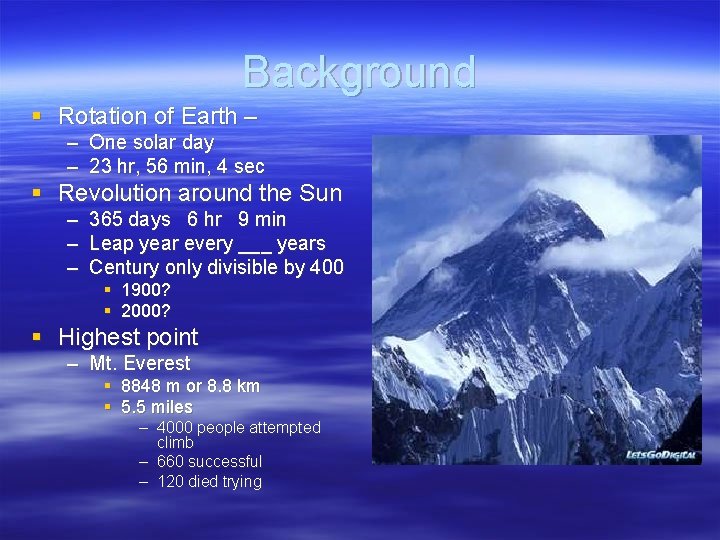
Background § Rotation of Earth – – One solar day – 23 hr, 56 min, 4 sec § Revolution around the Sun – 365 days 6 hr 9 min – Leap year every ___ years – Century only divisible by 400 § 1900? § 2000? § Highest point – Mt. Everest § 8848 m or 8. 8 km § 5. 5 miles – 4000 people attempted climb – 660 successful – 120 died trying
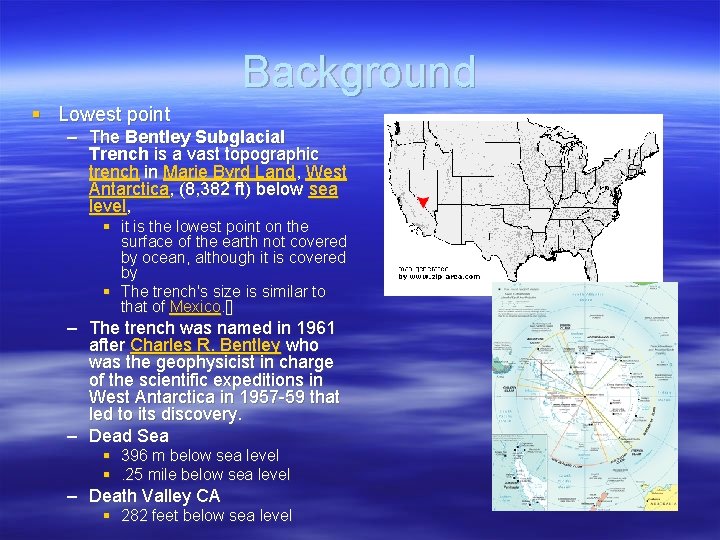
Background § Lowest point – The Bentley Subglacial Trench is a vast topographic trench in Marie Byrd Land, West Antarctica, (8, 382 ft) below sea level, § it is the lowest point on the surface of the earth not covered by ocean, although it is covered by § The trench's size is similar to that of Mexico. [] – The trench was named in 1961 after Charles R. Bentley who was the geophysicist in charge of the scientific expeditions in West Antarctica in 1957 -59 that led to its discovery. – Dead Sea § 396 m below sea level §. 25 mile below sea level – Death Valley CA § 282 feet below sea level
1. 2 Atmosphere § § Provides protection Provides materials necessary to support life
Temperature in Atmosphere
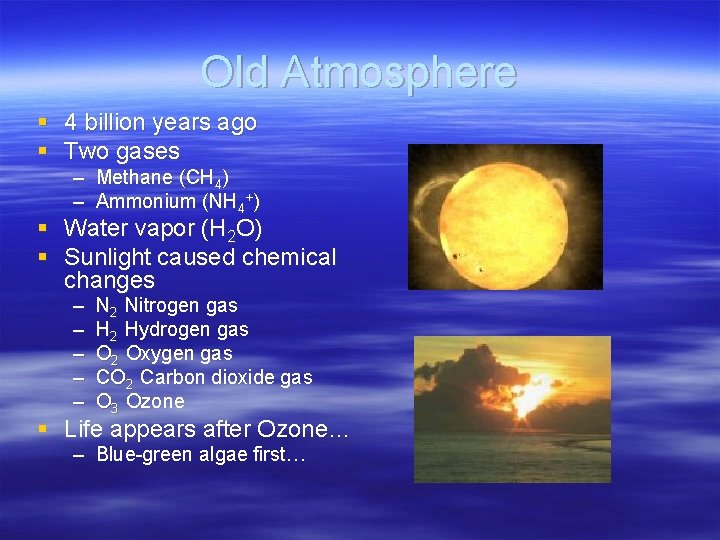
Old Atmosphere § 4 billion years ago § Two gases – – Methane (CH 4) Ammonium (NH 4+) § Water vapor (H 2 O) § Sunlight caused chemical changes – – – N 2 Nitrogen gas H 2 Hydrogen gas O 2 Oxygen gas CO 2 Carbon dioxide gas O 3 Ozone § Life appears after Ozone… – Blue-green algae first…
Present Atmosphere § § § 78% Nitrogen Gas 21% Oxygen Gas 1% other gases – water vapor – carbon dioxide – trace gases
Nitrogen Cycle § Free Nitrogen – N 2 – 78% of the atmosphere is free nitrogen – Will not burn – Odorless – Tasteless – Colorless
Why nitrogen? § Most abundant gas § Needed to make protein, growth and repair § Plants and animals can’t use it directly from the air.
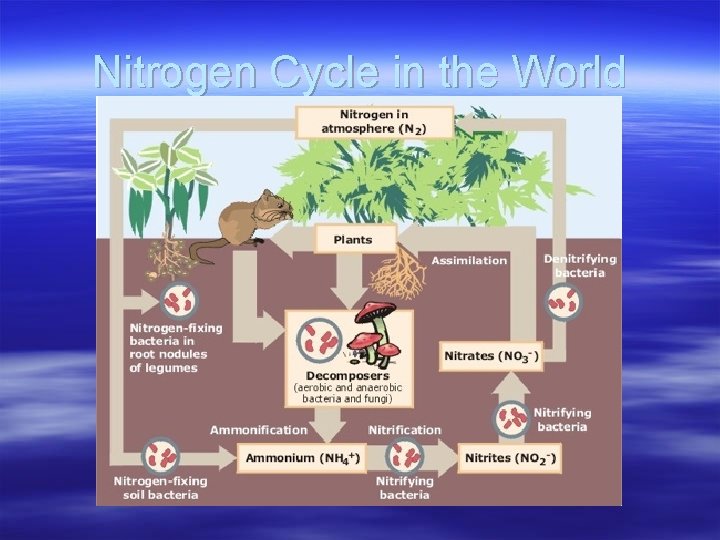
Nitrogen Cycle in the World
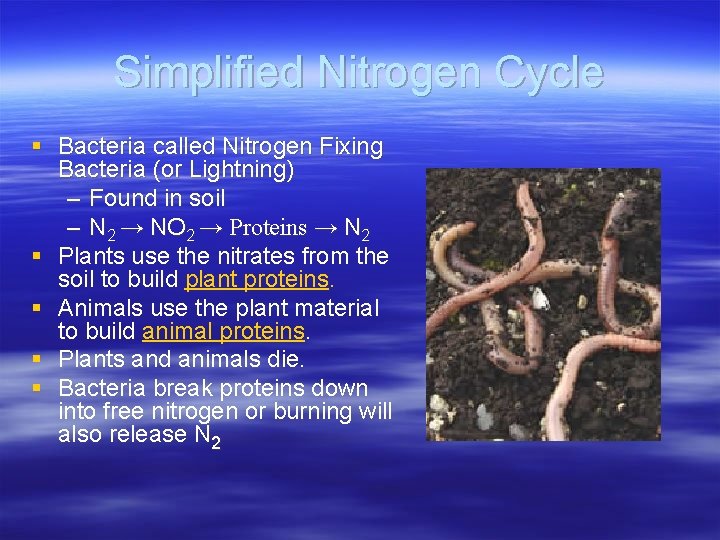
Simplified Nitrogen Cycle § Bacteria called Nitrogen Fixing Bacteria (or Lightning) – Found in soil – N 2 → NO 2 → Proteins → N 2 § Plants use the nitrates from the soil to build plant proteins. § Animals use the plant material to build animal proteins. § Plants and animals die. § Bacteria break proteins down into free nitrogen or burning will also release N 2
Sample Nitrogen Cycles Example 1 § Free nitrogen § Plant (legume) § Plant is eaten by a person § Person dies § Burning releases free nitrogen Example 2 § Free nitrogen § Lightning § Plant uses nitrate from soil § Rabbit eats plant § Hawk eats rabbit § Hawk dies § Decomposers liberate nitrogen
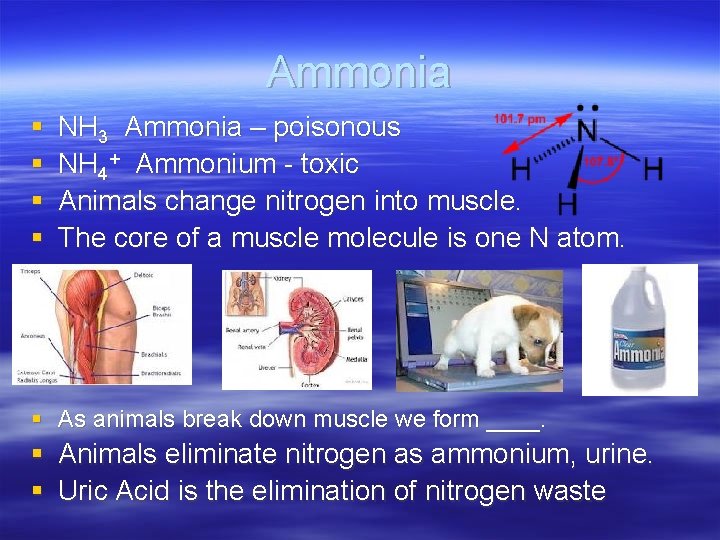
Ammonia § § NH 3 Ammonia – poisonous NH 4+ Ammonium - toxic Animals change nitrogen into muscle. The core of a muscle molecule is one N atom. § As animals break down muscle we form ____. § Animals eliminate nitrogen as ammonium, urine. § Uric Acid is the elimination of nitrogen waste
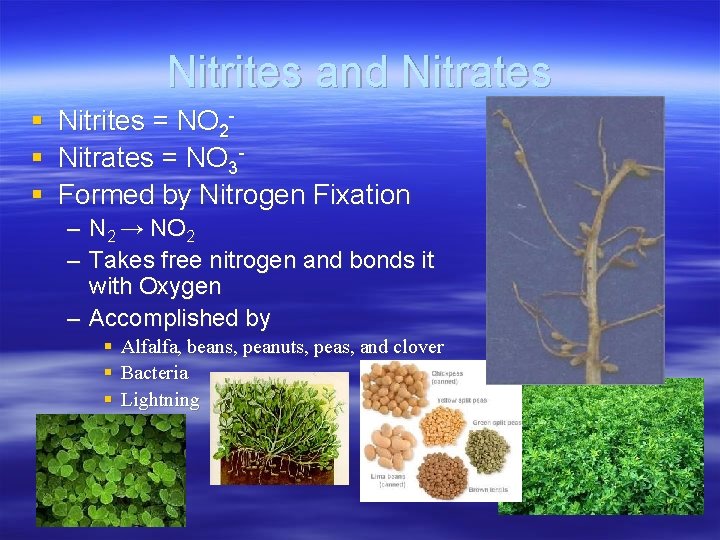
Nitrites and Nitrates § § § Nitrites = NO 2 Nitrates = NO 3 Formed by Nitrogen Fixation – N 2 → NO 2 – Takes free nitrogen and bonds it with Oxygen – Accomplished by § § § Alfalfa, beans, peanuts, peas, and clover Bacteria Lightning
Nitrogen Cycle Terms § § § § § Free Nitrogen Fixing Nitrogen Fixation Legumes Nodules Nitrite Nitrate Ammonia Ammonium § Nitrogen gas N 2 § Plants that do nitrogen fixing § Bubbles on roots where bacteria live on plants
Nitrogen Cycle Terms § Free Nitrogen – Nitrogen gas N 2 – found floating in atmosphere § Nitrogen Fixing or Nitrogen Fixation – When Oxygen is bonded to Nitrogen § Legumes – Plants that do nitrogen fixing § Nodules – Bubbles on roots where bacteria live on plants § Nitrite NO 2 – formed by legumes and lightning from free nitrogen § Ammonium NH 4+ – formed by breakdown of proteins in animals
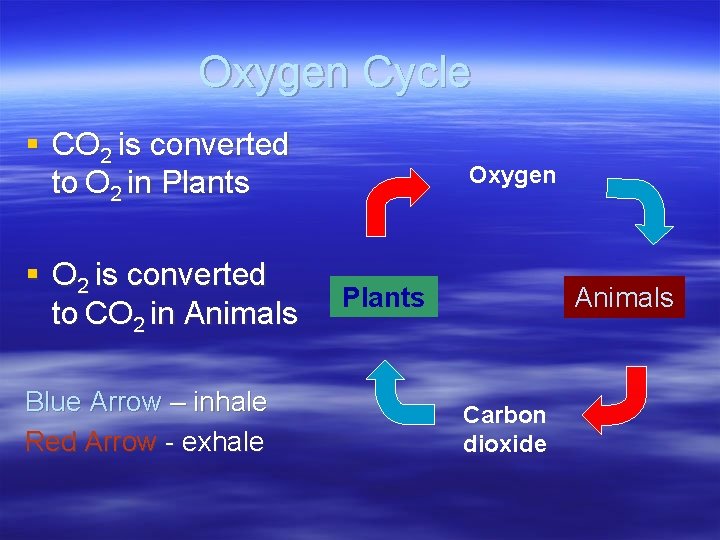
Oxygen Cycle § CO 2 is converted to O 2 in Plants § O 2 is converted to CO 2 in Animals Blue Arrow – inhale Red Arrow - exhale Oxygen Plants Animals Carbon dioxide
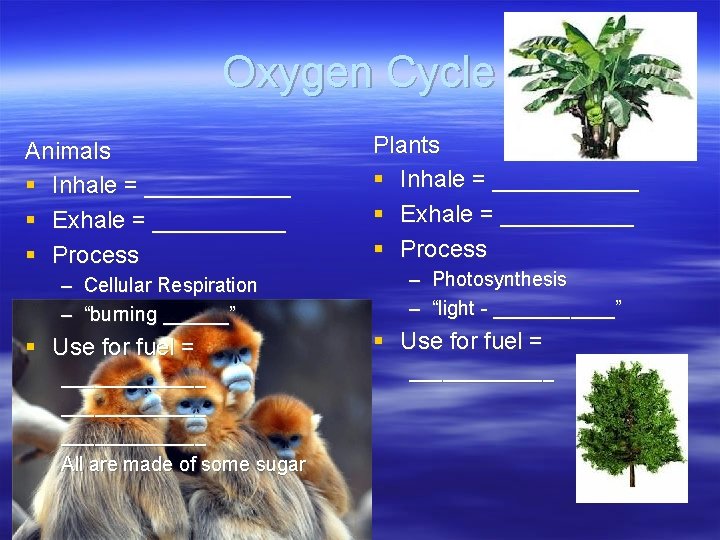
Oxygen Cycle Animals § Inhale = ______ § Exhale = _____ § Process – Cellular Respiration – “burning ______” § Use for fuel = _____________ All are made of some sugar Plants § Inhale = ______ § Exhale = _____ § Process – Photosynthesis – “light - ______” § Use for fuel = _______
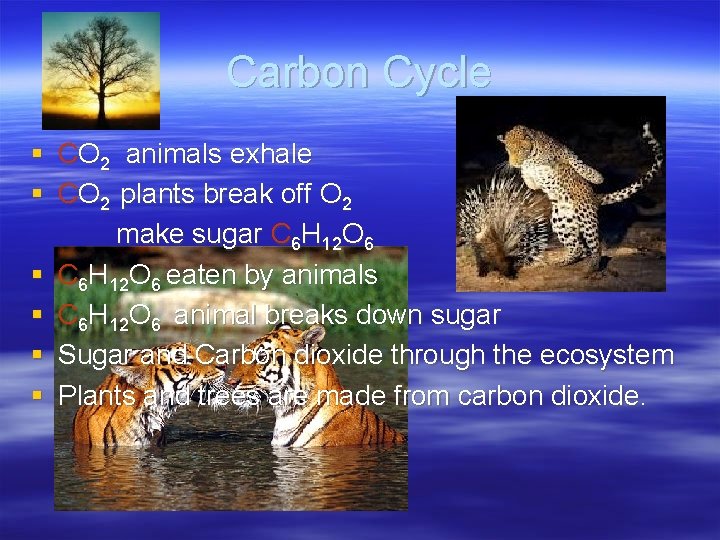
Carbon Cycle § CO 2 animals exhale § CO 2 plants break off O 2 make sugar C 6 H 12 O 6 § C 6 H 12 O 6 eaten by animals § C 6 H 12 O 6 animal breaks down sugar § Sugar and Carbon dioxide through the ecosystem § Plants and trees are made from carbon dioxide.
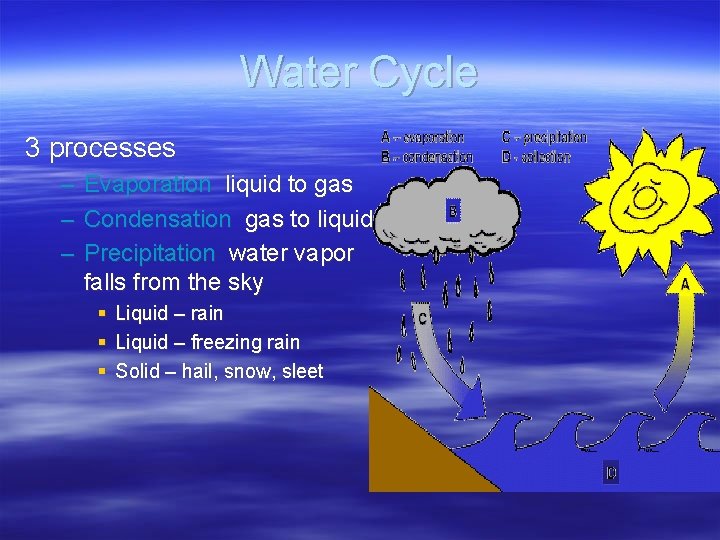
Water Cycle 3 processes – Evaporation liquid to gas – Condensation gas to liquid – Precipitation water vapor falls from the sky § § § Liquid – rain Liquid – freezing rain Solid – hail, snow, sleet
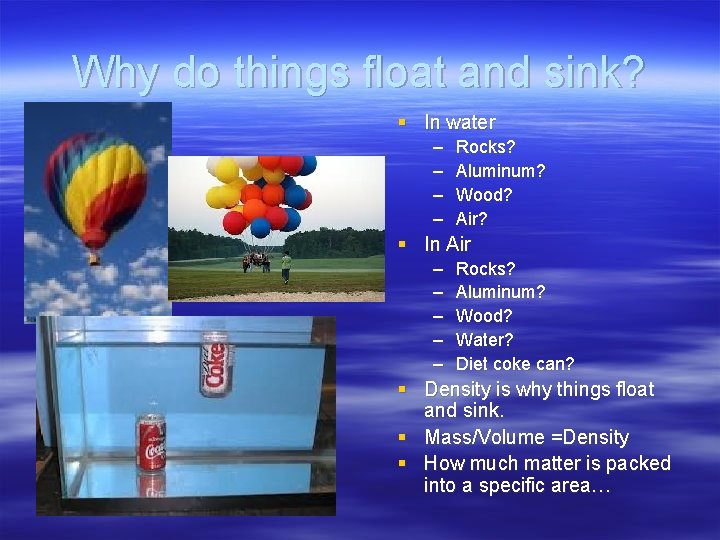
Why do things float and sink? § In water – – Rocks? Aluminum? Wood? Air? § In Air – – – Rocks? Aluminum? Wood? Water? Diet coke can? § Density is why things float and sink. § Mass/Volume =Density § How much matter is packed into a specific area…
Troposphere p 26 -27 1. 2. 3. 4. Where is it found? What do you find in it? What do you find above it? What is unique about it?
Troposphere 1. Where is it found? – Closes to the Earth (touching land) 2. What do you find in it? – – Our weather – clouds Convection Currents – warm air rises as it is heated by land the sun (creates wind) 3. What do you find above it? – Tropopause ? 4. What is unique about it? – – – Weather and clouds Life is found here We are most familiar with this area.
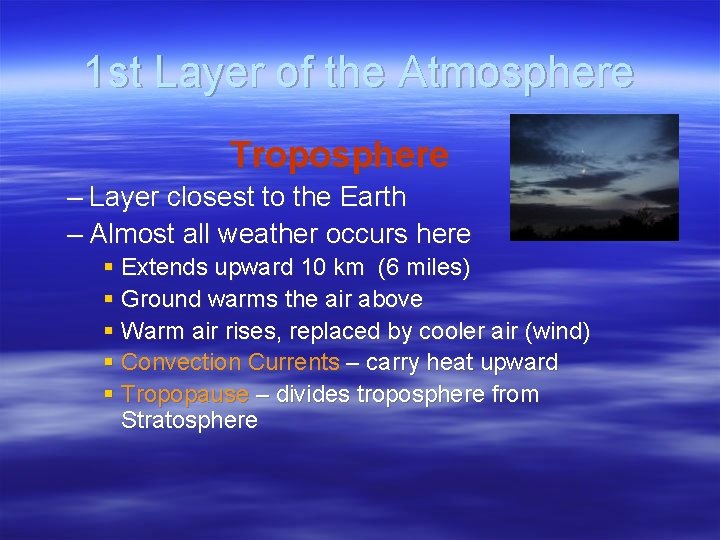
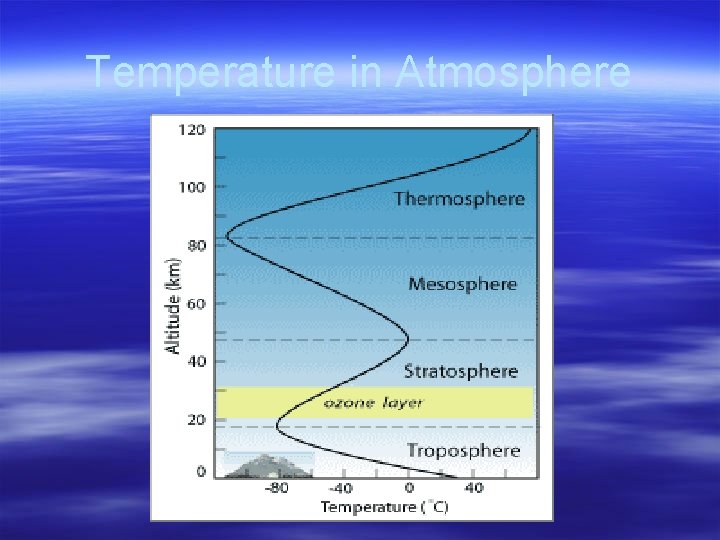
1 st Layer of the Atmosphere Troposphere – Layer closest to the Earth – Almost all weather occurs here § Extends upward 10 km (6 miles) § Ground warms the air above § Warm air rises, replaced by cooler air (wind) § Convection Currents – carry heat upward § Tropopause – divides troposphere from Stratosphere
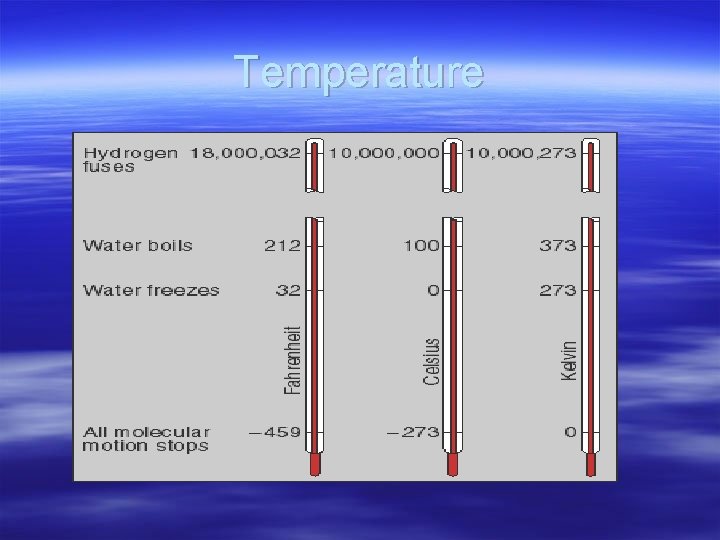
Temperature
Temperature
2 nd Layer of the Atmosphere Stratosphere – Extend from 10 -50 km (6 miles – 30 miles) – Temperature -60°C = ____°F – Very strong easterly winds “Jet Stream” blow around the earth – Contains Ozone Layer § § Is formed by electricity Clean, sharp smell Gives off heat as Ozone reacts with UV radiation Protection from UV rays – Stratopause divides Stratosphere from Mesosphere
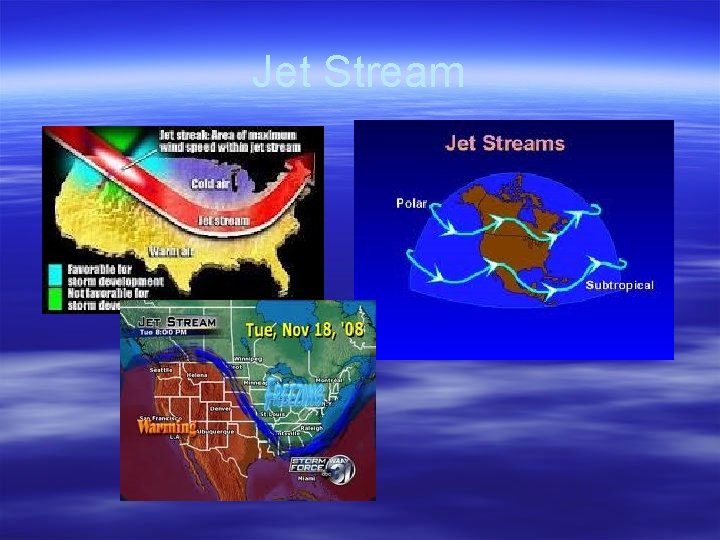
Jet Stream
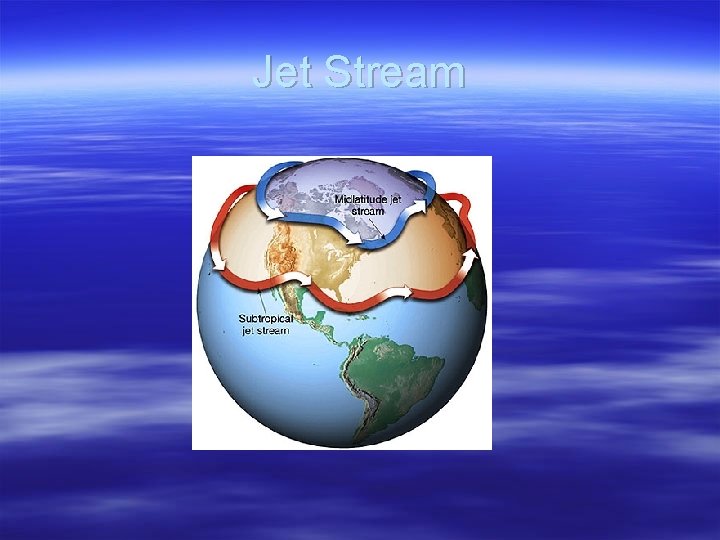
Jet Stream
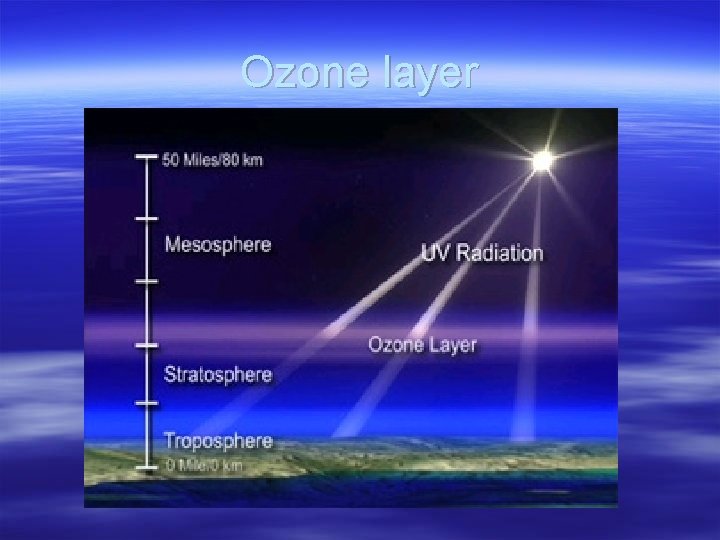
Ozone layer
3 rd Layer of the Atmosphere Mesosphere – Extend from 50 -80 km (30 miles – 50 miles) – Coldest area of Atmosphere – Temperature 0°C = ____°F → -100°C = ____°F – Upper portion - Coldest region in atmosphere – Protects earth from large meteoroids (rocks) § Burn up due to friction of the air § A few meteorites strike the earth, why? – Mesopause divides Mesosphere from Thermosphere
4 th Layer of the Atmosphere Thermosphere – – – Extend from 80 km (50 miles) and is undefined Largest area Temperature 2000°C = ____°F is the hottest § N 2 and O 2 absorb UV radiation from space § Ozone layer is reflecting heat – Special instrument to measure temperature § Temp. is how fast molecules are moving, not many molecules? – Empty space between particles is cold, NO ENERGY
Thermosphere Ionosphere 80 -550 km – – – Lower layer Gases absorb UV rad Important to radio broadcasting – AM radio waves bounce off ions and back to earth – carried greater distances Exosphere – – – 550 - 3000 km Upper layer Air is extremely thin Easy to see in space Artificial satellites orbit earth Satellites transmit TV signals, telephone and weather ISS § International Space Station § 300 miles above earth
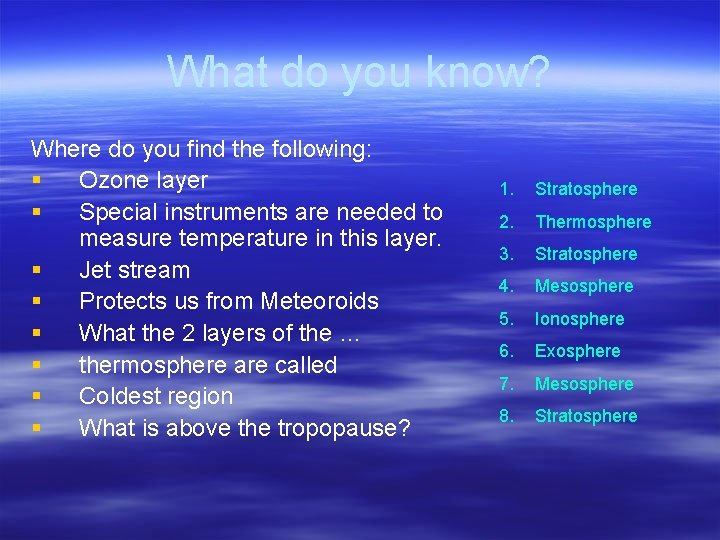
What do you know? Where do you find the following: § Ozone layer § Special instruments are needed to measure temperature in this layer. § Jet stream § Protects us from Meteoroids § What the 2 layers of the … § thermosphere are called § Coldest region § What is above the tropopause? 1. Stratosphere 2. Thermosphere 3. Stratosphere 4. Mesosphere 5. Ionosphere 6. Exosphere 7. Mesosphere 8. Stratosphere
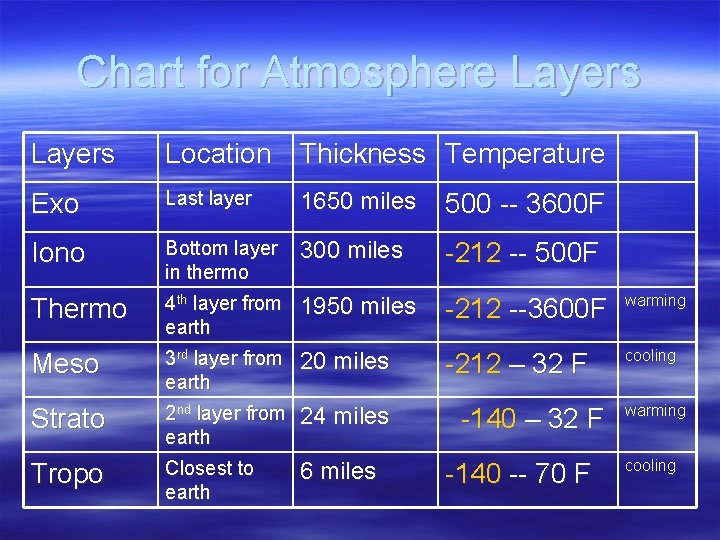
Chart for Atmosphere Layers Location Thickness Temperature Exo Last layer 1650 miles 500 -- 3600 F Iono Bottom layer in thermo 300 miles -212 -- 500 F Thermo 4 th layer from earth 1950 miles -212 --3600 F warming Meso 3 rd layer from earth 20 miles -212 – 32 F cooling Strato 2 nd layer from earth 24 miles Tropo Closest to earth 6 miles -140 – 32 F -140 -- 70 F warming cooling

Earth’s Magnetic Field § Magnetosphere – area around the earth, bigger than atmosphere – Has a magnetic field – Solar winds § Smash towards the sun § Away from the sun is big
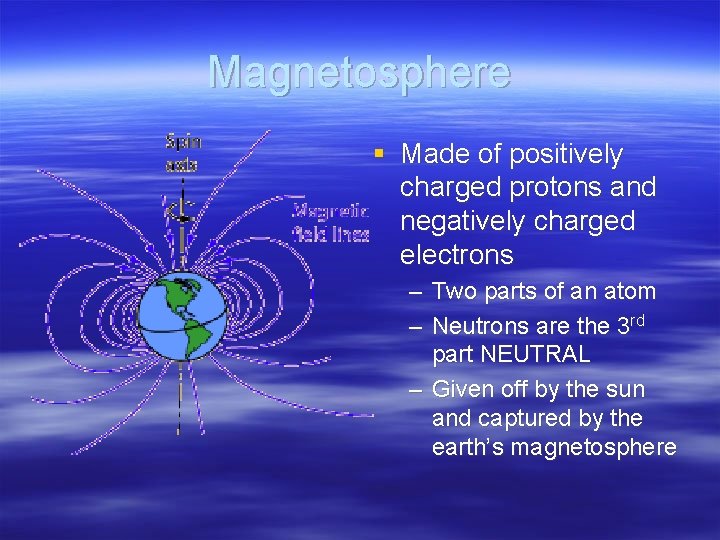
Magnetosphere § Made of positively charged protons and negatively charged electrons – Two parts of an atom – Neutrons are the 3 rd part NEUTRAL – Given off by the sun and captured by the earth’s magnetosphere
Quiz Time 1. Name the negative part of an atom. 2. What is another name for the Aurora Australis? 3. What does it mean if an object is described as being luminous? 4. How many planets are in our solar system? 5. What is the strongest part of a magnets field?
Answers 1. 2. 3. 4. 5. Electron Southern Lights Gives off its own light 8 poles
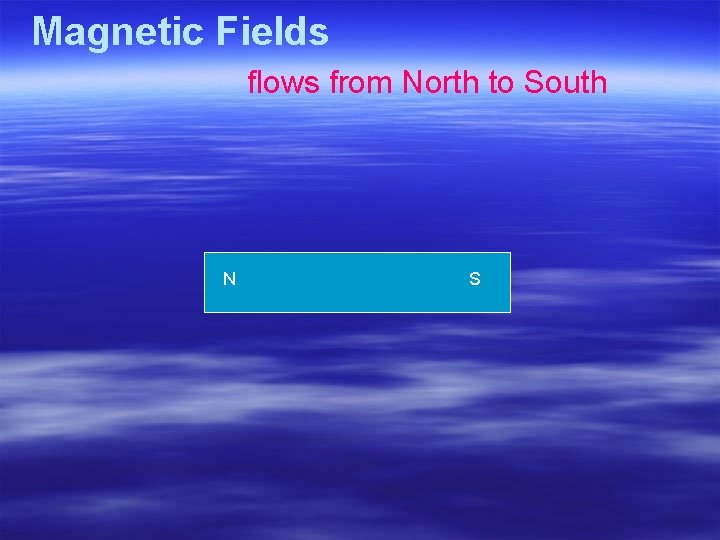
Magnetic Fields flows from North to South N S
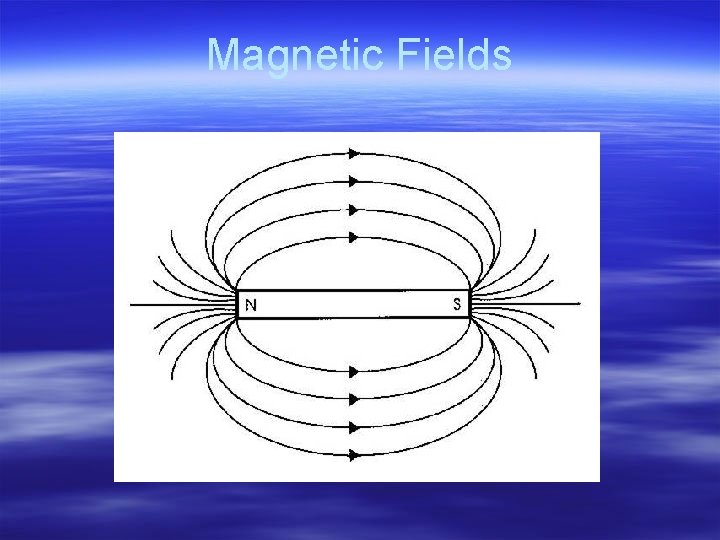
Magnetic Fields
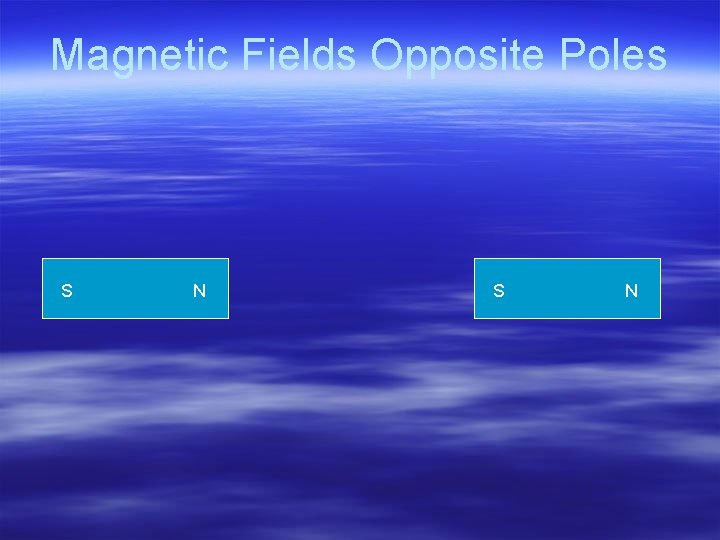
Magnetic Fields Opposite Poles S N
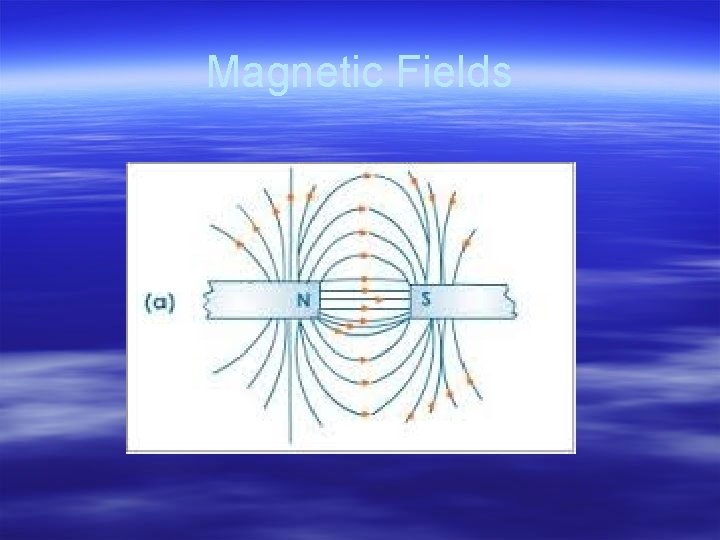
Magnetic Fields
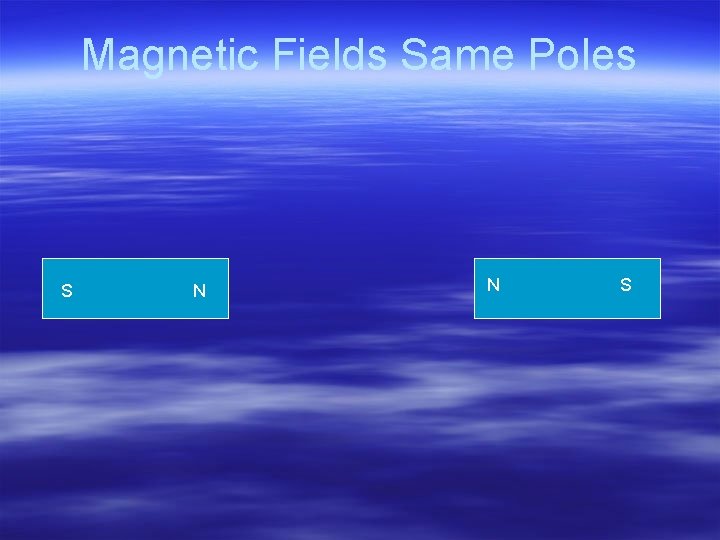
Magnetic Fields Same Poles S N N S
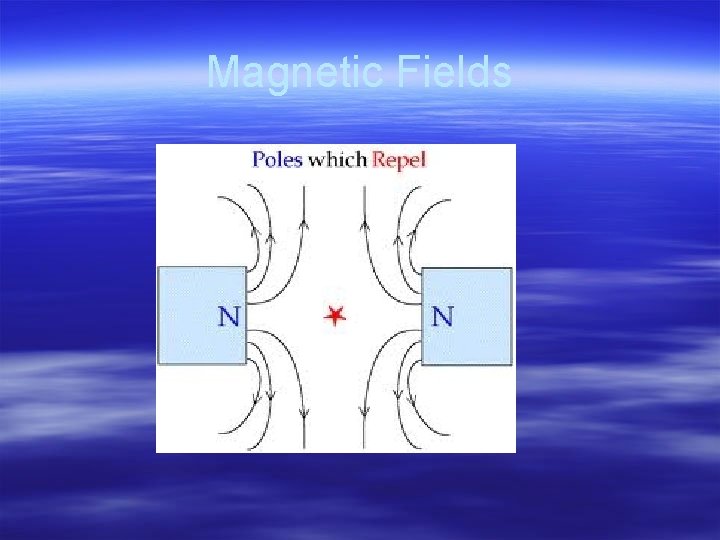
Magnetic Fields
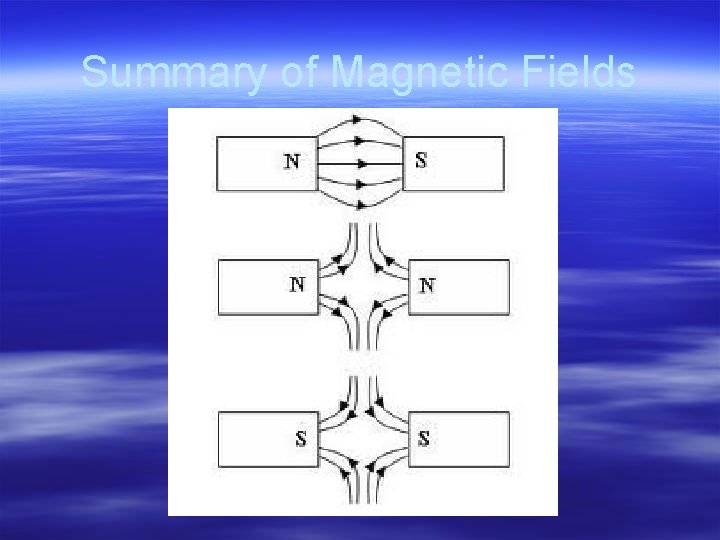
Summary of Magnetic Fields
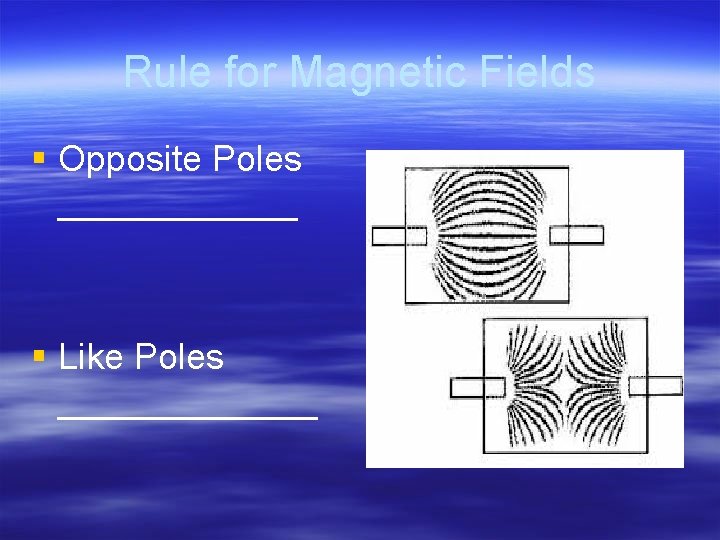
Rule for Magnetic Fields § Opposite Poles ______ § Like Poles _______
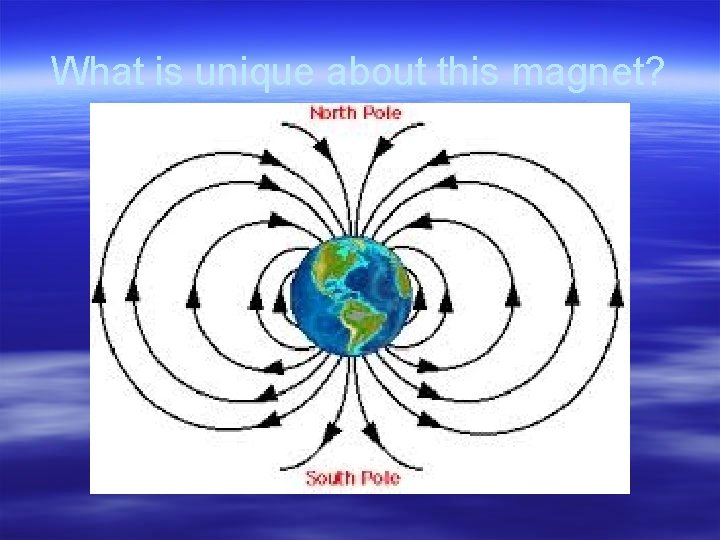
What is unique about this magnet?
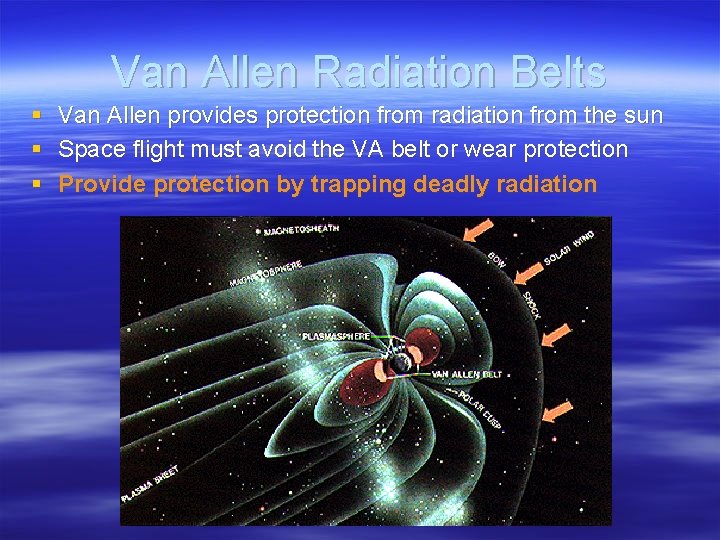
Van Allen Radiation Belts § Van Allen provides protection from radiation from the sun § Space flight must avoid the VA belt or wear protection § Provide protection by trapping deadly radiation
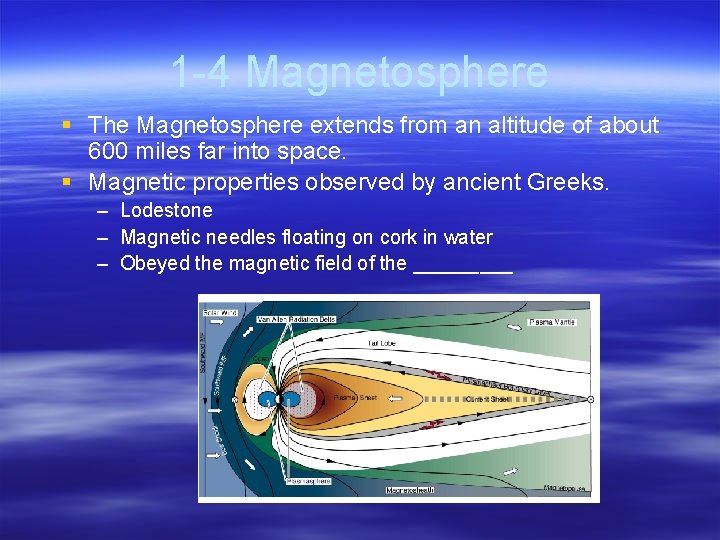
1 -4 Magnetosphere § The Magnetosphere extends from an altitude of about 600 miles far into space. § Magnetic properties observed by ancient Greeks. – Lodestone – Magnetic needles floating on cork in water – Obeyed the magnetic field of the _____
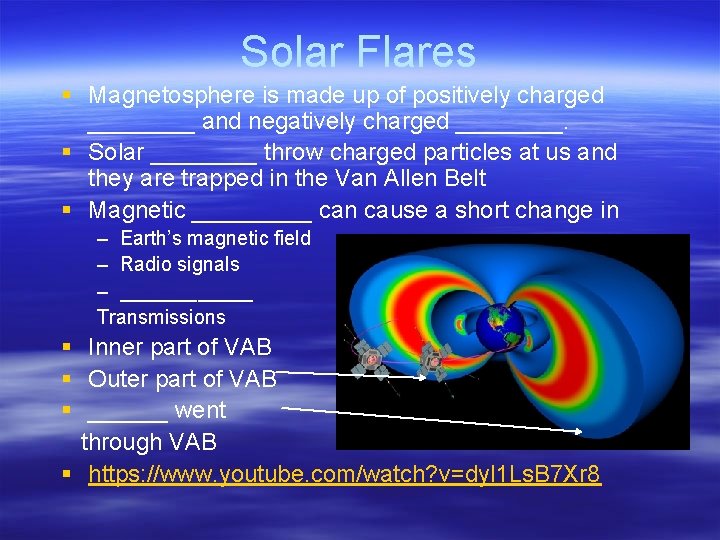
Solar Flares § Magnetosphere is made up of positively charged ____ and negatively charged ____. § Solar ____ throw charged particles at us and they are trapped in the Van Allen Belt § Magnetic _____ can cause a short change in – Earth’s magnetic field – Radio signals – ______ Transmissions § Inner part of VAB § Outer part of VAB § ______ went through VAB § https: //www. youtube. com/watch? v=dyl 1 Ls. B 7 Xr 8
Answers § § § Earth Protons and Electrons Flares Storms Cell phones Apollo
Subatomic Particles § § § Protons – positive particles in nucleus Neutrons – neutral particles in nucleus Electrons – negative particles in electron cloud
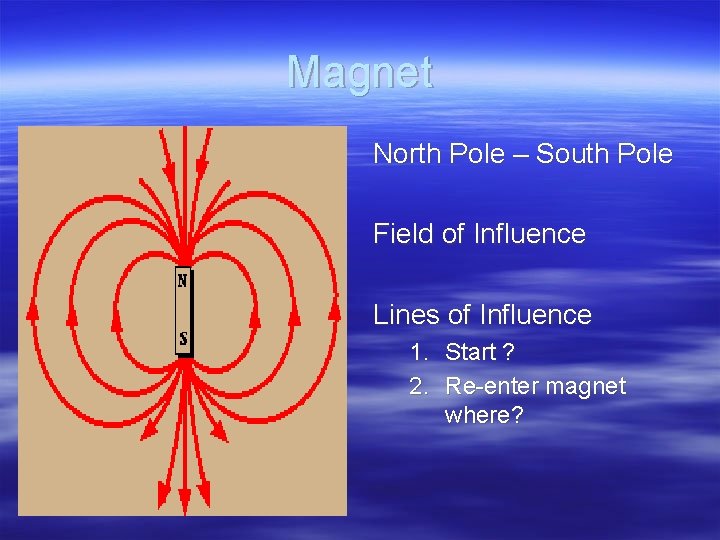
Magnet North Pole – South Pole Field of Influence Lines of Influence 1. Start ? 2. Re-enter magnet where?
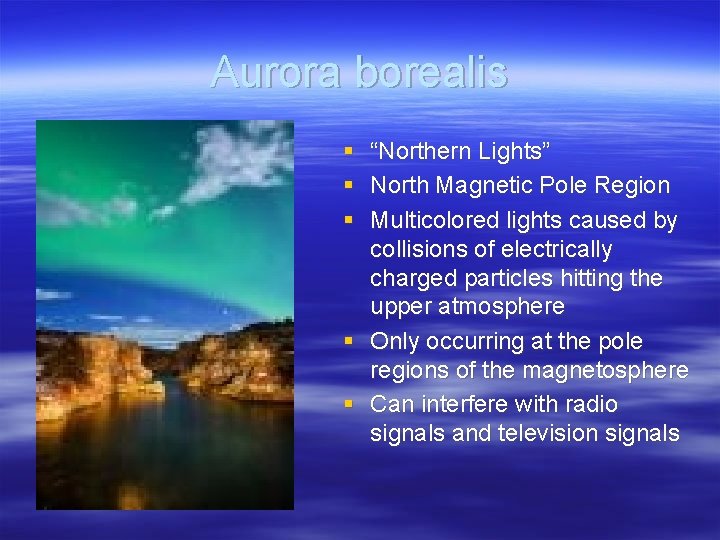
Aurora borealis § “Northern Lights” § North Magnetic Pole Region § Multicolored lights caused by collisions of electrically charged particles hitting the upper atmosphere § Only occurring at the pole regions of the magnetosphere § Can interfere with radio signals and television signals
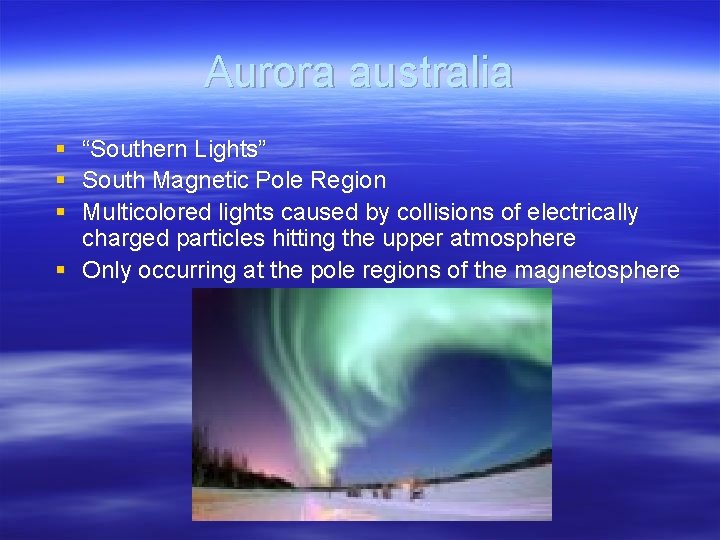
Aurora australia § § § “Southern Lights” South Magnetic Pole Region Multicolored lights caused by collisions of electrically charged particles hitting the upper atmosphere § Only occurring at the pole regions of the magnetosphere
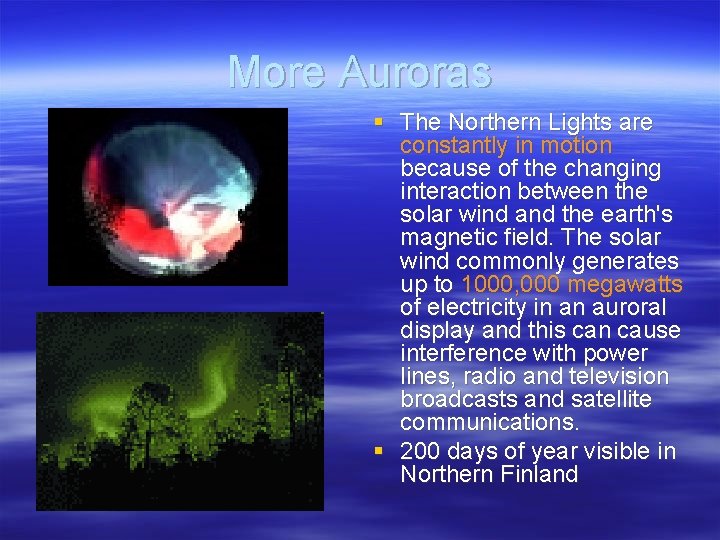
More Auroras § The Northern Lights are constantly in motion because of the changing interaction between the solar wind and the earth's magnetic field. The solar wind commonly generates up to 1000, 000 megawatts of electricity in an auroral display and this can cause interference with power lines, radio and television broadcasts and satellite communications. § 200 days of year visible in Northern Finland
Review Questions 1. What is the magnetosphere? 2. What is a proton? 3. Is the north pole at a different spot than the magnetic north pole? south pole? 4. What do we call the lines that show us the field of a magnet? 5. Give another name for the northern lights. 6. What causes the northern lights? 7. Can the northern lights be seen in New Jersey?
Review 1. What do we call an object that gives off its own light? 2. How would you define a galaxy? 3. What part of our world equals a day? 4. What part of our world equals a week? 5. What part of our world equals about month? 6. What part of our world equals a year?
Review 7. What do we call an objects that do not give off light? 8. Arrange our planets from smallest to largest? 9. Name a dwarf planet. 10. What is in the center of our solar system? 11. What does Astronomy literally mean? 12. What do we call the distance across a
Review 13. What is the imaginary line that circles the Earth dividing the northern and southern hemispheres called? 14. What do we call the two imaginary lines that circle the Earth an divide the eastern and western hemispheres called? 15. The equator is an example of this time of measurement around a sphere… 16. What % of the Earth’s atmosphere is Oxygen? 17. What is less than 1% of the Earth’s atmosphere? 18. Diameter, circumference, or distance to the sun… 93, 000 miles, 8, 000 miles and 25, 000 miles
Review 19. O 2 = ? 20. N 2 = ? 21. CO 2 = ? 22. What % of Earth’s water is fresh? 23. What % of the Earth’s water is saltwater? 24. What is a solar day?
1 -1 Planet Earth 1. Earth has 3 different regions? 2. Name the hemispheres the Earth is divided into… 3. Name the lines that divide the hemispheres? 4. How big is the Earth? Diameter and circumference…
1 -2 Old Atmosphere 1. 2. 3. 4. Starting reactants? Finishing products? What caused the reaction to take place? Name the cycles we studied?
1 -3 Layers of the Atmosphere 1. 2. 3. 4. 5. 6. 7. Lowest layer and what is in it? What is found between the layers? What causes the different layers? Second layer and what is in it? Third layer and what is in it? Fourth layers and what is in it? Name the two layers that make up layer 4.
1 -4 Magnetosphere 1. Give the shape of the magnetosphere. 2. What creates the Earth’s magnetosphere? 3. Draw a picture of the a magnetic field for a bar magnet. (Label the poles and use arrows. ) 4. What is the Van Allen Belt?
- Slides: 73