
Earth Chemistry Section 1 Comparing Physical and Chemical
- Slides: 55
Earth Chemistry Section 1 Comparing Physical and Chemical Properties Click below to watch the Visual Concept.
Earth Chemistry Section 1 Properties of Matter • matter anything that has mass and takes up space • Every object in the universe is made up of particles of matter. The amount of matter in any object is the mass of that object. • All matter has two types of distinguishing propertiesphysical properties and chemical properties.
Earth Chemistry Section 1 Properties of Matter, continued • Physical properties are characteristics that can be observed without changing the composition of the substance. • Physical properties include density, color, hardness, freezing point, boiling point, and the ability to conduct an electric current. • Chemical properties are characteristics that describe how a substance reacts with other substance to produce different substances.
Earth Chemistry Section 1 Properties of Matter, continued Elements • element a substance that cannot be separated or broken down into simpler substances by chemical means • Each element has a characteristic set of physical and chemical properties that identify it. • Approximately 90 elements occur naturally on Earth. Eight of these make up more than 98% of Earth’s crust.
Earth Chemistry Section 1 Properties of Matter, continued Atoms • Elements are made of atoms. • atom the smallest unit of an element that maintains the chemical properties of that element • A single atom is so small that its size is difficult to imagine.
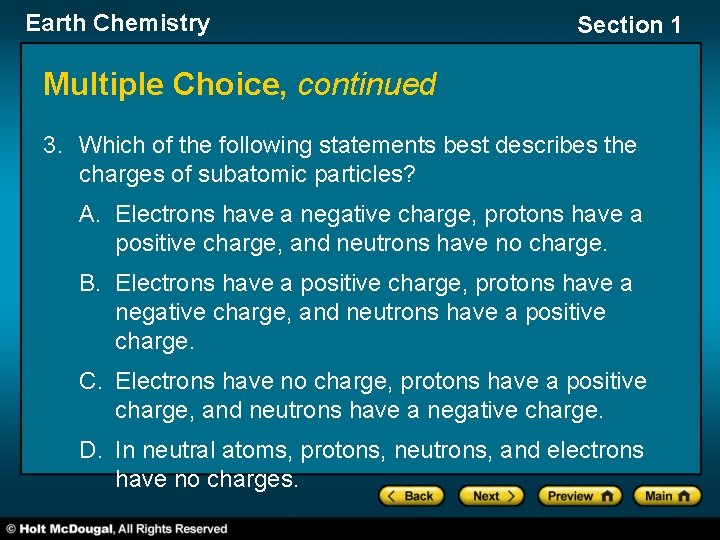
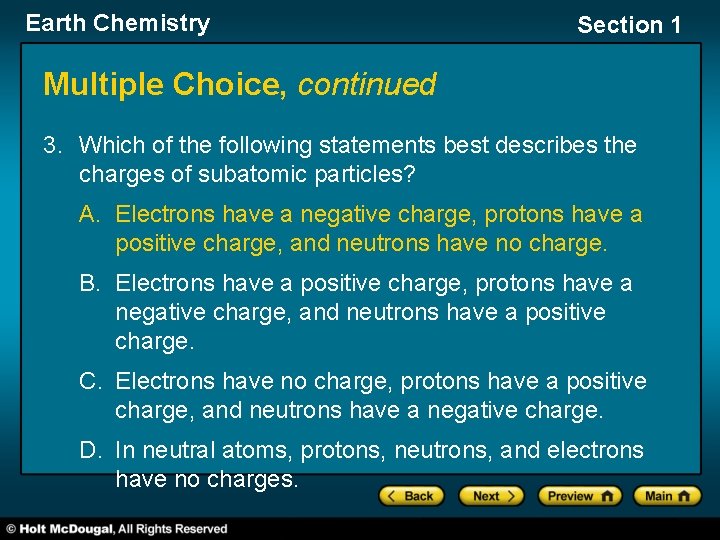
Earth Chemistry Section 1 Atomic Structure • Even though atoms are very tiny, they are made up of smaller parts called subatomic particles. • The three major kinds of subatomic particles are protons, electrons, and neutrons. • proton a subatomic particle that has a positive charge and that is located in the nucleus of an atom; the number of protons of the nucleus is the atomic number, which determines the identity of an element • electron a subatomic particle that has a negative charge • neutron a subatomic particle that has no charge and that is located in the nucleus of an atom
Earth Chemistry Section 1 Atomic Structure, continued The Nucleus • The protons and neutrons of an atom are packed close to one another and form the nucleus. • The positively charged nucleus makes up most of an atom’s mass but very little of its volume. The volume of an atom is mostly empty space. The Electron Cloud • The electrons of an atom move in a certain region of space called an electron cloud that surrounds the nucleus. • The negatively charged electrons are attracted to the positively charged nucleus. This attraction holds electrons in the atom.
Earth Chemistry Parts of the Atom Click below to watch the Visual Concept. Section 1
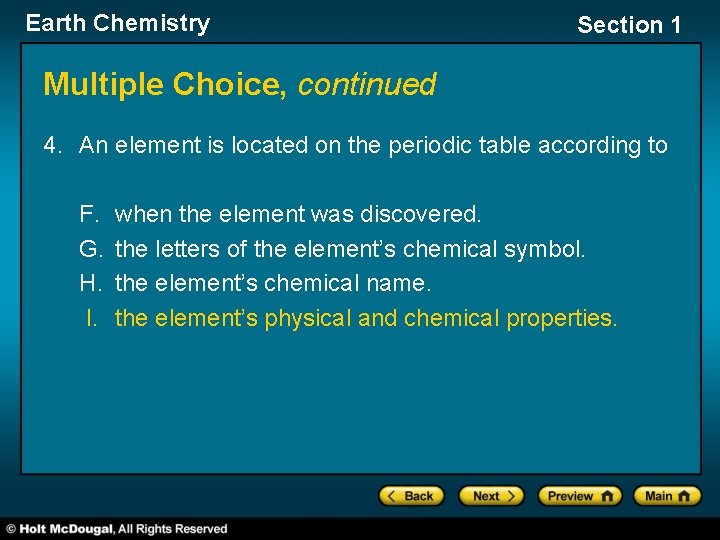
Earth Chemistry Section 1 Atomic Number • The number of protons in the nucleus of an atom is called the atomic number. • All atoms of any given element have the same atomic number. An element’s atomic number sets the atoms of that element apart from the atoms of all other elements. • Elements on the periodic table are ordered according to their atomic numbers. • Elements in the same column on the periodic table have similar arrangements of electrons in their atoms, and therefore have similar chemical properties.
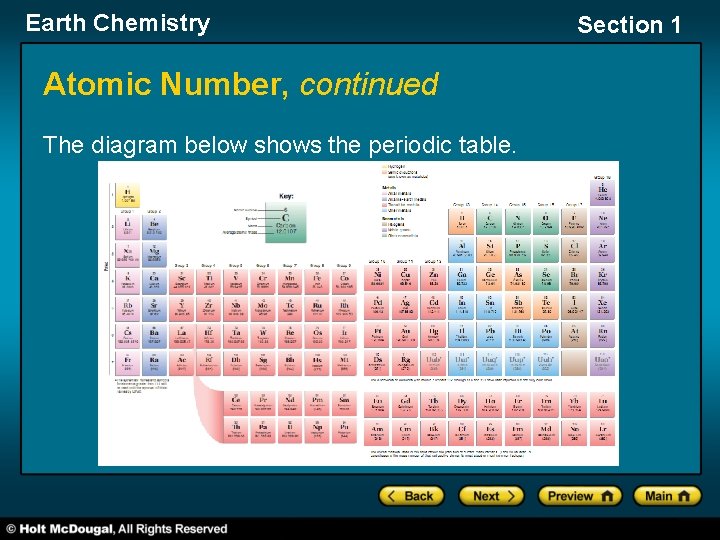
Earth Chemistry Atomic Number, continued The diagram below shows the periodic table. Section 1
Earth Chemistry Periodic Table Overview Click below to watch the Visual Concept. Section 1
Earth Chemistry Section 1 Atomic Mass • The sum of the number of protons and neutrons in an atom is the mass number. • The mass of a subatomic particle is too small to be expressed easily in grams, so a special unit called the unified atomic mass unit (u) is used. • Protons and neutrons each have an atomic mass close to 1 u.
Earth Chemistry Section 1 Atomic Mass, continued • Electrons have much less mass than protons or neutrons do. The mass of 1 proton is equal to the combined mass of about 1, 840 electrons. • Because electrons add little to an atom’s total mass, their mass can be ignored when calculating an atom’s approximate mass.
Earth Chemistry Section 1 Atomic Mass, continued Reading Check What is the difference between atomic number, mass number, and atomic mass unit? The atomic number is the number of protons in an atom’s nucleus. The mass number is the sum of the number of protons and the number of neutrons in an atom. The atomic mass unit is used to express the mass of subatomic particles or atoms.
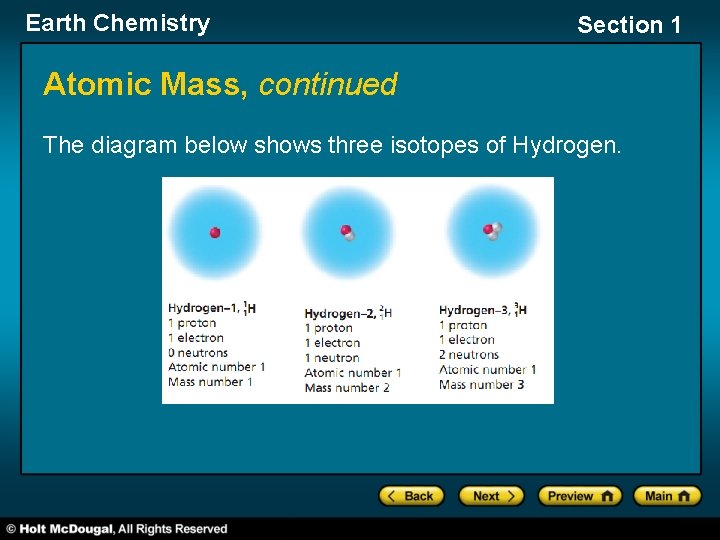
Earth Chemistry Section 1 Atomic Mass, continued Isotopes • Although all atoms of a given element contain the same number of protons, the number of neutrons may differ. • isotope one of two or more atoms that have the same number of protons (atomic number) but different numbers of neutrons (atomic mass) • Because of their different number of neutrons and their different masses, different isotopes of the same element have slightly different properties.
Earth Chemistry Section 1 Atomic Mass, continued Average Atomic Mass • Because isotopes of an element have different masses, the periodic table uses an average atomic mass of each element. • The average atomic mass is the weighted average of the atomic masses of the naturally occurring isotopes of an element.
Earth Chemistry Section 1 Atomic Mass, continued The diagram below shows three isotopes of Hydrogen.
Earth Chemistry Section 1 Valence Electrons and Periodic Properties • Based on similarities in their chemical properties, elements on the periodic table arranged in columns, which are called groups. • An atom’s chemical properties are largely determined by the number of the outermost electrons in an atom’s electron cloud. These electrons are called valence electrons. • Within each group, the atoms of each element generally have the same number of valence electrons.
Earth Chemistry Section 1 Valence Electrons and Periodic Properties, continued • When an atom has 8 valence electrons, it is considered stable, or chemically unreactive. Unreactive atoms do not easily lose or gain electrons. • Elements whose atoms have only one, two, or three valence electrons tend to lose electrons easily. These elements have metallic properties and are generally classified as metals. • Elements whose atoms have from four to seven valence electrons are more likely to gain electrons. Many of these elements are classified as nonmetals.
Earth Chemistry Section 1 Molecules • Elements rarely occur in pure form in Earth’s crust. They generally occur in combination with other elements. • compound a substance made up of atoms of two or more different elements joined by chemical bonds • The properties of a compound differ from the properties of the elements that make up the compound. • molecule a group of atoms that are held together by chemical forces • A molecule is the smallest unit of matter that can exist by itself and retain all of a substance’s chemical properties.
Earth Chemistry Compounds Click below to watch the Visual Concept. Section 1
Earth Chemistry Section 1 Chemical Formulas • A chemical formula is a combination of letters and numbers that shows which elements make up a compound. • A chemical formula shows the number of atoms of each element that are required to make a molecule of a compound. • In a chemical formula, the subscript that appears after the symbol for an element shows the number of atoms of that element that are in a molecule. For example: H 2 O = 2 H (hydrogen atoms) + 1 O (oxygen atom)
Earth Chemistry Section 1 Chemical Equations • Elements and compounds often combine through chemical reactions to form new compounds. • The reaction of these elements and compounds can be described in a formula called a chemical equation. Equation Structure • In a chemical equation, the reactants (to the left of the arrow) form the products (to the right of the arrow) through chemical reactions. • The arrow means “gives” or “yields. ”
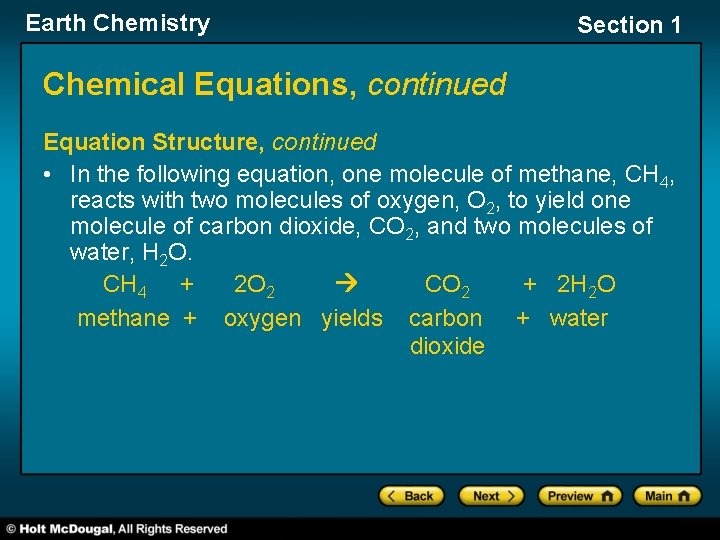
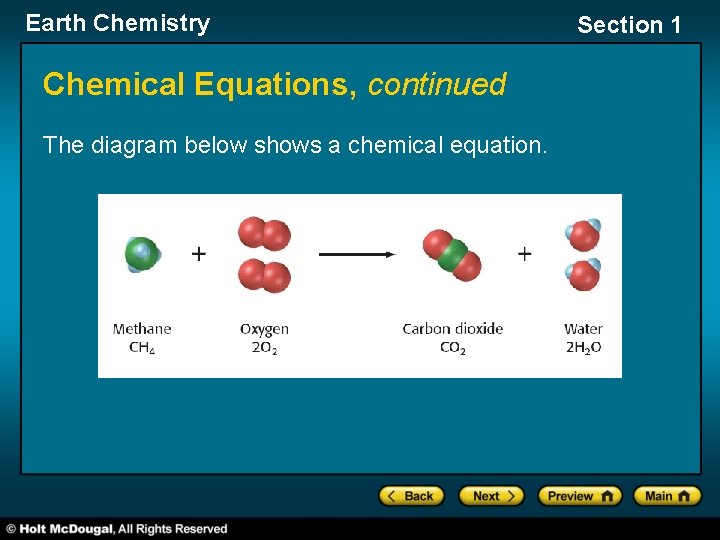
Earth Chemistry Section 1 Chemical Equations, continued Equation Structure, continued • In the following equation, one molecule of methane, CH 4, reacts with two molecules of oxygen, O 2, to yield one molecule of carbon dioxide, CO 2, and two molecules of water, H 2 O. CH 4 + 2 O 2 CO 2 + 2 H 2 O methane + oxygen yields carbon + water dioxide
Earth Chemistry Chemical Equations, continued The diagram below shows a chemical equation. Section 1
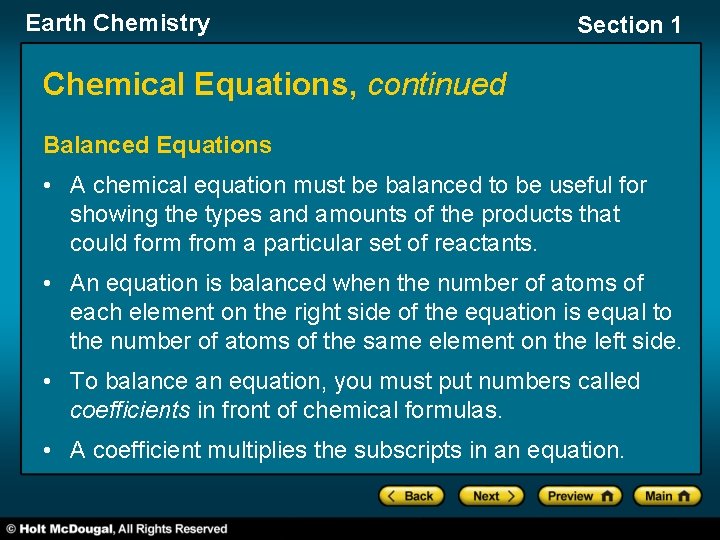
Earth Chemistry Section 1 Chemical Equations, continued Balanced Equations • A chemical equation must be balanced to be useful for showing the types and amounts of the products that could form from a particular set of reactants. • An equation is balanced when the number of atoms of each element on the right side of the equation is equal to the number of atoms of the same element on the left side. • To balance an equation, you must put numbers called coefficients in front of chemical formulas. • A coefficient multiplies the subscripts in an equation.
Earth Chemistry Section 1 Balancing a Chemical Equation by Inspection Click below to watch the Visual Concept.
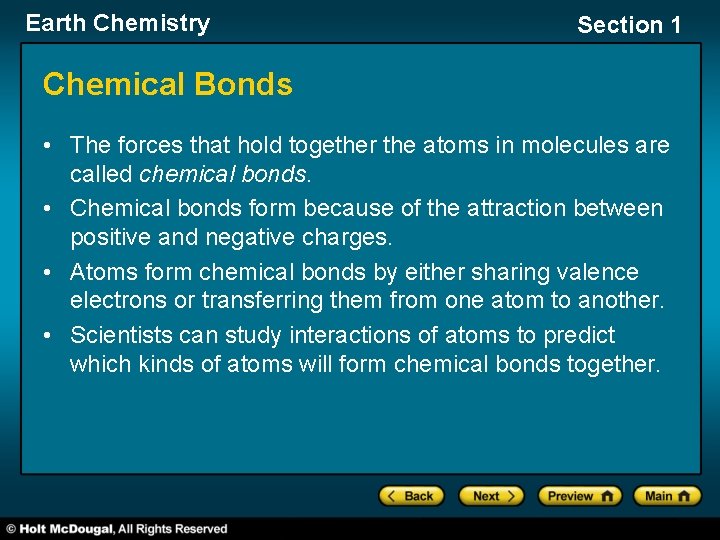
Earth Chemistry Section 1 Chemical Bonds • The forces that hold together the atoms in molecules are called chemical bonds. • Chemical bonds form because of the attraction between positive and negative charges. • Atoms form chemical bonds by either sharing valence electrons or transferring them from one atom to another. • Scientists can study interactions of atoms to predict which kinds of atoms will form chemical bonds together.
Earth Chemistry Section 1 Chemical Bonds, continued Reading Check In what two ways do atoms form chemical bonds? Atoms form chemical bonds by transferring electrons or by sharing electrons.
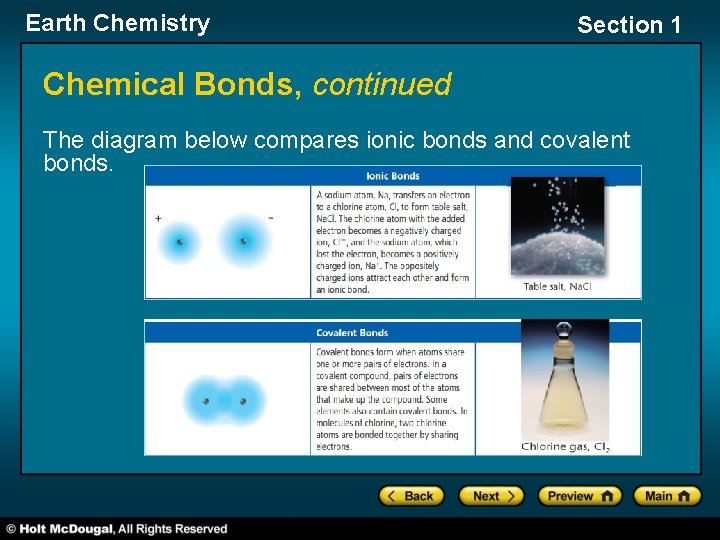
Earth Chemistry Section 1 Chemical Bonds, continued Ions • When an electron is transferred from one atom to another, both atoms become charged. • ion an atom or molecule that has gained or lost one or more electrons and has a negative or positive charge Ionic Bonds • ionic bond the attractive force between oppositely charged ions, which form when electrons are transferred from one atom or molecule to another • A compound that forms through the transfer of electrons is called an ionic compound.
Earth Chemistry Section 1 Chemical Bonds, continued Covalent Bonds • covalent bond a bond formed when atoms share one or more pairs of electrons • A compound that forms through the sharing of electrons is called a covalent compound. Polar Covalent Bonds • A covalent bond in which the bonded atoms have an unequal attraction for the shared electrons is called a polar covalent bond.
Earth Chemistry Section 1 Chemical Bonds, continued The diagram below compares ionic bonds and covalent bonds.
Earth Chemistry Section 1 Chemical Bonds, continued Reading Check Why do water molecules form from polar covalent bonds? The oxygen atom has a larger and more positively charged nucleus than the hydrogen atoms do. As a result, the oxygen nucleus pulls the electrons from the hydrogen atoms closer to it than the hydrogen nuclei pull the shared electrons from the oxygen. This unequal attraction forms a polar-covalent bond.
Earth Chemistry Section 1 Mixtures • mixture a combination of two or more substances that are not chemically combined • Because the substances that make up a mixture keep their individual properties, a mixture can be separated into its parts by physical means. Heterogeneous Mixtures • Mixtures in which two or more substances are not uniformly distributed are called heterogeneous mixtures.
Earth Chemistry Section 1 Mixtures, continued Homogeneous Mixtures • In chemistry, the word homogeneous means “having the same composition and properties throughout. ” • solution a homogeneous mixture throughout which two or more substances are uniformly dispersed • Liquids, gases, and solids can all be solutions. • An alloy is a solution composed of two or more metals, such as steel.
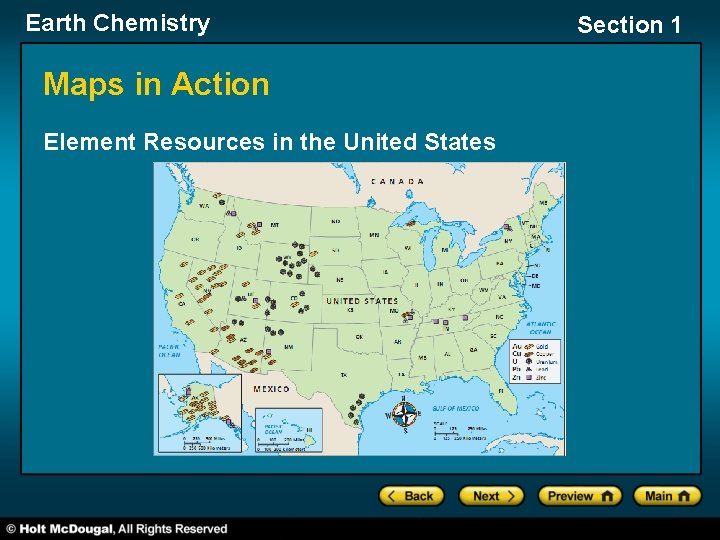
Earth Chemistry Maps in Action Element Resources in the United States Section 1
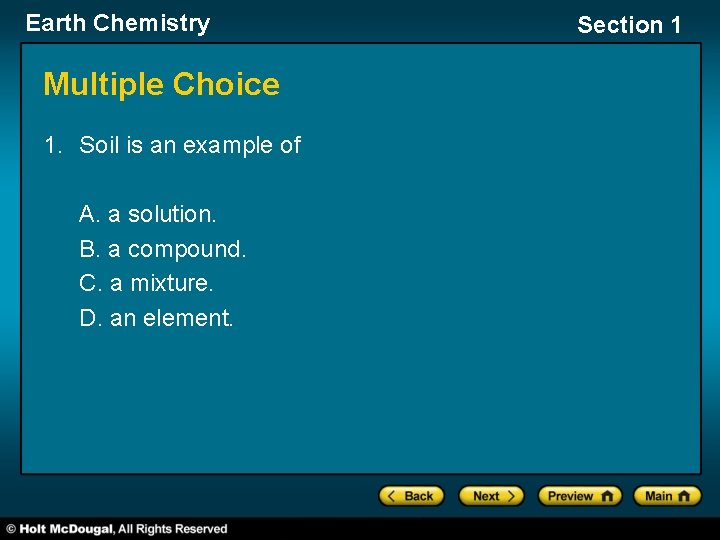
Earth Chemistry Multiple Choice 1. Soil is an example of A. a solution. B. a compound. C. a mixture. D. an element. Section 1
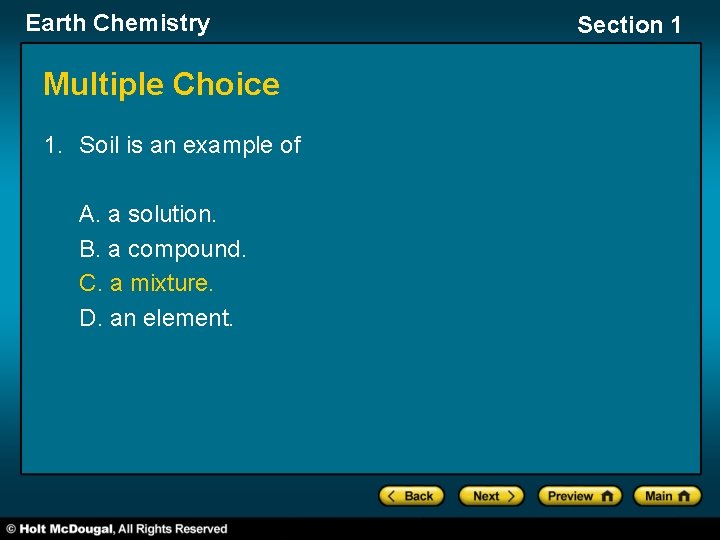
Earth Chemistry Multiple Choice 1. Soil is an example of A. a solution. B. a compound. C. a mixture. D. an element. Section 1
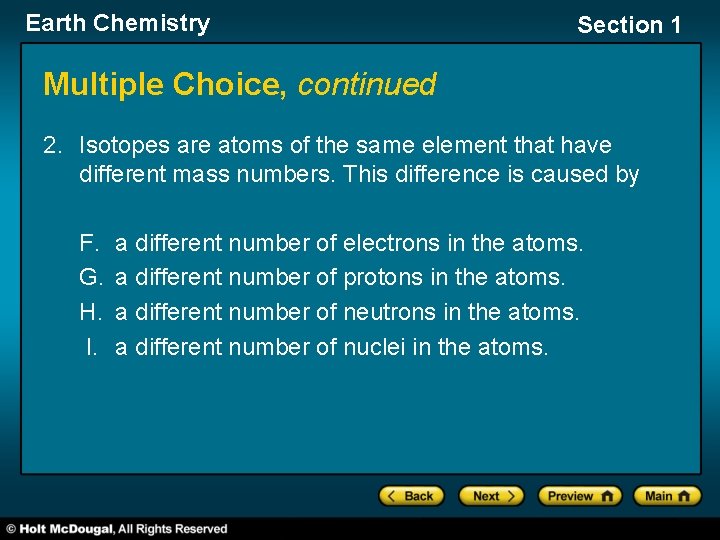
Earth Chemistry Section 1 Multiple Choice, continued 2. Isotopes are atoms of the same element that have different mass numbers. This difference is caused by F. G. H. I. a different number of electrons in the atoms. a different number of protons in the atoms. a different number of neutrons in the atoms. a different number of nuclei in the atoms.
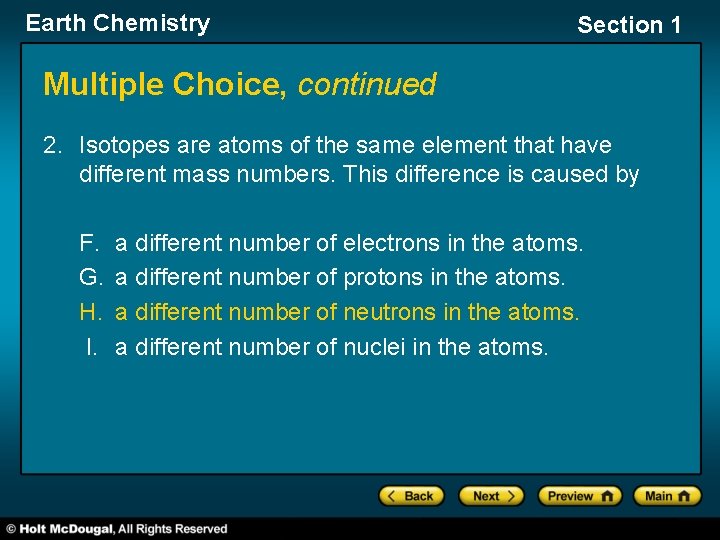
Earth Chemistry Section 1 Multiple Choice, continued 2. Isotopes are atoms of the same element that have different mass numbers. This difference is caused by F. G. H. I. a different number of electrons in the atoms. a different number of protons in the atoms. a different number of neutrons in the atoms. a different number of nuclei in the atoms.
Earth Chemistry Section 1 Multiple Choice, continued 3. Which of the following statements best describes the charges of subatomic particles? A. Electrons have a negative charge, protons have a positive charge, and neutrons have no charge. B. Electrons have a positive charge, protons have a negative charge, and neutrons have a positive charge. C. Electrons have no charge, protons have a positive charge, and neutrons have a negative charge. D. In neutral atoms, protons, neutrons, and electrons have no charges.
Earth Chemistry Section 1 Multiple Choice, continued 3. Which of the following statements best describes the charges of subatomic particles? A. Electrons have a negative charge, protons have a positive charge, and neutrons have no charge. B. Electrons have a positive charge, protons have a negative charge, and neutrons have a positive charge. C. Electrons have no charge, protons have a positive charge, and neutrons have a negative charge. D. In neutral atoms, protons, neutrons, and electrons have no charges.
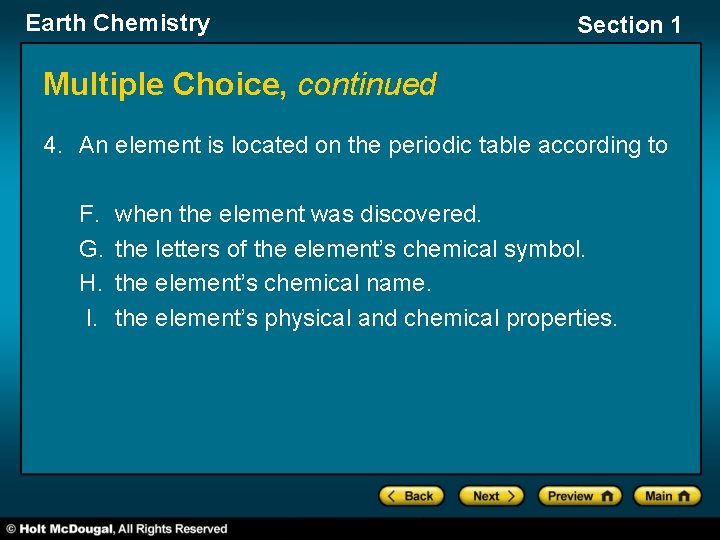
Earth Chemistry Section 1 Multiple Choice, continued 4. An element is located on the periodic table according to F. G. H. I. when the element was discovered. the letters of the element’s chemical symbol. the element’s chemical name. the element’s physical and chemical properties.
Earth Chemistry Section 1 Multiple Choice, continued 4. An element is located on the periodic table according to F. G. H. I. when the element was discovered. the letters of the element’s chemical symbol. the element’s chemical name. the element’s physical and chemical properties.
Earth Chemistry Section 1 Short Response 5. What is the name for an atom that has gained or lost one or more electrons and has acquired a charge? an ion
Earth Chemistry Section 1 Short Response, continued 6. Scientists use atomic numbers to help identify the atoms of different elements. How is the atomic number of an element determined? by the number of protons in the atom
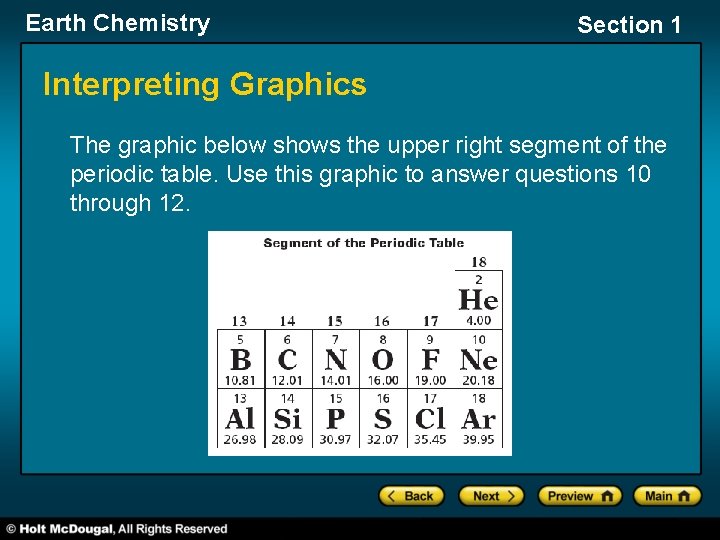
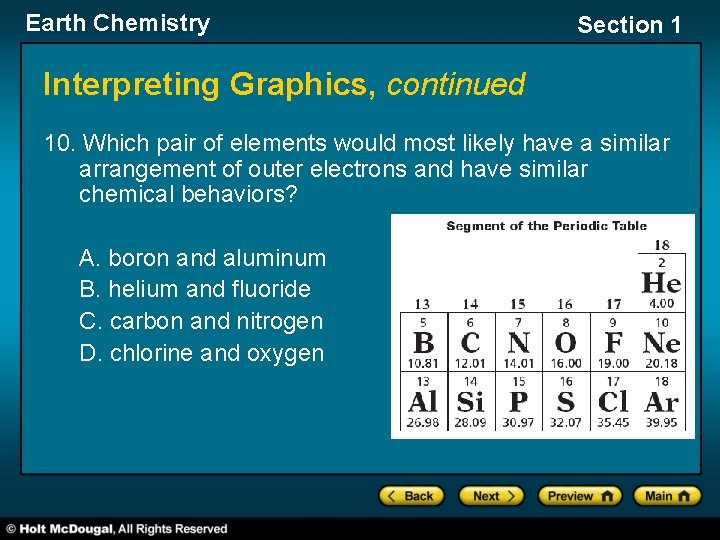
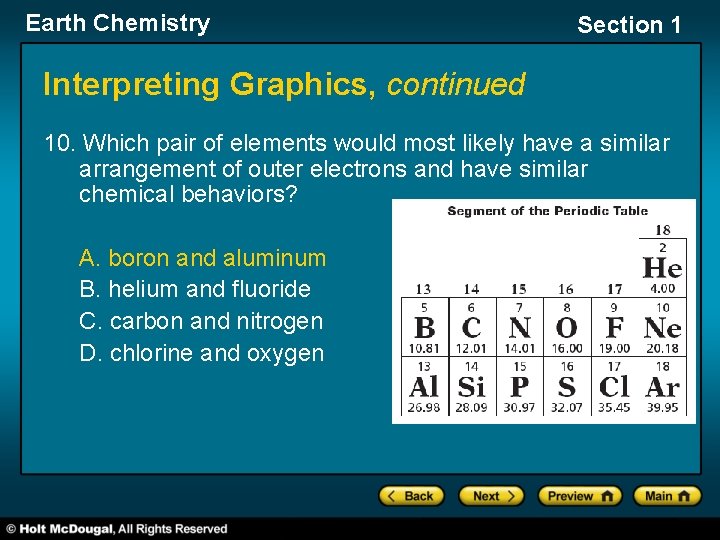
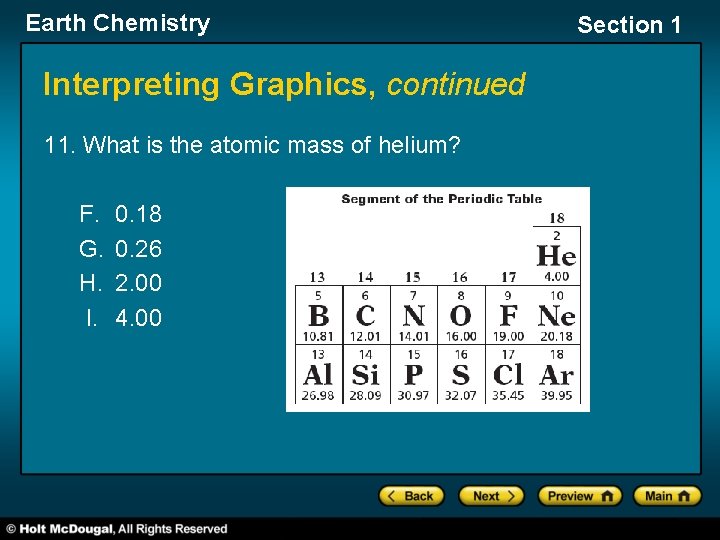
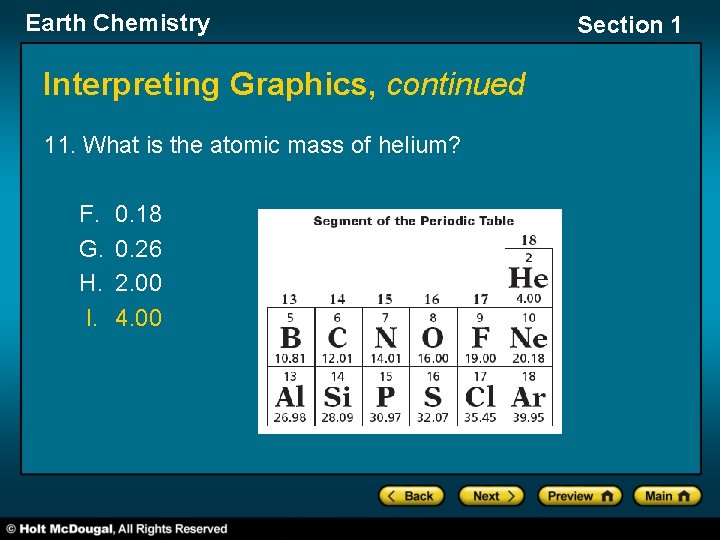
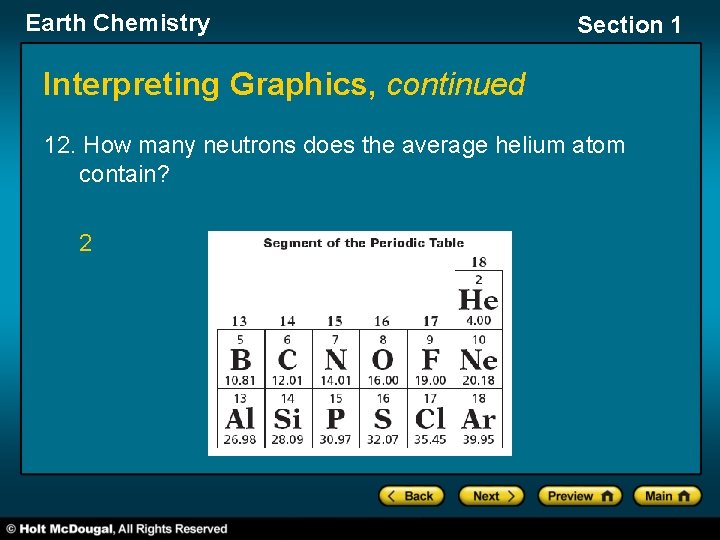
Earth Chemistry Section 1 Interpreting Graphics The graphic below shows the upper right segment of the periodic table. Use this graphic to answer questions 10 through 12.
Earth Chemistry Section 1 Interpreting Graphics, continued 10. Which pair of elements would most likely have a similar arrangement of outer electrons and have similar chemical behaviors? A. boron and aluminum B. helium and fluoride C. carbon and nitrogen D. chlorine and oxygen
Earth Chemistry Section 1 Interpreting Graphics, continued 10. Which pair of elements would most likely have a similar arrangement of outer electrons and have similar chemical behaviors? A. boron and aluminum B. helium and fluoride C. carbon and nitrogen D. chlorine and oxygen
Earth Chemistry Interpreting Graphics, continued 11. What is the atomic mass of helium? F. G. H. I. 0. 18 0. 26 2. 00 4. 00 Section 1
Earth Chemistry Interpreting Graphics, continued 11. What is the atomic mass of helium? F. G. H. I. 0. 18 0. 26 2. 00 4. 00 Section 1
Earth Chemistry Section 1 Interpreting Graphics, continued 12. How many neutrons does the average helium atom contain? 2
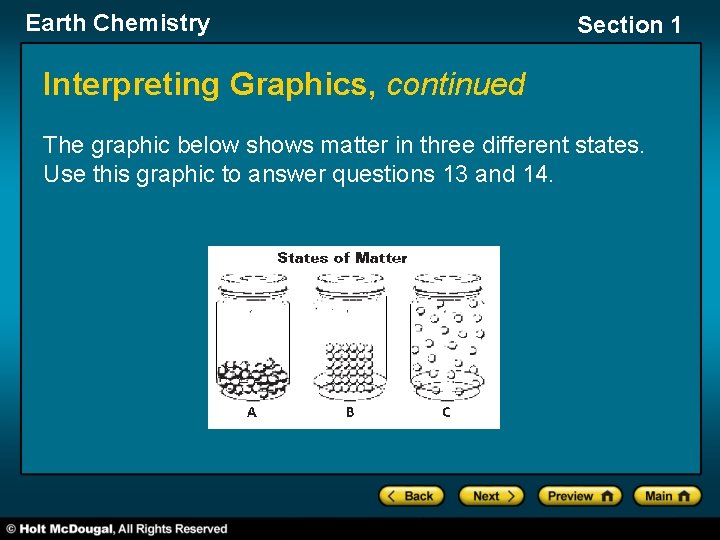
Earth Chemistry Section 1 Interpreting Graphics, continued The graphic below shows matter in three different states. Use this graphic to answer questions 13 and 14.
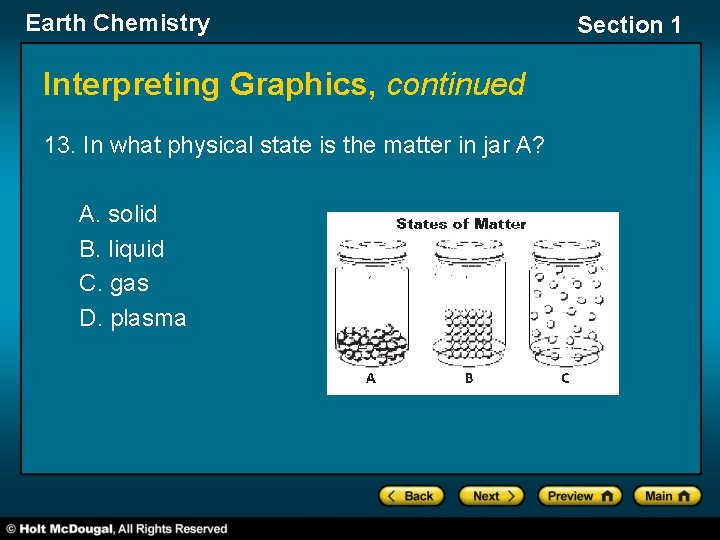
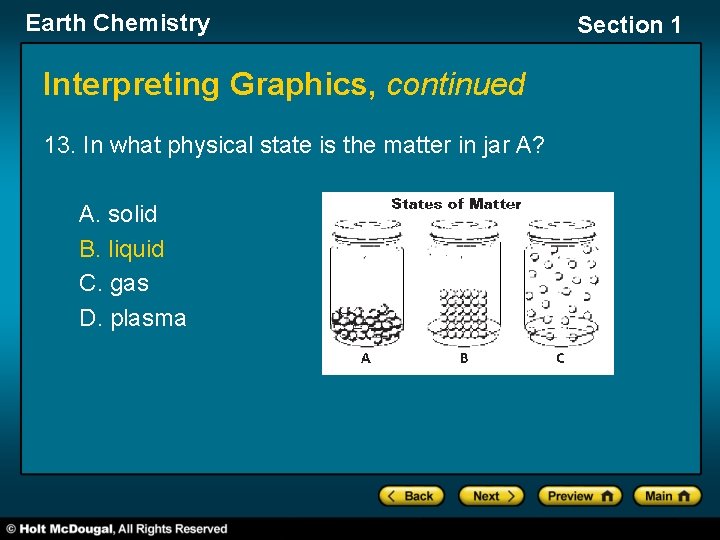
Earth Chemistry Interpreting Graphics, continued 13. In what physical state is the matter in jar A? A. solid B. liquid C. gas D. plasma Section 1
Earth Chemistry Interpreting Graphics, continued 13. In what physical state is the matter in jar A? A. solid B. liquid C. gas D. plasma Section 1