
Earth CARE Calibration and Validation Using an Airborne
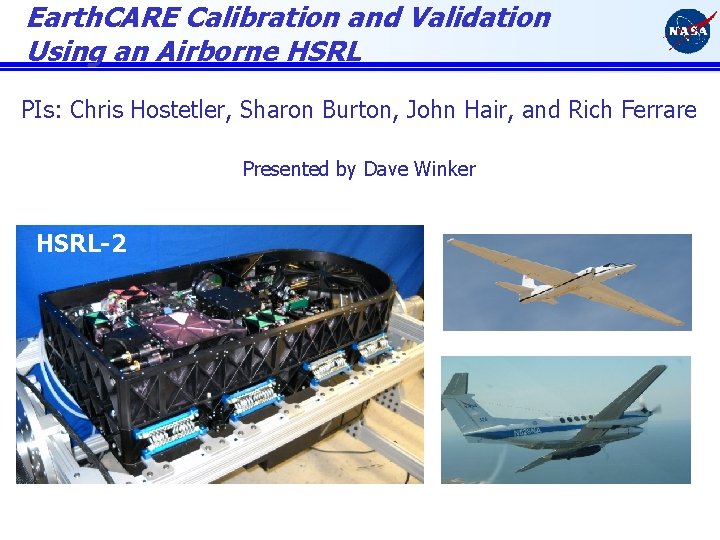
Earth. CARE Calibration and Validation Using an Airborne HSRL PIs: Chris Hostetler, Sharon Burton, John Hair, and Rich Ferrare Presented by Dave Winker HSRL-2
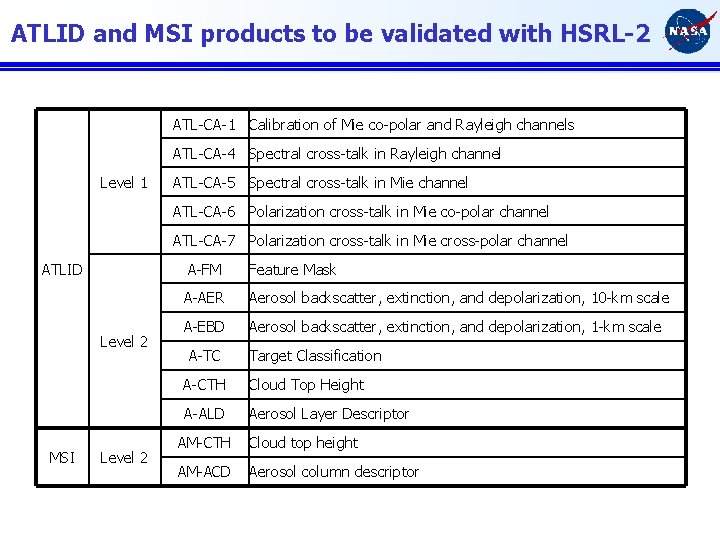
ATLID and MSI products to be validated with HSRL-2 ATL-CA-1 Calibration of Mie co-polar and Rayleigh channels ATL-CA-4 Spectral cross-talk in Rayleigh channel Level 1 ATL-CA-5 Spectral cross-talk in Mie channel ATL-CA-6 Polarization cross-talk in Mie co-polar channel ATL-CA-7 Polarization cross-talk in Mie cross-polar channel ATLID Level 2 MSI Level 2 A-FM Feature Mask A-AER Aerosol backscatter, extinction, and depolarization, 10 -km scale A-EBD Aerosol backscatter, extinction, and depolarization, 1 -km scale A-TC Target Classification A-CTH Cloud Top Height A-ALD Aerosol Layer Descriptor AM-CTH Cloud top height AM-ACD Aerosol column descriptor
HSRL-2 instrument and past experience in CALIOP validation
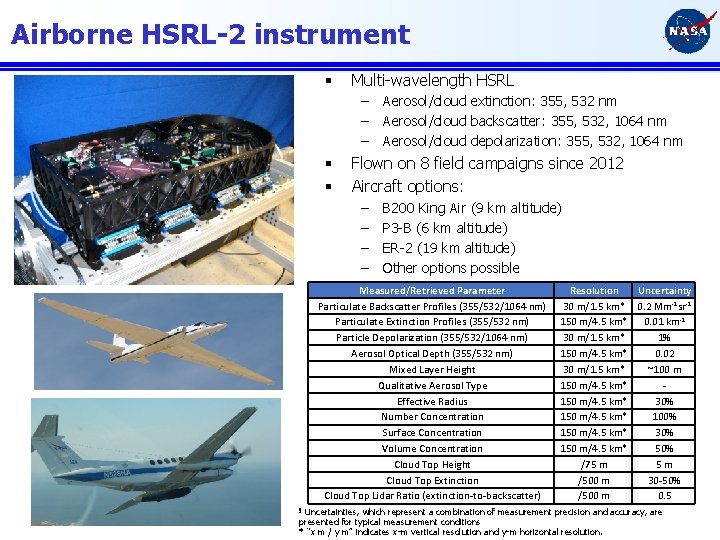
Airborne HSRL-2 instrument § Multi-wavelength HSRL – – – § § Aerosol/cloud extinction: 355, 532 nm Aerosol/cloud backscatter: 355, 532, 1064 nm Aerosol/cloud depolarization: 355, 532, 1064 nm Flown on 8 field campaigns since 2012 Aircraft options: – – B 200 King Air (9 km altitude) P 3 -B (6 km altitude) ER-2 (19 km altitude) Other options possible Measured/Retrieved Parameter Particulate Backscatter Profiles (355/532/1064 nm) Particulate Extinction Profiles (355/532 nm) Particle Depolarization (355/532/1064 nm) Aerosol Optical Depth (355/532 nm) Mixed Layer Height Qualitative Aerosol Type Effective Radius Number Concentration Surface Concentration Volume Concentration Cloud Top Height Cloud Top Extinction Cloud Top Lidar Ratio (extinction-to-backscatter) Resolution Uncertainty 30 m/1. 5 km* 0. 2 Mm-1 sr-1 150 m/4. 5 km* 0. 01 km-1 30 m/1. 5 km* 1% 150 m/4. 5 km* 0. 02 30 m/1. 5 km* ~100 m 150 m/4. 5 km* 30% 150 m/4. 5 km* 100% 150 m/4. 5 km* 30% 150 m/4. 5 km* 50% /75 m 5 m /500 m 30 -50% /500 m 0. 5 Uncertainties, which represent a combination of measurement precision and accuracy, are presented for typical measurement conditions * “x m / y m” indicates x-m vertical resolution and y-m horizontal resolution. §
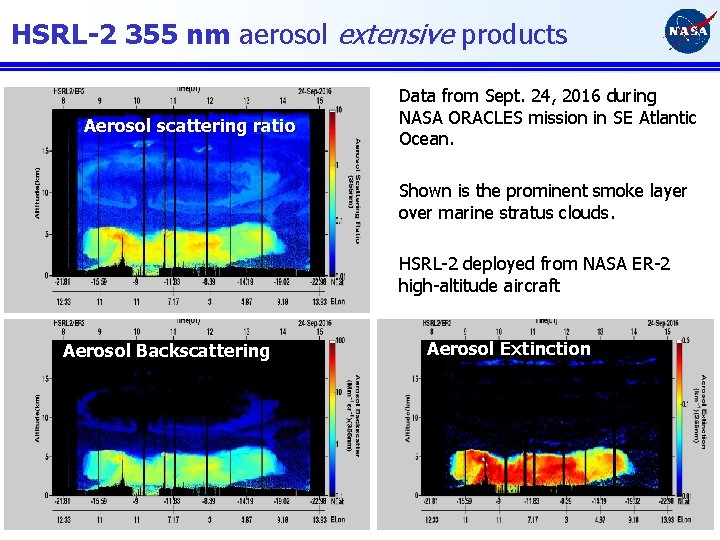
HSRL-2 355 nm aerosol extensive products Aerosol scattering ratio Data from Sept. 24, 2016 during NASA ORACLES mission in SE Atlantic Ocean. Shown is the prominent smoke layer over marine stratus clouds. HSRL-2 deployed from NASA ER-2 high-altitude aircraft Aerosol Backscattering Aerosol Extinction
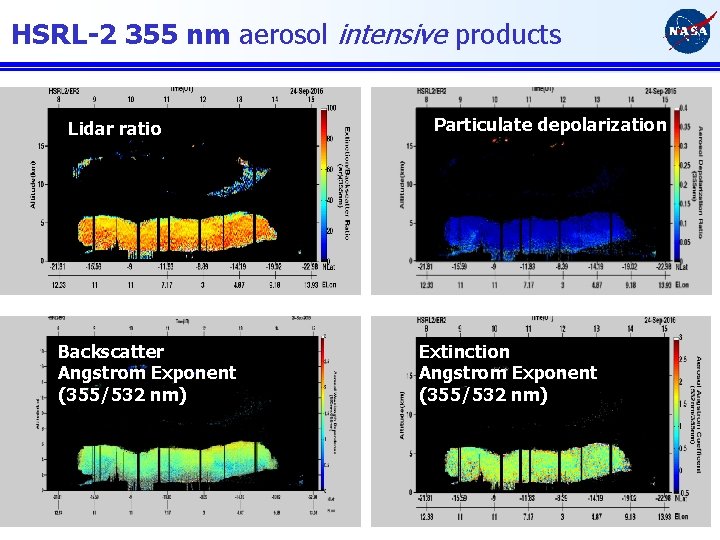
HSRL-2 355 nm aerosol intensive products Lidar ratio Backscatter Angstrom Exponent (355/532 nm) Particulate depolarization Extinction Angstrom Exponent (355/532 nm)
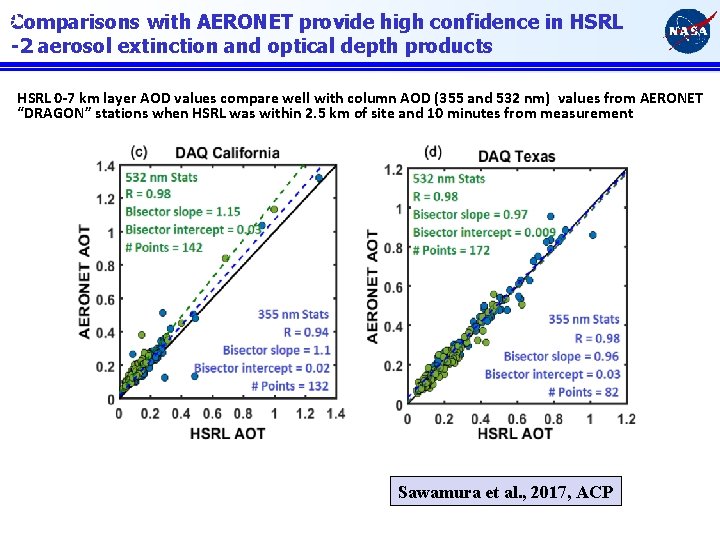
9 Comparisons with AERONET provide high confidence in HSRL -2 aerosol extinction and optical depth products HSRL 0 -7 km layer AOD values compare well with column AOD (355 and 532 nm) values from AERONET “DRAGON” stations when HSRL was within 2. 5 km of site and 10 minutes from measurement Sawamura et al. , 2017, ACP
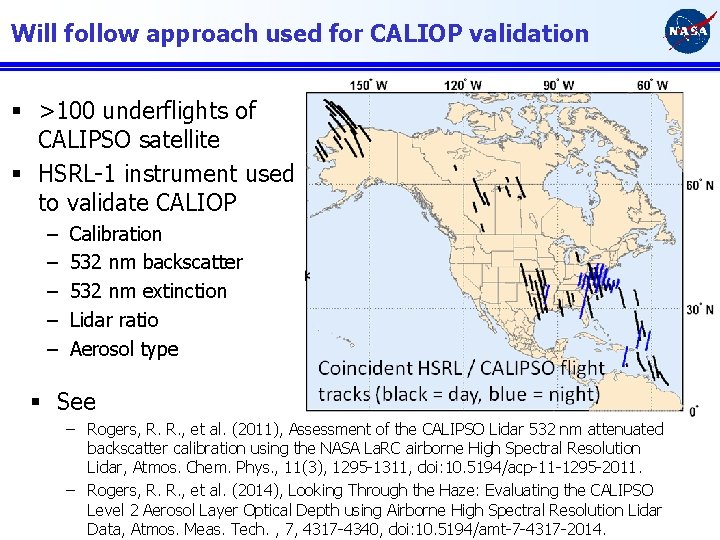
Will follow approach used for CALIOP validation § >100 underflights of CALIPSO satellite § HSRL-1 instrument used to validate CALIOP – – – Calibration 532 nm backscatter 532 nm extinction Lidar ratio Aerosol type § See – Rogers, R. R. , et al. (2011), Assessment of the CALIPSO Lidar 532 nm attenuated backscatter calibration using the NASA La. RC airborne High Spectral Resolution Lidar, Atmos. Chem. Phys. , 11(3), 1295 -1311, doi: 10. 5194/acp-11 -1295 -2011. – Rogers, R. R. , et al. (2014), Looking Through the Haze: Evaluating the CALIPSO Level 2 Aerosol Layer Optical Depth using Airborne High Spectral Resolution Lidar Data, Atmos. Meas. Tech. , 7, 4317 -4340, doi: 10. 5194/amt-7 -4317 -2014.
![Example – 09/20/2006: L 1 calibration [km-1 sr-1] CALIPSO [km-1 sr-1] HSRL bias =](http://slidetodoc.com/presentation_image_h2/771dd4270ed1418d916a7357161fed30/image-9.jpg "Example – 09/20/2006: L 1 calibration [km-1 sr-1] CALIPSO [km-1 sr-1] HSRL bias =")
Example – 09/20/2006: L 1 calibration [km-1 sr-1] CALIPSO [km-1 sr-1] HSRL bias = 2. 4%
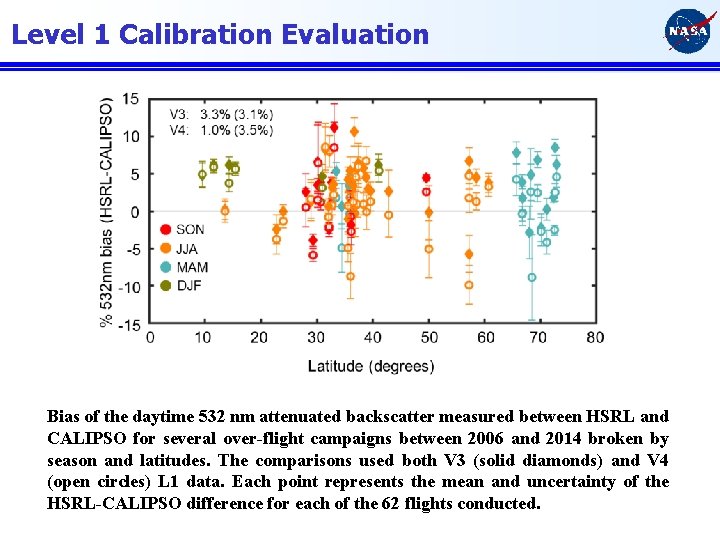
Level 1 Calibration Evaluation Bias of the daytime 532 nm attenuated backscatter measured between HSRL and CALIPSO for several over-flight campaigns between 2006 and 2014 broken by season and latitudes. The comparisons used both V 3 (solid diamonds) and V 4 (open circles) L 1 data. Each point represents the mean and uncertainty of the HSRL-CALIPSO difference for each of the 62 flights conducted.
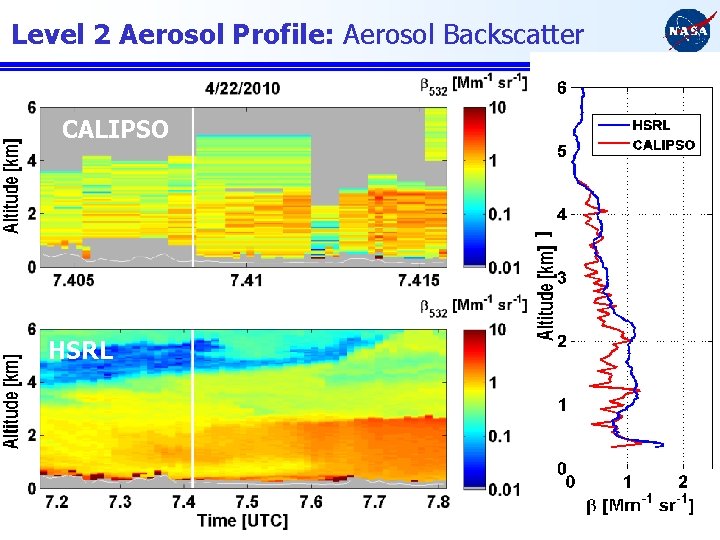
Level 2 Aerosol Profile: Aerosol Backscatter CALIPSO HSRL
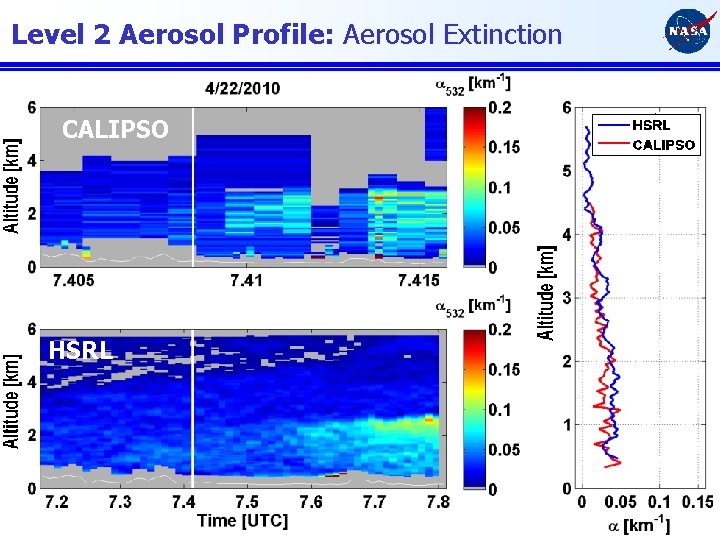
Level 2 Aerosol Profile: Aerosol Extinction CALIPSO HSRL
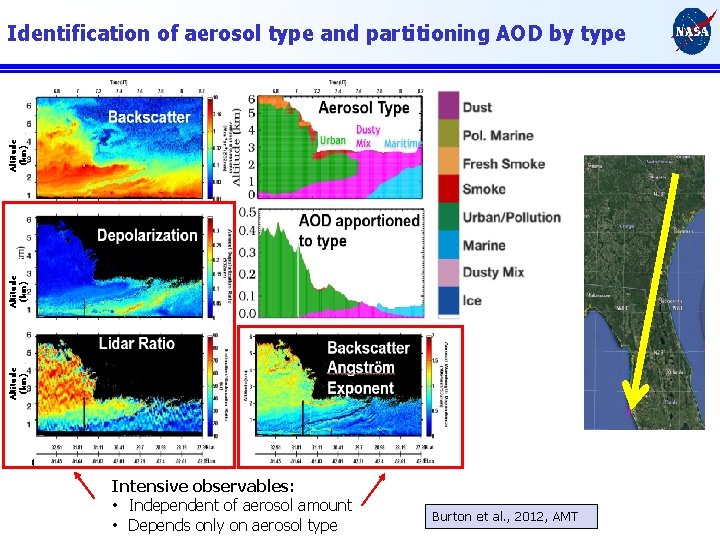
Identification of aerosol type and partitioning AOD by type Altitude (km) Backscatter Altitude (km) Extinction-to. Backscatter Ratio 0 0 Distance 665 km Intensive observables: • Independent of aerosol amount • Depends only on aerosol type Burton et al. , 2012, AMT
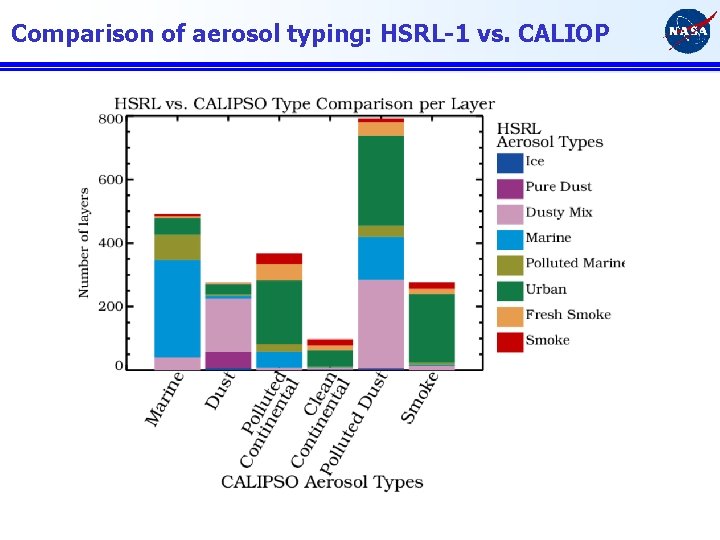
Comparison of aerosol typing: HSRL-1 vs. CALIOP
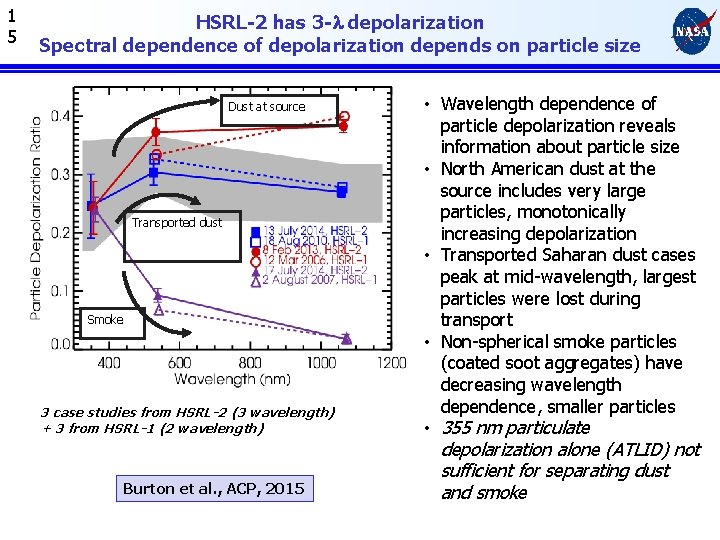
1 5 HSRL-2 has 3 -l depolarization Spectral dependence of depolarization depends on particle size Dust at source Transported dust Smoke 3 case studies from HSRL-2 (3 wavelength) + 3 from HSRL-1 (2 wavelength) Burton et al. , ACP, 2015 • Wavelength dependence of particle depolarization reveals information about particle size • North American dust at the source includes very large particles, monotonically increasing depolarization • Transported Saharan dust cases peak at mid-wavelength, largest particles were lost during transport • Non-spherical smoke particles (coated soot aggregates) have decreasing wavelength dependence, smaller particles • 355 nm particulate depolarization alone (ATLID) not sufficient for separating dust and smoke
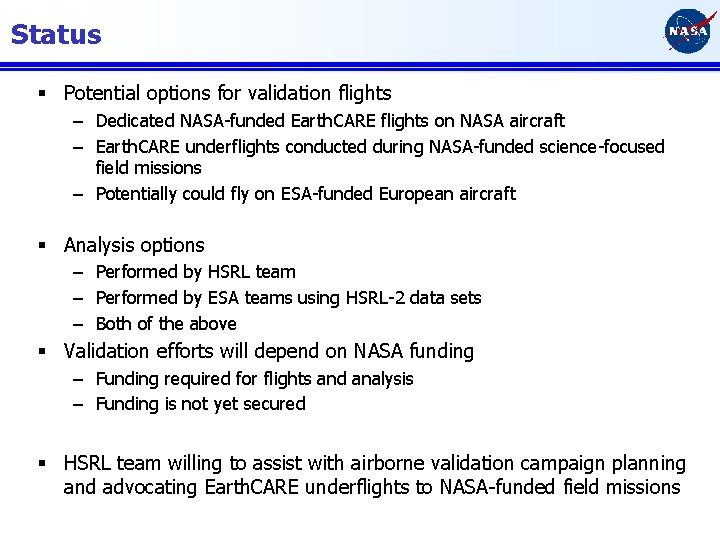
Status § Potential options for validation flights – Dedicated NASA-funded Earth. CARE flights on NASA aircraft – Earth. CARE underflights conducted during NASA-funded science-focused field missions – Potentially could fly on ESA-funded European aircraft § Analysis options – Performed by HSRL team – Performed by ESA teams using HSRL-2 data sets – Both of the above § Validation efforts will depend on NASA funding – Funding required for flights and analysis – Funding is not yet secured § HSRL team willing to assist with airborne validation campaign planning and advocating Earth. CARE underflights to NASA-funded field missions
- Slides: 16