
EARTH AND THE CARBON CYCLE Guiding Questions Carbon
EARTH AND THE CARBON CYCLE Guiding Questions: Carbon from plants and animals, how does it get underground far enough to get heated and compacted into oil and coal? How do internal Earth processes influence our culture/identity?
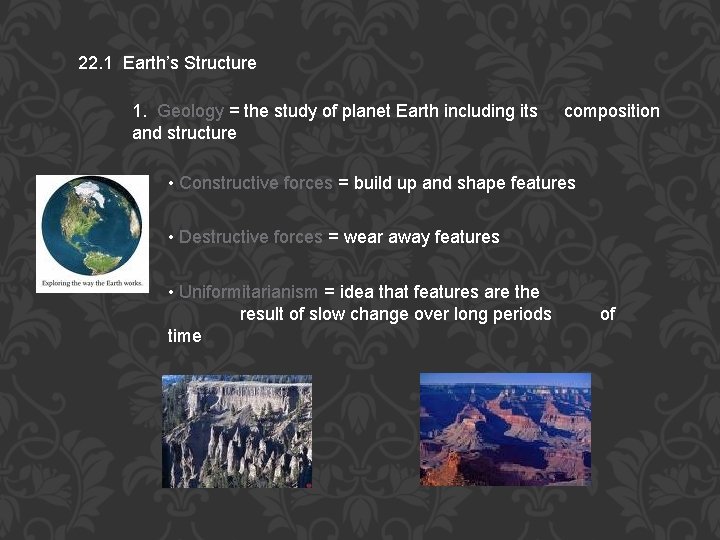
22. 1 Earth’s Structure 1. Geology = the study of planet Earth including its and structure composition • Constructive forces = build up and shape features • Destructive forces = wear away features • Uniformitarianism = idea that features are the result of slow change over long periods time of

2. Cross Section of Earth Granite A. Crust: • Outer, rocky layer of Earth • Made of silicates (Si) 1. Continental crust Basalt • Less dense rocks like granite • 40 km thick 2. Oceanic crust • Denser rocks like basalt • 7 km thick
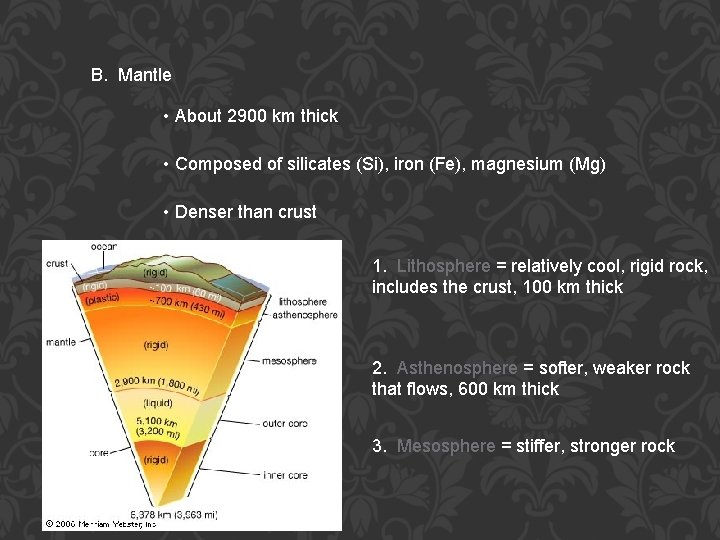
B. Mantle • About 2900 km thick • Composed of silicates (Si), iron (Fe), magnesium (Mg) • Denser than crust 1. Lithosphere = relatively cool, rigid rock, includes the crust, 100 km thick 2. Asthenosphere = softer, weaker rock that flows, 600 km thick 3. Mesosphere = stiffer, stronger rock

C. Core • Composed mostly of iron and nickel • Pressure is 3. 6 million times that at the surface • Temperature is 5500 C 1. Outer core • Liquid metal • Produces an electric current and magnetic field 2. Inner core • Solid – hot, but more pressure
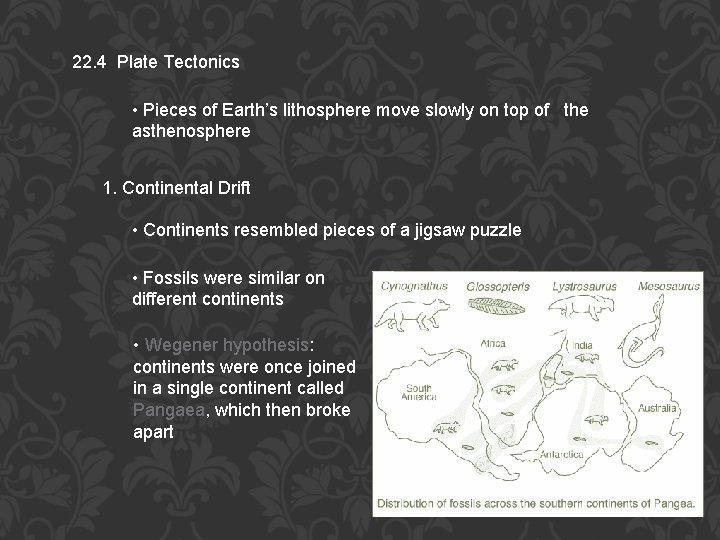
22. 4 Plate Tectonics • Pieces of Earth’s lithosphere move slowly on top of the asthenosphere 1. Continental Drift • Continents resembled pieces of a jigsaw puzzle • Fossils were similar on different continents • Wegener hypothesis: continents were once joined in a single continent called Pangaea, which then broke apart
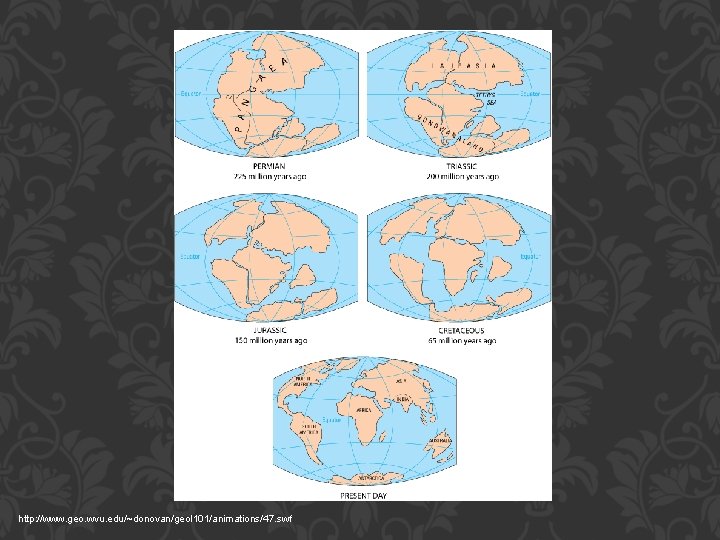
http: //www. geo. wvu. edu/~donovan/geol 101/animations/47. swf
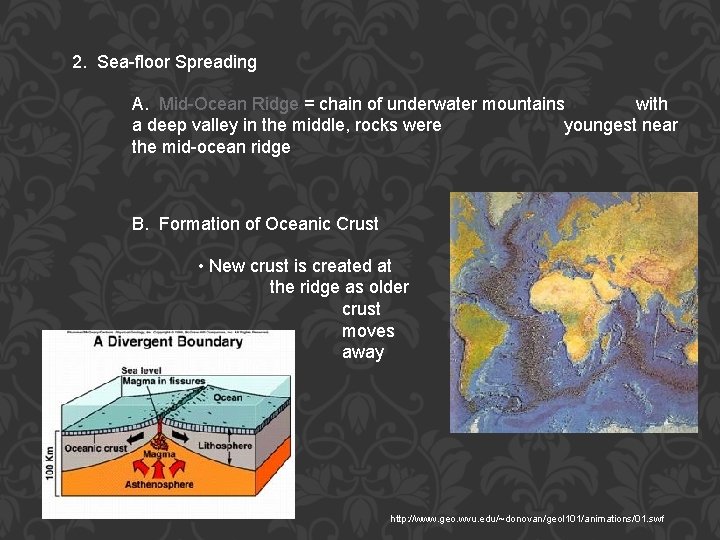
2. Sea-floor Spreading A. Mid-Ocean Ridge = chain of underwater mountains with a deep valley in the middle, rocks were youngest near the mid-ocean ridge B. Formation of Oceanic Crust • New crust is created at the ridge as older crust moves away http: //www. geo. wvu. edu/~donovan/geol 101/animations/01. swf
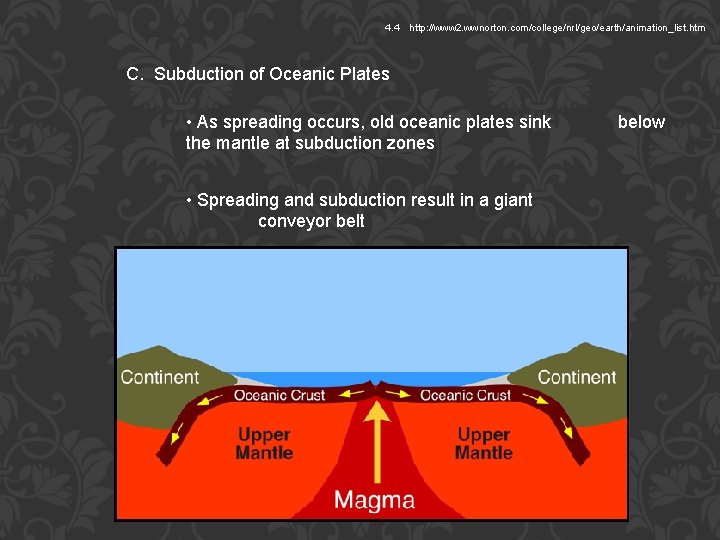
4. 4 http: //www 2. wwnorton. com/college/nrl/geo/earth/animation_list. htm C. Subduction of Oceanic Plates • As spreading occurs, old oceanic plates sink the mantle at subduction zones • Spreading and subduction result in a giant conveyor belt below
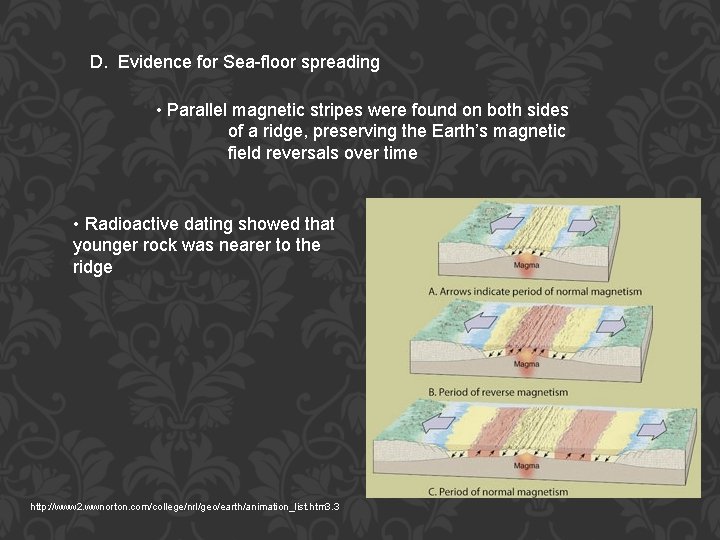
D. Evidence for Sea-floor spreading • Parallel magnetic stripes were found on both sides of a ridge, preserving the Earth’s magnetic field reversals over time • Radioactive dating showed that younger rock was nearer to the ridge http: //www 2. wwnorton. com/college/nrl/geo/earth/animation_list. htm 3. 3
Conduction Radiation Convection
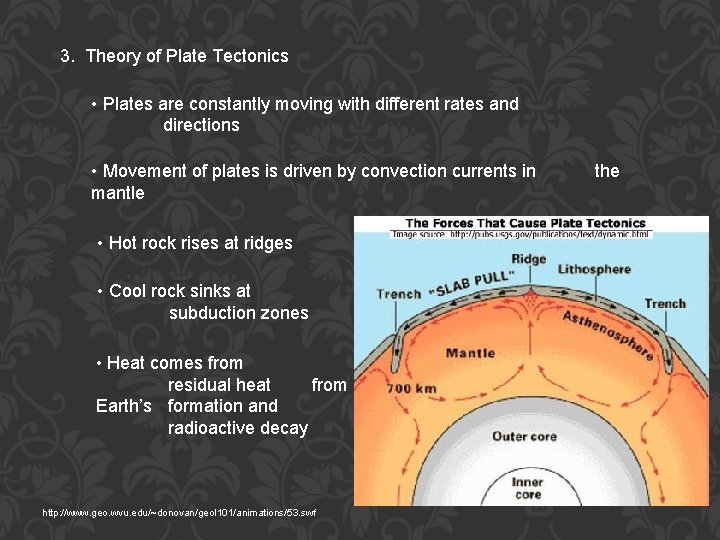
3. Theory of Plate Tectonics • Plates are constantly moving with different rates and directions • Movement of plates is driven by convection currents in mantle • Hot rock rises at ridges • Cool rock sinks at subduction zones • Heat comes from residual heat from Earth’s formation and radioactive decay http: //www. geo. wvu. edu/~donovan/geol 101/animations/53. swf the
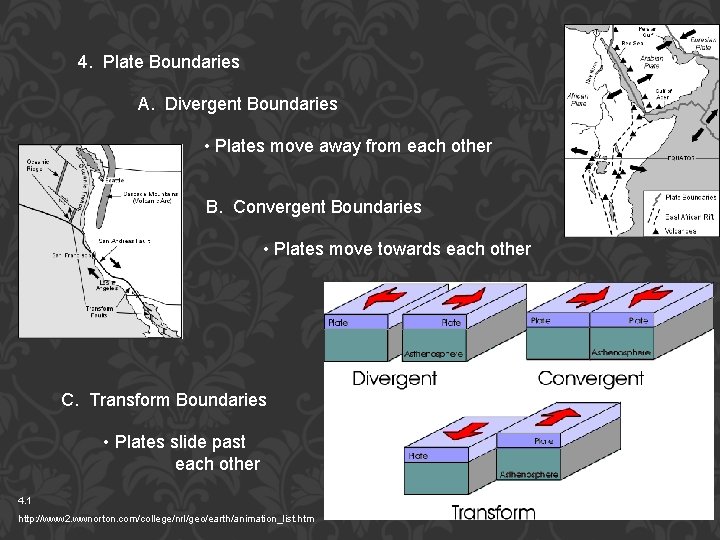
4. Plate Boundaries A. Divergent Boundaries • Plates move away from each other B. Convergent Boundaries • Plates move towards each other C. Transform Boundaries • Plates slide past each other 4. 1 http: //www 2. wwnorton. com/college/nrl/geo/earth/animation_list. htm
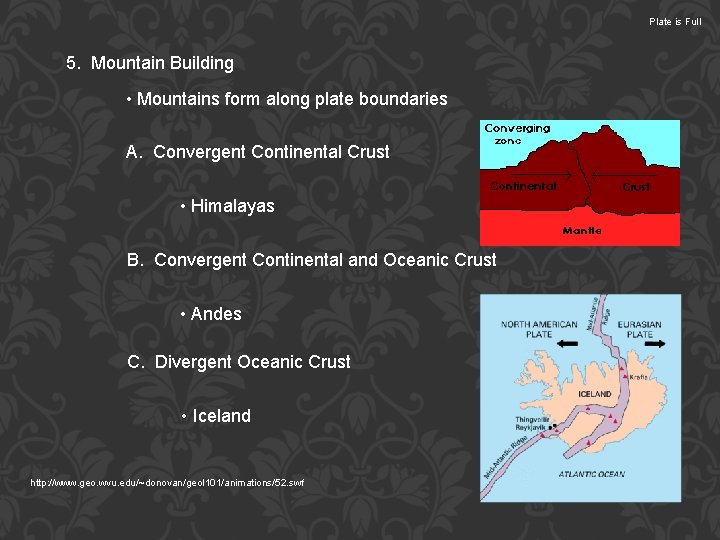
Plate is Full 5. Mountain Building • Mountains form along plate boundaries A. Convergent Continental Crust • Himalayas B. Convergent Continental and Oceanic Crust • Andes C. Divergent Oceanic Crust • Iceland http: //www. geo. wvu. edu/~donovan/geol 101/animations/52. swf
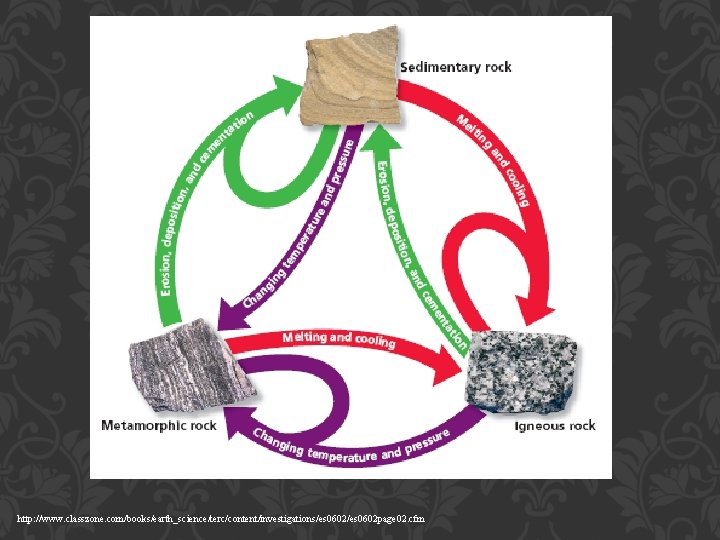
http: //www. classzone. com/books/earth_science/terc/content/investigations/es 0602 page 02. cfm
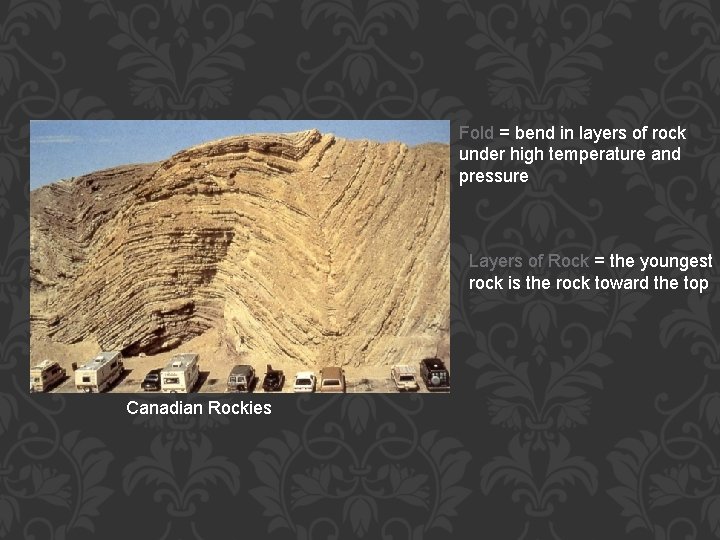
Fold = bend in layers of rock under high temperature and pressure Layers of Rock = the youngest rock is the rock toward the top Canadian Rockies
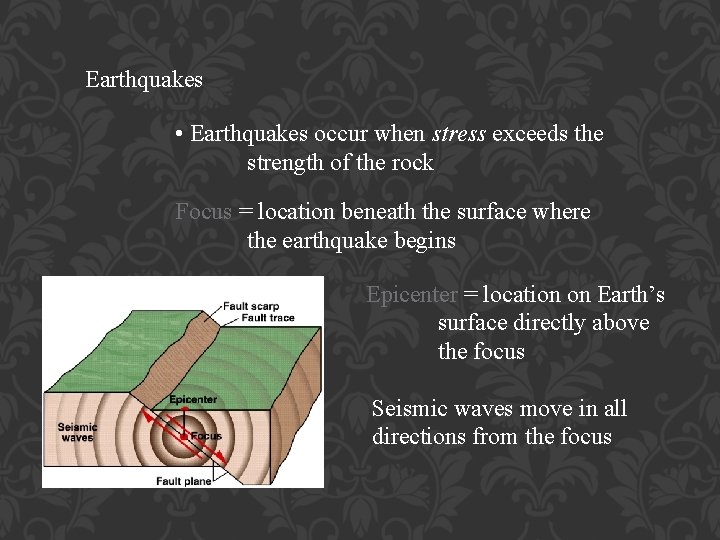
Earthquakes • Earthquakes occur when stress exceeds the strength of the rock Focus = location beneath the surface where the earthquake begins Epicenter = location on Earth’s surface directly above the focus Seismic waves move in all directions from the focus
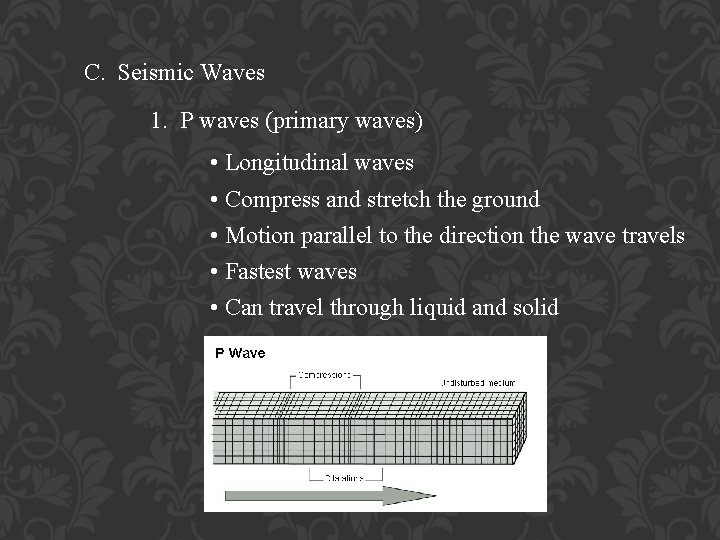
C. Seismic Waves 1. P waves (primary waves) • Longitudinal waves • Compress and stretch the ground • Motion parallel to the direction the wave travels • Fastest waves • Can travel through liquid and solid

2. S waves (secondary waves) • Transverse waves • Motion perpendicular to direction that the wave travels • Cannot travel through liquid
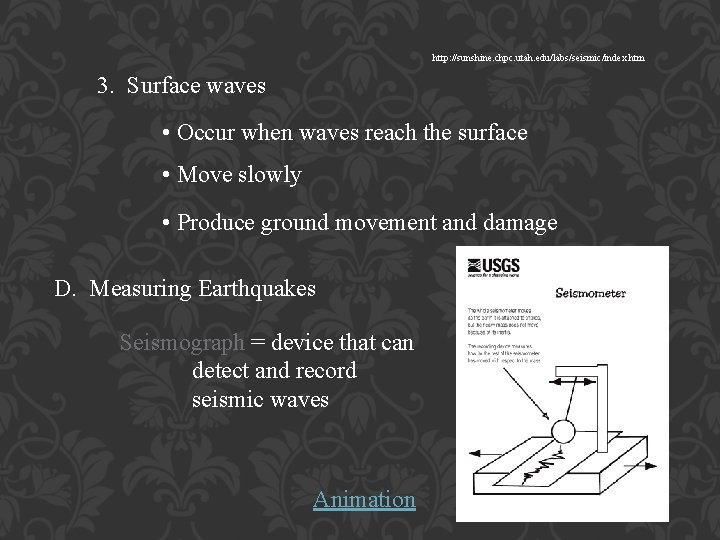
http: //sunshine. chpc. utah. edu/labs/seismic/index. htm 3. Surface waves • Occur when waves reach the surface • Move slowly • Produce ground movement and damage D. Measuring Earthquakes Seismograph = device that can detect and record seismic waves Animation
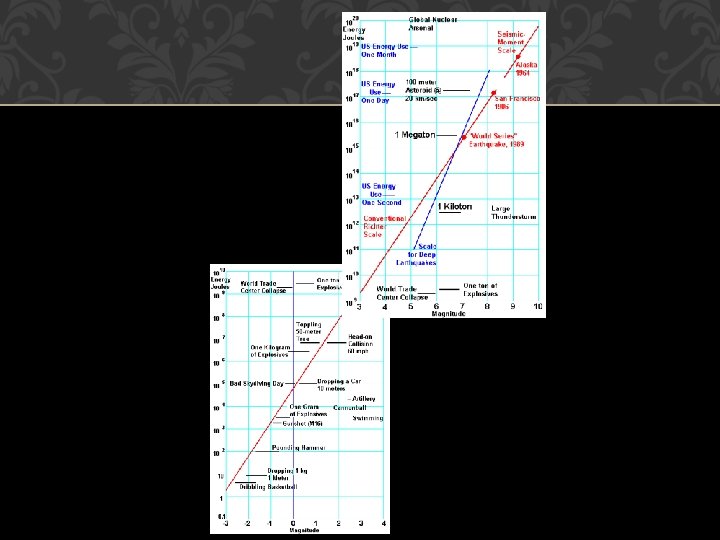
1. Richter Scale • Based on times and amplitudes of seismic waves • No longer used 2. Moment Magnitude Scale (used) • Measures amount of energy released by an earthquake • Each unit represents a 32 -fold increase in energy

3. Modified Mercalli Scale • Measures the effects of earthquakes • Based on intensity of ground shaking and damage
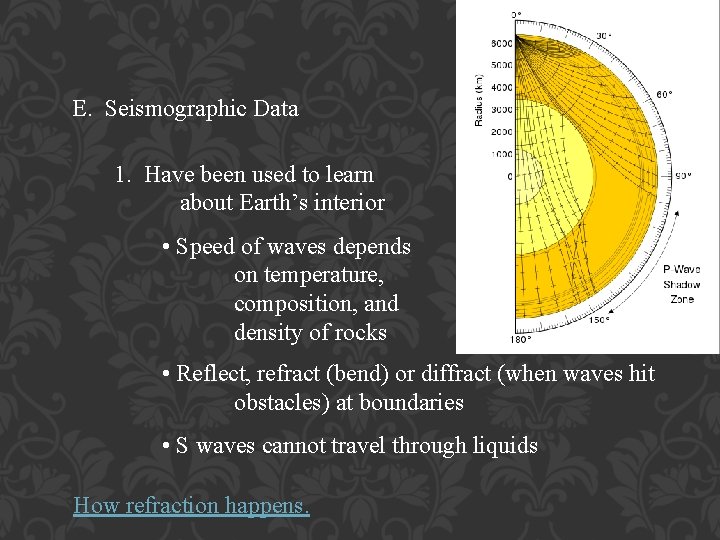
E. Seismographic Data 1. Have been used to learn about Earth’s interior • Speed of waves depends on temperature, composition, and density of rocks • Reflect, refract (bend) or diffract (when waves hit obstacles) at boundaries • S waves cannot travel through liquids How refraction happens.
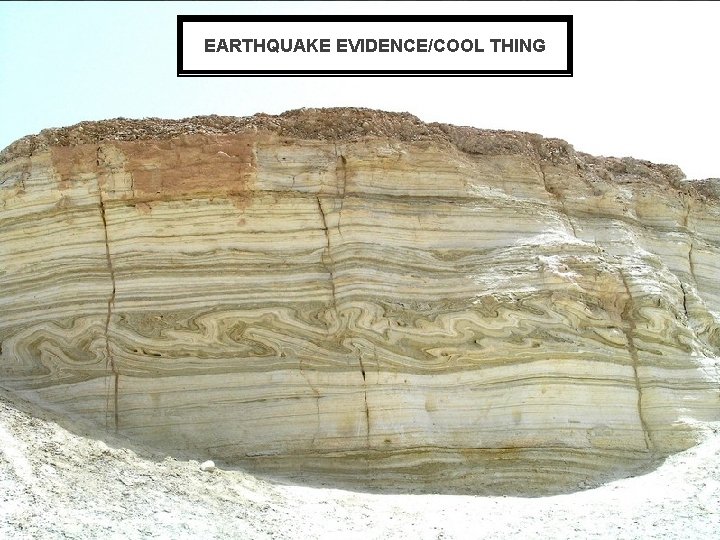
EARTHQUAKE EVIDENCE/COOL THING
CHECK IN! Discuss the recent content with your partners!
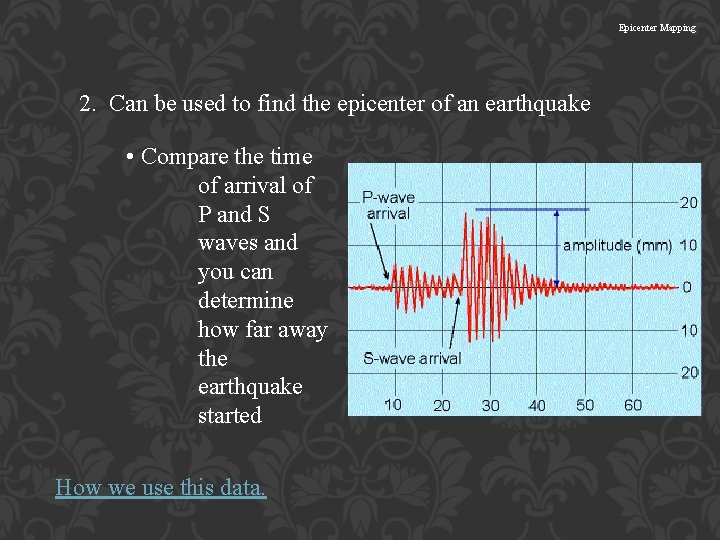
Epicenter Mapping 2. Can be used to find the epicenter of an earthquake • Compare the time of arrival of P and S waves and you can determine how far away the earthquake started How we use this data.

Connecticut Faults
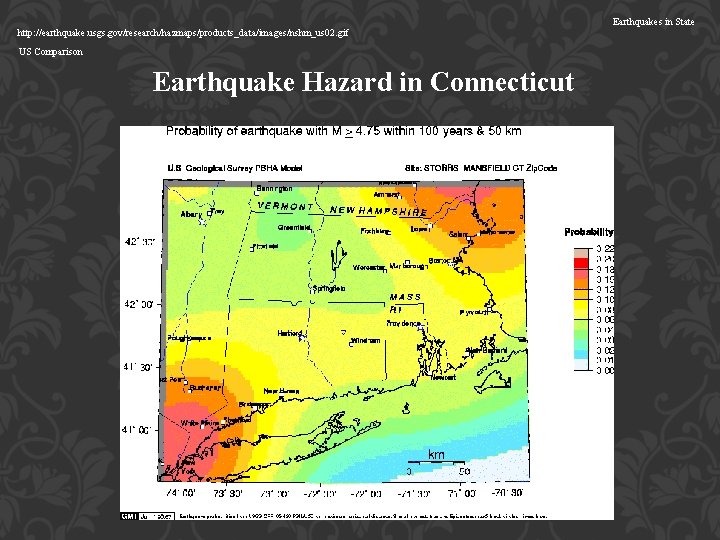
http: //earthquake. usgs. gov/research/hazmaps/products_data/images/nshm_us 02. gif US Comparison Earthquake Hazard in Connecticut Earthquakes in State
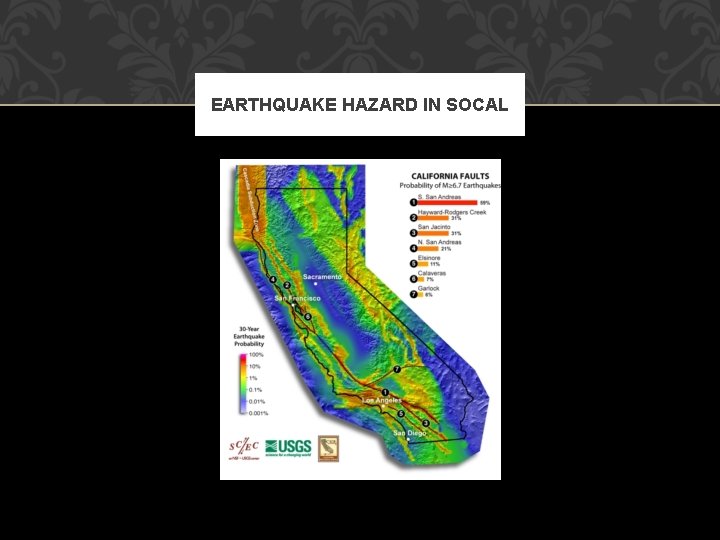
EARTHQUAKE HAZARD IN SOCAL
Earthquake Intensity
TSUNAMI Caused by shifting oceanic plates
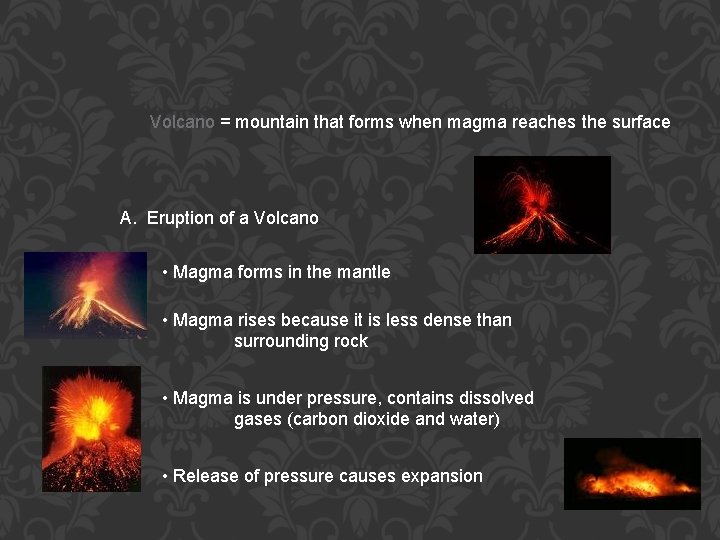
Volcano = mountain that forms when magma reaches the surface A. Eruption of a Volcano • Magma forms in the mantle • Magma rises because it is less dense than surrounding rock • Magma is under pressure, contains dissolved gases (carbon dioxide and water) • Release of pressure causes expansion
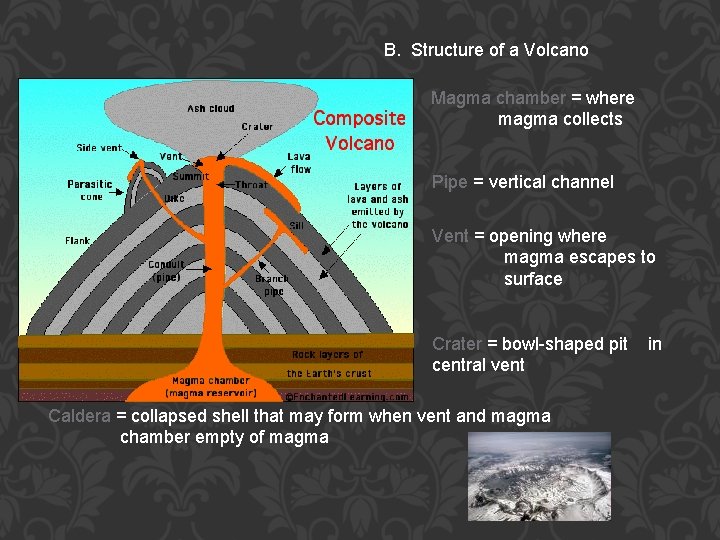
B. Structure of a Volcano Magma chamber = where magma collects Pipe = vertical channel Vent = opening where magma escapes to surface Crater = bowl-shaped pit central vent Caldera = collapsed shell that may form when vent and magma chamber empty of magma in
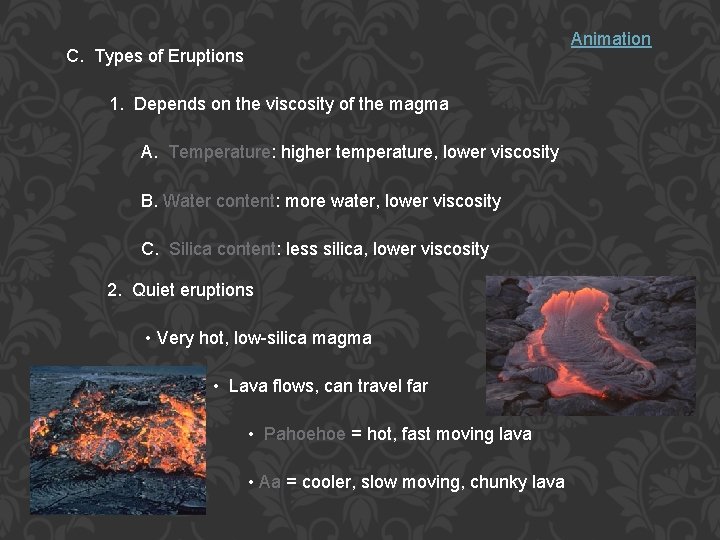
Animation C. Types of Eruptions 1. Depends on the viscosity of the magma A. Temperature: higher temperature, lower viscosity B. Water content: more water, lower viscosity C. Silica content: less silica, lower viscosity 2. Quiet eruptions • Very hot, low-silica magma • Lava flows, can travel far • Pahoehoe = hot, fast moving lava • Aa = cooler, slow moving, chunky lava
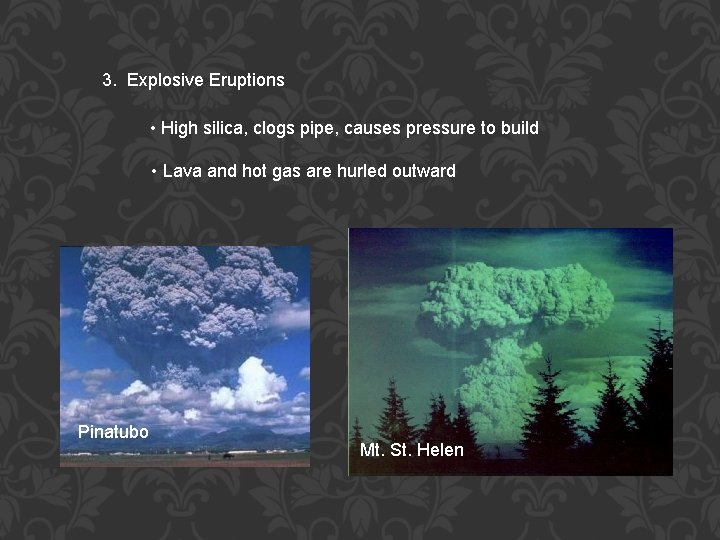
3. Explosive Eruptions • High silica, clogs pipe, causes pressure to build • Lava and hot gas are hurled outward Pinatubo Mt. St. Helen
CHECK IN! Discuss the recent content with your partners!
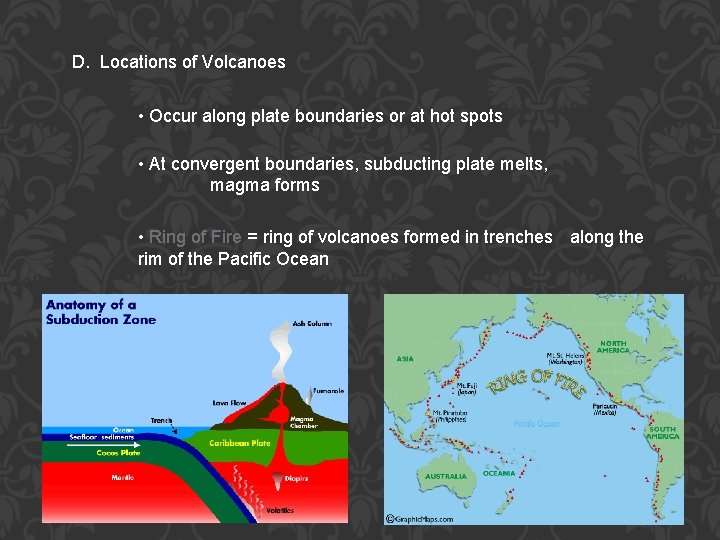
D. Locations of Volcanoes • Occur along plate boundaries or at hot spots • At convergent boundaries, subducting plate melts, magma forms • Ring of Fire = ring of volcanoes formed in trenches along the rim of the Pacific Ocean
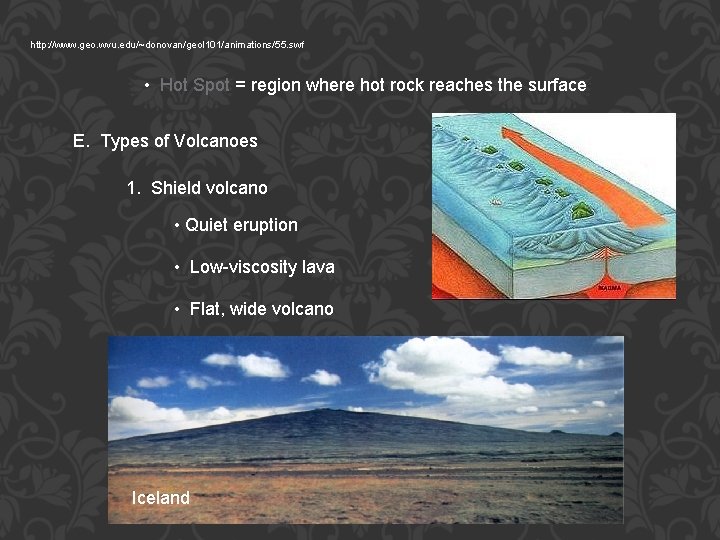
http: //www. geo. wvu. edu/~donovan/geol 101/animations/55. swf • Hot Spot = region where hot rock reaches the surface E. Types of Volcanoes 1. Shield volcano • Quiet eruption • Low-viscosity lava • Flat, wide volcano Iceland
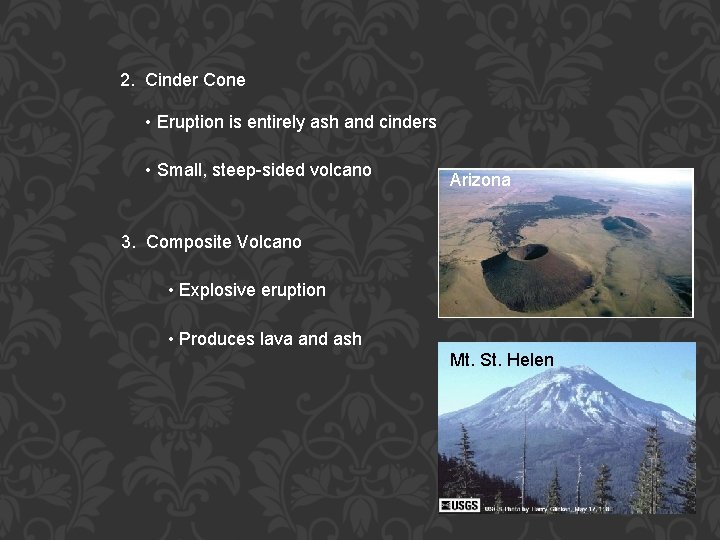
2. Cinder Cone • Eruption is entirely ash and cinders • Small, steep-sided volcano Arizona 3. Composite Volcano • Explosive eruption • Produces lava and ash Mt. St. Helen
EARTH SCIENCE WRAP UP: • Different rocks are formed when different rock components are put under varying amounts of stress and heat • Many layers of earth • Mantle contains convections of molten rock that moves tectonic plates • Moving tectonic plates bump and grind and slide into and under each other, sometimes causing earthquakes • We can determine earthquake locations by “listening” for them
WRAP UP CONT. Many plate boundaries exist Bottom of ocean Edge of continents Mountain ranges Volcanoes occur when pressure builds up under the crust, or there is a gap between plates, exposing magma Lava viscosity is based on composition Water content Silica content Temperature Type of volcano dependent on pressure, location (why? ), and type of magma
QUESTION TIME Earth Science
ALL OF THE FOLLOWING ARE MAJOR CARBON STORAGE RESERVOIRS EXCEPT A. B. C. D. E. Fossil fuels Sedimentary rocks The air The earth’s core The oceans
Of the earth’s three major layers, which one contains the greatest portion of molten rock? A. B. C. D. E. Lithosphere Core Mantle Crust Hydrosphere
In the earth’s interior, hot, molten rock rises, and cooler rock sinks in a process known as A. B. C. D. E. Subduction Erosion Convergence Convection The law of superposition
MAGMA FILLS THE GAP BETWEEN TECTONIC PLATES, FORMING NEW CRUST AT A. B. C. D. E. Subsidence zones Subduction zones Sedimentation zones Convergent faults Divergent faults
MOST DIVERGENT PLATE BOUNDARIES ARE DIFFICULT FOR SCIENTISTS TO STUDY BECAUSE MOST ARE LOCATED: A. B. C. D. E. At high elevations On the ocean floor In Antarctica Deep in the earth’s mantle In highly active earthquake zones
WHICH THREE PROCESSES ARE NEEDED IN ORDER TO CONVERT METAMORPHIC ROCK INTO SEDIMENTARY ROCK? A. B. C. D. E. Heating, pressure, and stress Erosion, heating, and transportation Pressure, erosion, and heat Cooling, pressure, and weathering Weathering, erosion, and deposition
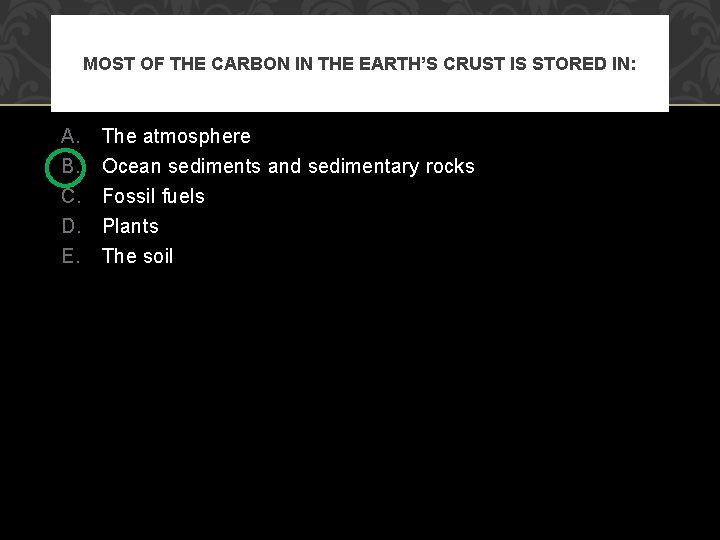
MOST OF THE CARBON IN THE EARTH’S CRUST IS STORED IN: A. B. C. D. E. The atmosphere Ocean sediments and sedimentary rocks Fossil fuels Plants The soil
WRAP UP! 3, 2, 1
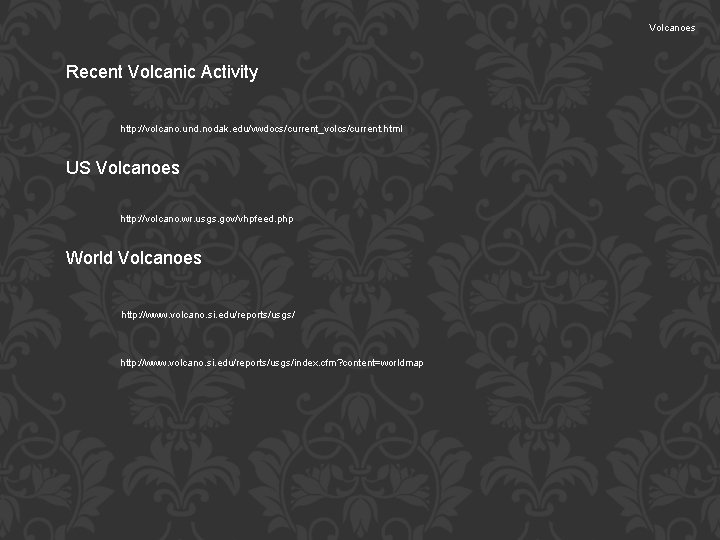
Volcanoes Recent Volcanic Activity http: //volcano. und. nodak. edu/vwdocs/current_volcs/current. html US Volcanoes http: //volcano. wr. usgs. gov/vhpfeed. php World Volcanoes http: //www. volcano. si. edu/reports/usgs/index. cfm? content=worldmap
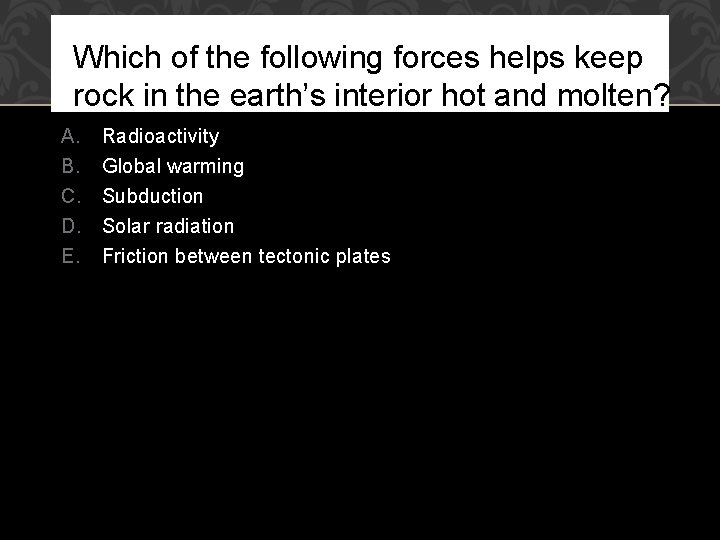
Which of the following forces helps keep rock in the earth’s interior hot and molten? A. B. C. D. E. Radioactivity Global warming Subduction Solar radiation Friction between tectonic plates
MINI-FRQ A. How does carbon cross over from the biological carbon cycle to the volcanic part of the geological carbon cycle? B. How does carbon make its way from volcanic carbon dioxide emissions into organisms?
- Slides: 54