
Earth and ocean basin Introduction Distribution of sea
Earth and ocean basin • • • Introduction Distribution of sea and land The earth’s interior Ocean and types Theory of formation of the oceans The world’s oceans List of oceanic basins History and composition of ocean Relief of sea floor
• Three major components of earth – Hydrosphere-Ocean – Lithosphere-Rocks – Atmosphere-Air • Biosphere- encompasses part of these three layers – Several meters in lithosphere- 6 miles in to atmosphere-and more than 11, 000 meters into ocean – World ocean occupy 71% of earth surface – Average depth of ocean 4 km

The earth basin • Earth interior-Three distinct layer • Core – Inner most portion of earth – Begins at 2900 km below the surface of earth and extends up to 3480 km to the center of the earth. Outer liquid core-> alloy of • Two cores Inner solid core Alloy of Fe & NI 80%
Mantle • Intermediate layer between earth’s core & crust • Accounts for 84% of earth & volume • It is 2900 km thick • Composed of silicon, magnesium, and iron • Upper mantle hotter than lower mantle because it have extensive distribution of radio active minerals such as uranium, thorium and potassium
Crust • Is the uppermost and thinnest segment of earth • Thickness various from 5 to 50 km • It is enriched in basaltic content in oceanic crust and granitic in continental crust. • 6 to 50 km thick • Crust is 50 km under mountain regions and less than 5 km under ocean

Lower SIMA (silica, magnesium) • Crust upper SIAL (silica and aluminium)
Theory of formation of the oceans • Continental drift theory • The theory of permanent oceans

World’s Ocean Volume (in Depth (in Temperature millions) of cubic meters) kilometers Salinity Remarks Pacific Area (in millions) of square kilometers 166, 241 696, 184 4, 188 3. 36 34. 62 Coldest, deepest, and largest ocean, occupying more than half of the volume of ocean basins Atlantic 94, 314 337, 210 3, 736 3. 72 34. 76 Received large amount of sediment from many rivers such as the Amazon, the Congo, the Mississippi. Indian 77, 118 284, 608 3, 872 3. 73 34. 90 Received large amount of sediment from the Indus, the Ganges, and the Brahmaputra Total Ocean 362, 033 1, 349, 929 3, 729 3. 52 34. 72 Oceans occupy 70 percent of the earth’s surface
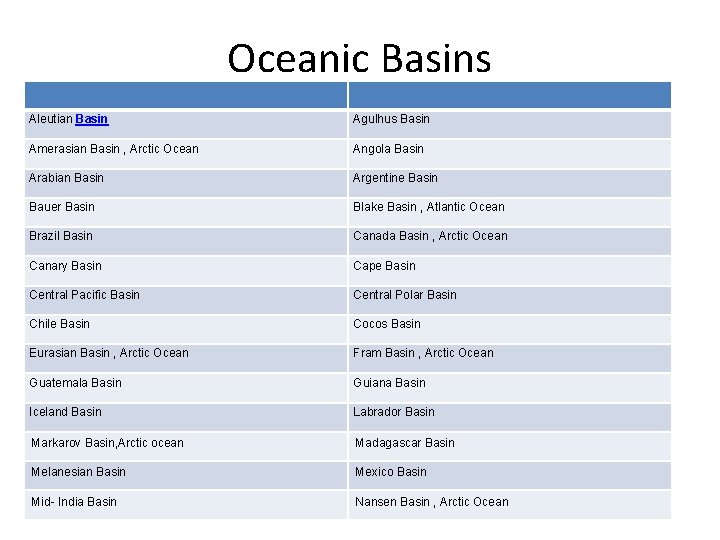
Oceanic Basins Aleutian Basin Agulhus Basin Amerasian Basin , Arctic Ocean Angola Basin Arabian Basin Argentine Basin Bauer Basin Blake Basin , Atlantic Ocean Brazil Basin Canada Basin , Arctic Ocean Canary Basin Cape Basin Central Pacific Basin Central Polar Basin Chile Basin Cocos Basin Eurasian Basin , Arctic Ocean Fram Basin , Arctic Ocean Guatemala Basin Guiana Basin Iceland Basin Labrador Basin Markarov Basin, Arctic ocean Madagascar Basin Melanesian Basin Mexico Basin Mid- India Basin Nansen Basin , Arctic Ocean
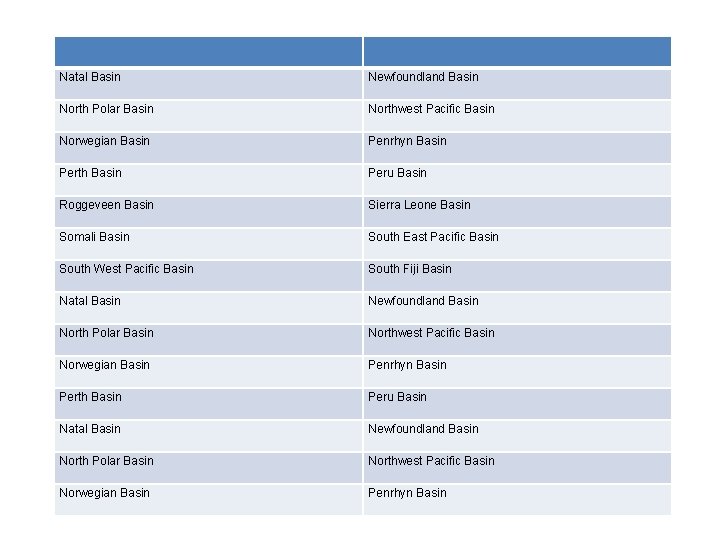
Natal Basin Newfoundland Basin North Polar Basin Northwest Pacific Basin Norwegian Basin Penrhyn Basin Perth Basin Peru Basin Roggeveen Basin Sierra Leone Basin Somali Basin South East Pacific Basin South West Pacific Basin South Fiji Basin Natal Basin Newfoundland Basin North Polar Basin Northwest Pacific Basin Norwegian Basin Penrhyn Basin Perth Basin Peru Basin Natal Basin Newfoundland Basin North Polar Basin Northwest Pacific Basin Norwegian Basin Penrhyn Basin
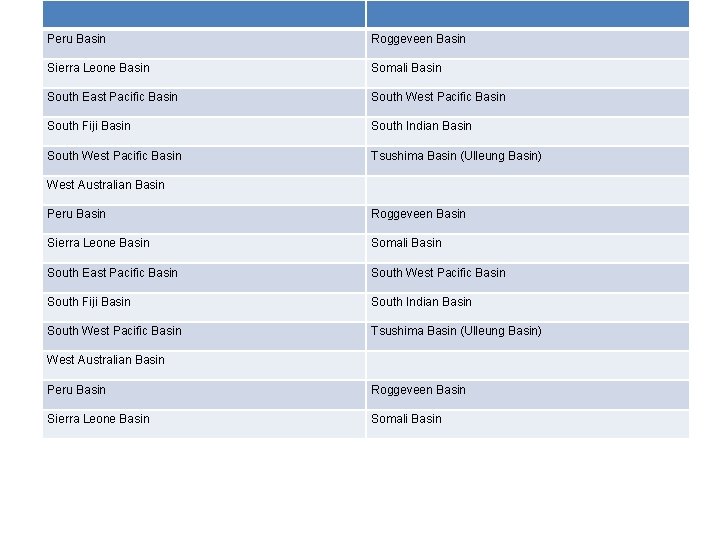
Peru Basin Roggeveen Basin Sierra Leone Basin Somali Basin South East Pacific Basin South West Pacific Basin South Fiji Basin South Indian Basin South West Pacific Basin Tsushima Basin (Ulleung Basin) West Australian Basin Peru Basin Roggeveen Basin Sierra Leone Basin Somali Basin
• Saucer –like depression of the seabed • have the features of continental margin to vast structural division of deep ocean • Largest ocean basin-3 -5 km • Stretch from outer margins of continents to mid ocean ridges • Cover 71% (36 million sqkm) of earth surface • Average depth 500 mts • Five major ocean basin – Pacific ocean basin – Indian ocean basin – Atlantic ocean basin
Pacific Ocean basin • Eastern side bounded by North and South American continents • Northern side bounded by Bering strait • Western side bounded by Asia, Archipelago and Australia • Southern side by southern ocean – Deepest of all oceans – Oldest of the existing ocean basin – The coastal shelf extends to depth of about 180 mts and is narrow along north & south America
Atlantic ocean basin • The continental shelves of American, African and European coasts forms the Atlandic ocean basin • The subbasins along American side are more than 500 mts deep • The North American basin, Brazil basin, Argentina basin are the other sub basins
Indian Ocean basin • Third largest of five oceans • Bounded on west by Africa, North by Asia, East by Australia, South by southern ocean • The basin includes the
Distribution of land water in the earth • Land water are unevenly distributed on the earth • Continents cover 29. 2% of earth surface • The ocean is directed in to 3 basins called Atlantic, Pacific and Indian. • Ocean basin covers 70. 8% of earth surface • The southern hemisphere is dominated by oceans (80. 4%) • Northern hemisphere contains most of the lard and is still dominated by ocean (60. 7%)
History and composition of ocean
List of oceanic basins
Chemical History of the Ocean
Relief of sea floor
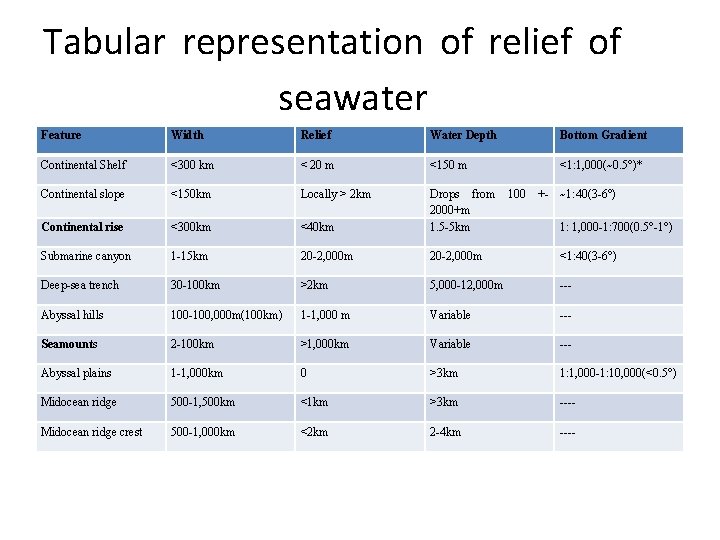
Tabular representation of relief of seawater Feature Width Relief Water Depth Bottom Gradient Continental Shelf <300 km < 20 m <150 m <1: 1, 000(~0. 5°)* Continental slope <150 km Locally > 2 km Continental rise <300 km <40 km Drops from 2000+m 1. 5 -5 km Submarine canyon 1 -15 km 20 -2, 000 m <1: 40(3 -6°) Deep-sea trench 30 -100 km >2 km 5, 000 -12, 000 m --- Abyssal hills 100 -100, 000 m(100 km) 1 -1, 000 m Variable --- Seamounts 2 -100 km >1, 000 km Variable --- Abyssal plains 1 -1, 000 km 0 >3 km 1: 1, 000 -1: 10, 000(<0. 5°) Midocean ridge 500 -1, 500 km <1 km >3 km ---- Midocean ridge crest 500 -1, 000 km <2 km 2 -4 km ---- 100 +- ~1: 40(3 -6°) 1: 1, 000 -1: 700(0. 5°-1°)
- Slides: 21