
EART 30351 Lecture 10 Reminder Rossby waves Basic

EART 30351 Lecture 10
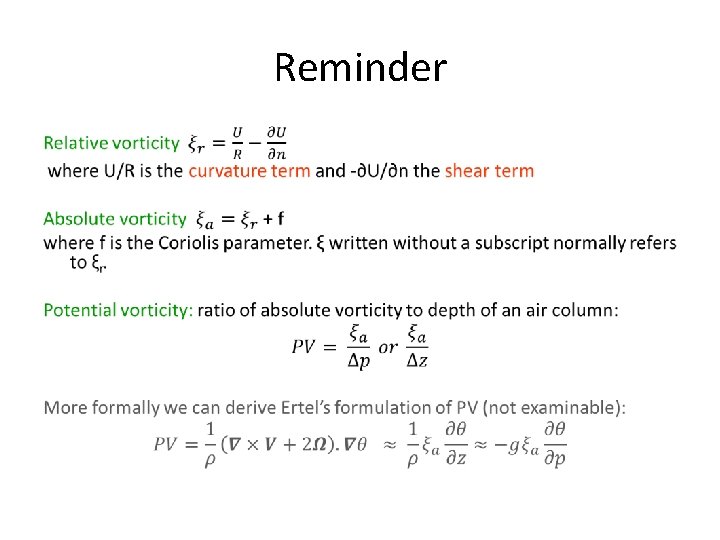
Reminder •

Rossby waves Basic mechanism is exchange of relative and planetary vorticity A ξr <0 Increasing f = 2Ωsinλ B Increasing ξ ξr >0 Dines compensation involves C-D dipoles. In the mid-troposphere there is a level of non-divergence. By the barotropic vorticity equation, ξ+f is conserved at this level. Parcel of air at A experiences increasing f so develops negative (anticyclonic) vorticity and turns clockwise. Parcel at B experiences the reverse. So we get undulating flow in the westerlies.

Simple mathematical ideas •
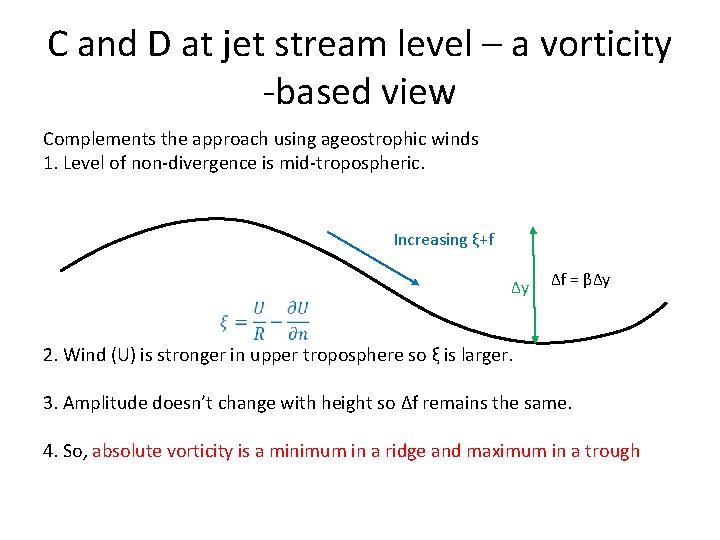
C and D at jet stream level – a vorticity -based view Complements the approach using ageostrophic winds 1. Level of non-divergence is mid-tropospheric. Increasing ξ+f Δy Δf = βΔy 2. Wind (U) is stronger in upper troposphere so ξ is larger. 3. Amplitude doesn’t change with height so Δf remains the same. 4. So, absolute vorticity is a minimum in a ridge and maximum in a trough
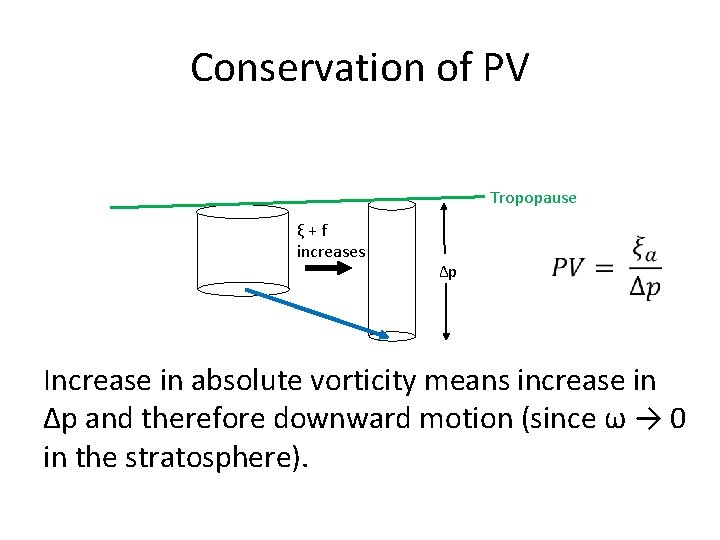
Conservation of PV Tropopause ξ+f increases Δp Increase in absolute vorticity means increase in Δp and therefore downward motion (since ω → 0 in the stratosphere).
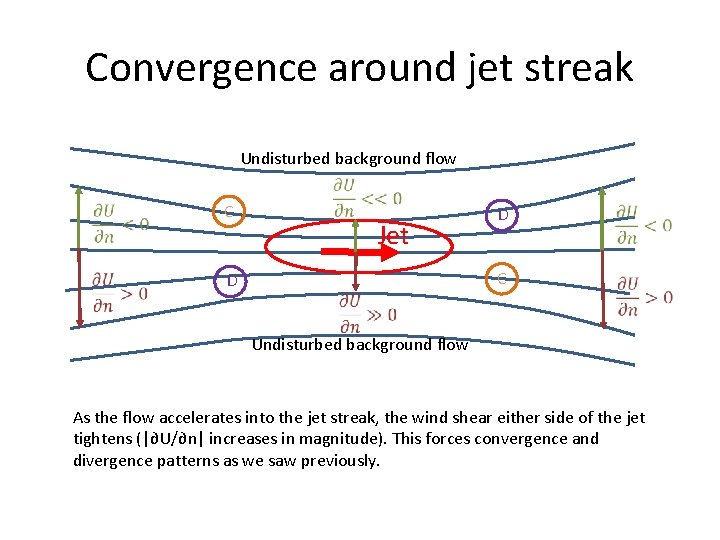
Convergence around jet streak Undisturbed background flow C Jet D C D Undisturbed background flow As the flow accelerates into the jet streak, the wind shear either side of the jet tightens (|∂U/∂n| increases in magnitude). This forces convergence and divergence patterns as we saw previously.

Convergence around Rossby wave A Divergence ξ+f increases ξr < 0 Convergence B C ξ+f decreases ξr > 0 As air flows from A to B the absolute vorticity increases, so the air parcels stretch – downward motion. Air flowing from B to C shrinks – upward motion. Upward motion in the troposphere promotes deep convection and cyclones Downward motion in the troposphere promotes clear skies and anticyclones
Example 1 Upper tropospheric air flows at a speed of 30 ms -1 through a sinusoidal trough-ridge pattern at 50 o. N, of peak-to-peak amplitude 500 km and wavelength 3000 km. Calculate the change in absolute vorticity between ridge and trough, and derive the fractional change in the depth of an air column as it traverses the pattern. (The radius of curvature of y = a sin(kx) is (ak 2)-1 at the crests).
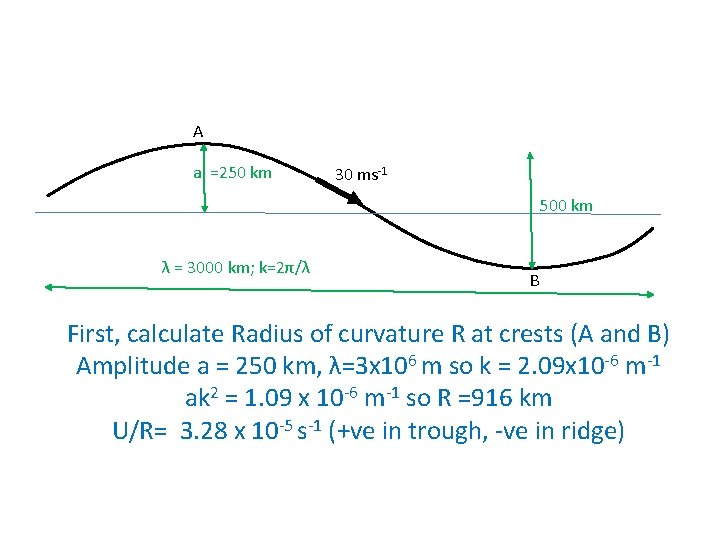
A a =250 km 30 ms-1 500 km λ = 3000 km; k=2π/λ B First, calculate Radius of curvature R at crests (A and B) Amplitude a = 250 km, λ=3 x 10⁶ m so k = 2. 09 x 10 -6 m-1 ak 2 = 1. 09 x 10 -6 m-1 so R =916 km U/R= 3. 28 x 10 -5 s-1 (+ve in trough, -ve in ridge)
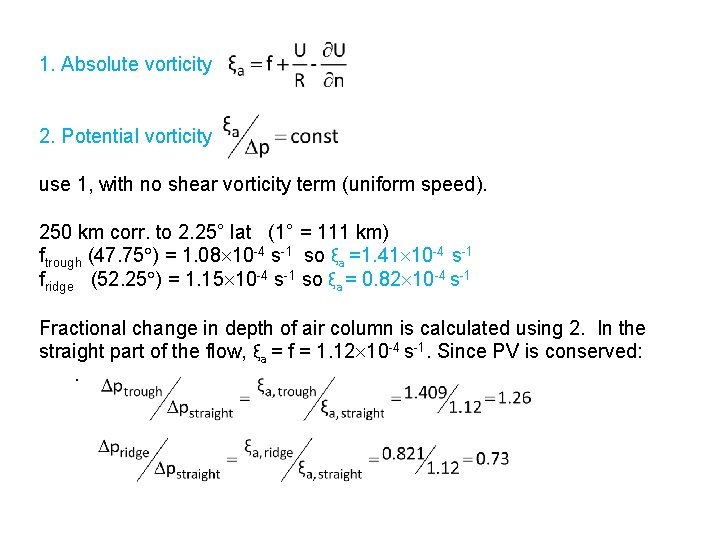
1. Absolute vorticity 2. Potential vorticity use 1, with no shear vorticity term (uniform speed). 250 km corr. to 2. 25° lat (1° = 111 km) ftrough (47. 75 ) = 1. 08 10 -4 s-1 so ξa =1. 41 10 -4 s-1 fridge (52. 25 ) = 1. 15 10 -4 s-1 so ξa = 0. 82 10 -4 s-1 Fractional change in depth of air column is calculated using 2. In the straight part of the flow, ξa = f = 1. 12 10 -4 s-1. Since PV is conserved: .
Example 2 A zonal jet streak develops in a uniform zonal flow of 30 m s-1 at 60°N. The jet has a maximum speed of 80 m s-1. The cyclonic side is 200 km wide and the anticyclonic side 600 km wide. If the initial depth of a column of air which enters the jet is 100 mb, use the barotropic vorticity equation to estimate its depth at maximum velocity if it is positioned: (i) poleward of the jet core (ii) equatorward of the jet core (iii) directly upstream of the jet core. What limits the accuracy of these estimates?
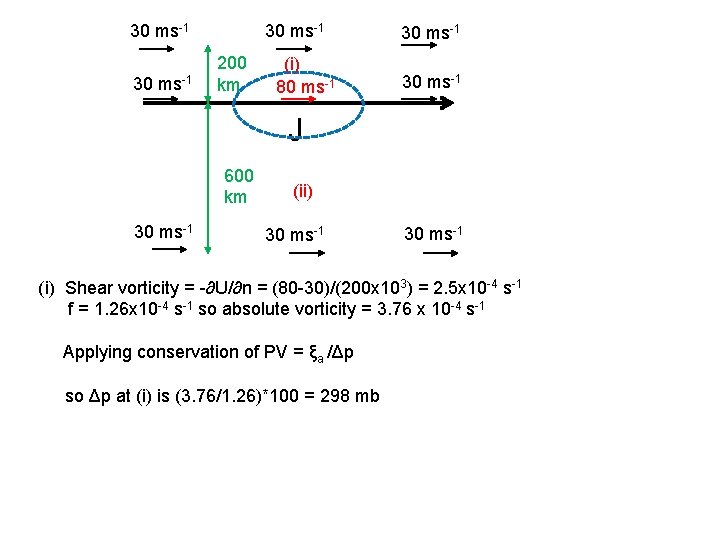
30 ms-1 200 km (i) 80 ms-1 30 ms-1 J 600 km 30 ms-1 (ii) 30 ms-1 (i) Shear vorticity = -∂U/∂n = (80 -30)/(200 x 103) = 2. 5 x 10 -4 s-1 f = 1. 26 x 10 -4 s-1 so absolute vorticity = 3. 76 x 10 -4 s-1 Applying conservation of PV = ξa /Δp so Δp at (i) is (3. 76/1. 26)*100 = 298 mb
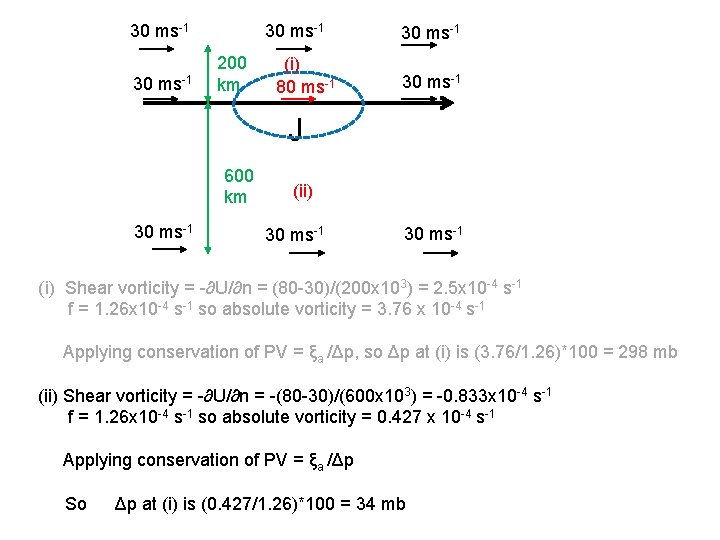
30 ms-1 200 km (i) 80 ms-1 30 ms-1 J 600 km 30 ms-1 (ii) 30 ms-1 (i) Shear vorticity = -∂U/∂n = (80 -30)/(200 x 103) = 2. 5 x 10 -4 s-1 f = 1. 26 x 10 -4 s-1 so absolute vorticity = 3. 76 x 10 -4 s-1 Applying conservation of PV = ξa /Δp, so Δp at (i) is (3. 76/1. 26)*100 = 298 mb (ii) Shear vorticity = -∂U/∂n = -(80 -30)/(600 x 103) = -0. 833 x 10 -4 s-1 f = 1. 26 x 10 -4 s-1 so absolute vorticity = 0. 427 x 10 -4 s-1 Applying conservation of PV = ξa /Δp So Δp at (i) is (0. 427/1. 26)*100 = 34 mb
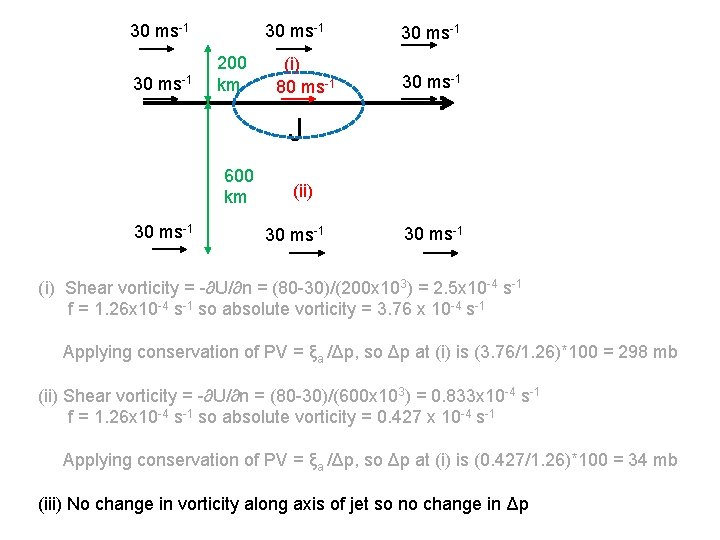
30 ms-1 200 km (i) 80 ms-1 30 ms-1 J 600 km 30 ms-1 (ii) 30 ms-1 (i) Shear vorticity = -∂U/∂n = (80 -30)/(200 x 103) = 2. 5 x 10 -4 s-1 f = 1. 26 x 10 -4 s-1 so absolute vorticity = 3. 76 x 10 -4 s-1 Applying conservation of PV = ξa /Δp, so Δp at (i) is (3. 76/1. 26)*100 = 298 mb (ii) Shear vorticity = -∂U/∂n = (80 -30)/(600 x 103) = 0. 833 x 10 -4 s-1 f = 1. 26 x 10 -4 s-1 so absolute vorticity = 0. 427 x 10 -4 s-1 Applying conservation of PV = ξa /Δp, so Δp at (i) is (0. 427/1. 26)*100 = 34 mb (iii) No change in vorticity along axis of jet so no change in Δp
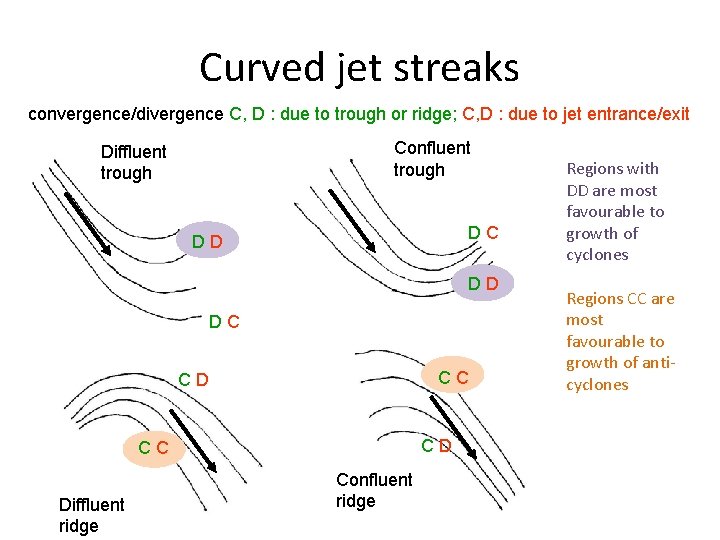
Curved jet streaks convergence/divergence C, D : due to trough or ridge; C, D : due to jet entrance/exit Confluent trough Diffluent trough DC DD DD DC CC CD CD CC Diffluent ridge Confluent ridge Regions with DD are most favourable to growth of cyclones Regions CC are most favourable to growth of anticyclones
- Slides: 16