
Early Warning Score EWS Training Module Last updated
- Slides: 29
Early Warning Score (EWS) Training Module Last updated 30 th Sep 2019
Contents Background Rationale of EWS monitoring system EWS Response Plan Communicating a common language FAQ
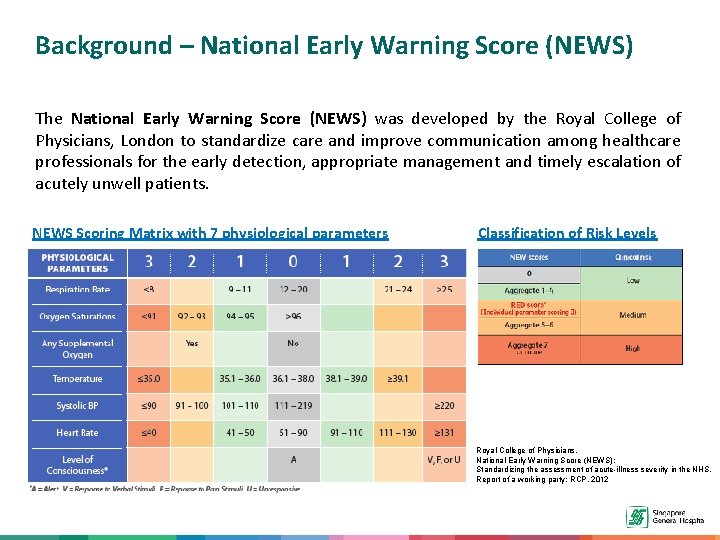
Background – National Early Warning Score (NEWS) The National Early Warning Score (NEWS) was developed by the Royal College of Physicians, London to standardize care and improve communication among healthcare professionals for the early detection, appropriate management and timely escalation of acutely unwell patients. NEWS Scoring Matrix with 7 physiological parameters Classification of Risk Levels Royal College of Physicians. National Early Warning Score (NEWS): Standardizing the assessment of acute-illness severity in the NHS. Report of a working party: RCP, 2012
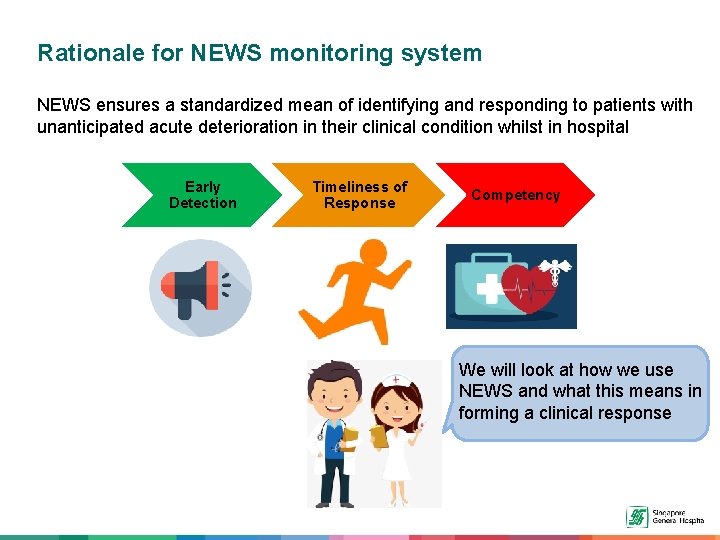
Rationale for NEWS monitoring system NEWS ensures a standardized mean of identifying and responding to patients with unanticipated acute deterioration in their clinical condition whilst in hospital Early Detection Timeliness of Response Competency We will look at how we use NEWS and what this means in forming a clinical response
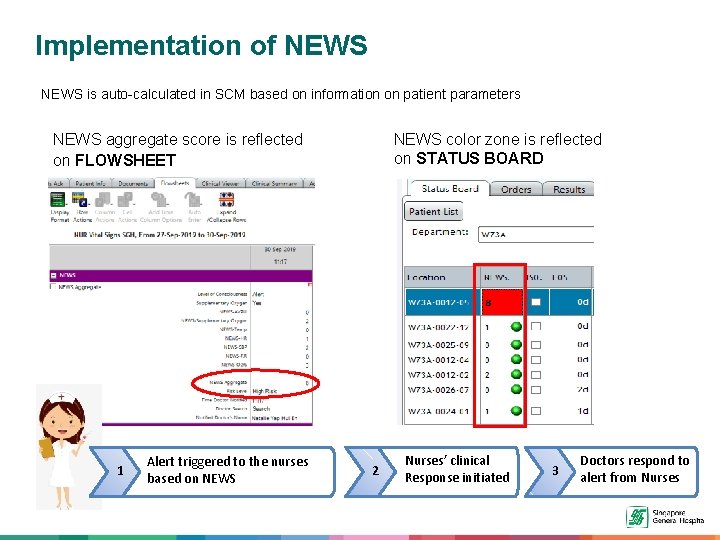
Implementation of NEWS is auto-calculated in SCM based on information on patient parameters NEWS aggregate score is reflected on FLOWSHEET 1 Alert triggered to the nurses based on NEWS color zone is reflected on STATUS BOARD 2 Nurses’ clinical Response initiated 3 Doctors respond to alert from Nurses
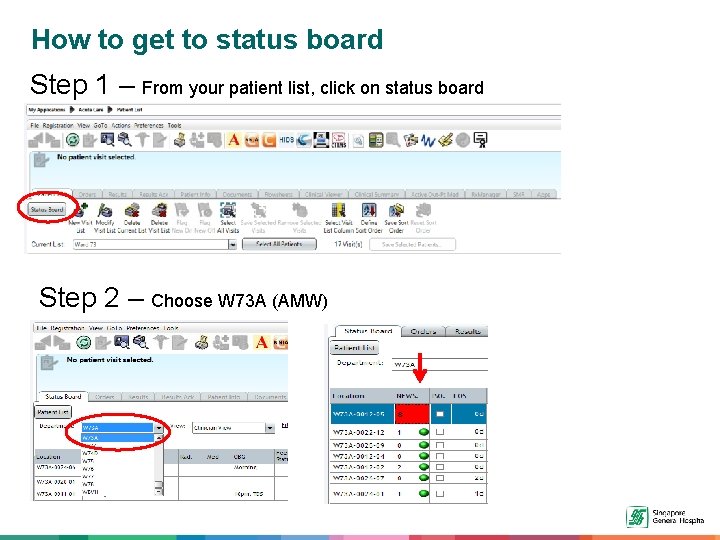
How to get to status board Step 1 – From your patient list, click on status board Step 2 – Choose W 73 A (AMW)
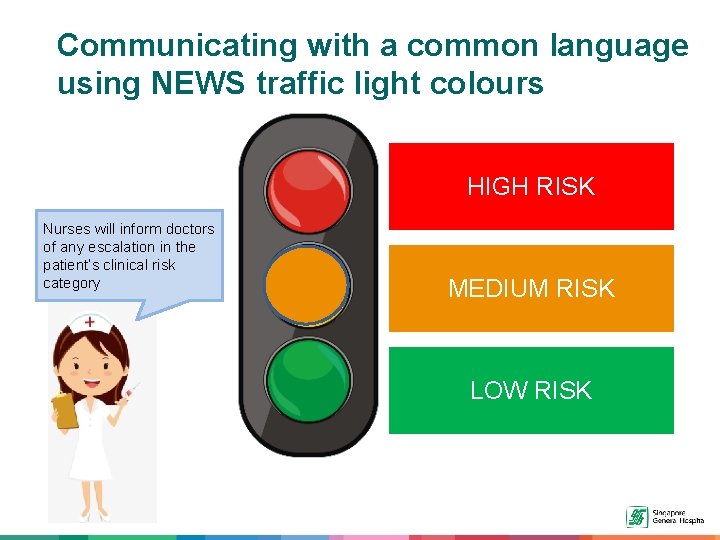
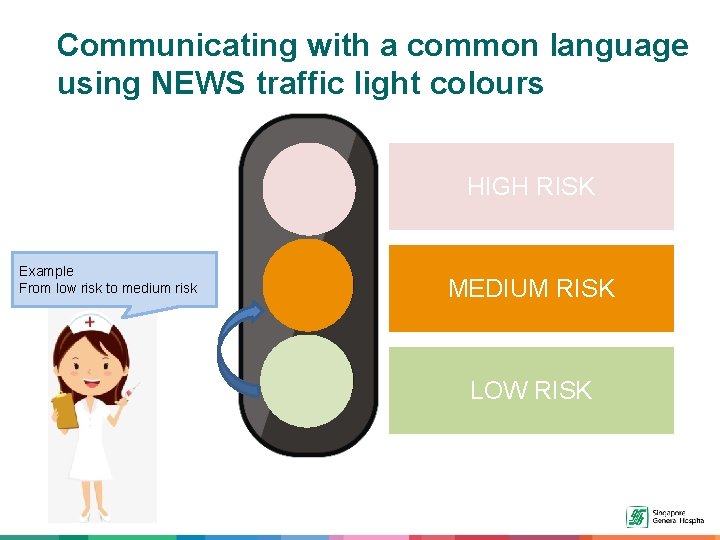
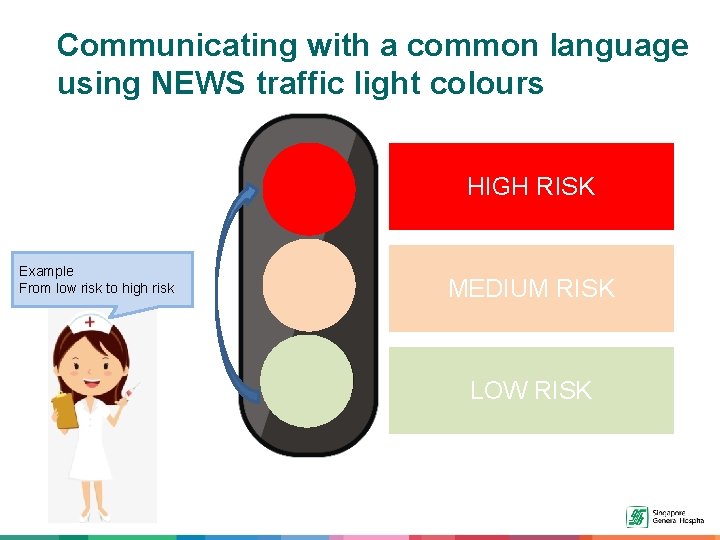
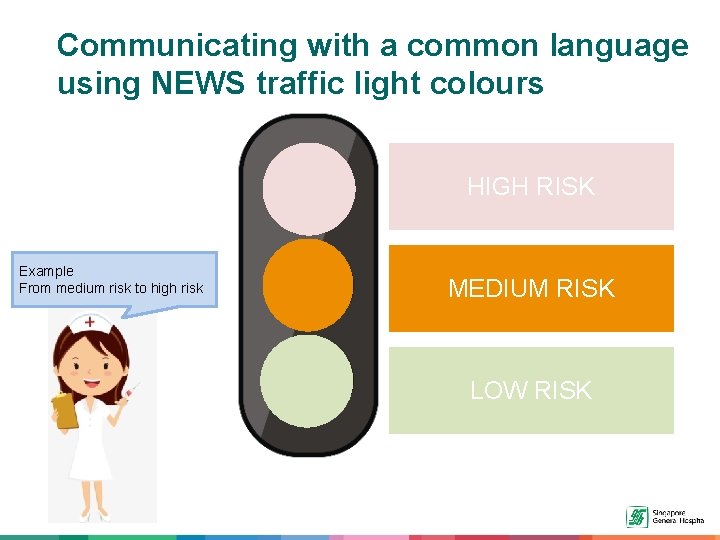
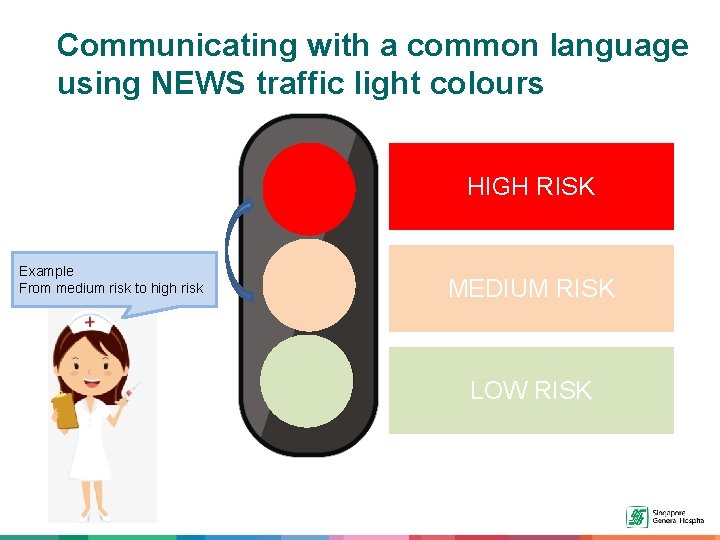
Communicating with a common language using NEWS traffic light colours HIGH RISK Nurses will inform doctors of any escalation in the patient’s clinical risk category MEDIUM RISK LOW RISK
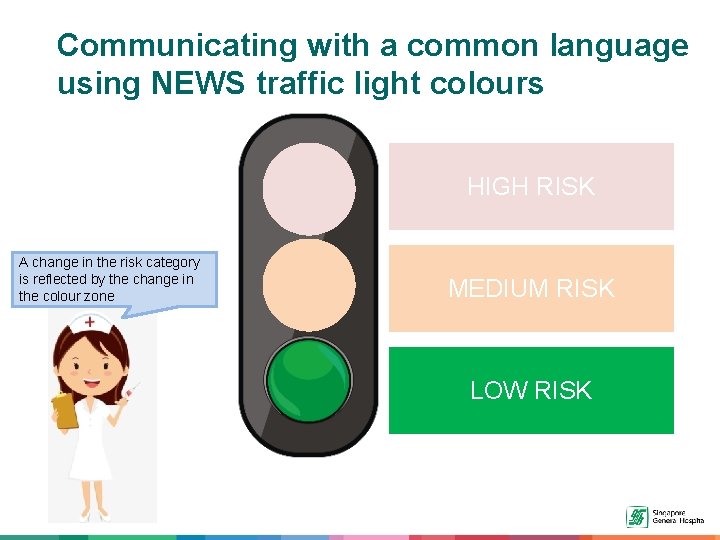
Communicating with a common language using NEWS traffic light colours HIGH RISK A change in the risk category is reflected by the change in the colour zone MEDIUM RISK LOW RISK
Communicating with a common language using NEWS traffic light colours HIGH RISK Example From low risk to medium risk MEDIUM RISK LOW RISK
Communicating with a common language using NEWS traffic light colours HIGH RISK Example From low risk to high risk MEDIUM RISK LOW RISK
Communicating with a common language using NEWS traffic light colours HIGH RISK Example From medium risk to high risk MEDIUM RISK LOW RISK
Communicating with a common language using NEWS traffic light colours HIGH RISK Example From medium risk to high risk MEDIUM RISK LOW RISK
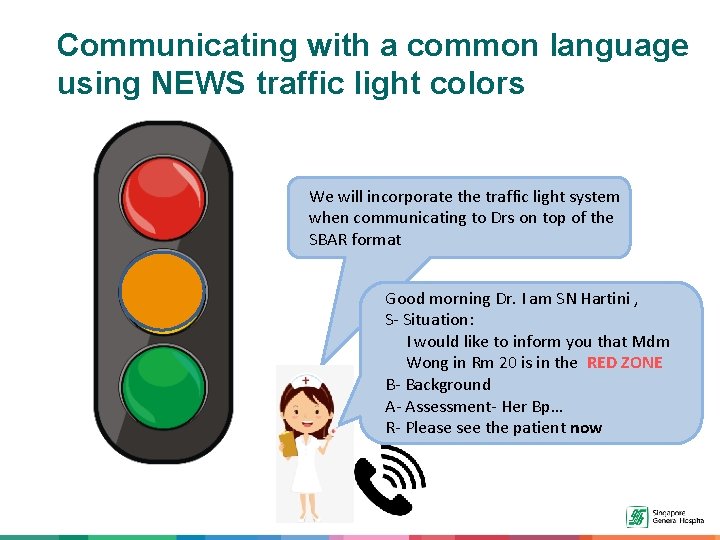
Communicating with a common language using NEWS traffic light colors We will incorporate the traffic light system when communicating to Drs on top of the SBAR format Good morning Dr. I am SN Hartini , S- Situation: I would like to inform you that Mdm Wong in Rm 20 is in the RED ZONE B- Background A- Assessment- Her Bp… R- Please see the patient now
NEWS Response Plan
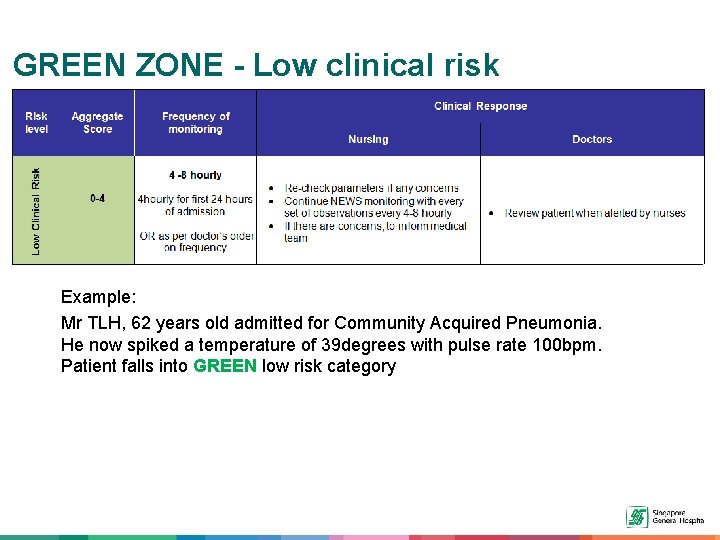
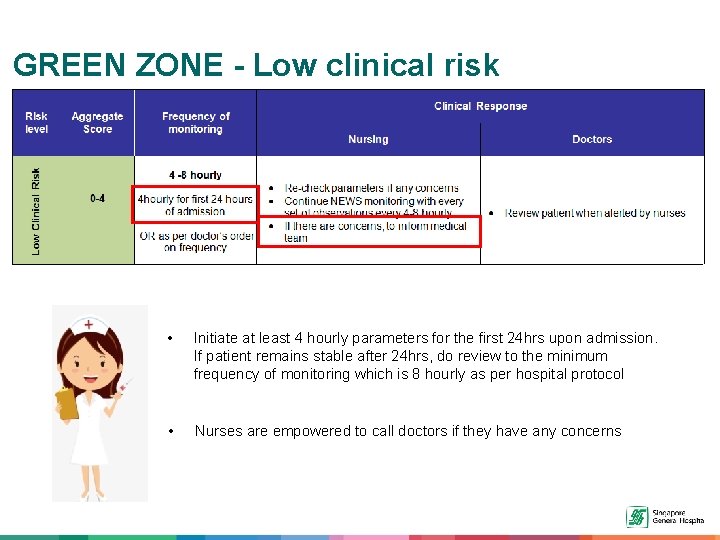
GREEN ZONE - Low clinical risk Example: Mr TLH, 62 years old admitted for Community Acquired Pneumonia. He now spiked a temperature of 39 degrees with pulse rate 100 bpm. Patient falls into GREEN low risk category
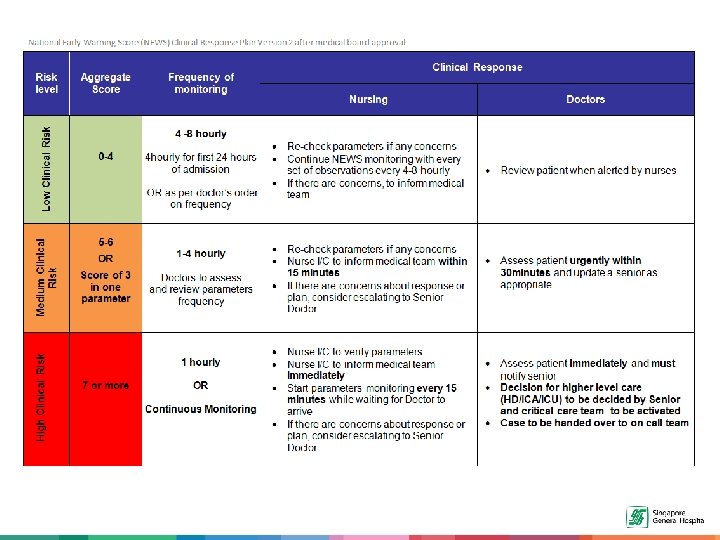
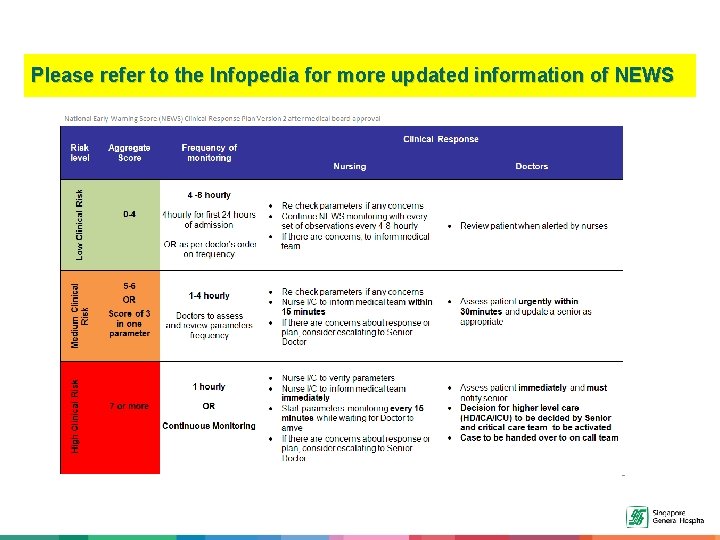
GREEN ZONE - Low clinical risk • Initiate at least 4 hourly parameters for the first 24 hrs upon admission. If patient remains stable after 24 hrs, do review to the minimum frequency of monitoring which is 8 hourly as per hospital protocol • Nurses are empowered to call doctors if they have any concerns
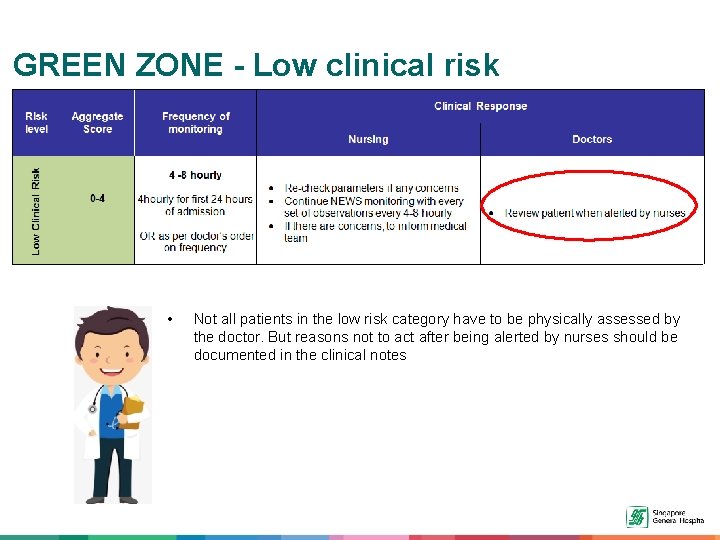
GREEN ZONE - Low clinical risk • Not all patients in the low risk category have to be physically assessed by the doctor. But reasons not to act after being alerted by nurses should be documented in the clinical notes
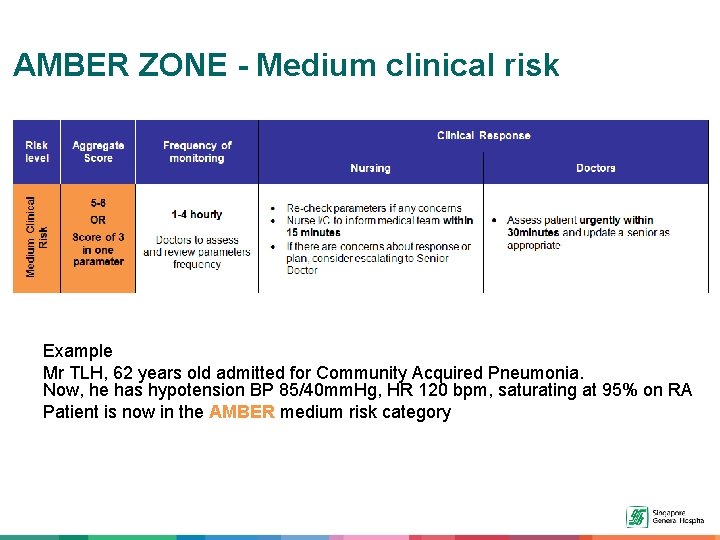
AMBER ZONE - Medium clinical risk Example Mr TLH, 62 years old admitted for Community Acquired Pneumonia. Now, he has hypotension BP 85/40 mm. Hg, HR 120 bpm, saturating at 95% on RA Patient is now in the AMBER medium risk category
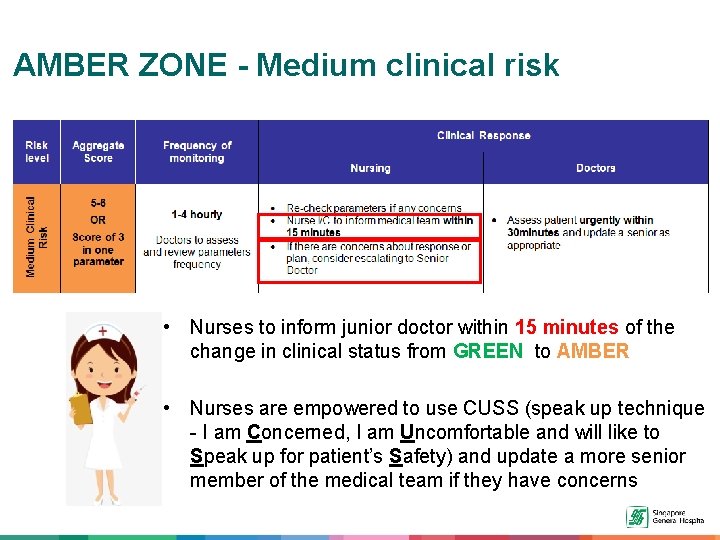
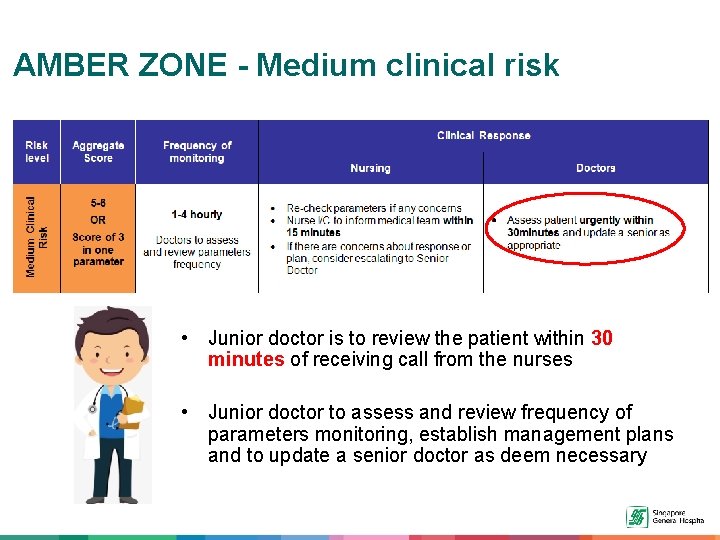
AMBER ZONE - Medium clinical risk • Nurses to inform junior doctor within 15 minutes of the change in clinical status from GREEN to AMBER • Nurses are empowered to use CUSS (speak up technique - I am Concerned, I am Uncomfortable and will like to Speak up for patient’s Safety) and update a more senior member of the medical team if they have concerns
AMBER ZONE - Medium clinical risk • Junior doctor is to review the patient within 30 minutes of receiving call from the nurses • Junior doctor to assess and review frequency of parameters monitoring, establish management plans and to update a senior doctor as deem necessary
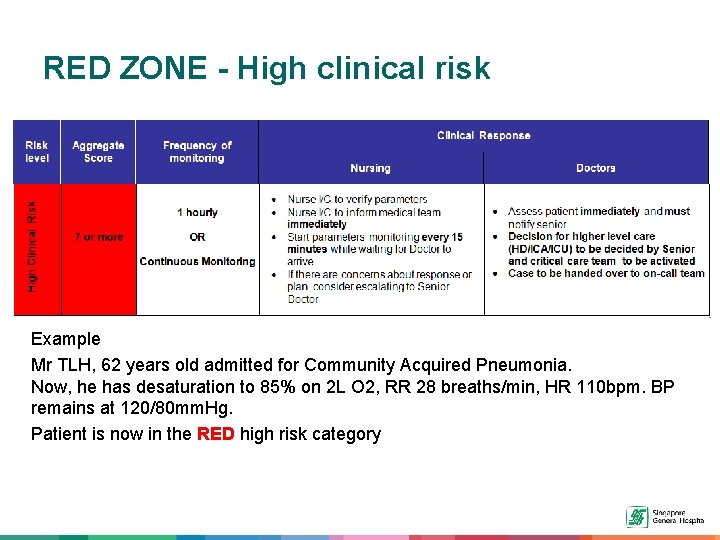
RED ZONE - High clinical risk Example Mr TLH, 62 years old admitted for Community Acquired Pneumonia. Now, he has desaturation to 85% on 2 L O 2, RR 28 breaths/min, HR 110 bpm. BP remains at 120/80 mm. Hg. Patient is now in the RED high risk category
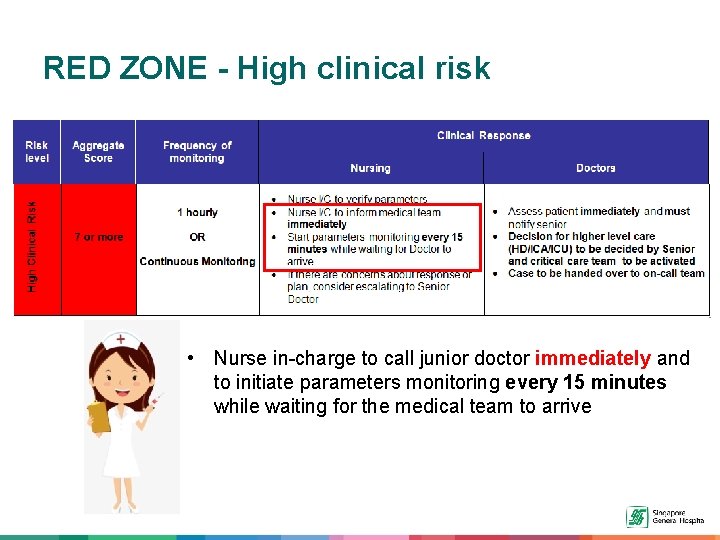
RED ZONE - High clinical risk • Nurse in-charge to call junior doctor immediately and to initiate parameters monitoring every 15 minutes while waiting for the medical team to arrive
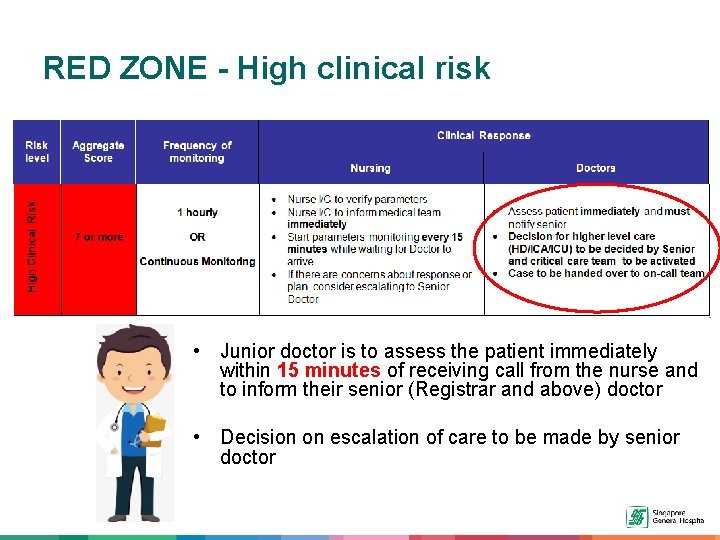
RED ZONE - High clinical risk • Junior doctor is to assess the patient immediately within 15 minutes of receiving call from the nurse and to inform their senior (Registrar and above) doctor • Decision on escalation of care to be made by senior doctor
Please refer to the Infopedia for more updated information of NEWS
Frequently Asked Questions
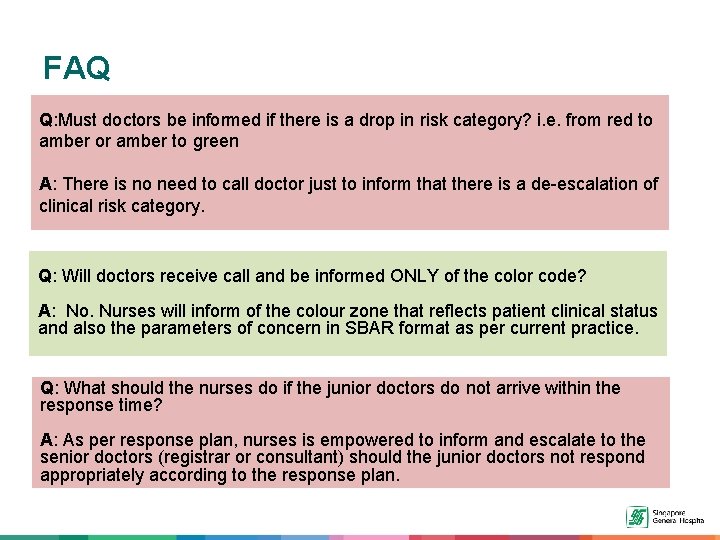
FAQ Q: Must doctors be informed if there is a drop in risk category? i. e. from red to amber or amber to green A: There is no need to call doctor just to inform that there is a de-escalation of clinical risk category. Q: Will doctors receive call and be informed ONLY of the color code? A: No. Nurses will inform of the colour zone that reflects patient clinical status and also the parameters of concern in SBAR format as per current practice. Q: What should the nurses do if the junior doctors do not arrive within the response time? A: As per response plan, nurses is empowered to inform and escalate to the senior doctors (registrar or consultant) should the junior doctors not respond appropriately according to the response plan.
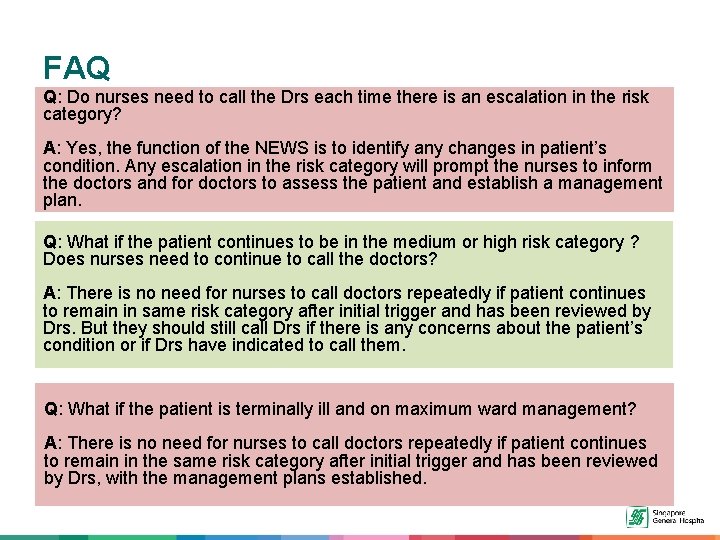
FAQ Q: Do nurses need to call the Drs each time there is an escalation in the risk category? A: Yes, the function of the NEWS is to identify any changes in patient’s condition. Any escalation in the risk category will prompt the nurses to inform the doctors and for doctors to assess the patient and establish a management plan. Q: What if the patient continues to be in the medium or high risk category ? Does nurses need to continue to call the doctors? A: There is no need for nurses to call doctors repeatedly if patient continues to remain in same risk category after initial trigger and has been reviewed by Drs. But they should still call Drs if there is any concerns about the patient’s condition or if Drs have indicated to call them. Q: What if the patient is terminally ill and on maximum ward management? A: There is no need for nurses to call doctors repeatedly if patient continues to remain in the same risk category after initial trigger and has been reviewed by Drs, with the management plans established.
Thank You