
Early Trade Theories Mercantilism to the introduction of
- Slides: 29
Early Trade Theories • Mercantilism to the introduction of Classical Trade Theory (classical trade theory is the topic of Chapter 3) • Mercantilism • David Hume and the price-specie-flowmechanism • Adam Smith and the concept of absolute advantage
Mercantilism • A collection or pattern of thinking about economics that became prominent in Europe from late 1400 s to 1750 • At the time, Europe was emerging from feudalist society to early industrialism, and trade • Discovery of new lands provided opportunities for trade & exploitation.
Mercantilism • Mercantilist thinking served the power holders of the time. Some of it still shows up today. • Mercantilist thinking included particular approaches to – The Economic System • Role of Trade – The Role of Government – Domestic Economic Policy
Mercantilist Economic System • Three components to Economic system – Manufacturing (new power rising) – Rural sector (feudal lords presiding) – Foreign colonies (newly found sources of wealth)
Mercantilist Economic System • One goal for the state: • ACCUMULATE GOLD OR SILVER (specie) IN NATIONAL TREASURY Bullionism (bullion: metal in the mass ) • This was how wars could be paid for… and mercantilists viewed the world as constantly at war.
Mercantilist Economic System • View of the workings of the Economy • ZERO-SUM GAME – In a zero-sum game, one side can only win if the other side loses the same amount. – Example: poker … I win $100 if someone else, or some other group of people lose $100. • This is a critically important view that is challenged.
Mercantilist Economic System • View of the workings of the Economy • Source of value: • Labour theory of value – the value of any good can be traced back to the labour that is used in its production. – This theory can have several effects on other parts of thought, depending on the rest of one’s world view.
Some economic realities of the time • Countries were emerging from feudalism, the idea of freedom of choice was not yet strong, especially for normal people • There was growing overpopulation, and underemployment. – The start of the industrial revolution meant more people lived to adulthood, • There were struggles for control of land & resources.
Mercantilism and Trade • Trade is a zero-sum game. • To ‘win’ at trade, a country should control it carefully. • A country wants to extract as much resources from colonies as possible • A country also wants to use trade to promote exports. This provides jobs for its population.
Mercantilism and Trade • Countries want to maintain a positive balance of trade, or trade balance • A positive trade balance is one where Exports > Imports
Mercantilism and Trade • Countries did not want a negative balance of trade, or trade balance Imports > Exports (We still have a problem with this situation. )
Mercantilism and Trade • To maintain – exports > imports AND – extract resources from colonies AND – acquire gold and silver for national treasuries • Countries used MONOPOLIES – East India Company – Hudson Bay Company
Mercantilism – Role of Government • Government’s role was to control trade and the economy in order to raise taxes and finance wars to protect the land from foreign invaders. – Government granted monopoly power to companies – Controlled inflow and outflow of gold & silver
Mercantilism – Role of Government • Government granted monopoly power to companies – contribute to positive trade balance • Controlled shipping – (only British ships could carry goods between British ports, including colonies) – today still true, e. g. US, only US ships can carry goods between US ports.
Mercantilism – Role of Government • Imposed controls on trade, limiting imports & promoting exports (especially of manufactured goods) – trying to keep prices low in imported raw materials which would be worked on at home and re-exported at a higher price. • Controlled inflow and outflow of gold & silver
Mercantilism – Domestic Policies • Internal restrictions were important too!!! • Government granted internal monopoly power through product charters monopolies (tax exemptions, subsidies, special privileges) • Keep workers poor to keep them productive and to get more $ for national treasury. • Labour mobility controlled through craft guilds • Labour wages set institutionally to keep people alive, and maintain class system.
Challenge to Mercantilism • Davide Hume • Price-specie-flow mechanism The inevitability argument
David Hume Price-Specie-Flow Mechanism Background: Discovery of Americas brought huge sums of gold into Spain • Instead of greatly increasing Spain’s wealth, the gold mainly increased the prices of goods in Spain • The increase of domestic prices in Spain resulted in an “unfavourable” balance of trade – – gold flowed out of the country as the Spaniards imported more goods (in spite of tariffs & restrictions)
Price-specie-flow mechanism • The general idea is that the natural flow of international trade and money will cause trade to come into balance. • If a country tries to win from trade, it will put into play forces that will cause it to be less competitive in the long-run.
Price-specie-flow mechanism • How does it work? First in words: • If a country keeps exports up and imports down, then – money flows into the country – the money gets slowly spread around – prices go up, – the price of goods goes up – the country can’t sell its exports because they are more expensive
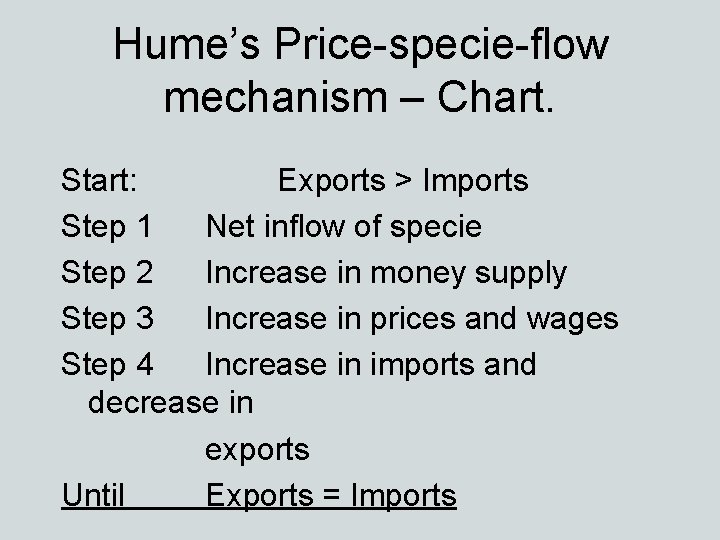
Hume’s Price-specie-flow mechanism – Chart. Start: Exports > Imports Step 1 Net inflow of specie Step 2 Increase in money supply Step 3 Increase in prices and wages Step 4 Increase in imports and decrease in exports Until Exports = Imports
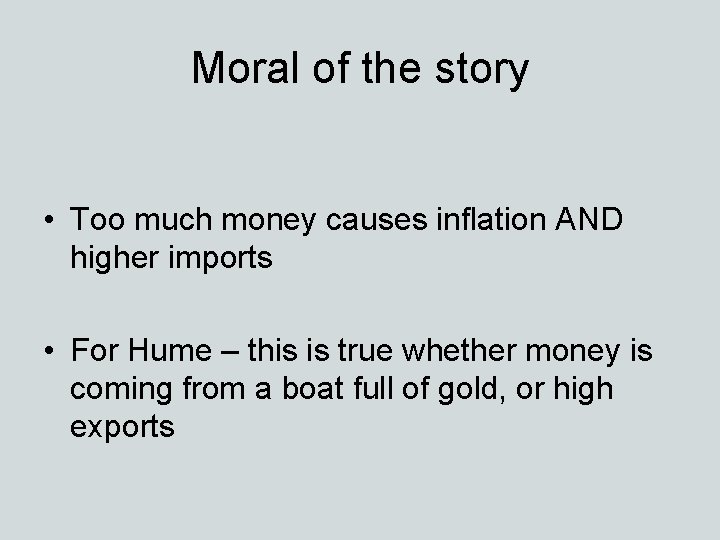
Moral of the story • Too much money causes inflation AND higher imports • For Hume – this is true whether money is coming from a boat full of gold, or high exports
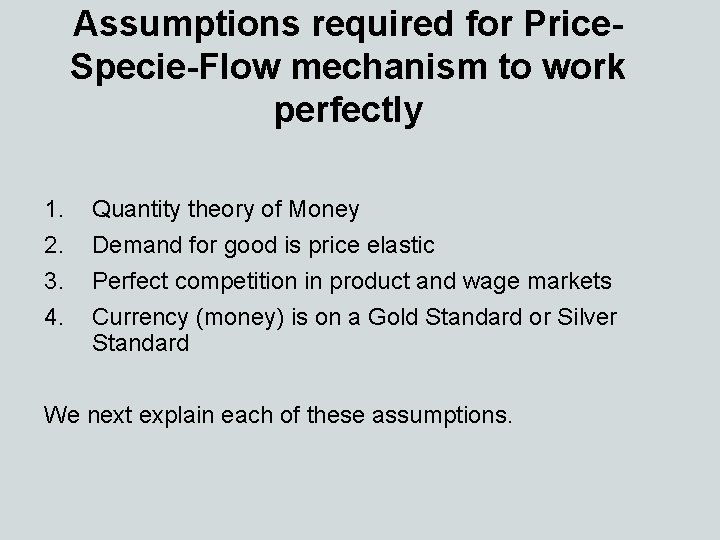
Assumptions required for Price. Specie-Flow mechanism to work perfectly 1. 2. 3. 4. Quantity theory of Money Demand for good is price elastic Perfect competition in product and wage markets Currency (money) is on a Gold Standard or Silver Standard We next explain each of these assumptions.
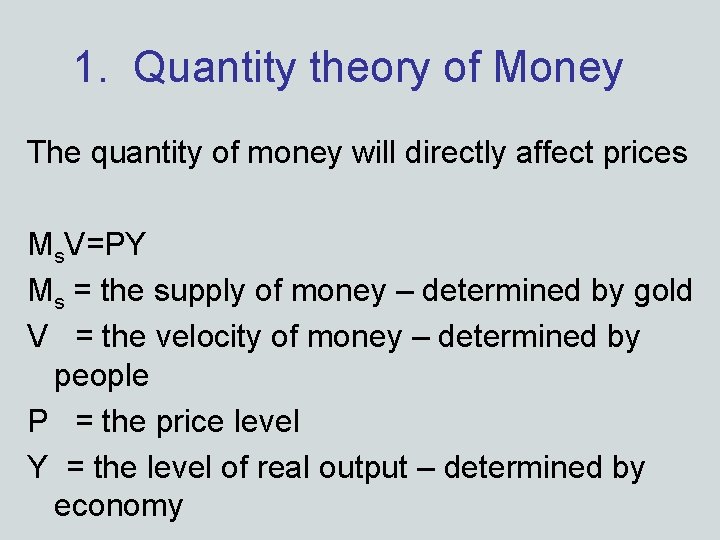
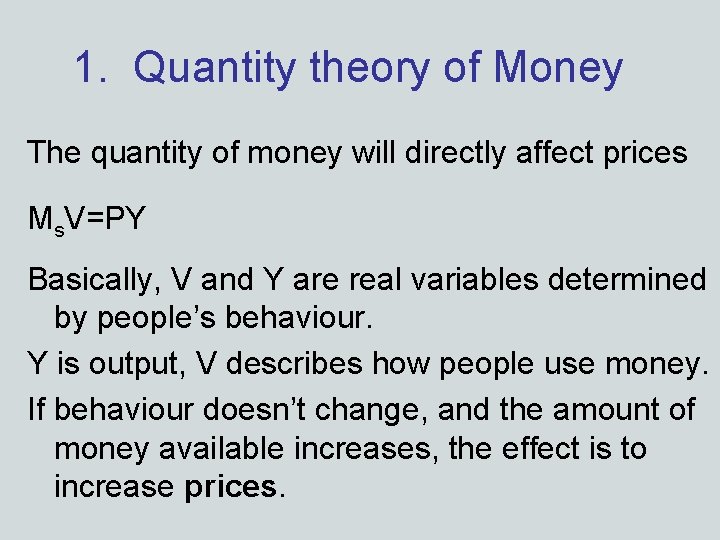
1. Quantity theory of Money The quantity of money will directly affect prices Ms. V=PY Ms = the supply of money – determined by gold V = the velocity of money – determined by people P = the price level Y = the level of real output – determined by economy
1. Quantity theory of Money The quantity of money will directly affect prices Ms. V=PY Basically, V and Y are real variables determined by people’s behaviour. Y is output, V describes how people use money. If behaviour doesn’t change, and the amount of money available increases, the effect is to increase prices.
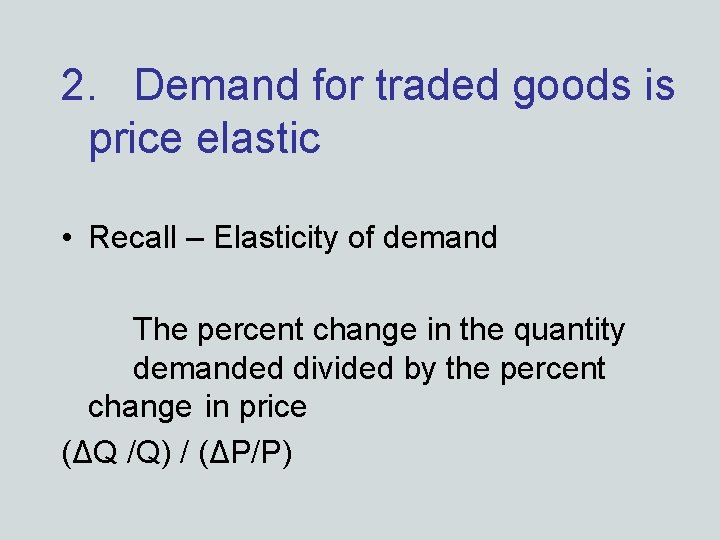
2. Demand for traded goods is price elastic • Recall – Elasticity of demand The percent change in the quantity demanded divided by the percent change in price (ΔQ /Q) / (ΔP/P)
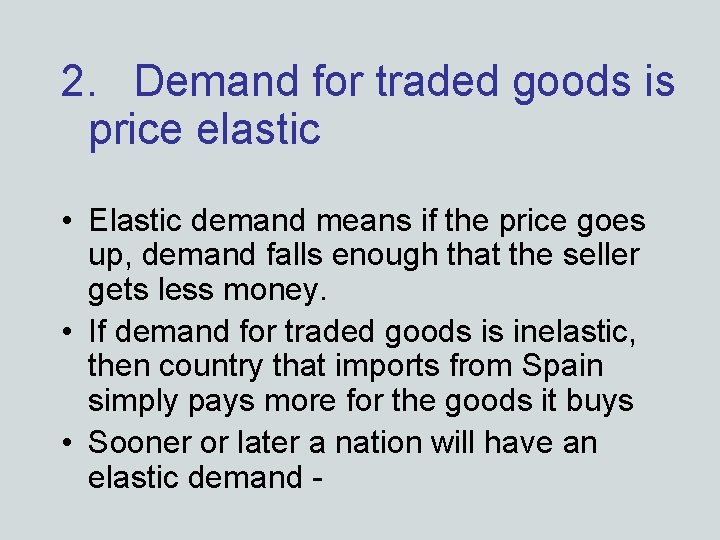
2. Demand for traded goods is price elastic • Elastic demand means if the price goes up, demand falls enough that the seller gets less money. • If demand for traded goods is inelastic, then country that imports from Spain simply pays more for the goods it buys • Sooner or later a nation will have an elastic demand -
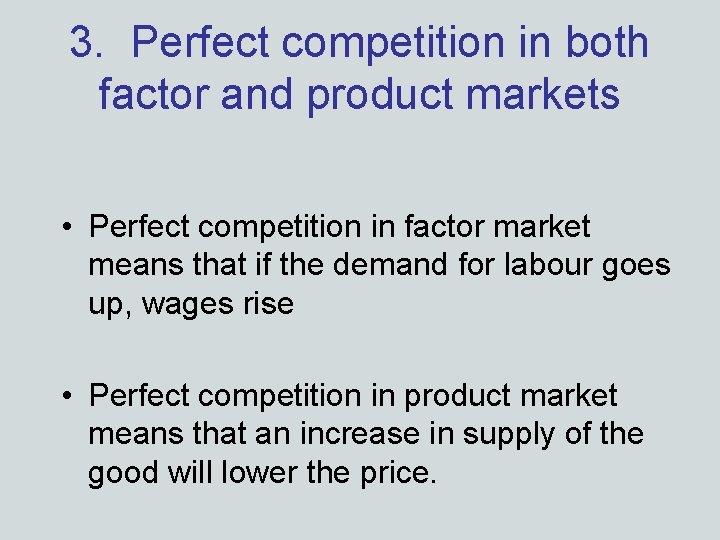
3. Perfect competition in both factor and product markets • Perfect competition in factor market means that if the demand for labour goes up, wages rise • Perfect competition in product market means that an increase in supply of the good will lower the price.
4. Gold Standard (or silver standard) exists • Influx of gold must increase money supply for the gold itself to matter • Gold standard can be the base of a fixed exchange system • Under flexible exchange rates, gold won’t leave the country, the currency will depreciate in value.