
Early Sports Specialization and Burnout Dr Lora Scott
Early Sports Specialization and Burnout Dr. Lora Scott Sports Medicine Program Director
Disclosures • No financial disclosures. • Due to the content of this presentation, my husband says I should disclose that I have been a Chiefs fan since the early 90 s and that I’m biased. (Note: he is a Patriots fan) 2
Definition • Organized Sports = Adults are involved in a supervisory role in any of the following capacities: o Determine the workout o Set the rules o Determine the schedule o Intervene during conflicts o Set the pace o Other ways adults interfere when kids are trying to have fun 3
Pre-Question #1 Your patient is a 15 yom, late-bloomer who is small for his age. Dad says he is “built like a blow pop. ” He is entering the 10 th grade. He is trying to decide what sport to play this fall. He is a promising baseball player. He also has experience in flag football, soccer, and track. Last year was his first time to try tackle football, and he was the 3 rd-string QB for the freshman team. He was invited to play in a select fall baseball league this year. He is debating between that, or playing high school football again. Which do recommend he plays? 1. Select fall baseball league 2. Football 4
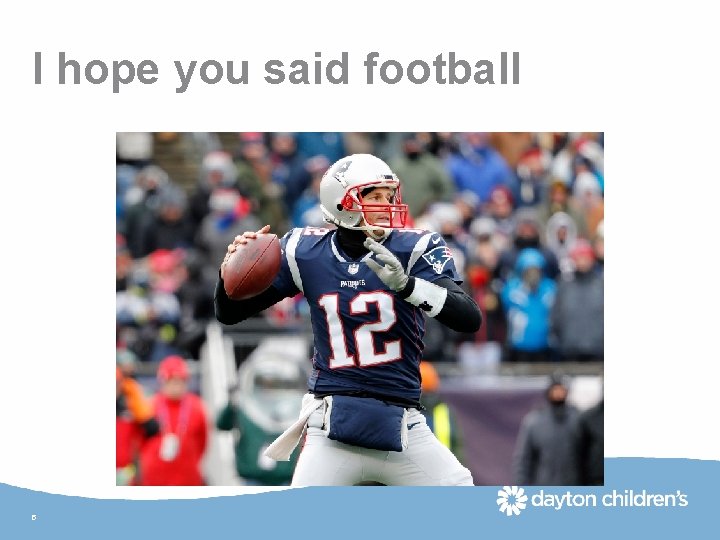
I hope you said football 5
Actual pre-test question #1 What is the maximum hours-per-week of organized sports recommended for children age 16 and under? 1. There is no maximum 2. Hours per week = age in years 3. 1 hour per day, 6 days per week (total = 6 hours per week) 4. That sounds like a good question for the coach or athletic director, not the doctor 6
Actual pre-test question #2 How many months per year may a child play the same sport? 1. 2. 3. 4. 7 12 months 10 months 8 months 6 months
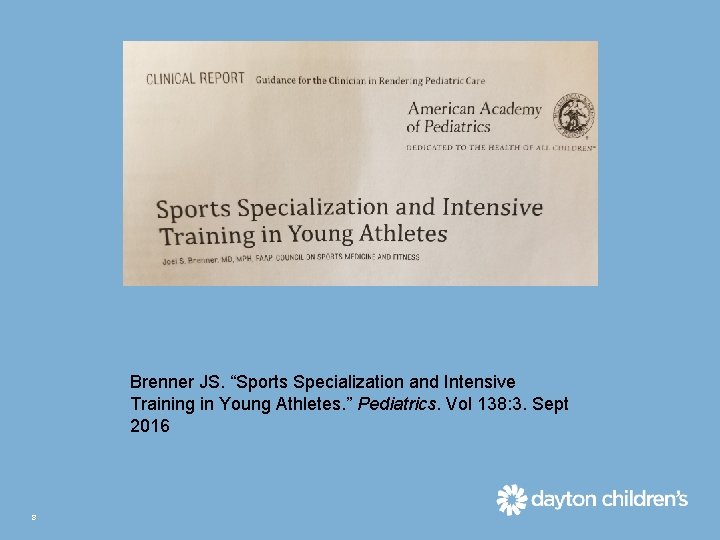
Brenner JS. “Sports Specialization and Intensive Training in Young Athletes. ” Pediatrics. Vol 138: 3. Sept 2016 8
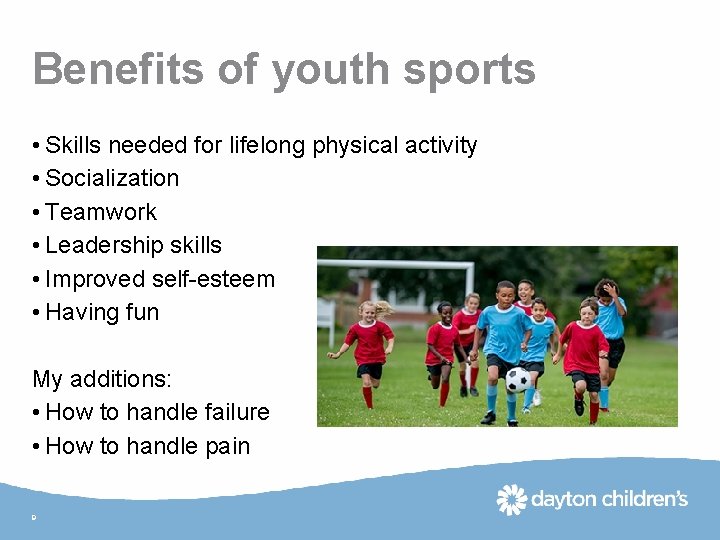
Benefits of youth sports • Skills needed for lifelong physical activity • Socialization • Teamwork • Leadership skills • Improved self-esteem • Having fun My additions: • How to handle failure • How to handle pain 9
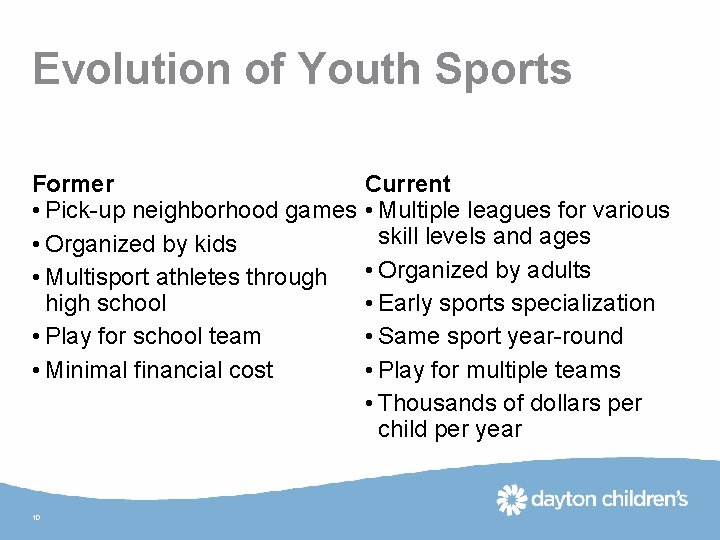
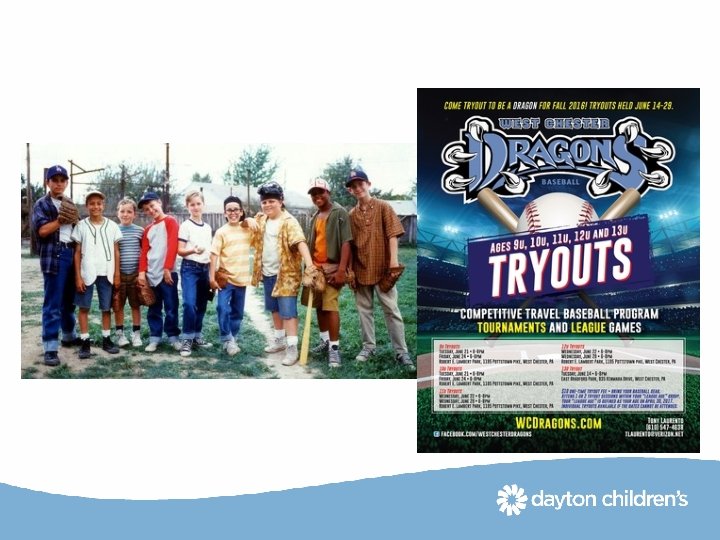
Evolution of Youth Sports Former • Pick-up neighborhood games • Organized by kids • Multisport athletes through high school • Play for school team • Minimal financial cost 10 Current • Multiple leagues for various skill levels and ages • Organized by adults • Early sports specialization • Same sport year-round • Play for multiple teams • Thousands of dollars per child per year
The results • 70% of athletes discontinue organized sports by age 13 • Of the 30% who still play sports in high school…. . o 3 -11% of those go on to compete in college o 1% of high school athletes receive a sports scholarship o 0. 03 – 0. 5% of high school athletes reach the professional level • At least 50% of injuries are related to overuse • Athletes in organized sports have >2: 1 injury ratio compared to free play activities 12
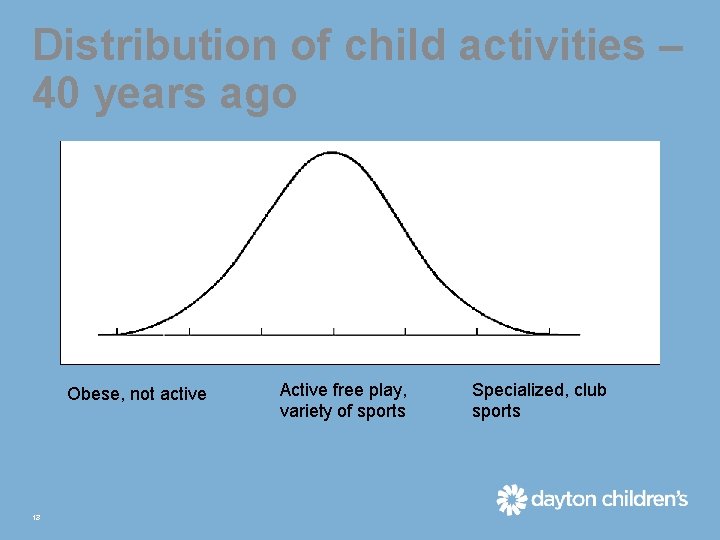
Distribution of child activities – 40 years ago Obese, not active 13 Active free play, variety of sports Specialized, club sports
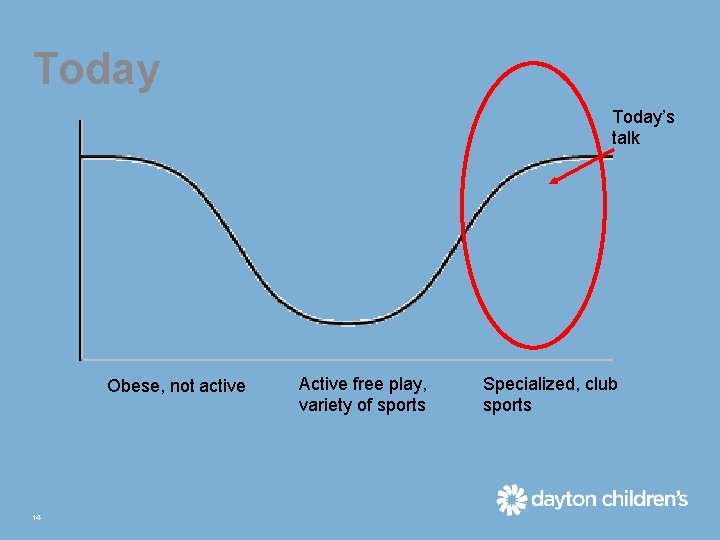
Today’s talk Obese, not active 14 Active free play, variety of sports Specialized, club sports
Did adults ruin youth sports? ? Sports specialization • Select and travel leagues start at age 7 (1 st grade) • Pressure athletes to commit to year-round participation, excluding participation in other sports • Promise early talent identification by coaches, media, sporting industry, colleges, and society in general • College recruitment starts in 6 th grade. The data • Only 1% of athletes get a college scholarship • Athletes who specialize before puberty have more injuries and quit at an earlier age 15

Early vs Late specialization Early Specialization • Goal = produce elite athletes • Con = shorter athletic careers Early Diversification • Goal = encourage lifelong health and fitness • Sample variety of sports • Include deliberate free play (pick-up games) • Pros: learn many sports skills, experience variety of social interactions with teammates and adults, less likely to drop out in the future 16
Pros of early diversification • Explore variety of sports • Physical, cognitive, social growth in a variety of positive environments • Develop intrinsic motivation • Learn fundamental movement skills which translate into multiple of sports o Can transfer skills to primary sport later o Require less deliberate practice at their chosen sport o Continue using skills in adulthood • Examples o Good jumpers can succeed in football, track, soccer, basketball, volleyball……. . 17
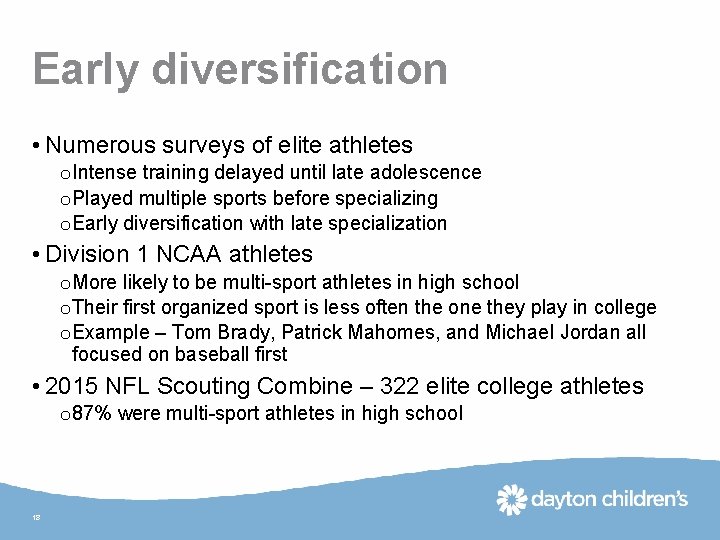
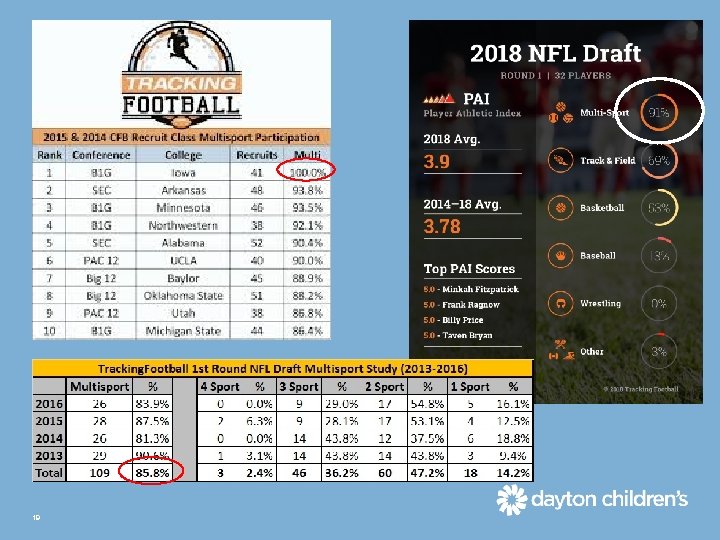
Early diversification • Numerous surveys of elite athletes o Intense training delayed until late adolescence o Played multiple sports before specializing o Early diversification with late specialization • Division 1 NCAA athletes o More likely to be multi-sport athletes in high school o Their first organized sport is less often the one they play in college o Example – Tom Brady, Patrick Mahomes, and Michael Jordan all focused on baseball first • 2015 NFL Scouting Combine – 322 elite college athletes o 87% were multi-sport athletes in high school 18
19

www. trackingfootball. com 20
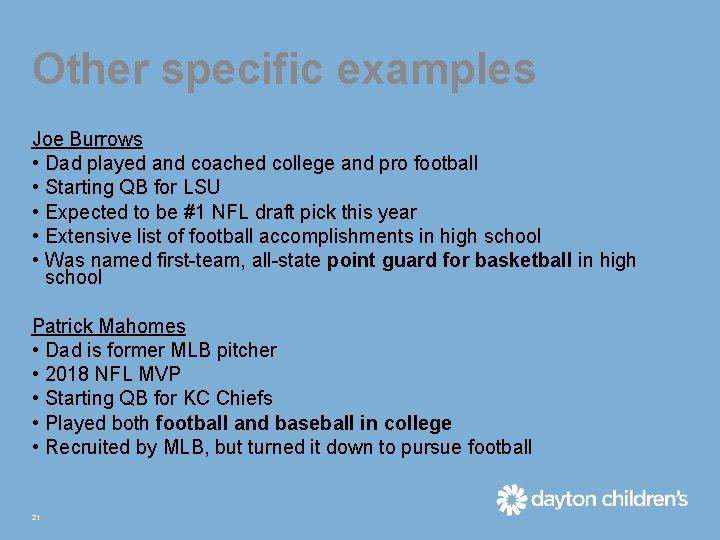
Other specific examples Joe Burrows • Dad played and coached college and pro football • Starting QB for LSU • Expected to be #1 NFL draft pick this year • Extensive list of football accomplishments in high school • Was named first-team, all-state point guard for basketball in high school Patrick Mahomes • Dad is former MLB pitcher • 2018 NFL MVP • Starting QB for KC Chiefs • Played both football and baseball in college • Recruited by MLB, but turned it down to pursue football 21
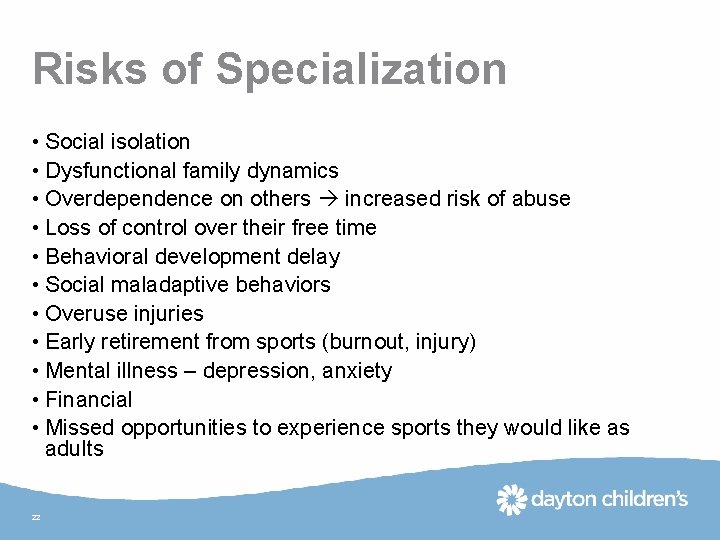
Risks of Specialization • Social isolation • Dysfunctional family dynamics • Overdependence on others increased risk of abuse • Loss of control over their free time • Behavioral development delay • Social maladaptive behaviors • Overuse injuries • Early retirement from sports (burnout, injury) • Mental illness – depression, anxiety • Financial • Missed opportunities to experience sports they would like as adults 22
Recognizing Burnout • Overtraining Syndrome o “a series of psychologic, physiologic, and hormonal changes that result in decreased sports performance” • Symptoms o chronic muscle or joint pain, personality changes, elevated resting HR, decreased sports performance, fatigue, lack of enthusiasm about sport, difficulty completing usual routines • Treatment / prevention o Sports diversification o Include age-appropriate games into practice o Allow 1 -2 days per week off of organized sports (free play!!!) o Take 2 -3 months time off organized sports per year o Teach athletes to listen to their bodies 23
When to specialize After puberty, preferably age 16+ • Minimizes risks of early specialization • Higher likelihood of athletic success • Have cognitive, physical, social, emotional, and motor skills necessary for more intense training • Have better understanding of risk: benefits of specialization 24
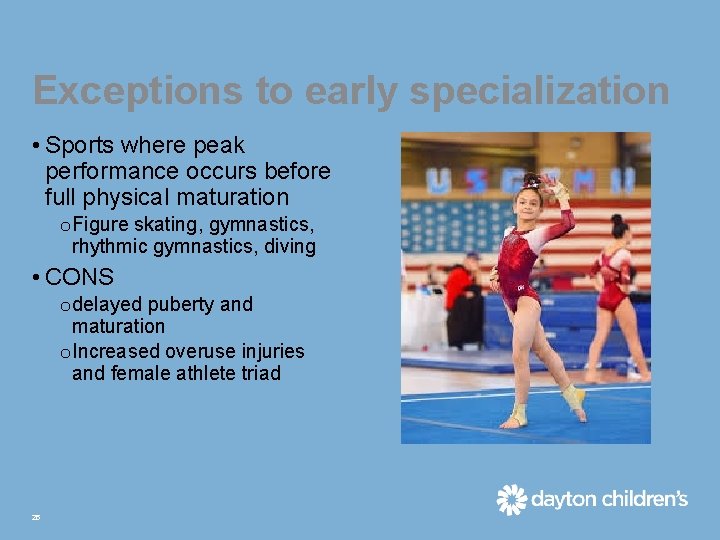
Exceptions to early specialization • Sports where peak performance occurs before full physical maturation o Figure skating, gymnastics, rhythmic gymnastics, diving • CONS o delayed puberty and maturation o Increased overuse injuries and female athlete triad 25
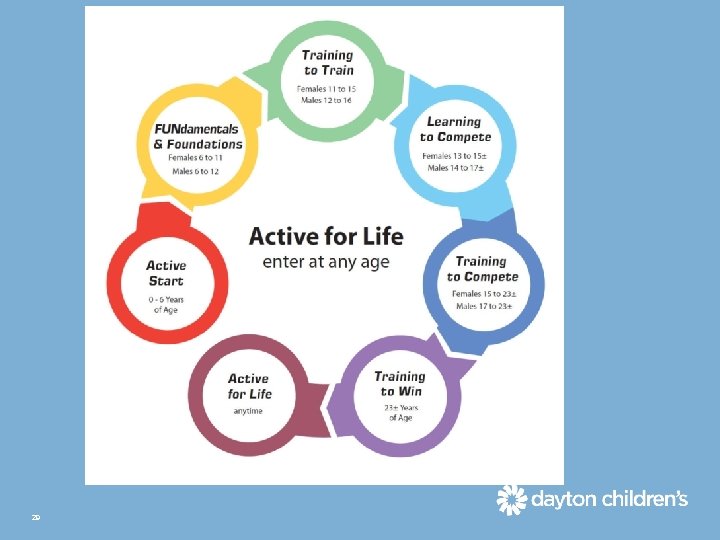
Recommended athlete development timeline Long Term Athletic Development Programs (LTADs) • Developed in the 1990 s • Counteract detrimental effects of early sports specialization • Master skills which are useful to a variety of sports o Agility, balance, coordination, speed (ABCs) • Schedule prophylactic breaks 26
LTAD Stages 1. Active Start o Ages 0 -6 o Gross motor skills 2. FUNdamental o Ages 6 -10 o Learn ABCs of athleticism through games, fun activities 3. Training to Train o Ages 10 -14 o Learn sport-specific skills o 75% training, 25% competition 27 4. Training to Compete o Ages 13 -18 o 50% technique and tactics o 50% competition-specific training and competition 5. Training to Win o Ages 17+ o Goal is to optimize performance o 75% is competition-specific training and competition
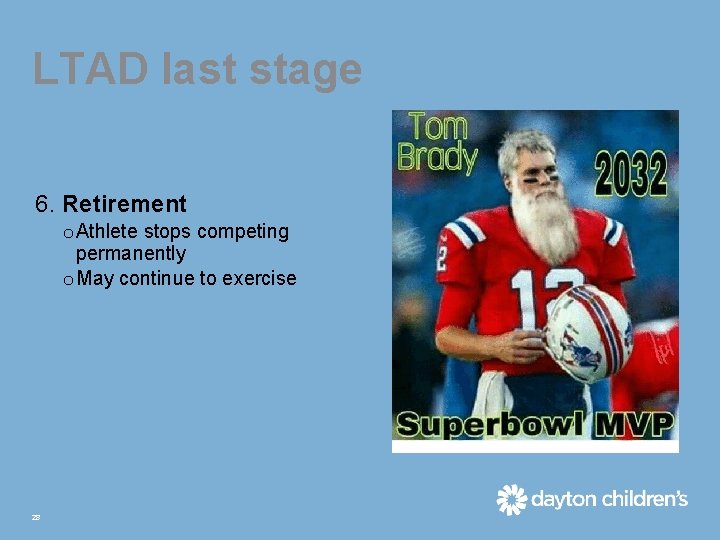
LTAD last stage 6. Retirement o Athlete stops competing permanently o May continue to exercise 28
29
LTAD disadvantages • Based on empirical evidence • General plans, not specific to the individual athlete’s needs • Can be misused to further develop elite talent, rather than promoting activity for the majority o Example – single sport focus instead of diversification 30
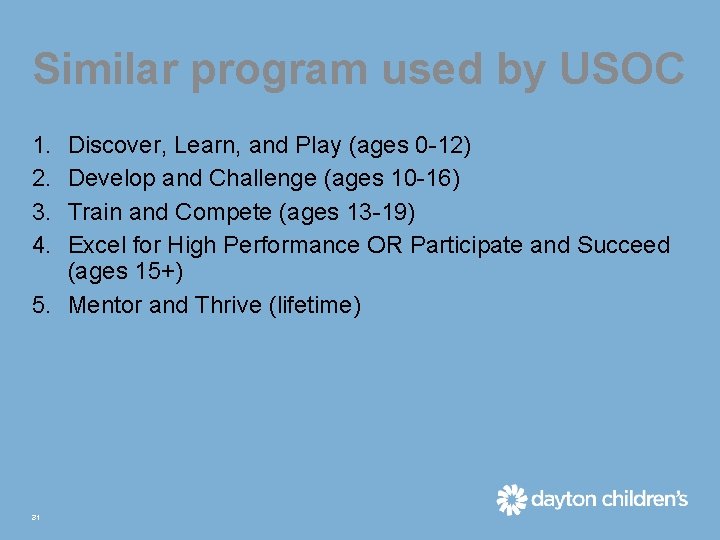
Similar program used by USOC 1. 2. 3. 4. Discover, Learn, and Play (ages 0 -12) Develop and Challenge (ages 10 -16) Train and Compete (ages 13 -19) Excel for High Performance OR Participate and Succeed (ages 15+) 5. Mentor and Thrive (lifetime) 31
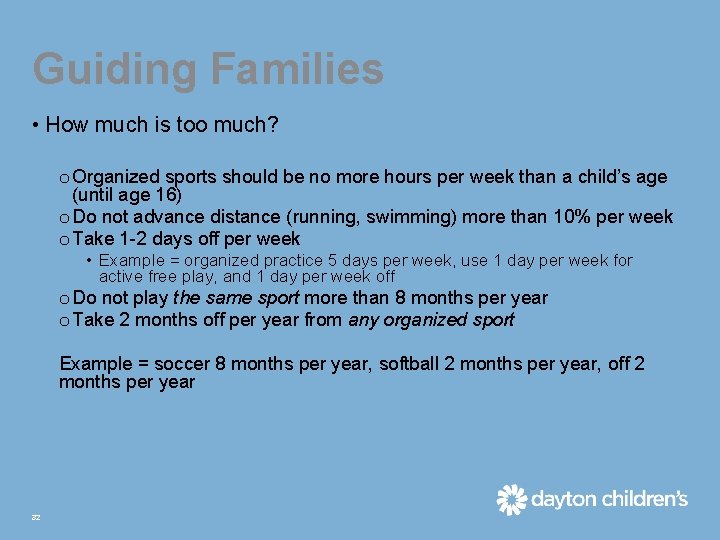
Guiding Families • How much is too much? o Organized sports should be no more hours per week than a child’s age (until age 16) o Do not advance distance (running, swimming) more than 10% per week o Take 1 -2 days off per week • Example = organized practice 5 days per week, use 1 day per week for active free play, and 1 day per week off o Do not play the same sport more than 8 months per year o Take 2 months off per year from any organized sport Example = soccer 8 months per year, softball 2 months per year, off 2 months per year 32
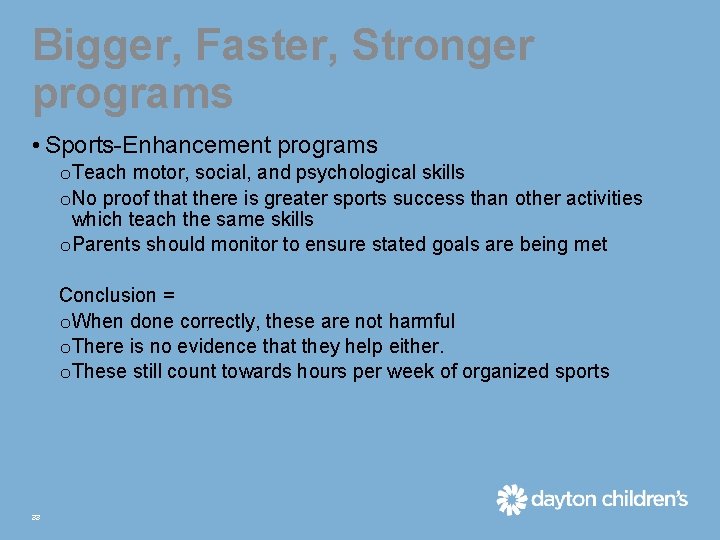
Bigger, Faster, Stronger programs • Sports-Enhancement programs o Teach motor, social, and psychological skills o No proof that there is greater sports success than other activities which teach the same skills o Parents should monitor to ensure stated goals are being met Conclusion = o When done correctly, these are not harmful o There is no evidence that they help either. o These still count towards hours per week of organized sports 33
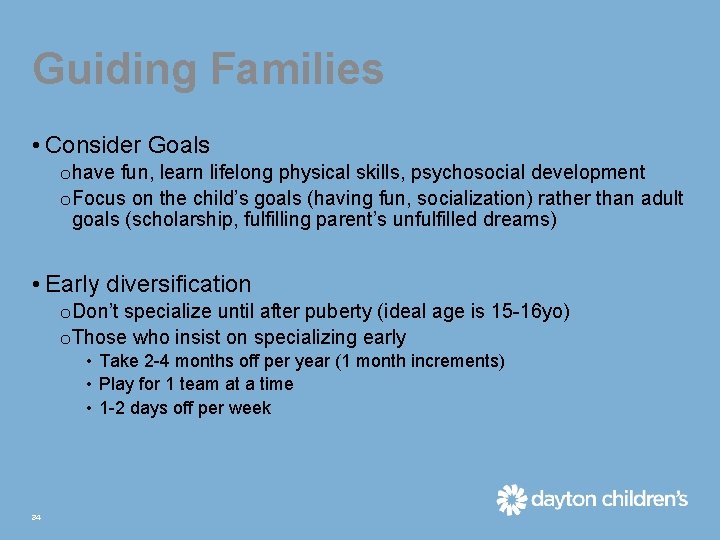
Guiding Families • Consider Goals o have fun, learn lifelong physical skills, psychosocial development o Focus on the child’s goals (having fun, socialization) rather than adult goals (scholarship, fulfilling parent’s unfulfilled dreams) • Early diversification o Don’t specialize until after puberty (ideal age is 15 -16 yo) o Those who insist on specializing early • Take 2 -4 months off per year (1 month increments) • Play for 1 team at a time • 1 -2 days off per week 34
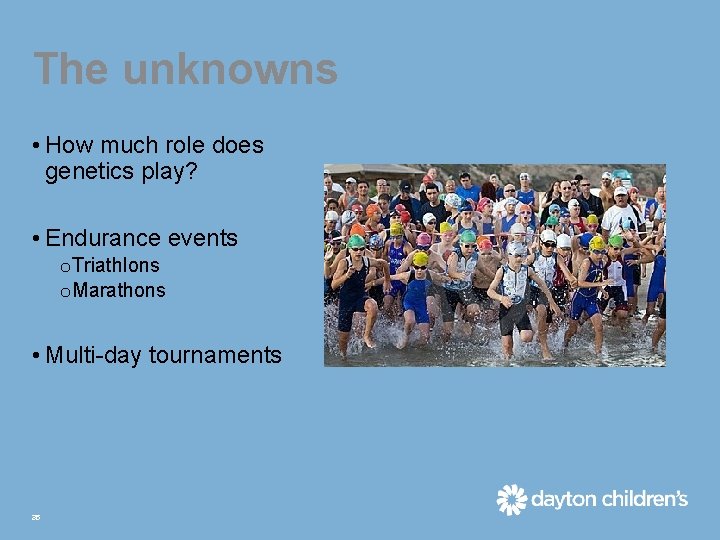
The unknowns • How much role does genetics play? • Endurance events o Triathlons o Marathons • Multi-day tournaments 35
What we do at my house • Ages 4 and 6 o Active Start o FUNdamentals • Swimming lessons as a life skill • Outside free play time – o Kicking, throwing, catching, batting, climbing, running, jumping, bike, scooter, neighbor’s parkour stuff, neighbor’s trampoline • Hiking in Sugar Creek o agility, balance, coordination, how to fall down • Organized sports (6 yo) still too early, but…. o Rec league this spring for ? ? ? (his pick) o Maybe karate (because he had fun at a karate birthday party and wants to try it) 36
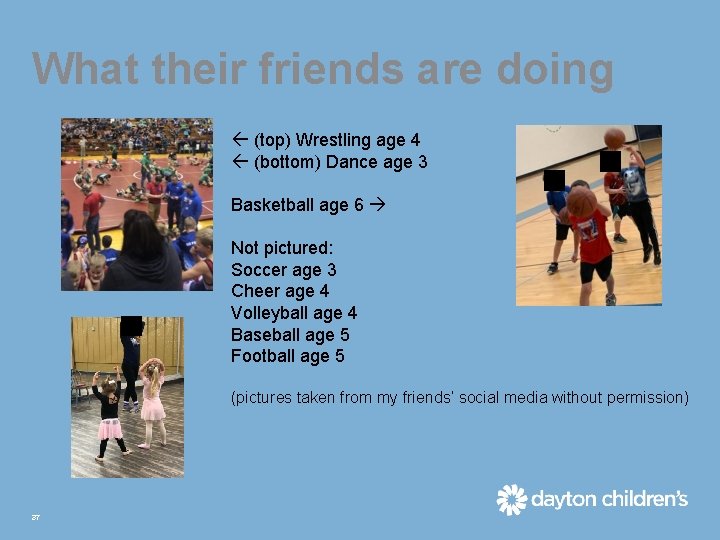
What their friends are doing ß (top) Wrestling age 4 ß (bottom) Dance age 3 Basketball age 6 Not pictured: Soccer age 3 Cheer age 4 Volleyball age 4 Baseball age 5 Football age 5 (pictures taken from my friends’ social media without permission) 37
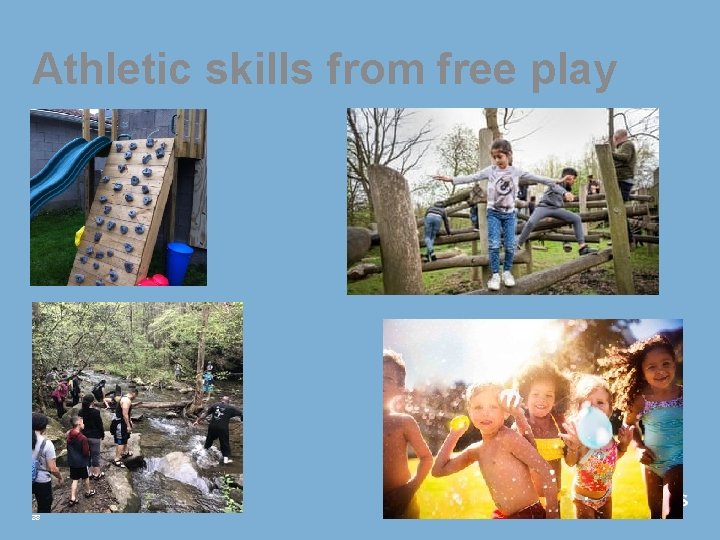
Athletic skills from free play 38
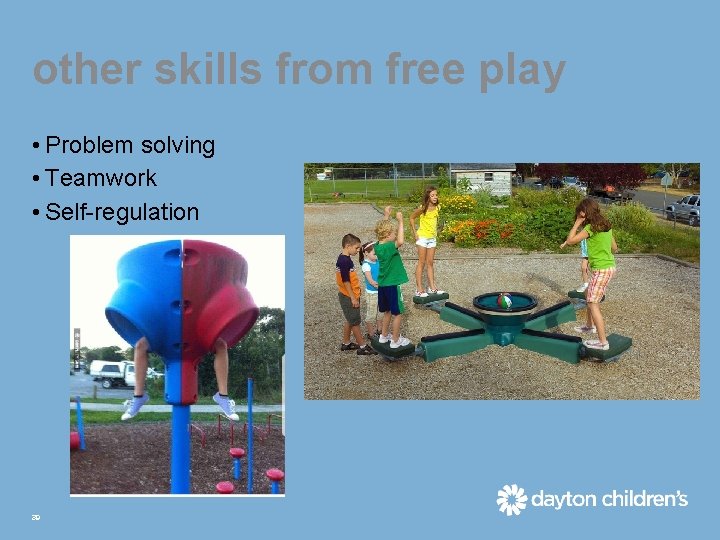
other skills from free play • Problem solving • Teamwork • Self-regulation 39
Post-test fake question #1 • Your patient is a 15 yom, late-bloomer who is small for his age. Dad says he is built like a “blow pop. ” He is entering the 10 th grade. He is trying to decide what sport to play this fall. He is a promising baseball player. He also has experience in flag football, soccer, and track. Last year was his first time to try tackle football, and he was the 3 rd-string QB for the freshman team. He was invited to play in a select fall baseball league this year. He is debating between that, or playing high school football again. Which do recommend he plays? 1. Select fall baseball league 2. Football 40
Post-test real question #1 What is the maximum hours-per-week of organized sports recommended for children age 16 and under? 1. There is no maximum 2. Hours per week = age in years 3. 1 hour per day, 6 days per week (total = 6 hours per week) 4. That sounds like a good question for the coach, not the doctor 41
Post-test real question #2 How many months per year may a child play the same sport? 1. 2. 3. 4. 42 12 months 10 months 8 months 6 months
References • Bell DR, et al. Sport Specialization and Risk of Overuse Injuries: A Systematic Review with Meta-analysis. ” Pediatrics. Vol 142: 3. Aug 2018 • Brenner, JS. “Overuse Injuries, Overtraining, and Burnout in Child and Adolescent Athletes. ” Pediatrics. Vol 119: 6. June 2007 • Brenner JS. “Sports Specialization and Intensive Training in Young Athletes. ” Pediatrics. Vol 138: 3. Sept 2016 43
Questions? ? 44
- Slides: 44