
Early Scientists ARISTOTLE Greek philosopher Made observations of
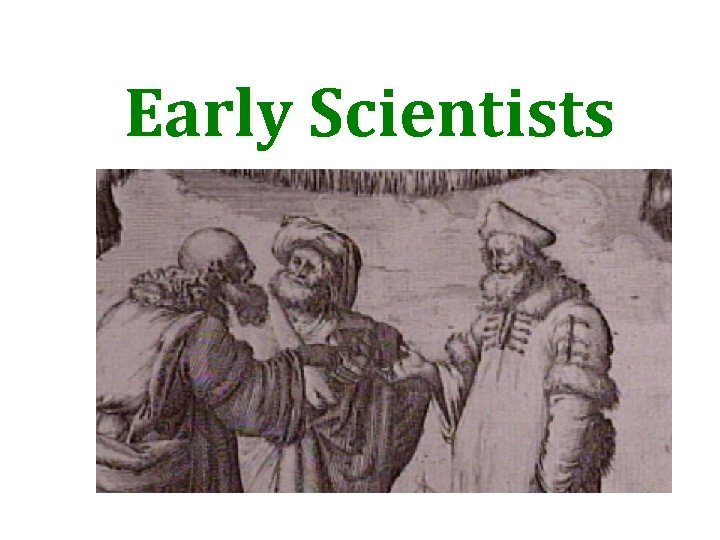
Early Scientists
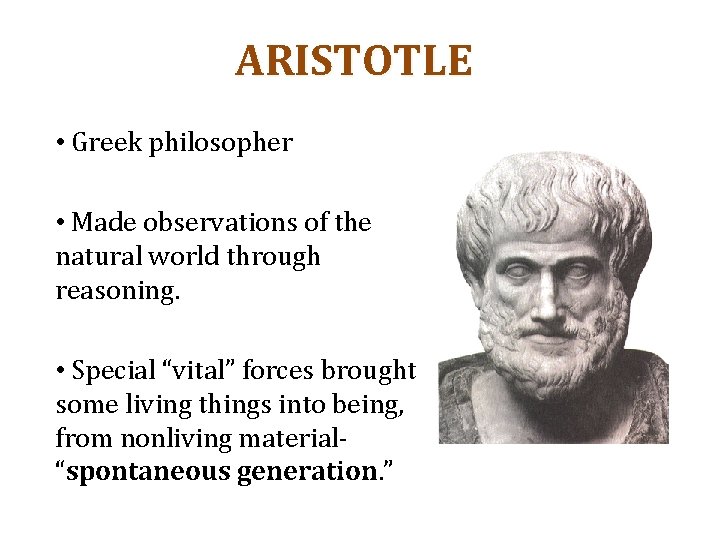
ARISTOTLE • Greek philosopher • Made observations of the natural world through reasoning. • Special “vital” forces brought some living things into being, from nonliving material“spontaneous generation. ”
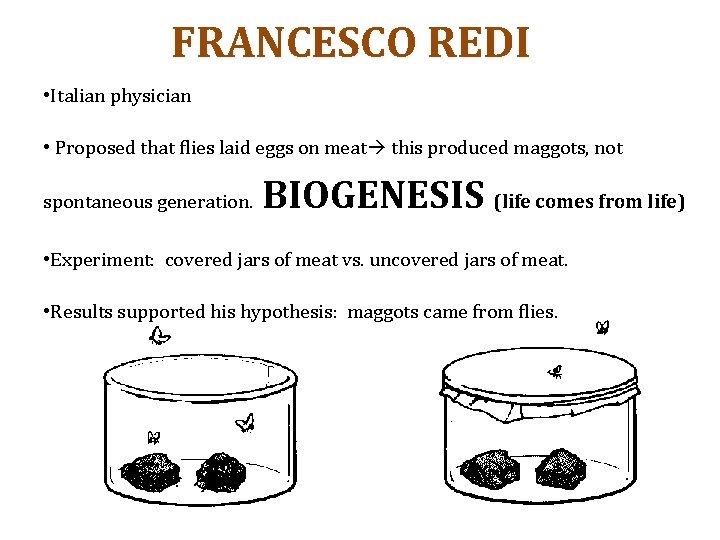
FRANCESCO REDI • Italian physician • Proposed that flies laid eggs on meat this produced maggots, not spontaneous generation. BIOGENESIS (life comes from life) • Experiment: covered jars of meat vs. uncovered jars of meat. • Results supported his hypothesis: maggots came from flies.
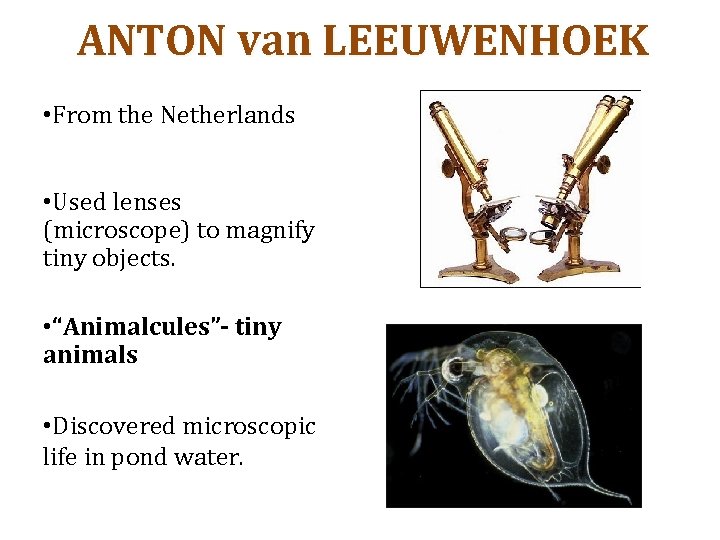
ANTON van LEEUWENHOEK • From the Netherlands • Used lenses (microscope) to magnify tiny objects. • “Animalcules”- tiny animals • Discovered microscopic life in pond water.

JOHN NEEDHAM • English scientist • Tried to prove spontaneous generation. • Sealed a bottle of gravy, then heated it (to kill any life). • Found life several days later, which he claimed came from the gravy. • Flaw with his experiment: the flask was not sealed and was exposed to the air.

LAZZARO SPALLANZANI • Italian scholar • Improved upon Needham’s experiment. • Boiled flasks of gravy to kill life, sealed one jar, left other jar open. • Open jar had living microorganisms, sealed jar did not. • Concluded that gravy did not produce life, organisms entered through the air.
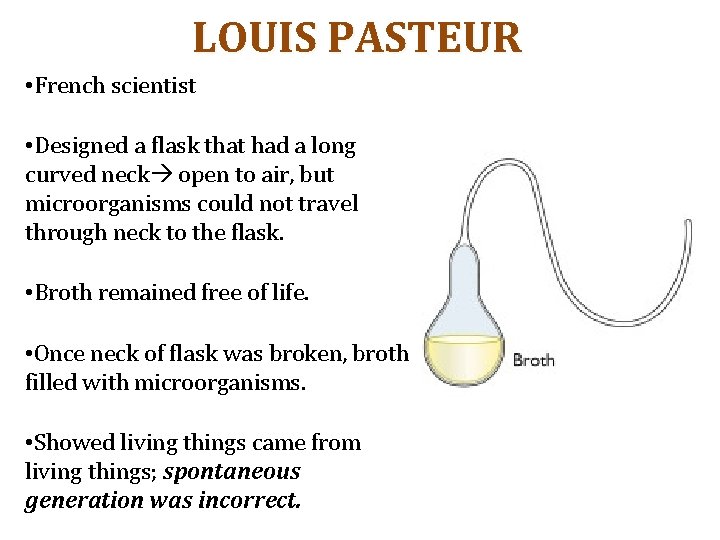
LOUIS PASTEUR • French scientist • Designed a flask that had a long curved neck open to air, but microorganisms could not travel through neck to the flask. • Broth remained free of life. • Once neck of flask was broken, broth filled with microorganisms. • Showed living things came from living things; spontaneous generation was incorrect.
- Slides: 7