
Early Onset Scoliosis in Ullrich Congenital Muscular Dystrophy
- Slides: 12
Early Onset Scoliosis in Ullrich Congenital Muscular Dystrophy Samuel R. Rosenfeld, M. D. CHOC Childrens Hospital ICEOS November 15 -16, 2012
�Purpose: Five patients diagnosed with Ullrich Congenital Muscular Dystrophy presented with early onset scoliosis. The scoliosis was rapidly progressive and not associated with the loss of independent ambulatory skills. The scoliosis was not responsive to spinal orthotic management and contributed to restrictive pulmonary disease. All patients have required aggressive surgical management.
�Methods: Ullrich Congenital Muscular Dystrophy is caused by a defect in one of the collagen VI genes resulting in abnormal type VI collagen. Muscle cells are greatly affected by type VI collagen deficiency with clinical manifestations of weakness, joint laxity, and eventual contracture.
�Ullrich Congenital Muscular Dystrophy is an autosomal recessive condition. A milder form of this disease is Bethlem myopathy which has an autosomal dominant inheritance. Mutations in the genes COL 6 A 1, COL 6 A 2, and COL 6 A 3 have been identified. Diagnostic testing is significant for only mild elevation of CPK, normal electrodiagnostic testing, and myopathic muscle biopsy findings. Confirmation of this disease is by muscle or skin biopsy demonstrating reduction in type VI collagen.
�Results: Five patients diagnosed with Ullrich Congenital Muscular Dystrophy evaluated at the Muscular Dystrophy Clinic presented with scoliosis prior to eight years of age. All of these children had rapid progression of scoliosis despite spinal orthotic management. All of these children developed restrictive pulmonary disease and have required surgical intervention. Four of these children have undergone surgery, and the fifth child has undergone gastrostomy tube placement for nutritional support prior to the spinal surgery.
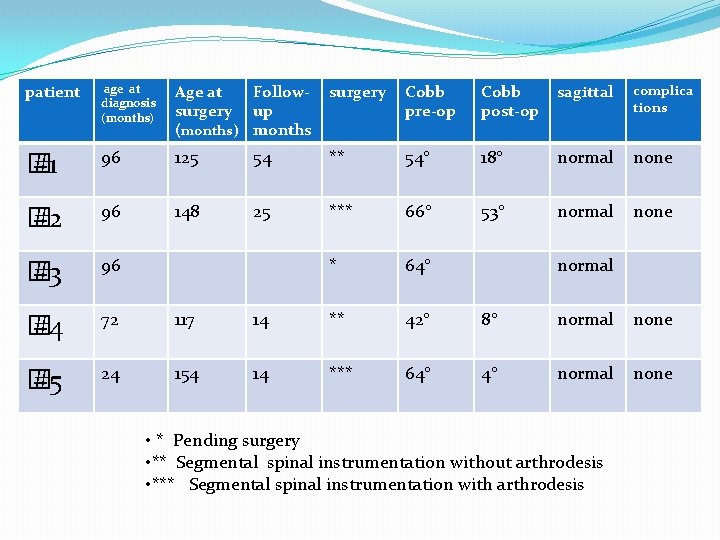
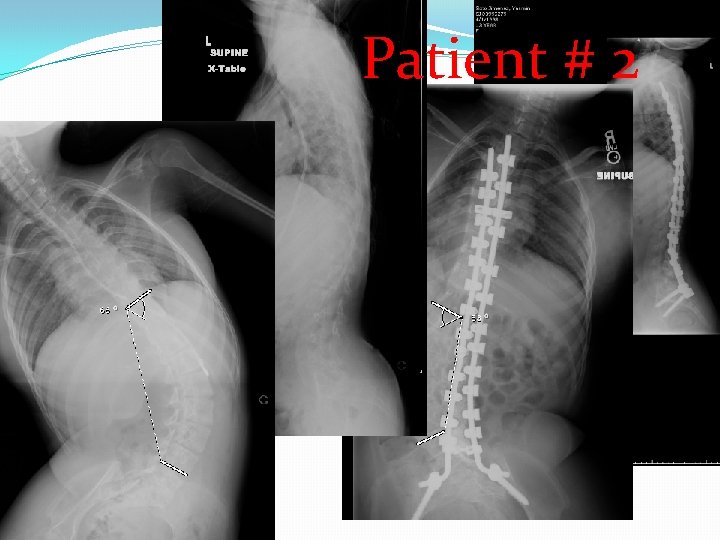
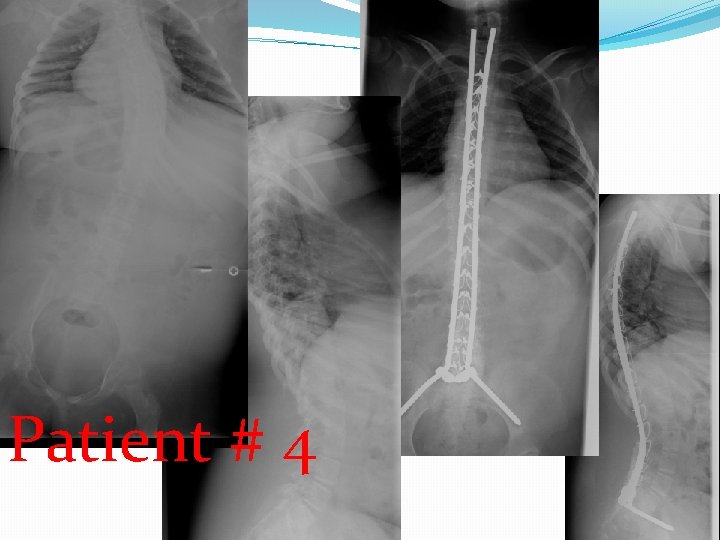
�At the time of surgery, two of these children were over 12 years of age and underwent posterior spinal arthrodesis with segmental spinal instrumentation from T 2 to pelvis. The other patients were under 10 years of age and were treated with spinal instrumentation in a growing rod construct, without arthrodesis. There were no complications from surgery with excellent sagittal and coronal correction of deformity obtained and maintained.
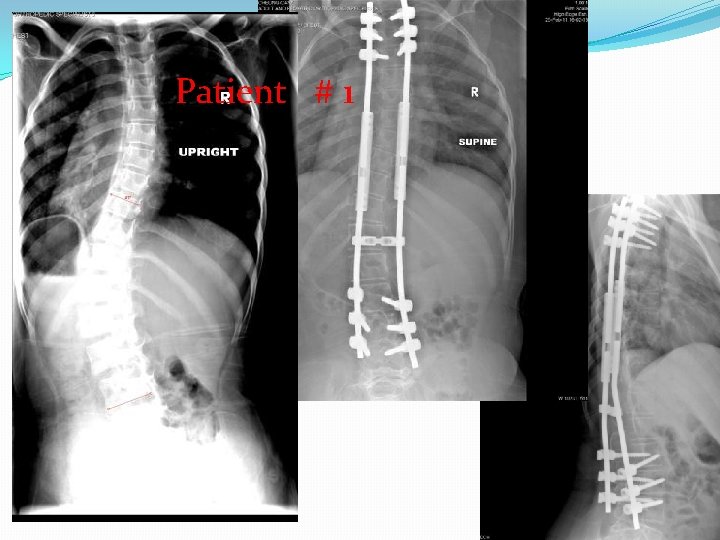
patient age at diagnosis (months) Age at Followsurgery up (months) months surgery Cobb pre-op Cobb post-op sagittal complica tions � #1 96 125 54 ** 54° 18° normal none � #2 96 148 25 *** 66° 53° normal none � #3 96 * 64° � #4 72 117 14 ** 42° 8° normal none � #5 24 154 14 *** 64° 4° normal none * normal • * Pending surgery • ** Segmental spinal instrumentation without arthrodesis • *** Segmental spinal instrumentation with arthrodesis
Patient # 1
Patient # 2
Patient # 4
�Conclusions: Ullrich Congenital Muscular Dystrophy is an autosomal recessive inherited condition with deficiency of type VI collagen. These children have progressive muscle weakness, contractures, and scoliosis with restrictive pulmonary disease. Early onset scoliosis has been observed in all of these children with progressive spinal deformity requiring surgery. Growing rod constructs have been successful in the management of the spinal deformity associated with Ullrich Congenital Muscular Dystrophy.
�References �Bonneman CG. The collagen VI-related myopathies Ullrich congenital muscular dystrophy and Bethlem myopathy. Handb Clin Neurol. 2011; 101: 81 -96. �Lampe AK, Flanigan KM, Bushby KM. Collagen type VI-related disorders: includes: Bethlem Myopathy, Ullrich Congenital Muscular Dystrophy. Gene. Reviews, Seattle, University of Washington, Seattle, 2007. �Nadeau A, Kanali M, Main M, Jimenez-Mallebrere C, Aloysius A, Clement E, North B, Manzur AY, Robb SA, Mercuri E, Muntoni F. Natural history of Ullrich congenital muscular dystrophy. Neurology. 2009; 73(1): 25 -31.