
EARLY ONSET BIPOLAR DISORDER Epidemiology Educational Implications and
EARLY ONSET BIPOLAR DISORDER: Epidemiology, Educational Implications, and Interventions Shelley Hart shelley_hart@charter. net
DIAGNOSIS
DSM-IV-TR Five types of episodes l Four subtypes l Four severity levels l Three course specifiers l American Psychiatric Association. (2000). Diagnostic and Statistical Manual of Mental Disorders-Fourth Edition-Text Revision. Washington, DC: Author.
Manic Episode Symptoms: 1. 2. 3. 4. 5. 6. 7. Inflated self-esteem or grandiosity Decreased need for sleep Pressured speech or more talkative than usual Flight of ideas or racing thoughts Distractibility Psychomotor agitation or increase in goaldirected activity Hedonistic interests
Hypomanic Episode l Similarities with Manic Episode = l Same symptoms l Differences = l Length of time l Impairment not as severe
Major Depressive Episode Symptoms: 1. Depressed mood (in children can be irritable) 2. Diminished interest in activities 3. Significant weight loss or gain 4. Insomnia or hypersomnia 5. Psychomotor agitation or retardation 6. Fatigue/loss of energy 7. Feelings of worthlessness/inappropriate guilt 8. Diminished ability to think or concentrate/indecisiveness 9. Suicidal ideation or suicide attempt
Mixed Episode Both Manic and Major Depressive Episode criteria are met nearly every day for a least a one week period.
Subtypes Bipolar Disorder I = more classic form; clear episodes of depression & mania Bipolar Disorder II = presents with less intense and often unrecognized manic phases Cyclothymia = chronic moods of hypomania & depression, often evolves into a more serious type Bipolar Disorder Not Otherwise Specified (NOS) = largest group of individuals
Children vs. Adults (or early vs. late onset ) l l l Irritability Depression Lack of mood reactivity Rejection sensitivity Less evident are the “classic” symptoms of mania

EPIDEMIOLOGY
Prevalence l Estimated between 3 -6% l Subsyndromal bipolar disorder l Equal distribution across gender variables l Average @ onset = 20 years old
Course l Initial cycle typically major depressive episode l Recovery l Relapse l Rapid Cycling l Rapid cycling=4 episodes/year l Ultrarapid cycling=5 -364 episodes/year l Ultradian cycling=>365 episodes/year
Age at Onset l Pediatric, prepubertal, or early adolescent (prior to age 12) l Adolescent (12 - 18 years) l Adult onset (+ 18 years)
IMPAIRMENTS
Comorbidity l Attention Deficit Hyperactivity Disorder (ADHD) l Between 60 -80%
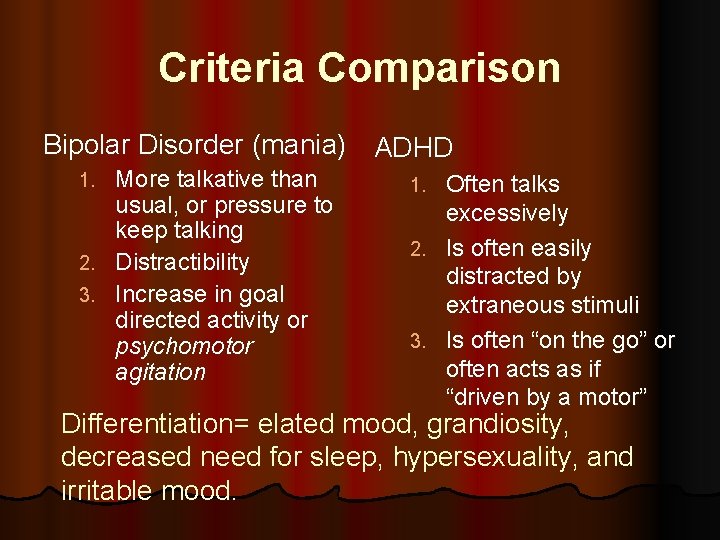
Criteria Comparison Bipolar Disorder (mania) ADHD More talkative than usual, or pressure to keep talking 2. Distractibility 3. Increase in goal directed activity or psychomotor agitation 1. 2. 3. Often talks excessively Is often easily distracted by extraneous stimuli Is often “on the go” or often acts as if “driven by a motor” Differentiation= elated mood, grandiosity, decreased need for sleep, hypersexuality, and irritable mood.
Comorbidity (cont’d…) l Oppositional Defiant Disorder (ODD) & Conduct Disorder (CD) l 70 -75% l Substance Abuse l 40 -50% l Anxiety Disorders l 35 -40%
Suicidal Behaviors l Prevalence of suicide attempts l 40 -45% l Age of first attempt l Multiple attempts l Severity of attempts l Suicidal ideation
Cognitive Deficits l Executive Functions l Attention l Memory l Sensory-Motor Integration l Nonverbal Problem-Solving l Academic Deficits l Mathematics
Psychosocial Deficits l Relationships l Peers l Family members l Recognition and Regulation of Emotion l Social Problem-Solving l Self-Esteem l Impulse Control
TREATMENT APPROACHES
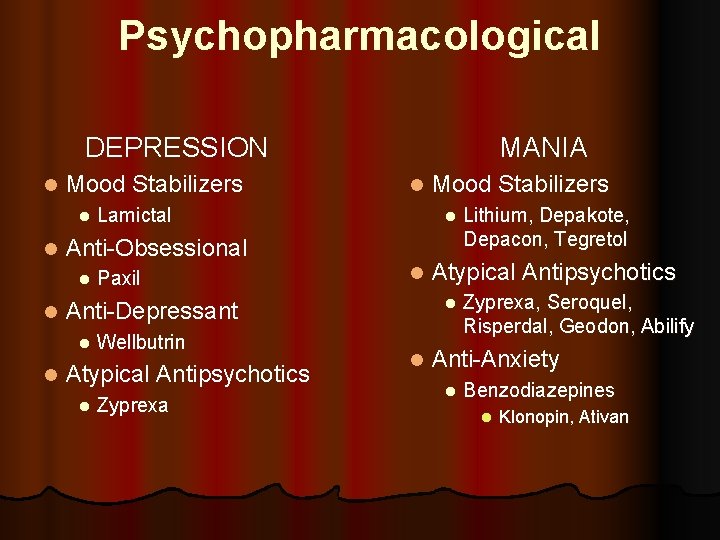
Psychopharmacological DEPRESSION l Mood Stabilizers l l Lamictal Paxil Wellbutrin Atypical Antipsychotics l Zyprexa Mood Stabilizers l l l Lithium, Depakote, Depacon, Tegretol Atypical Antipsychotics l Anti-Depressant l l l Anti-Obsessional l l MANIA Zyprexa, Seroquel, Risperdal, Geodon, Abilify Anti-Anxiety l Benzodiazepines l Klonopin, Ativan
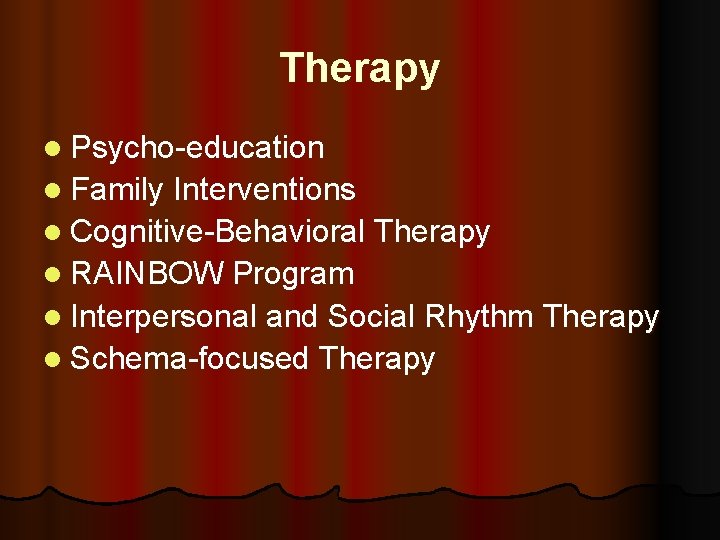
Therapy l Psycho-education l Family Interventions l Cognitive-Behavioral Therapy l RAINBOW Program l Interpersonal and Social Rhythm Therapy l Schema-focused Therapy
EDUCATIONAL IMPLICATIONS
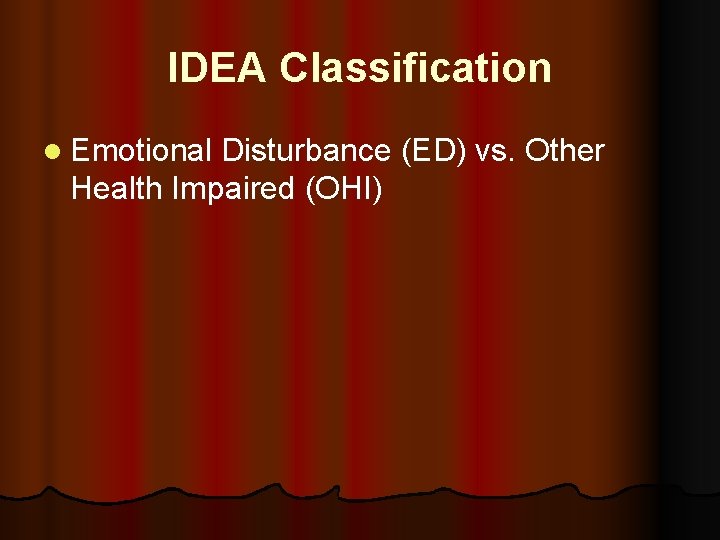
IDEA Classification l Emotional Disturbance (ED) vs. Other Health Impaired (OHI)
Considerations l l l l Rapidly changing moods of depression, irritability, grandiosity, pressured speech, racing thoughts, etc. Need for movement Poor relationships Difficulties with concentration and focus Difficulties with task completion Impaired judgment and impulsivity Disorganization Becoming overwhelmed with stressful situations
Possible Accommodations/Modifications l l l l Provide student with a safe place and person to go to when feeling overwhelmed or stressed Shortened day (permit late start as needed) Prior notice of transitions Consistent schedule Scheduling the student’s most challenging tasks at a time of day when the child is best able to perform Modified or shortened assignments Plan for unstructured times of the day Adjust for medication needs, dispensing, as well as plans for addressing side effects (e. g. , sedation)
Other Considerations l Educating staff l Communication l Hospitalization
RESOURCES BOOKS/BOOKLETS: Mondimore, F. (1999). Bipolar disorder: A guide for patients and families. City: Johns Hopkins Press. l Geller, B. , & Del. Bello, M. P. (Eds. ). (2003). Bipolar disorder in childhood and early adolescence. New York: Guilford Press. l Educating the child with bipolar disorder. Available from: www. bpkids. org l Anderson, M. , Kubisak, J. B. , Field, R. , & Vogelstein, S. (2003). Understanding and educating children and adolescents with bipolar disorder: A guide for educators. l
RESOURCES WEBSITES: l The Child and Adolescent Bipolar Foundation l l Depression and Bipolar Support Alliance l l www. bpparent. org The Gray Center for Social Learning and Understanding l l www. bipolarchild. com Parents of Bipolar Children l l www. dbsalliance. org The Bipolar Child l l www. bpkids. org www. thegraycenter. org/Social_Stories. htm National Institute of Mental Health (NIMH) l www. nimh. org
- Slides: 30