
Early Objects of Christianity 3 First known complete
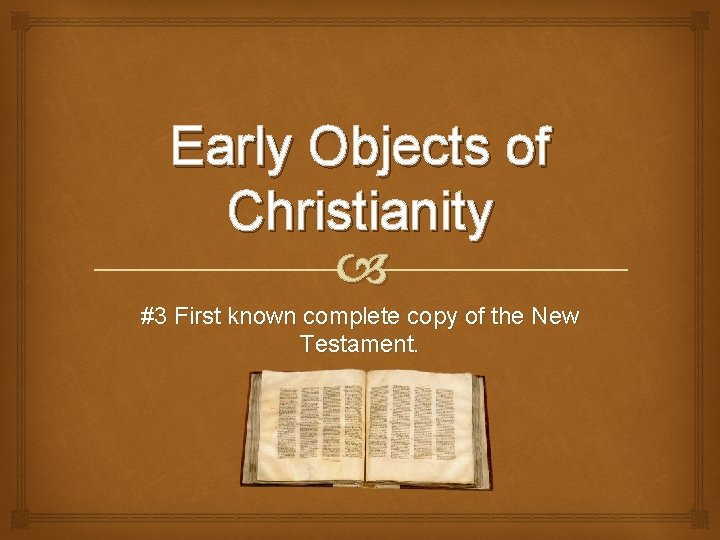
Early Objects of Christianity #3 First known complete copy of the New Testament.
The first of many… 1. First known church building. 2. First known piece of the New Testament. 3. First known complete copy of the New Testament. 4. First known copy of the Old Testament. 5. First known picture of Jesus. 6. First known hymn. 7. First known archaeological evidence of crucifixion.

The Four Great Uncials. Codex Sinaiticus Codex Vaticanicus Codex Ephraemi Rescriptus Codex Alexandrinus
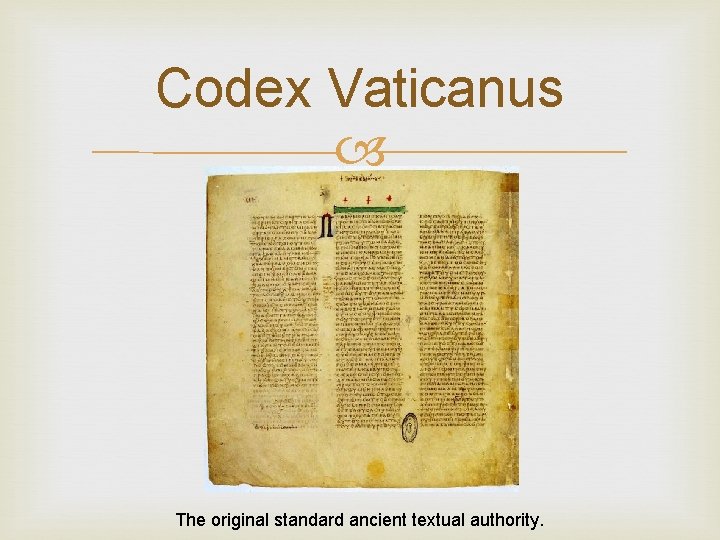
Codex Vaticanus The original standard ancient textual authority.
Codex Vaticanus Written sometime between 325 and 350 A. D. Considered to be the oldest complete Bible in any language, slightly older than the Codex Sinaiticus. Written in all capital Greek letters, called Uncials, which was the style of Bible scribes between the 4 th and 8 th century A. D. Named after its place of conservation in the Vatican Library, where it has appeared in the library's earliest catalog since 1475. It is believed to have been housed in Caesarea in the 6 th century, together with the Codex Sinaiticus. It came to Italy – probably from Constantinople – after the Council of Florence (1438– 1445).
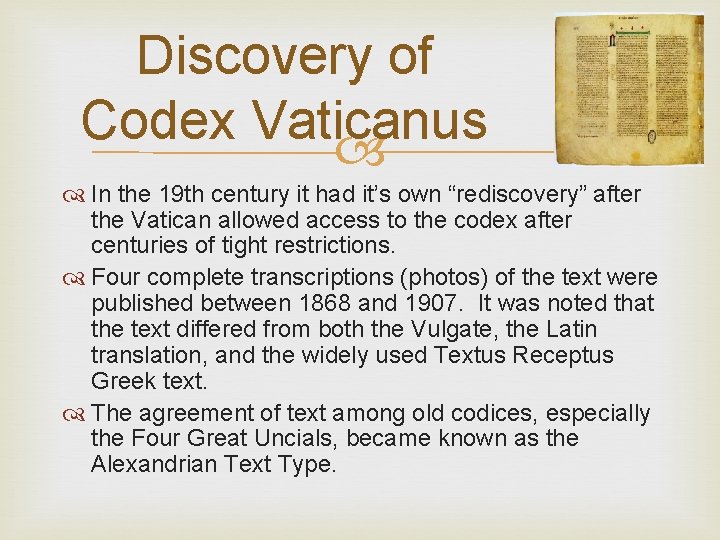
Discovery of Codex Vaticanus In the 19 th century it had it’s own “rediscovery” after the Vatican allowed access to the codex after centuries of tight restrictions. Four complete transcriptions (photos) of the text were published between 1868 and 1907. It was noted that the text differed from both the Vulgate, the Latin translation, and the widely used Textus Receptus Greek text. The agreement of text among old codices, especially the Four Great Uncials, became known as the Alexandrian Text Type.
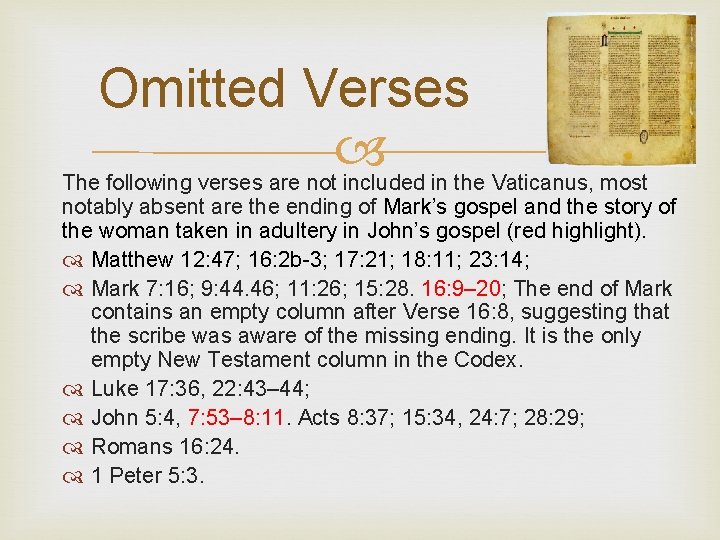
Omitted Verses The following verses are not included in the Vaticanus, most notably absent are the ending of Mark’s gospel and the story of the woman taken in adultery in John’s gospel (red highlight). Matthew 12: 47; 16: 2 b-3; 17: 21; 18: 11; 23: 14; Mark 7: 16; 9: 44. 46; 11: 26; 15: 28. 16: 9– 20; The end of Mark contains an empty column after Verse 16: 8, suggesting that the scribe was aware of the missing ending. It is the only empty New Testament column in the Codex. Luke 17: 36, 22: 43– 44; John 5: 4, 7: 53– 8: 11. Acts 8: 37; 15: 34, 24: 7; 28: 29; Romans 16: 24. 1 Peter 5: 3.
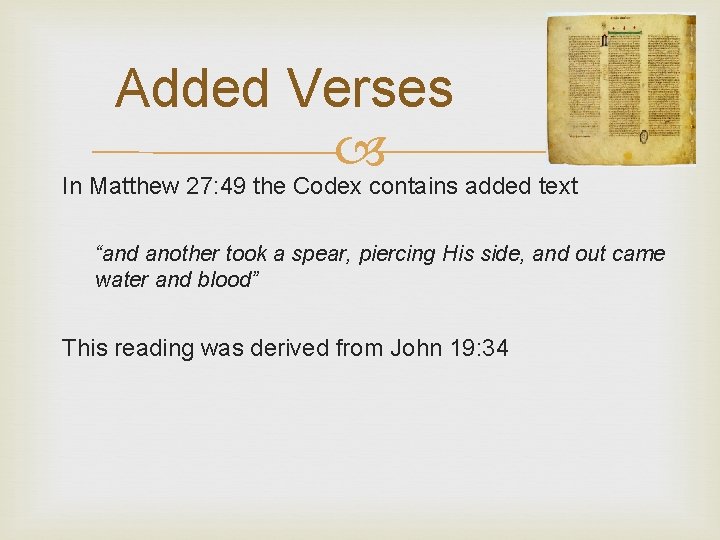
Added Verses In Matthew 27: 49 the Codex contains added text “and another took a spear, piercing His side, and out came water and blood” This reading was derived from John 19: 34
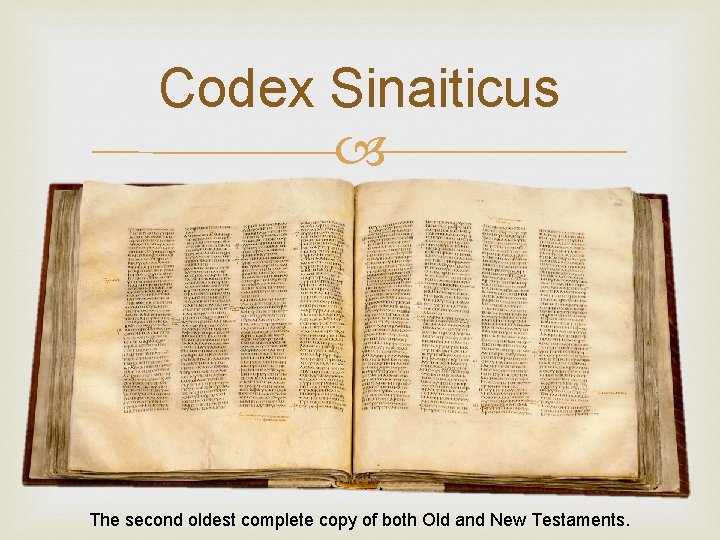
Codex Sinaiticus The second oldest complete copy of both Old and New Testaments.
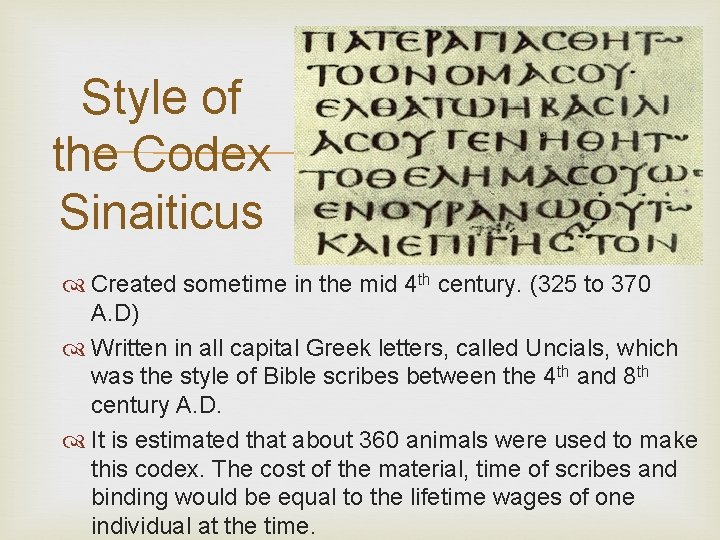
Style of the Codex Sinaiticus Created sometime in the mid 4 th century. (325 to 370 A. D) Written in all capital Greek letters, called Uncials, which was the style of Bible scribes between the 4 th and 8 th century A. D. It is estimated that about 360 animals were used to make this codex. The cost of the material, time of scribes and binding would be equal to the lifetime wages of one individual at the time.
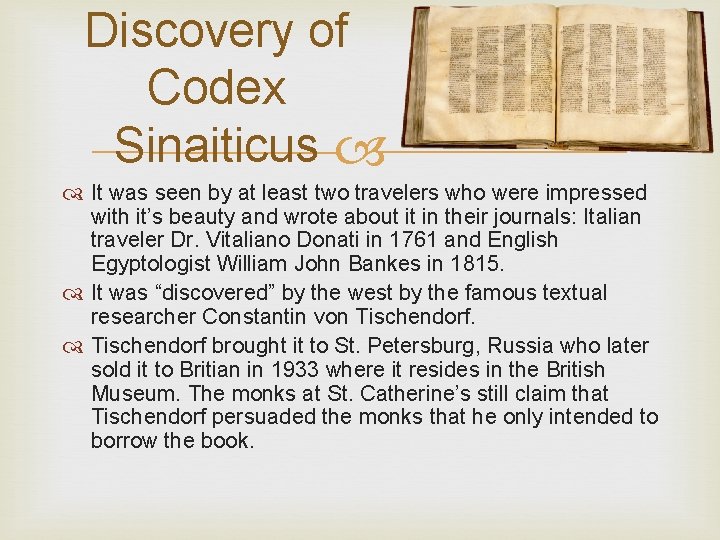
Discovery of Codex Sinaiticus It was seen by at least two travelers who were impressed with it’s beauty and wrote about it in their journals: Italian traveler Dr. Vitaliano Donati in 1761 and English Egyptologist William John Bankes in 1815. It was “discovered” by the west by the famous textual researcher Constantin von Tischendorf brought it to St. Petersburg, Russia who later sold it to Britian in 1933 where it resides in the British Museum. The monks at St. Catherine’s still claim that Tischendorf persuaded the monks that he only intended to borrow the book.
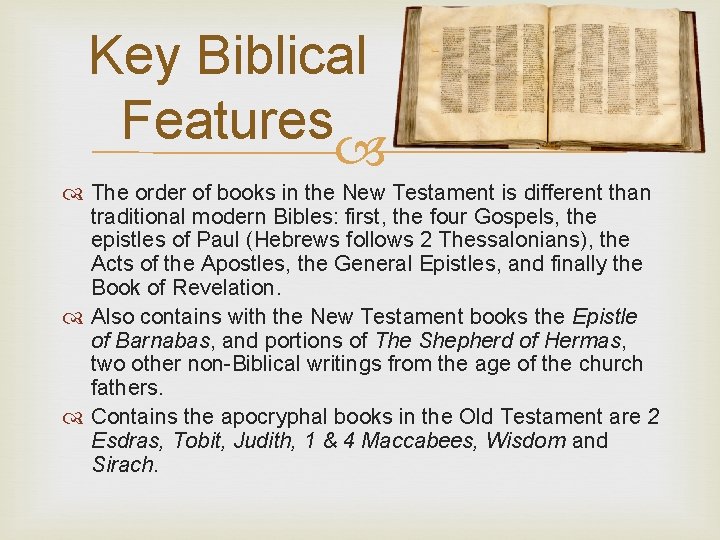
Key Biblical Features The order of books in the New Testament is different than traditional modern Bibles: first, the four Gospels, the epistles of Paul (Hebrews follows 2 Thessalonians), the Acts of the Apostles, the General Epistles, and finally the Book of Revelation. Also contains with the New Testament books the Epistle of Barnabas, and portions of The Shepherd of Hermas, two other non-Biblical writings from the age of the church fathers. Contains the apocryphal books in the Old Testament are 2 Esdras, Tobit, Judith, 1 & 4 Maccabees, Wisdom and Sirach.
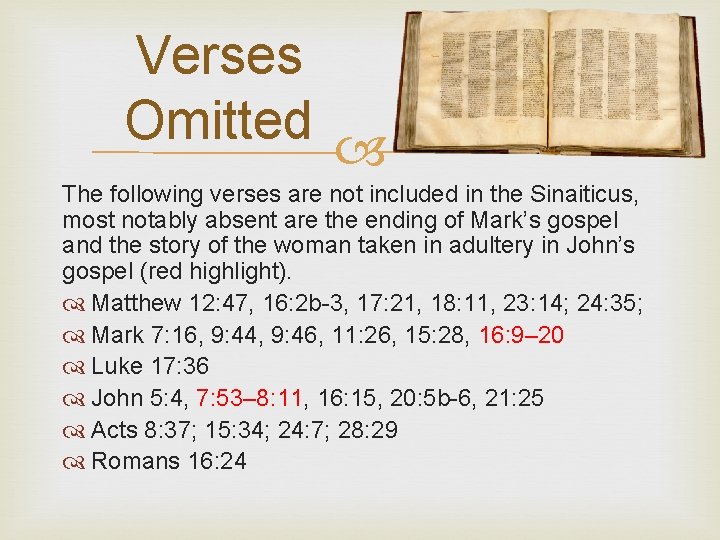
Verses Omitted The following verses are not included in the Sinaiticus, most notably absent are the ending of Mark’s gospel and the story of the woman taken in adultery in John’s gospel (red highlight). Matthew 12: 47, 16: 2 b-3, 17: 21, 18: 11, 23: 14; 24: 35; Mark 7: 16, 9: 44, 9: 46, 11: 26, 15: 28, 16: 9– 20 Luke 17: 36 John 5: 4, 7: 53– 8: 11, 16: 15, 20: 5 b-6, 21: 25 Acts 8: 37; 15: 34; 24: 7; 28: 29 Romans 16: 24
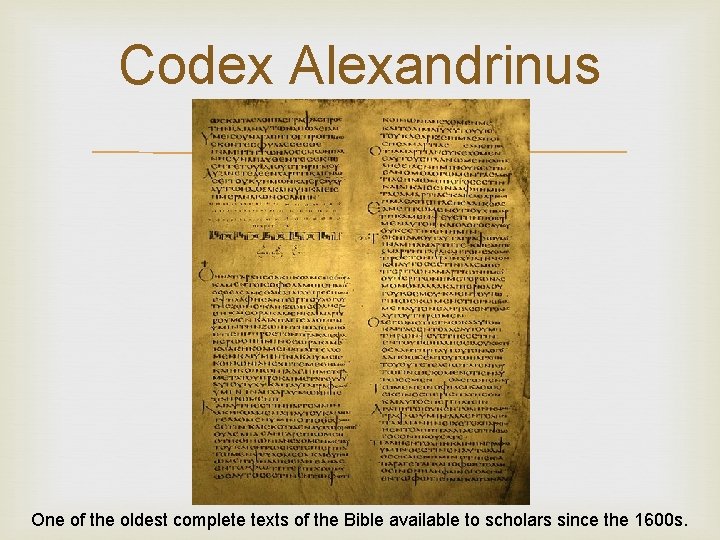
Codex Alexandrinus One of the oldest complete texts of the Bible available to scholars since the 1600 s.
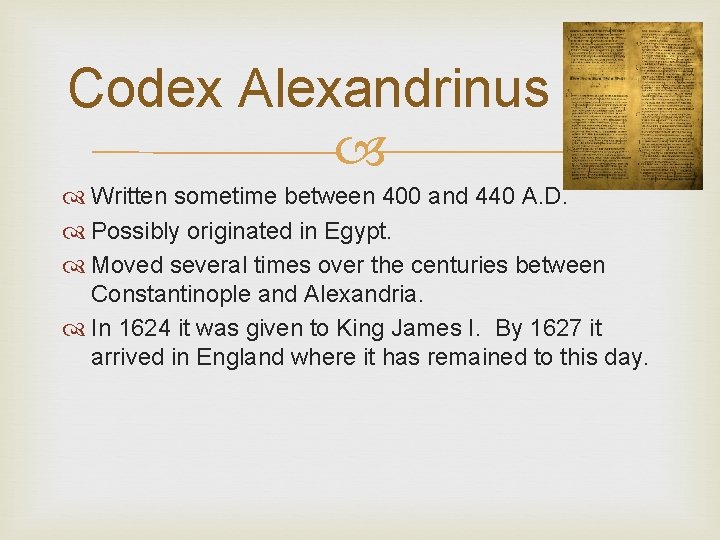
Codex Alexandrinus Written sometime between 400 and 440 A. D. Possibly originated in Egypt. Moved several times over the centuries between Constantinople and Alexandria. In 1624 it was given to King James I. By 1627 it arrived in England where it has remained to this day.
The Importance of Codex Alexandrinus It is considered valuable, but not to the extent of the Sinaiticus or Vatacanus. Previous to the availability of the Sinaiticus and Vaticanus, it was the single best ancient authority available to scholars. In translation footnotes, the Alexandrinus is assigned the letter “A” since 1730. “B” is given to the Vaticanus.
Features of Codex Alexandrinus Mark 16: 9– 20 is preserved in its traditional form in the Codex Alexandrinus. John 7: 53 -8: 11, the story of the adulterous woman, is not included. Although the two pages where the story should occur are lost, by counting the lines, it has been proven that it was not in the book. The books are slightly out of modern Bible publishing order: Gospels, Acts of the Apostles, General epistles, Pauline epistles (Hebrews placed between 2 Thessalonians and 1 Timothy), Book of Revelation.
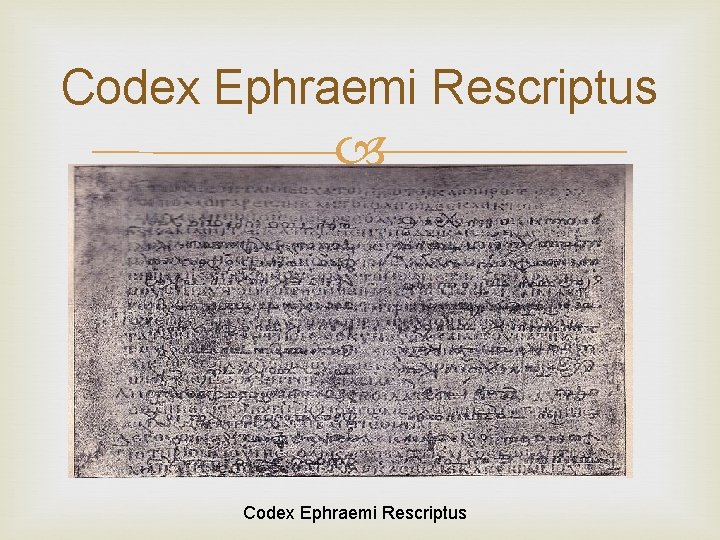
Codex Ephraemi Rescriptus
History The codex is dated to the 400’s (5 th century A. D. ) from either Egypt or Palestine. Sometime in the 12 th century, a scribe needed some vellum. Instead of making new animal skins into parchment, he recycled an old bible by scraping off the old writing but not quite eliminating it. Not all the leaves of the original codex were used by the scribe leaving some gaps in the biblical text. After the fall of Constantinople in 1453, the codex was brought to Florence by an émigré scholar, eventually making its way to the Bibliothèque Nationale de France, Paris, where it is today.
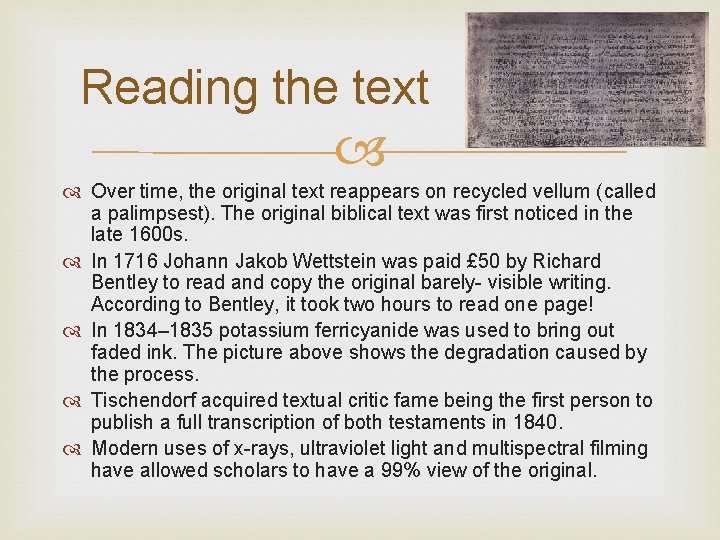
Reading the text Over time, the original text reappears on recycled vellum (called a palimpsest). The original biblical text was first noticed in the late 1600 s. In 1716 Johann Jakob Wettstein was paid £ 50 by Richard Bentley to read and copy the original barely- visible writing. According to Bentley, it took two hours to read one page! In 1834– 1835 potassium ferricyanide was used to bring out faded ink. The picture above shows the degradation caused by the process. Tischendorf acquired textual critic fame being the first person to publish a full transcription of both testaments in 1840. Modern uses of x-rays, ultraviolet light and multispectral filming have allowed scholars to have a 99% view of the original.
Features of the text John 7: 53– 8: 11 was omitted. As in Codex Alexandrinus, the original pages are lost but by counting lines it can be seen that there is not space for the story on the page. Mark 16: 9– 20 was included. It was also located on the lost leaves; by counting the lines it can be proved that it was in the work.
- Slides: 21