
Early Neoclassical Economists PART 2 Lon Walras 1834
- Slides: 12
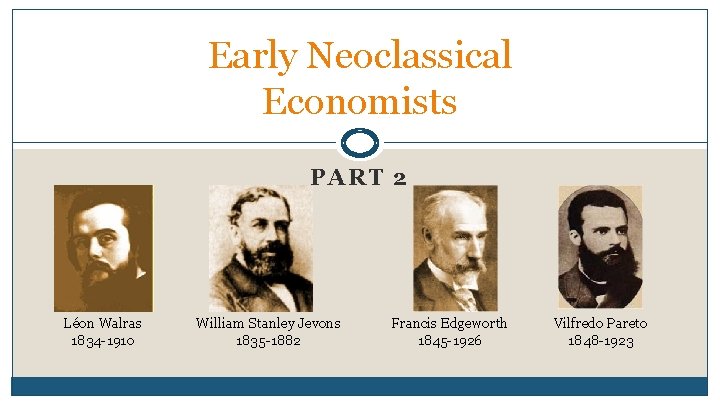
Early Neoclassical Economists PART 2 Léon Walras 1834 -1910 William Stanley Jevons 1835 -1882 Francis Edgeworth 1845 -1926 Vilfredo Pareto 1848 -1923
Léon Walras, 1834 -1910 Born in Normandy, France, the son of Auguste Walras, who had been a classmate of Cournot, who believed the economy could be described by systems of simultaneous equations. Léon Walras built on that foundation to develop and champion general equilibrium analysis. � Individuals seek to maximize utility (thus, he’s part of the “marginal revolution”) selling their labor and earning income on other resources, and purchasing final goods, taking account of their relative prices. � Firms purchase resources and intermediate goods to produce final consumer products (production functions) and are assumed to be perfectly competitive, so their revenues must be equal to their full economic costs. � The market for each final product and each resource (land, labor, capital) must “clear” (Qd = Qs) simultaneously to achieve a general equilibrium. � The general equilibrium approach contrasts with the step-by-step partial equilibrium process, based on ceteris paribus assumptions, used by Marshall.
William Stanley Jevons, 1835 -1882 Born in Liverpool and educated in London, he eventually served as a professor of logic and moral philosophy at Owens College, Manchester. Along with Hermann Gossen in Germany, Cournot/Walras in France and Carl Menger in Austria, he was the British name in the Marginal Revolution (initially reaching a larger audience), replacing the “objective” labor theory of value with a “subjective” marginal utility theory. His emphasis on utility is clearly influenced by Bentham’s analysis of pleasure and pain, which Jevons reviews in Chapter 2 of his Theory of Political Economy, 1871, but Jevons modifies Bentham’s theory to emphasize the importance of marginal utility in our decisions.
William Stanley Jevons, 1835 -1882 Consumer Utility Maximization and Exchange “The keystone of the whole Theory of Exchange, and of the principal problems of Economics, lies in this proposition—The ratio of exchange of any two commodities will be the reciprocal of the ratio of the final degrees of utility of the quantities of commodity available for consumption after the exchange is completed. When the reader has reflected a little upon the meaning of this proposition, he will see, I think, that it is necessarily true, if the principles of human nature have been correctly represented in previous pages. ”
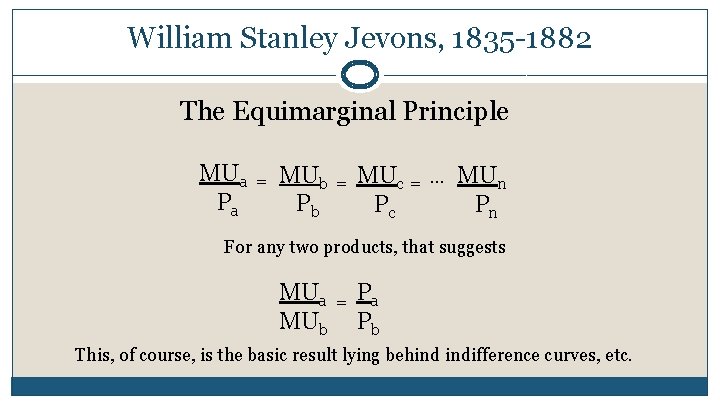
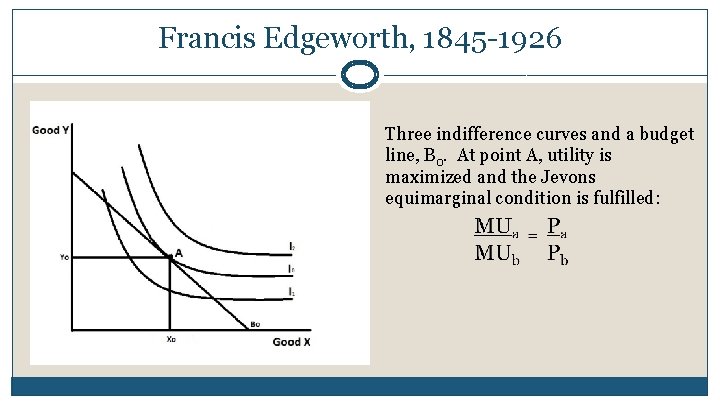
William Stanley Jevons, 1835 -1882 The Equimarginal Principle MUa Pa = MUb Pb = MUc = Pc … MUn Pn For any two products, that suggests MUa MUb = Pa Pb This, of course, is the basic result lying behind indifference curves, etc.
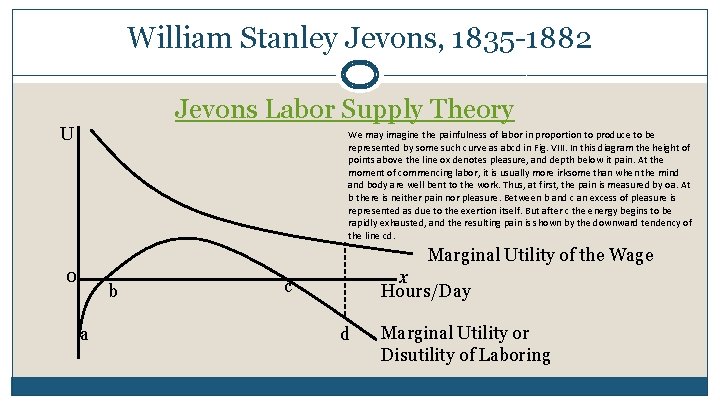
William Stanley Jevons, 1835 -1882 Jevons Labor Supply Theory U We may imagine the painfulness of labor in proportion to produce to be represented by some such curve as abcd in Fig. VIII. In this diagram the height of points above the line ox denotes pleasure, and depth below it pain. At the moment of commencing labor, it is usually more irksome than when the mind and body are well bent to the work. Thus, at first, the pain is measured by oa. At b there is neither pain nor pleasure. Between b and c an excess of pleasure is represented as due to the exertion itself. But after c the energy begins to be rapidly exhausted, and the resulting pain is shown by the downward tendency of the line cd. Marginal Utility of the Wage 0 b a x Hours/Day c d Marginal Utility or Disutility of Laboring
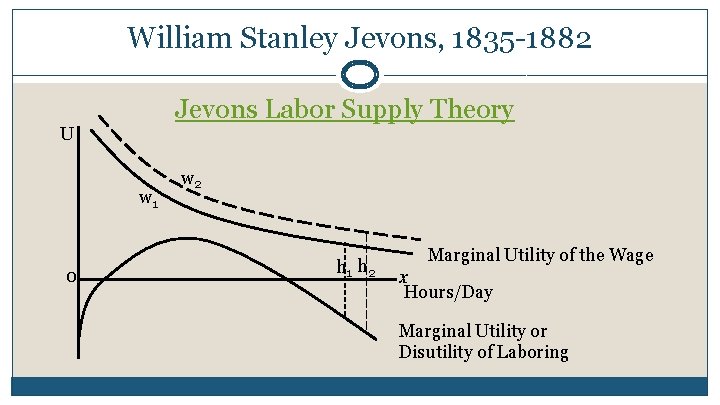
William Stanley Jevons, 1835 -1882 Jevons Labor Supply Theory U w 1 0 w 2 h 1 h 2 Marginal Utility of the Wage x Hours/Day Marginal Utility or Disutility of Laboring
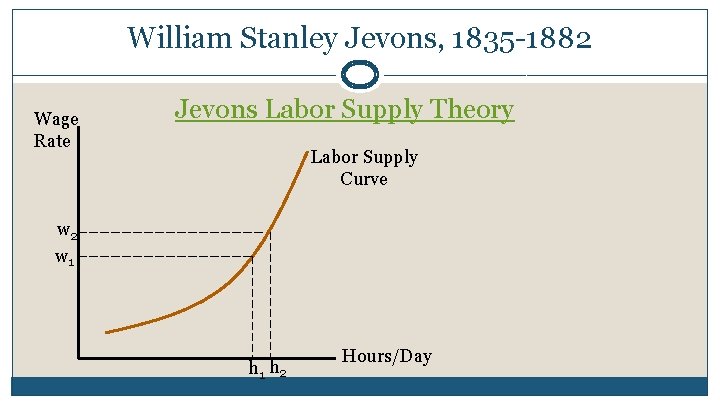
William Stanley Jevons, 1835 -1882 Wage Rate Jevons Labor Supply Theory Labor Supply Curve w 2 w 1 h 2 Hours/Day
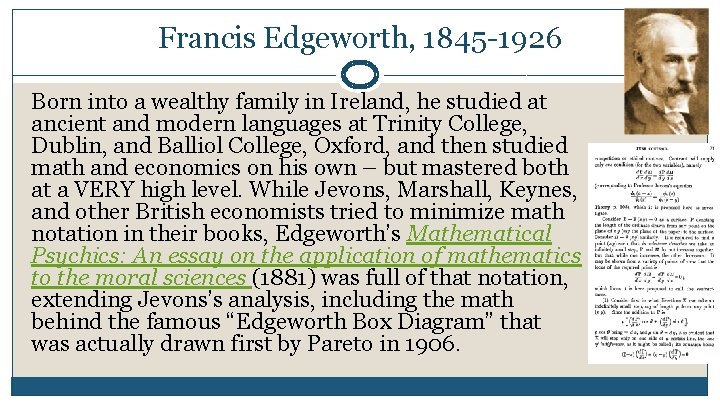
Francis Edgeworth, 1845 -1926 Born into a wealthy family in Ireland, he studied at ancient and modern languages at Trinity College, Dublin, and Balliol College, Oxford, and then studied math and economics on his own – but mastered both at a VERY high level. While Jevons, Marshall, Keynes, and other British economists tried to minimize math notation in their books, Edgeworth’s Mathematical Psychics: An essay on the application of mathematics to the moral sciences (1881) was full of that notation, extending Jevons’s analysis, including the math behind the famous “Edgeworth Box Diagram” that was actually drawn first by Pareto in 1906.
Francis Edgeworth, 1845 -1926 Three indifference curves and a budget line, B 0. At point A, utility is maximized and the Jevons equimarginal condition is fulfilled:
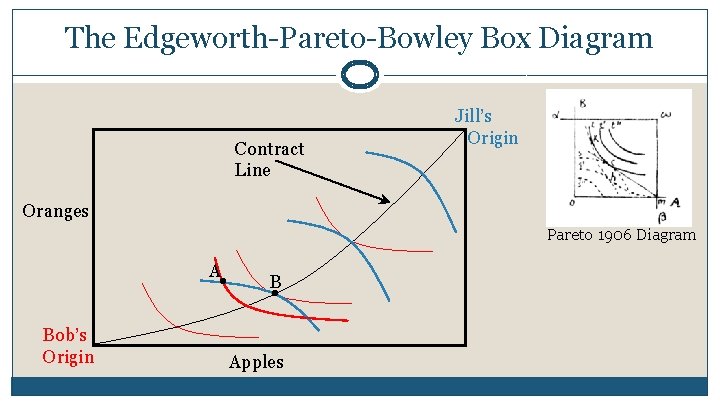
The Edgeworth-Pareto-Bowley Box Diagram Contract Line Jill’s Origin Oranges Pareto 1906 Diagram . . B A Bob’s Origin Apples
Vilfredo Pareto, 1848 -1923 Born into a wealthy family in Italy, and lived most of his life there. He read Smith’s Wealth of Nations at an early age and opposed growing state power in Italy (which was influenced by Bismarck in Germany), but he was also exposed to the mathematical economics of Walras, and from 1893 -1907 he lived in Switzerland to take over Walras’ chair in political economy at the University of Lausanne, which became known for its mathematical approach to economics. In 1906, he published his Manual of Political Economy, which first included the “Edgeworth” box diagram. However, he is best known for the idea of “Pareto Optimality: ” we have reached an optimum when you cannot improve the situation of one person without worsening the situation of another person. This is the kind of optimality that markets may be able to achieve, but it is a weak standard of optimality – every point on the contract curve is a Pareto Optimum, including the origins for Bob and Sue.